
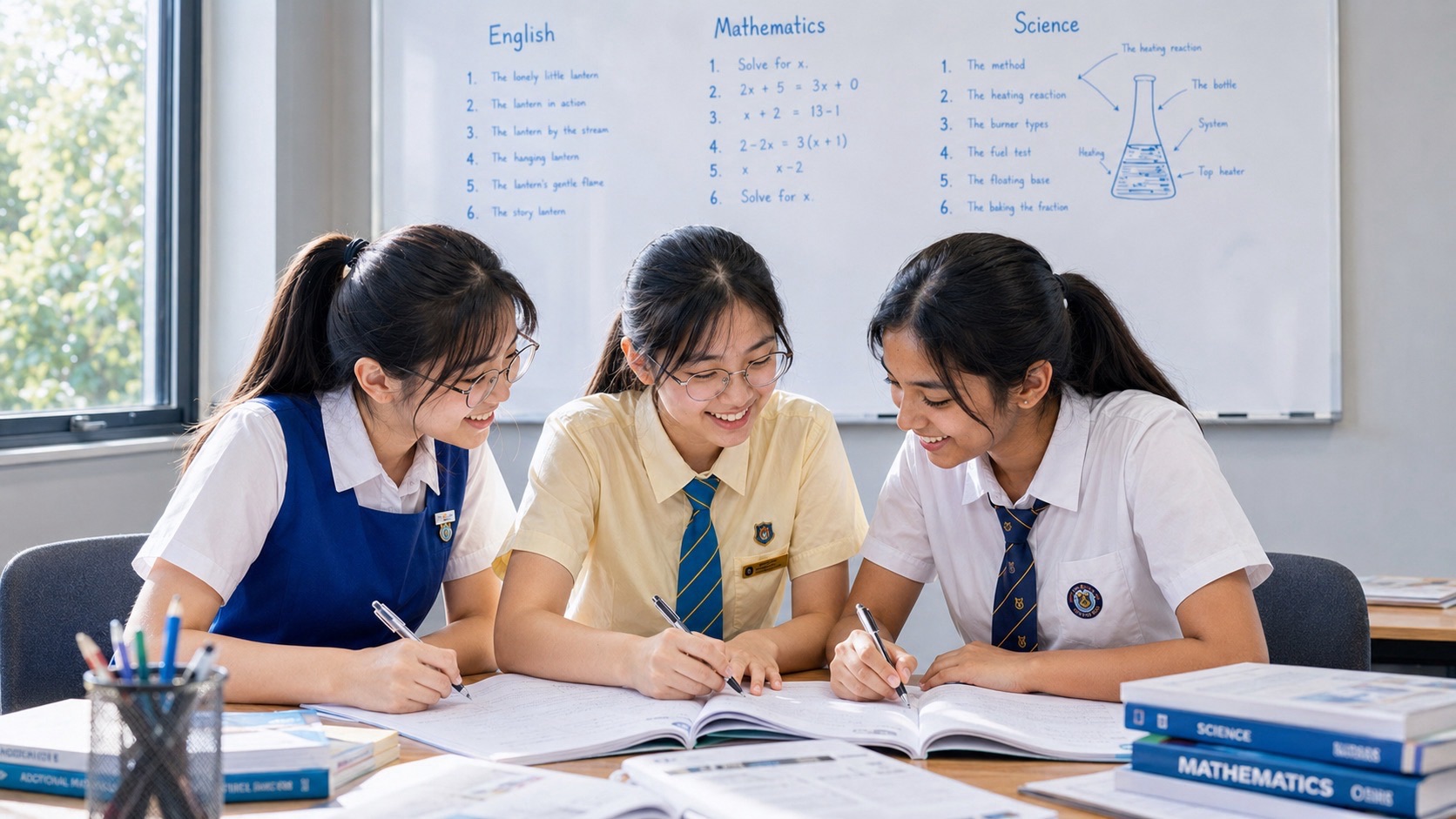
A mathematics curriculum is often encountered as a document: a list of topics, objectives, examples and assessment requirements arranged by level. Teachers read it to plan. Parents glance at it when a child begins struggling. Students usually experience it indirectly through lessons, textbooks, worksheets and examinations.
But the document is only the visible surface. A curriculum is really an architecture of decisions. Someone has decided what mathematical ideas matter, when a learner is likely to be ready for them, what earlier knowledge they depend on, how deeply they should be understood, how fluently they should be executed, what kinds of problems should reveal mastery and what future learning each idea is supposed to support.
If those decisions align, the learner experiences progression. New mathematics feels demanding but connected. Old knowledge returns with a purpose. Representations become more compressed. Reasoning becomes longer. The student gradually moves from counting and comparison towards generalisation, modelling, proof, calculus, statistics and mathematical independence.
If the decisions do not align—or if a student misses important parts of the sequence—the same curriculum can feel like a series of ambushes. Fractions appear before multiplicative thinking is stable. Algebra arrives while signed numbers are unreliable. Trigonometry becomes a formula problem because ratio and geometry never connected. Calculus looks impossible because functions remain superficial. The visible topic is new; the failure may be years old.
Featured answer: how does a mathematics curriculum work?
A mathematics curriculum works by selecting important mathematical knowledge, sequencing it according to conceptual and developmental dependencies, revisiting it at increasing levels of sophistication, connecting concepts to skills and processes, and assessing whether students can transfer what they know to unfamiliar problems. Its success depends not simply on coverage but on coherence: each stage should prepare the learner for what comes next.
Singapore’s Mathematics Curriculum Framework places mathematical problem solving at the centre and connects it to concepts, skills, processes, metacognition and attitudes. That structure is important for curriculum design because it says the curriculum is not only a content inventory. Number, algebra, geometry, statistics and other strands must be taught in a way that also develops reasoning, communication, application, modelling, self-monitoring and perseverance.
1. Curriculum is different from a syllabus
In everyday school conversation, curriculum and syllabus are often used as though they mean the same thing. They overlap, but the distinction is useful. A syllabus tells us what content and outcomes are expected within a course or level. Curriculum is broader: it includes the sequence of learning experiences through which students are supposed to reach those outcomes.
For mathematics, this broader view is essential. Knowing that fractions appear in Primary Mathematics does not tell us how the learner will come to understand fractions. Will she compare physical parts, use number lines, connect fractions to division, discover equivalence, practise operations, solve word problems and later use fractions inside ratio and algebra? The topic label alone does not reveal the pathway.
A curriculum therefore contains an implicit theory of learning. It assumes that some experiences prepare students for others. It assumes that certain representations help abstraction. It assumes that practice stabilises knowledge. It assumes that learners can revisit an idea at increasing depth. If these assumptions are sound and the implementation is strong, the sequence feels coherent. If they fail, students may “cover” a topic without acquiring what later topics expect.
Parents who want to understand a child’s mathematics should therefore look beyond the chapter list. Ask what the chapter is doing in the larger journey. What did it inherit? What is it preparing? What kinds of thinking should become possible after it?
2. The first design question is not “What chapter comes next?”
Curriculum design begins more productively with the destination. What should a mathematically educated learner be able to do by the end of a stage? Compute accurately? Certainly. But also interpret quantitative information, represent relationships, reason logically, model situations, communicate conclusions, use tools, check plausibility and continue learning.
Once the destination is clearer, designers can work backwards. If students are expected to reason with algebraic functions later, they need earlier experience with patterns, unknowns, equivalence, variables and graphs. If they will model change, they need proportional reasoning. If they will interpret statistics, they need number sense, measures, representations of data and an understanding that summaries can conceal variation.
This backward view prevents curriculum from becoming a historical pile of chapters that remain only because they were always there. Every major component should earn its place by contributing to present capability, future learning or both.
It also explains why curriculum debates cannot be settled by asking whether a topic is “useful in real life” in an immediate sense. Some ideas are valuable because they become infrastructure for later reasoning. Algebraic manipulation, for example, may not appear visibly in every adult task, but it trains the ability to preserve relationships while transforming representations—a skill foundational to higher mathematics, science, engineering, computing and quantitative analysis.
3. Knowledge has a dependency graph
The mathematics curriculum is best imagined not as a simple line but as a dependency graph. Some ideas feed many later ideas. Place value supports arithmetic and estimation. Multiplicative thinking supports fractions, ratio, percentage, rate and algebra. Equality supports equations. Coordinates support graphs, geometry and functions. Algebraic manipulation supports nearly everything in Additional Mathematics.
This means some weaknesses have unusually high downstream cost. A learner can sometimes work around a small gap in a peripheral skill. A gap in a high-connectivity prerequisite keeps returning under new names. The student may look as if she has many different problems when she has one unresolved structural problem.
A good curriculum attempts to establish these high-value prerequisites before loading them. A good teacher goes further: she checks whether the particular learner actually owns them. Official progression describes what should be ready. Diagnosis reveals what is ready.
The difference matters because classes are heterogeneous. Students arrive at the same lesson carrying different histories. Curriculum provides the common road; teaching has to manage the traffic on it.
The eduKatePunggol article How to Read the Additional Mathematics Syllabus makes this explicit by reading objectives, topics, dependencies, assessment and planning as one system rather than isolated sections.
4. Sequencing is an argument about readiness
Whenever a curriculum places topic B after topic A, it is making a claim: learning A first will make B more learnable. Sometimes the relationship is strict. A student cannot solve many algebraic equations without understanding equality and operations. Sometimes it is softer. A topic may be technically possible earlier but more meaningful after students have richer examples or greater abstraction capacity.
Good sequencing respects both mathematical logic and learner development. Mathematics has internal dependencies, but children also change. Their language, working memory, spatial reasoning and ability to generalise grow. A representation that is concrete and useful at one stage can become cumbersome later. A symbolic method that is elegant for an older student may be opaque for a younger one.
This is why progression should not be confused with simply moving advanced topics downward. Earlier is not automatically better. The question is whether earlier exposure produces durable structure or decorative familiarity. A child who can imitate an algebraic procedure without understanding equivalence has not necessarily gained an advantage.
Curriculum should therefore create readiness rather than merely reward precocity. It should stretch students while preserving conceptual integrity.
5. Concrete, visual and symbolic representations are not three separate subjects
One recurring design pattern in strong mathematics curricula is movement across representations. Learners may first encounter an idea physically or contextually, then visually, then symbolically. The point is not to perform a ritual sequence for every topic. It is to give meaning before compression.
Symbols are extraordinarily efficient. “3x + 5 = 20” compresses a relationship that would take a sentence to describe. But compression works only when the learner can decompress it. If x, equality and operations have no conceptual depth, the symbol becomes an instruction to move numbers around.
Visual models help because they can expose relationships before the learner has enough symbolic fluency. Bar models, number lines, area models, tables and graphs each reveal different structures. Later, algebra often becomes the faster representation. The curriculum should help students know when to switch.
Mathematical maturity can be seen partly as representational flexibility. The student is not loyal to one picture or one formula. She asks what representation will make the relationship easiest to inspect.
6. Number sense is the first high-connectivity node
Early curriculum gives great attention to number because number is not one topic among many. It is infrastructure. Place value, magnitude, decomposition, comparison, operations and estimation support almost everything that follows.
A student with strong number sense does more than calculate correctly. She sees 48 as 50 − 2, 6 × 8, 4 × 12, 3 × 16 and roughly half of 100. She can estimate before calculating. She recognises when a decimal answer is implausible. She can choose efficient routes because numbers have structure.
Curriculum therefore needs both fluency and flexibility. If early arithmetic remains painfully effortful, later reasoning becomes expensive because too much working memory is spent on basic operations. If arithmetic is fast but rigid, the learner struggles when a problem demands decomposition or estimation.
The Primary 1 Mathematics in Punggol journey begins with this foundation and the Primary 1 Mathematics at Home guide follows quantity, number, representation, operations, word problems and checking as a connected sequence.
7. Multiplicative thinking quietly reorganises primary mathematics
One of the most important curriculum transitions is from additive to multiplicative thinking. Young learners first become fluent at joining, separating and comparing quantities. Later they must understand equal groups, scaling, repeated measures and proportional relationships.
This change powers multiplication and division, but its influence is much larger. Fractions, ratio, percentage, rate, scale and many algebraic relationships depend on seeing how quantities change multiplicatively.
A curriculum that treats these as unrelated chapters misses the network. A student who understands multiplication only as repeated addition may manage early exercises but struggle when the multiplier is a fraction or when two quantities vary proportionally. The concept must eventually become broader than its first representation.
This is a good example of why revisiting matters. Curriculum progression is not simply adding new facts. Sometimes an old idea must be reconstructed at a more general level so that it can support new mathematics.
8. Fractions, ratio and percentage should become one connected neighbourhood
Students often experience fractions, ratio and percentage as separate chapters because that is how books are organised. Mathematically, they are deeply connected. Each concerns relationships between quantities, parts and wholes, comparison and scaling.
Curriculum should first make each idea clear enough to stand on its own, then deliberately connect them. A ratio of 1:4 can imply one part out of five in a part-to-whole context. Twenty per cent is one fifth. A fraction can be interpreted as division. A scaling factor can transform equivalent ratios. These links reduce the amount of mathematics the learner has to hold as unrelated rules.
Primary 5 is often where this network becomes demanding because the learner must coordinate fractions, percentage, ratio, models and multi-step problems. The Primary 5 Mathematics Practice Architecture is designed around those connections rather than treating every weakness as a separate worksheet problem.
By Primary 6, these ideas should survive mixing. The learner needs to identify the relationship even when the question is not labelled. That is the beginning of transfer.
9. Algebra is where the curriculum begins to speak in generalisations
Algebra is sometimes introduced as “letters in mathematics”. That description is technically visible and educationally shallow. Algebra is a language for expressing general relationships. It lets the learner reason about quantities without fixing them to one numerical case.
The curriculum prepares for algebra long before Secondary 1. Missing-number equations, patterns, properties of operations and model methods all build structural awareness. But secondary mathematics makes the generalisation explicit. Expressions can be transformed, equations solved, formulas rearranged, graphs related to symbolic rules and functions studied as objects.
A strong algebra curriculum keeps meaning attached to manipulation. When students “move a term to the other side”, they should eventually understand that they are performing equivalent operations on an equation. When they factorise, they should know that the expression has been rewritten, not magically changed.
This matters because Additional Mathematics later compresses reasoning into algebraic transformations. The student who has only memorised surface moves reaches a limit quickly.
10. Geometry develops a different kind of mathematical seeing
Geometry contributes more than formulas for perimeter, area and volume. It develops spatial visualisation, invariance, properties, deduction and the ability to move between diagrams and symbolic relationships.
Young learners first identify shapes and measure familiar objects. Later they reason about angles, symmetry, transformations, congruence, similarity, coordinate relationships and trigonometry. The curriculum gradually shifts from “what does this shape look like?” to “what must be true because of these properties?”
This shift is important because diagrams can deceive. A line that looks perpendicular may not be given as perpendicular. A triangle that looks isosceles may not be. Mature geometry requires students to distinguish visual suggestion from warranted information.
That habit—separating what appears true from what is established—is one of mathematics education’s most transferable intellectual contributions.
11. Statistics and probability teach students to reason with uncertainty
Not all mathematics leads to certainty in the same way. Statistics and probability introduce learners to variation, uncertainty, distributions, sampling and the difference between individual cases and aggregate patterns.
This is increasingly important in a data-rich society. Students encounter percentages, risk, averages, charts and claims long before they become statisticians. A curriculum should therefore teach not only how to compute a mean or probability but what those measures can and cannot tell us.
An average can hide spread. A percentage can be impressive or trivial depending on the denominator. A graph can distort through scale. A probability describes uncertainty, not fate. These are mathematical ideas and also civic survival skills.
Curriculum progression should therefore move from reading representations to questioning them. The mature student asks where the data came from, what was measured, what was omitted and whether the conclusion is justified.
12. A curriculum needs vertical coherence across years
Vertical coherence means that learning in one year prepares sensibly for the next. The Primary 1 teacher should not need to teach Primary 6 content, but Primary 1 experiences should create foundations that remain useful in Primary 6. Secondary 1 should inherit enough from Primary 6 that algebra and abstraction can grow rather than restart basic arithmetic.
This is why year-by-year learning journeys are valuable. They make the handoffs visible. The eduKatePunggol sequence from Primary 1 through Primary 6 and PSLE Mathematics, then Secondary 1 through Secondary 4, can be read as one long development rather than ten unrelated school years.
For families, vertical coherence changes planning. Instead of asking only how to score in the next test, we ask whether the current repair will reduce future friction. Fixing weak fraction concepts in Primary 5 is not only about Primary 5 marks; it changes the load carried into percentage, ratio, algebra and science.
13. The Primary 6 to Secondary 1 bridge deserves explicit curriculum attention
The transition from Primary 6 to Secondary 1 is not only a change of school. Mathematics becomes more formal, abstract and distributed across a wider set of topics. The learner also has new teachers, new routines and new social demands competing for attention.
Curriculum continuity therefore depends on more than whether the content formally overlaps. Students need to reinterpret familiar ideas in a new language. Arithmetic properties become algebraic manipulation. Patterns become general terms. Graphs become relationships. Angles and shapes become more deductive.
A strong bridge does not reteach all of primary mathematics from the beginning. It identifies the concepts that will carry the highest secondary load and ensures that students can use them under the new symbolic conditions.
The Secondary 1 Mathematics Transition in Punggol focuses specifically on this movement from PSLE to algebra.
14. G1, G2 and G3 require coherence without pretending students are identical
Singapore’s current secondary landscape recognises that students may study subjects at different levels. From 2027, the Secondary Education Certificate includes Mathematics syllabuses at G1, G2 and G3. Curriculum design must therefore solve a delicate problem: provide routes with different breadth, depth and pace while preserving meaningful mathematical progression.
The danger of differentiated routes is fragmentation. If one route becomes only procedural and another becomes the only place where reasoning happens, students receive different conceptions of what mathematics is. Good differentiation changes the level of demand without stripping away coherence, application or intellectual dignity.
Readiness matters. A student should experience work that is difficult enough to develop capability but not so dependent on missing prerequisites that every lesson becomes emergency repair. Subject-level decisions should therefore be informed by evidence of what the learner can sustain, not status anxiety.
The curriculum’s purpose is not to make every learner travel at the same speed. It is to keep each route mathematically alive and connected to viable next steps.
15. Additional Mathematics is not an extra stack placed beside Mathematics
Additional Mathematics is structurally dependent on Mathematics. The 2027 G3 Additional Mathematics syllabus explicitly assumes knowledge of G3 Mathematics and organises content into Algebra, Geometry and Trigonometry, and Calculus, while also emphasising reasoning, communication, application and modelling.
This matters for curriculum planning because a student taking Additional Mathematics is operating two connected systems. Weakness in ordinary algebra can appear as an Additional Mathematics problem. Poor graph interpretation can affect functions and calculus. Geometry and ratio can reappear in trigonometry.
The correct response is not to merge the subjects. Each has its own scope and assessment. The response is to build deliberate bridges. Students should know which prerequisite from Mathematics a new Additional Mathematics idea is loading.
The eduKatePunggol journeys for Secondary 3 Additional Mathematics and Secondary 4 Additional Mathematics are designed to preserve that connection while keeping the subject identities clear.
16. JC Mathematics raises the compression ratio
At Junior College, mathematical ideas are often presented with greater abstraction and less time for foundational repair. The learner is expected to retrieve secondary knowledge quickly, operate symbolically with confidence and manage longer chains of reasoning.
This is not simply because the curriculum wants to be harder. Higher mathematics gains power by compressing patterns into general structures. Functions organise relationships. Calculus describes change and accumulation. Vectors encode direction and magnitude. Probability distributions summarise families of uncertain outcomes.
Compression is efficient only when the learner can unpack it. A student who recognises notation but cannot connect it to meaning becomes vulnerable. The JC curriculum therefore exposes the quality of earlier coherence.
The progression continues through JC1 H2 Mathematics in Punggol and JC2 H2 Mathematics in Punggol. Seen from the curriculum level, these are not isolated final years. They are the upper floors of a structure begun with number and representation.
17. Revisiting is not the same as repeating
Mathematics curricula revisit ideas because learning changes with context and maturity. But productive revisiting should add something. A student may encounter fractions first as parts of a whole, later as numbers on a line, later as ratios and division, later inside algebraic expressions. The concept expands.
Unproductive repetition simply replays familiar exercises. It can create the illusion of mastery because the student recognises the format. The moment the representation changes, performance collapses.
A coherent curriculum therefore asks how each return increases generality, connection or independence. Does the learner see more structure? Can the idea operate in more contexts? Can it be retrieved after longer delays? Can it be combined with other concepts?
This distinction helps parents interpret homework. More of the same is not automatically stronger preparation. Sometimes the next useful task is variation, explanation, mixed practice or delayed retrieval rather than another page of identical questions.
18. Variation teaches students what changes and what stays invariant
Well-designed examples are part of curriculum. If every problem changes many features at once, learners may not see the concept. If nothing changes, they may memorise the surface. Variation can control attention by changing one feature while holding others constant.
For example, a set of equations can vary coefficients while preserving the same underlying structure. Geometry problems can alter orientation so students learn that a property does not depend on how a diagram is turned. Percentage questions can use different contexts while preserving the same base relationship.
The curriculum goal is not novelty for its own sake. It is discrimination. Students learn which features determine the method and which are incidental. That is essential for transfer because real problems rarely look exactly like the worked example.
Good variation also reveals misconceptions efficiently. When a student succeeds only in one orientation or wording, the teacher has learned something important about the representation, not merely the answer.
19. Fluency belongs in the curriculum because working memory is finite
Conceptual understanding is central, but curriculum cannot neglect fluency. Complex problem solving requires many small operations to happen reliably. If each arithmetic fact or algebraic transformation demands full attention, the learner has little capacity left for planning and reasoning.
This is the cognitive purpose of practice. We automate high-frequency low-level operations so attention can move upward. A pianist does not reason consciously about every finger movement during a performance. A mathematician should not need to rediscover basic manipulation during every advanced problem.
But fluency must be attached to meaning. Otherwise the learner becomes fast at procedures she cannot select intelligently. Curriculum therefore needs a sequence from understanding to guided practice to fluency to mixed selection.
This is why “drilling versus understanding” is a poor curriculum debate. The better question is what kind of practice, at what stage, for what purpose.
20. Spacing protects curriculum from the illusion of completion
School timetables encourage a dangerous illusion: once a chapter has been taught and tested, it is complete. Human memory does not respect the timetable. Knowledge that is not retrieved weakens. Skills that are never mixed remain context-bound.
A strong curriculum therefore returns to important ideas after delay. Spacing makes retrieval harder, which can feel worse than immediate repetition, but successful delayed retrieval is stronger evidence that learning will survive.
The PSLE Mathematics Revision Timetable uses evidence, priorities, spacing, mixed practice, simulation and taper rather than treating revision as one final block of massed work.
Spacing also helps curriculum connect vertically. A Secondary 2 student should still encounter Secondary 1 algebra. A Primary 6 learner should still retrieve Primary 5 ratio. The curriculum should not allow important prerequisites to vanish simply because the class has turned the page.
21. Interleaving teaches method selection
Blocked practice is useful when a method is new. Every question in the set may require the same operation so the learner can stabilise it. But examinations and real problems do not announce the method. Eventually practice must be mixed.
Interleaving forces a different skill: discrimination. Is this a ratio problem or a percentage problem? Is factorisation useful here? Does this geometry question need similarity, Pythagoras or trigonometry? Should I differentiate, integrate or reformulate the function first?
The transition from blocked to mixed work is therefore a curriculum transition from execution to selection. A student can be fluent at a method and still fail because she does not recognise when to use it.
Parents sometimes interpret lower marks on mixed practice as regression. In fact, the task has changed. The learner is now being asked to classify before solving. That difficulty is precisely why the stage matters.
22. Mathematical language is a hidden curriculum
Students can know mathematics and still misread mathematics. Words such as “at least”, “difference”, “consecutive”, “per”, “increase by”, “increase to”, “respectively”, “hence” and “otherwise” carry precise logical or quantitative roles.
Notation is language too. Brackets signal structure. Equality has meaning. Function notation compresses a relationship. An implication arrow is not decoration. Units constrain interpretation.
A coherent curriculum teaches this language explicitly enough that students can read mathematical instructions independently. Otherwise errors are incorrectly classified as “careless” when the learner is actually linguistically uncertain.
This is one reason English and Mathematics are separate subjects but not separate worlds. Reading precision supports mathematical interpretation, while mathematics teaches a form of compressed precise language that can strengthen general reasoning.
23. Mathematical processes should be embedded, not saved for enrichment
Reasoning, communication, connections, application, modelling, thinking skills and heuristics cannot be added only after “the real syllabus” is complete. They are part of the curriculum’s purpose.
A routine exercise can still contain reasoning if students explain why a transformation is valid. A basic graph can support communication if learners describe its behaviour precisely. A percentage lesson can include modelling if students decide which quantities should represent a real situation.
Embedding processes also prevents a common inequity: only fast students receiving rich mathematics while others receive endless procedure. Every learner needs opportunities to think, though the scaffolding and complexity may differ.
The curriculum becomes stronger when process is not a reward for finishing early but part of learning mathematics itself.
24. Metacognition is the curriculum for self-correction
Singapore’s Mathematics Curriculum Framework explicitly includes metacognition: awareness, monitoring and regulation of thought processes. In curriculum terms, that means students should gradually learn to manage their own mathematical activity.
At first, teachers supply the monitoring. “What are you trying to find?” “Does the answer fit the diagram?” “Which condition have you not used?” Repeated prompts can become internal questions. The learner begins to stop herself before an error propagates.
Curriculum should create occasions for this. Worked examples can include decision points, not only steps. Corrections can require students to identify the first wrong line. Reflection can ask which cue should have triggered a method. Verification can be expected, not optional.
Metacognition is the bridge between being taught and becoming teachable by oneself. Without it, even a rich curriculum can leave students dependent on external direction.
25. Assessment should sample the curriculum’s real intentions
Assessment exerts enormous influence over curriculum because students and teachers reasonably pay attention to what is tested. If assessments reward only routine execution, deeper aims may remain rhetorical. If assessments demand reasoning without giving students enough opportunities to develop it, the system becomes unfair.
Alignment matters. Concepts should be assessed at the intended depth. Skills should be required with appropriate fluency. Processes should appear in ways students have had a chance to practise. The balance should reflect the curriculum rather than distort it.
Assessment also provides feedback to curriculum. If an entire cohort repeatedly fails one type of task, the question is not only what is wrong with students. It may reveal a mismatch in teaching sequence, representation or practice.
The companion article How Mathematics Assessment Works follows this sensor function from daily classroom evidence to major examinations.
26. Transfer is the real test of curriculum coherence
Transfer occurs when students use learning outside the exact situation in which it was acquired. It is one of the hardest educational outcomes and one of the most important.
A learner shows near transfer when she can apply a method to a slightly changed problem. Farther transfer occurs when she recognises the same structure in a different context or combines ideas that were taught separately. Examination questions often test transfer by removing familiar cues or integrating chapters.
Curriculum can support transfer by varying examples, connecting representations, mixing topics, asking for explanations and revisiting ideas in new settings. But transfer cannot simply be instructed: “Use your knowledge elsewhere.” The learner needs enough underlying structure to recognise what stays the same beneath the changed surface.
This is why coherent knowledge is more transferable than collections of tricks. Tricks are attached to appearances. Concepts are attached to relationships.
27. The curriculum must manage cognitive load
Mathematics can overwhelm learners when too many unfamiliar elements must be coordinated at once. Curriculum sequencing, worked examples, representations and practice all help manage this load.
When a concept is new, unnecessary complexity should be reduced so attention can reach the target structure. As competence grows, support can be withdrawn and contexts made richer. This is not lowering standards. It is controlling the path by which students reach them.
The reverse is also important: over-scaffolding can prevent independence. If every problem is broken into tiny labelled steps forever, the student never practises deciding what to do. Curriculum should therefore fade support deliberately.
The design question is always dynamic: what can the learner now coordinate independently, and what additional complexity can be introduced without losing the mathematical idea?
28. Technology belongs in curriculum as a mathematical tool, not an answer machine
Spreadsheets, graphing tools, dynamic geometry, calculators and AI can extend what students are able to explore. Technology can make patterns visible, handle repetitive computation and allow faster experimentation.
The curriculum should therefore distinguish between mathematics worth automating and mathematics worth understanding. A calculator can execute arithmetic, but estimation remains important. Software can draw a graph, but students must interpret scale and behaviour. An AI system can produce a solution, but the learner must inspect whether assumptions, transformations and conclusions are valid.
This shifts curriculum emphasis toward judgement. As tools become more powerful, students need stronger model selection, verification and quantitative literacy—not less mathematics.
The goal is tool-enabled independence. A student should know when technology improves the work, when it obscures the work and what she must still be able to reason about without it.
29. A family can read curriculum as a year-long capability map
Parents do not need to reproduce the official syllabus at home. A more useful family map is smaller. At the beginning of the year, identify the major mathematical transitions. What new ideas will place the greatest load on earlier skills? Which examination periods matter? Which old weaknesses are likely to return?
Then watch evidence. Schoolwork, quizzes and conversations can reveal whether the learner is keeping pace. If difficulty appears, diagnose the prerequisite before adding volume. If learning is stable, widen practice and protect independence.
This prevents the common cycle of waiting for a bad examination, panicking, adding hours, then returning to normal when marks recover. Curriculum is a year-long system. Support should be a feedback loop.
For primary families, the eduKatePunggol journeys from P1 to P6 show these transitions in the context of home, school and tuition. For secondary families, the same local journey continues from Sec 1 to Sec 4.
30. Curriculum is lived inside a finite week
The official curriculum may be coherent on paper while a child’s week is not. Homework, CCA, commuting, sleep, family obligations, tuition and other subjects compete for time. A local education system has to acknowledge this constraint.
More mathematical work is useful only if it produces more mathematical learning. When extra classes reduce sleep, eliminate independent practice or create chronic backlog, the intervention can undermine the curriculum it is supposed to support.
This is where curriculum planning becomes family-life planning. The important mathematics should have protected time. Recovery after school matters. Practice should be scheduled when attention exists. High-load periods need tapering and prioritisation.
eduKatePunggol treats this as part of being a Family Life Education Local Expert: education is not detached from the household system in which the learner actually lives.
31. Punggol offers local contexts for curriculum transfer
Curriculum becomes memorable when some mathematics returns to the learner’s own environment. Punggol offers natural examples: transport schedules, walking and cycling distances, waterway geometry, housing layouts, construction, population change, energy systems and digital infrastructure.
The Punggol as a Classroom article connects local history, geography, science, mathematics and urban design. Its purpose is not to convert every family outing into homework. It is to show that curriculum ideas have lives beyond their chapters.
A student studying rate can think about travel. A student studying scale can inspect maps. A student studying statistics can ask how claims about population or traffic are measured. A student studying geometry can notice built forms. A student learning functions can recognise that cities are full of variables that change together.
Transfer becomes easier when the learner has practised seeing mathematics in more than one kind of room.
32. Curriculum should create options, not merely rankings
One purpose of mathematics education is selection: examinations help institutions decide readiness for later courses. But a curriculum should not be designed only as a sorting machine. Its larger purpose is capability.
A student who does not pursue advanced mathematics still benefits from quantitative reasoning, financial numeracy, data interpretation, estimation and logical structure. A student who does pursue mathematics-intensive fields needs a foundation strong enough to support rapid future learning.
Good curriculum therefore keeps future options open for as long as reasonably possible while also respecting different strengths. It makes transitions visible so students know what additional preparation a new route demands.
The measure of curriculum success is not only how many students reach the most advanced course. It is whether students leave each stage with mathematics they can actually use and with realistic next steps available.
33. The curriculum is successful when students no longer need the curriculum map
School curriculum is necessarily organised by adults. It tells students what to learn and when. But the ultimate educational aim is to produce a learner who can continue beyond prescribed sequences.
Mathematical independence means the student can identify what a new problem requires, locate missing prerequisites, learn from examples, use references, practise strategically and verify her own conclusions. She has internalised some of the curriculum designer’s work.
This is why knowledge, prerequisites, progression and transfer belong in one chain. Knowledge without prerequisites becomes fragile. Prerequisites without progression become stagnation. Progression without transfer becomes school-bound performance. Transfer without knowledge becomes empty generality.
A strong curriculum connects all four until the learner can begin connecting them herself.
34. A curriculum audit for a single student
Families and teachers can use a simple audit whenever mathematics becomes unstable:
- Target: What does the current topic or assessment actually require?
- Prerequisites: Which earlier ideas must already be usable?
- Representation: Can the learner move between words, diagrams, tables, graphs and symbols?
- Fluency: Are routine operations consuming too much attention?
- Reasoning: Can the learner explain why the method applies?
- Retrieval: Does the knowledge survive after delay?
- Selection: Can the learner choose the method when examples are mixed?
- Transfer: Does the idea work in unfamiliar contexts?
- Verification: Can the learner detect implausible or inconsistent results?
- Independence: How much prompting is still required?
This audit converts “weak at maths” into inspectable parts. It also prevents premature conclusions. A learner may need a concept repaired, more fluency, better reading, stronger checking or simply more time under mixed conditions.
35. Curriculum is a promise across time
At its best, curriculum is a promise that today’s effort will make tomorrow’s learning more possible. The seven-year-old learning place value cannot see the algebra that will one day depend on structural number sense. The thirteen-year-old practising algebraic manipulation may not yet see the calculus, physics or computing that will use it. The curriculum carries that long view on the learner’s behalf.
This is also why curriculum should be treated with care. Skipping foundations can create hidden debt. Overloading students can damage attention and motivation. Teaching tricks can create short-term marks while weakening transfer. Assessment can distort priorities if it rewards only surface performance.
The system works when each stage contributes something durable: concepts that remain meaningful, skills that remain available, processes that become habitual, metacognition that becomes internal supervision and attitudes that allow the learner to stay with difficult problems.
Then mathematics stops being a sequence of chapters passed and forgotten. It becomes a growing structure of thought.
Continue the Mathematics Education Systems series
- Mathematics Education Systems in Singapore | From Number Sense to Mathematical Independence
- How Mathematics Teaching Works | Explanation → Representation → Practice → Feedback → Mastery
- How Mathematics Assessment Works | Diagnosis → School Tests → PSLE → SEC → A-Level Mathematics
Official references
- Ministry of Education Singapore: Primary Mathematics Syllabus
- Ministry of Education Singapore: G2 and G3 Mathematics Syllabuses
- SEAB: 2027 SEC G1 syllabuses
- SEAB: 2027 SEC G2 syllabuses
- SEAB: 2027 SEC G3 syllabuses
eduKatePunggol: Family Life Education Local Expert. A curriculum is not merely what a child is supposed to cover. It is the architecture that should make the next stage possible.


