
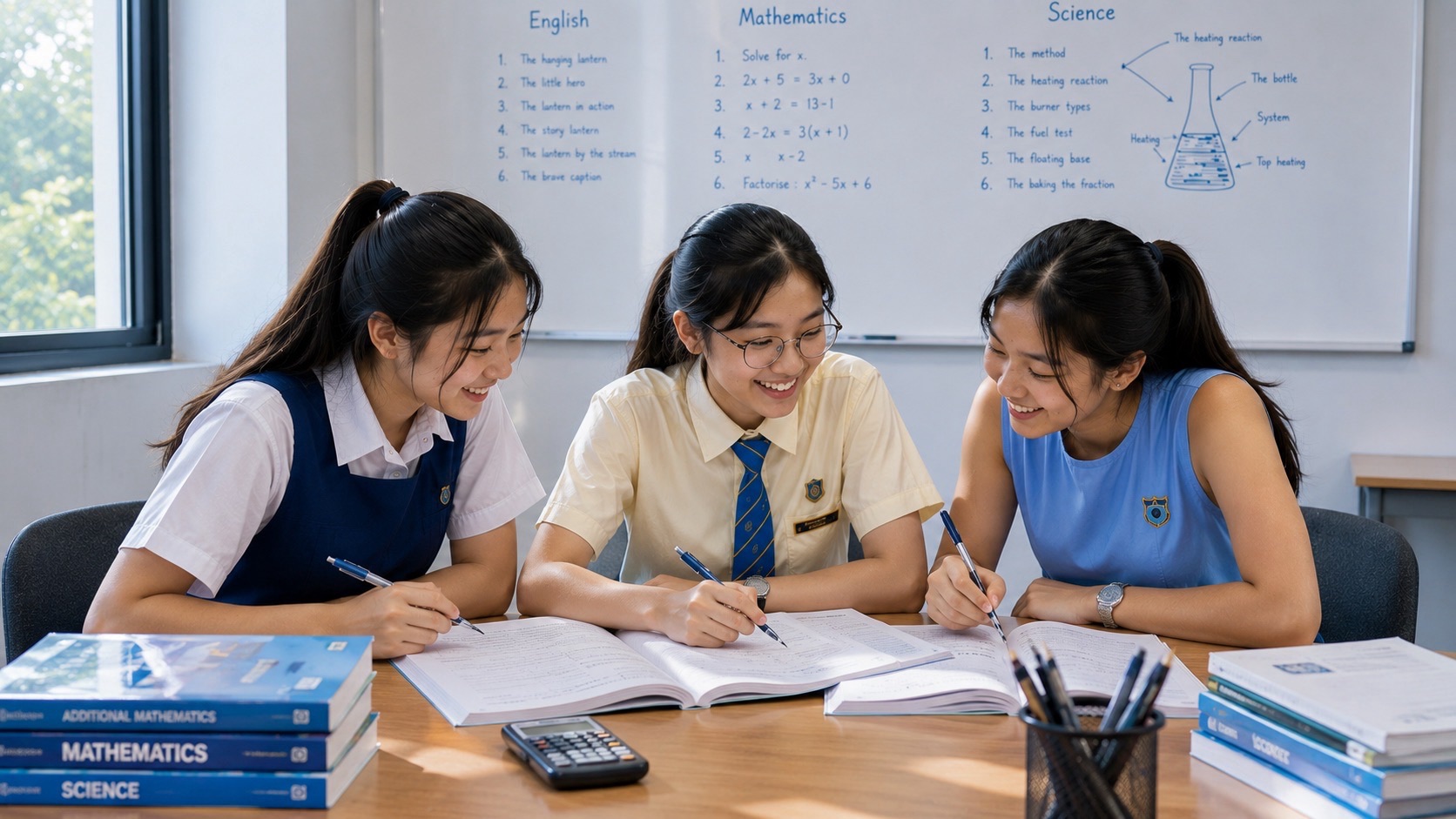
Secondary 2 does not begin with the same kind of fear as Secondary 1.
That is almost the problem.
When Mira entered Secondary 1, everything had been obviously new. New uniform. New timetable. New teachers. New CCA. New routes through school. New expectations. New mathematical language. The family knew they were crossing a bridge, so everybody paid attention.
A year later, the bridge has disappeared behind them.
On the first school morning of Secondary 2, Mira knows where she is going.
She knows which lift lobby becomes crowded at the wrong time. She knows which part of the route feels longer in the rain. She knows the school gates, the canteen queues, the teacher voices, the sound of friends arriving before assembly. She knows which pocket of her bag holds her student card. She knows that if she leaves one Mathematics worksheet loose inside the main compartment, it will somehow become a folded archaeological object within three days.
She is not new anymore.
That changes the year.
Adults expect more because she has already had one full year to settle. Teachers move with less ceremony. Friends know one another better. CCA has routines. Homework no longer feels like a surprising invasion from another planet.
And Mathematics changes too.
Secondary 1 introduced a language.
Secondary 2 begins asking whether Mira can actually speak it.
Can algebra travel from one question to another?
Can she see a relationship before somebody labels the chapter?
Can she carry fractions into algebra without losing control?
Can she read a graph as a model rather than a picture?
Can geometry move from visual intuition into justified reasoning?
Can she hold more than one equation at a time?
Can she recognise when a familiar method is hiding inside an unfamiliar surface?
Can she decide what deserves attention before a test?
Can she recover from a bad week without somebody rebuilding the whole week for her?
Secondary 2 is not yet upper secondary.
But it is the year that begins proving whether the lower-secondary foundation is strong enough to carry upper secondary when it arrives.
That makes it one of the quietest important years in Mathematics.
1. The Story Continues From Secondary 1
If Secondary 1 was Mira learning how to enter an unfamiliar system, Secondary 2 is her learning how to live inside it without being carried through every doorway.
The distinction matters.
At the end of the previous year, she had learned something simple but powerful: when she did not know what to do, she could still begin.
Label the diagram. Write what is known. Look for a relationship. Check the sign. Return to the last valid line when the first attempt fails.
That habit was more important than any single chapter.
The previous story is here for families entering this article midway through the journey: Secondary 1 Mathematics in Punggol.
Secondary 2 begins with that capability already present.
But present does not mean perfect.
Mira still makes mistakes.
Ben still asks questions that begin with “why”.
Some weeks still become too crowded.
Some topics arrive looking unnecessarily complicated.
The difference is that there is now a year of evidence.
Mira knows she has recovered before.
Her parents know that a low mark can be read rather than feared.
The tutor knows that Mira’s work reveals patterns if somebody is patient enough to look.
That history creates leverage.
Learning is easier when the student has learned something about how she learns.
This is one reason Secondary 2 deserves more respect than it receives.
It is not merely more content.
It is the first year in which the student can begin operating with a model of herself.
She knows that she tends to rush easy arithmetic when time pressure rises.
She knows negative signs deserve an extra glance.
She knows that a page full of correct familiar questions does not prove she can recognise a method in a mixed paper.
She knows that one difficult question can consume too much emotional attention if she lets it.
She knows that being tired changes how she reads.
These are not textbook facts.
They are operational knowledge.
Secondary 2 is where that knowledge can become part of the student’s mathematical system.
2. January Feels Easier Because the Unknowns Have Changed
On the first morning, Mira is not wondering where the classroom is.
She is wondering who changed seats.
That sounds trivial, but it tells us something important.
The brain is spending less energy on navigation.
Familiarity releases attention.
The route to school no longer needs to be solved every day. The physical environment no longer competes as strongly with the lesson. School has become part of the body’s map.
This creates room for more demanding work.
And schools use that room.
Secondary 2 generally expects stronger continuity from the previous year. The student is no longer treated as someone freshly arrived from Primary School. Earlier Mathematics becomes assumed knowledge more often. Teachers may revise, but revision is not the same as teaching the whole foundation again from the beginning.
This is the first important pressure point of the year.
A student can feel comfortable because school itself feels familiar while the Mathematics quietly becomes less forgiving of forgotten foundations.
Mira opens a new notebook.
The first page is perfectly neat.
It will not remain so.
Ben sees her write the date carefully.
By March your book will look normal again.
“Yours already looks like March.”
He looks at his handwriting.
Efficiency.
Their friendship has changed too.
Secondary 1 friendships often begin with proximity.
You sit here.
I sit here.
We are now friends.
Secondary 2 friendships have survived enough school days to become more real.
This matters educationally because friends shape behaviour.
A peer can normalise effort.
A peer can normalise avoidance.
A peer can turn revision into something less lonely.
A peer can also create unnecessary comparison.
Ben is quicker with some visual questions.
Mira is often more systematic with algebra.
Neither is simply “better at Mathematics”.
They are increasingly able to see difference without turning difference into rank.
That is a useful skill before the year begins asking more serious questions about future subject pathways.
3. Secondary 2 Is the Year Mathematics Stops Waiting
In Secondary 1, the system had tolerated a great deal of adjustment.
Everyone knew students were new.
By Secondary 2, that grace period is smaller.
Mathematics begins moving as though the student remembers what came before.
This is not cruelty.
It is how cumulative knowledge works.
If a student had to relearn every earlier idea completely before using a later one, subjects could never become deep.
Expertise depends on previous operations becoming reliable enough to serve as components inside larger ones.
Consider algebra.
In Secondary 1, simplifying something like 3x + 5x may have felt like a lesson.
In Secondary 2, that operation may sit inside a much longer problem.
The student is expected to handle it almost invisibly while thinking about factorisation, simultaneous equations, graphs or a word problem.
The same is true of fractions.
The same is true of negative numbers.
The same is true of ratio.
The same is true of equation balance.
Earlier knowledge becomes infrastructure.
This is why Secondary 2 is often the year hidden weaknesses become visible.
A weak fraction habit can reappear inside algebraic fractions.
A weak sign habit can reappear during expansion.
A shaky idea of equality can reappear inside simultaneous equations.
A child who could follow a teacher’s graph example may struggle when asked to interpret an unfamiliar graph without the same visual cues.
The student may describe all of this as:
Maths suddenly got harder.
Sometimes the new content is indeed harder.
But often the apparent jump is the cost of dependencies becoming visible.
This is good news if families interpret it correctly.
A visible weakness can be repaired.
A vague belief that “my child just isn’t a Maths person” cannot.
Secondary 2 should therefore not be treated as a pressure cooker.
It should be treated as an inspection year.
Which parts of the system are carrying weight?
Which parts wobble?
Which parts are strong enough for the demands ahead?
4. The Official Mathematics Is Becoming More Connected
Singapore’s current G2 and G3 Mathematics framework continues to organise learning through Number and Algebra, Geometry and Measurement, and Statistics and Probability, with problem solving, reasoning, communication, application and metacognition running across the content.
The official syllabus for Secondary Two includes, depending on subject level and sequence, ideas such as ratio and proportion, map scales, direct and inverse proportion, increasingly complex algebraic expressions, factorisation, functions and graphs, inequalities, simultaneous equations and other connected work that prepares students for the upper-secondary corridor. Families can refer to the official MOE syllabus here: MOE G2 and G3 Mathematics Syllabuses.
The important point is not to turn this article into a second syllabus document.
It is to notice the direction.
Mathematics is becoming more relational.
Earlier, a student could often solve one quantity from another directly.
Now relationships themselves become objects of study.
Direct proportion.
Inverse proportion.
Linear relationships.
Quadratic relationships for students on routes where they appear.
Pairs of equations that must both be true at the same time.
Graphs representing equations.
Algebraic identities representing structures that remain true for whole families of numbers.
This is a profound change in the character of school Mathematics.
The student is no longer mainly being asked:
What is the answer?
Increasingly she is being asked:
What relationship is operating here?
That is why Secondary 2 is so important for the future.
Upper-secondary Mathematics becomes much easier to understand when the student has begun seeing Mathematics as a network of relationships rather than a pile of procedures.
Mira does not use that phrase.
She says:
Everything keeps coming back.
Exactly.
5. Algebra Comes Back Bigger
In Secondary 1, algebra arrived as a language.
In Secondary 2, it starts behaving like a working language.
The sentences get longer.
There are more brackets.
There are products of expressions.
There are common factors.
There may be identities.
There may be algebraic fractions.
There are equations whose solution depends on clean manipulation across several lines.
Mira sees:
(x + 3)(x + 5)
She knows brackets.
She knows multiplication.
Yet the expression still feels new.
The tutor asks:
What does the first bracket multiply?
“The second bracket.”
“Which parts?”
She looks more carefully.
Every term in the first bracket combines multiplicatively with every term in the second.
So:
(x + 3)(x + 5) = x² + 5x + 3x + 15 = x² + 8x + 15.
This can be memorised as a method.
But the useful understanding is structural.
The product has been distributed.
Nothing has appeared by magic.
Every term has an origin.
This origin-tracing habit is useful because it makes checking possible.
Where did the x² come from?
x × x.
Where did 8x come from?
5x + 3x.
Where did 15 come from?
3 × 5.
When students treat the expansion as a visual ritual, a missed term becomes hard to diagnose.
When students understand the distribution, each part can be audited.
Secondary 2 algebra rewards this kind of auditability.
It is becoming less useful to merely remember what a worked example looked like.
The student needs to know why each line is legal.
6. Ben Discovers That Algebra Can Be Reversed
Ben prefers expanding brackets to factorising expressions.
Expansion feels like moving forward.
Factorisation feels like somebody has hidden the original expression and asked him to reconstruct it.
That is almost exactly what is happening.
Take:
x² + 8x + 15.
If expansion took:
(x + 3)(x + 5)
and produced:
x² + 8x + 15,
factorisation asks whether the structure can be recovered.
Ben says:
So it is backwards expansion?
That is a useful first model.
Reversibility appears everywhere in Mathematics.
Addition and subtraction.
Multiplication and division.
Powers and roots in appropriate contexts.
Expansion and factorisation.
Differentiation and integration much later, in a far more sophisticated way.
Students become stronger when they see operations as part of families rather than isolated tricks.
Mira is quicker with the factor pairs.
Ben is quicker at checking by expanding again.
That becomes their routine.
Factor.
Then expand mentally to verify.
The check is not an extra burden.
It uses the inverse relationship.
This is another important development in Secondary 2.
Checking begins to become mathematical rather than merely visual.
Instead of looking at an answer and asking whether it “looks right”, the student can sometimes apply the inverse process.
If the result survives reversal, confidence increases.
This is a tiny example of a much larger scientific habit.
Independent verification strengthens a claim.
7. Algebraic Identities Are Not Decorative Formulas
At some point, a formula appears that looks as though it exists mainly to be memorised:
(a + b)² = a² + 2ab + b².
Another:
(a - b)² = a² - 2ab + b².
And:
a² - b² = (a + b)(a - b).
Students can memorise these.
They should know them when their course requires them.
But memory becomes safer when the identity has been seen rather than merely announced.
Why does:
(a+b)²
not equal:
a²+b²?
Because:
(a+b)² = (a+b)(a+b).
Expanding gives:
a² + ab + ab + b² = a² + 2ab + b².
The middle term is not decoration.
It records the two cross-products.
Mira draws a square model in the margin.
A large square of side a+b can be partitioned into an a×a square, two a×b rectangles and a b×b square.
Now the algebra has geometry.
The formula is no longer a line to remember.
It is a relationship represented two ways.
This is exactly the kind of connection that makes Mathematics easier later.
A symbol can carry geometry.
A graph can carry an equation.
A ratio can carry a map.
An average can carry a dataset.
The student becomes more flexible when ideas can be represented in more than one form.
8. Fractions Return Wearing Algebra
Mira had repaired fractions in Secondary 1.
They return anyway.
Good.
A repaired skill should be used.
Students sometimes treat old topics as though completing a chapter permanently removes them from the curriculum.
Mathematics refuses.
A simple algebraic fraction might look like:
3a / 4b.
Multiply that by another algebraic fraction and the same fraction rules apply.
Factors can cancel only when they are genuinely factors.
Addition and subtraction require compatible denominators.
Signs still matter.
Common factors still matter.
What has changed is the symbolic load.
A student who never truly understood fraction structure may now feel as though algebraic fractions are an entirely new monster.
Often the monster has an old skeleton.
The tutor watches Mira simplify something too quickly.
She cancels terms across an addition sign.
He stops her.
What are you cancelling?
She points.
“Are they factors of the whole numerator and denominator?”
Pause.
No.
This is a crucial distinction.
Cancellation is division by a common factor.
It is not visual deletion.
Students who understand that are far less likely to perform illegal cancellation later.
Once again, meaning protects method.
9. A Weak Foundation Does Not Always Look Weak
One of the hardest parent problems in Secondary 2 is recognising fragility before marks collapse.
A student can score reasonably and still be unstable.
How?
Familiar questions.
Heavy school guidance.
Short assessments.
Last-minute revision.
Strong memory for worked examples.
Enough arithmetic fluency to survive routine work.
All of these can temporarily hide weak transfer.
Then the question changes.
Or several topics are mixed.
Or time pressure increases.
Or the student must decide how to begin without a chapter heading.
Suddenly the mark falls.
The family thinks the difficulty appeared this week.
Sometimes it has been growing for months.
This is why Secondary 2 should be read longitudinally.
Do not ask only:
What did she score?
Ask:
What kinds of questions does she solve independently?
What kinds require prompting?
What errors repeat?
What happens three weeks after a topic is taught?
Can she explain the method?
Can she recognise the method when the surface changes?
Can she check her own result?
This kind of evidence is richer than one number.
The existing commercial and diagnostic owner for this topic remains Secondary 2 Mathematics Tuition at eduKatePunggol. This narrative has a different job: showing what the year feels like from inside the student’s life.
10. Home Is Quieter Now, but Expectations Are Louder
Secondary 2 family life contains a strange shift.
There are fewer questions about where things are.
More questions about whether things were done.
In Secondary 1, a parent might ask:
Did you pack your Mathematics file?
In Secondary 2:
You remembered your Mathematics file, right?
The words are similar.
The expectation underneath is different.
Independence has moved from aspiration toward assumption.
This can create conflict if the student is independent in some areas but not others.
Mira remembers her file.
She still occasionally forgets to record a deadline.
She can plan one evening.
She is less reliable at seeing the whole week when two CCAs, a Science task and a Mathematics assessment collide.
This is normal.
Adolescent independence develops unevenly.
A parent who assumes total independence too early can interpret every failure as irresponsibility.
A parent who manages everything can prevent responsibility from developing.
The useful middle is controlled transfer.
Mira’s mother stops checking the bag.
But Sunday evening still includes a short family calendar conversation.
What is heavy this week?
Which day is long?
Any assessment?
Any project deadline?
Does tuition need to be used for repair or preview?
The student owns more of the details.
The family still protects the system from preventable overload.
Independence is not abandonment.
It is graduated responsibility.
11. The Mathematics of the Weekly Calendar
A Secondary 2 week is a constrained system.
School hours are fixed.
CCA may be fixed.
Tuition has a slot.
Sleep has a biological minimum whether the student respects it or not.
Meals consume time.
Travel consumes time.
Assignments have deadlines.
Some tasks require high concentration.
Some can be done when tired.
This is an optimisation problem hiding inside family life.
The mistake is to treat all remaining white space as equally available study time.
It is not.
Mira learns that after CCA, she is poor at starting unfamiliar Mathematics problems.
But she can still correct marked work.
So the timetable changes.
Hard mixed problems move to a fresher evening or weekend morning.
CCA nights hold lighter retrieval, error correction or other subjects that fit her energy better.
This is not laziness.
It is resource-aware planning.
A strong student is not someone who ignores human limits.
A strong student learns to allocate attention intelligently.
That skill becomes increasingly important as the curriculum expands.
12. Direct Proportion Makes Everyday Relationships Explicit
Secondary Mathematics often takes something students have felt intuitively and gives it a precise language.
Direct proportion is one example.
If each identical notebook costs $2, then the total cost increases directly with the number of notebooks.
Double the number of notebooks.
Double the total cost.
Triple the number.
Triple the cost.
If C is total cost and n is the number of notebooks, then:
C = 2n.
The relationship is not just “more notebooks means more money”.
It has a constant ratio.
This is the mathematical structure.
Mira sees that this idea connects several things she already knows.
Ratio.
Rates.
Graphs.
Algebra.
A direct proportion graph through the origin is not a new isolated object.
It is the same relationship represented visually.
This is one of the great pleasures of Secondary 2 when it is taught coherently.
A chapter becomes a bridge between other chapters.
13. Inverse Proportion Feels Stranger Because the Relationship Runs the Other Way
Inverse relationships are less intuitive to some students.
Suppose a fixed job is shared among workers under idealised conditions.
More workers can mean less time per worker group.
The quantities move in opposite directions.
But not every opposite-direction relationship is inverse proportion.
The mathematical condition matters.
This distinction is valuable because it trains students not to classify from superficial movement alone.
“One goes up, one goes down” is not enough.
The student needs the structural relationship.
Secondary 2 increasingly rewards this level of precision.
Ben initially identifies every decreasing graph as inverse proportion.
The tutor asks him to test the product of corresponding values.
Does the defining relationship hold?
Now classification becomes evidence-based.
This is a small mathematical habit with broad intellectual value.
Do not name a phenomenon because it resembles something.
Test whether it satisfies the defining conditions.
14. Map Scale Turns Punggol Into a Mathematics Question
Punggol is especially useful for understanding scale because students know the actual geography.
A map compresses their lived environment.
A centimetre on screen or paper can stand for hundreds of metres outside.
A scale such as 1:10,000 means one unit on the map corresponds to ten thousand of the same units in reality.
If one centimetre represents 10,000 centimetres, that is 100 metres.
Students often handle linear scale comfortably and become less certain when area enters.
This is where an important idea appears.
If lengths scale by a factor of k, areas scale by k².
The world does not enlarge one-dimensionally.
A square doubled in side length does not merely double in area.
Its area becomes four times as large.
This is one of those concepts that seems obvious after it is understood and surprisingly slippery before that.
Mira sketches two squares.
One side length 1.
One side length 2.
Areas 1 and 4.
The square makes the law visible.
Again, representation matters.
15. Graphs Stop Being Pictures and Start Becoming Arguments
In Secondary 1, Mira learned to read a graph as a story.
In Secondary 2, graphs begin carrying more mathematical authority.
A graph may represent an equation.
Two graphs may intersect at a solution.
A gradient may describe a rate of change.
A maximum or minimum may matter.
A curve’s shape may encode an algebraic relationship.
The student needs to move between symbolic and visual forms.
This is a major cognitive shift.
An equation and a graph can be two representations of the same relationship.
That means the graph is not an illustration added after the Mathematics.
It is Mathematics.
Mira begins seeing why coordinate axes matter so much.
Scale affects appearance.
Range affects what is visible.
The same line can look steep or shallow depending on how the axes are drawn.
So visual impression must be interpreted through scale.
This connects directly to the statistical caution she learned last year.
Graphs are powerful because they compress relationships into shapes.
They are dangerous when shapes are read without checking the axes.
16. Gradient Is a Number That Describes a Direction
Ben likes gradient because it feels geometric.
Mira likes it because it can be calculated.
Both perspectives are useful.
A gradient expresses vertical change relative to horizontal change.
gradient = change in y / change in x.
Positive gradient.
The line rises as x increases.
Negative gradient.
The line falls.
Zero gradient.
Horizontal.
Students who memorise the fraction without understanding the relationship sometimes choose points inconsistently and introduce sign errors.
The better habit is to see movement.
From this point to that point, what happened vertically?
What happened horizontally?
The ratio describes the line.
Now slope, rate and algebra are beginning to converge.
This is foundational for later coordinate geometry and functions.
Secondary 2 is quietly preparing intellectual equipment the student will reuse for years.
17. Simultaneous Equations Introduce the Idea of Conditions That Must Coexist
The phrase “simultaneous equations” sounds more intimidating than the core idea.
Two equations describe two conditions.
The solution must satisfy both at the same time.
This is an important conceptual upgrade.
One equation narrows possibilities.
A second condition narrows them further.
Suppose:
x + y = 10
and:
x - y = 2.
Many pairs satisfy the first equation.
Many pairs satisfy the second.
The solution is the pair satisfying both.
Add the equations:
2x = 12
so x = 6.
Then y = 4.
The ordered pair is not merely an answer.
It is the point where two conditions agree.
Graphically, it can be seen as an intersection.
Algebraically, it can be found by elimination or substitution.
Two methods.
Same mathematical object.
This is exactly the kind of representation flexibility Secondary 2 should build.
18. Elimination Is Not Magic Cancellation
Mira initially likes elimination because terms “disappear”.
The tutor refuses that word.
Nothing disappears without reason.
One equation is combined with another in a way that creates a zero coefficient for one variable.
The variable is eliminated from that combined equation because equal operations preserve the relationship.
This precision matters.
If students think elimination is visual cancellation, they become vulnerable when coefficients do not already match.
Why multiply one equation?
To create compatible coefficients.
Why can the whole equation be multiplied?
Because multiplying both sides of an equation by the same non-zero quantity preserves equality.
Again the method is built from earlier principles.
Secondary 2 Mathematics is not inventing arbitrary new rules.
It is composing familiar valid operations into more powerful ones.
19. Substitution Teaches a Different Kind of Flexibility
Substitution requires the student to see one expression as replaceable by an equivalent quantity.
If:
x = y + 2,
then wherever x appears in another relevant equation, y + 2 can stand in its place.
This is not merely a procedural step.
It is the use of equivalence.
Students who understand that can choose between elimination and substitution based on structure.
Students who memorise “use substitution when…” rules without seeing equivalence may become rigid.
Mira learns to ask:
Which variable is easiest to express?
Which method keeps the arithmetic clean?
This is route selection.
Upper-secondary Mathematics will increasingly reward route selection.
The best method is not always the first method remembered.
20. A Word Problem Can Hide Two Equations
The difficult part of simultaneous-equation word problems is often not solving the equations.
It is creating them.
Suppose two kinds of tickets are sold.
The total number of tickets is known.
The total revenue is known.
Two unknown quantities.
Two independent conditions.
That is the signal.
Let the number of one ticket type be x.
Let the number of the other be y.
One equation comes from total quantity.
Another from total value.
The algebra follows representation.
Mira sometimes wants to start calculating before defining the variables.
The tutor makes her slow down.
A clear definition reduces later confusion.
This is a recurring lesson:
Do not calculate before the mathematical model exists.
It is one of the most transferable habits a student can learn.
21. Inequalities Introduce Answers That Are Regions, Not Single Points
Equations train students to find values that make two quantities equal.
Inequalities widen the answer.
x > 3
does not have one solution.
It describes a whole region of the number line.
This changes the student’s mental model.
The answer can be a set.
A boundary matters.
Open and closed endpoints matter.
The direction of the inequality matters.
And when multiplying or dividing by a negative quantity, the inequality sign reverses.
Students often memorise the reversal rule without understanding it.
Why should it reverse?
Because multiplication by a negative number reverses order on the number line.
If 2 < 5, multiply both by -1:
-2 > -5.
The order has flipped.
Meaning again protects memory.
22. The First Weighted Assessment of the Year
The paper comes back on a Wednesday.
Mira sees the mark before she sees the mistakes.
That still happens.
Growth does not mean emotion disappears.
It means emotion becomes less likely to control the next action.
The mark is acceptable.
Not as high as she wanted.
Ben scores slightly higher.
For five seconds, comparison enters.
Then Mira looks at the paper.
Two marks lost in expansion.
One algebraic fraction error.
One question left unfinished.
A graph interpretation answered with the right number but poor explanation.
This is useful.
Her mother asks that evening:
What does the paper say?
Not:
Why did Ben get more?
The question directs attention toward evidence rather than hierarchy.
Mira explains the errors.
By the end of the explanation, she is already calmer.
Specific problems are smaller than vague disappointment.
23. Comparison Is Loudest in Secondary 2
Secondary 2 is often where students become more aware of relative academic position.
Who is taking what subject level?
Who seems ready for a stronger upper-secondary route?
Who is already talking about Additional Mathematics?
Who scored highest?
Who dropped?
Who improved?
Peer comparison can provide useful information.
It can also destroy attention.
If Mira spends too much time interpreting Ben’s mark, she has less attention for her own error pattern.
This is the central problem with uncontrolled comparison.
It uses another person’s data to answer a question that belongs to your own learning system.
The useful comparison is often longitudinal.
Can Mira solve more independently than six months ago?
Does she recover faster?
Are certain error classes disappearing?
Is her algebra more fluent?
Can she handle mixed work?
That is progress with causal meaning.
24. Full Subject-Based Banding Makes Precision More Important
Singapore’s secondary system now operates under Full Subject-Based Banding for the relevant cohorts, with subjects offered at G1, G2 and G3 levels rather than the older stream labels defining the entire student. This means subject-level conversations should be specific.
A student’s Mathematics level is information about Mathematics.
It is not a summary of the child.
That distinction is easy to say and harder to live when families are anxious about future pathways.
Secondary 2 can become emotionally loaded because Secondary 3 feels close.
Parents may start asking:
Will the child take Additional Mathematics?
Is the present Mathematics level stable?
Should the child aim for a different subject level?
Is current performance strong enough?
These are legitimate questions.
They should be answered with evidence.
Not prestige.
Not fear.
Not one unusually good or bad paper.
The correct decision is the route on which the student can learn productively.
25. Secondary 3 Should Not Be Used to Frighten Secondary 2
Adults often motivate through threat.
Wait until Secondary 3.
It is usually intended to create urgency.
But fear is a poor long-term curriculum.
Secondary 3 is indeed heavier in many ways.
More mature expectations.
More content.
Potentially additional subjects or more advanced subject demands.
But the purpose of Secondary 2 is not to make the student afraid of that future.
It is to make the future less threatening by building present competence.
This reframing matters.
Instead of:
“You had better work because Sec 3 will destroy you,”
try:
“Let’s make these parts reliable now so next year has less friction.”
One sentence produces panic.
The other produces a task.
26. Geometry Becomes Less About Looking and More About Knowing
In earlier years, many geometry questions can be solved by recognising familiar visual patterns.
Secondary 2 begins demanding more disciplined relationships.
Congruence.
Similarity.
Scale factors.
Area relationships.
Angle properties.
Pythagorean relationships and trigonometric ideas for routes and sequences where they arise.
The diagram becomes a field of conditions.
The student must distinguish what looks true from what is guaranteed.
This is mathematically mature.
A figure may appear symmetrical but not be marked or stated symmetrical.
Two lengths may look equal but have no evidence of equality.
Angles may look like right angles without right-angle markers.
The correct response is disciplined restraint.
Do not use information you were not given and have not proved.
That is geometry teaching intellectual honesty.
27. Congruence Means Same Shape and Same Size
Students sometimes collapse congruence and similarity into one vague idea of “same-looking shapes”.
Secondary 2 needs more precision.
Congruent figures match in both shape and size.
Similarity preserves shape while allowing scale to change.
That distinction creates different mathematical consequences.
If two triangles are congruent, corresponding lengths are equal.
If they are similar, corresponding lengths are proportional.
This difference matters.
Mira begins writing correspondence carefully rather than relying on the orientation of the drawing.
Rotation does not change identity.
Reflection does not change side relationships.
The student must track which vertex corresponds to which.
This is a small exercise in invariant thinking.
What remains true even when the object is transformed?
28. Similarity Connects Geometry to Ratio
Similarity is one of the places where Mathematics visibly crosses its own chapter boundaries.
A geometry question becomes a ratio question.
A scale factor becomes a relationship between corresponding lengths.
Area scale factor becomes the square of the linear scale factor.
Students who stored ratio in a separate mental box now need to retrieve it inside geometry.
This is transfer.
Ben likes the visual structure but forgets the area scaling.
Mira remembers the square relationship because of the map-scale work.
Two chapters support one another.
This is exactly how a connected Mathematics system should feel.
29. Pythagoras Is a Relationship, Not Just a Formula
For students encountering or revisiting Pythagorean relationships, the famous formula can become another object to memorise:
a² + b² = c².
But the formula belongs to a specific structure.
A right-angled triangle.
The side c is the hypotenuse, opposite the right angle.
The relationship is not available for arbitrary triangles.
This is where formula use must be tied to conditions.
Mira learns to ask before calculating:
Do I actually have a right-angled triangle?
Which side is the hypotenuse?
What quantity is unknown?
Students who start with substitution before checking structure are more likely to use the right formula on the wrong object.
This is another reason the question “What is this?” should often come before “Which formula?”
30. Trigonometry Begins as Ratio With Geometry Attached
Where trigonometric ratios enter the student’s course, they can initially appear as mysterious buttons on a calculator.
Sine.
Cosine.
Tangent.
Press.
Answer.
But the useful idea is that a right-angled triangle has stable relationships between angles and side ratios.
The calculator evaluates those relationships numerically.
It does not create them.
Ben enjoys pressing the buttons.
The tutor takes the calculator away for five minutes.
Not as punishment.
To force the diagram to speak first.
Which side is opposite the angle?
Which is adjacent?
Which is the hypotenuse?
What ratio connects the known and unknown quantities?
Only then should technology enter.
Tools are most powerful after representation is correct.
31. The Calculator Is a Tool, Not a Method
Secondary 2 students often become more dependent on calculators at exactly the point when reasoning becomes more important.
The device is useful.
It can also hide errors.
A wrong expression entered accurately produces a wrong answer efficiently.
The calculator does not know what the student meant.
This is why estimation remains valuable.
If a triangle side should be around 8 units and the calculator returns 82, something deserves inspection.
If a probability is 1.7, the result is impossible in the usual school probability framework.
If a discount calculation makes the final price larger than the original, ask why.
Plausibility checking is human supervision of computation.
This skill will become even more important in an AI-rich world.
32. Statistics Returns With a More Mature Question
In Secondary 1, Mira learned that graphs can mislead.
In Secondary 2, the questions around data become richer.
Which measure of centre is appropriate?
How should variation be interpreted?
What can a representation legitimately support?
What remains unknown?
Students often want statistics to behave like arithmetic.
One calculation.
One answer.
But statistics involves judgement.
A mean can be mathematically correct and contextually unhelpful.
A graph can be accurate but visually manipulative.
A sample can be large and still biased.
These ideas begin training a different relationship with numbers.
Numbers are evidence.
Evidence must be interpreted.
33. Probability Teaches the Difference Between Possible and Likely
Children understand possibility before they understand probability.
Something can happen.
That does not mean it is likely.
Probability gives language to uncertainty.
A probability near zero is possible but unlikely.
A probability near one is likely but not necessarily guaranteed unless it is exactly one in the model.
The distinction matters because humans are poor intuitive statisticians.
We remember dramatic events.
We confuse recent events with likely events.
We see patterns in randomness.
School probability is simple compared with real-world uncertainty.
But it begins training the mind to quantify uncertainty rather than merely feel it.
34. CCA Week Teaches the Difference Between a Plan and a System
A plan is what Mira writes on Sunday.
A system is what survives Wednesday.
That difference becomes clear during a crowded week.
CCA runs late.
A group project suddenly needs a meeting.
A Mathematics assessment is moved.
One teacher adds work.
Mira’s beautiful Sunday schedule becomes inaccurate.
Earlier, this would have produced a sense of failure.
Now she adjusts.
One task moves.
One low-value practice set is shortened.
One revision block is divided.
Sleep is protected.
This is resilience at the scheduling level.
Good learners do not merely follow plans.
They update plans when reality changes.
That is a general intelligence skill.
35. Tuition Becomes More Valuable When It Stops Duplicating School
By Secondary 2, the argument for simply teaching the same chapter twice becomes weaker.
Mira already has school instruction.
Tuition is most valuable when it adds information school may not have enough individual time to extract.
What is Mira’s actual error pattern?
Which old skill is slowing the new topic?
Can she do the method independently?
Can she explain it?
Can she retrieve it later?
Can she transfer it?
Does she need repair, consolidation, mixed practice or stretch?
Small-group teaching helps when the group remains small enough for working to be visible.
Three students can produce three different next steps from the same question.
The purpose is not to make tuition feel busy.
It is to make school Mathematics increasingly manageable.
36. One Question, Three Different Problems
The tutor gives:
2x + 3y = 13
x - y = 1
Mira chooses substitution.
Ben chooses elimination.
The third student freezes.
Same question.
Different needs.
Mira’s issue may be arithmetic accuracy.
Ben’s may be whether he can justify coefficient manipulation.
The third student’s may be recognition: not seeing the question as simultaneous equations at all.
A worksheet can reveal wrong answers.
A teacher must infer wrong states.
This is why diagnosis requires attention to process.
37. The First Weak Link Moves as the Student Improves
In Secondary 1, Mira’s first weak link was sometimes a negative-sign operation.
By Secondary 2, that link may be stable.
Now another weakness becomes visible.
Perhaps she recognises methods but chooses them slowly.
Perhaps she is algebraically accurate but weak in interpretation.
Perhaps she handles individual chapters but loses control in mixed work.
This is important.
A diagnostic system should not freeze a student into last year’s problem.
Repair changes the system.
New bottlenecks appear.
That is not failure.
It is progress exposing the next constraint.
38. June Is Not a Rewind Button
The mid-year break arrives.
Families are tempted to “redo Semester One”.
But a good June plan should not rewind every lesson equally.
Some knowledge is already stable.
Leave it alone except for spaced retrieval.
Some knowledge is understood but slow.
Build fluency.
Some knowledge is repeatedly wrong.
Repair.
Some knowledge has disappeared.
Retrieve and rebuild.
Some students are stable and need stretch.
Give them unfamiliar combinations rather than more of the same routine work.
Mira’s June begins with a diagnostic mixed set.
Not fifty questions.
Enough questions to reveal the current shape of the system.
39. A Holiday Still Needs to Be a Holiday
Secondary 2 is old enough for serious work.
It is still childhood.
Mira sleeps later on some mornings.
She meets friends.
She spends too long on her phone one afternoon.
Her mother complains.
They negotiate.
Life continues.
This matters because sustainable education cannot depend on every available hour becoming academic production.
Rest is not the opposite of learning.
It is part of the system that makes learning possible.
The aim is not zero work.
It is high-quality work inside a life that remains recognisably human.
40. Mixed Practice Changes the Question From How to Which
During chapter practice, the student asks:
How do I do simultaneous equations?
How do I factorise?
How do I find gradient?
Mixed practice asks a harder question:
Which idea applies here?
This is recognition.
Recognition is one of the hidden bridges between classroom understanding and examination performance.
Mira can solve ten factorisation questions when the heading says “Factorisation”.
Can she recognise factorisation as the useful move inside a larger algebra problem?
That is the next level.
41. Familiar Work Builds Fluency; Unfamiliar Work Builds Transfer
Both are necessary.
A student who only receives unfamiliar work may never stabilise the basic procedures.
A student who only receives familiar work may become fast without becoming flexible.
Good practice alternates.
First build the operation.
Then vary the surface.
Then mix topics.
Then apply under time.
Then return later to test retention.
This progression is more useful than simply measuring how many questions were completed.
42. The Secondary 2 Student Starts Becoming Her Own Tutor
One evening Mira gets an equation wrong.
She does not immediately ask for help.
She compares the line with the previous line.
Checks the sign.
Checks whether the same operation was applied to both sides.
Substitutes the final value back.
The check fails.
She traces upward.
Finds the first invalid line.
Corrects it.
This is one of the most important events in the entire year.
No adult is present.
The diagnostic loop is running inside the student.
That is independence.
43. A Good Error Log Is Not a Museum of Failure
Some students keep error logs that become enormous collections of everything they have ever done wrong.
This can become demoralising and useless.
A good error log should compress.
What pattern recurs?
Negative sign after expansion.
Forgetting to reverse inequality after dividing by a negative.
Mixing scale factor with area factor.
Choosing two non-corresponding points for gradient.
Failing to define variables clearly in word problems.
These categories are useful because one correction can repair many future questions.
The goal is not to remember every wrong answer.
It is to remove repeating causes.
44. Term Three Is Where Upper Secondary Begins Casting a Shadow
By Term Three, Secondary 3 no longer feels distant.
Teachers begin mentioning next year more often.
Students talk about subjects.
Parents ask questions.
The Mathematics results begin being interpreted not only as present performance but as evidence for future readiness.
This can distort the learning environment if every assessment becomes a referendum on the child’s future.
Mira’s family tries to keep the scale correct.
One paper matters.
It is not the whole year.
The whole year matters.
It is not the whole child.
Perspective is a form of emotional accuracy.
45. Additional Mathematics Should Be a Readiness Question, Not a Status Question
Some Secondary 2 families begin looking toward Additional Mathematics.
The temptation is to treat it as a badge.
That is unhelpful.
The better question is:
Is the student’s mathematical infrastructure ready for a more algebraically demanding subject?
Strong signs include reliable algebraic manipulation, comfortable fractions, stable signs, equation control, graph sense, willingness to persist through multi-step problems and the ability to learn abstract relationships.
None of these requires the student to start calculus early.
The best preparation for future Additional Mathematics is often excellent current Mathematics.
The wider eduKate route for that future stage is Additional Mathematics Hub.
46. A Strong Student Needs Diagnosis Too
Diagnosis is often associated with weakness.
But strong students also benefit from precise observation.
A student scoring 85 may still have a bottleneck.
Perhaps familiar work is too easy.
Perhaps speed is high but reasoning explanations are weak.
Perhaps the student has never needed to recover from being stuck.
Perhaps perfectionism causes excessive checking and lost time.
Perhaps challenge is too low to reveal true limits.
Stretch should therefore be diagnostic, not decorative.
Give harder work to discover what new capability should develop.
47. Confidence Can Become Dangerous When It Stops Checking
Mira improves.
Then something predictable happens.
She begins trusting herself more.
Good.
Then she skips checks.
Less good.
Confidence reduces hesitation, which is useful.
But unchecked confidence can produce preventable errors.
The goal is not doubt.
It is calibrated confidence.
I know this method.
I can execute it.
I still verify the fragile points.
Experts do not stop checking because they are experts.
They become selective about what deserves checking.
48. Examination Technique Becomes Route Management
By Secondary 2, exam technique is no longer merely “do the easy questions first”.
The student must manage route, time and cognitive load.
Read before calculating.
Estimate difficulty.
Use working that can be resumed.
Do not let one question consume the paper.
Check high-risk operations.
Watch units.
Watch signs.
Watch calculator mode where relevant.
Return to incomplete work with enough context to continue.
This is mathematical performance under constraints.
The paper tests knowledge and the ability to operate knowledge.
49. The Timed Paper Reveals a Different Student
At home, Mira can solve a simultaneous-equation problem in eight minutes.
In a timed paper, she sees the same structure after already completing twenty other questions.
Fatigue matters.
Attention matters.
Emotional state matters.
This is why timed practice should not begin as punishment.
It should be used to reveal operational behaviour.
Where does accuracy collapse?
Which questions consume too long?
Does Mira rush the opening?
Does she freeze late?
Does she leave checking until no time remains?
The timed paper is another diagnostic instrument.
50. Parents Should Read the Paper With the Child, Not Over the Child
There is a difference.
Reading over the child means the adult owns the analysis.
Reading with the child means the student increasingly explains.
Why was this wrong?
What would you do differently?
Which mistake is recurring?
Which one was genuinely new?
Which one should disappear next time?
The parent does not need to teach the Mathematics.
The parent helps preserve the child’s ownership of the learning process.
51. The Punggol Evening Is Part of the Curriculum Too
After tuition, Mira walks home through a town that has become ordinary to her.
The lights from shops.
The movement of buses.
The LRT.
The waterway.
Families carrying groceries.
Younger children still in Primary School uniforms.
Secondary students in groups.
Nothing announces itself as Mathematics.
Yet relationships are everywhere.
Transport intervals.
Building geometry.
Electricity consumption.
Retail pricing.
Inventory.
Population planning.
Water flow.
Mobile networks.
Data systems.
Mathematics does not need to be pointed out constantly.
It is enough for the student to know that the school subject belongs to a much larger human system.
52. One Punggol, One Ordinary Saturday, Many Quantities
A Saturday family errand becomes a quiet lesson without anybody planning one.
Two packages have different sizes and prices.
Unit rate.
A map shows distance.
Scale.
A promotion applies only above a spending threshold.
Inequality.
A queue moves faster at one counter than another.
Rate.
A phone predicts travel time.
Model.
None of these needs to become homework.
The educational value is in recognising that the abstraction is not separate from life.
53. The Year-End Revision Table
By October and November, depending on the school’s assessment calendar, revision becomes more deliberate.
Mira creates three columns.
Stable.
Needs Fluency.
Needs Repair.
This is much more useful than a giant checklist where every topic receives the same colour and the same emotional weight.
Stable topics get spaced retrieval.
Fluency topics get targeted practice.
Repair topics get explanation, re-teaching and carefully sequenced questions.
Mixed papers test whether the categories were accurate.
Revision becomes an updating model rather than a fixed plan.
54. Retrieval Is Different From Recognition
Mira reads a worked example and thinks:
Yes, I know this.
That is recognition.
Close the example.
Now solve a related problem from scratch.
That is retrieval.
The difference is enormous.
Students often overestimate learning because familiar notes produce a feeling of knowing.
Examinations require retrieval.
Good revision therefore spends less time looking at answers and more time producing methods independently.
55. Spacing Reveals Whether Learning Survives Time
A method that works immediately after tuition may still be fragile.
Three days later is a better test.
Two weeks later is another.
Spacing creates desirable forgetting.
The student has to reconstruct the method rather than simply repeat a warm memory.
This is harder.
It is also closer to what later performance requires.
Mira learns not to panic when retrieval feels effortful.
Effort can be evidence that memory is being rebuilt.
56. The Night Before the Paper Is Not for Building the House
There is a limit to what the night before an assessment can do.
It can remind.
It can organise.
It can calm.
It can check a few fragile points.
It cannot efficiently rebuild months of unstable understanding.
This is why long-term stability matters.
Mira’s final evening is deliberately boring.
A short review.
Calculator checked.
Stationery ready.
Sleep.
Boring is excellent when the important work was done earlier.
57. The Paper Is a Conversation With a Stranger
The examination setter does not know Mira.
The paper cannot ask what she meant.
Her working must communicate.
Her notation must be clear.
Her answers must address the question.
Her reasoning must survive without explanation from her face or voice.
This is why mathematical communication matters.
A good written solution is thought made portable.
Another person can inspect it.
That is one of the deepest functions of notation.
58. After the Paper, Let the Child Become a Child Again
The paper ends.
Ben wants to compare answers.
Mira allows three questions.
Then she stops.
“We can’t change it.”
This is wisdom acquired through experience.
Post-exam discussion has a point of diminishing returns.
When the marked script returns, analysis is useful.
Before that, speculative reconstruction often creates stress without information.
Effort needs release.
59. The Result Is More Useful When It Is Decompressed
Mira’s result arrives.
It is better than the first assessment of the year.
That feels good.
Then the family decomposes it anyway.
Improvement should be analysed too.
Which strengths are now stable?
Which errors remain?
Did timing improve?
Did unfamiliar questions improve?
Was the better mark caused by easier content, better preparation or genuine capability?
Success deserves diagnosis because the family needs to know what worked.
60. Secondary 2 Ends With a Different Kind of Readiness
At the beginning of the year, readiness meant remembering enough Secondary 1 Mathematics to start.
At the end, readiness means something larger.
Mira can carry algebra into other topics.
She can recognise that a graph and equation may represent the same relationship.
She can work with multiple conditions.
She can distinguish congruence from similarity.
She can manage a heavier week.
She can use a marked paper more intelligently.
She can tell the difference between a concept she does not know and a method she knows but cannot yet retrieve quickly.
She can repair more of her own mistakes.
She is not finished.
She is ready for a more demanding next layer.
61. Secondary 3 Is a Door, Not a Verdict
Students often arrive at the end of Secondary 2 feeling as though Secondary 3 will permanently define them.
It will not.
It matters.
Subject choices matter.
Academic pathways matter.
But education remains dynamic.
The correct goal is not to predict the entire future accurately at fourteen.
It is to enter the next stage with as much clarity and capability as possible.
Mira’s family asks:
What Mathematics is stable?
What needs repair before January?
Which subject route fits?
What habits should continue?
What support can be reduced?
What new responsibility can Mira take?
Those questions are enough.
62. The Independence Test Becomes Harder
In Secondary 1, independence meant remembering homework and checking a sign without prompting.
In Secondary 2, the test is harder.
Can Mira decide which topic needs revision?
Can she choose an appropriate question set?
Can she recognise when she needs help?
Can she explain the help she needs precisely?
Can she adjust a weekly plan when reality changes?
Can she stop studying when attention has collapsed and return effectively later?
Can she enter an unfamiliar problem without immediate rescue?
Independence grows in layers.
63. Ben Asks the AI Question Again
“AI can solve simultaneous equations too.”
Of course it can.
It can also graph.
Factorise.
Explain.
Generate practice.
Check solutions.
So why is Mira still learning?
Because a tool’s capability does not eliminate the human need for judgement.
Who formulates the problem?
Who checks whether the answer addresses the real question?
Who recognises a wrong assumption?
Who decides whether the model is appropriate?
Who distinguishes calculation from evidence?
Who understands the consequences of using the result?
Education in an AI-rich world should not become less conceptual.
It should become more conceptual.
Mechanical work can increasingly be delegated.
Representation, interpretation, verification and judgement become more valuable.
64. Mathematics Is Training the Ability to Preserve Truth Through Change
This is one way to understand the whole subject.
You transform an expression.
Meaning must be preserved.
You rearrange an equation.
Equality must be preserved.
You scale a figure.
Relationships must be tracked correctly.
You summarise data.
The statistic must still represent what you claim it represents.
You model a real situation.
Assumptions must be explicit enough for the model to remain useful.
Mathematics teaches disciplined transformation.
Change the representation.
Do not lose the truth.
That is a powerful intellectual habit.
65. The Parent’s Job Is Becoming Smaller, Which Is Success
At the start of Secondary 1, Mira’s parents were deeply involved in building the school system around her.
By the end of Secondary 2, their job is smaller.
They still care.
They still notice.
They still intervene when patterns suggest intervention is needed.
But they no longer need to operate every academic detail.
This reduction is success.
Parents sometimes fear becoming less necessary.
But the purpose of raising an independent learner is precisely to become less necessary for tasks the child can now own.
The relationship does not disappear.
Its function evolves.
66. The Tutor’s Job Should Become Smaller Too
The same principle applies to tuition.
If Mira needs the tutor to begin every unfamiliar question for her after years of teaching, something has gone wrong.
Good support should transfer capability.
The tutor may still teach more advanced ideas.
But the student should increasingly own the lower layers.
Recognise.
Attempt.
Check.
Diagnose.
Ask a precise question.
Return.
This is the difference between dependency and apprenticeship.
67. The Year Has Made Punggol Smaller
At thirteen, Punggol felt large enough to contain many unknown routes.
At fourteen, it feels smaller.
Not because the town changed.
Because Mira’s map became richer.
She knows more routes.
More people.
More timings.
More shortcuts.
More consequences of leaving five minutes late.
This is what knowledge does.
It makes the world more navigable.
Mathematics should do the same.
A page that once looked chaotic begins revealing structure.
The unknown does not disappear.
It becomes enterable.
68. November Again
One year after the final scene of Secondary 1, Mira sits at a tuition table again.
The question is harder now.
Two variables.
A diagram.
A ratio embedded in the wording.
No obvious chapter label.
Ben reads it first.
This is annoying.
Mira smiles.
That’s not a method.
He laughs.
They begin.
Mira defines the variables.
Ben notices a geometric relationship.
They disagree about the first route.
The tutor does not interrupt immediately.
That is important.
They have enough Mathematics now to test their own ideas.
Mira writes one equation.
Then another.
Something does not fit.
She checks the diagram.
Wrong correspondence.
She corrects it.
The algebra works.
Ben checks the final value against the geometry.
Plausible.
The solution survives.
No one celebrates loudly.
The children are used to small victories now.
That is another sign of growth.
69. Secondary 2 Mathematics in Punggol: The Year Before Upper Secondary
Secondary 2 is easy to underestimate because it is not the first year and not the final examination year.
It lacks the drama of transition.
It lacks the drama of graduation.
But structurally, it is one of the most important years.
It is where lower-secondary Mathematics proves whether it is becoming a connected system.
It is where algebra stops being a new language and begins becoming working infrastructure.
It is where graphs become relationships rather than pictures.
It is where geometry increasingly demands evidence.
It is where multiple conditions can be handled together.
It is where old weaknesses return in more expensive forms.
It is where students become more aware of future subject routes.
It is where comparison becomes louder.
It is where independence must grow.
It is where tuition should become sharper rather than merely heavier.
It is where parents should increasingly ask for explanation rather than obedience.
It is where revision should become diagnostic rather than indiscriminate.
It is where the student begins to understand that being good at Mathematics is not the same as never being stuck.
Being good at Mathematics increasingly means knowing what to do when stuck.
70. From Home to School to Tuition, the System Is Becoming Hers
At home, Mira manages more of the week.
At school, she understands more of the language without translation.
At tuition, she arrives with more precise questions.
During revision, she can distinguish stable work from fragile work.
In an examination, she manages time more deliberately.
After a paper, she can explain what happened.
When a mistake appears, she is more likely to trace it than hide it.
When a future pathway is discussed, she has enough experience to participate in the conversation.
This is the real preparation for Secondary 3.
Not simply having seen future chapters.
Not finishing a textbook early.
Not collecting more worksheets.
Preparation means the current system is reliable enough to carry a heavier next layer.
71. The Final Walk Home
The year ends in Punggol as school years often end: quietly.
No single moment announces that Secondary 2 is complete.
There is a last paper.
A last ordinary school day.
Books begin to feel finished.
Teachers talk about next year.
Students talk about holidays.
Mira leaves school.
The afternoon route is familiar enough that she barely thinks about it.
She passes places that once held uncertainty.
The town is full of younger children beginning journeys she has already survived.
At home, her Mathematics notes are stacked in a way they were not at the beginning of Secondary 1.
Not perfectly.
But retrievably.
Her error log is shorter because it contains patterns rather than every mistake.
Her marked papers are evidence.
Her calculator has scratches.
Her confidence is less dramatic than it once was.
It is more durable.
She knows she can be wrong without being lost.
She knows she can be confused without being incapable.
She knows a hard question can be entered one valid line at a time.
She knows that some future Mathematics will be harder than anything she has done so far.
That knowledge no longer feels like a threat.
It feels like a fact.
Facts can be planned for.
Secondary 3 is coming.
There will be new chapters.
New expectations.
Possibly new subject combinations.
Possibly Additional Mathematics.
More serious assessment.
More independence.
More consequences.
But the child walking home is not the same child who entered Secondary School two years earlier.
She has a method now.
Not one mathematical method.
A learning method.
Look at what is there.
Find what must remain true.
Choose a route.
Take the next valid step.
Check.
If it breaks, return to the first weak link.
Repair.
Continue.
That is Secondary 2 Mathematics in Punggol.
A year that appears ordinary from the outside.
A year that quietly strengthens the machinery inside.
Home.
School.
Tuition.
Friends.
Assessments.
Maps.
Graphs.
Equations.
Errors.
Decisions.
Another November.
Another child slightly more capable of meeting the unknown.
And another year in which Mathematics has done something larger than produce answers.
It has helped build the person who will face the next question.


