
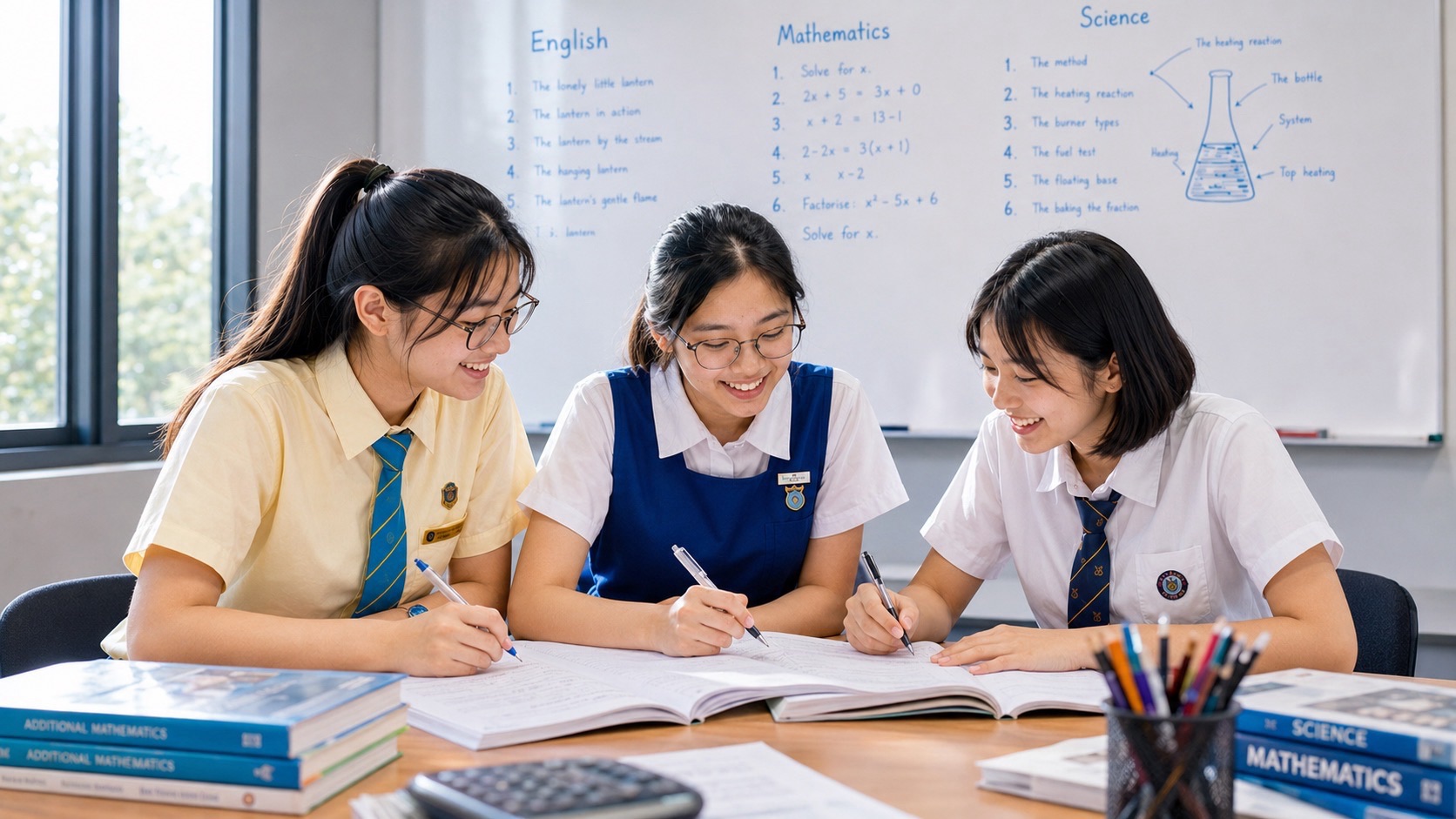
Mira has already survived Additional Mathematics, the first SEC, the transition into Junior College and the shock of H2 Mathematics. Now she enters the year in which everything has to hold at once.
This article continues the fictional eduKatePunggol residents Mira, Jonas, Nadia and Evan. Mira, Jonas and Nadia are now in JC2; Evan continues along his Polytechnic engineering route. They are fictional educational characters, not representations of actual eduKate students or guaranteed results.
The story takes place in Mira’s projected 2029 JC2 year. At the time this article is being written, SEAB has not yet published the 2029 H2 Mathematics examination specification. The currently published H2 Mathematics syllabus is 9758. This narrative therefore follows the intellectual and human journey of the final JC year without inventing future paper dates, durations, weightings or examination arrangements.
The windows are still there
At 6.11 in the morning, Punggol is mostly windows.
Again.
It occurs to Mira that perhaps every important year of her life will begin this way.
Somewhere in a high-rise block, in a kitchen lit before sunrise, with one parent awake, one cup on the table and some form of Mathematics waiting nearby.
Primary school Mathematics once waited in a small workbook.
Secondary school Mathematics arrived in thicker files.
Additional Mathematics arrived with algebra that looked personally hostile.
SEC preparation arrived in piles of papers.
JC1 brought the graphing calculator and complex numbers.
Now JC2 begins with almost nothing new on the dining table.
That is what makes it frightening.
The calculator is familiar.
The files are familiar.
The notation is familiar.
The subjects are familiar.
The institution is familiar.
Mira knows where her lecture theatre is.
She knows the quickest route through school.
She knows which canteen queue moves slowly despite appearing short.
She knows which free period tends to disappear.
She knows what her H2 Mathematics tutor expects.
She knows her tuition group.
She knows her weaknesses.
She knows what a long paper feels like.
She knows what it means to get 58 and recover.
She knows what it means to get 71 and be pleased.
Nothing is new enough to blame.
The year is simply asking whether everything she has built can now operate together.
Her father comes into the kitchen.
He looks at her.
Mira points at him before he speaks.
“No.”
“I haven’t said anything.”
“You’re going to.”
“I was going to ask whether you want toast.”
She lowers her finger.
“Yes.”
He prepares toast.
Then, without turning around:
“First H2 Math lesson?”
Mira closes her eyes.
Some family traditions cannot be defeated.
1. JC2 is the year the future stops being theoretical
In JC1, people say:
“A-Levels.”
The phrase has distance.
It belongs to seniors.
Teachers.
Calendars.
Older siblings.
JC2 students somewhere else.
The examination is real, but temporally polite.
It waits.
Then January arrives.
The phrase changes.
No longer:
“A-Levels.”
Now:
“My A-Levels.”
This creates an interesting psychological transformation.
The mathematics itself does not become harder overnight.
The same vectors remain vectors.
Complex numbers do not become more complex because the calendar changed.
A derivative does not wake on 1 January and decide to become vindictive.
But the interpretation of every piece of work changes.
A weak tutorial is no longer simply this week’s weak tutorial.
Students begin asking whether it predicts November.
A poor class test becomes a forecast.
A difficult chapter becomes a threat.
A missed question becomes evidence about university.
This is dangerous.
The final year requires seriousness.
It does not benefit from prophecy.
Mira has learned this before.
A score is evidence about an attempt under certain conditions.
It is not a crystal ball.
So she writes one sentence on the first page of her new notebook:
Do the year in the order it arrives.
January first.
Not November.
This is harder than it sounds.
2. JC1 has left behind more Mathematics than Mira expected
The first January audit is familiar.
Mira retrieves old work.
Functions.
Graphs.
Sequences and series.
Complex numbers.
Vectors.
Calculus.
Probability.
Statistics.
She no longer divides everything into “know” and “don’t know”.
Those categories are too crude.
A topic can be recognised but not independently generated.
It can be conceptually understood but algebraically slow.
It can be strong in routine questions and weak in unfamiliar contexts.
It can be stable untimed and fragile under pressure.
It can be retrievable on Monday and strangely absent on Thursday.
Mira has become more sophisticated about the condition of knowledge.
She tests.
A complex-number question returns quickly.
Good.
Vectors are slower.
Expected.
A probability problem produces an incorrect first model.
Important.
Differentiation is fluent.
Integration is less automatic.
Statistics interpretation is good.
The graphing calculator behaves because Mira now checks what she enters.
The audit does not frighten her.
It gives the year an address.
JC2 is large.
But not infinitely large.
That distinction matters.
3. Jonas begins January with a spreadsheet
Of course.
The spreadsheet contains tabs.
Many tabs.
Topic tracking.
Paper scores.
Timing.
Error types.
Question sources.
University courses.
Admissions information.
Scholarships.
Something labelled “Optimisation”.
Nadia looks at it.
“What are you optimising?”
Jonas pauses.
“Everything.”
“That is not a variable.”
“It can be.”
“No.”
Mira scrolls.
There are conditional colours.
Historical averages.
Projected completion dates.
A chart.
“How long did you spend making this?”
“That is irrelevant.”
“It is literally time management.”
Jonas changes the subject.
The spreadsheet is not useless.
It becomes useful when the tutor asks him one question.
“What decision will this data change?”
Jonas looks at the screen.
This becomes his JC2 challenge.
Measurement can become another form of procrastination.
If the data does not change an action, collecting more of it may simply create a very elegant record of standing still.
His spreadsheet survives.
Several tabs do not.
Progress.
4. Nadia begins with one piece of paper
Her system is almost offensive in its simplicity.
Three columns.
Stable.
Needs work.
Ask.
Jonas sees it.
“That can’t possibly be enough.”
Nadia looks at his fourteen-tab spreadsheet.
“We’ll see.”
This argument continues throughout the year.
Both systems can work.
The difference is not aesthetic.
It is whether the system reduces uncertainty and leads to useful action.
Nadia’s paper tells her:
Vectors need work.
Some integration forms need work.
One statistical concept needs clarification.
Everything else remains in normal rotation.
She begins.
The simplicity has one advantage.
There is nowhere to hide.
5. The first week is deliberately unimpressive
No full paper.
No heroic five-hour study session.
No annual transformation montage.
Mira attends school.
Completes tutorials.
Checks older material.
Repairs one vector weakness.
Sleeps.
This restraint is intentional.
She remembers how examination years invite students to perform intensity.
January is not a competition in how frightened everyone can become earliest.
The year needs endurance.
Mira thinks of it as distance running.
You cannot sprint the first kilometre because the finish line has emotional importance.
The body does not negotiate with symbolism.
Neither does attention.
A sustainable final year begins sustainably.
6. The H2 Mathematics syllabus no longer feels like chapters
By JC2, Mathematics has changed shape.
In earlier years, the subject could be experienced as a sequence.
Learn chapter.
Practise chapter.
Assess chapter.
Move on.
JC2 increasingly feels like a field.
Functions connect to calculus.
Graphs connect to almost everything.
Vectors carry geometry algebraically.
Complex numbers can move between algebraic and geometric interpretation.
Sequences and series require pattern, algebra and limiting behaviour.
Probability asks for modelling.
Statistics asks for interpretation and disciplined conclusions.
A question can activate several territories at once.
Mira no longer asks:
“What chapter is this?”
She asks:
“What structures are active?”
This is a much better question.
It took four years of increasingly difficult Mathematics to make it natural.
7. The problem with being better at Mathematics
You notice more things that can go wrong.
At fifteen, Mira’s error analysis was simple.
Wrong answer.
Find wrong line.
Repair.
At eighteen, she can identify an unsettling range of failure modes.
Wrong model.
Wrong representation.
Right representation, wrong manipulation.
Right method, poor efficiency.
Correct mathematics, invalid domain.
Correct mathematics, weak justification.
Correct answer, unsupported conclusion.
Calculator input error.
Premature approximation.
Misread statistical claim.
Failure to distinguish sample evidence from population conclusion.
Time allocation failure.
Emotional overcommitment to a blocked question.
Fatigue.
The list is longer because her understanding is deeper.
This occasionally feels like becoming worse.
It is the opposite.
Experts see more failure modes because they see more structure.
The objective is not to worry about all of them simultaneously.
It is to use that awareness selectively.
8. Mathematics tuition in JC2 begins with fewer explanations
The three students arrive on Saturday.
The tutor asks:
“What have you brought?”
Mira has a probability question.
Jonas has a calculus solution he believes is elegant.
Nadia has a statistics interpretation she believes is slightly wrong but cannot explain why.
Nobody has brought:
“I don’t understand Math.”
This is the endpoint of years of diagnostic training.
Questions now arrive with context.
Mira:
“I formed the distribution this way, but I think I’m treating independence incorrectly.”
Jonas:
“My solution works, but I want to know if this transformation is actually buying anything.”
Nadia:
“I think the numerical answer is fine. My conclusion overstates the evidence.”
The tutor can begin at the edge.
This is high-level tuition.
Not more teaching.
More precise teaching.
9. Evan sends a photo of an engineering project
It contains wires.
Metal.
Something bolted to something else.
A ruler.
A laptop.
Several items whose function Mira cannot infer.
The message says:
Real vectors.
Jonas replies immediately:
All vectors are real unless complex vector space—
Nadia:
Stop.
Evan:
You people need sunlight.
The paths continue diverging.
Evan’s Mathematics is becoming physical.
Tolerance.
Measurement.
Data.
Force.
Control.
Performance.
Mira’s remains more theoretical.
Yet the conceptual crossings are increasing.
The friends begin seeing that “Mathematics” is not one school subject.
It is infrastructure across disciplines.
This makes H2 Mathematics feel less like an examination requirement.
Not every topic will directly appear in every future career.
But the habits of representation, modelling, approximation, evidence and disciplined inference travel widely.
10. February: the first bad week
Not bad paper.
Bad week.
This is important.
Mira sleeps poorly on Monday.
A practical runs long on Tuesday.
CCA creates extra work.
Wednesday’s Mathematics tutorial contains two questions she cannot finish.
Thursday’s lecture introduces material before Wednesday feels resolved.
Friday brings another assignment.
By Saturday morning Mira feels as though she has become bad at everything simultaneously.
This is a common cognitive illusion.
Several small failures cluster.
The mind compresses them into one large identity statement.
I am falling apart.
At tuition, the tutor asks her to separate the problems.
Sleep.
One unresolved calculus idea.
One incomplete tutorial.
One scheduling issue.
One CCA deadline.
That is not “everything”.
It is five things.
Five things can be managed.
Everything cannot.
Language changes the size of the problem.
Mira goes home with three actions.
Finish the missing calculus link.
Protect Sunday morning.
Sleep.
The week ends.
Civilisation survives.
11. The year is won partly by preventing backlog
Backlog in JC behaves differently from backlog in Primary school.
The tasks are larger.
Dependencies are stronger.
A missed understanding can contaminate later understanding.
Therefore Mira treats unresolved mathematical debt seriously.
Not anxiously.
Seriously.
She does not require every question to be perfect before moving on.
That would be impossible.
But unresolved conceptual uncertainty gets captured.
No invisible backlog.
If she cannot resolve it that week, it remains listed.
The list is reviewed.
The goal is not zero uncertainty.
It is zero forgotten uncertainty.
This distinction saves her year.
12. Pure Mathematics becomes a conversation between representation and structure
Mira now routinely moves among forms.
Equation.
Graph.
Vector.
Parametric representation.
Complex plane.
Derivative.
Integral.
Sequence.
Approximation.
Each representation reveals something and hides something.
She discovers that many hard questions are not hard because the required mathematics is unknown.
They are hard because the current representation is unhelpful.
This becomes a reflex.
If stuck:
Can I draw?
Can I rewrite?
Can I parameterise?
Can I express in another basis?
Can I use symmetry?
Can I turn geometry into algebra?
Can I turn algebra into a graph?
Can the calculator expose behaviour worth proving?
A problem can become easier without changing mathematically.
Only the viewpoint changes.
This is one of the most beautiful lessons H2 Mathematics offers.
13. Jonas learns that elegant is not the same as short
He has always liked short solutions.
Minimal lines.
Maximum effect.
At JC2, this preference matures.
A short solution can be ugly if it hides the central argument.
A slightly longer solution can be elegant if each step makes the structure clearer.
The tutor shows Jonas two solutions.
One is six lines.
One is nine.
The nine-line solution is easier to verify, easier to communicate and exposes the key transformation naturally.
Jonas experiences philosophical difficulty.
He eventually concedes.
“Fine.”
This is historic.
Mathematical elegance is not a line-count competition.
It is economy of thought.
14. Nadia becomes very good at statistical language
The others notice.
A hypothesis-testing question reaches its conclusion.
Jonas writes something.
Nadia shakes her head.
Mira writes something else.
Nadia shakes her head again.
The tutor says nothing.
Nadia finally writes a sentence.
Precise.
Limited.
Correct.
Jonas looks at it.
“That is basically what I said.”
“It isn’t.”
“It means the same thing.”
“It doesn’t.”
He reads again.
It does not.
Statistics has taught Nadia to guard the distance between evidence and claim.
This becomes one of her strongest habits.
It also improves her General Paper.
The disciplines are crossing.
Evidence supports.
Evidence does not automatically prove.
Failure to establish one claim does not establish its opposite.
Association does not establish causation.
A model has conditions.
A conclusion has scope.
Nadia likes this world.
It rewards careful thought.
15. March begins with university open-house conversations
The future becomes physical.
Campuses.
Courses.
Talks.
Videos.
Admissions pages.
People wearing lanyards explaining programmes.
Mira walks through university spaces and experiences an unexpected feeling.
She can imagine herself there.
This is both exciting and destabilising.
Until now, university has been a concept.
Now there are buildings.
Lecture theatres.
Labs.
Libraries.
Course descriptions containing mathematical words she recognises and many she does not.
Engineering.
Data science.
Economics.
Computing.
Mathematics.
Science.
Quantitative fields.
Options multiply.
Jonas’s spreadsheet gains several tabs.
Nadia tells him nothing.
She has accepted that this is how he experiences hope.
16. Mira does not know what she wants to study
This is allowed.
She has preferences.
She likes Mathematics.
She likes Physics.
She enjoys ideas that combine abstraction and application.
She does not yet have a single inevitable degree.
Adults ask:
“What do you want to do?”
Mira has learned to say:
“I am still deciding.”
This is a complete sentence.
The final examination year already contains enough pressure.
It does not need a fictional certainty about the next twenty years.
One purpose of doing well is preserving good choices.
The choice itself can come later.
17. The March holidays are shorter emotionally than they are chronologically
The break arrives.
Mira has plans.
Rest.
Revision.
University visits.
Friends.
Family.
CCA work.
General Paper reading.
Physics.
Mathematics.
The calendar is immediately full.
She catches the pattern.
When every activity is valuable, the week can still become impossible.
She chooses.
Mathematics gets three serious sessions.
Not seven.
One mixed Pure Mathematics set.
One Probability and Statistics review.
One targeted calculus repair session.
The rest remains normal maintenance.
She sleeps.
This feels irresponsible for approximately two hours.
Then it feels excellent.
18. A difficult integration question takes forty-two minutes
Mira knows this because Jonas times everything.
It is not an examination question under examination conditions.
It is a learning problem.
The group is allowed to stay.
They try substitutions.
Rearrangements.
Graphical thinking.
A false route.
Another false route.
Nadia sees a relationship.
Mira modifies it.
Jonas executes.
The eventual solution is shorter than the search.
This is instructive.
Final solutions hide exploration.
When students read worked answers, they see the clean path.
They do not see the abandoned paths that made the clean path visible.
This can create a false image of expertise.
Experts do not always know instantly.
They search better.
Reject faster.
Recognise structure.
Use failure as information.
The forty-two minutes are valuable because the students experience mathematical discovery rather than only mathematical reporting.
19. The examination system eventually demands faster decisions
This creates a tension.
Deep learning may take forty-two minutes.
A timed paper will not grant forty-two minutes to one problem.
So the year must contain both modes.
Exploration mode.
Performance mode.
They are related but not identical.
Exploration expands capability.
Performance allocates capability under constraints.
If students only practise timed performance, they may never deepen.
If they only explore, they may not become exam-ready.
Mira’s weekly Mathematics now consciously includes both.
One long problem with permission to struggle.
One timed cluster with no permission to linger.
The same mind learns two gears.
20. April: the graphing calculator becomes boring
This is success.
In JC1, the graphing calculator was exciting.
Then dangerous.
Then useful.
Now it is ordinary.
Mira knows how to set windows.
Interpret graphs.
Check intersections.
Use numerical functionality appropriately.
Distinguish calculator evidence from mathematical reasoning.
The tool no longer consumes attention.
This is exactly what skill acquisition should do.
A tool begins as an object of attention.
Then becomes part of the environment.
Attention moves upward.
The boring calculator makes harder Mathematics possible.
21. The machine remains obedient
Mira remembers the lesson from last year.
Machines are obedient.
She enters an incorrect function.
The calculator once again produces an impeccable wrong graph.
This time she notices almost immediately.
Why?
Because she has an expectation.
The mathematics predicts rough behaviour.
The machine disagrees.
Instead of assuming the machine is authoritative, she checks the input.
This is a profound change.
Tool supervision requires an independent model of what should approximately happen.
Without that model, any plausible output can dominate.
Mira is no longer merely using technology.
She is judging technology.
That skill will matter far beyond graphing calculators.
22. April also contains the first full paper that feels genuinely good
Not easy.
Good.
There is a difference.
Mira works through a demanding mixed paper.
Several questions require thought.
One blocks temporarily.
A statistics interpretation needs care.
A calculus question is long.
She finishes with little spare time.
The score is not extraordinary.
What feels good is control.
She knew what she was doing most of the way.
Even uncertainty had shape.
The paper did not feel like random attack.
This is the psychological threshold the year needs.
A large syllabus can become navigable before it becomes mastered.
23. The first large internal examination arrives
The exact school assessment varies from institution to institution.
For Mira, this is the first major checkpoint of JC2.
She does not treat it as a miniature A-Level.
It cannot predict that precisely.
She does treat it as a systems test.
Can old JC1 Mathematics survive?
Can new JC2 learning integrate?
Can she sustain concentration?
Can she switch between Pure Mathematics and Statistics demands?
Can she use the calculator without becoming dependent?
Can she recover?
The paper answers.
Some yes.
Some no.
Her score is 68.
She wanted 75.
The script is rich with information.
That makes it worth more than the number.
24. One error costs seven marks
It begins with a wrong model.
Everything after is competent.
This is painful.
Mira looks at the page.
The old first-weak-line method still works.
The first incorrect decision happened before any difficult algebra.
She interpreted the relationship wrongly.
Seven marks descend from one bad sentence.
This is why problem modelling matters.
The ability to calculate perfectly is useless if the wrong problem has been constructed.
Mira adds a new pre-calculation habit for applied questions:
What exactly does this quantity represent?
One sentence.
Potentially seven marks.
25. Another error costs one mark and bothers her more
A careless sign.
The mathematics was trivial.
She had done harder work correctly.
Then donated one mark.
This irritates her.
The tutor asks:
“Which error deserves more training time?”
Mira wants to say the sign.
Emotionally, yes.
Mathematically, probably not.
The modelling error has higher leverage.
This is an important final-year discipline.
Do not let irritation set the revision agenda.
Use consequence and recurrence.
Some errors feel stupid.
That does not make them strategically important.
26. Jonas scores higher and is less pleased
His score is strong.
His paper is not.
He recognises several questions from similar practice.
He also sees that one unfamiliar question defeated him completely.
The number flatters his current transfer ability.
This is the opposite of Mira’s situation.
Again, score without context misleads.
Jonas chooses the unfamiliar question as his next week’s main work.
This is maturity.
The fifteen-year-old Jonas would have admired the score and ignored the hole.
The eighteen-year-old Jonas is more interested in the hole.
27. Nadia scores lower and is calmer
She knows why.
Timing.
Her reasoning is mostly sound.
She spends too long making solutions perfect.
A final-year examination rewards clarity.
It does not reward manuscript illumination.
Her tutor shows her several places where she could stop.
The question has been answered.
The argument is complete.
More lines add nothing.
Nadia has to learn completion.
Perfectionism is often described as high standards.
In exams it can also be poor resource allocation.
The best answer is not the longest correct answer.
It is the sufficient correct answer.
28. May is where the year becomes crowded
Academic deadlines intensify.
CCA reaches its final stages.
University discussions continue.
School events appear.
Class content still moves.
Revision begins in some areas while new work continues in others.
The calendar stops looking like a timetable and starts looking like a negotiation.
Mira discovers that final-year pressure is rarely one giant thing.
It is many individually reasonable things arriving at the same time.
A tutorial due tomorrow is reasonable.
A practical report is reasonable.
CCA handover is reasonable.
University research is reasonable.
A Mathematics revision set is reasonable.
A family dinner is reasonable.
Sleeping is extremely reasonable.
Put them together and Tuesday becomes structurally impossible.
The skill now is not discipline in the simplistic sense.
It is prioritisation under constraint.
Mira starts each crowded week by identifying what is fixed, what is movable and what can be reduced without damaging the system.
Fixed: school lessons, major deadlines, essential CCA commitments, sleep floor.
Movable: extra practice, optional reading, some revision blocks.
Reducible: redundant questions, duplicate resources, low-value perfection.
This sounds managerial.
It is.
JC2 is partly an education in operating one’s own life.
29. The last serious CCA month is emotional in an inconvenient way
Mira expected to feel relieved when CCA started ending.
She does.
She also feels sad.
For two years, CCA consumed afternoons she often wanted for studying.
Now the final sessions become countable.
The inconvenience becomes memory before it has fully ended.
There are younger students taking over.
Responsibilities are handed down.
People take photographs.
Someone says, “Last training.”
The phrase lands differently than expected.
This matters to Mathematics because attention is not divisible into perfectly labelled subject compartments.
A student can be emotionally occupied by endings while academically approaching the most important months of the year.
Mira does not treat the sadness as inefficiency.
She lets the ending be an ending.
That weekend, she does slightly less Mathematics.
Nothing collapses.
The following week, with CCA responsibilities reduced, her schedule opens.
She does not immediately fill every newly available hour.
This is restraint again.
Capacity created is not capacity that must instantly be consumed.
30. June is the last large repair window
The mid-year break arrives with a different weight from JC1.
This is no longer merely a holiday between terms.
It is the last long uninterrupted stretch before preliminary examinations and the final national-examination season begin to dominate the year.
Mira knows this.
The knowledge creates urgency.
Urgency creates a temptation to do everything.
She resists.
Her June plan has four jobs.
Coverage.
Nothing important should remain completely unknown.
Repair.
Recurring weaknesses need targeted work.
Integration.
Topics must survive outside chapter order.
Endurance.
Long-paper performance must be trained deliberately.
There is no fifth category called panic.
This is useful because panic tends to disguise itself as thoroughness.
A student can spend nine hours reorganising notes and call it revision.
Another can complete four full papers badly and call it intensity.
Mira wants change, not theatre.
31. The old three-part system returns one final time
Maintenance.
Development.
Performance.
The categories first appeared during the SEC year.
They still work.
Maintenance now means keeping already-strong mathematics available.
A few retrieval questions.
Formula familiarity.
Calculator fluency.
Short statistical interpretations.
Development means repairing or extending weaker structures.
Vectors.
Selected integration.
Probability modelling.
One recurring function issue.
Performance means timed mixed work.
Long sections.
Eventually full school papers built on the current syllabus.
The categories prevent Mira from using full papers to repair something that should have been repaired directly.
If a probability model is conceptually wrong, another three-hour paper is an extraordinarily inefficient lesson.
If endurance is the problem, a ten-minute worksheet will not reveal it.
Match the work to the failure.
This principle has survived every level because it is not really about Mathematics.
It is about learning.
32. A full paper becomes a data-producing event
Mira no longer says:
“I did a paper.”
That sentence is incomplete.
She performs the paper.
Then later investigates the paper.
The second session may matter more.
She records:
Questions she could not enter.
Questions she entered correctly but inefficiently.
Questions where algebra failed after the concept succeeded.
Questions where calculator use helped.
Questions where calculator use distracted.
Statistical conclusions that were numerically correct but verbally weak.
Places where time disappeared.
Places where she checked something low-risk while ignoring something high-risk.
Then she asks the only question Jonas’s spreadsheet eventually taught the whole group:
What decision will this data change?
If the answer is nothing, the record is decoration.
If the answer is clear, the paper has become instruction.
33. The first long June simulation teaches Mira about minute 130
The current published H2 Mathematics 9758 syllabus uses long examination papers, and schools preparing students on that curriculum therefore train sustained mathematical work. Mira’s eventual 2029 specification must be checked when SEAB publishes it, but the learning problem exists regardless of the precise future paper format.
Long mathematical work changes after enough time passes.
At the beginning, Mira is sharp.
After an hour, still good.
After two hours, something changes.
She begins rereading instructions.
Her handwriting becomes less patient.
A calculator entry goes wrong.
She catches it.
Then around minute 130, she makes two errors that have nothing to do with knowledge.
This becomes her attention cliff.
Every student may have a different one.
Endurance practice is partly about discovering it.
Mira does not solve the problem by drinking absurd amounts of coffee.
She practises reset behaviour.
Question ends.
Hands stop.
Eyes move away for several seconds.
Posture resets.
Next question begins as a new event.
The paper remains continuous.
Attention can be segmented.
34. Fatigue has a mathematical signature
Mira becomes able to recognise her own.
Early fatigue:
She rereads.
Mid fatigue:
She calculates too soon.
Late fatigue:
She stops checking whether an answer is reasonable.
This is useful because fatigue is not merely a feeling.
It produces predictable errors.
Once predictable, some can be defended against.
Mira creates a late-paper rule.
If the answer is surprising, stop before trusting the calculator.
Reconstruct the model.
Check sign.
Check scale.
Check domain or condition where relevant.
The rule costs seconds.
It saves entire solutions.
35. Probability modelling produces a perfect wrong answer
One June afternoon, Mira works a probability problem.
The arithmetic is clean.
The calculator gives a plausible value.
The answer lies between zero and one.
Everything looks respectable.
It is wrong.
Nadia finds the problem.
“You modelled the events as independent.”
Mira looks.
They are not.
The entire calculation has been built beautifully on an unjustified assumption.
This is a more sophisticated version of the Secondary 4 lesson.
A calculation is only as valid as the model that gives it meaning.
Mira adds another question before probability work:
What assumptions am I making?
Not every assumption has to be written.
It still has to be mathematically legitimate.
36. Statistics teaches the group that conclusions are also calculations
Not numerical calculations.
Logical ones.
A test produces evidence.
A student then moves from evidence to conclusion.
That move has rules.
Nadia is excellent at them.
Jonas continues to believe that if the numerical work is correct the English should be given reasonable freedom.
It should not.
His conclusion claims too much.
Nadia edits three words.
The statement becomes correct.
Three words.
Entirely different epistemic status.
Mira enjoys this more than she expected.
Statistics keeps teaching the same moral:
Do not say more than the evidence permits.
That principle applies to graphs.
Studies.
News.
Predictions.
Claims about students.
Claims about oneself.
A poor paper is evidence.
It is not proof of permanent inability.
The Mathematics and the life lesson have become the same sentence.
37. Mira’s June score rises and she trusts it less
She scores 76 on a strong practice paper.
She is happy.
Then cautious.
How familiar were the question structures?
How much of the paper resembled recent practice?
Did the score depend on one unusually favourable topic mix?
Were any correct answers produced by routes she could not reliably reproduce?
This is not pessimism.
It is calibration.
High scores deserve analysis too.
Mira discovers that two of the hardest-looking questions were actually close to things she had recently practised.
The 76 still matters.
It demonstrates improved fluency and accuracy.
It does not yet prove full transfer.
So the next paper is deliberately less familiar.
She scores 70.
The 70 teaches more.
This would have upset her three years ago.
Now she knows the difference between comfort and information.
38. Her parents no longer ask whether Mathematics is okay
The question has become too vague.
Instead her mother asks:
“What are you working on this week?”
Mira answers:
“Probability modelling and paper stamina.”
Her mother understands one of these more than the other.
That is enough.
Her father asks:
“Anything you need from us?”
Sometimes the answer is:
“No.”
Sometimes:
“Can dinner be slightly later Thursday?”
Sometimes:
“Please don’t ask me about the test the minute I get home.”
The family has learned to support without occupying the subject.
This is a mature home learning environment.
The student increasingly owns the academic details.
The family protects the operating conditions.
Food.
Sleep.
Perspective.
Space.
Trust.
39. July is where preliminary examinations become visible
Prelims are no longer a distant school event.
Teachers mention revision schedules.
Classes begin consolidating.
Paper sets become more frequent.
Students compare how much their schools have completed.
This comparison is mostly noise.
Schools sequence material differently.
Students have different weaknesses.
The relevant question remains local:
What must be reliable before my preliminary examinations?
Mira’s list is smaller than June’s.
This is encouraging.
Vectors are now usable.
Integration is stronger.
Probability modelling remains the highest-risk area.
Statistics language is good.
Late-paper fatigue still causes small leaks.
The system is narrowing.
40. The error ledger gets shorter and more expensive
Early in JC2, Mira had many kinds of errors.
By July, the list is shorter.
This sounds entirely good.
Mostly it is.
But remaining errors tend to be higher-level.
Not “forgot formula”.
More often:
Misread modelling condition.
Selected a route that works but is too expensive under time.
Failed to recognise a hidden representation.
Overstated a statistical conclusion.
Stayed with a problem too long.
The student is improving.
The frontier is moving.
This is why strong students still need thoughtful feedback.
Simply giving harder questions is not diagnosis.
The nature of the remaining errors matters.
41. Too many resources becomes a final-year risk
By July, Mira has access to more practice than she can possibly complete.
School papers.
Past-year questions.
Revision packages.
Tuition sets.
Online repositories.
Friends’ school papers.
Commercial books.
Videos.
Notes.
Shared drives.
The student who measures preparedness by resource consumption can never feel finished.
There is always another paper.
Another school.
Another difficult question.
Another list.
Mira stops collecting.
This feels radical.
She chooses enough.
Then uses it properly.
One analysed paper is worth more than three papers completed and forgotten.
One recurring error repaired is worth more than twenty screenshots of difficult questions.
Scarcity once limited education.
Abundance now requires judgment.
42. Mira opens her Secondary 3 A-Math file
She is looking for nothing important.
The file happens to be in the cupboard.
She opens it.
A quadratic worksheet.
Surds.
Logarithms.
A differentiation page.
Her handwriting looks younger.
This makes no sense, but it does.
She finds the margin note:
Do not automatically destroy useful structure.
Mira laughs.
The sentence is still good.
She turns another page.
A small dot beside the first wrong line.
Another old habit still good.
This is the continuity of mathematical education.
The formulas have grown.
The useful principles remain.
Preserve structure.
Find the first weak point.
Represent intelligently.
Do not confuse recognition with generation.
Use evidence.
These ideas were simple enough for Secondary 3.
They are powerful enough for JC2.
43. General Paper and Statistics unexpectedly become friends
Mira is reading an article for General Paper.
It contains a numerical claim.
A survey.
A percentage.
A dramatic conclusion.
She pauses.
Sample?
Population?
Selection?
What exactly is being measured?
What alternative explanations exist?
The Statistics classroom has followed her into reading.
Later, General Paper returns the favour.
A mathematical answer in context requires clear interpretation.
What does this result mean?
What does it not mean?
Is the claim proportional to the evidence?
The subjects are no longer isolated.
Reasoning is travelling between them.
This is one reason advanced education feels different from a collection of exam syllabuses when it is working well.
Ideas begin forming a network.
44. Evan’s machine fails and everybody understands the debugging story
Evan sends a video.
The machine starts.
Moves.
Makes an unfortunate sound.
Stops.
The group chat becomes unhelpful.
Jonas:
Boundary condition failure.
Nadia:
You don’t know what happened.
Evan later explains.
The failure was not where the machine stopped.
It began earlier.
A measurement.
A tolerance.
A setting.
Something small propagated.
Mira recognises the pattern instantly.
First weak line.
Different domain.
Same logic.
Systems fail downstream from causes.
Repair works better when it traces backwards.
Their education has diverged enough to become connected again at a deeper level.
45. August: preliminary examinations stop being practice in the abstract
The school prelim period approaches.
The exact schedule is the school’s own.
Mira does not treat it as a prediction machine for the eventual A-Level examination.
She does treat it as the most demanding integrated evidence available so far.
Her preparation is now deliberately narrow.
No new giant resource.
No desperate syllabus restart.
No attempt to learn every exotic method circulating among friends.
She protects stable Mathematics.
Repairs the few remaining recurring weaknesses.
Practises full-paper behaviour.
Checks calculator habits.
Sleeps.
The work looks less dramatic than June.
This is a good sign.
A well-built system should become quieter near performance.
46. The first prelim Mathematics paper feels terrible
This happens.
The first question is manageable.
The second is awkward.
The third contains a representation Mira does not immediately recognise.
By the middle of the paper, she feels behind.
This is where final-year training matters.
The feeling of being behind is not the same as being mathematically incapable.
She stops trying to judge the paper while sitting it.
Question.
Next decision.
Next mark.
Next representation.
One problem remains partly unfinished.
Another is probably wrong.
She leaves the room disappointed.
Jonas begins:
“For Question—”
Mira raises one finger.
The tradition has crossed another examination level.
“No autopsy.”
“We are adults now.”
“Then act like one.”
Nadia laughs.
47. The second prelim Mathematics paper begins after the first one ends
This seems obvious.
Emotionally, it is not.
Students carry previous papers forward.
A strong first paper can create overconfidence.
A weak first paper can create despair.
Both are irrelevant to the next first question.
Mira goes home.
Eats.
Rest.
Reviews only what remains useful.
She does not search extensively for answers to the first paper.
Nothing in that answer key can change marks already submitted.
The second paper deserves a student who has not spent the entire gap emotionally re-sitting the first.
When she enters the next examination, she is calmer.
The paper is still difficult.
Her behaviour is better.
This is an important distinction.
48. The prelim result is 74 and means more than it did in Secondary 4
Four years earlier, 74 would have been one number.
Now Mira reads the anatomy.
Pure Mathematics mostly stable.
One vectors problem weak.
Calculus good.
Probability modelling improved.
Statistics language strong.
One late-paper fatigue mistake.
One route-selection problem.
The number matters.
The anatomy matters more for what happens next.
Her mother asks:
“How do you feel?”
“Good.”
“What did you get?”
“Seventy-four.”
The order still makes Mira smile.
The family has learned how not to let marks enter the house before the student does.
49. Jonas scores higher and finds one frightening blank
His overall result is excellent.
One question is almost empty.
It required a representation he did not see.
He could execute every individual technique inside the official solution.
He simply did not assemble them.
This is high-level failure.
Jonas does not respond by doing ten more routine questions from the same chapter.
He studies entry.
What clue did he miss?
What alternative representations were available?
What made the correct route visible in retrospect?
How can he practise recognition without memorising that exact question?
His revision becomes more thoughtful because his knowledge is already strong.
50. Nadia’s prelim is her best performance yet
Not because every answer is perfect.
Because the old timing problem has reduced.
She stops when an argument is complete.
She trusts concise correctness.
She moves.
Her statistics remains excellent.
Her vectors hold.
Her calculus is slower than Jonas’s and accurate.
The group celebrates exactly long enough to be pleased.
Then Nadia identifies two weaknesses herself.
No tutor prompt.
This is independence.
51. After prelims, panic is strategically expensive
There is a cultural temptation around major school prelims.
Students compare.
Schools compare.
Parents compare.
Online conversations compare.
Everyone wants to convert prelim scores into future national grades.
Mira refuses the conversion.
Prelims are evidence.
Not prophecy.
The remaining weeks are too valuable to spend emotionally arguing with a forecast.
She asks:
What is stable?
What can still change?
Which change has highest leverage?
Then works.
This is the same response whether the prelim result is excellent or disappointing.
Strong students need calibration.
Struggling students need prioritisation.
Everybody needs the next useful action.
52. September becomes the month of narrowing
The exact national timetable for Mira’s projected 2029 examination year does not yet exist publicly at the time this article is written, so the family waits for the actual SEAB and school schedule rather than inventing dates.
But the broad educational stage is clear.
By the final stretch, revision should become narrower.
Mira’s weak list is now short enough to fit comfortably on one page.
One vectors configuration.
One kind of probability modelling decision.
A recurring integration-recognition issue.
Late-paper checking.
That is all.
This does not mean she knows every question.
Nobody does.
It means the underlying system is stable enough that unfamiliar questions are the main remaining uncertainty.
And unfamiliarity cannot be eliminated.
It can only be trained for.
53. University becomes a possibility, not a distraction
Courses remain in the background.
Mira has narrowed her interests.
Not to one answer.
To a family of possibilities.
Mathematics-heavy science.
Engineering.
Data-related programmes.
Perhaps something she has not yet seen.
This changes the emotional meaning of H2 Mathematics.
The subject is still an examination.
It is also a door.
Doors create motivation and pressure at the same time.
Mira tries to keep the order correct.
Do today’s Mathematics well.
Let future choices remain open.
Do not sit a calculus paper while mentally negotiating an undergraduate degree.
One year at a time.
One question at a time.
54. Stable, usable, fragile becomes almost boring
Mira has used these categories since Secondary school.
They remain useful because they are honest.
Stable:
Can retrieve, execute and transfer under ordinary pressure.
Usable:
Can solve with some hesitation or occasional support.
Fragile:
Performance depends too heavily on familiarity, prompting or favourable conditions.
The system is simple enough to survive changing curricula.
It does not care whether the topic is surds or hypothesis testing.
It asks about reliability.
In September, almost everything important is stable or usable.
That is readiness.
Not feeling fearless.
Not knowing every answer.
Reliability.
55. Tuition becomes smaller as the examination gets closer
This surprises parents sometimes.
Shouldn’t tuition become more intense?
Not necessarily.
If the student is well prepared, the useful intervention can become narrower.
Mira brings fewer questions.
They are better questions.
The tutor spends less time teaching content.
More time inspecting decision quality.
Why did you choose this representation?
Where did you decide to move on?
Why did you trust this calculator result?
What evidence supports this statistical conclusion?
Could this solution be shorter without becoming opaque?
The learning has moved upward.
That is exactly what successful tuition should produce.
56. One final difficult question refuses to become easy
It is a vectors problem.
Of course.
Mira has improved enormously.
This particular structure remains awkward.
She tries.
Gets partway.
Stops.
Tries again.
The tutor does not immediately explain.
Instead he asks:
“What object are you actually trying to find?”
Mira answers.
“What information would determine it?”
She answers again.
“Which of that information do you already have?”
The question shrinks.
The route appears.
The final lesson is not a new trick.
It is the oldest one.
Clarify the target.
Inspect the structure.
Use what is known.
Begin.
57. Sleep becomes less negotiable near the end
There are students who advertise late-night revision like military achievement.
Mira is no longer impressed.
She has enough evidence from four years of serious Mathematics.
Tired Mira makes particular mistakes.
She misreads.
She calculates early.
She trusts suspicious results.
Therefore sleep is not merely wellness language.
It is part of mathematical performance.
This does not mean every night is perfect.
Examination seasons are messy.
But sleep cannot remain the default sacrifice whenever the plan fails.
A plan that always requires borrowing from tomorrow’s attention is not a strong plan.
58. The final long practice is deliberately ordinary
No special “killer paper”.
No psychological warfare.
A solid school paper.
Current published syllabus coverage.
Long enough to rehearse sustained work.
Mira sits.
Works.
Gets stuck once.
Moves.
Returns.
Uses the calculator carefully.
Writes statistical conclusions with appropriate restraint.
Finishes.
The score is good.
More importantly, the paper is uneventful.
This is exactly what she wants.
Preparation has transformed a difficult mathematical performance into something that feels almost routine.
Routine is underrated.
Reliability often looks boring from the outside.
59. The last normal Mathematics lesson
Somebody says it.
“This is our last normal H2 Math lesson.”
The room reacts badly.
Someone laughs.
Someone groans.
Someone asks whether revision lecture counts as normal.
The teacher continues.
But Mira hears the sentence.
There will be consultations.
Revision.
Examinations.
Perhaps university Mathematics later.
But this particular rhythm is ending.
Lecture.
Tutorial.
Correction.
Next week.
The ordinary repetition that felt endless has become finite.
Education keeps doing this.
It turns routines into memories without warning.
60. The last tuition lesson before the national Mathematics papers
The exact 2029 examination arrangement will be whatever SEAB eventually publishes.
The three students do not need the tutor to predict it.
They need to be ready for the Mathematics actually specified when their year comes.
On the final Saturday before the first Mathematics paper, Mira brings one question.
Nadia brings two.
Jonas brings none.
This is alarming.
“I am stable,” he says.
Nadia looks at Mira.
“We should record this.”
They review behaviour.
Not predictions.
Read.
Model.
Represent.
Execute.
Move.
Recover.
Check.
Interpret.
Stop when the argument is finished.
The room that once taught them how to factorise errors now has almost nothing left to say.
This is success.
61. The night before the first H2 Mathematics paper
Mira wants to revise everything.
This is impossible.
Therefore the desire is ignored.
She reviews selected conditions.
Calculator settings.
A few formulas and representations.
One statistical wording point.
Then stops.
Her brain begins listing the whole syllabus.
Functions.
Sequences.
Complex numbers.
Vectors.
Calculus.
Probability.
Statistics.
Everything.
Mira recognises the old phenomenon.
Anxiety behaving like project management.
She closes the file.
The dining table becomes a dining table again.
Dinner arrives.
The books stay closed.
62. Examination morning begins exactly as it should not be allowed to
Ordinarily.
Punggol is mostly windows.
Breakfast exists.
The lift arrives.
Someone downstairs is walking a dog.
A delivery rider checks a phone.
The world has failed to acknowledge the significance of Mira’s H2 Mathematics examination.
Her father looks at her.
She waits.
He says:
“Toast?”
Mira almost feels disappointed.
Then he adds:
“First H2 Math lesson?”
“There it is.”
She laughs.
Six seconds.
The examination becomes normal-sized.
Enough.
63. The first national H2 Mathematics paper eventually becomes only Mathematics
Whatever precise format SEAB specifies for Mira’s actual 2029 cohort, the lived experience will eventually collapse into local decisions.
The paper begins.
Question.
Read.
Structure.
Representation.
Working.
Next question.
The national significance disappears.
The university implications disappear.
The years of tuition disappear.
There is only the line in front of her.
This is the great kindness of an examination once it begins.
It becomes concrete.
Mira can act on concrete things.
One question is unfamiliar.
She pauses.
At fifteen, unfamiliarity felt like absence.
At eighteen, unfamiliarity is simply the beginning state of a problem.
She looks for structure.
Finds one relationship.
Then another.
The solution opens.
64. One problem refuses
There is always one.
Mira tries.
The route becomes ugly.
She stops.
Attempts another representation.
Still no.
Time is passing.
This is where examination maturity becomes visible.
She leaves enough working to preserve what is justified.
Marks the place.
Moves.
Several questions later she returns.
She sees something new.
Not the entire solution.
Enough to advance.
She writes.
Then stops when the remaining cost exceeds the likely return.
Four years ago, leaving an unfinished problem felt like surrender.
Now it can be optimisation.
65. Outside the first paper, Jonas opens his mouth
Mira raises one finger.
“No.”
“You don’t even know what I was going to say.”
“Yes I do.”
“I was going to ask if you wanted lunch.”
She lowers the finger.
“Yes.”
Jonas waits.
“And also Question—”
“No.”
Nadia appears, laughing.
Some traditions have reached their final form.
The first paper is finished.
Whatever it was, it is now evidence locked inside submitted scripts.
The next Mathematics paper remains changeable.
The group eats.
They discuss almost everything else.
This is not avoidance.
It is resource protection.
66. Between the Mathematics papers, Mira does not try to become a different student
This is important.
Late examination gaps create desperate reinvention.
New methods.
New notes.
New shortcuts.
New predictions.
New panic.
Mira does none of this.
She uses the system that brought her here.
Light retrieval.
Selected fragile areas.
Statistics language.
Probability modelling.
Calculator check.
Rest.
The objective is not to add a new mathematical identity in the final days.
It is to preserve the one already built.
67. The final H2 Mathematics paper begins with a statistical question
Perhaps it does in Mira’s fictional future; perhaps the eventual real 2029 paper will be arranged differently. The specific order is not the point.
The point is that Mathematics has multiple voices now.
Pure abstraction.
Applied modelling.
Probability.
Inference.
Interpretation.
Mira moves among them.
She slows for language.
Speeds for routine algebra.
Pauses for model choice.
Uses the calculator when the calculator has a job.
Ignores it when it does not.
Her working is visible.
Her conclusions are bounded by evidence.
She is not perfect.
She is operating.
That is all the examination can reasonably ask of a human being.
68. The final difficult question is not solved beautifully
This bothers Mira for about forty seconds.
Her route is clumsy.
It has an unnecessary detour.
One line is crossed out.
The final argument is correct.
At fifteen, she thought good Mathematics looked clean immediately.
At eighteen, she knows clean final solutions often emerge from messy search.
The examiner sees the final working.
Mira sees the history behind it.
She finishes.
Checks.
Time ends.
She puts the pen down.
69. There is no music again
No soundtrack.
No cinematic fade.
Scripts are collected.
Students stand.
Chairs move.
Someone immediately begins discussing an answer.
Mira hears numbers.
Methods.
Arguments.
She does not participate.
For the first time since she was a child, there may be no school Mathematics paper waiting next term.
This feels enormous.
It also feels like lunch.
Human beings are wonderfully resistant to symbolism.
70. The train home is not a revision space anymore
Mira sits if she can.
The calculator remains in the bag.
No notes.
No answer key.
No final-minute retrieval.
The route from school to Punggol has carried lectures, tutorials, failed tests, good papers, CCA, sleepiness, messages, university discussions and years of Mathematics.
Today it carries nothing academic.
Mira looks out.
This is a rare state.
Nothing to prepare for tonight.
The emptiness is almost uncomfortable.
Then it becomes freedom.
71. The dining table is empty again
Not permanently.
There will be future forms of work.
Applications.
Perhaps university problem sets.
Perhaps engineering calculations.
Perhaps data.
Perhaps something nobody currently knows to name.
But H2 Mathematics is finished.
Mira puts the file in the cupboard.
Her mother looks at the table.
“Done?”
“Done.”
No qualification.
No “for today”.
No “until tomorrow”.
Done.
The word feels strange.
72. Results belong to a later day
The grades do not exist yet.
This used to be unbearable.
Mira has become better at uncertainty.
She hopes.
She estimates a little.
Then stops.
The submitted work belongs to the examination system now.
No amount of rumination can alter a single line.
The learner’s job has ended.
This is another kind of mathematical discipline.
Know when an operation is complete.
73. Jonas after H2 Mathematics
He still has the spreadsheet.
Of course.
But the final version contains fewer tabs than January.
The largest change is invisible.
Jonas no longer needs to be the fastest person in the room to feel like a mathematician.
He has learned from people who saw things before he did.
He has learned that elegant does not mean short.
He has learned that data is useful only when it changes a decision.
He has learned to inspect holes even when the score is flattering.
His intelligence has become less performative.
More useful.
74. Nadia after H2 Mathematics
She keeps the one-page system.
Naturally.
Stable.
Needs work.
Ask.
At the beginning of Secondary 3, Nadia worried that slow meant weak.
By JC2, she understands that careful reasoning has its own speed.
She has become excellent at statistical language.
She knows when evidence is insufficient.
She knows when a solution is complete.
She knows when perfection has become waste.
She has learned to navigate unfamiliar problems without waiting for a template.
This may be the largest transformation of the four friends.
75. Evan after two years of taking another road
He has machines.
As promised.
He also has Mathematics.
It appears differently.
Applied.
Measured.
Embedded in systems.
Sometimes hidden underneath software or hardware.
He and Mira no longer share a syllabus.
They share reasoning habits.
Debug backwards.
Measure carefully.
Model before calculating.
Do not trust output without understanding input.
The education routes separated.
The intellectual tools crossed back.
76. Mira after H2 Mathematics
She does not become a symbol of mathematical genius.
That was never the point.
She becomes someone who can enter difficult systems.
She can read structure.
Change representation.
Build a model.
Check assumptions.
Use a machine without surrendering judgment.
Separate evidence from conclusion.
Persist.
Leave.
Return.
Stop.
She understands that not every wrong answer comes from not knowing enough.
Some come from modelling.
Some from representation.
Some from attention.
Some from state.
Some from time.
That diagnostic maturity may be worth more than any single chapter.
77. What four years of advanced school Mathematics actually built
Secondary 3 Additional Mathematics taught Mira that unfamiliar structure can be entered.
Secondary 4 taught her to integrate, recover and perform.
JC1 taught her that the mathematical world was much larger than the examination she had just finished.
JC2 taught her to operate inside that larger world under constraint.
The subject content changed.
The deeper learning loop remained.
Read.
Represent.
Diagnose.
Prioritise.
Repair.
Practise.
Connect.
Perform.
Review.
Then become independent enough to run more of the loop yourself.
78. For parents of JC2 H2 Mathematics students
The final JC year can create a strong temptation to supervise every academic variable.
Resist where the student is already capable.
Look instead for operating signals.
Can your child identify current weaknesses specifically?
Can they explain what the last paper revealed?
Are they repairing recurring errors rather than simply collecting more resources?
Can they manage long-paper fatigue?
Are they using the graphing calculator as a tool rather than as a substitute for thought?
Can they distinguish a conceptual weakness from a modelling or execution weakness?
Can they manage school, sleep and the rest of life sustainably?
Can they ask for help before a small unresolved gap becomes a backlog?
These are strong signs of readiness even when the student still feels nervous.
Parents do not need to become H2 Mathematics tutors.
Protect the conditions.
Listen.
Keep meals human.
Keep the result separate from the child.
79. For students in the final H2 Mathematics year
You will never finish all the Mathematics available on the internet.
Stop trying.
You do not need every resource.
You need enough good evidence to know what should change next.
Do not confuse paper count with progress.
Do not confuse a high familiar-paper score with complete transfer.
Do not confuse a low difficult-paper score with permanent inability.
Read the work.
Find the first failure.
Repair the highest-leverage weakness.
Return later.
Mix topics.
Practise under time.
Practise sometimes without time.
Use the calculator.
Supervise the calculator.
Sleep.
Keep something in your life that is not Mathematics.
The examination is important.
It is not entitled to become your entire personality.
80. A factual note about H2 Mathematics and Mira’s future year
As of September 2026, SEAB’s latest published school-candidate GCE A-Level syllabus list is for 2027, and H2 Mathematics is listed as subject 9758. The current published 9758 framework includes Pure Mathematics and Probability and Statistics and is supported by the MF27 list of formulae and results. The precise specification for Mira’s fictional 2029 examination year should be taken only from SEAB once the 2029 documents are officially published.
This article therefore deliberately avoids pretending that today’s paper structure, duration, weighting or timetable is guaranteed for 2029.
The educational principles do not require that guess.
Algebraic control.
Representation.
Modelling.
Calculus.
Probability.
Statistical reasoning.
Calculator judgment.
Long-form mathematical communication.
These form the present learning floor from which Mira’s future H2 Mathematics journey grows.
81. Back beside Punggol Waterway
The four friends meet again.
They are older enough now that arranging a meeting requires calendars.
This is depressing.
Jonas arrives with opinions.
Nadia arrives on time.
Evan has a story involving a machine.
Mira arrives last.
“Transport?” Jonas asks.
“No.”
“Honesty. Growth.”
They walk.
The water reflects the lights.
This scene has repeated so many times that repetition has become meaning.
At fifteen they discussed Additional Mathematics.
At sixteen, the SEC.
At seventeen, JC and Polytechnic.
At eighteen, the future.
The conversation moves across university courses, projects, travel, money, people, technology, parents, school memories and food.
Mathematics appears.
Then disappears.
Exactly as it should.
82. The answer was never the last grade
For years, each stage appeared to end in a result.
PSLE.
SEC.
Promotion examinations.
A-Levels.
These results matter.
They influence pathways.
They deserve serious preparation.
But the educational system underneath them has another purpose.
Build a person who can continue when the syllabus changes.
Who can enter a problem with no chapter heading.
Who can use evidence without worshipping it.
Who can operate tools without surrendering judgment.
Who can detect weak links.
Who can repair.
Who can collaborate.
Who can tolerate uncertainty long enough to reason.
Who knows when to stop.
Mira has become more of that person.
83. The windows come on one more time
Weeks later, Mira wakes early despite having nowhere academic to be.
Habit.
She walks into the kitchen.
Punggol is mostly windows.
The dining table is clear.
Her father enters.
He looks at the table.
Looks at Mira.
“First university Math lesson?”
Mira stares.
“I haven’t even chosen a university.”
“Planning ahead.”
She laughs.
Six seconds.
The future becomes normal-sized.
Again.
84. The sentence that survives
Mira once wrote it in Secondary 3.
Not exactly in these words at first.
But the idea grew.
When the page is unfamiliar, I can still begin.
At fifteen, it meant a quadratic question.
At sixteen, a difficult SEC paper.
At seventeen, complex numbers and vectors.
At eighteen, H2 Mathematics under final-year pressure.
Soon the unfamiliar page may not be Mathematics at all.
A university course.
A project.
A job.
A financial decision.
A family problem.
A technological system.
A world that changes faster than the textbook.
The ability to begin intelligently is portable.
That is why the story was never really about one examination.
It was about becoming the kind of learner who can survive the next unknown.
85. From Punggol, forward
Mira closes the cupboard containing the old files.
She does not throw them away yet.
Someday she may.
The files are not sacred.
The learning has already moved out of them.
Into habits.
Judgment.
Language.
Attention.
Confidence that is not certainty.
Independence that is not isolation.
Precision without rigidity.
Curiosity without chaos.
She walks out of the room.
Outside, lifts open and close.
Buses collect people.
The LRT continues around its loops.
Students move beneath sheltered walkways.
Somebody is starting Primary school.
Somebody is choosing Additional Mathematics.
Somebody is preparing for the SEC.
Somebody is opening an H2 Mathematics tutorial and wondering why the subject has suddenly become enormous.
The answer is not to make the world smaller.
It is to make the learner more capable.
One good decision.
One repaired weak link.
One difficult question.
One ordinary day at a time.
Properly taught, the student eventually carries the light herself.
Official reference floor used for this future-set narrative: Singapore Examinations and Assessment Board, 2027 GCE A-Level syllabuses for school candidates, where H2 Mathematics is listed as subject 9758, together with the published H2 Mathematics syllabus and MF27 formula list. Future cohorts should always use the SEAB documents issued for their actual examination year.


