
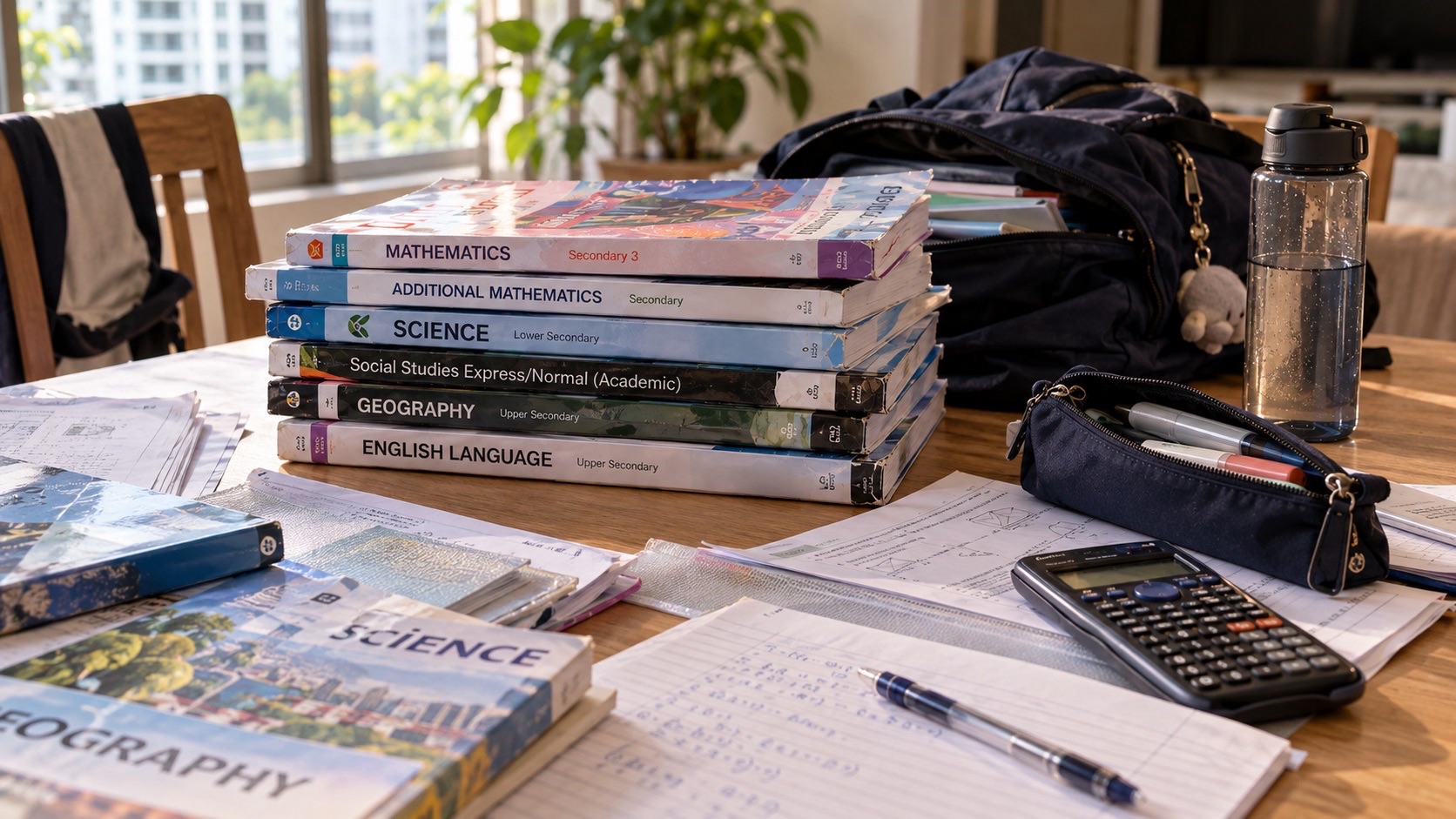
How heavy should a Punggol primary-school child’s bag be, and what can parents do when it feels uncomfortable? Singapore HealthHub and MOE-school guidance use a practical planning range of around 10%–15% of a child’s body weight, while emphasising good fit and smart packing. Use both shoulder straps on a suitable backpack, keep heavier books close to the back, pack only the next day’s necessary items and follow the actual school’s locker or textbook arrangements. If the child reports persistent back, shoulder or neck pain, numbness or visible asymmetry, get appropriate medical assessment rather than assuming a more expensive bag will solve it.
This Schoolbag and Back Comfort in Punggol 2026 guide is for Primary 1–6 and secondary students travelling between home, school, LRT or bus stops, CCAs and tuition. It explains the 10–15% guideline, actual weight examples, bag features, how to pack heavy books, school-run logistics, desk height, movement breaks and when symptoms require professional help. The existing Packing Is Planning in Punggol guide owns organisational independence; this article focuses specifically on physical comfort and health.
Schoolbag comfort: the quick family decision table
| Question | Useful starting point | Important limitation |
|---|---|---|
| How heavy? | Use 10%–15% of the child’s body weight as a commonly cited guide. | It is not a diagnostic or universally safe load for every child. |
| Which straps? | A suitable backpack normally distributes the load across both shoulders. | Fit and actual contents matter as much as style. |
| Where should heavy books go? | Pack close to the back and secure them so the load doesn’t move excessively. | Check the school’s textbook and locker policy. |
| Does an expensive ergonomic bag solve everything? | No. Size, own weight, fit and packing can matter more than branding. | A heavy premium bag may increase the total load. |
| What about PE and CCA? | Pack according to the actual timetable; separate suitable gear when necessary. | Avoid carrying equipment needlessly every day. |
| Do lockers help? | They may reduce carrying when available and permitted. | Not every Punggol school or class has the same arrangement. |
| What about study desks? | Recheck desk and chair fit as children grow; breaks matter. | No single posture can be held comfortably forever. |
| Is slouching proof of scoliosis? | No. Backpacks have not been shown to cause scoliosis. | Persistent pain or visible concerns deserve assessment. |
| What if pain persists? | Seek appropriate healthcare advice and share actual symptoms. | Do not simply force the child to carry more. |
1. The difference between a bag’s weight and the body carrying it
A schoolbag load can be reasonable for one student but uncomfortable for another. Age and body weight provide some context, but size, strength, health, route and bag design also matter. A small Primary 1 pupil may be carrying textbooks, a water bottle, lunch, a PE kit and stationery. A Secondary 2 student might carry fewer books but have heavier project or CCA equipment on particular days. The right decision begins with the actual next-day load.
HealthHub’s Sit Up Straight, Darling cites around 10%–15% of body weight as a guide for schoolbag loading, alongside two-shoulder distribution, padded straps, a suitable back panel and weight kept close. MOE’s Qihua Primary School bag-care advice, updated August 2026, likewise uses the 10%–15% range and describes practical packing changes. These are helpful general guidelines, not mathematical thresholds that guarantee no injury.
Do not tell a child that a bag just under 15% is automatically safe if it causes pain, imbalance or difficulty moving. Equally, a momentary load above the range does not prove a medical disorder. Treat the guideline as an observation prompt: what is in the bag, what can stay at school, how long must the child carry it and how does the child feel?
Some young people have disabilities, previous back problems or other conditions requiring more specific advice. A family should follow clinicians, physiotherapists and school arrangements relevant to the student. A general website cannot select an individual bag weight, diagnose spinal curvature or prescribe corrective exercises.
2. What 10%–15% means in ordinary kilograms
| Illustrative child weight | 10% of body weight | 15% of body weight | How to use the calculation |
|---|---|---|---|
| 20 kg | 2.0 kg | 3.0 kg | A planning reference, not an automatic pass/fail test. |
| 25 kg | 2.5 kg | 3.75 kg | Include the bag itself, books, water and lunch. |
| 30 kg | 3.0 kg | 4.5 kg | Notice how loads change on PE or CCA days. |
| 35 kg | 3.5 kg | 5.25 kg | Recheck fit, comfort and carrying duration. |
| 40 kg | 4.0 kg | 6.0 kg | Consider the school route and individual capability. |
| 50 kg | 5.0 kg | 7.5 kg | Do not assume the full upper figure is needed or comfortable. |
The computation is straightforward: multiply body mass by 0.10 and 0.15 to obtain the reference band. For a 30 kg child, that is 3.0 kg to 4.5 kg. But the calculation is not a prescription to fill the bag to the upper number. The best load is the necessary, suitable load for the school day, with appropriate fit. A child carrying an unnecessarily heavy bag gains no academic benefit simply because it remains below the reference limit.
Include the bag’s own weight. A rigid multi-compartment bag can be heavy before a single textbook is inserted. A water bottle filled with water adds weight; stationery, a lunch box and sports shoes do too. An impressive “ergonomic” label is not evidence that the entire packed bag is light. Weigh the bag in its real morning condition rather than measuring the empty product alone.
The mathematics can become a small family learning moment: invite an older primary pupil to add the weight of the actual items, identify the largest contributors and ask which are essential for tomorrow. Do not turn the exercise into body-weight criticism or a comparison between classmates. The objective is practical planning, not judging the child.
3. Bag features that matter more than a premium name
| Feature | Why it can help | What to avoid |
|---|---|---|
| Correct size | Keeps the bag proportionate to the child’s torso. | Buying an oversized bag only for future use. |
| Two adjustable straps | Shares load across shoulders when properly worn. | One-shoulder carrying out of habit. |
| Padded shoulder contact | Can improve comfort where load rests. | Assuming padding compensates for needless weight. |
| Close-fitting back panel | Helps keep mass close rather than dangling. | A bag swinging low and far from the body. |
| Secure compartments | Reduces excessive movement of heavy items. | Loose heavy books pulling outwards. |
| Optional waist support | May help distribute certain loads appropriately. | Treating every accessory as compulsory for every child. |
| Manageable fasteners | Lets the child use the bag independently. | Complex straps the child cannot adjust or close. |
| Reasonable empty weight | Leaves more room for essential contents. | A heavy shell purchased for marketing appearance. |
SingHealth’s schoolbag ergonomics article explains that parents should examine real design elements before paying a premium for a product marketed as ‘ergonomic’. Adding features may also increase a bag’s own weight. The article discusses two-strap versus one-strap designs and the need for a size matched to the child. This helps readers avoid confusing price with a health guarantee.
It is easy to think the most expensive bag automatically offers the safest posture. Yet a child can wear a good bag badly or pack it with unnecessary items. A practical check is whether the student can lift, put on, adjust and remove the bag without awkward twisting or discomfort. If the fastening is cumbersome, a child may simply sling one strap across a shoulder in a rush and defeat the design’s intended balance.
4. How to pack for stability: the heavy books belong near the back
MOE school guidance recommends placing larger, heavier objects close to the body inside the backpack and securing them so they do not shift. This can reduce the feeling of the load pulling away from the student’s back. Keep notebooks, pencil case and lighter items in other suitable spaces. There is no need for a laboratory-perfect arrangement; the point is that the child should understand why placement matters.
A typical Punggol Primary 5 example includes Mathematics and Science texts, an English workbook, a water bottle and a PE kit. The family checks tomorrow’s lessons first. If the teacher has not requested every book, the child need not carry them. Any school locker or classroom storage arrangement may help, but follow the actual school’s instructions rather than leaving items unattended in an unauthorised place.
The existing Packing Is Planning guide addresses cognitive preparation: turning tomorrow’s timetable into today’s checklist. That idea becomes a physical-health tool here. Reducing unnecessary weight is easier when the child knows what tomorrow actually requires.
A water bottle is a good example of a genuine need that adds mass. Do not respond by telling children to avoid drinking or carry too little water, especially in Singapore’s heat. Instead, consider appropriate available drinking-water arrangements, bottle size, school rules and the total backpack plan. Health and hydration should not be sacrificed to achieve a bag-weight number.
5. The twice-weekly ‘what is still in the bag?’ audit
- Take out yesterday’s worksheets and unnecessary loose papers.
- Remove books not needed for tomorrow’s confirmed timetable.
- Check whether a project or CCA requires special equipment on a particular day.
- Place heavier required items closest to the back.
- Use both adjustable shoulder straps appropriately.
- Check that the bag does not hang excessively low.
- Make sure shoes or a water bottle are secured and not swinging awkwardly.
- Confirm lunch or essential medicine is present when needed.
- Review school locker and borrowing rules before leaving anything at school.
- Let the child explain the packing choice, rather than having adults silently do it all.
- Recheck the child can lift and remove the bag comfortably.
- Notice recurring pressure marks, shoulder discomfort or other symptoms.
A family may make the check on Sunday and midweek, or adapt it to the school’s schedule. A child should gradually learn independence: a Primary 1 child may need a parent beside them, while a Secondary 3 student can take responsibility for organising and assessing their own school supplies. The process becomes a habit when it takes a few useful minutes rather than an emotional argument each morning.
If a child has special learning needs or forgets items frequently, use a visual checklist, labelled compartments or suitable assistance rather than merely scolding. The object is a dependable school-day system. An overpacked bag may be the symptom of a planning problem, not a child trying to make life difficult.
6. Two straps, a comfortable height and careful lifting
HealthHub advises using appropriately fitted backpacks with both shoulder straps and a suitable back panel. MOE’s Qihua Primary guidance emphasises adjusting straps so the bag rests appropriately near the pelvis and keeping hands free enough to hold handrails. These recommendations are intended to reduce awkward carriage; no online paragraph can demonstrate the best adjustment for every child’s body or bag.
Children sometimes twist sharply to pick up a heavy bag or wear it on one shoulder while reaching for a phone. Help them develop a calm routine: place the bag in a suitable position, handle it without sudden strain and secure both straps before moving away. A child already complaining of pain may need professional review rather than more instructions to ‘stand straight’.
A backpack carried appropriately should not obscure the child’s ability to see steps or other users. At crowded LRT entrances and school gates, the student also needs awareness of the bag’s bulk so it does not strike another child. A slim well-packed load makes these situations easier; a large rigid bag can be cumbersome even when the number on the scale is moderate.
7. Punggol school runs: the journey changes what a load feels like
A student whose school is within a short supervised walk may carry the bag for only a few minutes. Another travels by bus or LRT, crosses several pedestrian routes, climbs station stairs and then goes directly to tuition. The latter may spend much more time carrying the same load. Parents should consider total travel duration, available seating, weather and the child’s energy rather than rely only on one bag-weight number.
Punggol’s neighbourhood geography matters. A family near Oasis Terraces has different school and transit connections from someone in Northshore or Matilda. A child attending after-school CCA may carry sports equipment that is unnecessary on other days. A practical approach is to review the real sequence of destinations and ask where authorised storage, collection or other arrangements could reduce avoidable carrying.
The Walking for Everyday Errands and Punggol Evening Return Home After CCA guides address route and household transitions. This article focuses on the bag. A safer arrangement might mean fewer unnecessary books, a suitable stop at home before another activity or an agreed parent collection—not automatically replacing school transport or expecting everyone to walk farther.
8. PE and CCA days are a special load-management problem
Sports shoes, uniform changes, water, a musical instrument or project materials can turn one day into an unusually heavy one. The student should use the timetable to identify such days and avoid carrying the equipment on every other day. Some items may need a different suitable carrying arrangement or authorised school storage. The appropriate option depends on the school, activity and equipment; do not improvise unsafe transport of heavy or fragile instruments.
Parents sometimes respond to one heavy CCA day by buying an even larger backpack. That may make daily overpacking easier rather than solve the root problem. First ask which items truly need to travel together, whether the school provides storage and whether the family can adjust pickup or schedules. If the school requires a particular item, discuss legitimate practical solutions with the teacher rather than telling the student simply not to bring it.
For children with disabilities, medical devices or unusually heavy required equipment, a generic 10–15% recommendation may not describe the real situation. Work with relevant school personnel and healthcare professionals about appropriate assistance. The principle is safe access to learning, not excluding children because their equipment makes the number higher.
9. Desks, chairs and growing bodies: the bag is only one contributor
A student may have a manageable bag but still complain of back or neck discomfort after sitting for hours. HealthHub’s posture guidance emphasises desk height and the relationship between chair, arms, screen and head position. The desk that suited a Primary 2 child may feel awkward when the child reaches Secondary 1. Check the actual setup instead of assuming that one furniture purchase should last comfortably through all stages of growth.
The desk surface should permit a reasonable writing position, and the chair should support comfortable sitting with a chance to change position. A student should not be forced to hold a rigid ‘perfect posture’ indefinitely. Regular movement breaks can help interrupt prolonged sitting. The companion Movement Microbreaks in Punggol page deals with how to make these breaks useful without turning homework into an all-day workout.
A laptop screen positioned very low can encourage looking down for long periods, particularly during online assignments. Yet lifting the screen without considering keyboard and arm position can create a different discomfort. Students and working adults may benefit from suitable ergonomic adjustments and professional advice when symptoms persist. The Working From Home in Punggol guide covers adult workstations separately.
10. An important myth: a heavy backpack does not automatically mean scoliosis
The American Academy of Pediatrics’ backpack safety guidance states that backpacks have not been shown to cause scoliosis or other long-term spinal disorders, even though poorly worn heavy bags may contribute to back, shoulder or neck discomfort. This distinction matters because a family may become frightened after hearing that a child sometimes slouches. Not every posture complaint signals a structural spine problem.
That is not a reason to ignore symptoms. Visible differences in shoulders, significant asymmetry, persistent pain, numbness or progressive functional difficulty deserve suitable clinical assessment. HealthHub discusses postural problems and stresses the importance of identifying concerns early. An article cannot distinguish a temporary posture habit from a medical condition merely by looking at a backpack photograph.
Avoid diagnosing scoliosis by asking a child to lean forward at home and making a final judgement from a casual observation. A healthcare professional can determine whether assessment or referral is appropriate. The role of a parent is to listen to the child, reduce avoidable burdens and get proper help if signs persist.
11. Two scenarios: a lighter bag can still be uncomfortable
Scenario A: a bag just inside the percentage guideline
A child weighing 30 kg carries a 4.2 kg bag, which is 14% of body weight. That falls within the commonly discussed 10–15% reference range, but the straps are loose, the bottom swings low and a large bottle hangs to one side. The child complains of discomfort. The response is not to say ‘14% means you are fine’. The parent reviews fit, placement, travel duration and actual symptoms. The bag may become more comfortable through sensible changes, or a clinical review may be needed if pain continues.
Scenario B: a lighter bag but a much longer commute
Another pupil carries 3.0 kg but spends a long time walking, waiting and changing between transport modes before tuition. The bag is lighter on a scale but the day is physically tiring. The family adjusts the timetable, explores legitimate storage or collection options and ensures food, rest and hydration fit the day. A child’s comfort is about the entire journey and daily load, not just one morning measurement.
12. A simple formula for parents: remove before replacing
When a schoolbag causes concern, use a sequence of questions. First, is everything in it required tomorrow? Second, is the load positioned and secured well? Third, does the bag fit and is it carried appropriately? Fourth, how long must the child carry it and what symptoms occur? Only then consider whether a different bag would genuinely improve fit or comfort. This avoids a common consumer error: purchasing a costly product before checking the simplest causes.
For a busy Punggol family, a five-minute timetable and packing conversation is usually more sustainable than a long search for the “best ergonomic schoolbag”. A bag may be well designed yet still carry three unnecessary books. The child should participate in the decisions so that the improvements continue on mornings when the parent is not there to pack it.
13. A four-week schoolbag comfort experiment
| Week | What to examine | One simple change | How to evaluate |
|---|---|---|---|
| 1 | Packed load and discomfort | Weigh the actual morning bag and identify unnecessary contents. | Understand the baseline without blame. |
| 2 | Fit and two-strap carrying | Adjust an appropriate backpack and secure heavier items near the back. | Ask the child about comfort. |
| 3 | School and CCA timetable | Remove daily items that belong only on specified days. | Reduce avoidable routine weight. |
| 4 | Desk and journey | Review home study ergonomics and actual travel fatigue. | Decide if another adjustment or professional help is needed. |
The table is a family organisation example, not a programme for treating back pain. If the child has concerning symptoms, do not wait until week four to seek an assessment. A pupil with medical or disability-related needs should use individual professional guidance from the start. Successful routines protect learning without treating the body as an experiment in endurance.
14. Four worked Punggol student stories
A Primary 1 pupil starting school for the first time
The child wants a colourful bag with many compartments, and the parent wants it to last for years. They try the empty bag and discover that the larger version hangs awkwardly. Instead of buying the biggest one, they choose a manageable fit, practise using the straps and involve the child in a simple next-day checklist. They confirm the actual school’s booklist and supplies rather than pack every item all week.
A Primary 6 pupil carrying revision books
The student is preparing for examinations and adds several optional practice books to the bag each morning ‘just in case’. The parent and student review the daily timetable and decide which materials belong at home, which are needed in school and what can legitimately be stored. The student still gets the practice required, but the entire library no longer travels on every school run. The change is about planning, not reduced academic ambition.
A Secondary 2 pupil with a physically demanding CCA
A teenager attends school, CCA and then tuition. One day requires sports shoes and extra clothing. The family identifies that special day, chooses a manageable carrying arrangement and reviews whether a stop at home or authorised storage is feasible. They also protect dinner and recovery. The pupil is encouraged to say when discomfort or fatigue becomes significant rather than compete with teammates over who carries the most.
A child with ongoing neck or back symptoms
The parents discover that the bag fits poorly, but the child continues reporting pain even after unnecessary books are removed. The family avoids assuming that one posture correction must cure the issue. They seek healthcare assessment, share the symptom pattern and coordinate school arrangements where appropriate. Honest symptom management is a stronger outcome than forcing the child to ‘sit straight’ in silence.
15. Does the backpack have to be replaced?
Not necessarily. A well-fitting current bag with adjustable straps may be fine once the load is organised. If straps are broken, the size is unsuitable, the bag is too heavy before packing or the student cannot carry it comfortably, a replacement may make sense. The new product should be assessed for actual fit and empty weight, not simply its marketing vocabulary. More features can add weight and cost.
Parents also have real budgets. Uniforms, textbooks, transport, stationery and PE kit all require spending, and not every family can buy a premium backpack. MOE and individual schools provide financial-assistance and school supply arrangements where eligible. A school should be asked about practical solutions before parents assume the only answer is an expensive shopping trip.
The Punggol Back-to-School Shopping guide addresses buying and budgeting, while this page addresses comfort after a bag has been selected. No child should feel that having a branded bag is evidence of being a better student or having superior health.
16. Common schoolbag mistakes
- Buying an oversized bag to last many years. Size must match the child now.
- Using only one strap on a heavy pack. Distribute appropriately when using a backpack.
- Keeping every textbook inside all week. Pack against the actual timetable.
- Putting the heaviest item farthest from the back. Secure it closer when appropriate.
- Forgetting the bag’s own weight. Count the entire loaded bag.
- Turning the 15% reference into a medical guarantee. Listen to discomfort and symptoms.
- Assuming every Punggol school offers identical lockers. Confirm local rules.
- Making the child rush and twist to lift the bag. Allow a calmer handling routine.
- Replacing equipment without checking fit. Test a simple adjustment first.
- Assuming a heavy bag causes scoliosis. Distinguish discomfort from diagnosed conditions.
- Ignoring desk and screen habits. Review the entire school-and-home day.
- Delaying assessment when pain, numbness or changes persist. Seek appropriate help.
17. A schoolbag and back-comfort checklist
- Weigh the loaded bag occasionally without making body weight a comparison tool.
- Use the 10–15% reference as a guide, not an automatic target.
- Check whether the child finds the bag comfortable and manageable.
- Follow the school’s actual daily timetable and locker rules.
- Keep necessary heavy items appropriately secured near the back.
- Use both straps when a suitable backpack is designed for them.
- Adjust strap length to the child’s current size and bag design.
- Keep stair and crossing awareness in mind on Punggol routes.
- Do not remove essential water, food or health items merely to meet a number.
- Recheck PE, CCA and tuition materials on their relevant days.
- Review chair, desk and screen comfort as the child grows.
- Allow appropriate breaks from prolonged sitting.
- Seek clinical help for persistent or concerning back, neck or shoulder symptoms.
- Involve the student in decisions so the routine becomes independent.
18. Frequently asked questions
How heavy should a child’s schoolbag be?
HealthHub and MOE-school guidance use approximately 10–15% of body weight as a planning reference, subject to comfort and individual needs.
What is 15% of a 30 kg child’s weight?
4.5 kg, but that is a guideline calculation, not a goal to fill the bag.
Do you count the empty bag?
Yes. Include the bag itself, books, water, food and other items.
Should children use both shoulder straps?
For a suitable backpack, two correctly adjusted straps generally help distribute load.
Is an ergonomic branded bag always better?
No. Actual fit, design, empty weight and packing matter; marketing claims are not a medical guarantee.
Where should heavy books go?
Generally near the back, secured rather than swinging far outwards.
Can my Punggol child use school lockers?
It depends on the actual school and class arrangement; verify with staff.
Should a child take every textbook every day?
Only what is needed under the school’s instructions and actual timetable.
What about PE shoes and CCA gear?
Plan special items for relevant days and discuss legitimate storage where appropriate.
Can a heavy bag cause scoliosis?
Backpacks have not been shown to cause scoliosis, though heavy or poorly worn bags can cause discomfort.
Should I make a child stand perfectly straight all day?
No. Comfort, suitable ergonomics and regular movement matter; persistent concerns warrant professional advice.
What if a child says the shoulders hurt?
Review load and fit and seek appropriate healthcare evaluation if pain persists or is concerning.
Is the same bag suitable from Primary 1 to Secondary 4?
Not necessarily. A child’s size and requirements change with growth and school level.
What if a school requires a heavy project?
Discuss approved carrying and storage arrangements with the school rather than using unsafe shortcuts.
What if the bag is under 15% but still uncomfortable?
The guideline is not a guarantee. Review fit, journey, symptoms and individual needs.
Do online lessons affect back comfort?
Desk, chair and device positioning can matter, alongside prolonged sitting and movement breaks.
Is an expensive new bag the best first solution?
Usually first check necessity, packing and actual fit; replace when a real problem warrants it.
How can my child take ownership?
Use a simple timetable-based checklist and let the child explain what is needed tomorrow.
Who should assess ongoing back pain?
An appropriate healthcare professional; do not diagnose a spine condition from a photo or web article.
Connected eduKate Punggol education and lifestyle articles
- Life in Punggol — Master Guide
- Packing Is Planning — School Bags and Checklists
- Punggol Back-to-School Shopping
- After-School Returns, CCA, Tuition and Sleep
- Healthy Teenage Life in Punggol
- Working From Home in Punggol
- Foot Care for Punggol Walkers
- Safe Listening for Punggol Students and Commuters
- Movement Microbreaks in Punggol
- eduKateSG — Our Approach to Learning
- Clementi Mathematics — First-Principles Teaching
Official and professional sources
- HealthHub — Schoolbag Load, Straps and Study Posture
- MOE School — School Bag and Back Care Advice, August 2026
- SingHealth — Ergonomic School Bags and Their Value
- HealthHub — Scoliosis and Healthy Back Behaviour
- American Academy of Pediatrics — Backpack Safety and Scoliosis
- HealthHub — Parenting and Healthy Habits
- HealthHub — Movement During the Day
Reviewed 21 October 2026. General education and ergonomic planning information, not a diagnosis of scoliosis or a personalised lifting or rehabilitation prescription. The 10–15% bag-weight reference is not a universal safety guarantee; current school requirements and individual clinical advice take precedence. Examples and calculations are illustrative.


