
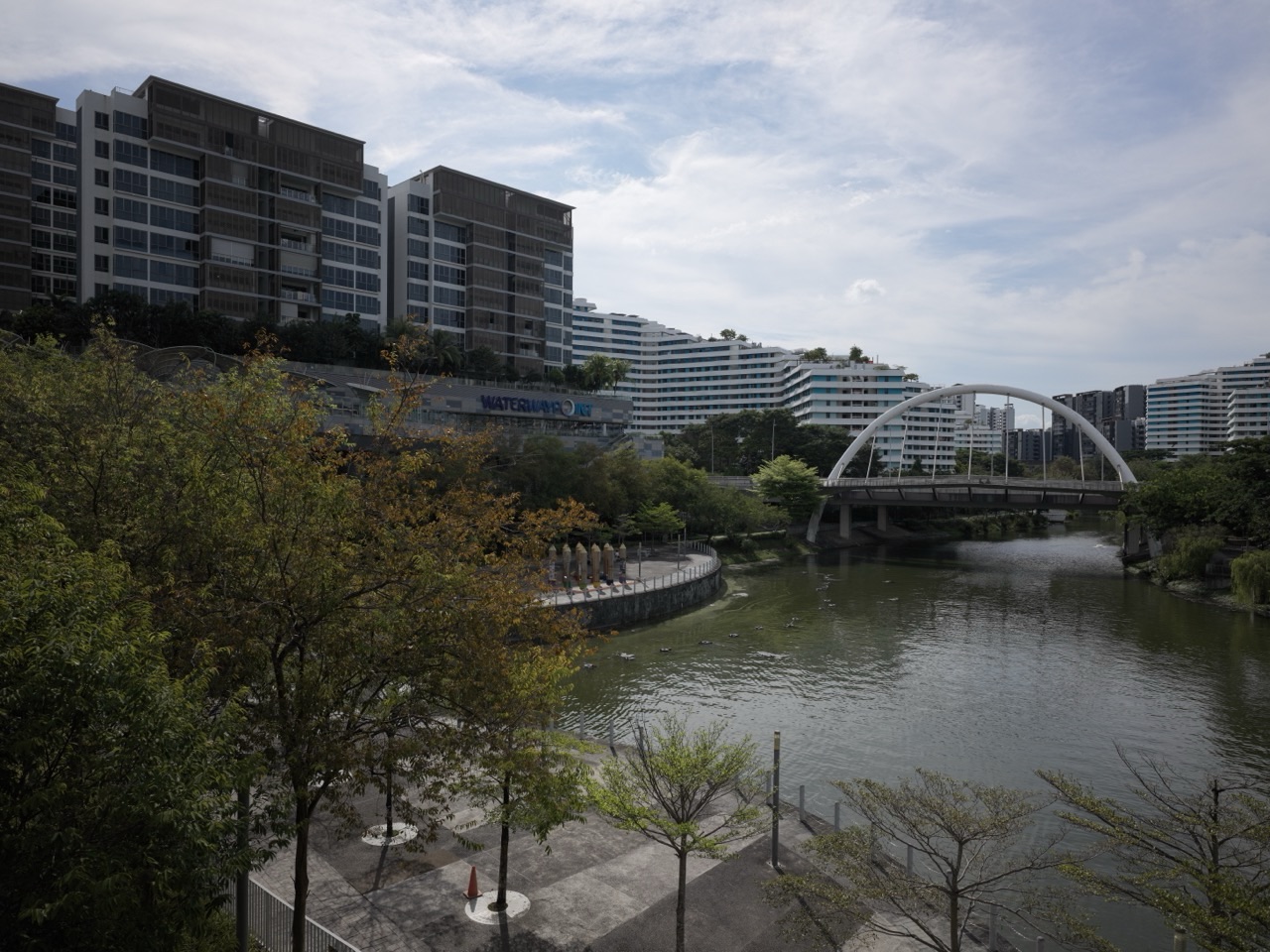
Where can beginners try urban sketching in Punggol? Start from a safe, permitted seat or wide public stopping point beside Punggol Waterway Park, near One Punggol, or within a publicly accessible part of Punggol Digital District. Bring an A5 notebook and an ordinary pencil. Draw one bridge, railing pattern, tree or building outline for just 10–15 minutes. You do not need to draw the whole landscape or learn perfect perspective before you begin. If the weather or air quality is unsuitable, work from a photograph you already have, from a window or from a memory sketch indoors.
Things to draw in Punggol include curved bridges, water reflections, the contrast between trees and HDB blocks, sheltered pedestrian links, public art and the new structures around Punggol Coast. Unlike a guide that merely identifies attractive buildings or a photo-spots directory, this article is an activity: it shows how to select a subject, break it into simple shapes, compare proportions, add a few textures and write one small observation about the place. It works for adults who have never drawn before, families with school-age children and friends looking for an inexpensive creative afternoon.
Important 17–18 October 2026 note: NEA’s 17 October advisory forecasts unhealthy to very unhealthy PSI on 18 October and recommends limits on outdoor exertion, with stricter advice for more vulnerable groups. Sketching does not require strenuous movement, but sitting outdoors still involves exposure. Use current 1-hour PM2.5 for immediate decisions, follow NEA/MOH health advice and choose an indoor session when appropriate. Never enter a closed park, construction compound or private building to find a supposedly better drawing position.
Punggol urban sketching: choose a first subject
| Subject | Good starting idea | Simple drawing technique | Important boundary |
|---|---|---|---|
| Waterway bridge | Look at an open public viewpoint | One large curve plus supporting lines | Do not stop in cycle lanes |
| Tree near a path | Draw the canopy and trunk silhouette | Two or three large shapes first | Do not pull branches or enter plant beds |
| HDB block or public building exterior | Observe visible roof and facade lines | Boxes and repeated windows | Respect entrances and residents |
| One Punggol’s public-facing architecture | Choose a permitted open space | Large outlines before details | Library interior rules differ |
| Northshore community spine | Use a confirmed public path | Repetition and sheltered links | Avoid closed promenade sections |
| Punggol Digital District | Draw a visible completed public building | Simple vertical/horizontal relationships | No worksite or restricted campus entry |
| Public mural | Sketch a small original response | One motif rather than the whole work | Attribute the original artists |
Urban sketching is about noticing before drawing skill
The first drawing does not have to resemble a photograph
People who are beginning to sketch often become frustrated because a bridge is not perfectly symmetrical or the building appears too short. A sketch is a record of attention. It may capture the main shape, one interesting detail and the experience of being in the place without providing a mechanically accurate illustration.
Try starting with a thirty-second outline made from three major shapes. Add one or two details after the main proportions are visible. If the drawing goes wrong, continue or start another small sketch; you have lost nothing but a few minutes.
Choose a subject that stays still
A person moving through the Waterway, a bird in flight or a cyclist crossing a bridge makes a challenging first subject. A tree trunk, public railing, building corner or broad bridge curve is easier because you can look at it repeatedly. Once you are comfortable, you may add short gesture sketches of moving elements without needing to draw identifiable strangers.
Avoid photographing or following another person without their consent for reference. An unoccupied bench or public streetscape can tell an equally interesting story about Punggol life.
Big shapes make complicated buildings manageable
When a new student draws a building, they may start with individual windows and discover that the roof no longer fits on the page. Begin by placing the whole building as a box, triangle, cylinder or combination of simple shapes. Then add the roofline, primary divisions and finally a few repeated details.
This is a creative approximation, not an architectural survey. Do not label drawings with precise engineering dimensions unless they have been measured by a suitable reliable method.
A useful sketch is selective
Punggol has many visually rich settings: water, trees, paths, bridges, homes and signage can occupy the same view. Trying to record every element makes a ten-minute drawing overwhelming. Pick the feature that brought you to the scene and simplify everything else.
If you want the bridge to be the focus, make its main curve the clearest line. If the tree matters most, simplify the apartment block behind it. Drawing selectively helps the viewer know where to look.
You can draw water without copying every reflection
Waterway reflections change with light, movement and wind. A beginner does not need hundreds of careful wavy lines to show water. Use a few broken horizontal marks or broad shapes to suggest the surface, keeping any direct observation separate from memory or artistic invention.
Stay behind railings and away from slippery edges. Do not move closer to the canal merely to draw a better reflection. The site has a Waterway reflections photography article if you want visual reference ideas.
One page can record how a place feels without making claims
A sketchbook can hold words as well as lines: ‘bright shade beneath a tree’, ‘busy transport junction’ or ‘quiet enough to notice leaves moving’. These are personal observations at a particular time, not official facts about the whole location. A building that feels quiet on a weekday may be crowded on a weekend.
Add the date and a general location name, and be honest about what is observed. If you make a later sketch from a photograph rather than on site, label it accordingly.
Sketching with children should not become a lesson in perfection
A child may draw the Waterway as a blue line and the bridge as a giant rainbow. That can still be an enjoyable creative interpretation. For a family outing, one question—’Which shape caught your eye?’—is often better than constant correction of perspective or proportion.
Let children choose colours and duration. If the family wants formal instruction, it can book a suitable class elsewhere, but a simple public sketch does not have to meet examination standards.
Site access comes before the perfect view
A dramatic vantage point is not worth crossing fencing, walking into university buildings, entering a resident-only facility or setting up in a narrow shared path. Punggol Point Park has been under upgrading closure, and parts of the Punggol Heritage Trail are phased. Draw from completed publicly accessible areas instead.
Keep the group compact and leave space for cyclists, pedestrians, wheelchairs and strollers. For commercial workshops or large sketching groups, check whether the venue has relevant rules or permission requirements.
Light and air quality are part of the plan
A bridge may look different at noon, during golden hour or under haze. This is valuable visually, but it is not a reason to ignore current NEA health recommendations. Outdoor sketching can be postponed easily because the subject will often still be there another day, even if the light changes.
For a haze-affected October day, use a previous photo, a sketch from memory or a printed authorised reference. The goal is practising observation, not spending extra time outdoors to complete a calendar.
Public art is an opportunity for response, not unattributed copying
Punggol Digital District’s Our Punggol Story mural has named artists and a documented creative history. Visitors may be inspired to draw a small motif or make a personal visual response, but they should not take credit for the original composition or reproduce large portions commercially without considering rights and permissions.
In a sketchbook, credit the work, note what interested you and create your own response. The public-art and creative-walk guide explains the original work and a responsible viewing approach.
A ten-minute drawing method that works almost anywhere
Minute 1: choose a single subject
Look at the full scene and name one focus: the bridge, a tree, a public building or a railing. Put your sketchbook on a stable surface and identify a safe, comfortable place to remain.
Don’t start by copying every object. Decide what you want the viewer to notice.
Minutes 2–3: outline the largest shape
With a light pencil mark, draw the big curve, rectangle or silhouette. Compare width and height without judging precision. Place the shape roughly in the centre or slightly off centre according to preference.
Make the first marks small and light enough to adjust. You are placing relationships, not final technical lines.
Minutes 4–5: add two structural lines
For a bridge, add support or rail lines; for a tree, add trunk and main branches; for a building, add roofline and one floor division. The drawing begins to look recognisable when the largest relationships are correct.
Do not add thirty windows before the entire building fits on the page.
Minutes 6–7: include a foreground or surrounding object
Draw a path edge, planted bank or simple tree shape to show where the main subject sits. You can simplify a background block to a rectangle or leave it out.
Do not stand in a roadway or cycle path for a better composition.
Minutes 8–9: choose one texture
Use a few short marks to suggest water ripples, leaves, brickwork or shade. Repetition helps a sketch feel coherent without every detail being present.
Avoid touching surfaces or picking up natural materials to imitate them.
Minute 10: add date, place and one honest sentence
Write a short note such as ‘public view near central Punggol Waterway, afternoon’ and one thing you noticed. If the sketch was made indoors from a photo, say so.
A sketchbook entry need not be published. Keeping a private personal record can be the finished activity.
Five Punggol sketching settings and how to use them
Central Waterway: bridges, railings, trees and water
Punggol Waterway Park is a 24-hour NParks public park with multiple themed areas, but you need only one convenient accessible part. A place near Punggol MRT can offer recognisable lines and natural framing. Try drawing a bridge as a single arc, then adding a few vertical rail lines and a basic water edge.
NParks path etiquette applies, including shared-use priority. Avoid blocking narrow crossings, and remember that ‘open 24 hours’ does not make every viewpoint safe at every hour. Pick a known route and suitable weather.
One Punggol exterior: architecture and community
The One Punggol hub can be an interesting drawing subject because its public-facing form hints at the mix of library, food and community facilities inside. A simple building-outline sketch can focus on lines and repeated shapes rather than drawing individual people.
Do not infer that ordinary library interior areas are suitable for a large group drawing class. Use permitted public spaces and ask before organising any event requiring space or equipment.
Oasis Terraces: plants meet architecture
Oasis Terraces is a neighbourhood centre by Oasis LRT with designed greenery and public retail areas. The layered forms and planted terraces make good subjects for observing how human structures and plants sit together. Draw one edge of the building and one visible group of plants, not the entire complex.
Some garden and play areas have maintenance or access rules. Healthcare spaces in the complex are not leisure destinations, and sketches should respect the privacy of staff and visitors.
Northshore and Samudera: shaded links and seafront design
Northshore Plaza’s community-spine setting offers repeated sheltered forms and landscaped urban space. A small drawing can compare the thickness of tree foliage with the straight building lines, capturing the feeling of a newer HDB neighbourhood.
Check the actual open path. Punggol Point Park remains affected by upgrading, so don’t follow old waterfront routes into works areas. Strong seafront wind, rain or heat may make a sketch uncomfortable.
Punggol Digital District: new buildings and heritage landscape
The public-facing part of the Digital District around Punggol Coast brings modern building forms, public art and the first open stretch of the heritage landscape. Try an elevation sketch with one strong rectangular form and a nearby tree or public-space line.
The longer planned Heritage Trail is phased and campus/workplace interiors have their own access. Draw from signed open public ground only. The architecture lovers’ guide owns the wider public destinations.
Twenty small urban sketching prompts for a Punggol notebook
1. Bridge arch
Try: Draw one large curve before adding supporting lines. Keep it appropriate: Focus on relationship rather than exact engineering dimensions. Every prompt can stand alone as a five- to fifteen-minute activity.
2. Waterway railing
Try: Use several repeated vertical lines to show pattern. Keep it appropriate: Do not sit in or block a busy narrow bridge. Every prompt can stand alone as a five- to fifteen-minute activity.
3. Tree canopy
Try: Use two broad irregular shapes and one trunk. Keep it appropriate: Look from a public path without pulling branches. Every prompt can stand alone as a five- to fifteen-minute activity.
4. Distant housing block
Try: Draw one rectangle and a few floor divisions. Keep it appropriate: Avoid showing private residents’ routines. Every prompt can stand alone as a five- to fifteen-minute activity.
5. Public bench
Try: Observe seat, support and shadow. Keep it appropriate: Do not ask an occupant to move for the sketch. Every prompt can stand alone as a five- to fifteen-minute activity.
6. Park sign
Try: Sketch the outline and one legible symbol. Keep it appropriate: Do not copy sign text inaccurately if it communicates a rule. Every prompt can stand alone as a five- to fifteen-minute activity.
7. Stair-step roofline
Try: Find a sequence of buildings with varied heights. Keep it appropriate: Simplify the skyline without inventing completed buildings. Every prompt can stand alone as a five- to fifteen-minute activity.
8. Shadow pattern
Try: Draw one dark shape beside a lighter one. Keep it appropriate: No need to stay under harmful heat exposure. Every prompt can stand alone as a five- to fifteen-minute activity.
9. Rain-garden edge
Try: Show the relationship between planting and path. Keep it appropriate: Do not enter the planted soil. Every prompt can stand alone as a five- to fifteen-minute activity.
10. Bridge reflection
Try: Make broken horizontal strokes for ripples. Keep it appropriate: Keep a safe distance from water. Every prompt can stand alone as a five- to fifteen-minute activity.
11. LRT track curve
Try: Sketch the shape of an elevated line from a permitted viewpoint. Keep it appropriate: Never enter rail infrastructure or restricted areas. Every prompt can stand alone as a five- to fifteen-minute activity.
12. Civic hub entrance
Try: Draw the large outline and one distinctive doorway. Keep it appropriate: Respect staff, visitors and access restrictions. Every prompt can stand alone as a five- to fifteen-minute activity.
13. Shopping-centre facade
Try: Select a public-facing architectural detail. Keep it appropriate: Individual shop interiors have their own rules. Every prompt can stand alone as a five- to fifteen-minute activity.
14. Long walkway
Try: Draw two lines approaching a vanishing point. Keep it appropriate: Do not stand in the centre of a busy pedestrian route. Every prompt can stand alone as a five- to fifteen-minute activity.
15. Old/new contrast
Try: Place a historic sketch reference beside a modern public view. Keep it appropriate: Label historical sources and dates. Every prompt can stand alone as a five- to fifteen-minute activity.
16. Large leaf close-up
Try: Capture broad shape, midrib and a few veins. Keep it appropriate: Observe without plucking public plants. Every prompt can stand alone as a five- to fifteen-minute activity.
17. Cloud shapes
Try: Draw three large soft forms instead of trying to shade every edge. Keep it appropriate: During lightning or haze, work from indoors. Every prompt can stand alone as a five- to fifteen-minute activity.
18. Mural-inspired shape
Try: Create a personal drawing after viewing a documented artwork. Keep it appropriate: Credit original artists and avoid misleading reproduction. Every prompt can stand alone as a five- to fifteen-minute activity.
19. Everyday errand scene
Try: Draw a public path, bicycle rack or building feature. Keep it appropriate: No need to make identifiable strangers the focus. Every prompt can stand alone as a five- to fifteen-minute activity.
20. Return sketch
Try: Repeat an earlier subject with improved selection of main shapes. Keep it appropriate: Compare your technique without judging yourself harshly. Every prompt can stand alone as a five- to fifteen-minute activity.
Three complete beginner sketching outings
At home: your first bridge drawing
Open a Punggol photograph you own or have permission to use, choose the bridge as the subject and follow the ten-minute method. Draw the main curve, two supports, a path line and one nearby natural feature. Write the date the original photograph was taken if known.
This is the right version during the current haze. The goal is practising shape selection, not suggesting the photo shows today’s air quality or current access.
A 30-minute central Waterway sketch
On a day when conditions suit, travel to a familiar publicly accessible Waterway segment, spend ten minutes observing and ten to fifteen minutes drawing one static feature, then return by a known safe route. Try comparing the sketch with a photograph taken from a similar public position.
The best location is not necessarily the most famous bridge. Choose seating, shade or a convenient turning point where appropriate. Do not block shared pathways and do not overstay outdoors when heat or haze creates risk.
A 60-minute architecture-and-food outing
Begin at a confirmed public part of Punggol Coast, One Punggol or an HDB neighbourhood centre, draw one publicly visible building detail, then finish with a suitable food or indoor rest stop. A friend can sketch a different feature and compare the drawings over a meal.
This plan is useful for social creativity rather than formal art tuition. Food and venue hours vary, and a worksite or private interior is never part of the drawing route without authorisation.
How to extend urban sketching without making it expensive
A notebook and pencil are enough at first. If you enjoy the process, add a pen, a few coloured pencils or a watercolour wash appropriate to the venue’s rules. You do not need to buy every professional marker set. Ask what you actually wish to change—line confidence, basic shapes or colour—and practise that one thing on familiar subjects. Borrowing a book on sketching from Punggol Regional Library can be a sensible next step, subject to current holdings.
For a longer hobby, keep a private monthly sketch diary: the same bridge, a tree through changing light, or one public building that you pass often. Date each drawing and label whether it was made on site or from reference. A growing set of sketches can become a personal history of how you noticed the neighbourhood over time, rather than a claim about how quickly development took place.
Urban sketching also supports everyday language. A child can describe a railing as parallel, a bridge as curved or one building as behind another. An older student can distinguish observed geometry from a stylised drawing. The eduKate ecosystem includes place description and prepositions for language practice, but the outing should remain a voluntary creative activity, not a compulsory extension of school.
Frequently asked questions about sketching in Punggol
Where can I sketch outdoors in Punggol?
A suitable publicly accessible view in Punggol Waterway Park, a neighbourhood public square or an open public part of Punggol Coast can work. Respect site rules and choose safe stopping space.
Do I need drawing experience?
No. The first task is seeing big shapes and placing them on the page. A five- or ten-minute simple sketch counts.
Can children join?
Yes with age-appropriate supervision and an easy subject. Let them choose how to depict what they see rather than insisting on perfect accuracy.
Should I draw the whole bridge?
Not necessarily. One support, an arch or a railing pattern can make a complete study.
What if I cannot draw perspective?
Start with flat silhouettes and simple boxes. Perspective can be developed gradually if you enjoy it; it is not a prerequisite for a fun outing.
Can I use a photo as reference?
Yes when you own it or have permission to use it appropriately. Label the sketch as drawn from a photograph, not from direct on-site observation.
Where can I sketch when haze is bad?
At home from a photograph, memory or a window view. Follow current NEA/MOH advice before planning outdoor activity.
Is Punggol Waterway Park open 24 hours?
NParks lists it as open 24 hours, but safe access and path conditions vary. Daylight and a familiar legal public stopping place are often easier for beginners.
Can I stand on the bridge and sketch?
Only where doing so is safe, permitted and does not obstruct pedestrians or cyclists. On a busy shared path, move to a wider safe space.
Is the Punggol Heritage Trail completely open?
No. Its initial public section has opened, but the planned longer route is phased. Do not cross construction fencing or claim inaccessible sites as sketching stops.
Can I enter SIT buildings to sketch the architecture?
Not merely because they are visible from a public district. Use public paths, and follow any campus or building-specific entry rules.
Can I draw people I see?
You can practise public-scene observation while respecting privacy, venue rules and consent. Avoid intrusive identifiable portraits, especially of children.
Can I sketch the Our Punggol Story mural?
It can inspire a credited personal response, but do not misrepresent the artists’ design as your own or assume all reproduction uses are unrestricted.
Is a digital tablet better than paper?
Both can work. Start with whatever you own; paper and pencil avoid extra cost or battery limitations.
Do I need an easel or chair?
No. A handheld A5 notebook or drawing at a permitted public seat is enough. Avoid placing equipment where other people need to pass.
How long should the first sketch take?
Ten minutes is a useful starter target. Stop earlier or continue longer depending on enjoyment, weather and comfort.
Can sketching improve a child’s Maths?
It can create opportunities to discuss shapes and spatial relationships, but no particular academic outcome is guaranteed. Enjoy the activity first.
What if the drawing is inaccurate?
Use it to notice one proportion or shape differently next time. A sketchbook documents your developing attention; it does not require photographic precision.
Can we make a family group outing?
Yes, if the group is manageable, supervised appropriately and follows shared-space etiquette. A larger organised event may have permission requirements.
Can I bring watercolours into a library?
Check the library’s current facility rules before using paint or messy supplies. Pencil drawing may be easier for a casual indoor visit.
Can I combine sketching with history?
Yes. Compare a documented historical photograph with a current publicly visible view, cite the source and distinguish interpretation from original evidence.
Where can I get more Punggol art ideas?
Use the public art guide and creative things to do in Punggol for wider arts and workshops. This page focuses on beginner drawing practice.
Continue through eduKate’s Punggol lifestyle and learning ecosystem
- Punggol Public Art and Creative Walks — mural and artist context.
- Creative Things to Do in Punggol — maker spaces and courses.
- Four-Weekend Punggol Photo Diary — a visual documentary companion.
- Punggol Family Map-Making Challenge — landmarks and orientation.
- Punggol Waterway Park Guide — park access and bridge features.
- Punggol Architecture and Design Lovers — public buildings and urban design.
- Nature Without Hiking in Punggol — short nature observations.
- Punggol History Lovers’ Guide — documented historical places.
- Punggol Calm Things to Do — low-pressure leisure.
- Punggol Lifestyle Planner — time, weather and budget.
- eduKateSG Place Descriptions and Prepositions — optional language learning.
Official references and current conditions
Reference current public-space conditions with NParks Punggol Waterway Park, JTC Punggol Digital District community amenities, NParks shared park-connector guidance, SLA OneMap, NEA 17 October 2026 haze advisory and MOH haze health advice. This is an independent arts-and-lifestyle activity guide, not a ticketed course or assertion that current outdoor conditions are suitable. Updated 17 October 2026.


