
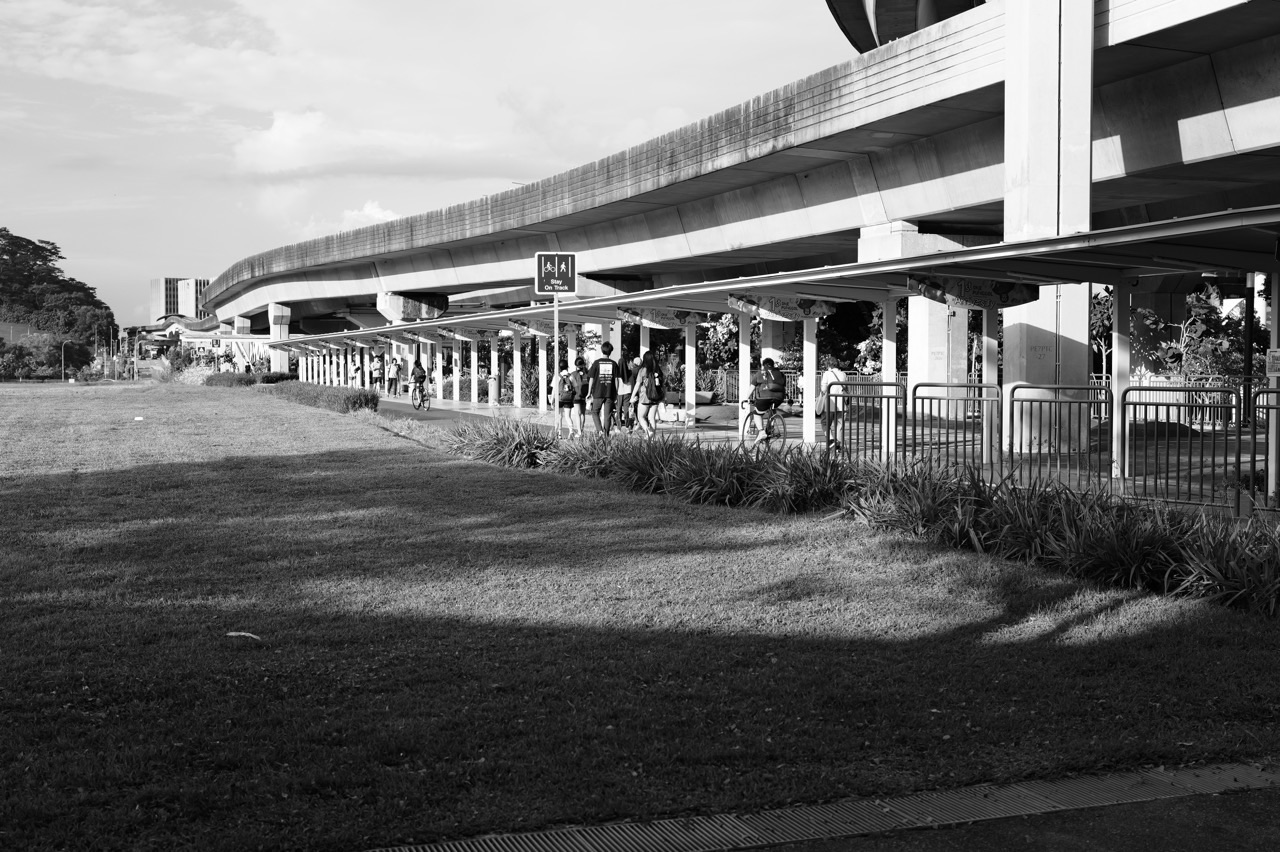
Punggol changes character before 8 AM.
The town that looks spacious beside the Waterway in the evening becomes a finely timed family machine in the morning. Parents are getting children dressed, primary-school pupils are moving toward gates and bus stops, secondary-school students are crossing the town more independently, commuters are feeding into Punggol MRT and Punggol Coast MRT, LRT platforms are filling, childcare drop-offs are beginning and breakfast has to happen somewhere inside all of it.
For people searching living in Punggol, Punggol schools, Punggol MRT, Punggol LRT, school runs in Punggol or even Punggol tuition, this weekday rhythm explains something a directory cannot. A family does not experience a town as a list of amenities. It experiences it as a sequence of journeys that must fit together without exhausting the child before school has properly begun.
This article is therefore not another transport guide, school directory or ranking. Those jobs already have their own owners on eduKatePunggol. This is the human layer: what happens when the clocks begin to matter.
Start with the Complete Punggol Guide if you need the town-wide directory, or use Getting to Punggol Schools for a route-focused school travel guide.
The morning is a logistics problem before it is an education problem
Parents often describe a difficult morning as a problem with a child: slow to wake, slow to eat, unable to find a worksheet, unwilling to put on shoes, suddenly remembering a form that needed a signature. Sometimes that is accurate. Quite often, however, the system around the child is simply too tight.
A family may be trying to fit wake-up, washing, dressing, breakfast, medication, water bottles, school bags, transport, sibling drop-offs and an adult commute into a narrow window. Add rain, an LRT delay, a missing PE shirt or a child who slept late after CCA and the timetable loses its margin.
The useful question is not, “Why is everybody so disorganised?” It is, “Where does this morning have no buffer?”
That is a small change in language, but it produces better decisions. A missing buffer can be designed. A supposedly difficult child becomes harder to help when every problem is treated as a character flaw.
Before the first alarm, last night is already inside the morning
A calm Punggol school morning usually begins the night before. The school bag is packed. The uniform or PE attire is known. Devices are charged if they are needed. The water bottle is visible. The child knows whether the next day is a normal lesson day, a CCA day, an excursion day or an assessment day.
None of this is glamorous. It is also one of the most reliable ways to protect attention.
Children have a limited amount of useful decision-making energy at 6 AM. If ten small decisions have to be made before leaving the flat, adults should not be surprised when a minor problem feels enormous. The aim is not to remove responsibility from the child. It is to place responsibility at the time when the child can carry it well.
Older primary pupils can pack against a short checklist. Secondary students can own more of the sequence: timetable, materials, charged device, calculator, PE kit, umbrella, transport card, money and any signed school item. Parents can verify the system occasionally without becoming the permanent morning search party.
6 AM in Punggol is not one morning
The town contains many different mornings at once.
- A preschool family may be negotiating wake-up, breakfast and childcare drop-off.
- A lower-primary child may still need an adult to manage the route and the handover at school.
- An upper-primary child may be travelling with a sibling, neighbour or school bus.
- A secondary student may be moving independently by LRT, bus, MRT or on foot.
- A parent may need to reach the city while another adult handles the school gate.
- A household with children in different schools may have two or three departure times.
- A family near Punggol Coast may now use a different combination of MRT, bus and walking routes from a family near Punggol Field, Matilda, Sumang or Waterway East.
This is why “Is Punggol convenient?” is too broad a question. Convenience belongs to a route, a time and a family configuration.
For a neighbourhood-by-neighbourhood view, use Punggol Neighbourhoods Explained. For families deciding whether a car is necessary, see Living in Punggol Without a Car.
The school run is really a chain of handoffs
Think of the school run as a chain.
Home hands the child to the corridor. The corridor hands the child to the lift. The block hands the child to a pavement, bus stop, LRT station, car or school bus. Transport hands the child to a school zone. The school zone hands the child to the gate. The gate hands the child to the institution.
Most mornings feel easy when every handoff is predictable.
Friction appears when one handoff is uncertain. A lift is slow. The umbrella was left in the car. The bus is fuller than usual. A younger sibling does not want to enter childcare. The child does not know which gate is used that day. A parent tries to improvise a new route while already late for work.
The practical improvement is to stabilise the handoffs that recur. Children do not need every morning to be identical. They benefit from knowing the default.
Punggol MRT and the LRT loops create a particular kind of morning
Punggol has a transport pattern unlike a simple linear town. The North East Line provides the major outward rail spine, while the Punggol LRT distributes movement around the estate. The result is a morning built from transfers: home to LRT or bus, then perhaps to MRT, then onward.
For schoolchildren, that can be a useful independence system once the route is familiar. For adults, it means that a household timetable should include transfer time rather than treating the published journey as one uninterrupted movement.
Punggol Coast has also changed the northern end of the town. Punggol Coast MRT, the integrated bus interchange and the wider Punggol Digital District now create another strong movement node. LTA opened Punggol Coast Bus Interchange in June 2025, integrating it with the MRT station and Punggol Coast Mall; in September 2026, Service 381 was extended to Punggol Coast, another example of how intra-town routes continue to adjust as the north develops.
For current routes, use official journey-planning information rather than relying on an old article. LTA’s September 2026 bus connectivity update is one useful reference point. eduKatePunggol also maintains a dedicated Punggol Coast MRT guide and a Punggol and Punggol Coast bus-interchange guide.
Breakfast is part of the school system whether schools teach it or not
A child who leaves home hungry has not failed an education strategy. The household has a morning design problem.
Breakfast does not need to become a nutrition performance. Families need something repeatable enough to survive ordinary weekdays. A complicated ideal breakfast that happens twice a month is less useful than a simple one that fits the morning.
The quiet luxury of a workable routine is that nobody has to debate it at 6:20 AM.
Some children eat immediately after waking. Others need time. Some eat at home; some households use a nearby coffee shop, food court or takeaway as part of the route. What matters is that the decision is known and that the child is not discovering the plan while already walking to the lift.
Rain changes the geometry of Punggol
Punggol is walkable in many places, but tropical rain changes a five-minute route very quickly.
A family that usually walks may suddenly need a covered route, bus, private-hire ride or different drop-off point. Roads near schools become busier. Pavements compress under shelters. Children carry wet umbrellas into already full bags.
The useful family strategy is not to build a perfect rain plan. It is to decide the fallback before rain creates urgency.
- Which route is most covered?
- Who carries the umbrella?
- Where does the child wait if the adult is delayed?
- Does the child know the alternate bus or LRT route?
- Is there enough time margin on a wet morning?
This is a small example of a larger principle: resilient family routines have a Plan B that children understand.
The youngest children need certainty; older children need ownership
Morning independence should expand with capability.
A Primary 1 child may need repeated practice of the entire route. Which lift lobby? Which gate? Which adult? What if it rains? What if the bus is missed? What if a transport card does not work? What if the child feels unwell?
By upper primary, a child can often own more of the sequence. By secondary school, many students are capable of managing travel, bags, money, devices and timing with far less supervision. The transition matters because independence is not created by suddenly withdrawing help. It is created by transferring one responsibility at a time.
Parents can ask: “Which part of your morning can you now run without me?” That question has more developmental value than doing everything efficiently on the child’s behalf.
Punggol parents are often managing two clocks
The first clock is the school clock.
The second is the adult work clock.
The pressure comes from their overlap. A parent may need a child safely inside school before beginning an MRT journey. Another may work from home but still have a fixed meeting. A shift worker may be returning while the household is leaving. Grandparents, domestic helpers, neighbours, school buses and childcare arrangements may all become part of the family operating system.
This is why local family life cannot be reduced to “near school” or “near MRT”. A home can be geographically close and operationally awkward if the routes point in different directions. Another home can be slightly farther away but easier because the journeys align.
The best morning routine protects the child’s first hour of learning
The purpose of a school morning is not to win a punctuality contest. It is to deliver a child to school awake enough, regulated enough and prepared enough to learn.
A child who arrives exactly on time after forty minutes of shouting, rushing and searching is technically punctual but educationally depleted.
That does not mean every morning must be serene. Real families have difficult days. The useful standard is whether the routine usually leaves enough emotional and cognitive margin for the child to enter school without carrying the entire household’s urgency into the classroom.
Parents can improve the system by moving decisions away from the morning, shortening unnecessary steps and protecting sleep. Those changes often improve school readiness more reliably than another motivational speech.
Where tuition belongs — and where it does not
Punggol is a tuition-heavy family town because it is a young family town, but tuition should not own the morning.
The weekday morning belongs to school preparation, transport and readiness. A child who stayed up late finishing excessive tuition homework has borrowed from the next day’s attention. That is poor exchange.
Good tuition should fit the child’s real week. It should not force the family into a schedule where school, CCA, travel, dinner, tuition homework and sleep compete every night.
If your family is trying to decide whether tuition fits at all, use the eduKatePunggol Contents & Learning Routes rather than treating this article as a sales page. For schedule design, see Punggol Tuition Timetable 2027.
A small morning audit for Punggol families
If mornings feel harder than they should, do not rebuild everything. Observe one normal week.
- Wake-up: Is the child actually getting enough sleep for the departure time?
- Preparation: Which items are repeatedly searched for?
- Food: Is breakfast decided before the morning starts?
- Departure: Is there a real buffer or only a theoretical one?
- Route: Does the child know the default and wet-weather route?
- Handoffs: Where do delays most often appear?
- Emotion: At what point does the morning usually become tense?
- Ownership: Which task can the child take over next?
Then repair the first weak point, not all eight.
This is how household systems become calmer: one recurring friction is removed, the new routine is allowed to settle, and only then does the family decide whether anything else needs changing.
What a visitor misses when they see Punggol only at noon
At noon, Punggol can look like parks, water, new flats and wide pedestrian space.
Before 8 AM, it reveals its real family density.
You see uniforms at lift lobbies, school bags on LRT platforms, adults holding umbrellas and coffee at the same time, grandparents walking younger children, teenagers moving with the confidence of routes repeated hundreds of times and commuters making the practiced transfer from local streets to the North East Line.
This is not a tourist attraction. It is the town functioning.
And that is exactly why it belongs in a local Punggol website. A place is not understood only by knowing where the landmarks are. It is understood by seeing how ordinary people move through them.
Frequently asked questions
Is Punggol difficult for school runs without a car?
Not necessarily. Many households use combinations of walking, LRT, buses, MRT and school transport. The important question is whether your specific home-to-school route works at the required time, including wet-weather alternatives. Start with Living in Punggol Without a Car.
Should a primary-school child travel independently in Punggol?
That depends on age, maturity, route complexity and family judgment. Independence works best when it is rehearsed: walk the route together, practise alternatives, agree on what to do if something changes and increase responsibility gradually.
Is Punggol Coast changing morning travel?
Yes. Punggol Coast MRT, the integrated bus interchange and the growing Digital District create a stronger northern transport node. Routes continue to evolve, so check current LTA information for service changes.
How much time should families leave in the morning?
There is no universal number. The useful test is whether the routine survives one ordinary disruption without immediate panic. If one slow lift or light rain makes the child late, the system has too little margin.
What is the best way to reduce morning arguments?
Move decisions and preparation to the previous evening, simplify breakfast, make the departure sequence visible, protect sleep and give the child age-appropriate ownership. Repair the recurring friction instead of adding more instructions.
Continue through Punggol
- The Complete Punggol Guide
- Getting to Punggol Schools
- Punggol Neighbourhoods Explained
- Punggol Coast MRT Station Guide
- Living in Punggol Without a Car
- Contents & Learning Routes
Local note: transport services and school arrangements change. Check current school and LTA information for operational details. This article explains the family rhythm rather than replacing live transport or school notices.
Explore the Punggol education and town-life library for related guides.


