
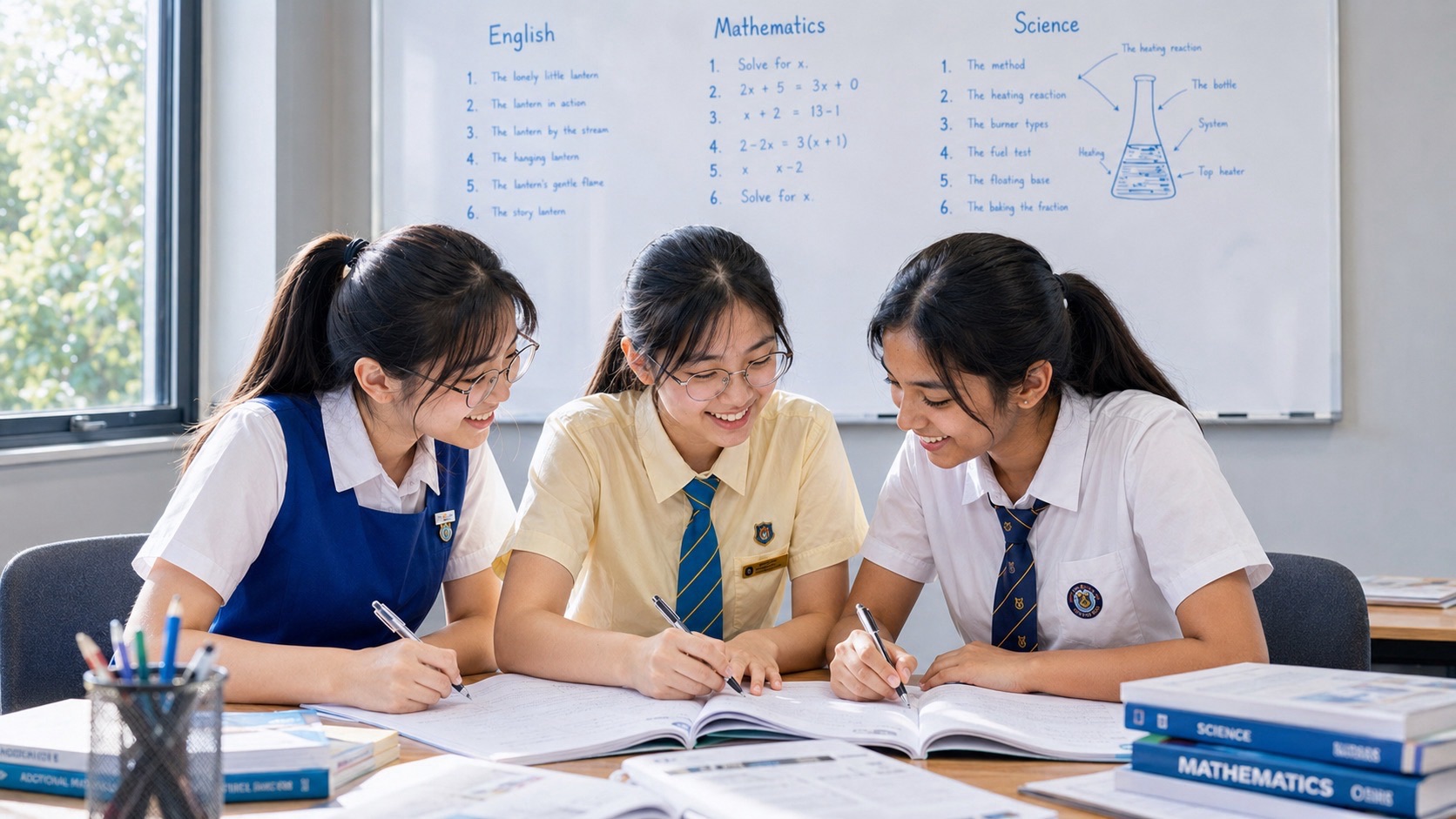
Secondary school is not Primary school with harder worksheets. The subjects become more abstract, the school system becomes larger, the social world becomes more complicated, and the student has to carry more of the operating system themselves.
On the first morning of Secondary 1, Maya’s mother does something she has spent six years learning not to do.
She does not open the school bag.
The bag is by the door.
Inside it are files for English, Mathematics, Science and several subjects that did not exist in the same form during Primary school.
There is a timetable Maya checked the night before.
A water bottle she filled herself.
A pencil case with two working pens.
Probably.
Her mother looks at the bag.
Then at Maya.
“Everything?”
Maya looks back.
“I think so.”
Primary 1 mother would have checked.
Secondary 1 mother says:
“Okay.”
This is the first lesson of Secondary school.
Not algebra.
Not comprehension.
Not subject combinations.
A handoff.
The student has entered a larger system and has to carry more of it.
More teachers.
More classrooms.
More deadlines.
More subject-specific language.
More decisions about what to do first.
More social complexity.
More independence.
By Secondary 3, some students add Additional Mathematics.
By Secondary 4, assessment becomes increasingly consequential.
For cohorts graduating from 2027 onward, the Singapore-Cambridge Secondary Education Certificate, or SEC, replaces the former separate N- and O-Level certificates, with subjects examined at the relevant G1, G2 or G3 levels.
The road from Secondary 1 to that final examination is therefore not simply a syllabus sequence.
It is a four-year development in academic control.
This is the story of that road in Punggol.
The 90-Second Parent Route
- Secondary 1: stabilise the transition before interpreting every wobble as permanent weakness.
- Secondary 2: identify emerging strengths, dependencies and subject-level needs before upper-secondary specialisation intensifies.
- Secondary 3: repair foundations aggressively where new abstraction exposes them; for students taking A-Math, audit algebra before blaming calculus or trigonometry.
- Secondary 4: shift from broad learning to reliable examination performance—timing, answer form, recovery, checking and selective late repair.
- English: reading must become more abstract, writing more purposeful, argument more disciplined and answer scope more controlled.
- Mathematics: number relationships become symbolic structures; algebra, graphs, geometry and functions increasingly depend on one another.
- Additional Mathematics: the subject amplifies prerequisite weaknesses; strong algebra is the carrying system.
- Home: move from supervision toward planning conversations, conditions and accountability.
- Tuition: use it when there is a clear job—Foundation Repair, School Stability, Stretch, Transition or Exam Performance.
- The long outcome: by Secondary 4, the student should be able to name their own weak links and operate more of the learning cycle without adult rescue.
1. Secondary School Is a Systems Transition
Primary school gave Maya one main classroom and a relatively stable daily architecture.
Secondary school distributes responsibility.
Different subject teachers.
Different rooms.
Different expectations.
Different files.
Different homework rhythms.
One missed instruction can now affect a subject the parent never hears about until a week later.
The first difficulty is therefore not always academic content.
It can be operating complexity.
2. Do Not Confuse Transition Noise With Ability
First weeks can look messy.
Homework forgotten.
Wrong file.
New timetable.
New classmates.
CCA choices.
Longer days.
A child who was organised in Primary 6 may briefly look disorganised again.
The system changed faster than the routine.
Observe before declaring a permanent problem.
3. Secondary 1 Is the Year the Student Learns to Operate a Larger School
The hidden curriculum is coordination.
Know what is due.
Know where materials are.
Know what was missed.
Know which subject needs attention first.
Know when help is needed.
Academic independence now has logistics inside it.
4. The Parent’s Job Changes Immediately
Primary parent:
“Put your English file in.”
Secondary parent:
“What do you have tomorrow?”
The difference is not neglect.
It is transfer.
The student has to perform more of the checking routine themselves.
5. Secondary 1 English: Meaning Becomes More Abstract
Texts widen.
Vocabulary becomes more conceptual.
Purpose and audience become more explicit.
Writing forms broaden.
Comprehension demands more inference and synthesis.
The child who could read fluently in Primary school now needs to reason through language with greater independence.
See Secondary 1 English in Punggol.
6. English Is Still Carrying the Whole School Day
Science instructions.
Mathematics word problems.
Humanities sources.
Project briefs.
CCA communication.
School notices.
English has become infrastructure.
See How English Carries the School Day.
7. Secondary 1 Mathematics: The Representation Changes
Primary Mathematics often anchors relationships in concrete quantities and visual models.
Secondary Mathematics increasingly compresses those relationships into symbols.
Numbers become variables.
Patterns become general rules.
Relationships become equations.
Tables become graphs.
This can feel like a new subject.
The underlying Mathematics remains connected to what came before.
See Secondary 1 Mathematics in Punggol.
8. Algebra Is Generalised Arithmetic
3 + 4 = 4 + 3.
Later:
a + b = b + a.
3(x + 2) = 3x + 6.
The distributive structure existed before letters.
Students who see algebra as compressed relationship often adapt better than students who treat every symbol rule as new.
9. The Equals Sign Returns With Greater Consequence
Primary students sometimes read equals as “the answer comes next”.
Secondary algebra requires a relational meaning.
Both sides are equal.
Transformations preserve equality.
A small Primary misconception can become a Secondary obstacle.
This is why Mathematics has a long memory.
10. Signed Numbers Are a Small Link With Large Consequences
Negative signs appear everywhere.
Algebra.
Coordinates.
Graphs.
Trigonometry.
Additional Mathematics.
A recurring sign problem can make many topics look weak at once.
Do not call it merely “careless”.
Build a visible procedure.
11. Secondary 1 Science Becomes More Disciplinary
Primary Science built broad systems, cycles, interactions and evidence habits.
Secondary Science increases abstraction and specialised models.
Students need to distinguish scientific explanation from everyday intuition more carefully.
The evidence habits from Primary school remain useful.
12. Subject Vocabulary Begins Growing Faster
Gradient.
Inference.
Photosynthesis.
Diffusion.
Democracy.
Economic.
Perspective.
Students are not only learning more words.
They are learning increasingly precise concepts through words.
Vocabulary now carries disciplinary access.
13. A Secondary Student Can Be Strong in One Subject and Need Support in Another
Full Subject-Based Banding reinforces a useful truth.
A student is a profile, not one global academic label.
Strong English.
Developing Mathematics.
Strong Science.
Different subject level.
Different next step.
Tuition should be just as specific.
14. Full Subject-Based Banding Changes the Language Parents Should Use
From 2024, Full Subject-Based Banding has been fully implemented in secondary schools.
Students may take subjects at different G1, G2 or G3 levels according to strengths, interests and learning needs.
That makes broad labels less useful.
Ask about the subject, the level, the current evidence and the learner’s readiness.
15. The Student Is Not “A G2 Child” or “A G3 Child” in Every Dimension
A subject level describes the level at which a subject is taken.
It should not become an identity verdict.
Different subjects can carry different profiles.
Students can develop.
Education should keep pathways visible rather than freeze assumptions.
16. The Secondary 1 Family Week Gets Longer
School can end later.
CCA becomes more substantial.
Travel matters.
Homework increases.
Adolescents need sleep too.
Family scheduling must adapt before tuition is added on top.
17. Remove Before Adding Still Applies
A new Secondary tuition class consumes:
lesson time.
travel.
homework.
attention.
recovery.
Before adding, name what moves.
If nothing moves on paper, sleep usually pays in reality.
18. The First Three Months of Secondary 1 Should Produce a Better Diagnosis
Which subject is genuinely weak?
Which problem is transition?
Which difficulty is organisation?
Which old Primary dependency has become visible?
Which area is already strong?
Do not buy permanent solutions before the problem has resolution.
19. Maya’s Secondary 1 Problem Is Not Speed Everywhere
She reads Mathematics structure fast.
Good.
Then skips a sign transition.
Her tutor creates a specific rule:
show the line when signs change.
Selective friction.
Her speed remains an advantage.
20. Hana’s Secondary 1 Problem Is Not Reading
She reads deeply.
The challenge is choosing what matters.
In English, answer scope.
In Mathematics, method economy.
Strengths create advanced training needs.
21. Jia Jun’s Secondary 1 Problem Is Not Ideas
He has too many.
English now needs paragraph architecture, audience and purpose.
Structure does not suppress voice.
It lets voice survive longer tasks.
22. Ethan’s Secondary 1 Problem Is Not Accuracy
He is accurate.
His challenge is pacing.
More subjects and longer papers mean every act of checking has opportunity cost.
He begins learning proportional verification.
23. Secondary 1 Tuition Should Be a Transition Tool When Transition Is the Problem
Organisation.
Foundations.
New abstraction.
School rhythm.
Do not immediately turn every transition wobble into exam preparation.
The year has its own job.
24. The First Weak Link Still Matters
“Weak in Secondary Math.”
Which layer?
Signed numbers?
Algebra?
Equation meaning?
Graph reading?
Word problem interpretation?
The narrower the diagnosis, the more efficient the repair.
25. Marked School Work Is the Best Early Map
One class test.
One assignment.
One teacher comment.
Patterns across several pieces.
School evidence should lead tuition decisions.
Tuition is supplementary.
26. Inside a 3-Pax Secondary Class, the Same Question Can Produce Three Jobs
Maya:
sign transition.
Hana:
shorter method.
Ethan:
time boundary.
Same content.
Different feedback.
See Inside a 3-Pax Tuition Class in Punggol.
27. Secondary 2 Is the Year Familiarity Becomes Responsibility
The student knows how secondary school works now.
That changes the problem.
Missing work can no longer be explained entirely by transition.
Study habits begin revealing themselves more clearly.
See Secondary 2 English in Punggol.
28. Secondary 2 Is a Routing Year
Where is the student strong?
Which subject levels fit?
Which future subjects require stronger prerequisites?
Is Additional Mathematics a realistic later option?
What must be repaired before upper-secondary work begins?
Secondary 2 is not merely a waiting room.
29. The Future Begins Pressing Backwards
A-Math in Secondary 3 depends on algebra now.
Upper-secondary English depends on reading and sentence control now.
More formal Science depends on model and evidence habits now.
The next stage tells us which present weaknesses deserve attention.
30. Secondary 2 Mathematics Should Audit Algebra Readiness
Signed numbers.
Brackets.
Expansion.
Factorisation.
Linear equations.
Graphs.
Ratios.
Fractions.
Students do not need to be perfect.
But weak foundations should be visible before they carry upper-secondary load.
See Secondary 2 Mathematics in Punggol.
31. Secondary 2 English Should Audit Reading Depth and Writing Control
Can the student infer with evidence?
Identify tone?
Track reference?
Write coherent paragraphs?
Adapt register?
Edit?
The next stage will ask for more abstraction.
32. Vocabulary Becomes More Conceptual
Bias.
Assumption.
Consequence.
Perspective.
Significance.
Students need language not just for description but for analysis.
See Secondary 2 Vocabulary in Punggol.
33. Secondary 2 Is a Good Year to Learn Study Planning
Not a colour-coded fantasy timetable.
A real plan.
Fixed commitments.
Current school work.
Retrieval of older material.
Priority repair.
Buffer.
Sleep.
The plan should survive the week.
34. Students Need to Learn the Difference Between Urgent and Important
Homework due tomorrow.
Urgent.
Algebra weakness affecting many future topics.
Important.
A good week needs both.
Without deliberate scheduling, urgent tasks consume everything and foundational repair never happens.
35. Backlogs Become Dangerous in Secondary School
One missed chapter.
Then another.
Current lessons assume both.
Homework takes longer.
The child starts avoiding the subject.
The backlog now has emotional cost as well as academic cost.
36. Repair Backlogs by Dependency, Not Chronology
Oldest topic is not always first.
Which missing skill blocks the most current work?
Repair that.
If fractions are blocking algebraic fractions and percentage, fractions may outrank an isolated geometry chapter.
37. Tuition Can Become a Time Compressor
A student spending two hours repeatedly failing homework may need twenty minutes of precise diagnosis.
Repair the bottleneck.
Return to the school task.
Good tuition can give the week time back.
See Tuition: The Time Compressor.
38. Tuition Can Also Become a Time Multiplier in the Wrong Direction
School homework.
Tuition homework.
Separate revision book.
Online course.
Four systems.
Same weak link.
Activity expands while learning remains stuck.
Coherence matters.
39. Secondary 2 Is Where Parent Supervision Should Continue Shrinking
Not disappear.
Change form.
Instead of checking every homework question, ask:
“What is your plan this week?”
“What is still unfinished?”
“Which subject needs help?”
Planning replaces constant supervision.
40. The Student Should Begin Running a Weekly Review
What did I learn?
What did I forget?
What did I get wrong more than once?
What is due next week?
Which subject is taking too long?
What should I ask my teacher or tutor?
Five minutes can prevent a month of drift.
41. Secondary 3 Is Where Old Compromises Become Expensive
Upper-secondary work increases abstraction.
Weak foundations that were survivable before begin carrying heavier loads.
Algebra.
Reading.
Writing.
Scientific reasoning.
Organisation.
The year is a stress test of prerequisites.
42. Secondary 3 English: The Future Starts Feeling Close
Writing must become more controlled.
Argument becomes more important.
Comprehension demands mature inference.
Vocabulary must support abstraction.
See Secondary 3 English in Punggol.
43. Secondary 3 Vocabulary Is Language for Analysis
Nuance.
Implication.
Validity.
Contradiction.
Identity.
Motivation.
Students need words that let them make finer distinctions.
See Secondary 3 English Vocabulary in Punggol.
44. Argument Is Not Opinion With Better Vocabulary
Claim.
Reason.
Evidence.
Connection.
Alternative.
Judgement.
Language makes reasoning visible.
Fancy words cannot compensate for weak logic.
45. Paragraphs Need Jobs
One paragraph.
One part of the argument.
Topic.
Development.
Evidence or example.
Connection.
Secondary writing becomes easier to control when each paragraph has a purpose.
46. Secondary 3 Mathematics: The SEC Runway Begins
The final examination is not tomorrow.
Good.
There is time to repair.
Algebra.
Functions.
Graphs.
Geometry.
Trigonometry.
Statistics.
See Secondary 3 Mathematics in Punggol.
47. Mathematics Is a Chain
Number sense became fractions.
Fractions became ratio and percentage.
Arithmetic became algebra.
Algebra became equations and functions.
Functions became graphs.
Graphs prepare rate-of-change thinking.
Later Mathematics keeps consuming earlier links.
48. Additional Mathematics Is a Dependency Amplifier
A-Math does not merely add harder chapters.
It asks existing algebra to carry more abstraction.
Manipulation.
Indices.
Functions.
Quadratics.
Coordinate geometry.
Trigonometry.
Calculus.
When the floor is weak, every new topic feels unstable.
49. Before Blaming Calculus, Audit Algebra
Can the student:
expand?
factorise?
simplify?
handle indices?
solve equations?
rearrange?
substitute accurately?
If not, calculus may only be exposing the carrying weakness.
50. The Chain Rule Is a Structural Reading Test
y = (3x + 1)5.
Outer function.
Inner function.
Differentiate the outer.
Multiply by the derivative of the inner.
dy/dx = 15(3x + 1)4.
The missing factor 3 can reveal failure to classify nested structure, not inability to understand all calculus.
51. “What Is Inside What?” Is Better Than “Remember the Formula”
Formulas matter.
Structure tells us which formula applies.
Students who read expressions structurally have more robust Mathematics.
52. Secondary 3 A-Math Should Not Become Endless Hard Questions
Hard work is valuable.
But difficulty without diagnosis can hide the same algebra failure inside twenty impressive questions.
Stop when the repeated mechanism is visible.
Repair cleanly.
Then return to complexity.
53. See the Secondary 3 Additional Mathematics Journey
Secondary 3 Additional Mathematics in Punggol | A Year from Home to School to Tuition—and Back Again.
54. Secondary 3 Is Also an Identity Year
Students begin saying:
“I am a Math person.”
“I am not a language person.”
“Science is my subject.”
“I can’t write.”
These statements can become self-fulfilling.
Keep capability descriptions specific.
55. Specific Identity Is Safer Than Global Identity
“I can solve quadratics but still lose signs in algebraic fractions.”
Good.
“I’m bad at A-Math.”
Too broad.
The first statement creates an action path.
56. Strong Students Need Stretch Without Permanent Overload
Harder reasoning.
Alternative methods.
Unfamiliar contexts.
More demanding texts.
Fewer prompts.
Strong students do not automatically need more classes.
They need appropriate intellectual demand.
57. Students Catching Up Need Priority, Not Panic
Several weak topics.
Limited time.
Which dependency unlocks the most?
Repair high-centrality links first.
A backlog is a routing problem.
58. Secondary 3 Family Conversations Should Become More Adult
“What do you think the problem is?”
“What evidence do you have?”
“What are you willing to change?”
“What help do you want?”
The teenager should participate in the learning plan.
59. Agency Does Not Mean the Teenager Decides Everything
Parents still set boundaries.
School still has requirements.
Tutors still teach.
Agency means the student is increasingly a participant rather than cargo.
60. The Teenager Should Know Why They Are in Tuition
Not:
“Because my parents made me.”
Better:
“My algebra is okay, but my exam papers show I lose marks through notation and time pressure.”
Purpose improves cooperation.
61. Tuition Should Tell the Student the Current Hypothesis
“We think the main problem is method selection.”
Then test it.
Do not keep the diagnosis mysterious.
Students learn self-diagnosis partly by seeing adults diagnose clearly.
62. The Hypothesis Can Be Wrong
Good.
New evidence should change it.
Teaching is not weakened by revising the model.
It is strengthened.
63. Secondary 3 CCA and Life Are Still Real
Leadership roles.
Training.
Competitions.
Friendships.
Family.
Sleep.
Upper-secondary academic demands do not suspend adolescence.
The week still needs slack.
64. Adolescents Need More Autonomy and More Consequence
If homework is forgotten, the teenager should increasingly experience the result.
Parents can support recovery without preventing every consequence.
Responsibility develops through use.
65. Rescue Can Delay Maturity
Parent emails every teacher.
Parent tracks every deadline.
Parent prints every worksheet.
Parent asks every night.
The system works.
Then the parent is the system.
Secondary school should move operational control inward.
66. Neglect Is Not the Alternative
The student misses three deadlines.
Grades collapse.
Adult says:
“You are old enough.”
Maybe.
But support can be scaffolded.
Weekly planning.
One shared calendar.
Then fade.
Independence is taught.
67. The Parent Needs a Higher-Resolution Question
Not:
“Did you study?”
Ask:
“What did you retrieve?”
“Which problem is still active?”
“What is due first?”
“What are you doing about it?”
Conversation becomes about decisions.
68. The Teenager Needs a Stop Rule
One impossible problem cannot consume midnight.
Attempt.
Mark.
Use resources.
Write the question.
Move.
Bring it to school or tuition.
Self-regulation includes knowing when independent struggle has stopped being productive.
69. The Parent Needs a Stop Rule Too
One bad test.
Read the paper.
Find the pattern.
Agree the next action.
Stop discussing it.
Return to ordinary family life.
70. The Tutor Needs a Stop Rule Too
One more technique.
One more worksheet.
One more advanced method.
Not automatically useful.
Stable systems need time to become automatic.
71. Secondary 4 Changes the Question Again
By the final year, broad learning remains important.
Performance becomes urgent.
Can the student express what they know under time?
This is a separate training problem.
72. Secondary 4 English Is Performance Under Constraint
Read.
Interpret.
Plan.
Write.
Support claims.
Control scope.
Manage time.
Recover after a difficult section.
See Secondary 4 English in Punggol.
73. Secondary 4 Vocabulary Is Precision Under Pressure
Students do not need the fanciest word.
They need the right word.
Register.
Nuance.
Argument.
Clarity.
See Secondary 4 SEC English Vocabulary in Punggol.
74. Secondary 4 Mathematics Is Also Performance Under Constraint
Technique.
Problem solving.
Reasoning.
Communication.
Time.
Checking.
Recovery.
See Secondary 4 Mathematics in Punggol.
75. Secondary 4 Additional Mathematics Needs Reliability More Than Endless Novelty
Students should not arrive in the final months with twenty competing methods for every question.
Choose reliable routes.
Repair persistent algebra leaks.
Train mixed recognition.
Simulate.
Then stabilise.
See Secondary 4 Additional Mathematics in Punggol.
76. The 2026 and 2027 Examination Labels Need to Stay Clear
Students graduating in 2026 remain under the existing GCE examination arrangements.
From the 2027 graduating cohort, the Singapore-Cambridge Secondary Education Certificate becomes the common certificate, with subjects examined at G1, G2 or G3 levels as applicable.
Families should always check current SEAB information for the cohort actually sitting the examination.
77. The Examination Reform Does Not Remove the Need for Core Skills
Terminology changes.
Assessment structures evolve.
The learner still needs subject knowledge, problem solving, communication, time control and independence.
Good tuition should update to the current system without pretending every educational principle changed overnight.
78. The Final-Year Plan Should Begin With Evidence
Recent school paper.
Prelim when available.
Timed section.
Error log.
Not:
“Everyone is doing ten papers, so we should too.”
Training should follow the learner’s evidence.
79. Knowledge and Performance Need Separate Diagnosis
Does not know?
Teach.
Knows but cannot retrieve?
Retrieve.
Retrieves but cannot select?
Mix.
Selects but executes poorly?
Practise.
Executes but runs out of time?
Train performance.
Different bottlenecks.
80. The Full Paper Is a Test, Not Always the Repair
A full paper reveals combined performance.
If the same algebra error appears four times, another full paper may simply reveal it again.
Leave the paper.
Repair the mechanism.
Then return.
81. Prelims Are Diagnostic Gold
Real school conditions.
Real timing.
Mixed syllabus.
Pressure.
The score matters.
The error distribution matters more for the next decision.
82. Do Not Treat Prelims as Prophecy
Strong prelim.
Good evidence.
Not guarantee.
Weak prelim.
Important evidence.
Not destiny.
Use the paper to decide the remaining work.
83. Prioritise by Expected Mark Return
Recurring error worth ten marks across a paper.
Rare hard item worth two.
The first may deserve priority.
Late-stage strategy is selective.
84. The Error Ledger Should Shrink Near the Exam
Early year:
many issues.
Late year:
three or four personal triggers.
The active system should become smaller.
Students need something they can carry under stress.
85. Maya’s Final-Year English Trigger
Question first.
Evidence second.
Commit third.
Her speed now has a gate.
86. Maya’s Final-Year Mathematics Trigger
Show high-risk sign transitions.
Do not hide two operations in one mental jump when the cost of error is high.
87. Hana’s Final-Year English Trigger
Scope.
Strongest evidence.
Stop.
Depth becomes precision.
88. Hana’s Final-Year Mathematics Trigger
Choose the shortest defensible method unless a longer route creates a checking advantage.
Method economy is exam skill.
89. Jia Jun’s Final-Year English Trigger
Structure before flourish.
Paragraph job.
Argument spine.
Conclusion earned.
Voice survives because architecture is stable.
90. Jia Jun’s Final-Year Mathematics Trigger
Novel solution?
Good.
Make every transition visible enough to mark and verify.
Creativity needs communication.
91. Ethan’s Final-Year English Trigger
Answer fully.
Check once.
Move.
Do not turn every sentence into an editing project.
92. Ethan’s Final-Year Mathematics Trigger
If no progress after the movement threshold, mark and continue.
Completion first.
Optimisation second.
93. Four Learners Need Four Different Performance Rules
This is personalisation.
Not necessarily four different syllabuses.
Different learners leak marks in different places.
The final-year system should know those places.
94. The Student Should Know the Rules Too
By Secondary 4, adult-only diagnosis is insufficient.
The learner should be able to say:
“This is my common error.”
“This is my checking method.”
“This is when I move.”
“This is what I still need help with.”
95. Self-Diagnosis Is a Major Secondary-School Outcome
Not perfect self-diagnosis.
Enough to participate intelligently.
The student who can name the mechanism gets better help faster.
96. The Tutor Should Become Less Necessary as the Exam Approaches
More independent timed work.
More observation.
Less rescue.
If the student cannot operate without constant live prompting, the training has not fully transferred.
97. The Parent Should Become Less Operational Too
Not less caring.
Less operational.
The teenager packs.
Plans.
Tracks deadlines.
Brings the paper.
Names the weak link.
The parent protects conditions and helps with major decisions.
98. The Final-Year Family Conversation Should Be Weekly, Not Constant
One planning conversation.
What matters this week?
What changed?
What is overloaded?
Then stop.
Do not let examination concern leak into every meal.
99. Sleep Is Still Academic Infrastructure at Sixteen
Adolescents do not stop needing sleep because examinations matter.
Late-night revision can create the next day’s attention problem.
The timetable should not routinely borrow from cognition to pay for studying.
100. CCA Does Not Become Meaningless in Secondary 4
Leadership.
Teamwork.
Physical health.
Identity.
But priorities can shift as examination season approaches.
Manage load.
Do not treat non-academic life as automatically wasteful.
101. Friendship Matters More, Not Less, in Adolescence
Peers become central.
Comparison becomes dangerous.
One student’s score.
Another’s tuition schedule.
Another’s subject combination.
Families should keep returning to the actual learner.
102. Social Comparison Is Low-Resolution Data
“Her friend does four tuition classes.”
So what?
Different learner.
Different school.
Different weaknesses.
Different family.
Copying another student’s intervention without their diagnosis is poor reasoning.
103. Strong Students Need Protection From Competitive Overload
Because they can cope, adults assume they can absorb more.
More competition.
More classes.
More advanced material.
Capacity is not infinite.
Stretch should remain purposeful.
104. Students Who Are Behind Need Protection From Shame
Secondary school makes comparison visible.
Subject levels.
Scores.
Classmates.
Shame reduces help-seeking.
Repair should be specific and dignified.
105. A Weak Secondary Student Can Still Have Strong Foundations Somewhere
Good vocabulary.
Strong mental arithmetic.
Excellent scientific reasoning.
Use strengths as routes into repair.
Learners are profiles.
106. Strength Can Be Used as a Bridge
Strong oral explanation?
Use it to build writing.
Strong visual thinking?
Use diagrams before algebra.
Strong checking?
Use it to build confidence, then teach time limits.
Strength is instructional capital.
107. English and Mathematics Intersect More Than Students Notice
Read precisely.
Interpret conditions.
Build a representation.
Communicate an answer.
Different knowledge.
Shared cognitive processes.
108. Science and English Intersect Through Explanation
Condition.
Mechanism.
Outcome.
Good English carries the reasoning.
Science determines whether the reasoning is valid.
109. Mathematics and Science Intersect Through Data
Graph.
Rate.
Proportion.
Measurement.
Students need enough mathematical fluency to read scientific evidence accurately.
110. Secondary School Rewards Connected Learners
Not because subjects merge into one.
Because capabilities travel.
Reading.
Reasoning.
Representation.
Evidence.
Self-regulation.
These processes support multiple domains.
111. The Student Should Build a Personal Operating Manual
What helps me start?
Where do I usually lose marks?
How do I check?
When do I move?
How much sleep do I need to function?
When should I ask for help?
What study method actually works for this subject?
Secondary school is an ideal place to learn these answers.
112. Study Methods Should Differ by Job
Vocabulary?
Retrieval.
Writing?
Draft and revise.
Mathematics?
Solve and inspect errors.
Science?
Retrieve models and apply to evidence.
One generic “study harder” method is not enough.
113. Rereading Has a Job but Cannot Do Everything
Refresh.
Orient.
Clarify.
Then close the notes.
Retrieve.
Apply.
Examinations remove the page.
114. Retrieval Should Run All Year
Not only before exams.
Old content needs to return.
Secondary syllabuses are cumulative enough that forgotten foundations create later friction.
115. Mixed Practice Trains Method Selection
When every question is labelled “quadratics”, the student already knows the family.
Mixed papers remove the cue.
Recognition becomes part of performance.
116. Worked Examples Should Become Less Complete
Full worked solution.
Missing final step.
Missing middle.
Only first hint.
Fresh question.
Support fades.
Independence grows.
117. Model Essays Should Fade Too
Read them.
Analyse choices.
Borrow principles.
Then write new work.
Do not make model prose a cage.
118. Model Science Answers Should Fade Too
Identify claim.
Evidence.
Reasoning.
Then reconstruct under a new context.
If wording changes and understanding disappears, transfer is weak.
119. The Student Should Learn to Use Feedback
A red mark is not the end.
What type of error?
Why?
What is the repair?
When will it be retested?
Feedback becomes useful when it changes the next attempt.
120. The Error Log Should Not Become a Museum
Current recurring errors only.
Retire what is stable.
The active list should remain small enough to use.
121. Secondary Students Should Learn to Distinguish Content and Performance Errors
Did not know?
Content.
Knew but misread?
Performance.
Knew but ran out of time?
Performance.
Knew but selected wrong method?
Recognition and selection.
This classification changes revision.
122. Exam Performance Is a Real Skill
See How Examination Performance Works | Why Knowing Is Not the Same as Scoring.
Knowledge and scoring overlap.
They are not identical.
123. Time Management Is a Real Skill
See Exam Time Management.
Students need movement rules, section budgets and checking strategies.
124. Careless Mistakes Need Mechanisms
See Careless Mistakes in Exams.
Skipped signs, wrong scope, copied numbers and unsupported answer changes are different failures.
125. Error Analysis Should Change Training
A wrong answer should generate a more precise next decision.
126. Mock Examinations Need a Follow-Up Loop
Simulate.
Diagnose.
Repair.
Retest.
Otherwise the mock becomes theatre.
See Mock Examinations.
127. Past-Year Papers Are Valuable When They Stay Informative
Use them deliberately.
Do not memorise a paper into uselessness and call the second score progress.
See Past-Year Papers for Exams.
128. Exam Readiness Is Evidence, Not Feeling
See Exam Readiness.
Ready does not mean fearless.
It means enough of the system is stable under realistic conditions.
129. The Final Two Weeks Should Reduce Novelty
Known methods.
Known routines.
Short active error list.
Targeted retrieval.
Representative timed work.
Sleep.
Late-stage stability beats constant reinvention.
130. The Night Before the Exam Is Not a Moral Test
One more paper does not prove seriousness.
One more hour does not prove commitment.
Preparation has already happened.
Protect the system that will need to perform tomorrow.
131. The Exam Hall Is the Final Tutor-Absence Test
No prompt.
No parent.
No peer explanation.
No live correction.
The learner operates.
This is why independence must be rehearsed before the day arrives.
132. After the Paper, Context Decides Whether to Review
Prelim?
Review deeply.
National exam already submitted?
Often release and protect the next paper.
Reflection is useful when it has an action path.
133. The Secondary School Years Are Also Social Years
Friends become more influential.
Belonging matters.
Identity becomes more self-authored.
Adults should not imagine academic development happens separately from adolescence.
134. A Bad Week Can Be Social Before It Is Academic
Friend conflict.
CCA pressure.
Sleep loss.
School stress.
Marks dip.
Do not immediately buy another class.
Understand the system.
135. Several Subjects Slipping Together Is a Signal to Zoom Out
One shared cause may exist.
Overload.
Transition.
Illness.
Emotional stress.
Foundational language.
Organisation.
Several symptoms can share one upstream problem.
136. One Subject Slipping Alone Is a Signal to Zoom In
Stay specific.
Which topic?
Which process?
Which condition?
Which error family?
Do not redesign the entire life because trigonometry is unstable.
137. The Family Tuition Handbook Still Applies
Use The Punggol Family Tuition Handbook for the wider decision framework:
what job tuition should do, how to protect the week, and how to know whether the support transfers.
138. The 3-Pax Model Is One Possible High-Resolution Environment
Up to three students.
Close observation.
Peer explanation.
Independent intervals.
Different prompts.
The number is not magic.
The teaching has to use the visibility.
139. The Small Group Should Not Become a Small Lecture
Students need to produce.
Solve.
Explain.
Write.
Retrieve.
Check.
Feedback needs evidence.
140. Secondary Students Need More Time Working Without the Tutor
Not less support overall.
More deliberate independent intervals.
The tutor can observe what happens when cues disappear.
That is where transfer becomes visible.
141. A Strong 3-Pax Lesson Can Hold Different Jobs
One student repairs.
One stabilises.
One stretches.
Shared concept.
Different feedback.
Group coherence remains.
142. Placement Still Matters
Three students with no useful common ground are not magically compatible.
Academic level.
Pace.
Temperament.
Group chemistry.
All matter.
143. The Tutor Should Know When Another Format Is Better
One-to-one.
Different group.
Larger class.
Specialist assessment.
No tuition.
The learner should determine the format, not the business model.
144. Tuition Should Have Exit Logic
Foundation Repair completes.
School Stability becomes independent.
Exam Performance ends after the exam.
Stretch changes form.
Review each term.
Attendance is not an outcome by itself.
145. The Teenager Should Increasingly Own the Error Log
Not the parent.
Not only the tutor.
By Secondary 4, the student should know the current recurring issues and how to respond.
146. The Teenager Should Increasingly Own the Timetable
Parents can review.
The student should construct more of it.
Deadlines.
Tests.
CCA.
Revision.
Sleep.
Planning is an academic skill.
147. The Teenager Should Increasingly Own Help-Seeking
Teacher.
Tutor.
Friend.
Parent.
Online resource.
Know which source fits the question.
Independence includes intelligent use of help.
148. “I Don’t Understand” Should Become More Precise
Secondary 1:
“I don’t get algebra.”
Secondary 4:
“I can differentiate, but I still misclassify composite functions when the inner expression is disguised.”
Precision is development.
149. “I Need Help” Should Become More Precise Too
“Can you explain?”
Becomes:
“Can you check whether my first assumption is valid? I think the rest follows if that is right.”
Students learn to use expert attention efficiently.
150. “I Am Ready” Should Become Evidence-Based
Not:
“I feel okay.”
But:
“I completed three representative papers within time, the same error has not recurred, and I know my checking order.”
Confidence gains structure.
151. “I Am Not Ready” Should Also Become Specific
“My algebra is stable but I still run out of time on Paper 2.”
Good.
Now the remaining training job is visible.
152. Secondary School Is Where Students Learn to Distinguish Difficulty From Danger
A hard topic feels uncomfortable.
That does not mean something is wrong.
A difficult paper can be survived.
A low mark can be analysed.
Academic discomfort becomes less threatening when the learner has a repair process.
153. Recovery Is a School Skill
Bad test.
One day.
Read evidence.
Repair.
Continue.
The student should not lose the next month to one result.
154. Recovery Is an Examination Skill
Hard Question 4.
Mark it.
Move.
Question 5 still exists.
One problem should not colonise the paper.
155. Recovery Is a Life Skill
Plans fail.
People make errors.
Evidence changes.
Good education should teach revision rather than fragility.
156. Secondary School Should Increase Responsibility Without Removing Support
This is the balance.
More student ownership.
Adults still present.
Scaffolding fades according to readiness.
Not according to age alone.
157. The Parent’s Support Can Become More Strategic
Transport.
Major timetable decisions.
Health.
Boundaries.
Resources.
Perspective.
Less nightly micromanagement.
158. The Tutor’s Support Can Become More Diagnostic
Marked papers.
Timed sections.
Error patterns.
Prerequisite checks.
Transfer tasks.
Less generic reteaching.
159. The Teacher’s Feedback Can Become More Valuable if the Student Uses It
Read comments.
Correct.
Ask.
Retrieve later.
School produces evidence continuously.
Students need to become consumers of that evidence.
160. The Student Should Build One Coherent Learning System
School.
Tuition.
Home study.
Online resources.
These should not become four unrelated worlds.
One learner moves through all of them.
161. School Should Lead Current Curriculum
It is the main programme.
Tuition can reinforce, repair, extend or train performance.
Home can support routines and retrieval.
Each environment has a job.
162. Tuition Should Not Compete With School for Legitimacy
A strong tutor does not need to make school seem inadequate.
The child benefits when adults work from the same reality.
Coherence reduces cognitive translation.
163. Home Should Not Become Tuition Number Two
The teenager already has teachers.
Parents can discuss.
Ask.
Review the plan.
Protect conditions.
Not every evening needs another lesson.
164. The Punggol Geography Still Matters in Secondary School
Longer school days mean travel costs more.
A local tuition option can protect dinner and homework time.
Location is not pedagogy.
It affects whether pedagogy can fit sustainably into the week.
165. Punggol Waterway Is Still a Classroom
English observation.
Science systems.
Mathematics measurement.
Urban design.
Or simply a place where no one discusses school.
Both uses are valid.
166. Punggol Regional Library Changes Meaning for Teenagers
Research.
Study.
Books.
Independent browsing.
The student can increasingly choose information without an adult selecting every source.
167. Information Literacy Becomes More Important
Search.
Source.
Evidence.
Bias.
Authority.
Students live inside abundant information.
School English, Science and Humanities all contribute to judgement.
168. AI Raises the Requirement for Verification
Fluent answers are easy to obtain.
Students need to ask:
Is this correct?
What evidence supports it?
Does the logic follow?
Can I explain it independently?
Can I solve without the generated answer?
Learning still requires ownership.
169. A Student Who Copies a Perfect AI Answer Has Not Necessarily Learned
Output exists.
Capability uncertain.
Ask for reconstruction.
Changed context.
Explanation.
Transfer reveals learning.
170. AI Can Be Useful When It Creates Better Questions
Explain another way.
Generate a variant.
Compare methods.
Challenge an argument.
Then the student must still judge.
Technology should extend learning, not replace cognition.
171. Secondary Education Should Prepare Students to Self-Educate
Read a source.
Identify what is not understood.
Find help.
Test the explanation.
Practise.
Review.
This capability matters far beyond SEC.
172. The Road to SEC Is Not the End of the Road
JC.
Polytechnic.
ITE.
Other pathways.
Work.
Further study.
The final Secondary examination is a handoff point.
Education continues.
173. Students Need to Leave Secondary School With More Than Examination Tricks
They need durable English.
Mathematics.
Reasoning.
Evidence.
Study systems.
Self-knowledge.
Otherwise the next stage simply recreates the same dependency.
174. The Best Examination Technique Is Built on Real Capability
Read the command word.
Allocate time.
Check known risks.
These help.
But techniques cannot permanently replace knowledge and practice.
Performance sits on capability.
175. The Best Capability Is Built With Performance in Mind
Knowledge that cannot be retrieved under reduced cues is fragile.
Writing that only works with unlimited time is incomplete for exams.
Mathematics that only works when the chapter is labelled lacks recognition.
Learning and performance should converge gradually.
176. Secondary 1 Should Not Feel Like Secondary 4
Do not bring the final-year pressure backwards unnecessarily.
The first year needs adaptation, foundation and exploration.
Long-term preparation is not the same as permanent examination mode.
177. Secondary 2 Should Not Feel Like a Lost Year
It is a prerequisite and routing year.
Use it.
Repair before specialisation.
Build study systems before the final runway.
178. Secondary 3 Should Not Feel Like an Emergency if Earlier Years Were Used Well
New difficulty is expected.
The system should have enough reserve to repair.
There is still time.
Use it structurally.
179. Secondary 4 Should Not Feel Like Four Years of Unfinished Work Arriving at Once
If it does, prioritise.
Do not attempt to repair everything equally.
Expected return.
Dependency.
Frequency.
Repairability.
Time remaining.
Late strategy is selection.
180. The Secondary School Years in Four Questions
Secondary 1:
Can the student operate the new system?
Secondary 2:
Which strengths, dependencies and future routes are becoming visible?
Secondary 3:
Can the learner carry upper-secondary abstraction without old foundations breaking?
Secondary 4:
Can the student perform independently under the final assessment constraints?
181. The English Question Across Four Years
Can the student receive increasingly complex meaning and express increasingly precise meaning for a purpose?
That is the long English arc.
182. The Mathematics Question Across Four Years
Can the student recognise, represent and operate increasingly abstract relationships while preserving accuracy and reasoning?
That is the long Mathematics arc.
183. The Additional Mathematics Question
Can the student carry greater abstraction through stable algebraic structure and select appropriate methods under time?
That is the A-Math arc.
184. The Family Question Across Four Years
Are adults transferring responsibility fast enough to develop independence but slowly enough to provide real support?
That is the home arc.
185. The Tuition Question Across Four Years
Does the intervention have a clear job, evidence of transfer and a reason to continue?
That is the tuition arc.
186. The Learner Question Across Four Years
What can I now do, diagnose, plan and recover from without another person carrying the process?
That is the independence arc.
187. Maya in Secondary 1
Fast.
Curious.
New system.
She learns that a bigger school requires organisation as well as intelligence.
188. Maya in Secondary 2
She knows the routines.
Now her speed needs finer calibration.
Different tasks require different levels of verification.
189. Maya in Secondary 3
Nested A-Math structures expose where fast classification can be dangerous.
“What is inside what?” becomes a mathematical pause trigger.
190. Maya in Secondary 4
She no longer needs the tutor to say “slow down”.
She knows the conditions that require it.
General advice has become internal control.
191. Hana in Secondary 1
Deep reader.
Strong understanding.
Secondary school gives her more complexity.
She enjoys it.
192. Hana in Secondary 2
She begins seeing too many possible routes in some tasks.
Selection becomes a skill.
193. Hana in Secondary 3
Argument suits her.
Now she must make depth economical.
Every paragraph needs a job.
194. Hana in Secondary 4
She understands widely.
Answers narrowly.
Depth has become controlled precision.
195. Jia Jun in Secondary 1
His voice expands.
Writing forms become more varied.
Structure needs to keep pace.
196. Jia Jun in Secondary 2
He learns that an interesting example must still support the claim.
Creativity becomes argumentative evidence.
197. Jia Jun in Secondary 3
He discovers that strong ideas can fail if paragraph architecture is unclear.
Planning becomes a creative tool.
198. Jia Jun in Secondary 4
He writes with more freedom because structure is automatic enough to carry it.
The repair became part of the strength.
199. Ethan in Secondary 1
Accurate.
Careful.
Longer school days begin exposing the cost of endless verification.
200. Ethan in Secondary 2
He learns confidence calibration.
Not every answer needs perfect certainty before moving.
201. Ethan in Secondary 3
Harder Mathematics makes method choice matter.
He learns that the elegant route is not always the efficient route.
202. Ethan in Secondary 4
He still checks carefully.
Now he checks strategically.
Accuracy has learned to move.
203. The Children Are Not Four Fixed Types
They changed.
Strengths developed.
Weaknesses retired.
New challenges emerged.
Education should keep updating the model of the learner.
204. The Parent Changes Too
Secondary 1:
help the transition.
Secondary 2:
review routines.
Secondary 3:
discuss priorities and pathways.
Secondary 4:
protect conditions while the learner operates.
Parenting should mature with the child.
205. The Tutor Changes Too
Secondary 1:
diagnose transition and foundations.
Secondary 2:
stabilise and prepare prerequisites.
Secondary 3:
repair deep dependencies and build upper-secondary integration.
Secondary 4:
compress, simulate, refine and release.
206. The Student Changes Most
At thirteen:
“What should I do?”
At sixteen:
“This is what I think I need to do, and this is where I still need help.”
That sentence is one of the best outcomes of Secondary education.
207. The eduKate Learning Loop Grows With the Teenager
Read → Diagnose → Prioritise → Repair → Practise → Connect → Perform → Review.
At Secondary 1, adults may operate much of the loop.
By Secondary 4, the learner should increasingly run it themselves.
208. Read
What is the task?
What does the paper show?
What does the teacher feedback say?
What is the actual problem?
209. Diagnose
Concept?
Language?
Representation?
Procedure?
Retrieval?
Timing?
Recovery?
Name the first weak link.
210. Prioritise
Which repair will unlock the most?
Which matters for the next stage?
Which is realistically changeable now?
Do that first.
211. Repair
Teach clearly.
Use a clean example.
Make the mechanism visible.
Then return responsibility to the learner.
212. Practise
Enough repetition to stabilise.
Not endless repetition after transfer is proven.
Practice should have a job.
213. Connect
Mix topics.
Change representation.
Use unfamiliar contexts.
Ask where else the idea appears.
Connection builds transfer.
214. Perform
School test.
Timed section.
Essay.
Oral task.
Prelim.
SEC paper.
Can the learner operate under real constraints?
215. Review
What changed?
What still fails?
What can now be retired?
What is the next job?
Experience should change the plan.
216. The Secondary Years Are One Long Transfer of Control
Teacher to learner.
Tutor to learner.
Parent to learner.
Worked example to retrieval.
Prompt to self-prompt.
School routine to personal routine.
The learner receives more control and more consequence.
217. Too Little Transfer Creates Dependence
Adult still tracks everything.
Tutor still announces every method.
Student waits.
Final examination removes the adults.
The system fails suddenly.
218. Too Much Transfer Too Early Creates Abandonment
Student is overwhelmed.
Adult says:
“You are in Secondary school now.”
Support should fade according to evidence of readiness.
Independence is not neglect.
219. Good Secondary Education Finds the Moving Boundary
Help enough.
Then step back.
Observe.
Return when the learner reaches a real boundary.
Release again.
This is controlled autonomy.
220. Family Life Should Remain Larger Than School
Meals.
Grandparents.
Siblings.
Birthdays.
Walks.
Arguments.
Jokes.
Secondary school is a major part of adolescence.
It should not become all of adolescence.
221. The Empty Evening Still Matters at Sixteen
Not necessarily every week.
Exam seasons disrupt it.
But the principle remains.
A system with no margin breaks under surprise.
Slack is resilience.
222. Good Secondary Performance Is Sustainable Performance
Can the student repeat it?
Recover?
Continue next week?
One excellent result produced by an unsustainable emergency is not yet a robust system.
223. High Performance Is Not Visible Suffering
Long nights.
Permanent stress.
No free time.
These are not proof of seriousness.
Reliable output from a coherent system is the goal.
224. A Strong Secondary Student Should Know What Not to Do
Do not redo stable topics endlessly.
Do not change methods without evidence.
Do not check every line equally.
Do not let one hard question consume the paper.
Do not confuse one poor result with identity.
Selection includes subtraction.
225. A Student Catching Up Should Know What Not to Do
Do not attack the whole backlog at once.
Do not compare hours with stronger peers.
Do not hide mistakes.
Do not stay on advanced work when the prerequisite is broken.
Repair by dependency.
226. A Parent Should Know What Not to Do
Do not manage every deadline forever.
Do not turn one test into a personality diagnosis.
Do not add tuition before naming the problem.
Do not let anxiety become the weekly planning system.
227. A Tutor Should Know What Not to Do
Do not create permanent dependence.
Do not bury weak students under volume.
Do not bore strong students with endless repetition.
Do not pretend every learner needs the same intervention.
228. A School System Works Best When the Learner Learns How to Use It
Teachers.
Consultations.
CCA.
Libraries.
Classmates.
Feedback.
Assessments.
The student should learn how to extract educational value from the institution they are already in.
229. Tuition Should Help the Student Use School Better
Understand lessons.
Repair gaps.
Ask better questions.
Perform more independently.
School success is the transfer environment.
230. The Best Tuition Outcome May Be Less Emergency at Home
Homework starts faster.
Questions become more precise.
Parents stop reteaching.
The student knows where to seek help.
Family evenings become calmer.
That is educational value too.
231. The Secondary School Years in One Sentence
Use Secondary 1 to stabilise the larger system, Secondary 2 to identify routes and prerequisites, Secondary 3 to repair foundations under greater abstraction, and Secondary 4 to convert knowledge into reliable independent performance—while steadily transferring control of learning from adults to the student.
232. Ten Rules for the Road from Secondary 1 to SEC
- Do not confuse transition noise with permanent weakness.
- Treat students as subject profiles, not fixed global labels.
- Repair algebra, reading and organisational dependencies before upper-secondary load makes them expensive.
- Use English as a meaning and reasoning system, not only an examination subject.
- See Mathematics as a chain of relationships, not isolated chapters.
- For Additional Mathematics, audit the carrying algebra before blaming advanced topics.
- Use tuition for a named job and test transfer back to school.
- Shift from content learning to performance training gradually, not suddenly at prelims.
- Reduce parent and tutor prompts as the learner becomes ready.
- By Secondary 4, make self-diagnosis, recovery and independent planning part of the outcome.
233. Secondary English Journey
- Secondary 1 English in Punggol
- Secondary 2 English in Punggol
- Secondary 3 English in Punggol
- Secondary 4 English in Punggol
234. Secondary Mathematics Journey
- Secondary 1 Mathematics in Punggol
- Secondary 2 Mathematics in Punggol
- Secondary 3 Mathematics in Punggol
- Secondary 4 Mathematics in Punggol
235. Additional Mathematics Journey
- Secondary 3 Additional Mathematics in Punggol
- Secondary 4 Additional Mathematics in Punggol
- How Additional Mathematics Tuition Works in Punggol
236. Deep Subject Routes
237. Family and Tuition Routes
- The Punggol Family Tuition Handbook
- Inside a 3-Pax Tuition Class in Punggol
- When Do Punggol Students Need Tuition?
- When to Start Tuition?
- How Tuition Works | The Weak Link
- Tuition: The Time Compressor
- Book a Tuition Consultation | eduKatePunggol
238. Examination Performance Routes
- How Examination Performance Works
- Error Analysis for Exams
- Careless Mistakes in Exams
- Exam Time Management
- Past-Year Papers for Exams
- Mock Examinations
- Exam Readiness
239. Primary-to-Secondary Bridge
240. Official Singapore Education Routes
- Ministry of Education Singapore — Full Subject-Based Banding
- Singapore Examinations and Assessment Board — Secondary Education Certificate
- Singapore Examinations and Assessment Board
241. The Last Secondary-School Morning
Four years after the bag by the door, Maya is awake before the alarm again.
This time, her mother does not ask whether everything is packed.
Maya has checked.
She knows the reporting time.
Knows the paper.
Knows the route.
Knows what she will do if one question refuses to open.
Knows the two places she tends to rush.
Knows which errors are old enough to be retired.
Knows which one still deserves attention.
Her mother asks:
“Breakfast?”
“Yes.”
That is the whole conversation.
Secondary school has not made Maya independent in every part of life.
She is still a teenager.
Still asks for help.
Still forgets things.
Still changes her mind.
Still gets nervous.
But she carries more.
English is no longer only a subject she studies.
It is a tool for reading, argument and judgement.
Mathematics is no longer only a sequence of chapters.
It is a system of relationships she can recognise and operate.
Additional Mathematics, where she took it, taught her that abstraction becomes manageable when the structure underneath is stable.
School taught content.
Teachers gave feedback.
Tuition, when useful, repaired specific weak links.
Home protected conditions and gradually stepped back.
And the student learned something larger than any one paper:
when difficulty appears, she can read the situation, identify what is failing, seek the right help, repair, practise, perform and review.
The final Secondary examination matters.
It opens pathways.
It records real performance.
But the deeper handoff is the learner leaving Secondary school with more of the operating system inside themselves.
Four years earlier, Maya’s mother looked at the school bag and chose not to open it.
Now there is almost nothing left for her to check.
That is not the disappearance of parenting.
It is one of its successes.
The child became a teenager.
The teenager became a more independent learner.
And the road from Secondary 1 to SEC did what a good educational road should do.
It carried the student somewhere larger than the examination at the end of it.
eduKatePunggol
Properly Taught Kids Shine a Bright Light Into the Future.


