
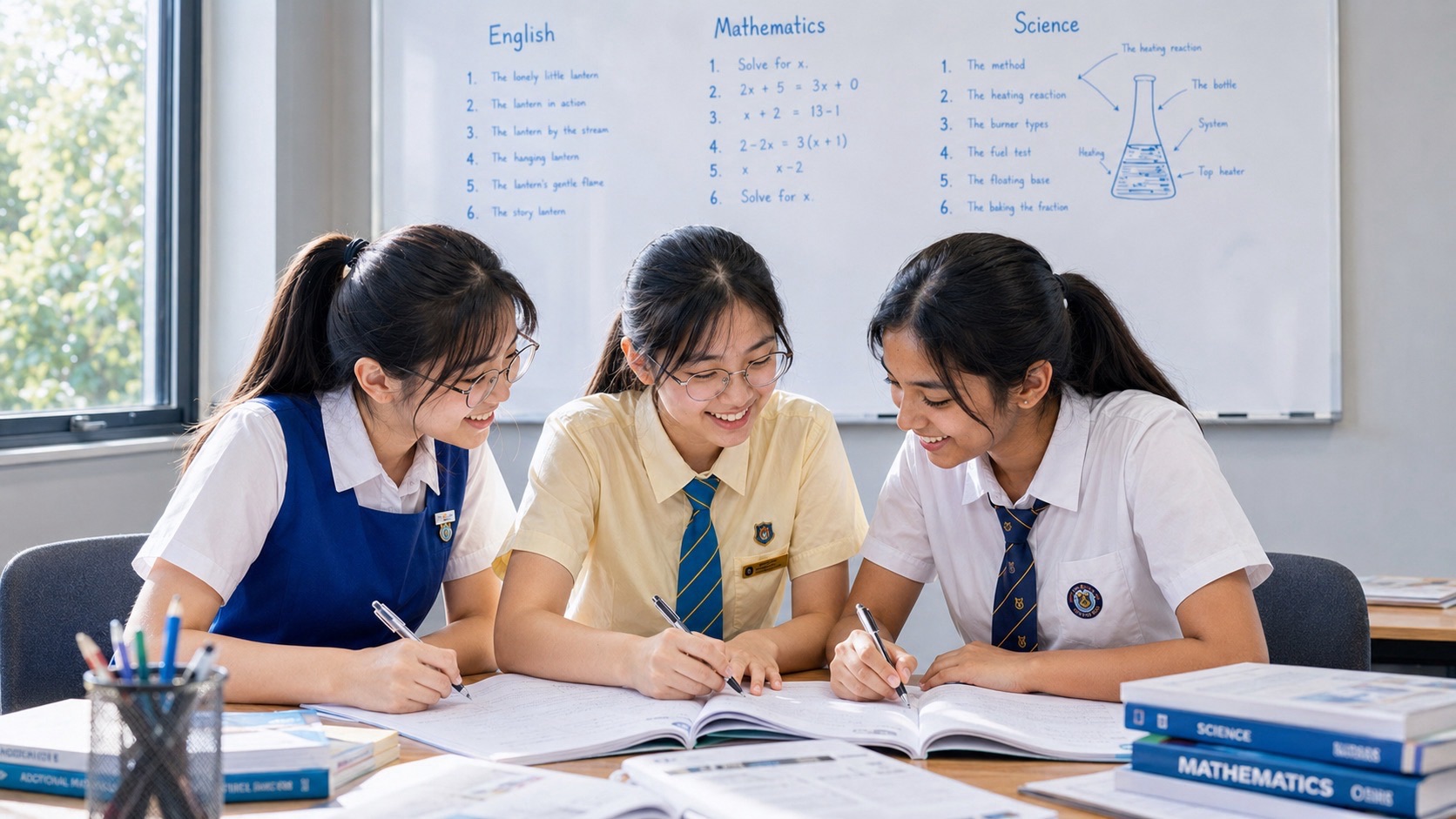
The first year of secondary school teaches a child how to enter a larger world. The second year asks a harder question: now that the world is familiar, how much of it can the student carry without being constantly prompted? This is the continuation of Mira and Ben’s Punggol story—from home to school, CCA, friendship, the library, the waterway, tuition, the holidays and the approach of upper secondary. Secondary 2 English is not merely another year of English. It is the year language begins to become a system the student must increasingly operate for themselves.
Mira does not wake before the alarm on the first Monday of Secondary 2.
This time, the alarm wins.
She reaches for it without opening both eyes, switches it off, and lies still for another thirty seconds while the room reminds her what year it is.
There is no new uniform hanging dramatically on the wardrobe door. The school shoes are not impossibly white. The bag has a scratch near the bottom and a stubborn zip that catches if she pulls it too quickly. She no longer needs to check the route to school. She knows which station exit she prefers, which corridor becomes crowded, which day of the week feels longest, and approximately how many minutes can disappear between “I am leaving now” and actually leaving the flat.
Secondary school is no longer a future she has to imagine.
It is simply her life.
That difference changes the whole purpose of Secondary 2.
In Secondary 1, Mira had to learn how to enter the system.
In Secondary 2, the system begins asking her to carry more of itself.
The teacher no longer explains every routine as if it is new.
A missed instruction is less easily excused by transition.
A forgotten worksheet is no longer a charming first-term mistake.
A group project expects more negotiation.
CCA expects more competence.
English texts expect more patience.
Writing expects more development.
Discussion expects the student not merely to have an opinion but to support it, qualify it, and respond to what somebody else has said.
The school day looks familiar.
The cognitive demand does not.
That is the central story of Secondary 2 English in Punggol:
familiarity must become responsibility.
The child has spent a year building routines. Now those routines have to begin working without an adult standing beside every switch.
Mira knows this before anyone says it.
She feels it in small moments.
A teacher asks the class to take out a text they were told to read over the weekend. Nobody repeats the instruction. Some students have read it. Some have not.
A Science task contains a long paragraph of information. The difficulty is not the science alone. The student has to decide which information matters.
A Humanities source makes a claim that sounds persuasive until another source complicates it.
A friend sends a message whose tone is ambiguous. Mira no longer assumes immediately that the worst interpretation is correct.
A composition topic looks simple, but the first obvious idea feels too thin to carry an entire response.
A teacher writes “develop” beside a paragraph. Mira knows now that this is not a decorative comment. It means a relationship is missing.
The second year is full of these almost-invisible demands.
The child is expected to notice more without being told to notice.
That is why Secondary 2 matters so much.
It is the quiet year between transition and upper-secondary consequence.
It does not have the symbolic drama of Secondary 1.
It does not yet have the examination pressure associated with later years.
But it is where weak habits either begin to repair or become expensive.
It is where strong habits either deepen or remain dependent on adult prompting.
It is where English can become the student’s own operating system.
And in Punggol, that system is running from the moment the day begins.
The Continuation: What Mira Carries from Secondary 1
Mira does not enter Secondary 2 empty.
That matters.
One of the easiest mistakes in education is to treat every January as if the child has been reset to zero.
But learning is cumulative.
A student arrives with habits, memories, misunderstandings, vocabulary, routines, anxieties, confidence, teacher feedback and a personal history of what has worked before.
Mira carries several useful things from Secondary 1.
She has learned to separate evidence from inference.
She knows that a confident answer is not automatically a strong answer.
She has stopped treating correction as a personal attack every single time, although tiredness can still make her defensive.
She reads questions more carefully.
She knows that vocabulary is useful when it creates precision rather than decoration.
She understands that “example” and “explanation” are different jobs.
She has begun to edit in more than one pass.
She knows that the phone beside the bed is a bad idea.
She has discovered that Punggol Regional Library can be a place she chooses rather than a place adults bring her to.
She knows that the waterway becomes more interesting when she looks before naming.
Most importantly, she has learned that English is not contained by English period.
It appears in Science explanations, Mathematics word problems, Humanities sources, project slides, friendship, digital information and family conversation.
That network now gives Secondary 2 something to build on.
A good second year therefore does not restart every skill.
It consolidates.
It extends.
It connects.
It increases independence.
This is also why a continuation article should not repeat the first-year story with a different number in the title.
Secondary 1 was about arrival.
Secondary 2 is about ownership.
In the first year, the tutor may have asked, “What exactly is the question asking?”
In the second year, Mira should increasingly ask herself before anybody intervenes.
In the first year, her parents checked whether the school bag contained everything.
In the second year, forgotten materials should become rarer because the checking system belongs to her.
In the first year, she needed help distinguishing what a paragraph was doing.
In the second year, she should begin seeing weak structure in her own writing.
This does not mean adults disappear.
Thirteen became fourteen, not thirty-four.
Mira still needs teachers.
She still needs parents.
On some weeks she still needs a tutor to see what she cannot see.
But the adult’s job changes.
Less carrying.
More calibration.
Less reminding.
More watching for patterns.
Less solving the first difficulty.
More helping the student identify what kind of difficulty it is.
This is the correct direction because Secondary 3 will not ask permission before becoming more demanding.
Upper-secondary subjects will widen.
Texts will become denser.
Writing will require stronger argument and control.
The eventual SEC route will require performance under conditions in which the student cannot ask, “What should I do next?”
Secondary 2 is where that future becomes visible without needing to dominate the present.
The student does not need to live inside the final examination.
The student needs to become the person who will eventually be able to handle it.
Home in Secondary 2: The Parent Steps Back Half a Pace
The home floor changes first.
In Secondary 1, Mira’s parents often asked questions because the family itself was learning the new school.
What time does CCA end?
Which teacher teaches English?
How does the school communicate assignments?
What happens before a weighted assessment?
How tired is the child after a long day?
By Secondary 2, many of those logistics are known.
The danger is that familiarity can make parents either too controlling or too absent.
The controlling parent thinks: the work is harder, so I must monitor more.
The absent parent thinks: the child knows the school now, so they should manage everything alone.
Neither extreme is ideal.
Secondary 2 needs supervised independence.
Mira’s parents gradually change the questions they ask.
In Secondary 1:
“Have you finished your homework?”
In Secondary 2:
“What are the three things you need to get done tonight?”
In Secondary 1:
“Did you pack your English file?”
In Secondary 2:
“What is your plan for tomorrow?”
In Secondary 1:
“Why did you lose these marks?”
In Secondary 2:
“What pattern do you see in the marks you lost?”
The wording matters because it moves cognitive work back to the student.
A parent can easily become an external executive function.
Remember this.
Pack that.
Start now.
Check again.
The child performs, but the system remains outside the child.
Secondary 2 should gradually bring that system inward.
Mira begins using a short Sunday review.
She does not call it a planning system because she is fourteen and that would make it sound too respectable.
She looks at the week.
Assessments.
CCA.
Projects.
Tuition.
One English priority.
If there is a marked script to review, she places it where it will not disappear beneath other papers.
If a composition is due, she decides when the first draft will happen.
If the week is crowded, she identifies what can be done early.
The routine takes fifteen minutes when it works and forty-five minutes when she becomes distracted.
Both are still part of learning.
The parents’ role is not to demand perfect self-management instantly.
It is to make self-management visible enough that it can improve.
A good Secondary 2 home therefore asks questions such as:
What are you responsible for?
What is your plan?
Where do you usually get stuck?
What have you already tried?
What support do you actually need?
That last question is especially useful.
Teenagers sometimes ask for help when they want rescue.
Adults sometimes provide rescue when the student only needed a prompt.
If Mira says, “I can’t do this comprehension,” a parent does not need to become the English teacher.
The parent can ask:
“What part can’t you do?”
Now the giant problem has to become more specific.
The passage is confusing?
The question is unclear?
A word blocks meaning?
The evidence is difficult to locate?
The inference feels uncertain?
The answer is in her head but not on the page?
Specificity reduces panic.
It also prepares the student for tuition and school feedback because she can bring a better question.
“I don’t understand English” is not teachable.
“I keep choosing evidence that is related to the topic but does not prove the exact inference” is teachable.
The second year should produce more sentences like the second one.
The Morning Route Is Familiar; Attention Must Become New
A familiar route can make a person stop seeing.
Mira discovers this because the journey to school now requires almost no conscious thought.
Lift.
Walkway.
Station.
Train.
Exit.
School.
Her feet know.
That is convenient.
It is also dangerous for a writer.
Writers depend on noticing what familiarity tries to erase.
In Secondary 1, Punggol felt new because secondary-school life was new.
In Secondary 2, Mira has to learn a more difficult form of observation: seeing a place she thinks she already knows.
A new advertisement appears near the station.
A shop changes.
Construction alters a walking route.
A younger batch of Secondary 1 students move awkwardly through the morning crowd.
Mira notices them and, for the first time, understands how young she must have looked a year earlier.
This is a small but important shift in perspective.
She is now capable of seeing herself historically.
Last year’s Mira was not stupid.
She was new.
This year’s Mira is not finished.
She is more experienced.
English benefits from that growing ability to hold two versions of a person at once.
Narrative becomes more mature when a writer understands that characters contain histories.
Argument becomes more mature when a student understands that current behaviour may have causes.
Comprehension becomes more mature when the reader remembers that one action does not define the whole person.
Even the route to school can teach this.
A place contains layers.
The student who sees only “Punggol MRT” sees the label.
The student who sees morning commuters, school groups, advertisements, public instructions, accessibility features, timing, noise, impatience, design and habit begins to see a system.
Secondary 2 English should increasingly teach students to read systems.
Not only sentences.
A text is a system.
A paragraph is a system.
An argument is a system.
A friendship conflict is a system of interpretations.
A news article is a system of selection and framing.
A school week is a system of priorities.
The second year is where the student becomes capable of asking not merely, “What is this?” but “How do the parts work together?”
That question sits underneath stronger comprehension and stronger writing.
Back in the Classroom: Familiarity Removes the Excuse
The classroom looks almost the same.
That is exactly why expectations rise.
Nobody needs a tour.
Nobody needs to explain what recess means.
Students know that teachers differ.
They know that some instructions appear on the board and some are spoken only once.
They know that “submit by Friday” becomes expensive on Saturday.
The school does not become cruel.
It simply assumes more competence.
English makes the same move.
The text may not be radically longer than the previous year’s, but the questions may require more synthesis.
A student may need to connect information across paragraphs.
A writer’s purpose may not be stated.
Tone may need to be inferred from patterns rather than one obvious word.
The distinction between what a writer says and what a writer implies becomes more important.
A visual may complicate the written text.
A discussion may require the student to respond to another view rather than deliver a prepared speech beside it.
This is the year when some students discover that fluency can hide weakness.
Ben is one of them.
He still speaks quickly.
He can still produce ideas at speed.
He can still make a class laugh.
But Secondary 2 exposes a new problem.
His first interpretation is often plausible.
Plausible is no longer enough.
The teacher asks:
“Which detail makes that interpretation stronger?”
Ben points to a line.
The teacher asks:
“Does the line actually prove that?”
Ben pauses.
This pause is valuable.
He has spent years being rewarded for speed.
Now he is learning the value of verification.
Mira has the opposite issue.
She verifies so carefully that she sometimes loses time.
The two students continue to make each other useful.
Ben reminds Mira that a first answer can be attempted before certainty is perfect.
Mira reminds Ben that a first answer can be tested before confidence turns into commitment.
Secondary 2 is full of this balancing work.
Speed and care.
Voice and evidence.
Independence and support.
Confidence and revision.
The student is learning not simply to possess skills but to regulate them.
Reading in Secondary 2: The Text Starts Hiding Its Architecture
A beginning reader often looks for sentences.
A stronger reader looks for relationships.
By Secondary 2, this distinction becomes increasingly important.
Consider a non-fiction text with six paragraphs.
A weak reader may remember six sets of details.
A stronger reader asks what each paragraph is doing.
Problem.
Example.
Counterpoint.
Evidence.
Consequence.
Recommendation.
Now the six paragraphs become an architecture.
This is one reason Secondary 2 comprehension can feel suddenly harder even when vocabulary is manageable.
The text is no longer difficult because every sentence is obscure.
It is difficult because meaning is distributed.
The writer may introduce an idea in paragraph one, complicate it in paragraph three, support it in paragraph four and qualify it in paragraph six.
The reader has to keep the structure active long enough to see the whole.
Mira develops a habit of writing tiny margin labels.
Not summaries.
Jobs.
“claim”
“example”
“shift”
“problem”
“cause”
“counter”
“result”
These labels are useful because they compress function.
She does not need to remember every word while deciding how the text moves.
Ben draws arrows.
His page looks untidy and works well for him.
This difference matters.
Reading strategy is not one ritual everybody must perform identically.
The goal is not beautiful annotation.
The goal is better comprehension.
A strategy earns its place if it helps the student:
find structure,
retain relationships,
identify relevant evidence,
and answer more accurately.
Secondary 2 is also where students should become suspicious of over-highlighting.
Some students highlight half the page.
This produces a bright text and a weak hierarchy.
If everything is important, nothing has been selected.
Mira uses a simple test:
“If I could keep only one sentence from this paragraph, which one carries the most meaning?”
Sometimes the answer is not a single sentence.
Sometimes the paragraph’s meaning exists in the relationship between two ideas.
That itself is a useful discovery.
Texts are not always reducible to one quotable line.
The reader must understand the movement.
Plausible Answers: The Secondary 2 Trap
One of the defining English problems of Secondary 2 is the plausible answer.
It sounds right.
It fits the general topic.
It may even use language from the passage.
It still loses marks.
This frustrates students because they feel close.
But closeness is exactly what Secondary 2 has to refine.
Suppose a passage describes a character repeatedly checking the time, looking towards a door and answering questions with unusually short replies.
A student writes:
“The character is impatient.”
Possible.
Another writes:
“The character is anxious about someone arriving.”
Also possible.
Which is stronger?
The answer depends on evidence and context.
The job is not to guess what the examiner likes.
The job is to choose the interpretation most defensible from the text.
Mira uses a three-step test:
- What does my answer claim?
- Which exact evidence supports that claim?
- Could the same evidence support a different explanation just as well?
That third question is where Secondary 2 begins becoming intellectually interesting.
A student learns to compare explanations.
This habit travels far beyond English.
A graph changes.
Why?
A historical event occurs.
Why?
A friend becomes quiet.
Why?
A news report makes a claim.
Why should I believe it?
The best available explanation is rarely established by confidence alone.
It is established by fit.
How well does the explanation account for the evidence?
How much unsupported assumption does it require?
Does another detail contradict it?
Mira finds this slow at first.
Then something changes.
The questions stop feeling like traps.
They start feeling like reasoning.
This is the moment comprehension becomes more than answer-finding.
It becomes judgement.
Vocabulary in Secondary 2: From Meaning to Register
Secondary 1 taught Mira that vocabulary is precision.
Secondary 2 adds another layer:
register.
A word can be technically correct and still be wrong for the situation.
The language used in a message to a close friend differs from language used in a report.
A phrase that sounds natural in speech may sound careless in formal writing.
A formal word can make a personal narrative sound absurd.
A teenager who understands meaning but not register can produce writing that is accurate and strange.
Ben learns this through overcorrection.
After being told that his vocabulary is sometimes too simple, he tries to upgrade every sentence.
A boy no longer “walks” across a room.
He “traverses the interior environment”.
A friend is not “annoyed”.
He is “experiencing substantial indignation”.
The class enjoys this far more than the task requires.
The tutor asks Ben a useful question:
“Would this person actually think or speak this way?”
That question brings vocabulary back to voice.
Strong language is not always the most advanced-looking language.
It is the most appropriate language.
Secondary 2 students should therefore begin distinguishing:
formal and informal,
neutral and emotive,
precise and vague,
technical and everyday,
literal and figurative,
assertive and qualified.
Consider:
“Teenagers are addicted to their phones.”
versus
“Many teenagers may develop habits of frequent phone checking.”
The first is rhetorically forceful.
The second is more qualified.
Neither is automatically better.
The writer chooses according to evidence, purpose and tone.
This is register working with judgement.
Vocabulary development in Secondary 2 should therefore include not only new words but relationships between words.
Which one is stronger?
Which one is more formal?
Which one carries judgement?
Which one implies intention?
Which one is safer when evidence is limited?
Which collocation sounds natural?
Which verb reduces the need for an adverb?
Mira begins collecting vocabulary differently.
Instead of one-word lists, she keeps clusters.
claim — assert — suggest — imply — argue — maintain — allege.
Each verb places a different burden on the sentence.
“Suggests” leaves room.
“Asserts” describes confidence.
“Alleges” signals a claim that may be disputed.
“Implies” tells the reader the meaning is indirect.
Now vocabulary becomes analytical equipment.
That is a Secondary 2 step.
Grammar in Secondary 2: Cohesion, Not Merely Correctness
By Secondary 2, grammar teaching should move beyond catching isolated errors.
Accuracy still matters.
Subject-verb agreement still matters.
Tense still matters.
Pronoun reference still matters.
Sentence boundaries still matter.
But the larger question becomes cohesion.
Do the sentences hold together?
Can the reader follow who “they” refers to?
Does the paragraph maintain the same time frame?
Does a connective express the relationship the writer actually means?
Does the subject of the sentence remain stable enough for the reader to track?
Does the paragraph move, or does each sentence restart the idea?
Ben can write five grammatically acceptable sentences that still do not form a good paragraph.
That is the Secondary 2 problem.
Correctness is local.
Cohesion is relational.
Mira sees this when she reads two versions of a paragraph.
Version one:
“Public spaces are important. People use them for exercise. They can also meet friends. Punggol has parks. These places can improve community life.”
Nothing is dramatically wrong.
But the movement is weak.
Version two:
“Public spaces matter not only because they provide room for exercise, but because repeated shared use can turn a neighbourhood into a community. In Punggol, parks and the waterway create places where residents who may never speak to one another still occupy the same social space. That repeated visibility can make a town feel less anonymous.”
The second paragraph contains more than better vocabulary.
Its sentences depend on one another.
The idea advances.
This is cohesion.
Secondary 2 writing should increasingly teach students to ask:
What does this sentence add?
What does “this” refer to?
What relationship does the connective express?
Have I repeated the same point using different words?
Does the example actually develop the claim?
Can the paragraph survive if one sentence is removed?
These questions turn grammar into architecture again.
The student stops seeing grammar as a police force at the end of writing.
Grammar becomes one of the systems that carries thought from sentence to sentence.
Writing in Secondary 2: The Middle Matters More Than the Opening
Ben still loves introductions.
Introductions feel productive.
They are visible.
They let the writer sound confident before difficult thinking begins.
This is why students can spend fifteen minutes constructing a dramatic opening and then hurry through the argument that follows.
Secondary 2 is the year to break this habit.
The middle matters.
A piece of writing succeeds because the central material develops.
Mira has a different weakness.
She plans carefully, but sometimes the plan is so neat that the final writing feels mechanical.
Point.
Example.
Explanation.
Next point.
Everything is correct.
Nothing breathes.
Secondary 2 writing must therefore balance structure and voice.
Students need organisation strong enough to prevent wandering and flexibility strong enough to allow real thought.
A useful paragraph is not a fixed recipe.
It is a unit of movement.
It should begin somewhere and end somewhere further.
In argument, the movement may be:
claim → reason → evidence/example → consequence → qualification.
In reflection:
experience → interpretation → change in understanding.
In narrative:
situation → pressure → choice → consequence.
In explanation:
concept → mechanism → example → implication.
The structure depends on the job.
This is why “one paragraph formula for everything” eventually becomes limiting.
Form should follow purpose.
Secondary 2 students are ready to learn that.
Ben finds it liberating.
He thought structure meant obedience.
Now he sees structure as load-bearing design.
Different buildings need different frames.
Different paragraphs do too.
Argument Begins When the Student Can See the Other Side
A one-sided opinion is easy.
Real argument begins when a student can represent another position fairly enough to answer it.
Secondary 2 is an excellent year to begin this more seriously.
Mira’s class discusses whether schools should limit student phone use more strictly.
The first round is predictable.
“Phones distract students.”
“Phones are useful for learning.”
“Students should be responsible.”
“Teachers need control.”
All true enough.
Then the teacher changes the task.
Each group must produce the strongest version of the view they disagree with.
The room becomes quieter.
This is harder.
If Mira supports stricter limits, she must explain why someone might reasonably oppose them.
Emergency communication.
Digital learning.
Personal responsibility.
Practical difficulty of enforcement.
Different needs for different students.
Now the disagreement has substance.
The teacher asks:
“What would your opponent say is the weakness in your argument?”
That question is uncomfortable.
It is also one of the best thinking questions available.
Argument becomes stronger when the writer knows where it can be attacked.
This produces qualification.
“Although…”
“However…”
“This concern is valid, but…”
“In situations where…”
“The policy would be more reasonable if…”
These are not decorative essay phrases.
They are evidence that the student can hold more than one idea at a time.
Ben initially thinks concession makes an argument weaker.
If you admit the other side has a point, have you not lost?
Then he discovers the opposite.
A writer who acknowledges a real limitation appears more trustworthy.
The argument becomes calibrated rather than absolute.
This is an important Secondary 2 maturity.
Students begin moving away from words such as:
always,
never,
everyone,
completely,
obviously.
Not because these words are forbidden.
Because reality rarely earns them easily.
Situational Writing: The Reader Is Now a Real Constraint
Secondary 1 introduced audience and purpose.
Secondary 2 should make them operational.
A student can write grammatically correct sentences and still fail the communication task if the reader receives the wrong message.
Suppose Mira has to propose an activity to a school committee.
She loves the activity.
That is not enough.
The committee needs different information from her friends.
Cost.
Feasibility.
Benefits.
Timing.
Participation.
Possible concerns.
The writing changes because the reader changes.
Ben learns this when he writes a speech that sounds like an email.
The content is relevant.
The register is not.
A speech needs to be heard.
Sentences need rhythm.
The listener cannot reread the previous paragraph.
Transitions have to work orally.
Direct address may help.
Repetition can be useful when controlled.
An email has different affordances.
A report has others.
This is where Secondary 2 students begin seeing genre as a solution to a communication problem rather than a template.
Why does a report use headings?
Because the reader may need to locate information quickly.
Why does a speech sometimes repeat a phrase?
Because listeners need auditory structure.
Why does an email make purpose clear early?
Because the recipient needs to know why the message exists.
These questions are more powerful than memorising “features” in isolation.
Students who understand the reason can adapt when the surface changes.
That adaptability becomes increasingly important later.
Digital Texts: Reading What Is Designed to Make You React
The phone remains part of the English classroom even when it is not on the desk.
Secondary 2 students live inside texts designed for reaction.
Headlines.
Notifications.
Short videos.
Captions.
Comments.
Thumbnails.
Advertisements.
Generated summaries.
Recommendation feeds.
The text is not neutral.
It wants attention.
Sometimes it wants belief.
Sometimes it wants action.
Sometimes it wants outrage because outrage increases engagement.
Secondary 2 English should therefore strengthen one habit above almost all others:
notice the design of the message.
What emotion is the headline trying to produce?
What does the thumbnail imply before the video begins?
Why is this quotation isolated?
What context is missing?
Why is a statistic shown without a denominator?
Who benefits if I click?
Who benefits if I believe?
Mira encounters a post claiming that a particular study method “improves grades by 300%”.
The number is impressive.
It is also suspiciously empty.
Three hundred percent compared with what?
For whom?
Over what period?
Measured how?
Ben says, “It has a graph.”
Mira says, “Graphs can lie politely.”
Ben saves that sentence because he plans to use it later.
They trace the claim.
The original source does not say what the post says.
This is not unusual.
The educational goal is not to make teenagers cynical.
Cynicism is lazy too.
If everything is assumed false, no evaluation is required.
The better goal is calibrated trust.
Strong evidence earns more confidence.
Weak evidence earns less.
Uncertain evidence remains uncertain.
This is English because the student is reading meaning, purpose, evidence and context.
It is also preparation for adulthood.
AI in Secondary 2: Fluency Is No Longer Proof of Understanding
By Secondary 2, many students have encountered AI-generated language.
Some use it to explain a concept.
Some use it to brainstorm.
Some use it to rewrite.
Some use it badly.
The central educational problem is simple:
a machine can produce a fluent paragraph without the student understanding the paragraph.
That means fluency has become a weaker signal of learning.
This changes what good English education should value.
Can the student explain why the answer is strong?
Can they verify a claim?
Can they identify the weakest sentence?
Can they adapt the explanation to a different audience?
Can they reproduce the reasoning without the tool?
Can they detect when the generated answer sounds plausible but misreads the question?
Mira uses AI occasionally as a challenger.
She writes a paragraph first.
Then she asks for two objections to her argument.
She evaluates the objections.
One is useful.
One is generic.
She strengthens the paragraph using her own judgement.
Ben initially uses AI differently.
He asks it to improve a sentence.
The result sounds sophisticated.
He cannot explain one of the words.
The tutor asks him to remove every word he cannot defend.
The sentence becomes shorter and better.
This is a useful principle:
Never outsource the judgement you are supposed to be learning.
AI can supply options.
The student still has to choose.
AI can suggest examples.
The student still has to verify relevance.
AI can produce a polished answer.
The student still has to know whether it answers the actual question.
Secondary 2 English becomes more important in this environment because judgement cannot be replaced by surface fluency.
When machines can write, students need to become better readers of writing—including their own.
Speaking in Secondary 2: From Giving an Opinion to Joining a Conversation
Secondary 1 speaking was partly about finding a usable voice.
Secondary 2 speaking is about entering a shared intellectual space.
The student must listen, respond and adjust.
A discussion is not six mini-speeches placed beside one another.
Mira is good at listening but can disappear.
Ben is good at entering but can dominate.
The class practises a simple rule:
Before disagreeing, summarise the other person’s point accurately enough that they would accept the summary.
This changes the discussion.
Students cannot attack a caricature.
They have to listen.
“I think your point is that…”
“Would it be fair to say…”
“You are not saying X; you are saying Y…”
Then respond.
This habit has enormous value.
It reduces unnecessary conflict.
It improves oral communication.
It teaches intellectual honesty.
It also strengthens writing because students become better at representing counterarguments.
Mira finds another useful sentence:
“I agree with the concern, but I am not convinced by the solution.”
That sentence lets her separate diagnosis from response.
Ben uses:
“What evidence would change your mind?”
The teacher smiles because that question can become dangerous in the best way.
A strong discussion is not about winning.
It is about improving the shared map of the issue.
Secondary 2 students are old enough to begin experiencing this.
Listening: The Skill That Makes Every Other Class Easier
Listening remains one of the least visible school skills.
A student who listens poorly often looks like a student with memory problems, organisation problems or comprehension problems.
Sometimes those problems are real.
Sometimes the original information was never encoded accurately.
Secondary 2 demands better listening because instructions grow denser.
A teacher may say:
“Read the article, annotate the writer’s position, identify one limitation, and be prepared to discuss it tomorrow.”
The student who hears only “read the article” arrives partially prepared.
Mira begins taking selective notes during instructions.
Not every word.
Action words.
Read.
Annotate.
Identify.
Discuss.
This is listening as extraction.
Ben needs a different improvement.
He hears the instruction but starts acting before it ends.
Secondary 2 teaches him to wait.
That sounds trivial.
It is not.
Premature action is a recurring problem across subjects.
Students answer the first half of the question.
Begin calculation before identifying the required quantity.
Start writing before understanding audience.
Respond to a friend before reading the full message.
Listening teaches patience.
And patience is a cognitive skill.
Friendship in Secondary 2: The Language Becomes Less Innocent
Secondary 1 friendship is often about finding people.
Secondary 2 friendship is about maintaining relationships after people know more about one another.
This can be harder.
The group now has history.
Jokes have context.
Small resentments can accumulate.
Students have reputations.
Someone who was “the funny one” wants to be taken seriously.
Someone who was quiet becomes more confident.
Groups change.
CCA introduces other friendships.
Academic differences become more visible.
Language carries these shifts.
A message that would have been ignored in January can become loaded in August because of what happened in between.
Mira learns that context is not only a reading skill.
It is a relationship skill.
Ben learns that “I was joking” does not automatically erase impact.
The students also become more capable of indirect language.
Sarcasm.
Implication.
Exclusion without explicit insult.
Praise that is not really praise.
Secondary English texts often contain similar complexity.
Tone becomes easier to understand because life supplies examples.
The reverse is also true.
Literature and narrative can help students name interpersonal patterns they feel but cannot yet describe.
Why is this character’s apology unsatisfying?
Why does the dialogue feel tense even though nobody argues directly?
Why does one person have more power in the conversation?
Why does silence matter here?
These are textual questions.
They are also human questions.
Secondary 2 is old enough for both.
CCA: Competence Creates Responsibility
In Secondary 1, CCA is another new environment.
In Secondary 2, Mira is no longer the newest person.
That matters.
Younger students arrive.
Suddenly she sees what seniors saw when she first entered.
The year becomes vertical.
There are people above and below.
Even without a formal leadership role, students may be expected to help, explain routines or model behaviour.
Language changes again.
Giving an instruction to a peer is different from giving an instruction to a younger student.
Correction requires tone.
Encouragement requires credibility.
Leadership requires clarity.
Ben discovers that saying “just do it like this” is not an explanation.
If someone does not already know the method, “like this” carries nothing.
He has to decompose the action.
First.
Then.
Because.
If.
This improves his academic explanations too.
Teaching is a powerful test of understanding because hidden steps become visible.
Mira discovers another leadership skill:
asking before assuming.
“Do you need help?”
is different from
“Here, give it to me.”
The first preserves agency.
The second solves faster.
Sometimes speed matters.
Sometimes learning matters more.
These are not English syllabus points in a narrow sense.
They are what language looks like when responsibility increases.
Secondary 2 is the year this begins to happen more often.
The Study System Must Begin to Belong to the Student
By now, Mira knows several useful study ideas.
Break a task into parts.
Correct marked work.
Retrieve rather than reread everything.
Schedule demanding work before exhaustion where possible.
Read beyond the syllabus.
Use a weekly priority.
The new challenge is consistency.
Knowing a system is not the same as operating it.
Secondary 2 exposes this difference because adults prompt less.
A student may be able to describe a perfect revision plan and still begin the night before.
This is not hypocrisy.
It is a self-regulation gap.
The solution is not another lecture about discipline.
The solution is to make the first action easier to execute.
For Mira, a composition begins with opening the file and writing three possible directions.
For Ben, comprehension begins with underlining the exact demand before reading for evidence.
Small starts reduce friction.
The students also learn to distinguish open tasks from active tasks.
An open task lives in the mind.
“Need to fix English.”
“Need to read.”
“Need to revise.”
These consume attention because they are undefined.
An active task has a next action.
“Rewrite paragraph two using the teacher’s feedback.”
“Read pages 45–60.”
“Redo questions 3 and 6 from the marked comprehension.”
Secondary 2 English benefits from this operational clarity.
The more independent the student becomes, the more useful it is to know what “work on English” actually means today.
The Governing Principle of the Year
By the end of the first month, the shape of Secondary 2 becomes clearer.
The child does not need a louder educational system.
The child needs a more internal one.
The governing principle is:
What an adult had to prompt last year should increasingly become something the student can notice, decide or repair this year.
Not everything.
Not immediately.
But progressively.
That is the year.
The rest of the story is how this principle survives contact with the calendar.
January: The Familiar Start Can Be More Dangerous Than the New One
January in Secondary 2 feels easier than January in Secondary 1.
That is true.
It can also create complacency.
The student knows the school.
The student knows the teachers will eventually assign work.
The student knows roughly how the term runs.
This can produce a dangerous thought:
“I know how this works.”
Mira has that thought.
Then she receives the first substantial English text of the year.
She understands the topic.
She understands nearly every word.
She still answers one question weakly because she assumes the question is asking the same kind of thing as a similar question from last year.
Familiarity creates prediction.
Prediction saves time.
Prediction also creates error when the surface looks familiar but the demand has changed.
The lesson is immediate:
Do not let prior knowledge replace reading.
Use prior knowledge to support reading.
January therefore becomes a month of recalibration rather than orientation.
The student asks:
What remains the same?
What is now expected at a higher level?
Where did last year’s support remain external?
Which habits survived the holidays?
Which disappeared?
Mira notices that her reading structure returns quickly.
She still labels paragraph jobs.
She still separates evidence from inference.
Her writing, however, has one old weakness waiting patiently for her.
She begins strongly.
The paragraph loses precision in the middle.
The first English priority of the year becomes obvious:
develop one idea fully before reaching for another.
Ben discovers that his planning habit decayed over the holidays.
His first piece is energetic and badly proportioned.
The introduction occupies too much space.
The last point arrives exhausted.
He does not need a new theory of writing.
He needs retrieval.
January is therefore not the month to teach every new Secondary 2 technique at once.
It is the month to restore the strong parts of Secondary 1 and identify where expectations have moved.
A useful January review may ask:
What did the student do independently last October that they no longer do automatically now?
Which reading routines return quickly?
Which grammar problems return under pressure?
Can the student interpret teacher feedback without translation?
Can the student plan a week without a parent constructing it?
Can the student name one real English priority?
This is how familiarity becomes useful rather than lazy.
February: The First Assessment Reveals Whether Last Year Travelled
The first meaningful assessment of the year is not important because it predicts the final result.
It is important because it tests transfer.
Did last year’s learning survive?
Mira receives a comprehension script.
The overall mark is respectable.
That is not the most useful information.
She studies the lost marks.
One error is new.
One is careless.
Two come from the same old weakness: her explanation is accurate but underdeveloped.
She can now see the pattern herself.
That is progress even before the mark improves.
Ben receives a writing task back.
His teacher has written:
“Good ideas. Need greater control.”
A year earlier, Ben might have interpreted that as a contradiction.
If the ideas are good, why is the writing not good?
Now he understands that content and control are separate dimensions.
He has something to say.
He has not organised it reliably enough for the reader.
February becomes the month of evidence.
Not dramatic intervention.
Evidence.
The student should begin constructing a personal error profile.
For Mira:
- underdeveloped explanation;
- occasional overqualification;
- slower timing on unfamiliar non-fiction;
- generally strong task reading.
For Ben:
- proportion;
- rushed conclusions;
- grammar instability in long sentences;
- strong oral ideas;
- sometimes chooses examples before defining the point.
These profiles should not become labels.
They are working maps.
A good map changes as the terrain changes.
If Mira’s inference weakness disappears by June, it should stop receiving disproportionate attention.
If a new cohesion problem appears, the map updates.
This is where Secondary 2 becomes more efficient than Secondary 1.
The student no longer needs equal practice in everything.
The year can narrow around the highest-leverage weaknesses while continuing to maintain the whole system.
March: The First Audit Should Now Be More Student-Led
In Secondary 1, Mira’s parents helped spread the work across the table.
In Secondary 2, Mira does more of the audit herself.
This is a small but deliberate transfer of responsibility.
She chooses:
one comprehension script,
one piece of writing,
one vocabulary record,
one teacher comment she keeps ignoring.
She looks for repetition.
The adult is available.
The adult does not begin.
This is important.
If every review starts with a parent identifying the problems, the child may become very good at waiting to be diagnosed.
Secondary 2 should begin building self-diagnosis.
Mira writes three headings:
Working
Unstable
Next
Under Working:
question reading,
evidence selection,
editing for obvious grammar errors.
Under Unstable:
paragraph development,
timing on dense texts.
Under Next:
develop explanation without adding repetition.
That final phrase matters.
She has become more precise.
Ben’s March review is less tidy but equally useful.
He writes:
“Stop spending forever on intros.”
“Long sentences = check grammar.”
“Don’t use an example before I know what point it proves.”
The language is his.
That is good.
A student-owned rule is more useful than a teacher phrase copied without understanding.
The March break still needs rest.
Secondary 2 may feel more important, but it is still not a reason to turn every school holiday into an academic siege.
Mira reads.
Ben plays games.
They both do some deliberate English.
They also do things nobody assesses.
The point of the audit is to improve the next term, not to punish the previous one.
A healthy holiday review creates direction.
An unhealthy one creates shame.
The difference is often in the questions.
Not:
“Why are you still making this mistake?”
But:
“What makes this mistake survive?”
That question invites mechanism.
Does it happen only under time?
Only in long sentences?
Only when the topic is unfamiliar?
Only when the student is tired?
Only in writing but not grammar drills?
Now the repair can be designed.
April: The Year Begins to Accelerate
Term 2 is where the second year stops feeling like a continuation of January and begins becoming its own terrain.
Projects appear.
Assessments accumulate.
CCA becomes more serious.
The student is expected to remember routines without celebration.
English begins integrating more fully with the rest of school.
Mira has to read an article for a project outside English.
The article is not written for fourteen-year-olds.
The sentences are manageable.
The ideas are not.
She discovers a new reading problem:
background knowledge.
A student can know every word in a paragraph and still not understand the paragraph if the underlying concept is unfamiliar.
This matters enormously.
Vocabulary is not the only gateway to comprehension.
Knowledge matters.
Mira begins asking:
What does this text assume I already know?
This becomes one of the strongest questions of the year.
A text about climate policy assumes some understanding of emissions, incentives, public policy and trade-offs.
A text about artificial intelligence assumes some understanding of data, models or automation.
A text about urban planning assumes some understanding of land, transport and public space.
The student cannot build all this knowledge during the English lesson alone.
That is why reading beyond the syllabus matters.
Secondary 2 is where broad knowledge begins paying obvious dividends.
A student with wider knowledge reads faster because more references have somewhere to attach.
Writing improves because examples become richer.
Discussion improves because the student can compare.
Argument improves because the student can see consequences.
April therefore becomes the month when English and world knowledge begin to fuse more visibly.
May: Work-in-Progress Becomes the Enemy
May is not difficult only because there is more work.
It is difficult because there are more unfinished things.
A composition started but not revised.
A project researched but not assembled.
A comprehension correction understood but not redone.
A book begun but abandoned.
A vocabulary list created but never reviewed.
A presentation drafted but not practised.
Each open task occupies mental space.
Mira discovers that she feels “busy” even on evenings when she is not doing much.
The problem is work-in-progress.
Too many open loops.
Secondary 2 is old enough to learn a useful operational principle:
finish small things before opening unnecessary new ones.
This does not mean every project must be completed in one sitting.
Large work needs stages.
But stages should close.
Research completed.
Outline completed.
Draft completed.
Revision completed.
The mind benefits from knowing what “done for today” means.
English tasks are especially prone to remaining half-open because writing can always be improved.
Students need stopping rules.
For example:
Today I will finish the outline and first two paragraphs.
Today I will correct every lost mark in this comprehension.
Today I will learn and use eight words from this cluster.
Today I will practise the oral response twice and revise the opening.
This is better than “do English”.
Ben initially hates the idea of stopping rules because he prefers working according to mood.
Then he notices that mood often arrives after he begins.
This is another Secondary 2 discovery.
Motivation is not always the starting condition.
Sometimes action produces motivation.
The student opens the document.
Writes the first weak sentence.
The next sentence becomes easier.
By May, the goal is not perfect productivity.
It is reducing the cost of beginning.
June: The Long Holiday Is Now a Bridge to Upper Secondary Thinking
The June holiday feels different in Secondary 2.
Secondary 3 is not next week.
It is still close enough to become imaginable.
Students begin hearing more conversation about upper-secondary subjects, subject combinations, expectations and the future.
This can make families overreact.
June does not need to become premature Secondary 3.
It should become a bridge.
A bridge is not the destination.
It makes the next movement easier.
For English, the best June bridge has three parts:
repair,
breadth,
independence.
Repair one or two persistent weaknesses.
Broaden reading and knowledge.
Practise managing a small learning project independently.
Mira chooses a question again, but this year the question is harder:
What makes a city feel like it belongs to the people who live in it?
The question begins in Punggol.
She thinks about One Punggol.
The library.
The waterway.
HDB common spaces.
Transport.
Schools.
Playgrounds.
Shops.
Older residents.
Children.
Workers.
Cyclists.
People passing through.
The question leads to public space, community design, inclusion, accessibility, safety and ownership.
She reads articles.
She watches talks.
She notices that different writers use the word “community” in very different ways.
Some mean social bonds.
Some mean geographic proximity.
Some mean organised groups.
Some mean a political ideal.
Vocabulary becomes conceptual.
This is an important Secondary 2 step.
Students should begin seeing that words can carry contested meanings.
“Progress.”
“Fairness.”
“Freedom.”
“Safety.”
“Success.”
“Community.”
“Responsibility.”
These are not simple dictionary entries.
They become arguments.
Ben chooses a different project.
He wants to understand why some explanations on the internet feel clear and others feel impossible.
He compares videos, articles and diagrams on a topic he likes.
He begins identifying features of good explanation.
Define the thing.
Show the mechanism.
Use an example.
Avoid unexplained jargon.
Sequence information.
Connect the new idea to something known.
Now he has accidentally built a theory of teaching.
He also becomes better at explaining in English.
This is what a good June holiday can do.
It lets the student learn sideways and return with stronger vertical capability.
Punggol Regional Library in Secondary 2: From Browsing to Research
In Secondary 1, the library taught Mira controlled wandering.
In Secondary 2, it can begin teaching research.
Not formal academic research.
Not yet.
But the student can learn that one source is not enough for many questions.
Mira’s city project brings her to Punggol Regional Library with a notebook.
This time she has a question before she has a book.
That changes the visit.
She looks for sources that answer different parts.
Urban design.
Community.
Public transport.
Architecture.
Singapore development.
Youth spaces.
She also discovers something important:
books organise knowledge differently from search engines.
A search engine often returns an answer-shaped result.
A book gives context the student did not know to request.
This matters because good research requires both retrieval and discovery.
The student needs answers.
The student also needs to discover better questions.
Mira finds a concept she did not search for:
“third place”.
A place that is not home and not work or school, but where people gather socially.
The concept changes how she thinks about libraries, cafés, community centres and parks.
That is what knowledge does.
It gives names to patterns already partly visible.
Once named, the pattern becomes easier to think about.
English grows because the student now has language for an idea.
This is the deeper vocabulary pipeline:
experience → concept → word → connection → use.
A word learned this way is harder to forget because it belongs to a structure.
The library also becomes a place to compare source quality.
An introductory book.
A newspaper article.
A government report.
A personal essay.
Each source has different purposes and limitations.
Mira begins asking:
What can this source reasonably tell me?
That is more useful than the crude question:
“Is this source good?”
A personal essay may be excellent evidence of one person’s experience and poor evidence for a national trend.
A government report may be strong for official data and less useful for private emotion.
A news article may synthesise quickly but simplify technical detail.
Source evaluation becomes contextual.
Secondary 2 can handle that sophistication.
The Waterway in Secondary 2: Description Becomes Interpretation
In Secondary 1, Mira practised seeing.
In Secondary 2, she practises deciding what the details mean.
She walks along Punggol Waterway at different times.
Morning.
Afternoon.
Evening.
The same place produces different human behaviour.
Runners.
Families.
Cyclists.
Children.
People sitting alone.
People taking photographs.
Workers moving through.
Older residents walking slowly.
Teenagers occupying a bench without doing anything adults would classify as productive.
Description can now become interpretation.
Why do people choose this place?
What makes one space feel public but comfortable?
How does design invite or discourage behaviour?
How does light change mood?
What happens when a route becomes crowded?
What does the place reveal about the town?
This does not mean every composition about a park needs social analysis.
The value is that the student now has layers available.
Surface.
Function.
Meaning.
A mature description can move between them.
“The benches faced the water” is observation.
“The benches faced the water, so strangers could sit beside one another without being forced into conversation” is interpretation.
The second sentence sees design and social behaviour together.
This is Secondary 2 English growing through the local world.
July: Retrieval Is Now the Student’s Responsibility
Returning from June creates the same forgetting problem as the previous year.
But the response changes.
Mira no longer waits for someone to tell her what to review.
She notices that one reading routine feels slower.
She retrieves it.
This matters because self-regulated learning depends on noticing decay.
A student who can only improve when an adult identifies the decline remains externally managed.
Secondary 2 should build monitoring.
What feels rusty?
What is taking longer than it used to?
Which error has returned?
Which habit disappeared during the break?
Ben notices that his long-sentence grammar problem has returned.
He does not need a full grammar course.
He needs to re-activate the check.
Find the subject.
Find the verb.
Check agreement.
Check whether the sentence has changed direction halfway.
He does five deliberate examples.
Then returns to real writing.
This sequence is important.
Retrieve in isolation.
Transfer immediately.
Do not let drill become a separate universe.
July also tests whether June breadth can enter school.
Mira uses her city reading as an example in a class discussion.
Not because she memorised a model essay.
Because knowledge is portable.
That is the payoff of wide reading.
The student becomes less dependent on generic examples such as “technology has advantages and disadvantages”.
They have something specific to say.
August: Public Language Becomes a Study of Framing
A year earlier, Mira noticed large public words around National Day.
This year, she studies framing.
Two texts can celebrate the same event differently.
One emphasises history.
Another emphasises future ambition.
One focuses on ordinary citizens.
Another focuses on institutions.
One uses statistics.
Another uses personal stories.
Neither necessarily lies.
Selection creates emphasis.
This becomes one of the most important reading lessons of Secondary 2.
Framing is not automatically manipulation.
Every text selects.
No article can include everything.
The critical question is:
What does this selection make easier to see, and what does it make easier to forget?
Mira compares several pieces about Singapore’s development.
The facts overlap.
The stories differ.
One text emphasises economic transformation.
Another emphasises housing.
Another environmental cost.
Another social cohesion.
Now “reading critically” stops meaning “find something wrong”.
It means understanding how a perspective is constructed.
Ben applies the idea to social media.
A twenty-second clip can frame a whole argument through one dramatic case.
The case may be real.
The frame may still be incomplete.
This nuance is exactly what Secondary 2 should cultivate.
Do not move from naïve belief to reflexive disbelief.
Move towards better-calibrated interpretation.
September: Repair Has to Survive Pressure
By September, the year has enough data to show which weaknesses are stubborn.
Mira’s paragraph development has improved.
In untimed work.
Under time pressure, the old compression returns.
She knows what to do.
She does not always have enough cognitive space to do it.
This is a new stage of repair.
The weakness is no longer conceptual.
It is performance under load.
That means practice must change.
Shorter planning time.
Timed paragraph.
Immediate review.
Fresh prompt.
Repeat.
The aim is not speed for its own sake.
The aim is retrieval under realistic pressure.
Ben has the same issue with grammar.
He can explain the rule.
He can correct a worksheet.
He can correct his own writing after the fact.
During timed writing, the error returns.
The repair therefore has to enter timed writing.
This is the Secondary 2 distinction between knowing and deploying.
Many students remain stuck because adults continue teaching knowledge that is already present.
The problem is not “does not know”.
The problem is “does not access reliably when several demands compete”.
That requires different training.
The tutor or teacher reduces prompts gradually.
The student performs.
The review identifies where the method disappeared.
Then the method returns under slightly more demanding conditions.
This is how a repair becomes robust.
October: Assessment Should Now Produce a Student Explanation
At the end of an assessment, the first explanation should increasingly come from the student.
Mira receives a script.
Her parent asks:
“What happened?”
Mira can answer.
“I spent too long on the first comprehension section. I got the evidence for question six but my explanation repeated the wording instead of interpreting it. The writing was better because I planned the middle first.”
This is an excellent answer even before anyone discusses the mark.
It shows metacognition.
The student can see process.
Ben receives a weaker-than-expected result.
He says:
“I thought the topic was easy, so I didn’t plan properly.”
That is also useful.
Easy topics can be dangerous because they produce familiar, undeveloped answers.
The assessment becomes information about decision-making.
Secondary 2 parents should watch for this ability.
Can the child explain performance accurately?
Not excuse.
Not self-attack.
Explain.
There is a difference between:
“The teacher marked unfairly.”
and
“I lost marks because…”
There is also a difference between:
“I’m stupid.”
and
“I understood the text but answered too broadly.”
The second form is specific.
Specific problems can move.
A student who can explain their own performance is becoming ready for the greater independence of upper secondary.
November: Secondary 2 Ends with a Choice About What Travels Forward
The end of Secondary 2 is more consequential than the end of Secondary 1 because the next year changes the academic landscape.
Upper-secondary subjects become more prominent.
The timetable changes.
Expectations increase.
The student’s English system will soon have to operate inside denser content and more examination-shaped work.
November is therefore not only a conclusion.
It is a transfer point.
Mira asks:
What do I want to carry into Secondary 3?
She chooses five things.
- Read the exact question before building the answer.
- Develop one idea before adding another.
- Verify dramatic claims.
- Use feedback to identify a repeatable rule.
- Start difficult writing before the evening is exhausted.
Ben chooses his own.
- Plan the middle.
- Shorter sentences when control drops.
- Define the point before choosing the example.
- Listen until the instruction ends.
- Check what the reader actually needs.
These lists are not universal.
That is why they matter.
They are personal operating rules.
Secondary 2 should end with more of these rules inside the student than at the beginning.
The year has succeeded if the student requires fewer external reminders to perform the same strong process.
Not zero reminders.
Fewer.
That is measurable independence.
December: Preparation Without Pretending Secondary 3 Has Already Begun
The year-end holiday now contains genuine anticipation.
Secondary 3 is coming.
Parents hear stories.
Students hear stories.
Work becomes harder.
Subjects become more specialised.
The eventual SEC route feels closer.
This can produce premature exam drilling.
A better December has a different shape.
Repair one persistent weakness.
Read widely.
Review important English structures.
Build a manageable Secondary 3 system.
Rest.
Mira does not spend December writing full examination papers.
She reads.
She writes some shorter pieces.
She revisits one or two difficult comprehension types.
She practises timed paragraphs.
She chooses a notebook system she will actually use.
Ben creates a one-page checklist for writing.
Not a huge formula.
A short set of high-risk reminders.
Question.
Purpose.
Plan middle.
Examples prove point.
Long sentence check.
Leave time to edit.
The holiday also remains a holiday.
This matters.
The child who enters Secondary 3 already exhausted has not been well prepared.
Preparation includes recovery.
The aim is to arrive with attention available.
One Complete Secondary 2 Day in Punggol
It is a Wednesday in September.
The alarm sounds at 6:15.
Mira is awake at 6:13 but refuses to acknowledge this because doing so would surrender two minutes to the morning.
Her English file is already in the bag.
That detail would have required adult confirmation in the first months of Secondary 1.
Now nobody asks.
This is what progress often looks like.
Not a trophy.
An unasked question.
At breakfast, a parent mentions an article about teenagers and AI.
The headline is dramatic.
“Students are losing the ability to think.”
Ben would enjoy that headline.
Mira asks:
“According to what?”
The parent laughs.
This is becoming a family joke.
But Mira has learned that “according to what?” is one of the most useful English questions available.
The article cites a survey.
Mira does not have time to read it properly.
She sends the link to herself.
That matters too.
Good judgement does not require instant judgement.
Sometimes the correct response is:
I do not know yet.
At the station, Mira sees a younger student standing on the wrong side of a flow of commuters and looking uncertain.
For a second, she sees herself from the year before.
She points the student towards the right exit.
The interaction takes ten seconds.
“Thank you.”
“No problem.”
Secondary 2 is full of these tiny reversals.
The student who needed orientation becomes someone else’s orientation.
At school, English begins with two short texts about the same issue.
The first is an opinion piece.
The second is an infographic.
The question is not merely what each text says.
The class has to compare how each one shapes the reader.
Mira looks at the infographic.
Large number.
Bold heading.
Simple icons.
Little room for uncertainty.
The opinion piece is more qualified.
Longer sentences.
Counterargument.
Examples.
Ben says the infographic is “more convincing”.
The teacher asks:
“More convincing, or more immediate?”
That distinction stops the class.
Immediate is not the same as convincing.
Something can be quick to understand and weakly supported.
Something can be slower and stronger.
Mira writes the distinction down.
In Science, the class receives data and has to explain a pattern.
Again, English appears beneath the subject.
The data shows what happened.
The answer must explain why.
In Humanities, a source presents a perspective.
The student has to consider provenance and context.
Again, English.
By recess, Mira has used comparison, inference, explanation and source reading in three subjects.
The timetable says otherwise.
After recess, a group project becomes complicated.
One student has not completed their section.
Ben is angry.
Last year he might have written something sharp in the group chat.
This year he asks first:
“Do you need help or do you need more time?”
The answer is both.
The group reallocates one small part.
This is not perfect group work.
It is functional communication.
At lunch, the conversation turns to upper-secondary subject choices.
Everyone suddenly has theories about which subjects are “hard”.
Hard is a broad word.
Mira asks what they mean.
Too much content?
Difficult concepts?
Heavy writing?
Fast pace?
Unpredictable assessment?
The conversation becomes more useful.
Vocabulary has turned anxiety into categories.
After school, CCA runs longer than expected.
Mira leaves tired.
She has tuition later.
The old version of the schedule would have placed a full composition between school and tuition because there was technically enough time.
The current version knows better.
She eats.
She rests.
She looks through a marked English script for ten minutes.
At tuition, the class begins not with a new worksheet but with real evidence.
Mira’s script has one recurring problem.
Her answer identifies the writer’s concern but does not explain how the language creates urgency.
The tutor asks:
“What did you notice?”
Mira points to repetition and a short sentence.
“Why does that matter?”
She explains.
“Now write the answer.”
The gap between seeing and writing becomes visible.
Across the table, Ben is working on a paragraph.
He has written a strong example before stating the exact claim.
The tutor asks him to cover the example.
“What are you trying to prove?”
Ben answers orally.
“Write that first.”
The paragraph improves.
Same lesson.
Different weak link.
Later, the class moves to a fresh text.
No one tells Mira to look for language effect.
She notices it.
No one tells Ben to define the point before selecting evidence.
He does it.
The tutor’s silence returns.
This is the same success as Secondary 1, but at a higher level.
The student is carrying more.
On the way home, Mira reads the AI article she saved at breakfast.
The survey is real.
The headline is broader than the evidence.
The study describes a specific group under specific conditions.
The article has expanded the implication.
Mira does not conclude that the article is “fake”.
She concludes that the headline is stronger than the evidence allows.
That is calibrated judgement.
At home, she tells the parent.
The parent says:
“So the headline was bad?”
Mira thinks.
“Not exactly bad. Too certain.”
That is a fourteen-year-old using qualification.
English has travelled.
At 9:50, she has one task left.
A paragraph for school.
She does not feel like doing it.
She opens the document anyway.
The first sentence is weak.
She writes the second.
The third improves.
She returns to the first.
At 10:12, the paragraph is done for tonight.
Not perfect.
Closed.
The day ends.
Secondary 2 has happened across English lesson, Science, Humanities, friendship, CCA, tuition, a news article and one reluctant paragraph.
No single worksheet could contain it.
What Changed Between the Secondary 1 Day and the Secondary 2 Day
The difference is not simply harder work.
The difference is ownership.
In Secondary 1, Mira learned useful questions.
In Secondary 2, she asks more of them herself.
In Secondary 1, Ben learned that examples require explanation.
In Secondary 2, he begins detecting when his example has arrived before the point.
In Secondary 1, a tutor exposed the weak link.
In Secondary 2, the student increasingly arrives able to suggest where the weak link might be.
In Secondary 1, parents monitored routines.
In Secondary 2, they ask for the student’s plan.
This is the progression.
The external system becomes internal.
That is why Secondary 2 deserves its own educational story.
It is not a waiting room before the important years.
It is the year that determines how much adult scaffolding the student will still require when the important years arrive.
When Tuition Enters Secondary 2, the Question Changes
In Secondary 1, tuition often begins with diagnosis.
What is breaking?
Reading?
Vocabulary?
Inference?
Writing structure?
Grammar?
Confidence?
Time?
Secondary 2 still needs diagnosis, but the question becomes more demanding:
Can the student now diagnose part of the problem themselves?
This is a major developmental step.
Mira brings a marked script to tuition.
Before the tutor reads it, she is asked:
“What do you think happened?”
At first, this felt unfair.
If she knew what happened, why would she need the tutor?
But the point is not to make the student perfectly self-sufficient.
The point is to compare internal judgement with expert judgement.
Mira says:
“I think the evidence is okay, but I didn’t explain the language effect enough.”
The tutor reads.
Mostly correct.
There is also a pronoun-reference issue in another answer.
The tutor adds it.
Now the lesson begins from a shared map.
This is much more powerful than the tutor announcing the problem from above.
The student is learning to inspect her own performance.
Ben arrives with a composition.
He says:
“The last third is rushed.”
True.
Why?
“I spent too long on the first part.”
Also true.
Why?
“The topic felt easy, so I started writing before planning.”
Now the chain is visible.
The visible weakness is a rushed conclusion.
The upstream weakness is premature drafting.
If the tutor repairs only the conclusion, the cause survives.
Secondary 2 tuition should increasingly work upstream.
What decision created the error?
What routine failed?
What skill was unavailable under pressure?
This is how support becomes more intelligent as the student matures.
The First Weak Link in Secondary 2 Is Often Not a Missing Skill
In Primary school and early Secondary 1, a weak link may genuinely be missing knowledge.
The student does not know the word.
Does not know the grammar rule.
Does not know how to identify evidence.
Does not know the difference between purpose and audience.
By Secondary 2, some weak links change category.
The student knows.
The student does not deploy.
This distinction is essential.
Consider Mira’s paragraph development.
She can explain the method.
She can identify a developed paragraph.
She can improve a weak paragraph with time.
Yet under pressure, her own paragraph compresses.
The skill exists.
The retrieval is unstable.
Consider Ben’s grammar.
He knows subject-verb agreement.
He can ace a grammar exercise.
He can find the error during editing.
He still makes the error while composing a long sentence quickly.
Again, the knowledge exists.
The production system drops it under load.
If tuition misdiagnoses these cases as “does not know”, students receive endless re-teaching.
They become excellent at the lesson and unchanged in performance.
Secondary 2 repair therefore needs a more precise diagnostic vocabulary.
Unknown — the student does not know the rule or concept.
Unclear — the student partly understands but cannot distinguish reliably.
Unstable — the student can perform with support or time but not consistently.
Untransferred — the student can perform in drills but not authentic tasks.
Unretrieved — the student knows but fails to access the method under pressure.
Unmonitored — the student can correct the issue if they notice it, but does not notice it independently.
These are different teaching problems.
The intervention should match the state.
This is what a mature tuition system should do.
Small Groups in Secondary 2: The Value Is in Comparison Without Erasing Difference
A three-student table creates an interesting English environment.
Students can hear other minds.
That matters.
Mira watches Ben answer a question too quickly.
She sees the cost.
Ben watches Mira spend too long perfecting a sentence.
He sees the opposite cost.
A third student may struggle with vocabulary rather than reasoning.
Now the class can see that “English difficulty” is not one thing.
This can reduce shame.
Everyone has a different profile.
The student who speaks brilliantly may write poorly.
The student who writes accurately may struggle with spontaneous oral response.
The student with strong grammar may have thin ideas.
The student with rich knowledge may misread task demands.
A small group lets these differences remain visible.
The danger in any class is teaching to the average.
The average student does not exist.
Secondary 2 benefits from selective intervention.
One common text.
Different questions.
One writing task.
Different feedback.
One discussion.
Different speaking goals.
This is how shared learning and individual diagnosis can coexist.
Mira does not need Ben’s exact correction.
Ben does not need Mira’s exact drill.
They still learn by hearing one another’s reasoning.
This is especially useful in English because language is social.
A student needs audiences other than the teacher.
Peers expose ambiguity.
If two intelligent readers interpret a sentence differently, perhaps the sentence is unclear.
If one student cannot follow a paragraph, the writer learns something about cohesion.
If another student provides a stronger example, the class sees what relevance looks like.
The small group becomes a testing environment for meaning.
The Secondary 2 Tuition Lesson Should Contain a Transfer Test
A good lesson can feel successful too early.
The tutor explains.
The student nods.
The guided example works.
The student says, “Oh.”
Everyone feels productive.
That is not yet proof.
Secondary 2 should increasingly include a transfer test.
A fresh text.
A fresh topic.
Less prompting.
A time constraint.
A different surface.
Can the student use the repaired skill now?
Mira learns to explain language effect using a short extract.
Then she receives a new extract with different language features.
Can she still identify effect without searching for the same feature?
Ben learns to control long sentences.
Then he writes a paragraph on a different topic.
Does the control survive idea generation?
The transfer test prevents what looks like learning from remaining context-bound.
This is one of the most important differences between tutoring and simply completing material.
The goal is not to finish the worksheet.
The goal is to change the student’s future performance.
That requires checking whether the skill travels.
The Independence Test: Can the Student Do It Without the Adult Voice?
At intervals during Secondary 2, the adult should disappear on purpose.
Not permanently.
Temporarily.
The student receives a task.
No prompts.
No reminders.
No “remember what we did last week”.
Then the adults watch.
What does the student remember to do?
What vanishes without support?
This is the independence test.
Mira discovers that she reliably reads the exact question.
Good.
She also plans more consistently.
Good.
She still forgets to leave enough editing time.
That becomes the next target.
Ben remembers to identify his point before the example.
Good.
He still writes long sentences when excited.
The monitor needs strengthening.
This test is useful because supported performance can be misleading.
A student may look excellent in tuition because the tutor has become part of the cognitive system.
The real goal is performance when the tutor is absent.
The student should eventually carry the prompts internally.
“What is the demand?”
“Where is the evidence?”
“Does this example prove the point?”
“Who is the reader?”
“Did I answer the actual question?”
“Have I checked the high-risk grammar?”
When these questions appear without external prompting, tuition has done something durable.
School, Home and Tuition Have Different Jobs
A healthy Secondary 2 system does not make every adult do the same thing.
School owns the core educational programme.
The teacher teaches the curriculum, sets class expectations, assesses, gives feedback and develops the student inside the school environment.
Home owns the base.
Sleep.
Routine.
Conversation.
Values.
Boundaries.
Space to recover.
A place where the child can say “I do not understand” before the statement becomes “I cannot do this”.
Tuition owns focused supplementary intervention.
Diagnose.
Repair.
Practise.
Extend.
Transfer.
Review.
When these roles blur, the child can become overloaded.
If home becomes a second school, family conversation turns into performance review.
If tuition becomes a second full curriculum, the student carries duplicate work.
If school feedback is ignored by outside support, the child must navigate competing systems.
The better model is coherence.
School generates real learning evidence.
Tuition helps interpret and respond to relevant evidence.
Home supports the conditions under which the response can work.
The student gradually becomes the connector.
That last part matters.
By Secondary 2, Mira should increasingly be the person carrying information between systems.
“My teacher said my examples are relevant but underdeveloped.”
“I keep losing marks on language effect.”
“I have a test next week and this is the part I’m least confident about.”
Now the student is not merely transported between adults.
She is participating in her own learning system.
Upper-Secondary Readiness Is Not a Score
The phrase “upper-secondary readiness” sounds like a test result.
It is bigger.
A Secondary 2 student can have a high English mark and still be poorly prepared for upper secondary if the performance depends on heavy prompting.
Another student can have a moderate mark and be better prepared if they are improving quickly, correcting independently and reading widely.
Readiness includes capability and operating habits.
Can the student read a longer unfamiliar text without immediate panic?
Can they distinguish a difficult question from a badly read question?
Can they sustain writing beyond an energetic opening?
Can they use evidence rather than assertion?
Can they qualify a claim?
Can they revise after feedback?
Can they manage a deadline?
Can they bring a specific question to a teacher or tutor?
Can they recover from a weak assessment?
Can they use English inside other subjects?
Can they learn from digital sources without trusting fluency automatically?
Can they listen accurately enough to follow multi-step instructions?
Can they speak when required even if they are not naturally loud?
Can they identify one recurring weakness?
Can they work on it without an adult initiating every session?
This is readiness.
The mark is one signal.
The system underneath is the real runway.
A Secondary 2 Readiness Audit for the Student
A student-led audit can be surprisingly simple.
Reading
- Can I explain what each paragraph is doing?
- Can I identify the writer’s main position?
- Can I distinguish evidence from inference?
- Can I support an interpretation precisely?
- Can I read visual and written information together?
- Can I summarise without copying everything?
- Can I notice when a headline is stronger than the evidence?
Writing
- Can I identify audience, purpose and context?
- Can I plan the middle, not only the opening?
- Can I develop one idea before jumping?
- Can I use examples as evidence rather than decoration?
- Can I vary sentence structure without losing control?
- Can I edit my recurring grammar risks?
- Can I write a conclusion that resolves rather than repeats?
Speaking
- Can I give a reasoned answer beyond one sentence?
- Can I respond to another person’s point?
- Can I disagree without attacking?
- Can I ask a useful follow-up question?
- Can I speak under mild preparation time?
Listening
- Can I follow multi-step instructions?
- Can I identify the main point?
- Can I take selective notes?
- Can I wait until the speaker finishes before acting?
Self-management
- Can I name my current English priority?
- Can I bring marked work for review?
- Can I explain why I lost marks?
- Can I start work without waiting for panic?
- Can I notice when a method has become rusty?
A student who cannot answer all these positively is normal.
The point is not perfection.
The point is direction.
Full Subject-Based Banding: The Level Is a Route, Not a Personality
Secondary 2 families are now living inside Singapore’s Full Subject-Based Banding environment.
Students may take subjects at G1, G2 or G3 subject levels according to their educational route and readiness.
By the time students reach the SEC examination years, English exists at the corresponding subject levels.
The labels matter administratively.
They should not become identity.
Mira hears students speak casually.
“G3 kid.”
“G2 English.”
“Only G1.”
This language can compress a complicated learner into one category.
Education should resist that.
A subject level tells us the level at which a subject is currently being taken.
It does not tell us:
how curious the student is,
how quickly they can grow,
which other subjects are strong,
how disciplined they are,
how they speak,
how they lead,
how they treat others,
or what adult they will become.
Secondary 2 is especially sensitive because students are old enough to compare.
Comparison can become identity quickly.
English can help here too.
Words frame people.
The way adults describe a student becomes part of the student’s internal story.
“Needs more support in English right now” is different from “weak English student”.
“Developing at G2” is different from “only G2”.
Language can preserve movement.
That matters.
The Current SEC Runway: Know It, Do Not Live Inside It Yet
The Singapore-Cambridge Secondary Education Certificate begins from 2027, combining the previous N(T), N(A) and O-Level certification routes under one certificate structure, with subjects reflected at their respective G1, G2 or G3 levels.
For English, the current SEC codes are:
- G1 English Language: K100
- G2 English Language: K200
- G3 English Language: K300
A Secondary 2 student does not need to memorise these codes.
Parents may want to understand the route.
The student needs something simpler:
later English will require integrated performance across writing, comprehension, listening and oral communication at the relevant level.
For G3 English under the current SEC syllabus, the four-paper architecture includes Writing, Comprehension, Listening and Oral Communication.
That architecture should influence long-term preparation.
But it should not turn Secondary 2 into a final-year exam camp.
The correct response is to build the underlying capabilities early.
Writing control.
Comprehension accuracy.
Listening discipline.
Spoken interaction.
Vocabulary.
Grammar.
Source judgement.
Time management.
Independent correction.
Then later examination preparation can organise and calibrate these capabilities.
It is much easier to teach exam craft to a capable reader and writer than to use exam craft as a substitute for capability.
G1, G2 and G3 English Still Share the Human Core
Subject levels differ in demand.
The human purpose of English remains recognisable across them.
Read meaning.
Generate meaning.
Communicate.
Understand audience.
Control language.
Respond.
Interpret.
Listen.
Speak.
Write.
Revise.
The pace, complexity, text demand and assessment expectations vary.
But every student deserves English teaching that treats language as usable human capability rather than a ranking mechanism.
This matters for eduKatePunggol because support should meet the student where the student is.
A G1 student should not be handed G3 material merely because “harder is better”.
A G3 student should not be kept inside easy confidence-building tasks when ready for extension.
A G2 student may need different pacing across reading, writing and oral work.
The level is not an excuse to ignore diagnosis.
The student remains the student.
Why Secondary 2 Is the Last Good Year for Cheap Repairs
A repair is “cheap” when it can be made before the rest of the system grows heavier.
Not cheap in money.
Cheap in cognitive cost.
Suppose Ben’s planning weakness survives into Secondary 3.
Now he is learning more specialised subjects.
The timetable is denser.
Assessment stakes feel higher.
English writing tasks are more demanding.
The same weak habit now competes with more pressure.
Repair becomes harder.
Suppose Mira’s tendency to underdevelop explanation survives.
In upper secondary, denser texts and more demanding tasks will amplify it.
The weakness may appear in English, Humanities and even Science explanation.
Secondary 2 is therefore a valuable repair window.
The student has enough maturity to understand the mechanism.
The schedule is not yet at maximum pressure.
There is time to practise without every exercise feeling like examination survival.
This is why the year should be taken seriously without making it joyless.
It is the last lower-secondary year.
Use it.
Reading Knowledge: The Hidden Upper-Secondary Preparation
Upper-secondary English becomes easier when the student knows more of the world.
Not because the exam rewards trivia.
Because comprehension and writing operate through concepts.
A student who has read about cities, science, technology, health, environment, education, culture, media and institutions has more anchors.
Unfamiliar texts become less unfamiliar.
Examples become more specific.
Arguments become less generic.
Vocabulary comes with context.
This is why the “World Knowledge” side of the eduKate ecosystem matters to English even when it is not branded as English tuition.
Knowledge and language reinforce one another.
The student reads to know.
Knowing makes future reading easier.
Future reading adds vocabulary.
Vocabulary makes writing more precise.
Writing forces the student to organise knowledge.
Discussion tests whether the organisation survives another mind.
This is a positive loop.
Secondary 2 is an ideal year to accelerate it.
The Reading Portfolio: A Better Measure Than Counting Books
“How many books did you read?”
This can be useful.
It can also become meaningless.
One student reads twenty easy books.
Another reads five difficult books carefully.
Another reads mostly long-form journalism and non-fiction.
Another reads fiction deeply.
Counting alone tells little.
A Secondary 2 reading portfolio can be broader.
One novel.
One biography or memoir.
Several long-form articles.
One science or technology topic.
One Singapore issue.
One global issue.
One text the student disliked but finished.
One text the student abandoned for a good reason.
One text that changed the student’s mind.
One concept the student now sees differently.
Mira’s portfolio includes urban design.
Ben’s includes explanation and digital media.
The point is not to prescribe identical reading.
The point is to create breadth with memory.
A reader should be able to say:
“This year, I learned about…”
That sentence is valuable for English.
It means the language acquired content.
Writing Portfolio: Keep Evidence of Change
Marks compress.
Portfolios reveal.
A Secondary 2 student should keep at least a few pieces that show change across the year.
January writing.
A March rewrite.
A June independent piece.
A September timed piece.
An October assessment.
Then compare.
Sentence control.
Paragraph development.
Examples.
Tone.
Editing.
The student can see what became easier.
This is powerful because improvement in English is often gradual.
A single mark may fluctuate with topic or paper difficulty.
Comparing work over months shows the direction.
Mira notices that her paragraphs have become less repetitive.
Ben notices that his conclusions no longer collapse as often.
These observations build realistic confidence.
Not “I am good at English.”
Not “I am bad at English.”
“I have improved this.”
That is stronger because it is evidence-based.
The Role of Vocabulary Before Secondary 3
Vocabulary in Secondary 2 should not be treated as an emergency stockpile.
Students sometimes believe they need hundreds of “powerful words” before upper secondary.
They need something better.
A flexible vocabulary network.
Academic verbs.
Words for argument.
Words for emotion.
Words for evaluation.
Words for cause and consequence.
Words for change.
Words for scale.
Words for uncertainty.
Words for comparison.
Topic vocabulary from reading.
Morphological knowledge to infer new words.
Collocations.
Register awareness.
For example, knowing the root “cred” connects:
credible,
credibility,
incredible,
credential,
credit.
Knowing “mit” and “miss” helps with:
submit,
transmit,
admit,
dismiss,
permission,
emission.
Word families reduce memory load.
They also support inference.
The student begins seeing vocabulary as structure rather than isolated inventory.
This is exactly the kind of low-cost Secondary 2 investment that compounds later.
Grammar Before Secondary 3: Fix High-Frequency Failures First
A student can spend years doing grammar exercises without reducing the errors that actually appear in writing.
Secondary 2 should become more targeted.
Collect real writing errors.
Count them.
Which categories recur?
Tense?
Agreement?
Pronoun reference?
Articles?
Prepositions?
Sentence boundaries?
Punctuation?
Word form?
Then prioritise.
If 60% of Ben’s grammar losses come from long-sentence agreement and sentence boundaries, those deserve attention before rare grammar trivia.
Repair.
Practise.
Transfer.
Monitor.
The grammar programme becomes personal.
This is more efficient than treating every grammar topic as equally urgent.
Mira’s grammar profile differs.
She makes fewer agreement errors but occasionally creates ambiguous pronoun references when paragraphs become complex.
Her repair is different.
Same age.
Same subject.
Different first weak link.
That is why diagnosis matters.
Oral Communication Before Upper Secondary: Build Responsiveness, Not Performance Theatre
Students can become very good at prepared oral performance and still struggle in genuine interaction.
Secondary 2 should build responsiveness.
Watch.
Think.
Respond.
Listen.
Extend.
A planned response matters.
So does the discussion after it.
Mira practises giving a position with a reason and example.
Then the tutor challenges one assumption.
She has to adapt.
Ben practises listening to the entire challenge before replying.
This is oral communication as thinking under social pressure.
The goal is not polished theatre.
The goal is a student who can remain coherent when the conversation changes.
This is useful for later oral assessment.
It is even more useful for life.
Listening Before Upper Secondary: Note-Taking Without Transcription
As information becomes denser, students need to stop trying to write everything.
Listening notes are selective.
Main idea.
Key evidence.
Sequence.
Numbers.
Contrast.
Action.
Mira practises on short audio clips.
First attempt:
too many words.
Second attempt:
too few.
Third:
better hierarchy.
This skill supports every subject.
It also connects with summary.
Both require compression without destroying meaning.
Listening and writing are not separate systems.
The same judgement about importance appears in both.
Secondary 2 English and Mathematics: Read the Constraint
The cross-subject relationship deepens in Secondary 2.
Mathematics questions often become more layered.
The student must identify conditions.
At least.
At most.
Exactly.
Difference.
Rate.
Percentage change.
Given that.
Hence.
Explain.
Show.
The mathematical operation may be known.
The constraint is linguistic.
Mira learns to circle constraint words.
Not because English tutors should teach Mathematics.
Because accurate reading protects the Mathematics the student already knows.
This habit also strengthens English.
Constraint words determine claim strength.
“May” is not “will”.
“Some” is not “all”.
“Usually” is not “always”.
The same precision travels.
Secondary 2 English and Science: Explain the Mechanism
Science increasingly punishes description masquerading as explanation.
Mira sees this repeatedly.
Observation:
the rate increased.
Explanation:
why?
English provides the causal connectors, but the science provides the mechanism.
The student needs both.
This creates a useful discipline for English argument too.
Do not stop at:
“This is harmful.”
Explain the mechanism.
How does it produce harm?
Under what conditions?
For whom?
With what consequence?
Science teaches English to respect mechanism.
English helps Science communicate it.
Secondary 2 English and Humanities: Read Position and Context
Humanities asks students to consider sources.
English strengthens the same muscles.
Who speaks?
What is selected?
What is implied?
What does the language make the reader feel?
What evidence is offered?
What is missing?
Mira becomes better at reading opinion pieces because Humanities has trained her to think about provenance.
Humanities becomes easier because English has trained her to notice tone and framing.
The subjects reinforce one another.
That is the educational network becoming real.
Secondary 2 English and Literature: Humans Are Not Single-Answer Questions
If the student takes Literature or encounters literary texts, Secondary 2 is a good year to learn a crucial idea:
characters are not equations.
A character can love someone and resent them.
Act bravely for selfish reasons.
Tell the truth to hurt.
Lie to protect.
Change.
Misunderstand.
Readers must tolerate complexity.
This strengthens English comprehension because students stop reaching for one-word character labels.
“Kind.”
“Angry.”
“Jealous.”
Instead:
What kind of jealousy?
Why now?
What evidence?
How does it change?
What tension exists between what the character says and does?
The same maturity helps real life.
People are not single-answer questions either.
Secondary 2 English and the Future of Learning
The world Mira and Ben will enter as adults will contain more generated language, more automated summaries and more information than any student can manually read.
This increases the value of English judgement.
What deserves attention?
What can be trusted?
What can be delegated?
What requires direct reading?
What has been simplified too far?
What should be verified?
What is the author or system trying to optimise?
Students who can only produce text may find machines produce text faster.
Students who can evaluate, question, interpret and direct language retain a deeper advantage.
Secondary 2 English therefore belongs to future readiness in a very practical sense.
The student is learning to operate inside an information-rich civilisation.
That requires language.
Career English Is Already Appearing in School Projects
Career English does not begin with résumés.
It begins with coordination.
A group needs to know who does what.
A deadline must be understood.
A problem must be explained.
A proposal must persuade.
A presentation must fit time.
Feedback must be received.
A disagreement must be managed.
These are workplace patterns already visible in Secondary 2.
Ben’s group project is not a corporate meeting.
Good.
It should not be.
But the underlying communication capabilities are continuous.
Clarify.
Coordinate.
Deliver.
Revise.
Present.
Secondary English can help students see this without turning school into premature career training.
The child is not preparing to become an employee.
The child is preparing to become a capable communicator in whatever adult life eventually requires.
Punggol as the Secondary 2 English Classroom
Punggol is not useful to this article because local place names improve a search result.
It is useful because a fourteen-year-old lives here.
The town supplies real language problems.
A public notice has a purpose.
A transport map compresses information.
An advertisement uses persuasion.
A library organises knowledge.
A community centre speaks to multiple audiences.
A park creates observational material.
A construction notice balances technical information and public instruction.
A school announcement needs clarity.
A shopfront uses language to create desire.
A neighbourhood debate contains competing values.
A student who learns to read the local environment becomes harder to trap inside purely artificial English practice.
The subject reconnects to life.
This matters especially in Secondary 2 because students can become worksheet-efficient.
They learn patterns.
They know what a school comprehension question looks like.
They know the expected length.
Efficiency is useful.
It can also narrow reading.
Punggol reopens the subject.
Why is this sign written this way?
Why does this map choose these landmarks?
Why does one poster use a statistic and another use a face?
How does One Punggol present the idea of community?
Why does a library need zones for different users?
What makes a public instruction easy to follow?
The world is full of texts.
The English student should learn to see them.
One Punggol: English as Institutional Communication
One Punggol is useful to Mira because it brings several functions together.
Community.
Library.
Services.
Shared space.
Different groups use the building for different reasons.
This creates an English question:
How does one institution communicate with many audiences?
Children.
Teenagers.
Parents.
Older residents.
Visitors.
People seeking services.
People attending programmes.
People simply passing through.
Language has to work across differences.
Signs need clarity.
Programme descriptions need purpose.
Instructions need accessibility.
Public information needs to avoid ambiguity.
This is situational writing at civic scale.
Mira begins noticing that the best public writing is often invisible.
You read it.
You know what to do.
You continue.
Poor public writing becomes visible because the user stops.
What does this mean?
Where do I go?
Does this apply to me?
Secondary 2 students can learn a great deal from this.
Clear writing is not less intelligent writing.
Clarity is a design achievement.
Punggol LRT and MRT: Compression, Sequence and User Experience
Transport language is compressed because nobody wants to read an essay while trying to catch a train.
Direction.
Exit.
Transfer.
Platform.
Service change.
Time.
Safety.
The writing has to work quickly.
This gives students a useful contrast with academic writing.
Different purpose.
Different form.
A transport instruction is successful when the reader acts correctly.
An argumentative essay is successful when the reader understands and can follow the reasoning.
A narrative may deliberately delay information.
A safety notice usually should not.
Purpose changes style.
Mira uses the transport system as a thought experiment.
If you had to explain the route from home to a visitor who had never been to Punggol, what information would they actually need?
Not every landmark.
Not every memory.
Relevant information.
Order.
Decision points.
This is procedure writing.
It is also a lesson in audience.
The writer knows the route.
The reader does not.
Good communication bridges that asymmetry.
This is the same problem students face in essays.
The writer knows what they meant.
The marker can only read what was written.
Meaning that remains in the writer’s head earns nothing.
The Waterway Again: A Place Becomes a Longitudinal Text
By the end of Secondary 2, Punggol Waterway has appeared in Mira’s learning for two years.
That repetition is useful.
A place can become a longitudinal text.
In Secondary 1, she learned observation.
In Secondary 2, interpretation.
Later, the same place may become material for argument about public space, sustainability, urban development or community.
This demonstrates something important about knowledge.
The student does not need a new world for every new skill.
Sometimes the same world becomes deeper.
Mira looks at the water and remembers how hard she once tried to find impressive adjectives.
Now she is more interested in why people use the space the way they do.
This is growth.
Not more decoration.
More structure.
Parents: How to Know Whether Secondary 2 English Is Actually Moving
Parents often see marks because marks are visible.
But Secondary 2 progress has leading indicators.
The child brings home marked work instead of hiding it.
The child can explain one recurring weakness.
The child begins a task before panic.
The child questions a dramatic claim.
The child reads a question twice without being told.
The child revises a paragraph voluntarily.
The child disagrees with better language.
The child can say, “I need help with this part,” rather than “I cannot do English.”
The child uses a word accurately that was unfamiliar months earlier.
The child finishes a book because it becomes interesting.
The child abandons a weak source because the evidence is poor.
The child notices that a message could be interpreted two ways and checks before reacting.
These are real gains.
They may not produce a straight-line mark increase every month.
Learning is noisy.
Topics differ.
Assessments differ.
Energy differs.
But the underlying system can still be improving.
Parents should therefore track direction, not only snapshots.
Green, Amber and Red Signals for the Secondary 2 Parent
A simple parent diagnostic can be useful if it avoids turning the child into a traffic light.
Green
The child is generally coping.
Work is submitted.
Marks may vary but there is evidence of learning.
The student can explain feedback.
Reading happens at least sometimes.
The child can recover after a weak result.
Support can focus on extension, breadth and independence.
Amber
Patterns are repeating.
The same comprehension weakness appears.
Writing feedback does not transfer.
Homework is increasingly reactive.
The child depends heavily on reminders.
Reading outside school has disappeared.
The student cannot explain why marks are lost.
This is the time for focused intervention.
Do not wait for collapse.
Red
The child is persistently lost.
Work is repeatedly missing.
English tasks trigger avoidance.
The student cannot access basic text meaning at the level expected.
Marked work is hidden or ignored.
A large backlog has formed.
The child’s confidence has become globally negative.
Now the family should respond more directly.
School teacher.
Tutor if appropriate.
A narrower workload.
Repair the first weak link.
The purpose of the colours is action.
Not judgement.
If the Student Is Already Strong
Strong Secondary 2 students need teaching too.
They do not need to spend the year repeating easy success.
Extension can include:
more complex non-fiction,
wider fiction,
stronger argument,
counterargument,
source comparison,
multimodal analysis,
more precise vocabulary,
longer independent writing,
oral discussion with genuine disagreement,
research projects,
and deliberate style.
The risk for a strong student is shallow fluency.
Because school tasks feel manageable, the student may not develop the habits needed when difficulty eventually arrives.
A strong student should sometimes encounter texts that require rereading.
Ideas that resist quick judgement.
Writing that needs substantial revision.
Intellectual friction is useful.
The goal is not to protect a high mark.
It is to build capacity beyond the current mark.
If the Student Is Struggling
A struggling student does not need every Secondary 2 problem repaired at once.
That creates overload.
Narrow.
Can the student understand the text?
If not, why?
Vocabulary?
Sentence structure?
Background knowledge?
Attention?
If the student understands the text, can they understand the question?
If yes, can they locate relevant evidence?
If yes, can they explain the inference?
Find the first break.
Repair there.
Writing works the same way.
Can the student understand the task?
Generate an idea?
Organise?
Develop?
Write accurate sentences?
Edit?
The visible low mark is the end of the chain.
Do not start at the end automatically.
Struggling students benefit most from precision.
They already know what failure feels like.
They need to experience a specific problem becoming controllable.
That changes the story.
If the Student Is Inconsistent
Inconsistent students are often misunderstood.
One week excellent.
Next week poor.
Adults may call them careless.
Sometimes that is true.
Often there is a performance-system issue.
Sleep.
Preparation.
Interest.
Task familiarity.
Time.
Attention.
Prompt dependence.
The student may know more than the mark shows but lack reliable retrieval.
Secondary 2 is the right year to stabilise.
Use similar skills across different topics.
Vary the surface.
Reduce prompts.
Add time pressure gradually.
Track what changes performance.
The goal is not the student’s best result.
The goal is making good performance more available.
Consistency is trained.
If the Student Is Quiet
Quiet students are not one category.
Mira is quieter than Ben.
She thinks before speaking.
That can be a strength.
But silence can also hide uncertainty.
A good teacher distinguishes.
Does the student understand but prefer not to compete for airtime?
Can they answer when invited?
Can they speak in a pair?
Can they build a planned response?
Can they respond spontaneously with support?
The goal is not personality conversion.
English oral work should give the quiet student usable voice, not punish introversion.
Mira does not need to become Ben.
She needs to be able to speak when the situation requires her thinking.
That is competence.
If the Student Talks Constantly
Ben represents the opposite problem.
Speech can hide underdevelopment.
A student may sound confident but rely on:
repetition,
general claims,
stories without relevance,
humour,
or speed.
Secondary 2 should teach spoken structure.
Point.
Reason.
Evidence/example.
Response.
Qualification.
Listening.
Ben becomes a better speaker when he learns not merely to produce more language but to choose language.
Again, the year moves from quantity to control.
The Parent-Tutor Conversation Should Become More Specific
A useful parent update in Secondary 2 should not sound like:
“She is doing okay.”
“He needs more practice.”
Those statements are too broad.
A useful update sounds like:
“Mira now identifies relevant evidence reliably, but her explanation compresses under time pressure. We are training timed paragraph transfer.”
“Ben’s ideas are strong, but he begins before planning and his grammar drops in long sentences. We are working on planning the middle and monitoring sentence boundaries.”
This specificity helps parents avoid adding random extra work.
It also makes progress visible.
Next month:
Did the problem move?
If yes, narrow again.
If no, question the intervention.
Education should be able to update.
Why More Worksheets Can Make a Secondary 2 Problem Worse
A student with too much unfinished correction can receive more worksheets.
Now there is more evidence of the same weakness.
No repair.
A student with weak vocabulary receives full comprehension papers.
They repeatedly fail at the same word barrier.
No repair.
A student with poor planning writes many essays.
They repeatedly practise premature drafting.
No repair.
Volume is useful after the method is correct enough to benefit from repetition.
Before that, volume can automate the error.
Secondary 2 is old enough for students to understand this.
Practice does not make perfect.
Practice makes patterns easier to repeat.
Therefore practise the right pattern.
The Role of Feedback: The Student Must Translate It
Teacher feedback is often compressed.
“Develop.”
“Explain.”
“Be precise.”
“Check grammar.”
“Link.”
“Tone.”
The student can copy the comment without knowing what action it requires.
Secondary 2 should teach feedback translation.
“Develop” becomes:
Add the missing reasoning between claim and example.
“Be precise” becomes:
Replace the broad word with one that identifies exactly what changed.
“Check grammar” becomes:
Which grammar? What is my repeat category?
“Tone” becomes:
Which word makes this too casual or too aggressive for the audience?
Feedback becomes executable.
This is a powerful independence skill.
A student who can translate feedback can improve between lessons.
The Secondary 2 Error Log Should Be Short Enough to Use
Some students create beautiful error logs they never open.
The tool has become the project.
Keep it small.
Date.
Task.
Error.
Cause.
New rule.
Example.
Mira’s entry:
Error: language-effect explanation repeated quotation.
Cause: described feature but did not connect it to reader response.
Rule: feature → meaning/effect → why it matters.
Ben’s:
Error: rushed ending.
Cause: started before planning proportion.
Rule: plan middle before opening.
The log is useful only if it changes future action.
Secondary 2 students should be encouraged to retire old errors.
If the problem no longer recurs, remove it from the high-risk list.
This makes improvement visible.
A Better Secondary 2 Weekly English Rhythm
There is no universal timetable.
But a healthy rhythm contains different kinds of work.
One deep reading session
Not necessarily long.
Read something difficult enough to require attention.
One correction session
Use real school feedback.
One writing-development session
Paragraph or full piece depending on need.
Vocabulary through reading
Not only lists.
Some spoken thinking
Discuss a question.
Explain a concept.
Some pleasure reading
No worksheet attached.
This can be distributed across school, home and tuition.
The point is balance.
English grows through multiple modes.
The Year-at-a-Glance: Secondary 2
January — Recalibrate. Restore Secondary 1 habits and identify what now requires more independence.
February — Gather evidence. Build the personal error profile from real work.
March — Self-audit. The student should identify more of the priorities before adults do.
April — Connect. Use English across subjects and begin expanding background knowledge.
May — Close loops. Reduce work-in-progress and make next actions specific.
June — Bridge. Repair, widen knowledge and complete one independent reading/research project.
July — Retrieve. Notice what decayed and restore it without waiting for rescue.
August — Read framing. Study public language, perspective and selection.
September — Pressure-test. Train known skills under time and full-task conditions.
October — Explain performance. The student should be able to account for lost marks.
November — Transfer. Decide which operating rules must travel into Secondary 3.
December — Recover and prepare. Strengthen a few essentials without living prematurely inside the final exam.
This is not a rigid schedule.
It is the shape of the year.
Recalibrate.
Diagnose.
Connect.
Widen.
Pressure-test.
Transfer.
What Secondary 3 Will Ask That Secondary 2 Must Prepare
Secondary 3 introduces a psychological shift even before any specific syllabus detail.
The student begins to feel closer to final certification.
Upper-secondary subject demands become more visible.
Writing must carry more content.
Reading must manage denser texts.
Time becomes more valuable.
Feedback needs faster conversion into improvement.
The student has less room for routines that depend on constant adult prompting.
That is why Secondary 2 should prepare:
independent task reading,
reliable paragraph development,
grammar monitoring,
source judgement,
listening discipline,
oral responsiveness,
knowledge breadth,
and self-correction.
The future is not one giant leap.
It is a set of habits arriving on time.
The Secondary 2 Independence Checklist
Before moving to Secondary 3, the student should be moving towards the ability to:
- pack and manage English materials without routine adult checking;
- track upcoming assessments;
- bring marked work for review;
- identify at least one recurring weakness;
- explain teacher feedback in their own words;
- start a writing task with a workable plan;
- read a difficult passage more than once without treating rereading as failure;
- distinguish relevant evidence from merely related evidence;
- qualify claims;
- edit known grammar risks;
- discuss an issue with reasons and examples;
- listen and respond rather than recite;
- verify suspicious claims;
- and recover after a disappointing result.
Not every student will reach all of these equally.
The checklist describes direction.
The Punggol Parent’s Most Useful Question at the End of Secondary 2
Not:
“What mark did you get?”
Ask that too.
Marks matter.
But the deeper question is:
What can you now do without help that you could not do without help a year ago?
Mira can answer.
She can analyse her lost marks.
She can plan the middle of a piece.
She can identify when evidence does not support the strength of a headline.
She can organise most of her school English without a parent managing every deadline.
She can bring a specific question to tuition.
Ben can answer too.
He waits longer before committing to his first interpretation.
He understands his writing proportion problem.
He monitors long sentences more often.
He can represent the other side of an argument more fairly.
He asks better questions in discussion.
These are durable gains.
They are the true product of the year.
The Last School Week
The final week of Secondary 2 feels strangely light.
Not because nothing matters.
Because the year has already happened.
The classrooms contain the residue of months.
Old notices.
Returned work.
Inside jokes.
A timetable about to become obsolete.
Mira packs a file and finds a January paragraph.
She reads it.
The ideas are not bad.
The paragraph is impatient.
It reaches for the next idea before finishing the first.
She finds a September paragraph.
Slower.
More controlled.
The difference is visible.
Ben finds an early composition.
The introduction is enormous.
He laughs.
“This is ridiculous.”
It was not ridiculous then.
It was his best available method.
That distinction matters.
Students should not mock earlier versions of themselves too cruelly.
The old work is evidence of growth.
If you are embarrassed by something you once wrote, you may have learned enough to see what you could not see before.
That is progress.
The Last Walk Home: Secondary 2
Mira leaves school without rushing.
The route is almost completely automatic now.
She notices the Secondary 1 students again.
Some look lost.
Some already look confident.
She knows appearance tells little.
Ben walks part of the way with her.
They argue about whether one of the year’s class discussions was fair.
Ben says the teacher clearly favoured one interpretation.
Mira says:
“What evidence?”
He says:
“You are unbearable.”
She says:
“That is not evidence.”
He laughs.
The joke is old now.
So is the habit underneath it.
Evidence.
They reach the point where their routes separate.
“See you.”
“Yeah.”
No dramatic speech.
No montage.
No one says, “We have completed the transformative journey of Secondary 2 English.”
Fourteen-year-olds deserve better.
Mira goes home.
The lift arrives.
The flat door opens.
A parent asks:
“How was the last day?”
“Fine.”
Then Mira stops.
A year earlier, “fine” often ended the conversation.
This time she adds:
“I found my January writing. It was kind of bad.”
The parent smiles.
“Bad?”
Mira thinks.
“No. Just… I can see more now.”
That sentence may be the best Secondary 2 English result of the year.
I can see more now.
English has always been partly about that.
More distinctions.
More relationships.
More perspectives.
More control over what a sentence can carry.
More awareness of what evidence supports.
More ability to see one’s own writing as something that can change.
More capacity to understand another person without agreeing automatically.
More awareness of the world’s attempts to persuade.
More confidence in saying:
I do not know yet.
Show me.
Why?
According to what?
What does that word mean here?
What is the strongest evidence?
Could there be another explanation?
That is not simply examination preparation.
It is preparation for intelligence in public.
Secondary 2 English in Punggol: What the Year Was For
The purpose of Secondary 2 was not to create a fourteen-year-old who writes like an adult.
It was not to finish upper-secondary English early.
It was not to collect as many worksheets as possible.
It was not to turn every weekend into preparation.
It was to convert familiarity into responsibility.
The student entered knowing the school.
The student leaves knowing more about how they learn inside it.
The student entered with useful routines.
The student leaves carrying more of those routines internally.
The student entered able to receive feedback.
The student leaves increasingly able to interpret it.
The student entered with opinions.
The student leaves more capable of evidence and qualification.
The student entered knowing that English appears across subjects.
The student leaves better able to use that connection.
The student entered as someone who could be helped.
The student leaves more able to help themselves.
That is the bridge to Secondary 3.
For Parents Considering Secondary 2 English Support in Punggol
Begin with evidence.
Bring the marked script.
Bring the composition.
Bring the teacher’s comment.
Bring the real question the student cannot answer.
Do not begin with the giant label:
“English weak.”
Ask where the process first becomes unstable.
Read.
Interpret.
Evidence.
Inference.
Development.
Grammar.
Vocabulary.
Time.
Oral response.
Listening.
Self-management.
Then choose the highest-leverage next repair.
At eduKatePunggol, the most useful Secondary 2 support should complement the school’s main curriculum rather than reproduce another full school day. The goal is to help the student catch up where foundations are missing, keep up where school pace is exposing an unstable habit, and move ahead where the student is ready for greater depth and independence.
The measure of success is not how much the tutor speaks.
It is what the student can eventually do when the tutor is not speaking.
That is why Secondary 2 matters.
The student is getting closer to upper secondary.
The adult should not simply work harder around the student.
The student must learn to carry more.
Continue the Punggol English Journey
This Secondary 2 chapter follows directly from:
For the existing Secondary 2 service and diagnostic owners, continue through:
Secondary 2 English Tuition at eduKatePunggol
Secondary 2 English Marked-Work Diagnostic | Punggol Upper-Secondary Readiness Guide
Secondary 2 English Upper-Secondary Readiness Audit | Punggol Parent Guide
For the wider route:
The SEC Examinations and JC/Poly/ITE Pathway
How Tuition Works | The Weak Link
And when the student is ready to move into the next lived chapter, the route continues towards Secondary 3 English in Punggol.
Current Singapore English Framework Note
This article is written for the current Full Subject-Based Banding and SEC transition environment. Under the Singapore-Cambridge Secondary Education Certificate framework beginning in 2027, students sit subjects at the relevant G1, G2 or G3 subject level. Current SEAB listings identify English Language as K100 at G1, K200 at G2 and K300 at G3.
The article deliberately does not make Secondary 2 an examination-drilling year. The governing educational principle remains aligned with Singapore’s secondary English curriculum: language is used to make and generate meaning through integrated reading, writing, speaking, listening, viewing and multimodal communication. The later examination architecture matters, but the lower-secondary job is to build the language capability and learner independence on which strong later performance depends.
Common Secondary 2 English Questions from Punggol Parents
“My child did well in Secondary 1. Do we still need to worry about Secondary 2?”
Worry is not useful.
Observation is.
A strong Secondary 1 result is encouraging because it shows the student handled the transition well. Secondary 2 asks whether the strong process survives with less prompting and greater complexity.
If the child reads widely, writes with growing control, responds to feedback, manages work independently and can explain performance, the year may need extension more than repair.
Do not manufacture a problem.
But do not assume last year’s mark guarantees next year’s independence.
The useful question is:
What is the next capability to build?
For a strong student, that may be deeper argument, broader reading, stronger oral interaction, better style or more independent research.
“My child’s marks are okay but I keep reminding them about everything.”
This is exactly why marks should not be the only readiness signal.
The student may be academically capable and operationally dependent.
Secondary 2 is the right year to transfer routines.
Do not remove every reminder overnight.
Fade.
Instead of:
“Pack your English file.”
Ask:
“What do you need tomorrow?”
Instead of:
“Start your composition now.”
Ask:
“When are you planning to do the first draft?”
Then allow the student to experience small consequences when safe.
Responsibility grows partly because the child learns that systems matter.
“My child reads a lot but writing is still average.”
Reading helps writing.
It does not automatically become writing.
The student may have rich input but weak output control.
Can they select?
Organise?
Develop?
Adapt tone?
Edit?
A reader may know what good writing sounds like without being able to produce it under pressure.
The bridge is deliberate writing practice with feedback and revision.
Reading supplies material.
Writing needs its own training.
“My child hates reading. What should we do?”
First, find out what “hates reading” means.
Hates fiction?
Hates assigned school texts?
Finds reading slow?
Vocabulary too weak?
Phone attention makes long reading uncomfortable?
Never found a topic worth sustained attention?
Different causes need different responses.
A teenager who will read football analysis, game guides, technology reviews or true stories but not novels does not hate all reading.
Start from genuine attention.
Then widen.
Do not make every reading experience a comprehension test.
If every book produces a worksheet, reading becomes a disguised school task.
Pleasure and curiosity need room.
“Should Secondary 2 start doing full SEC papers?”
Usually the better question is whether the underlying skills are ready.
Some exposure to later task shapes can be useful.
Premature full-paper volume can be inefficient if the student still has unstable foundations.
Build the capabilities.
Use authentic school-level work.
Introduce time and transfer progressively.
Then examination practice later becomes meaningful calibration rather than repeated failure.
“How much vocabulary should my child memorise?”
Enough to grow.
Not so much that vocabulary becomes a warehouse of unused words.
Prioritise high-frequency academic language, useful word families, collocations, register and vocabulary from actual reading.
A word is not truly learned because it appeared on a list.
Can the student recognise it?
Explain it?
Distinguish it from a near-synonym?
Use it naturally?
Choose it under pressure?
Ownership matters more than collection.
“How do we know if tuition is helping?”
Look for transfer.
Does school work improve?
Does the same error recur less often?
Can the child explain a method without the tutor?
Does the student begin to self-correct?
Can they handle a fresh task?
Is the tutor gradually able to reduce prompting?
If performance only improves inside tuition, investigate.
The goal is not a strong tuition student.
The goal is a stronger student everywhere else.
What a Healthy Secondary 2 Week Feels Like
A healthy week is not empty.
Secondary school is demanding.
It should also not feel like every waking hour has been colonised by work.
There should be pressure.
There should be recovery.
There should be deadlines.
There should be time that is not a deadline.
There should be reading that is assessed.
There should be reading that belongs to the student.
There should be difficult writing.
There should be conversation that goes nowhere useful and is valuable anyway.
The child is still growing.
The brain learning English is the same brain navigating friendship, sleep, identity, CCA, family, devices and physical development.
A learning plan that ignores the whole child eventually meets the whole child anyway.
Mira’s best weeks are not the weeks in which she completes the maximum number of worksheets.
They are the weeks in which the important work closes.
She understands the feedback.
She finishes the draft.
She reads.
She sleeps.
She goes to CCA.
She laughs with Ben.
She comes home with enough attention left to talk.
Education should produce a more capable life.
Not simply a busier one.
The Happiest Serious Version of Secondary 2 English
Serious education and happiness are sometimes presented as opposites.
Work now.
Enjoy later.
But joy has a legitimate place inside intellectual growth.
The pleasure of finally understanding a difficult paragraph.
The satisfaction of rewriting a sentence until it lands.
The surprise of discovering a book about something you did not know you cared about.
The moment an argument changes because someone else made a better point.
The joke that becomes a memorable grammar lesson.
The first time a student notices a misleading headline before an adult does.
The quiet pride of seeing January writing and knowing October is better.
These moments are not distractions from rigour.
They are part of why a person continues learning.
Mira does not need to love every English task.
Ben does not need to become delighted by editing.
There will be boring work.
There will be repetition.
There will be disappointing marks.
But the year should contain enough successful difficulty that the student learns an important emotional fact:
hard does not mean hostile.
A difficult text can become understandable.
A weak paragraph can be repaired.
A bad result can be analysed.
A misunderstanding can be clarified.
A skill can become more stable.
This creates confidence of the useful kind.
Not confidence that everything will be easy.
Confidence that difficulty can be worked on.
That is an excellent thing to carry into Secondary 3.
From Secondary 2 to Secondary 3
The final transition is quieter than the transition out of Primary 6.
No posting result creates a new school.
The student does not change uniform.
The route through Punggol may remain almost identical.
That is what makes it easy to underestimate.
Internally, however, the change is real.
Secondary 3 asks the student to use lower-secondary foundations under greater subject complexity.
English now sits beside a more specialised academic world.
The student who enters with independent reading, stronger paragraph development, better source judgement, reliable grammar monitoring and a workable study system has more cognitive space available for the new demands.
The student who enters with every routine still externally managed will have to learn independence while simultaneously learning harder content.
That is possible.
It is simply more expensive.
Secondary 2 is the cheaper place to build.
So the final job of the year is not to race ahead.
It is to finish installation.
Close the recurring loops.
Strengthen the high-frequency weak links.
Widen knowledge.
Make feedback executable.
Fade prompts.
Let the student carry.
Then, when January arrives again, the same Punggol morning will contain a different learner.
Mira will wake.
Ben will send something ridiculous.
The train will move.
School will begin.
And English will continue.
Not as a new subject.
As a larger system now capable of carrying more of the student’s future.


