
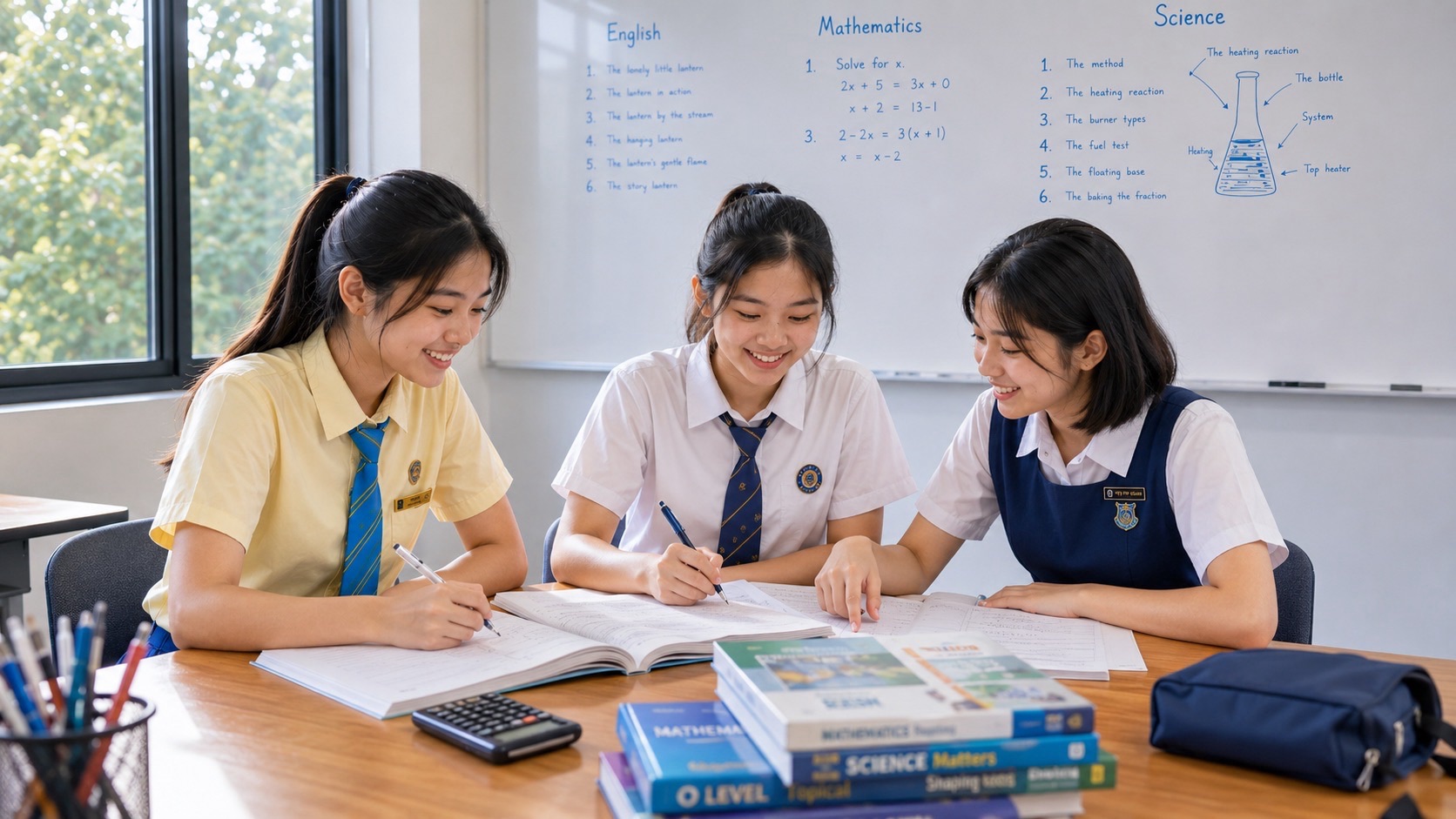
The first year of secondary school is not simply Primary 7 with a heavier bag. It is the year a child begins to carry a larger life: new teachers, new classmates, CCA, longer days, denser texts, more independent homework, more complicated friendships, more mature ideas and a growing expectation that the child can explain what they mean. In Punggol, that life happens across home, school, the MRT and LRT, the library, the waterway, tuition, weekends and school holidays. English travels through all of it.
Mira wakes before the alarm on the first Monday of Secondary 1.
For a moment she does not remember why.
Then she sees the new uniform hanging on the wardrobe door.
The school shoes are too white. The bag is too carefully packed. Her pencil case has been checked three times. Somewhere in the living room, one of her parents is already moving around quietly, trying not to turn an ordinary school morning into an event.
It is, of course, an event.
A child who finished Primary 6 only weeks ago is about to walk out of the front door and begin a different kind of education.
Mira knows the route. Her family has talked about Edgefield Secondary School enough times that the place no longer feels like a name on a posting result. They know where it is in Punggol. They know the school is near Punggol MRT. They have imagined the week: which mornings will be rushed, which afternoons may stretch because of CCA, which evenings will need quieter homework, and which days might still have room for tuition.
What nobody can fully imagine is the child who will come home at the end of the year.
That is the real story of Secondary 1 English in Punggol.
It is not the story of one worksheet, one composition, one comprehension passage or one test. It is the story of a child becoming more capable of carrying meaning from one part of life to another.
At home, English is the language of instructions, jokes, arguments, messages and explanations.
At school, it is the language of English lessons, but also of Mathematics questions, Science explanations, Humanities sources, project discussions, online research and presentation slides.
Among friends, it becomes humour, belonging, disagreement, persuasion and the delicate art of saying something without saying too much.
On a phone, it becomes search, captions, comments, video, claims, headlines and the constant problem of deciding what deserves to be believed.
At tuition, English can become visible again: a sentence can be slowed down, a weak inference can be located, a vague answer can be sharpened, a paragraph can be rebuilt and a child can discover that “I am bad at English” is usually too large a diagnosis for a much smaller, teachable problem.
Secondary 1 is where these routes begin to join.
The central question of the year is not, “How many English worksheets should my child finish?”
It is this:
Can the child learn to read, think, speak and write with enough control to move through a bigger world?
That is what this year prepares.
And in Punggol, the preparation begins before the first English lesson of the day.
The Child Before the Subject
Adults often begin a school year with the timetable.
Children begin it with the feeling.
The new uniform feels different. The school gate looks larger. A form class contains people who were not part of the child’s life last month. Teachers no longer know the student from years of accumulated Primary-school history. The child who was a senior in Primary 6 is suddenly a junior again.
That change matters to English because language is one of the first places uncertainty appears.
A student can understand a passage and still hesitate to answer because the question sounds unfamiliar.
A student can have a good idea and still avoid raising a hand because the idea has not yet been arranged into a sentence.
A student can write fluently and then discover that Secondary English wants something different: better development, clearer purpose, stronger control of tone, more mature judgement, more precise evidence.
The mistake is to interpret every hesitation as weakness.
Sometimes the child is simply recalibrating.
Mira discovers this in the first weeks. She is not incapable of English. She is learning a new scale of English.
The passages feel longer because they are beginning to ask more of her attention. The questions feel less obvious because the answer is not always sitting in one neat sentence waiting to be copied. Class discussion feels more exposed because other students answer in ways she did not expect. A teacher asks, “What makes you think that?” and suddenly the answer “because the character is upset” is no longer enough.
What makes you think that?
Which word suggests it?
What changed before this moment?
Could the same line be interpreted differently?
Why did the writer place this detail here?
How does the tone affect the reader?
Secondary English grows through questions like these.
The child is no longer being trained only to locate language.
The child is being trained to use language as evidence of thought.
This is one reason the first months of Secondary 1 should not be treated as a race to Secondary 4.
There is a great deal to install before examination technique becomes useful.
The student needs to become comfortable with not knowing immediately.
They need to reread without feeling that rereading is failure.
They need to learn that a first draft is allowed to be rough.
They need to discover that vocabulary is not a decorative collection of “big words” but a way of seeing distinctions.
They need to learn that grammar is not punishment. Grammar is engineering. It lets one person place an idea into language strongly enough that another person can receive it.
They need to speak before every sentence is perfect.
They need to listen for what another person actually said rather than merely waiting for a turn to reply.
They need to read beyond school because no school timetable can contain the whole world English refers to.
And they need to keep being thirteen.
That last point is easy to lose.
A Secondary 1 student is not a small adult preparing continuously for a future examination. The student is a young person learning how to handle increasing independence while still needing sleep, friendship, movement, humour, family, mistakes, second chances and time in which nothing is being measured.
The happiest version of a serious education does not remove childhood in order to produce results.
It uses the expanding world of childhood to make learning richer.
That is why a Punggol morning matters.
A conversation in the lift can become observation.
A disagreement at breakfast can become perspective.
A sign at the MRT can become audience and purpose.
A message from a teacher can become tone.
A news headline on a phone can become source evaluation.
A walk by the waterway can become descriptive precision.
A conversation with a grandparent can become narrative voice.
The subject called English is not waiting at school for the child to arrive.
English has already been happening since the child woke up.
Leaving Home: The First Daily Passage
Every school day has a passage before the reading passage.
It is the journey from home to school.
For some Punggol students, that passage begins in a lift lobby while the sky is still pale. For others it is a walk to an LRT station, a bus stop, Punggol MRT or a school close enough to reach on foot. The Punggol LRT loops through the residential estate and feeds the town centre; Punggol MRT connects the neighbourhood to the North East Line. The transport map is ordinary because families use it every day, but to a Secondary 1 student it is also part of the year’s first lesson in independence.
Mira learns to check more things without being told.
Card.
Phone.
Water bottle.
Assignment.
PE attire.
The correct day for the correct book.
The correct time to leave.
She is learning logistics, but logistics has a language layer.
A timetable must be read accurately.
A message must be interpreted correctly.
A reminder must be understood.
An instruction must survive the journey from teacher to student to home.
This sounds trivial until a child misreads one line and arrives without the required material.
Secondary school makes small misunderstandings expensive because there are more moving parts.
English therefore becomes operational.
It is not only the subject where a child writes an essay about responsibility. It is the medium through which responsibility is often carried.
On the way to school, Mira notices that the estate seems to contain two different Punggols.
There is the Punggol that adults describe: transport, housing, schools, services, development, community spaces.
Then there is the Punggol a thirteen-year-old actually experiences: the exact place where a friend waits, the sheltered walkway that is useful when it rains, the convenience store where students look at snacks after school, the station exit that saves a few minutes, the bench where someone once cried, the escalator where the group always becomes separated, the shortcut a parent dislikes, the library corner that feels safe when the afternoon is long.
This distinction between the official map and the lived map is important to English.
Writers make this distinction all the time.
A place is never only its coordinates.
A good description asks what the place means to the person inside it.
A good narrative understands that the same corridor can feel exciting on the first day, exhausting in July and almost sentimental in November.
A good comprehension reader learns that setting is not wallpaper. Setting changes action, mood, possibility and choice.
A good speaker learns to explain a place to someone who has never seen it.
A good thinker learns that people can occupy the same physical space and experience it differently.
By the time Mira reaches school, she has already practised half a dozen English skills without opening an English file.
She has read signs.
Interpreted time.
Followed instructions.
Listened to speech.
Responded to a message.
Observed people.
Noticed a change in the sky.
Made a small decision.
Remembered a story.
This is what it means to say that English is a living subject.
The child is always inside the material.
Parents Before the Timetable
Secondary 1 changes the parents’ role as much as it changes the child’s. Before we return to the school day, it is worth looking at the home floor that makes the rest of the year possible.
Parents: The Home Should Not Become the Second Examination Hall
The Secondary 1 transition does not happen only to the child.
Parents transition too.
Primary school offered a familiar rhythm.
By Primary 6, many families knew the teachers, the school routines, the PSLE language and the shape of the final year.
Secondary 1 resets much of that certainty.
The child has more teachers.
Homework may be less visible.
School communication changes.
The student wants more privacy.
Marks may move.
The parent has less direct control over the day.
That loss of visibility can become pressure.
“How was school?”
“Fine.”
“What did you learn?”
“Nothing.”
“Any homework?”
“Done.”
“What was your English test mark?”
“Can we not talk about it now?”
This can feel alarming when parents care deeply.
But Secondary 1 requires a new kind of support.
The parent gradually moves from manager to reader of signals.
Is the child generally settling?
Are assignments repeatedly being missed?
Is one subject creating disproportionate distress?
Can the child explain what is difficult?
Does feedback produce improvement or only defensiveness?
Is the student sleeping enough?
Are friendships stabilising?
Can the child recover after a disappointing mark?
Is the problem isolated or repeating?
This is much more useful than turning every evening into interrogation.
Home has a unique educational function precisely because it is not school.
It is where the child should be able to admit confusion before confusion becomes shame.
It is where a weak mark can become information.
It is where effort can be acknowledged without pretending effort guarantees results.
It is where parents can insist on responsibility while keeping the relationship larger than performance.
For English, parents do not need to become English teachers.
They can do something more powerful.
They can make language matter.
Ask the child what they think about something real.
Ask why.
Listen to the answer instead of immediately correcting it.
Read an article and disagree kindly.
Notice an interesting word.
Talk about a film’s ending.
Ask whether a headline is fair.
Discuss why a message sounded rude.
Let the child explain a school concept.
Go to the library without turning the trip into a test.
Let reading sometimes be pleasure.
Let conversation sometimes wander.
The home is where English can remain connected to life.
That connection protects the subject from becoming only an examination technology.
And paradoxically, students often perform better when language is larger than the exam.
The Parent’s Hardest Question: When Does Support Become Necessary?
The word “tuition” can arrive too early in a family conversation.
A child gets one disappointing result.
Someone worries.
A classmate is attending tuition.
Another parent recommends a centre.
The school pace feels faster.
Soon the question becomes, “Should we add tuition?” before anyone has properly asked, “What is actually happening?”
Secondary 1 is a good year to resist that sequence.
Support is useful when it solves a real problem.
The first job is to identify the problem accurately.
Suppose Mira performs weakly on a comprehension task.
That result alone does not tell us what to teach.
Did she misunderstand the passage?
Did she understand the passage but misread the question?
Did she find the correct evidence but fail to explain the inference?
Was the vocabulary too difficult?
Did she run out of time?
Did she change a correct answer because she lost confidence?
Was this an isolated test on a tired week?
Does the same error appear repeatedly?
Each explanation suggests a different response.
The same is true of writing.
A composition mark may conceal several different problems.
Ideas may be thin.
Organisation may be weak.
Sentences may be inaccurate.
Vocabulary may be repetitive.
The child may have ideas but fail to develop them.
The introduction may consume too much time.
The student may not edit.
The response may not fit purpose or audience.
The child may understand every correction but be unable to reproduce the improvement independently.
“Needs English tuition” is therefore not a diagnosis.
It is a category.
A useful support system should become more specific.
What is the first weak link?
What does the student already do well?
What is unstable?
What can be repaired quickly?
What needs months of reading and repeated use?
What should school continue to own?
What can home support without creating conflict?
What does tuition add that the student is not currently getting from the rest of the week?
This prevents tuition from becoming another pile of work.
If a student already has too much undigested practice, adding more practice can create the appearance of diligence while leaving the underlying weakness untouched.
If the student understands the method but does not apply it under time pressure, the work should include timed transfer.
If the student lacks language exposure, one extra worksheet may be less useful than a sustained reading plan.
If the student avoids writing because correction feels painful, the first task may be to rebuild a healthier revision loop.
If the student is already strong, support should not keep the child permanently inside remedial tasks. The work should extend reading, deepen argument, broaden knowledge and increase independence.
The parent is not choosing between “tuition” and “no tuition” in the abstract.
The parent is choosing the best next support for a particular child at a particular point in the year.
That is a calmer question.
It is also a more intelligent one.
School and Classes
The New School Is a New Language Environment
Edgefield Secondary School becomes concrete to Mira because it is no longer the school that appeared on a screen after posting.
It is where her week happens.
The official school is at 36 Punggol Field, near Punggol MRT. But the meaningful school begins forming from dozens of smaller details: the classroom seat, the teacher who speaks quickly, the friend who always has correction tape, the staircase used after recess, the CCA noticeboard, the first assembly, the place where students line up, the canteen stall that becomes a default choice, the sound of a class when a teacher is late by thirty seconds.
This is also where the student meets a larger language environment.
In Primary school, many routines were already known so well that language could disappear into habit.
Secondary school makes language visible again because the child must decode a new institution.
Different teachers use different instructions.
Different subjects use different command words.
A Science teacher may ask a student to describe, explain, compare or justify.
A Mathematics problem may look like numbers but still depend on precise reading.
A Humanities source may require the student to distinguish claim, evidence, perspective and reliability.
A project brief may ask a group to propose, evaluate, design, present or reflect.
The child who thinks English exists only during English period will miss how much of secondary education is mediated by language.
This is why Secondary 1 English has leverage beyond its own marks.
When a child becomes better at distinguishing what a question is asking, other subjects often become less noisy.
When a child can explain causation clearly, Science answers improve.
When a child can separate evidence from inference, Humanities becomes more manageable.
When a child can summarise a paragraph, research becomes faster.
When a child can speak precisely in a group, project work becomes less frustrating.
When a child can write an email with appropriate tone, school life becomes easier.
The MOE secondary English syllabus treats language as an integrated system for meaning and communication rather than as isolated tricks. That principle matters in real life: reading, writing, speaking, listening, viewing and representing are constantly crossing into one another.
A student watches a video, discusses it, reads a source, decides whether the source is credible, writes a response and presents a conclusion.
Where, exactly, did English begin and end?
It did not.
That is the Secondary 1 shift.
English stops looking like one school subject among many and starts revealing itself as part of the infrastructure beneath the whole timetable.
For Mira, this does not happen in one grand realisation.
It happens slowly.
A teacher asks her to explain how she knows.
A classmate challenges her interpretation.
A Science answer loses a mark because the wording is imprecise.
A project group misunderstand one another.
A message sounds rude even though the sender insists it was not meant that way.
She reads a story in which the narrator is not completely reliable.
She discovers that two articles can describe the same event with different emphasis.
She edits a paragraph and realises the second version actually says what she meant.
Every one of these moments teaches the same larger lesson:
Language is not just a container for thought.
Language shapes how thought travels.
The First English Lessons: From Finding Answers to Building Reasons
The first major English adjustment is often not difficulty.
It is ambiguity.
Primary-school questions can certainly require inference and careful reading, but Secondary English increasingly places the student in situations where several interpretations look possible and the job is to decide which one can be defended.
Mira notices this when a class reads a passage about a character who keeps checking the door.
“Why is she nervous?” someone asks.
“Because she keeps checking the door,” a student says.
That answer points to evidence but does not complete the reasoning.
The checking is an action.
The student still needs to infer what the action suggests.
Perhaps the character expects someone.
Perhaps she fears someone.
Perhaps she has done something she regrets.
Perhaps the author has withheld information deliberately.
Now English becomes interesting.
The question is no longer “Can you find the line?”
The question is “Can you build a reasonable bridge from the line to the conclusion?”
That bridge is one of the most important structures in Secondary English.
Evidence does not speak for itself.
Evidence has to be interpreted.
Interpretation cannot float free.
It must remain answerable to the evidence.
This discipline eventually supports comprehension, literature, argument, source work, essay writing and everyday judgement.
It also supports a child outside school.
A friend does not reply to a message.
What does that mean?
Maybe nothing.
Maybe the friend is busy.
Maybe the friend is upset.
Maybe the phone is away.
The weak thinker turns one observation into one certainty.
The stronger thinker separates what is known from what is inferred.
Secondary English quietly teaches this form of intellectual humility.
Mira begins using a three-part habit:
What do I know?
What does it suggest?
What makes that interpretation stronger than the alternatives?
At first, she uses it only because a teacher wants better comprehension answers.
By the middle of the year, it begins to appear in other places.
She uses it when reading a news story.
She uses it when a group project produces conflicting claims.
She uses it when Ben says, “Everyone thinks this,” and she asks the dangerous but useful question: “Everyone who?”
Ben laughs.
Then he thinks.
That small moment is Secondary English doing exactly what it should.
It is turning language into better judgement.
Ben Knows the Answer but Cannot Yet Land It
Ben enters the Punggol story from a different direction.
He is not afraid of speaking.
He has ideas quickly, sometimes several at once. He can tell a story in the corridor, explain a game, argue about a video and make people laugh. If an English teacher asks for an opinion, Ben often has one before the question has finished.
On paper, however, his answers can be strangely weak.
He writes the first thing that feels correct.
He assumes the teacher can see the rest of the thought.
He uses words like “this shows” without explaining what “this” is.
He writes “the writer makes it interesting” and seems genuinely surprised when someone asks, “How?”
Ben’s problem is not lack of intelligence.
His problem is compression.
The idea in his head is larger than the sentence on the page.
This is a common Secondary 1 problem because children are thinking faster than they are learning to formalise thought.
The solution is not to make Ben sound artificial.
It is to teach him how to preserve more of his real thinking when he writes.
A useful answer begins with the exact demand of the question.
Then it chooses evidence.
Then it explains the relationship between the evidence and the claim.
Then, where necessary, it qualifies.
Ben learns that “more words” and “more explanation” are not the same thing.
A long answer can still be empty.
A short answer can be powerful if each part does a job.
This distinction becomes one of the year’s most useful lessons.
Students often think improvement means adding.
Add vocabulary.
Add adjectives.
Add examples.
Add paragraphs.
Add quotations.
But mature English frequently improves by choosing.
Choose the strongest evidence.
Choose the precise verb.
Choose the relevant detail.
Choose the sentence that advances the idea.
Remove the sentence that merely repeats it.
Ben enjoys this because it feels less like “English” and more like engineering.
A sentence either carries the load or it does not.
A paragraph either develops or it wanders.
A quotation either proves something or decorates the page.
A conclusion either resolves the argument or announces that the essay has ended.
Once he sees language this way, English becomes less mysterious.
The subject begins to have parts he can inspect.
And anything that can be inspected can be improved.
Vocabulary: The Year Words Begin to Become Precision
Primary students often meet vocabulary as lists.
Word.
Meaning.
Spelling.
Sentence.
There is nothing wrong with this as a beginning. Memory needs handles.
But Secondary 1 is where vocabulary should start becoming a system of distinctions.
Consider the difference between these words:
angry, irritated, resentful, furious, indignant, bitter.
A student who knows only that all six are “negative feelings” has memorised a rough category.
A student who can distinguish them has acquired thinking tools.
Irritation can be small and immediate.
Resentment often carries history.
Indignation usually contains a judgement that something is unfair or wrong.
Bitterness can persist.
Fury has intensity.
Each word changes the interpretation of a person.
This matters in comprehension because the precise word can reveal tone.
It matters in writing because the precise word can remove three weaker sentences.
It matters in speaking because the precise word can prevent an argument from becoming larger than necessary.
“I am angry” and “I am disappointed” are not the same family conversation.
Mira begins noticing this at home.
One evening, she says she is “stressed” about school.
A parent asks what she means.
She almost says, “Just stressed.”
Then she tries again.
Tired?
Not exactly.
Worried?
A little.
Overwhelmed?
Closer.
Behind?
Only in one subject.
Embarrassed?
Actually, yes. She did not understand something in class and everyone else seemed to.
Now the problem can be helped.
Vocabulary has turned an emotional fog into a more accurate signal.
This is one reason vocabulary instruction should never become a contest to sound impressive.
Words are useful when they let the child see, think and communicate more precisely.
A strong Secondary 1 vocabulary programme therefore has several layers:
- high-frequency academic words used across subjects;
- words that help describe thought, emotion and judgement;
- words associated with text analysis and writer’s choices;
- connective language for causation, contrast, qualification and consequence;
- topic vocabulary built through real reading;
- collocations and phrase patterns that make language natural;
- morphology, roots, prefixes and suffixes that help students infer unfamiliar words;
- and repeated use, because a word recognised once is not yet a word the student owns.
The goal is not to produce a teenager who inserts “perambulate” into a sentence about walking home.
The goal is to produce a student who knows when “walked”, “hurried”, “drifted”, “paced”, “stumbled” or “followed” actually changes the meaning.
Precision is more beautiful than decoration.
And by Secondary 1, students are ready to learn the difference.
Grammar Is the Quiet Architecture
Grammar becomes unpopular when it is taught as a museum of errors.
Do not do this.
Do not do that.
Wrong tense.
Wrong agreement.
Wrong punctuation.
Wrong preposition.
But grammar is much more interesting when a student sees what it makes possible.
A simple sentence can deliver force.
A complex sentence can show relationship.
A subordinate clause can qualify an idea.
A colon can prepare a reader.
A dash can interrupt.
A semicolon can hold related thoughts apart without fully separating them.
A change in tense can reposition time.
Pronoun control can prevent ambiguity.
Subject-verb agreement can keep a sentence stable.
Punctuation can determine whether a sentence breathes, trips or collapses.
Mira discovers this when she rewrites a paragraph about a rainy afternoon in Punggol.
Her first version contains everything she remembers, but all the details have equal weight.
Rain on the walkway.
Wet shoes.
A delayed friend.
An umbrella turning inside out.
A message from home.
A bus arriving.
The paragraph is accurate but shapeless.
Then she changes the sentence architecture.
One short sentence becomes the turn.
One longer sentence gathers the chaos.
One subordinate clause reveals why she was waiting.
A carefully placed detail makes the final line matter.
Nothing major happened.
But the writing now has control.
Grammar did not make the memory more “correct”.
Grammar helped the memory become communicable.
This is the deeper purpose of grammar in Secondary English.
It gives the student control over relationships between ideas.
As thought becomes more complex, syntax must become capable of carrying it.
A student cannot write mature argument using only one sentence pattern forever.
They need language for concession:
Although…
Even if…
While it is true that…
A student needs language for cause:
because, therefore, consequently, as a result.
They need language for qualification:
often, may, tends to, in this context, to some extent.
They need language for contrast:
however, whereas, despite, on the other hand.
These are not fancy transitions to sprinkle over an essay.
They are logical equipment.
The grammar is carrying the reasoning.
Writing Changes Because the Reader Changes
One of the strangest parts of growing up in English is discovering the reader.
Primary students are often told to write clearly, use vivid details and organise a composition. Those are good foundations. But in Secondary 1, the imagined reader becomes more important.
Who is this for?
What does this reader already know?
What does the reader need to understand next?
What tone is suitable?
What should be explained, and what can be assumed?
What would make the reader trust this voice?
What would make the reader stop reading?
These questions transform writing from self-expression into communication.
Mira first notices the problem in a school task that looks easy. She has to write a short message proposing an activity.
She knows the activity.
She knows why she likes it.
She has enough vocabulary.
But the first draft is written entirely from her own point of view.
It explains what she wants without showing why anybody else should care.
That is the moment the reader appears.
Writing is not merely putting thought on paper.
Writing is designing a path another mind can follow.
This is why audience and purpose are so powerful in Secondary English.
A student can write about the same event as a friend, a witness, a school leader, a journalist or a participant and produce five very different texts.
The facts may remain similar.
The selection changes.
The order changes.
The tone changes.
The vocabulary changes.
The amount of explanation changes.
The writer’s responsibility changes.
Once students understand this, situational writing stops being a format to memorise and becomes a communication problem to solve.
The same principle helps continuous writing.
A narrative needs a reader to care about something.
A reflective piece needs a reader to see why the experience matters.
An expository piece needs a reader to understand an idea more clearly by the end than at the beginning.
An argumentative piece needs a reader to follow the reasoning even if the reader does not initially agree.
A strong Secondary 1 writing year therefore should not chase one “perfect essay”.
It should build range.
Students need to practise beginnings that create direction without becoming theatrical.
They need paragraphs with internal logic.
They need evidence and examples that actually support the idea.
They need transitions that reflect real relationships rather than decorative phrases.
They need endings that feel earned.
They need editing routines.
Most of all, they need to learn that writing improves between drafts.
This can be a surprisingly emotional lesson.
Some students experience correction as a verdict.
The red mark says: you are careless.
The crossed-out sentence says: you are weak.
The low score says: you cannot write.
But revision offers a healthier interpretation.
The first version is information.
It tells us what the writer can currently do without further support.
The correction shows where the communication failed.
The rewrite is the actual learning event.
Mira begins keeping one page in her file for sentences she has improved.
Not perfect sentences.
Improved ones.
A vague sentence made precise.
A repetitive sentence tightened.
A flat paragraph reorganised.
A conclusion rewritten so it says something.
By June, that page is more encouraging than a mark.
It shows movement.
And movement is what Secondary 1 needs.
Reading Longer Is Not the Same as Reading Better
Secondary school brings longer texts.
Students feel this immediately.
The page has more words. The article may contain information the child does not already know. The narrator may be less straightforward. The argument may unfold across several paragraphs before revealing its direction.
The easy response is to tell students to “read more”.
That advice is true but incomplete.
A student can read a large volume while remaining a passive reader.
They can move their eyes across every word and retain almost nothing.
Secondary 1 should teach what active reading feels like.
Before reading, the student predicts the kind of text they are entering.
During reading, the student tracks who is speaking, what has changed, which idea is central, where the writer shifts direction and which details seem to carry unusual weight.
After reading, the student can say what the text is doing, not just what it is about.
This distinction matters.
A text may be about social media but be doing something more specific: warning, explaining, comparing, persuading, questioning or satirising.
A story may be about a family meal but be doing something beneath the events: revealing distance between two people, showing a change in power, exposing a misunderstanding.
A school notice may be about an event but be doing practical work: instructing a reader, managing risk, setting expectations and prompting action.
Mira begins asking four questions when she reads:
- What is happening on the surface?
- What is the writer trying to make me notice?
- Which details are doing the most work?
- What changed between the beginning and the end?
Ben prefers a different method. He draws quick arrows in the margin when ideas connect.
Cause.
Contrast.
Example.
Problem.
Response.
For him, the page becomes a map.
Both methods are useful because reading is partly about finding structure.
Students who struggle with comprehension often feel buried under sentences. Once they can see the architecture, the text becomes smaller.
This is why summary is such a powerful learning skill even outside examination preparation.
To summarise, a student must decide what can be removed without damaging the meaning.
That requires hierarchy.
Important.
Supporting.
Illustrative.
Repeated.
Incidental.
A child who can build that hierarchy reads the internet differently too.
Not every sentence deserves equal trust.
Not every headline deserves equal attention.
Not every anecdote is evidence.
Not every statistic is meaningful without context.
Reading longer is one part of Secondary 1.
Learning what deserves attention is the deeper part.
The Phone in the School Bag Is Also an English Classroom
No serious account of Secondary 1 English can pretend the student spends the year moving only between printed books and handwritten worksheets.
A thirteen-year-old also lives inside digital language.
Messages arrive all day.
Short videos compress claims into seconds.
Headlines compete for attention.
Comments reward certainty.
Images are captioned.
Screenshots remove context.
Search results rank information before the student has evaluated it.
AI tools can generate fluent language faster than a student can decide whether the language is accurate.
This does not make digital life an enemy of English.
It makes digital literacy part of English.
The student needs to ask:
Who made this?
Why was it made?
What evidence is offered?
What has been left out?
Is the source reporting, interpreting, advertising, entertaining or persuading?
Can I trace the claim backwards?
Does another credible source agree?
What does the image prove, and what does it merely suggest?
How has the wording shaped my reaction?
These are reading questions.
They are also civic questions.
Secondary English becomes more valuable, not less, in a world where machines can produce sentences.
When fluent language is cheap, judgement becomes expensive.
The student must learn to distinguish polish from truth.
Ben discovers this after bringing a dramatic “fact” into a discussion. The claim came from a short clip with confident narration and impressive graphics.
Mira asks where the number came from.
Ben does not know.
The class searches.
The number has been repeated across several accounts, but the original source is unclear.
For a moment, Ben is embarrassed.
Then the teacher reframes the moment.
This is not a failure.
This is exactly what source verification is for.
The lesson is not “never trust the internet”.
The lesson is “learn how trust is earned”.
That phrase stays with Mira.
Trust is earned.
By sources.
By writers.
By speakers.
By evidence.
By a student answering a question.
It also becomes a useful principle for AI-supported learning.
A tool can help a student generate examples, test understanding, compare explanations or receive feedback. But if the student cannot judge the output, the tool can amplify confusion as easily as understanding.
The purpose of Secondary 1 English is therefore not to compete with technology at sentence production.
It is to make the student a better director of language.
Ask better questions.
Detect weak claims.
Choose stronger evidence.
Recognise uncertainty.
Revise unclear output.
Keep ownership of judgement.
That is future English.
And it begins with very old habits: read carefully, ask what something means, and do not confuse confidence with proof.
Speaking: Learning to Have a Voice Without Needing to Win
Secondary school is noisier than a worksheet.
There are group discussions, presentations, class questions, CCA conversations, friendships, disagreements, negotiations and the constant social work of finding one’s place.
Speaking well is therefore not simply oral-examination preparation.
It is part of becoming a person among other people.
Mira is careful when she speaks.
Ben is quick.
Each has something to learn from the other.
Mira sometimes waits so long for the perfect sentence that the conversation moves on.
Ben sometimes speaks so fast that the sentence arrives before the thought has been checked.
A good Secondary 1 classroom gives both students room to grow.
Mira practises entering a discussion with a simple structure:
“I think…”
“because…”
“for example…”
“but I can also see…”
Ben practises the last part.
But I can also see.
That is a powerful sentence stem because it turns speaking away from performance and towards thinking.
Students learn that disagreement does not require aggression.
They can challenge the idea rather than the person.
They can ask for clarification.
They can paraphrase another speaker before responding.
They can acknowledge a strong point on the other side.
They can change their mind without losing face.
These skills matter in examinations, but they matter even more in life.
A child who can say, “I misunderstood what you meant,” has a tool for friendship.
A child who can say, “I agree with the concern but not the solution,” has a tool for reasoning.
A child who can say, “Can you show me how you reached that conclusion?” has a tool for learning.
A child who can present an idea to a room despite nervousness has a tool for the future.
The aim is not to turn every Secondary 1 student into a charismatic speaker.
Some people are quiet.
Quiet is not failure.
The aim is control.
Can the student make a point when it matters?
Can the student listen accurately?
Can the student extend an answer beyond one sentence?
Can the student organise a short explanation?
Can the student respond rather than merely recite?
Can the student remain human while doing it?
There is joy in watching a child acquire this control.
Not the theatrical joy of suddenly becoming somebody else.
The quieter joy of becoming more fully able to be oneself.
Friendship Has a Language Curriculum Too
Adults design syllabuses.
Children also learn from each other.
The unofficial curriculum of Secondary 1 includes friendship.
This curriculum has no textbook, but it is full of language problems.
How do you join a group without forcing yourself into it?
How do you say no?
How do you tell whether a joke went too far?
How do you apologise when intention and impact were different?
How do you ask for help without feeling small?
How do you disagree with someone you still want as a friend?
How do you respond when a message looks hostile but may have been typed carelessly?
How do you know when silence is kind and when silence is cowardice?
These are language questions with moral weight.
Mira learns this during a small misunderstanding in Term 1.
A group message is read in the worst possible tone.
Nobody uses punctuation carefully.
Nobody has facial expression or voice to help interpretation.
One person assumes sarcasm.
Another assumes criticism.
A third forwards a screenshot.
By the time everyone sees each other, the original sentence has acquired a life of its own.
The solution is not a better vocabulary list.
It is better communication.
What did you mean?
This is what I thought you meant.
That was not my intention.
I can see why it sounded that way.
Next time, tell me directly.
That sequence contains comprehension, inference, perspective, clarification, tone and revision.
English again.
The most important reading a teenager does in a day may sometimes be reading another person accurately.
Of course, human beings are not texts. They cannot be reduced to clues.
That is precisely why qualification matters.
Maybe.
Perhaps.
I might be wrong.
Can I check?
The mature reader does not turn every signal into certainty.
The mature friend should not either.
This is one reason Secondary English benefits when students encounter literature, narrative and complex characters. Stories give young people safe access to minds unlike their own.
A character can make a poor decision for understandable reasons.
A narrator can misread a situation.
A conflict can contain two partial truths.
An action can be both kind in intention and harmful in effect.
The ability to hold these tensions is part of language maturity.
It is also part of growing up.
CCA Days: When the Timetable Meets the Body
By February, the novelty of Secondary 1 begins to wear off.
The year becomes physical.
The student is tired.
School may end later on some days. CCA changes the rhythm. There are books to carry, tasks to remember, group messages to answer, tests beginning to appear, and the subtle pressure of trying to become competent in public.
This is where families discover that a study plan made in December can look very different inside an actual week.
Mira’s parents had imagined neat blocks of time.
School.
Home.
Dinner.
Homework.
Reading.
Sleep.
The real week has friction.
A bus is slow.
CCA overruns.
A project suddenly becomes urgent.
A child comes home mentally full.
A worksheet that “should take twenty minutes” takes fifty because the student is stuck on the first task.
One evening, Mira opens an English passage and reads the same paragraph three times.
Nothing stays.
The problem is not comprehension.
It is fatigue.
This distinction matters enormously.
If every poor performance is treated as a skill deficit, the family may add work when the student needs recovery.
If every tired evening is treated as evidence that the child cannot cope, the family may become anxious unnecessarily.
Good education requires diagnosis.
What kind of problem is this?
Knowledge?
Method?
Attention?
Language?
Confidence?
Organisation?
Fatigue?
Avoidance?
Too many open tasks?
The answer determines the intervention.
On some evenings, the right English work is a careful twenty minutes.
On others, it is correcting one paragraph properly.
On others, it is reading something enjoyable and going to bed.
The goal is not to create a permanently busy child.
The goal is to build a student who can work with increasing independence over years.
That requires energy management as well as time management.
Secondary 1 is the ideal year to teach this because the stakes are real but still forgiving enough for experimentation.
The student can discover which days are suitable for demanding writing.
Which routines prevent forgotten work.
Which study environment reduces distraction.
How long focused reading actually lasts before quality drops.
How to start a task when motivation is absent.
How to stop when continuing would only produce mistakes.
These are not separate from English.
They determine whether English practice becomes effective.
A brilliant worksheet cannot teach a brain that is no longer processing it.
The Year in Preparation
January: Orientation Before Acceleration
January feels full even when little has yet been tested.
The child is learning names, routes, procedures, expectations and social geography.
This is why January should not be wasted, but it should not be overloaded either.
For Secondary 1 English, the first month is an orientation month.
The student needs to understand the new mode.
Read the whole question before answering.
Expect longer texts.
Mark uncertainty instead of pretending it does not exist.
Keep vocabulary from real reading.
Write in complete thoughts.
Learn the teacher’s correction language.
Keep returned work.
Notice repeated errors.
Speak at least sometimes.
Ask when instructions are unclear.
Do not let one difficult passage become a story about your ability.
Mira’s January goal is deliberately small: leave no English correction unexplained.
If a teacher marks an answer wrong, she does not merely copy the correct answer.
She tries to identify the reason.
Wrong evidence?
Incomplete inference?
Misread question?
Too broad?
Too narrow?
Grammar altered the meaning?
This creates a correction habit before the workload becomes heavy.
Ben’s January goal is different: slow down the first answer.
He must underline the demand of the question before he writes.
The goals differ because the students differ.
That is exactly the point.
The beginning of Secondary 1 should not force every student into an identical improvement plan.
It should establish a floor:
Read accurately.
Think visibly.
Correct carefully.
Keep going.
January also gives parents baseline information.
How does the child come home?
What does the child talk about?
Which tasks are unexpectedly difficult?
What disappears into the bag and never reappears?
How much sleep is actually happening?
What does Sunday evening feel like?
These signals matter because the plan designed before school started now meets reality.
A family should be willing to revise the plan.
The schedule is not the child.
The child is the child.
February: The First Real Patterns Appear
By February, the first-week explanations are no longer enough.
If the same problem keeps appearing, it begins to look like a pattern.
Mira notices that inference questions take her too long.
She can often reach the answer, but only after rereading several times.
Ben notices something else: his writing is lively at the beginning and rushed at the end.
Neither problem requires panic.
Both require a method.
Mira begins separating text evidence from interpretation.
She draws a tiny line between what the text states and what she concludes.
This prevents the inference from becoming guesswork.
Ben begins planning the middle of a piece before polishing the first paragraph.
He learns an uncomfortable truth: a beautiful introduction cannot rescue an undeveloped body.
February is where these small methods start earning trust.
A student uses a strategy once and it feels artificial.
Uses it again and it feels slow.
Uses it ten times and it begins to become available under pressure.
This is how learning often works.
The useful method initially costs attention.
With repetition, the cost falls.
The student can then use attention for the harder parts of the task.
Parents may not see this immediately in marks.
That can be frustrating.
But some of the most important Secondary 1 gains appear first as better process.
The child starts earlier.
The child checks the question.
The child can explain a mistake.
The child edits without being told.
The child asks a better question.
The child brings home a marked script and is willing to look at it.
These are leading indicators.
Marks often follow later.
The family that watches only the final score may miss the machinery being built underneath.
March: The First Holiday Is an Audit, Not a Boot Camp
The March school holiday is short.
That is useful.
It is long enough to look back and short enough to discourage grand reinvention.
For Secondary 1 English, the March break is a natural audit point.
Take out the work from January and February.
Do not begin by counting pages.
Look for patterns.
Which comprehension questions lose marks most often?
Which grammar errors repeat?
Does writing improve after feedback?
Is vocabulary being collected but never used?
Does the student understand corrections?
Is reading happening outside assigned texts?
Can the student explain what English is currently asking them to do differently from Primary school?
If the answer to that last question is vague, the child may be working hard without yet understanding the new game.
Mira’s family keeps the March review simple.
One morning, they spread a few pieces of work on the table.
The conversation begins with what improved.
That matters.
A review that searches only for defects teaches the child to hide evidence.
Then they identify one recurring issue.
Inference speed.
Not five issues.
Not a total reconstruction of English.
One.
For the rest of the holiday, Mira reads, rests, meets friends, goes out with family and does a modest amount of focused practice.
The aim is to return to school with more clarity, not with the emotional sensation of having survived an academic camp.
Ben spends part of the break rewriting one older piece.
The new version is noticeably better.
He is delighted for approximately six minutes before pretending not to care.
This, too, is thirteen.
Term 2: When English Starts Connecting Across Subjects
Term 2 often feels more serious because the novelty has faded.
Teachers know the classes better.
Students know enough of the routines to be expected to manage them.
The calendar begins accumulating tasks.
This is where English starts showing its cross-subject value.
Mira receives a Science task that asks for explanation.
She knows the science concept.
But her first answer describes what happens without explaining why.
The correction feels familiar.
It is the same gap she has been learning to close in comprehension: do not stop at the observation; build the relationship.
Ben encounters a Humanities source that contains a strong claim.
He wants to accept or reject it immediately.
Then he remembers the source-verification lesson.
Who is speaking?
What evidence supports the claim?
What context might change its meaning?
This is what connected learning looks like.
A skill taught in English becomes available elsewhere.
The student begins to see patterns across subjects rather than storing every lesson in a separate box.
This is especially valuable in Secondary 1 because the timetable can initially feel fragmented.
Many teachers.
Many files.
Many subject names.
Many assessment formats.
The child’s mind benefits from discovering common structures.
Evidence matters in English and Science.
Logical sequence matters in English and Mathematics.
Perspective matters in English and Humanities.
Precise vocabulary matters everywhere.
Reading the question matters everywhere.
Explaining rather than merely asserting matters everywhere.
The more these structures connect, the less school feels like a warehouse of unrelated tasks.
Education becomes a network.
English is one of its strongest connectors.
May: The Month of Accumulation
May has a way of making the school year feel heavier.
Tasks accumulate.
Some students who looked completely settled in February suddenly look tired.
This is not unusual.
The first half of the year has been running for long enough that weak organisational habits now have consequences.
Files become messy.
Unfinished corrections remain unfinished.
Reading is postponed because urgent homework wins.
A student begins each day reacting instead of planning.
For English, this can create a particular problem.
Language growth requires work that does not always feel urgent.
Reading a chapter.
Reviewing vocabulary.
Rewriting a paragraph.
Practising oral expansion.
Looking back at errors.
These tasks are easy to sacrifice because nobody may collect them tomorrow.
But they are exactly the tasks that build long-term capability.
Mira learns to separate urgent work from important work.
Urgent: submit the assignment due tomorrow.
Important: keep reading even when no test demands it.
Urgent: prepare for the class quiz.
Important: fix the repeated pronoun-reference problem that keeps appearing in writing.
Urgent: finish the group slide.
Important: learn how to explain an idea without reading from the slide.
Secondary 1 is a good time to teach this distinction because later years become less forgiving.
The student who only reacts to deadlines can survive for a while.
Then the system becomes crowded.
English suffers particularly because reading, vocabulary and writing fluency are cumulative. They are difficult to cram in one weekend.
May therefore becomes a lesson in maintenance.
Keep the machine clean.
File the work.
Finish the correction.
Read something.
Sleep.
Begin again.
June Holidays: Space to Grow Sideways
The June holiday is the first long opening in the Secondary 1 year.
It should not be wasted.
It should also not be treated as four weeks of school without a school bell.
This is the best part of the year for English to grow sideways.
During term time, school necessarily sets the route.
During holidays, a student can widen the route.
Read a novel that is not being tested.
Read a biography of someone interesting.
Read about football, fashion, engineering, medicine, space, food, transport, music, crime, design, animals, games, history or whatever makes the child voluntarily ask the next question.
Visit Punggol Regional Library at One Punggol and let curiosity choose some of the books.
Walk along Punggol Waterway and notice how hard it is to describe water without using the word “beautiful”.
Listen to an interview and pay attention to how a good speaker answers a difficult question.
Watch a documentary and ask which facts were selected to create the story.
Cook from a recipe and notice how procedural writing works.
Read a museum label and ask what the writer assumed the visitor already knew.
Follow a topic for a week and see how vocabulary repeats across sources.
The June holiday is also a good time to repair without urgency.
If grammar is unstable, rebuild a small set of high-frequency structures.
If comprehension is weak, slow reading down and make the reasoning visible.
If writing is thin, spend time generating and developing ideas rather than producing many rushed essays.
If vocabulary is weak, build it through reading instead of memorising disconnected lists.
If speaking confidence is low, practise discussion in low-pressure settings.
Mira chooses a reading project for June.
She wants to understand why some cities feel easy to move through and others do not.
That question begins in Punggol because she thinks about her own daily route: home, station, school, shops, library, tuition, waterway.
One question leads to transport design.
Transport design leads to public space.
Public space leads to accessibility.
Accessibility leads to ageing.
Ageing leads to how cities plan for people who move differently.
Now vocabulary grows naturally because the ideas require new words.
Infrastructure.
Connectivity.
Pedestrian.
Accessibility.
Density.
Amenities.
Wayfinding.
The words are not being memorised for a spelling test.
They are entering a network of meaning.
This is how knowledge makes English stronger.
Students sometimes try to improve writing using language alone.
But writing also needs something to say.
A child who knows more of the world has more material for comparison, example, analogy and judgement.
June can supply that world.
Punggol Regional Library: A Secondary English Resource Hiding in Plain Sight
Punggol Regional Library sits inside One Punggol, close enough to the daily life of the estate that a visit does not need to become a grand expedition.
That ordinary accessibility matters.
A library is most useful when it can become habit.
For a Secondary 1 student, the library offers something school cannot completely provide: controlled wandering.
A child can enter looking for one thing and leave with another.
Mira goes to find a book on urban design and notices a book about maps.
The maps book leads to a question about borders.
A nearby shelf contains travel writing.
Now she is reading a writer describing a city she has never visited.
The point is not that every library trip must produce an intellectual chain reaction.
Sometimes the child simply borrows a funny book and enjoys it.
That counts.
Pleasure is not an enemy of literacy.
Pleasure is one reason people keep reading long enough to become strong readers.
A library also teaches a subtle form of independence.
The student must select.
There are more books than time.
Which one deserves attention?
Is this book too easy, too difficult or exactly right for now?
Should the student finish a book they dislike?
Sometimes yes, because persistence matters.
Sometimes no, because life is finite and there are other books.
Learning to choose is part of becoming a reader.
The library can also help Secondary 1 students move beyond algorithmic recommendations.
Online platforms tend to show more of what a user already clicks.
A shelf can surprise you simply because two unrelated books happen to stand beside each other.
That accidental adjacency is educational.
It allows curiosity to escape the profile built from past behaviour.
For English, this matters because strong language comes from breadth as well as depth.
Students need encounters with unfamiliar sentence rhythms, unfamiliar topics, unfamiliar lives and unfamiliar assumptions.
The child who reads only what already feels familiar may become fluent inside a narrow corridor.
The library opens doors sideways.
Punggol Waterway: Observation Before Description
Teachers often tell students to “add descriptive details”.
Students respond by adding adjectives.
Beautiful blue water.
Bright green trees.
Cool gentle breeze.
Peaceful quiet park.
The problem is not grammar.
The problem is observation.
The writer is using generic language because the writer has not looked closely enough.
Punggol Waterway is useful precisely because it is familiar.
A student who thinks they already know a place can practise seeing it again.
Mira walks with a simple rule: no adjective in the first five minutes.
She can write only nouns and verbs.
Water folds around the concrete edge.
A cyclist rings a bell behind two walkers.
A bird drops from a railing and disappears under the bridge.
Children lean over the side.
A train moves in the distance.
Clouds gather above the blocks.
Already the description is more alive.
Then she adds sensory information selectively.
Not every sense needs to be used.
Not every detail deserves the page.
The writer chooses what contributes to the mood or meaning.
This exercise changes how Mira reads descriptive passages too.
She begins noticing that good writers rarely describe everything.
They select.
A rusted hinge can tell us more about a neglected house than three paragraphs of adjectives.
A character checking the time twice can reveal more anxiety than writing “she was extremely anxious”.
Observation therefore connects reading and writing.
The student learns to respect the meaningful detail.
This is a recurring Secondary English principle:
Specificity creates power.
The exact word.
The exact evidence.
The exact example.
The exact detail.
The exact reason.
Secondary 1 is the year to move from “more” towards “better chosen”.
July: Return, Reset, and the Danger of Forgetting
The first week after the June holidays is revealing.
Some habits survive the break.
Others vanish.
This is normal.
Learning that is not yet automatic can decay quickly when the context changes.
Students sometimes interpret this as proof that the earlier work failed.
More often, it means retrieval needs strengthening.
Mira returns to inference practice and feels slower than she did in May.
For two sessions she is frustrated.
Then the structure returns.
Evidence.
Inference.
Explanation.
The speed comes back faster than it took to build originally.
This is important for students to understand.
Forgetting is not the opposite of learning.
The process of retrieving and rebuilding can strengthen memory.
July is therefore a good reset month.
Review the essential structures from the first half of the year.
Do not attempt to reread everything.
Retrieve.
Can the student explain the reading method without notes?
Can the student produce the paragraph structure?
Can the student identify the grammar error?
Can the student use new vocabulary in a fresh context?
Can the student summarise a new passage?
Can the student speak for a minute on an unfamiliar issue without collapsing into fragments?
Performance on a new task tells us more than recognition of an old one.
That distinction becomes increasingly important as the student moves towards later examination years.
The real question is not “Have you seen this before?”
It is “Can you use what you learned when the surface changes?”
Secondary 1 should begin building that transfer habit now.
August: National Stories, Public Language and Belonging
August changes the language environment in Singapore.
Flags appear.
National Day enters school programmes, public displays, news, speeches and social media.
For English, this is an opportunity to study public language.
How does a speech create a sense of shared identity?
What stories does a nation repeat about itself?
How do slogans compress values?
What is the difference between celebration and analysis?
How can a student appreciate something while still asking thoughtful questions about it?
Mira notices that public language often uses large nouns.
Resilience.
Progress.
Unity.
Future.
Community.
Opportunity.
These words are meaningful, but they are also broad.
A strong reader asks what they mean in a specific context.
A strong writer learns that abstract nouns need concrete evidence.
If you write that a community is resilient, show what people did.
If you write that a city is inclusive, show which design or policy makes inclusion possible.
If you write that education creates opportunity, explain for whom, by what mechanism and with what limitation.
This is how Secondary English begins moving from slogan to argument.
It does not teach cynicism.
It teaches clarity.
The happiest thinkers are not those who believe nothing.
They are those who can care about something enough to examine it properly.
September: The Second Short Break Is for Repair
By September, the Secondary 1 year has enough history to tell the truth.
January was orientation.
March showed the first patterns.
June created space for wider growth.
September is different.
Now the student can see what has not yet moved.
This is where repair becomes important.
Mira has improved at inference. She reads with more patience and supports answers more reliably. But her writing still has one persistent weakness: she knows what she wants a paragraph to do, yet the middle sometimes becomes a collection of examples rather than a developed line of thought.
Ben has improved at planning, but his grammar weakens under time pressure.
These are not reasons to restart English from the beginning.
They are reasons to narrow.
A useful September repair cycle can be small:
- identify one recurring weakness;
- collect two or three examples of it from real work;
- teach the missing distinction or method;
- practise it in isolation briefly;
- put it back into a complete task;
- check whether the student can now use it without prompting.
This sequence matters because students often become good at drills without becoming good at transfer.
Ben can correct subject-verb agreement perfectly on a grammar worksheet.
Then he makes the same mistake inside a timed essay.
That tells us the rule is known but not yet stable under load.
The solution is not another hundred isolated questions.
The solution is to move the rule back into authentic writing, where ideas, planning, time and language are all competing for attention.
Mira can explain what a developed paragraph should contain.
But when she writes quickly, she sometimes jumps from claim to example to a new idea.
Again, the knowledge exists.
The execution is unstable.
September teaches an important educational principle:
A weakness should be repaired at the level where it actually fails.
If the child cannot identify evidence, teach evidence.
If the child can identify evidence but cannot explain it, teach the bridge from evidence to inference.
If the child can explain during practice but not in a full task, train transfer.
If the child can perform untimed but not timed, train retrieval under time pressure.
If the child can perform in tuition but not at school, examine whether the support has become too visible and needs to be faded.
Repair is precise.
It is not punishment for getting something wrong.
It is the shortest reasonable route from current performance to stronger independent performance.
Term 3: From Supported Performance to Independence
There is a hidden danger in good support.
The support can work so well that the student becomes dependent on it.
A tutor reminds the child to check the question.
A teacher prompts the student to add evidence.
A parent asks whether homework is complete.
A friend explains what the instructions mean.
The student performs better, but the performance belongs partly to the surrounding adults.
Secondary 1 should begin the slow work of removing those supports.
Mira’s English process becomes more independent in Term 3.
At first, someone had to ask:
“What exactly is the question asking?”
Later, the prompt becomes shorter:
“Question?”
Later still, nobody says anything.
Mira checks it herself.
This is the direction of education.
Teach.
Guide.
Prompt.
Fade.
Watch.
Intervene only where necessary.
The child should gradually carry more of the system.
Ben experiences this when he brings a piece of writing for feedback.
Instead of immediately marking it, the tutor asks him to identify the two weakest parts first.
He finds one.
Then another.
The tutor asks what he would change.
Ben fixes part of the problem before receiving external correction.
This changes the purpose of feedback.
Feedback is no longer something done to the student.
It becomes a comparison between the student’s judgement and an experienced reader’s judgement.
That is a much more powerful relationship.
By Secondary 4, a strong student needs to make many decisions alone under examination conditions.
The preparation for that independence does not begin in the final year.
It begins when adults stop doing for the child what the child is ready to do.
This is why the best Secondary 1 support can sometimes look quieter by the end of the year.
The student is doing more.
The adult is watching more carefully and interrupting less.
October: Assessment Without Letting Assessment Swallow the Subject
By October, students and parents may feel that English has become marks again.
Tests, weighted assessments, year-end tasks and school reporting can pull attention towards scores.
Scores matter.
They are part of the evidence.
But a score is a compressed signal.
It cannot explain itself.
Suppose Mira improves from one assessment to the next.
Good.
What improved?
Was the paper easier for her strengths?
Did she manage time better?
Did inference improve?
Did writing become more developed?
Was grammar more stable?
Did she simply avoid a previous careless mistake?
The mark matters, but the explanation matters more because the explanation can guide the next step.
Now suppose Ben’s mark drops.
Again, the number alone is incomplete.
Perhaps he tried a more ambitious writing approach and lost control.
Perhaps he misread one task and the error was expensive.
Perhaps his preparation was poor.
Perhaps his vocabulary was insufficient for the text.
Perhaps he was rushing.
Perhaps the result reveals a real weakness that needs repair.
The mature response is neither denial nor panic.
It is investigation.
This is a useful mindset for the whole family.
Assessment is not the moment learning stops and judgement begins.
Assessment is another source of information about learning.
For Secondary 1 English, the most valuable post-assessment questions are often:
- Which marks were lost because the skill was missing?
- Which marks were lost because the method was not used?
- Which marks were lost because time or attention failed?
- Which errors are new?
- Which errors are recurring?
- What did the student do better than last time?
- What one change would produce the largest improvement next?
This turns a script into a map.
Mira’s parents learn not to begin with, “Why did you get this?”
They begin with, “What happened here?”
The difference is small in language and large in effect.
One sounds like a verdict.
The other sounds like an inquiry.
Children are more likely to show the truth when the truth is useful.
November: The Child Who Comes Home Is Not the Child Who Left in January
The end of Secondary 1 arrives without the drama of PSLE.
There is no single national examination closing the year.
No one stands at the school gate announcing that childhood has advanced one level.
Yet the change can be significant.
Mira knows the route now.
The uniform no longer looks new.
She knows where she likes to sit.
She knows which days feel long.
She knows the difference between a question she cannot answer yet and a question she has not read carefully enough.
She knows that one poor composition is not a prophecy.
She has words she did not have in January.
She has read things she did not know existed.
She has been wrong in public and survived.
She has changed her mind about people.
She has learned that some friendships arrive quickly and some grow slowly.
She has discovered that teachers are different from one another and that learning to learn from different teachers is itself a skill.
She has learned that a phone can help with school and destroy an hour with equal efficiency.
She has learned that tiredness can imitate stupidity.
She has learned that asking for help early is often easier than hiding a problem for three weeks.
Her English is better, but the most interesting improvement is not one isolated score.
Her language system has become larger.
She can read a more difficult article without immediately deciding it is “too hard”.
She can explain an opinion with evidence.
She can revise a sentence rather than defending the first version out of pride.
She can distinguish what a text states from what she infers.
She can hear when a claim sounds too certain.
She can speak more clearly when a discussion matters.
She can write for a reader with greater awareness.
She is not finished.
That is the good news.
Education has not completed her.
It has increased what she can do next.
The November and December Holidays: Reading Without a Deadline
The year-end holidays create a rare kind of time.
No immediate school deadline is pushing from behind.
Secondary 2 has not yet begun pushing from ahead.
This gap can become one of the best reading periods of the year.
A good holiday English plan is not a disguised school term.
It has rhythm.
Some deliberate work.
Some broad reading.
Some writing that matters to the student.
Some conversation.
Some complete rest.
Mira returns to Punggol Regional Library with a different confidence from June.
She no longer needs every book to be perfectly matched to her level.
She is willing to open a book, read several pages and decide.
She borrows fiction and non-fiction.
One book is easy and delightful.
One is challenging enough that she reads slowly.
One is abandoned halfway.
That is a real reading life.
Ben starts a small holiday project that sounds unserious: he ranks the best explanations he can find online for a topic he likes.
But the ranking forces him to articulate criteria.
Clear.
Accurate.
Well organised.
Good examples.
Not misleading.
Appropriate for the audience.
He has accidentally built a rubric for communication.
This is the kind of holiday learning worth protecting.
It comes from genuine interest but still strengthens academic capability.
The year-end break is also a good time to revisit the year’s archive.
Choose one January piece and one October piece.
Compare them.
What changed?
Choose one early comprehension script and one later one.
What is more controlled?
Choose five words learned during the year that now feel ordinary.
That ordinariness is success.
The word has moved from unfamiliar to usable.
Then choose one goal for Secondary 2.
Not ten.
One main goal.
Maybe reading breadth.
Maybe writing development.
Maybe grammar under pressure.
Maybe oral confidence.
Maybe time control.
Maybe independent correction.
The child enters the new year with direction rather than a vague command to “improve English”.
Weekends in Punggol
Saturday Is Not a Smaller Monday
A family can accidentally turn Saturday into a warehouse for everything the week could not contain.
Homework.
Tuition.
Enrichment.
Revision.
Projects.
Errands.
Reading.
Exercise.
Family obligations.
By evening, the child has technically completed many useful things and experienced none of them fully.
Secondary 1 is a good year to defend a more intelligent weekend.
The weekend should serve several functions.
Recovery.
Completion.
Preparation.
Family.
Friendship.
Movement.
Curiosity.
Focused learning.
Not every weekend will balance all of them. But over time, the pattern matters.
Mira’s family notices that difficult writing goes badly late on Saturday after a crowded day.
So they move the most demanding English work earlier when possible.
A correction session can happen in a shorter block.
Reading can happen later because it is less effortful for her.
A walk becomes a break rather than a reward that must be earned after every worksheet is finished.
This may sound like lifestyle advice rather than English tuition advice.
It is both.
Learning is embodied.
Attention has limits.
Language quality falls when working memory is overloaded.
The student who is exhausted does not practise the same skill as the student who is alert.
They may only practise making hurried mistakes.
Weekend design therefore influences learning quality.
This does not mean children should do only what feels pleasant.
Discipline matters.
A student sometimes needs to begin work despite preferring not to.
But discipline is not the same as permanent occupation.
The aim is a child who can sustain learning for years.
Sustainability belongs in the plan.
Sunday Evening: The Week Begins Before Monday
Sunday evening has a particular emotional weather.
The weekend is ending.
The school week is approaching.
For some students, this is when anxiety appears.
What is due?
What was forgotten?
Which test is coming?
Is the uniform ready?
Where is the worksheet?
Did the group finish the slide?
A simple weekly reset can remove a surprising amount of noise.
Mira spends fifteen minutes checking the week.
Not studying.
Checking.
Timetable.
Assignments.
CCA.
Tests.
Materials.
One English priority.
That final item is important.
A broad subject needs a narrow weekly focus.
This week: inference.
This week: paragraph development.
This week: editing.
This week: speaking more fully in discussion.
This week: reading thirty pages of the novel.
The priority does not replace school work.
It gives direction inside it.
Ben uses a different Sunday habit. He looks at one piece of teacher feedback from the previous week and writes the correction principle in his own words.
“Don’t just quote. Explain why the quotation proves the point.”
“Read the audience before choosing tone.”
“Check singular/plural when the sentence gets long.”
“Example is not explanation.”
These become portable rules.
The teacher’s comment leaves the old script and enters the student’s operating system.
That is what feedback is supposed to do.
English Beyond English
Mathematics Is Also a Reading Subject
A Secondary 1 student can know the Mathematics and still lose the question.
The cause may be language.
“Find.”
“Show.”
“Explain.”
“Hence.”
“Given that.”
“At least.”
“Difference between.”
“Percentage increase.”
“Not drawn to scale.”
These phrases determine action.
Mira experiences this in a problem where the calculation is within her ability but the wording requires her to distinguish the quantity given from the quantity requested.
She begins too quickly, calculates correctly and answers the wrong thing.
That is not an English exam error.
It is still a reading error.
Secondary 1 English can support Mathematics by building command-word awareness, sentence parsing and the habit of identifying the actual demand before beginning.
This is not about turning Mathematics into a language lesson.
It is about recognising that symbols and words work together.
The same applies to word problems, graphs with written interpretation, data questions and explanations of reasoning.
A student with stronger language control has more room to show the Mathematics they actually know.
Science Is Also an Explanation Subject
Science reveals another connection.
Students often know what happened but fail to explain why.
The plant grew less.
The temperature increased.
The object moved faster.
The substance changed.
Those may be observations or outcomes.
Scientific explanation requires relationships.
Because.
Therefore.
As a result.
This caused.
This reduced.
This increased.
The variable affected.
The evidence suggests.
Language carries the causal model.
Mira recognises the same structure from English comprehension.
Evidence alone is not the complete answer.
The student has to articulate the reasoning.
The benefit flows both ways.
Science also improves English because it trains precision.
Scientific terms cannot be replaced casually by vaguely similar words.
Conditions matter.
Variables matter.
Evidence matters.
Claims must fit what was observed.
A student who learns this discipline can become a better argumentative writer.
Good argument is not louder language.
It is a better relationship between claim and evidence.
Humanities Is Also a Perspective Subject
Humanities adds another layer.
Who produced the source?
When?
For whom?
With what purpose?
What does the source show?
What does it not show?
How might another person see the same event?
These are close relatives of English reading questions.
A Secondary 1 student begins to understand that information is never received in a vacuum.
Context changes meaning.
Tone changes interpretation.
Selection changes narrative.
A photograph frames some things and excludes others.
A quotation can be accurate and still misleading if context is removed.
A statistic can be correct and still incomplete.
This is not a reason to distrust everything.
It is a reason to build calibrated trust.
The student learns to ask for enough evidence, from suitable sources, interpreted with appropriate caution.
This is one of the deepest gifts Secondary English can provide to the rest of education.
It teaches the child not merely to receive information but to examine how meaning has been constructed.
The Larger Route
Full Subject-Based Banding Changes the Labels, Not the Need for Strong English
Secondary students in Singapore now move through Full Subject-Based Banding rather than the old streaming structure. Subjects may be taken at different levels according to the student’s readiness and route.
For English, the present SEC framework uses G1, G2 and G3 subject levels. The exact examination code belongs to the later examination year and should always be checked against the current SEAB syllabus when the student reaches that stage.
For a Secondary 1 family, the important idea is simpler.
Subject level describes the route being taken.
It should not become the child’s identity.
A student taking English at one level is still developing the same human capacities in age-appropriate ways: reading for meaning, writing clearly, listening, speaking, using vocabulary, controlling grammar, responding to purpose and audience, and becoming more independent with language.
The pace and assessment demand differ.
The dignity of the learner does not.
This matters because labels can enter family language too easily.
“My child is a G3 student.”
“My child is only doing…”
“She is the strong one.”
“He is the weak one.”
These sentences can harden temporary educational arrangements into permanent stories about ability.
Secondary 1 should remain developmental.
A child may be strong in one subject and need more support in another.
A student may grow rapidly after foundations stabilise.
A confident Primary-school performer may need time to adjust.
A previously inconsistent student may thrive when the new environment fits better.
The useful question is not “What label is the child?”
It is “What does the child need to learn next at the level they are currently taking?”
That keeps the focus on movement.
SEC English Is in the Distance; The Habits Are Here Now
A Secondary 1 student should know there is a larger route ahead.
The Secondary Education Certificate will eventually matter.
English assessment in the later years will require control across reading, writing, listening and spoken communication at the appropriate subject level.
But there is little value in making a thirteen-year-old live psychologically inside the final examination every week.
The better approach is to build the capabilities the later examination will need.
Read accurately now.
Build vocabulary now.
Write complete paragraphs now.
Learn how evidence supports a claim now.
Practise editing now.
Speak with increasing confidence now.
Listen properly now.
Learn to manage time now.
Learn to correct mistakes now.
Learn to read beyond school now.
Learn to judge sources now.
Learn to work independently now.
Then examination craft has something real to organise later.
This is the difference between preparing early and exam-drilling early.
Preparing early builds the person and the system.
Exam-drilling early repeatedly rehearses a future performance whether or not the underlying capability is ready.
Mira does not need to spend Secondary 1 pretending it is Secondary 4.
She needs to become the student who can eventually handle Secondary 4 well.
That is a much more hopeful project.
Career English Begins Much Earlier Than a Career
The phrase “Career English” can sound ridiculous when attached to a thirteen-year-old if it is interpreted as training a child to write corporate emails.
That is not the point.
Career English is the long route from school language towards adult communicative control.
Can you understand a complex instruction?
Can you explain a problem accurately?
Can you ask a useful question?
Can you write so that another person knows what to do next?
Can you distinguish evidence from opinion?
Can you present an idea?
Can you disagree professionally?
Can you summarise a complicated issue?
Can you adapt tone to audience?
Can you detect when confident language is hiding weak reasoning?
Can you learn unfamiliar material through reading?
These abilities matter in school, polytechnic, ITE, junior college, university, training, entrepreneurship, public service, technical work, medicine, law, engineering, design, hospitality, finance, science, technology and almost every field in which people coordinate with other people.
The careers will change.
The communication problem remains.
A human being knows something.
Another human being needs to understand it.
Language carries the bridge.
Secondary 1 is early enough to build that bridge carefully.
A Practical Secondary 1 English Capability Map
Reading
By the end of Secondary 1, a student does not need to have mastered every form of difficult text.
But the student should be moving towards stronger independence.
A healthy reading trajectory includes the ability to:
- sustain attention across longer passages;
- identify the main direction of a text;
- distinguish main idea from supporting detail;
- track reference across pronouns and phrases;
- infer meaning using textual evidence;
- recognise tone and purpose with increasing accuracy;
- identify relationships such as cause, contrast, example and consequence;
- summarise without copying everything;
- make reasonable vocabulary inferences from context and word structure;
- recognise when a claim requires verification;
- and explain why a particular interpretation is defensible.
The key word is defensible.
Secondary reading is not a treasure hunt for hidden teacher thoughts.
It is disciplined interpretation.
Writing
A healthy Secondary 1 writing trajectory includes:
- understanding the task before beginning;
- identifying audience and purpose where relevant;
- generating enough material before drafting;
- selecting rather than dumping ideas;
- organising paragraphs around clear jobs;
- developing examples instead of merely listing them;
- using sentence variety with control;
- improving grammar accuracy;
- choosing vocabulary for precision rather than display;
- maintaining coherent tense and reference;
- writing conclusions that resolve rather than repeat;
- and editing with a deliberate routine.
The student should also learn that different writing tasks require different shapes.
There is no universal “good essay” template that solves every communication problem.
Form follows purpose.
Listening
Listening can be underestimated because it leaves less visible evidence than writing.
Yet a student spends enormous portions of school receiving information through speech.
Good listening includes:
- sustaining attention;
- identifying the main point;
- distinguishing examples from central ideas;
- following sequence;
- noticing emphasis and tone;
- keeping track of instructions;
- making notes selectively;
- asking for clarification when needed;
- and resisting the urge to assume before the speaker has finished.
Listening is also part of friendship and family life.
A child who listens accurately creates fewer unnecessary conflicts.
A student who listens accurately learns faster.
Speaking
Speaking development includes:
- answering beyond one unsupported sentence;
- giving reasons;
- using examples;
- organising a response under mild pressure;
- pronouncing clearly enough to be understood;
- adjusting volume and pace;
- responding to another person’s point;
- asking follow-up questions;
- qualifying an opinion;
- and speaking even when the sentence will not be perfect.
Confidence should not be confused with volume.
A calm, well-reasoned student can be an excellent speaker.
Vocabulary
Vocabulary growth should move from recognition to ownership.
A student may pass through several stages:
“I have never seen this word.”
“I recognise it.”
“I roughly know what it means.”
“I understand its nuance.”
“I can use it correctly.”
“I can choose it instead of a weaker alternative.”
That final stage is where vocabulary becomes real writing power.
Students should meet words repeatedly across contexts rather than expecting one memorisation session to create ownership.
Grammar and Editing
The aim of grammar is increasing control.
The student should know their own recurring error patterns.
Perhaps tense shifts.
Perhaps agreement.
Perhaps sentence fragments.
Perhaps run-on sentences.
Perhaps punctuation.
Perhaps pronoun reference.
Perhaps prepositions or article use.
The exact profile differs.
Editing becomes more effective when the student does not “check everything” vaguely.
Check the known high-risk areas first.
Then read for meaning.
Then read for surface accuracy.
Different passes catch different problems.
The Parent’s Year-at-a-Glance
A Calm Twelve-Month Route
A practical Secondary 1 English year can be understood like this:
January — Orientate. Learn the new school, the new English mode and the correction language. Establish basic organisation.
February — Observe patterns. Notice recurring reading, writing, grammar, vocabulary or time problems.
March — Audit. Use the short holiday to identify one meaningful repair target without turning the break into a boot camp.
April — Build. Strengthen methods and connect English skills across the school timetable.
May — Maintain. Protect reading, correction and sleep as workload accumulates.
June — Widen. Read beyond school, explore interests, use the library, repair foundations and let knowledge grow sideways.
July — Retrieve. Rebuild habits after the break and test whether learning survives new contexts.
August — Apply. Use public language, current issues and Singapore life as material for reading, discussion and writing.
September — Repair. Narrow onto recurring weaknesses and train transfer into authentic tasks.
October — Read assessment intelligently. Analyse marks rather than reacting only to marks.
November — Consolidate. Identify what the child can now do independently that required help in January.
December — Restore and prepare. Read widely, rest properly, review selectively and choose one major Secondary 2 goal.
This route is not a rigid calendar.
Schools differ.
Students differ.
Assessment dates differ.
The point is the shape.
Orientation.
Observation.
Build.
Widen.
Repair.
Transfer.
Consolidate.
Move forward.
One Complete Secondary 1 Day in Punggol
A Tuesday in August
It is 6:07 in the morning when Mira hears the kettle.
She is awake but not yet willing to admit it.
Secondary school has taught her that six minutes can feel like a meaningful unit of time. Six minutes can be one more page. Six minutes can be the difference between walking calmly and rushing for the lift. Six minutes can disappear completely if a message arrives at the wrong moment.
Her phone is on the desk across the room because the family discovered in Term 1 that putting it beside the bed created a very efficient system for becoming tired.
She gets up.
The house is quiet in the way HDB homes are quiet before everybody’s day separates. A parent is packing something in the kitchen. A younger child somewhere nearby is already unhappy about being awake. Water runs through pipes. A lift opens and closes in the corridor.
Mira checks the school timetable.
English.
Mathematics.
Science.
Mother Tongue.
Physical Education.
CCA later.
She also checks the one thing she wrote on Sunday evening as her English focus for the week:
Do not stop at the example. Explain why the example matters.
That sentence looks almost too simple to deserve its own line.
But it is the line she needs.
At breakfast, a parent asks whether the group presentation is settled.
“Mostly.”
That answer is technically true and operationally useless.
The parent raises an eyebrow.
Mira tries again.
“We have all the slides. Ben still has to cut one section because we’re over time. I need to practise my part once tonight.”
Now the sentence carries action.
No one says so, but this is English before school.
A vague answer has become an informative answer.
At 6:48, Mira leaves home.
The route is no longer dramatic. That is one of the year’s achievements. In January, every movement had to be anticipated. By August, the body knows where to turn.
She sees the same types of morning people: adults already moving towards work, students in several uniforms, someone carrying breakfast in a plastic bag, a parent walking faster than the child beside them, runners who appear to belong to a different species because they have voluntarily chosen exercise before sunrise.
At the station, Mira reads without intending to.
Directional signs.
Service information.
An advertisement.
A notification.
A message from Ben: “presentation gonna die lol”.
Mira replies: “That is not a status update.”
Ben sends a photograph of a slide with too much text.
Mira sends back: “Cut half.”
This is not elegant prose.
It is effective communication.
At school, the first English task is a short article about whether convenience always improves life.
The question is broad enough to produce empty opinions.
“Yes, because convenience makes things easier.”
“No, because people become lazy.”
Both statements are possible beginnings.
Neither is yet a developed answer.
The teacher asks the class to identify one concrete case.
Food delivery.
Navigation apps.
Online shopping.
AI assistants.
Public transport.
Cashless payment.
Mira thinks about her morning route.
Punggol’s transport network makes movement easier. But convenience also changes expectation. When a train is delayed, even briefly, people react strongly because reliable systems teach people to expect reliability.
That is a more interesting thought.
Convenience is not just about saving time. It changes what people consider normal.
Mira writes it down before the idea disappears.
Then the teacher asks for the next step.
“So what?”
There it is again.
The Secondary English question that lives under half the curriculum.
So what?
Why does the example matter?
What does it show?
What does it change?
What follows from it?
Mira develops the point.
A reliable system can improve life by reducing uncertainty, but it can also make users less tolerant of failure. Convenience creates benefits and new expectations at the same time.
The answer is not perfect.
It is better because it contains a relationship.
After English comes Mathematics.
The class meets a word problem with enough information to tempt students into calculation before understanding.
Mira starts writing numbers, then stops.
She circles the quantity actually requested.
A tiny English habit saves a Mathematics error.
In Science, the teacher asks why a result occurred.
A classmate gives an observation.
The teacher asks, “That’s what happened. Why did it happen?”
Mira almost laughs.
Different subject, same bridge.
Evidence to explanation.
By recess, the school day has already crossed English several times even though English period ended an hour ago.
This is what Secondary 1 slowly reveals.
The timetable is divided.
Thinking is not.
At lunch, friendship takes over the curriculum.
Ben is annoyed because another student changed part of the group presentation without asking.
“He always does this.”
Always is a dangerous word.
Mira knows it, but does not say so immediately because being technically correct is not always the same as being helpful.
Instead she asks what was changed.
Ben shows her.
The change is not terrible.
It is also not what the group agreed.
They decide to ask the student why before deciding what the action means.
That decision takes approximately twenty seconds.
It is still a form of intellectual discipline.
Observation first.
Interpretation second.
Verification where possible.
Secondary English has entered friendship without anyone inviting it.
After lessons, CCA changes the pace.
By the time Mira leaves school, she is hungry and mentally slower. The afternoon Punggol is different from the morning one. The station is louder. Students are everywhere. Shops feel more interesting when school has ended. The distance home feels longer.
This is the point where an adult-designed study plan can become unrealistic.
On paper, 5:00 p.m. may look like available time.
Inside a child, 5:00 p.m. may contain seven hours of school, social decisions, physical activity, travel and hundreds of small acts of attention.
Mira goes home first.
She showers.
She eats.
She sits down for ten minutes and does nothing that can be described as productive.
This is not failure.
It is recovery.
Later, on a tuition day, she heads to eduKatePunggol.
The English work there does not begin with a random demand to produce more output.
She has brought the paragraph from the morning lesson.
The tutor asks her to read it aloud.
The first two sentences are clear.
The example is useful.
Then the explanation becomes thinner.
Mira recognises the problem before the tutor says it.
“I’m doing the thing.”
“What thing?”
“Stopping at the example.”
That moment matters more than the correction itself.
She can now see the weakness.
The tutor asks her to add one sentence answering three possible questions:
What does this example reveal?
Why does it matter to the argument?
What larger conclusion can reasonably follow?
Mira writes a new sentence.
Then another.
The tutor removes one because it repeats the previous point.
More writing is not always better writing.
Across the table, Ben is doing something different. His problem today is not idea development. His conclusion has become rushed because he spent too long on the opening.
The class is small enough that their different weaknesses can remain different.
They are working on the same broad subject without pretending they are the same learner.
Before the session ends, Mira receives a fresh prompt.
No model paragraph.
No reminder about examples.
No sentence starter.
Can she transfer the correction?
She plans.
Writes.
Stops halfway through the paragraph.
Looks at the example.
Then writes the explanation.
The tutor says nothing.
That silence is the success.
The support is beginning to disappear because the student has started carrying the method herself.
On the journey home, Mira reads messages from the presentation group.
The student who changed the slide explains why.
There was a misunderstanding about the time limit.
Ben replies with something much more reasonable than his lunchtime reaction.
The problem is solved.
At home, dinner is late enough that nobody wants a long conversation about academic performance.
This is probably healthy.
Mira practises the presentation once.
Her first run is too long.
She cuts a sentence she likes.
This annoys her.
Then she understands why writers revise.
The sentence is good.
The presentation is better without it.
At 9:42, she reads several pages of a library book.
No questions follow.
No vocabulary sheet appears.
No one asks for a summary.
She simply reads.
At 10:03, the phone goes back across the room.
The school bag is mostly packed.
One worksheet is still on the table.
The day has contained English in almost every form available to a thirteen-year-old.
She read for school.
She read for transport.
She read messages.
She interpreted tone.
She explained an idea.
She listened to a teacher.
She argued with evidence.
She used language inside Mathematics and Science.
She negotiated with friends.
She received feedback.
She revised writing.
She presented aloud.
She read for pleasure.
Tomorrow will not look exactly the same.
That is why Secondary 1 English cannot be reduced to one workbook.
The child is learning language across a whole life.
The work of school, family and tuition is to help the important parts connect.
What This One Day Reveals
A full day makes several principles visible.
First, English is not contained by English period.
Second, the child’s performance changes with energy, context and pressure.
Third, real school evidence gives tuition something meaningful to work with.
Fourth, the best correction is the one the student eventually learns to anticipate.
Fifth, friendship and digital communication are not distractions from language development. They are major places where language is tested.
Sixth, reading for pleasure still belongs in a serious academic year.
Seventh, progress often appears as a quieter adult.
At the beginning, the adult says more.
Check this.
Read that.
Explain here.
Try again.
By the end, the child begins saying those things internally.
That is the direction of Secondary 1.
Not from child to machine.
From dependent learner to increasingly self-directing learner.
Not finished.
Not independent in everything.
But moving.
That movement is the year.
When Tuition Enters the Story
Tuition Should Not Duplicate the School Day
By the time tuition enters Mira’s week, school has already done a great deal.
The school teacher has introduced the curriculum.
The class has read texts, written responses, discussed ideas and received feedback.
The student has experienced the school pace, the school expectations and the real places where understanding becomes unstable.
Good tuition should not pretend none of that exists.
It should begin from the student who actually arrives.
That is a different philosophy from simply opening another worksheet at page one.
Suppose Mira arrives with a marked comprehension script.
The most useful first question may not be, “What topic are we doing today?”
It may be, “Show me where the answer stopped making sense.”
The script is evidence.
The tutor can inspect the question, the student’s choice of evidence, the written explanation, the correction and the student’s ability to explain what went wrong.
That reveals far more than a general statement such as “comprehension weak”.
Or suppose Ben arrives with an essay that received a middling mark.
He already knows the teacher said “develop your ideas”.
The tuition class can make that comment operational.
What does development look like?
Where did the paragraph stop too early?
Which example needed explanation?
Where did the writing jump?
Can Ben improve the paragraph while keeping his own voice?
Can he then reproduce the improvement in a new paragraph without copying the model?
That final question matters.
Tuition is valuable when it increases transfer back to school.
It should help the child understand school better, not create a separate private curriculum that the child can perform only inside tuition.
This is why the marked school paper is often more valuable than an untouched stack of generic practice.
It tells us where the student is losing meaning in the environment that actually matters each weekday.
From there, additional practice can be selected with purpose.
The student does not need more work simply because more work exists.
The student needs the right work at the right point.
Small Groups Make Signals Easier to See
Secondary English contains many errors that look similar from far away.
A vague answer.
A thin paragraph.
A weak oral response.
A grammar mistake.
But the cause can differ from student to student.
One child is unsure.
Another is rushing.
One lacks vocabulary.
Another has vocabulary but cannot select evidence.
One understands orally but writes too little.
Another writes fluently but does not answer the exact question.
One student is quiet because they are thinking.
Another is quiet because they are lost.
The closer the teacher can observe, the easier it becomes to distinguish these cases.
That is the practical value of a small-group environment.
The tutor can see hesitation.
The tutor can ask the second question.
The tutor can compare what the child says with what the child writes.
The tutor can notice that the same mistake has appeared three weeks in a row.
The tutor can also notice improvement that a mark may not yet show.
Mira’s first few tuition sessions are not dramatic.
That is intentional.
No one announces that her English is being transformed.
Instead, the work gets smaller and more exact.
Read the question.
Show the evidence.
Explain the bridge.
Check the wording.
Rewrite.
Try a new example.
Do it again without the prompt.
Ben’s work has a different rhythm.
Plan before performance.
Make the claim.
Develop it.
Choose one good example.
Explain why it matters.
Edit the sentence that is trying to do three jobs at once.
Then the class returns to a larger task.
The students are not being trained to obey one universal writing formula.
They are learning to see what their own language is doing.
That awareness is the beginning of self-correction.
The First Weak Link
A student can lose marks at the end of a chain because of a weakness near the beginning.
Consider a comprehension question.
The visible failure is the final answer.
But the chain may be:
read question → understand command → read relevant section → understand vocabulary → track reference → identify evidence → infer meaning → formulate response → check precision.
If vocabulary breaks, the later reasoning may never start.
If reference tracking breaks, the student may attach the action to the wrong person.
If the question is misread, perfect evidence can still answer the wrong demand.
If the inference is correct but the explanation is not written, the student’s thinking remains invisible to the marker.
This is why a good diagnosis searches upstream.
Where is the first point at which the student’s process becomes unstable?
The same applies to writing.
Task interpretation → idea generation → selection → organisation → paragraph development → sentence construction → vocabulary choice → grammar control → editing.
A student with weak ideas needs different teaching from a student with strong ideas but unstable syntax.
A student who cannot organise needs different teaching from a student who organises well but writes generic examples.
The phrase “poor writing” hides too much.
The first weak link gives the tutor somewhere useful to work.
Once that link strengthens, the rest of the chain can improve disproportionately.
Mira likes this idea because it is kinder than a global judgement.
“English weak” sounds like a personality.
“Your inference is sound, but the explanation between evidence and answer is incomplete” sounds like a task.
Tasks can be repaired.
Ben likes it because it gives him something to beat.
He treats recurring errors almost like opponents in a game.
This week: vague pronouns.
Next week: undeveloped examples.
Then: rushing the conclusion.
The approach is different, but the educational principle is the same.
Make the problem small enough to teach.
Read → Diagnose → Prioritise → Repair → Practise → Connect → Perform → Review
A useful tuition cycle is not complicated when expressed in ordinary language.
Read. Look at the student, the school work, the marked script, the current assignment, the hesitation and the repeated pattern.
Diagnose. Identify what is actually causing the loss of meaning or marks.
Prioritise. Decide which weakness matters most now. Not every weakness deserves equal attention in one lesson.
Repair. Teach the missing distinction, method, language structure or reading habit.
Practise. Give enough focused repetition for the student to control it.
Connect. Put the repaired skill back into the wider English system and, where useful, other school subjects.
Perform. Ask the student to use it in a fresh, more complete task with less support.
Review. Check whether the improvement survives and decide the next step.
This cycle protects tuition from becoming a worksheet conveyor belt.
Worksheets can be useful.
Past papers can be useful.
Vocabulary exercises can be useful.
Grammar drills can be useful.
The value depends on where they sit in the cycle.
A tool without a diagnosis can produce activity without movement.
Mira experiences this when she practises inference.
At first, the tutor isolates short examples so the reasoning is visible.
Then she returns to longer passages.
Then the prompt disappears.
Then a week later, she meets a new text and must use the method without being told.
That final step is the proof.
Ben experiences the same cycle in writing.
He learns to develop one point.
Then he writes a full paragraph.
Then a full response.
Then he receives a task with a different topic and audience.
Can the structure survive the change?
If yes, learning has travelled.
Tuition and the School Teacher Should Point in the Same Direction
A child should not feel trapped between two competing English systems.
“The school says this, but tuition says that.”
“My teacher wants one thing, but my tutor wants another.”
Different teachers will naturally use different terms, examples and methods. That is not a problem by itself.
But the student’s underlying learning should remain coherent.
If the school teacher uses a particular correction code, tuition can help the student understand it.
If the school is teaching a genre, tuition can reinforce the deeper principles rather than replacing the genre with unrelated work.
If the student has an upcoming school assessment, tuition can train the relevant skills without pretending to know the exact paper.
If the school feedback identifies a recurring weakness, tuition can help the student repair it.
School owns the main curriculum.
Tuition supports the student within that curriculum.
This distinction prevents duplication and keeps the child from carrying two full school days.
Mira’s parents appreciate this because the week is already crowded enough.
They do not need a second institution generating a second universe of obligations.
They need focused support that makes the first universe easier to navigate.
What a Secondary 1 English Tuition Lesson Can Actually Do
A useful lesson may begin with a short check-in.
What happened in school English this week?
Any marked work?
Any question you did not understand?
Any writing feedback that keeps repeating?
Any test approaching?
The tutor is collecting signals, not running a therapy session.
Then the lesson has a priority.
Perhaps reading.
The class works on a passage and the tutor watches how students decide where to look, how they interpret the command and how they support an inference.
Perhaps writing.
The class studies how one paragraph develops and then builds a fresh paragraph under a new prompt.
Perhaps grammar.
A recurring error is isolated, explained and returned to authentic sentences.
Perhaps vocabulary.
Words are grouped by meaning, root, collocation or topic and then used in reading and writing.
Perhaps oral communication.
Students practise expanding a response, listening to another view and responding rather than reciting.
The lesson should contain teaching, guided attempt, correction and independent attempt.
The independent attempt is where the truth appears.
Can Mira do it without the tutor’s sentence starter?
Can Ben remember to check the question when nobody reminds him?
That is what the lesson is trying to build.
The Tutor Should Eventually Become Less Necessary
There is a beautiful paradox in good tuition.
Success makes the tutor less central.
At the beginning, the student may need close intervention.
What does this word mean?
Where is the evidence?
What is the question asking?
How do I start this paragraph?
What did the teacher mean by this comment?
Over time, the student should internalise more of these questions.
What does this word mean in context?
Where is my evidence?
What exactly is the demand?
What job does this paragraph need to do?
Why did I lose the mark?
The teacher’s voice becomes part of the student’s self-questioning.
This is independence.
It is not the absence of help.
It is the ability to use help strategically rather than needing help to begin everything.
Secondary 1 is an excellent year to aim for this because the student has several years ahead in which independence can compound.
The child who learns self-correction at thirteen carries that advantage into Secondary 2, Secondary 3, upper-secondary English, SEC preparation and beyond.
The Punggol Ecosystem Around the Child
Home Is the Base
The child’s education begins and ends each day at home.
This gives home enormous influence, but not because parents must teach every subject.
Home sets the conditions under which learning can recover and continue.
Sleep.
Routine.
Food.
Conversation.
Boundaries.
Devices.
Respect.
Expectation.
A place to put the bag.
A place where a mistake does not become the whole identity.
Mira’s family gradually learns that the best school questions are often not about marks.
“What was unexpectedly difficult today?”
“What made you laugh?”
“What did someone explain well?”
“What still does not make sense?”
“Is anything due that you have not started?”
These questions produce better information than a nightly cross-examination.
They also keep English alive as conversation.
School Is the Main Curriculum
School gives the child the national educational route.
Teachers introduce the curriculum, build the class, assess learning, set expectations and place English among the wider demands of Secondary education.
For Mira, Edgefield Secondary is not a prop in a tuition story.
It is the main stage of her weekday learning.
The school has its own programmes, teachers, culture, activities and future-ready work. The child’s English develops inside that environment through lessons, projects, digital tasks, presentations, CCA interactions and the daily experience of becoming more independent.
The purpose of outside support is not to compete with that environment.
It is to help the child benefit from it more fully.
The Neighbourhood Supplies the World
Punggol gives the student a lived environment dense enough to become learning material.
Housing.
Transport.
Water.
Parks.
Community spaces.
Libraries.
Shops.
Schools.
Families.
Construction.
Technology.
Public design.
Different generations sharing the same estate.
Every one of these contains English topics.
Why do neighbourhoods need libraries?
How should public spaces be designed for children and older people?
What makes transport convenient?
How should a town balance development and nature?
What makes a community feel safe?
How does architecture shape behaviour?
What is lost when every place becomes optimised only for efficiency?
A student does not need to answer these like an academic researcher.
The value is in learning that ideas begin nearby.
A composition topic about community is not abstract if the child can think of actual shared spaces.
A discussion about sustainability becomes more concrete when the student observes transport, water, parks and housing.
A piece about technology can connect to the devices used in school and the infrastructure around Punggol.
Knowledge grows when the local world is treated as worthy of attention.
The Library Supplies Breadth
Punggol Regional Library expands the child’s route beyond the curriculum.
The school tells the student some of what must be learned.
The library reminds the student how much more there is.
That encounter with abundance matters.
Secondary 1 students are old enough to begin forming genuine intellectual preferences.
Some discover history.
Some prefer science.
Some read fantasy.
Some like graphic novels.
Some become fascinated by true crime, engineering, mythology, psychology, sport, politics, animals, fashion, computing or design.
The English teacher cannot prescribe curiosity into existence.
But adults can give it places to land.
The library is one of those places.
The Waterway Supplies Attention
The waterway teaches something simpler.
Look.
Most students spend large portions of the day receiving language made by other people.
Teachers.
Texts.
Videos.
Messages.
Platforms.
Instructions.
A walk gives the mind raw material again.
What do you notice before someone tells you what to notice?
That question is the beginning of observation.
Observation makes description stronger.
It also makes thinking more independent.
Friends Supply Other Minds
Mira needs Ben because Ben is not Mira.
Ben notices different things.
He reaches conclusions faster.
He takes risks she avoids.
She checks details he skips.
He can make a discussion lively.
She can make it precise.
Neither student should become the other.
Education is not a factory for one ideal personality.
The value of discussion is that different minds make one another visible.
A student hears an interpretation they did not consider.
A joke reveals a cultural assumption.
A disagreement exposes an unstated premise.
A friend recommends a book.
A group project forces compromise.
Language grows socially because meaning is negotiated between people.
Tuition Supplies Focused Repair and Extension
This is where eduKatePunggol enters the ecosystem.
Not at the beginning of the child’s life.
Not above the school.
Not as the reason every weekend exists.
It enters as one support structure inside the larger route.
For Secondary 1 English, its job is to make the child’s language learning more visible and more teachable.
Catch up where a foundation is missing.
Keep up where school pace is exposing a weak habit.
Move ahead where the student is ready for deeper reading, stronger writing and more independent judgement.
The class can slow down a difficult inference.
It can rebuild a paragraph.
It can diagnose why an answer is vague.
It can strengthen vocabulary through connected use.
It can correct grammar closely.
It can give students room to speak.
It can help them read a marked school script intelligently.
It can teach the child to carry feedback into the next piece of work.
Then the student returns to school.
That return matters.
The value of tuition is not the elegance of the tuition exercise.
The value is whether the child becomes more capable in the rest of life.
What the Year Is Really Preparing
Secondary 1 English Prepares the Child to Read the World
When adults hear “English preparation”, it is easy to imagine future examination papers.
Those papers matter.
But English prepares something larger.
The world will keep sending the child language.
Contracts.
Instructions.
News.
Advertisements.
Policies.
Messages.
Interfaces.
Medical information.
Financial information.
Political claims.
Scientific claims.
AI-generated text.
Workplace communication.
Relationships.
Stories.
The child will need to decide what words mean, which claims deserve trust, what information is missing and how to respond.
Reading the world is an English problem before it becomes many other kinds of problem.
It Prepares the Child to Be Understood
Knowing something is not always enough.
The child also needs to make knowledge travel.
Explain the method.
Ask the question.
Describe the problem.
Write the application.
Present the idea.
Defend the conclusion.
Tell the story.
Apologise properly.
Give the instruction.
Clarify the misunderstanding.
Language converts private thought into shared action.
Secondary 1 begins making that conversion more deliberate.
It Prepares the Child to Change Their Mind
Strong English is not only the ability to argue.
It is the ability to update.
A better source appears.
A friend offers a perspective you had not considered.
The evidence does not support your first interpretation.
A word you used turns out to mean something more precise.
A paragraph you loved does not serve the essay.
A confident claim needs qualification.
The mature response is not humiliation.
It is revision.
English teaches revision on the page.
Life asks for revision in the mind.
A student who learns to revise without losing identity has acquired one of the strongest intellectual habits available.
It Prepares the Child for a Bigger Punggol and a Bigger World
Punggol itself keeps changing.
A thirteen-year-old will see the town differently at sixteen, twenty, thirty and fifty.
Some familiar places will remain.
Others will change function.
New transport, institutions, workplaces, homes, technologies and communities will appear.
The student is growing inside a growing place.
That is an unusually good metaphor for Secondary 1.
Nothing is finished.
The route is being built while it is being used.
English gives the child a way to notice that change, understand it, describe it, question it and participate in it.
The Last Walk Home
December, Again
Near the end of the year, Mira walks through Punggol with no new uniform waiting at home.
Secondary school is no longer an imagined future.
It is part of her biography.
The places have changed because she has changed.
The route to school is not a route she rehearses with a parent.
It is simply her route.
The library is not somewhere adults take her because reading is good.
It is somewhere she can choose to go.
Tuition is not a mysterious place where someone is supposed to “make English better”.
It is one place where she has learned to inspect her own thinking.
The waterway is not just scenery.
It contains a rainy-day memory, a June observation exercise, a conversation with a friend and the moment she realised that describing a place well requires seeing it before naming it.
Ben sends a message containing an outrageous claim.
Mira replies with two words.
“Source?”
He sends back a laughing emoji.
Then, a minute later, a link.
Progress.
Mira is still young enough to leave a cup on the table and forget it exists.
She can still misread a question.
She can still write a terrible first paragraph.
She can still become defensive when tired.
She still needs adults.
Secondary 1 has not transformed her into an ideal student.
That was never the purpose.
The purpose was to help a child become more able to carry the next part of life.
A little more language.
A little more judgement.
A little more independence.
A better relationship with correction.
A larger reading world.
A stronger ability to explain.
A growing sense that difficult work can be broken into parts.
The confidence to ask what a claim is built on.
The humility to change an answer.
The courage to speak before every sentence is perfect.
The discipline to rewrite after the first attempt.
That is preparation.
Not preparation for one paper alone.
Preparation for Secondary 2.
Preparation for the upper-secondary years.
Preparation for the later SEC route at the appropriate subject level.
Preparation for further education.
Preparation for work that does not yet exist.
Preparation for friendships, institutions, technologies and arguments the child has not yet encountered.
Preparation to read the world and be understood inside it.
And it happens in ordinary places.
At breakfast.
In the lift.
On the way to Punggol MRT.
At school.
In the canteen.
During English.
During Science.
Inside a group chat.
At CCA.
At the library.
By the waterway.
At the tuition table.
At home on Sunday evening.
Across school holidays that are allowed to contain both work and life.
This is why Secondary 1 English in Punggol should not be understood as one more subject added to the year.
English is one of the systems through which the child learns to carry the year.
And by the end of it, if the work has gone well, the child does not merely know more English.
The child can do more with meaning.
That is the real beginning.
For Parents Considering Secondary 1 English Support in Punggol
If your child has just moved from PSLE English into Secondary 1, begin with the child rather than the label.
Look at the real week.
School.
CCA.
Travel.
Homework.
Sleep.
Reading.
Friends.
Family.
Then look at the real English.
What can the child already do independently?
Where does meaning begin to break down?
Reading?
Inference?
Vocabulary?
Grammar?
Paragraph development?
Task interpretation?
Oral confidence?
Listening?
Time?
Correction habits?
Do not ask tuition to solve “English” as one giant problem.
Find the first useful problem.
At eduKatePunggol, Secondary 1 English support is designed to help students catch up, keep up and move ahead while school remains the main curriculum and home remains home. The work is strongest when the student’s real school evidence—marked scripts, current demands, repeated mistakes and actual questions—helps guide what should be repaired or extended next.
Secondary 1 is not a verdict on the child.
It is an installation year.
Build reading that can handle more.
Build writing that can carry ideas.
Build vocabulary that creates precision.
Build grammar that supports clarity.
Build speaking that gives the student a usable voice.
Build listening that receives other people accurately.
Build correction habits that turn mistakes into information.
Build enough independence that, year by year, the student needs less prompting to do the right thing.
Then let the child go back into the larger life of Punggol and use it.
That is where English becomes real.


