
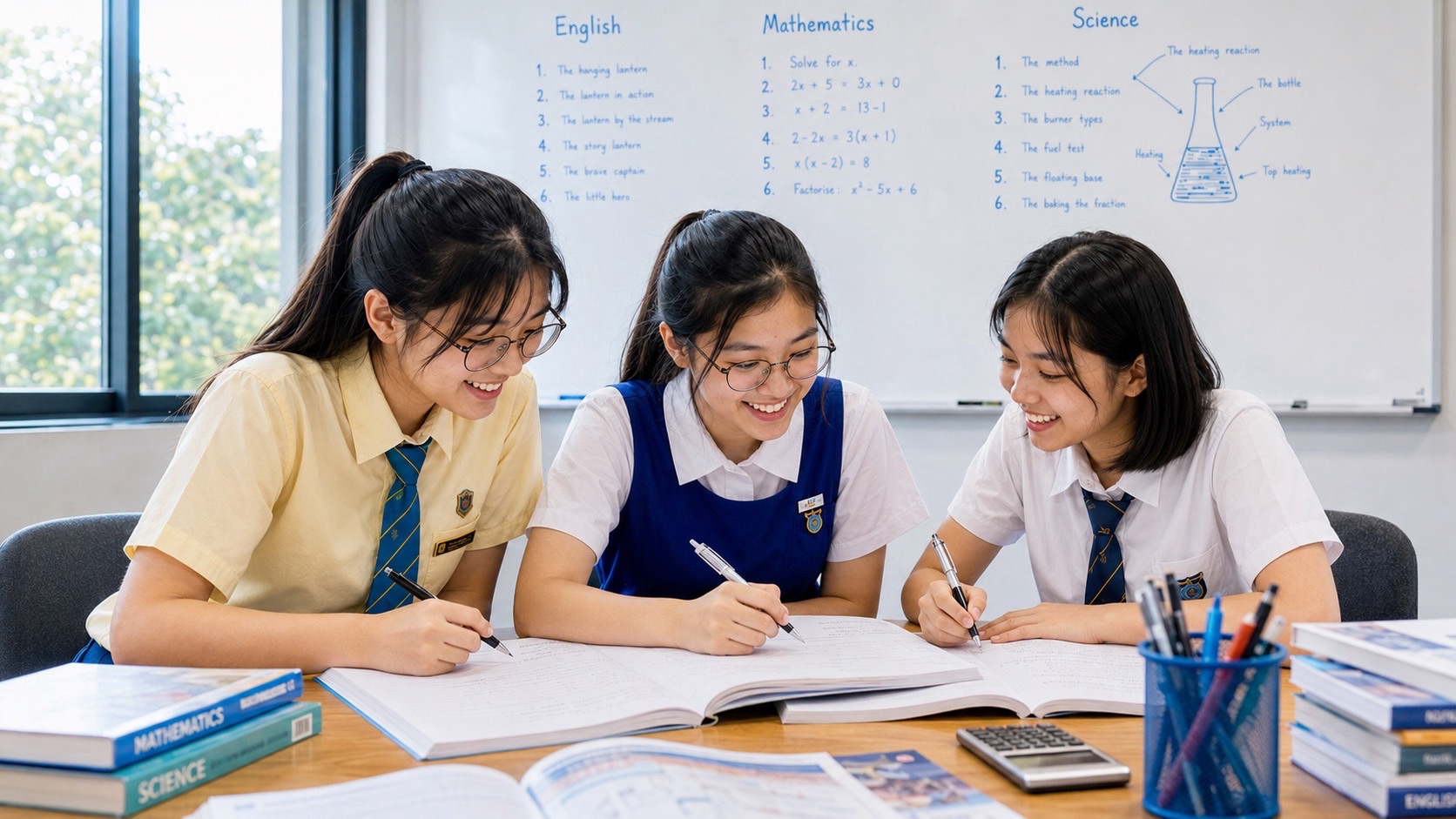
Secondary 1 taught Mira how to enter secondary school. Secondary 2 taught her to carry more of the system herself. Secondary 3 changes the emotional geometry again: the school is familiar, the route through Punggol is familiar, even many of the routines are familiar—but the future suddenly feels close enough to cast a shadow. Upper-secondary subjects have begun. The eventual SEC route is no longer an abstract conversation. English now has to do more than help the student cope. It has to become reliable under pressure.
Mira wakes before the alarm.
Not because the first day of Secondary 3 is new in the way Secondary 1 was new.
There is no untouched uniform waiting like a promise. No one has rehearsed the route. No parent stands in the kitchen pretending not to be nervous about whether a child will find the correct classroom.
The route is known.
That is precisely what makes this morning different.
The unknown has moved.
It is no longer outside her.
It is ahead.
Secondary 4.
The SEC.
Subject expectations.
Upper-secondary writing.
Longer answers.
Heavier weeks.
More independent study.
More moments in which an adult will assume that a fifteen-year-old can work out what to do next.
Mira sits up.
The phone remains across the room. That habit survived.
Her bag is packed. That no longer feels like an achievement.
On the table is a notebook she intends to use for English.
The first page contains one sentence:
Make the thinking visible.
It came from the previous year.
Evidence is not enough unless the relationship is explained.
An example is not enough unless the point it proves is clear.
An opinion is not enough unless it survives another person’s question.
A correction is not enough unless it changes the next attempt.
Secondary 3 begins there.
Not with the fantasy of becoming an examination machine twelve months early.
With a more demanding question:
Can the student now make good English decisions quickly enough, independently enough and reliably enough for upper-secondary pressure?
That is the year.
The Future Moves Closer Without Arriving Yet
There is an awkward temptation in Secondary 3.
Adults can see Secondary 4.
Students can see it too.
So everyone is tempted to begin living there immediately.
Full papers.
Exam countdowns.
Mark targets.
Revision schedules designed before the child has accumulated enough current-year work to revise intelligently.
Some examination orientation is sensible.
Premature examination life is not.
Secondary 3 has its own job.
It is the first upper-secondary year in which foundations must survive stronger load.
The student should learn to:
read more densely,
write more deliberately,
edit more independently,
manage more competing work,
use evidence with greater precision,
qualify claims,
respond to source and multimodal material,
speak with structure,
listen selectively,
and recover faster when performance drops.
These are not “nice to have” skills.
They are the runway.
Mira understands this because Secondary 2 ended with an independence test.
What can she do without an adult voice?
She can read the exact task.
She can diagnose some of her lost marks.
She can plan the middle of a piece.
She can recognise when a headline is stronger than its evidence.
She can bring a specific problem to tuition rather than saying, “I don’t understand English.”
But Secondary 3 exposes where independence is still fragile.
She sometimes knows the method and fails to retrieve it under time.
She can edit thoroughly when calm and incompletely when tired.
She can qualify an argument in discussion and become too absolute when writing quickly.
She can read a difficult article if she has enough background knowledge and become slow when the context is unfamiliar.
None of this means the previous years failed.
It means the load has changed.
A bridge tested by heavier traffic reveals different weaknesses.
Secondary 3 is the year the bridge must become stronger.
Ben Arrives Faster Than the Year
Ben sends a message at 6:42.
“Sec 3 already. tragic.”
Mira replies:
“Evidence?”
He sends a photograph of his timetable.
“Exhibit A.”
Ben is still Ben.
That is part of the continuity.
He still thinks quickly. Still speaks before Mira when a class discussion opens. Still enjoys making an argument sound more certain than the evidence deserves because certainty has rhythm.
But he is not the same Ben who entered Secondary 1.
He knows his first answer is often a draft.
He has learned to define the point before selecting the example.
He knows his long sentences become dangerous when he is excited.
He knows that an energetic opening cannot pay the debt of an undeveloped middle.
And he knows the most irritating thing Mira can ask him is often the most useful:
“How do you know?”
Secondary 3 will make that question harder.
How do you know what the writer’s tone is?
How do you know the source is reliable enough for this claim?
How do you know your example actually proves the point?
How do you know the audience will read the sentence the way you intended?
How do you know this paragraph belongs?
How do you know the answer is precise enough rather than merely related?
Ben’s speed will remain an advantage.
Only if judgement can keep up.
The Upper-Secondary English Shift
Lower secondary introduced the systems.
Upper secondary increases coordination.
English becomes less forgiving of fragments of competence.
A student may have good vocabulary and weak task control.
Strong ideas and weak paragraph development.
Accurate grammar in exercises and unstable grammar in timed writing.
Good comprehension when the topic is familiar and slow comprehension when background knowledge is thin.
Strong oral confidence and poor listening.
Good first drafts and almost no self-editing.
Secondary 3 reveals these combinations because more skills have to operate at once.
The student is no longer merely learning what a strong answer looks like.
The student is learning to produce one under competing demands.
Time.
Topic.
Language.
Evidence.
Audience.
Purpose.
Grammar.
Organisation.
Revision.
That is why self-editing becomes one of the defining Secondary 3 English skills.
The student must begin reading their own work as if it was written by somebody else.
Not:
“I know what I mean.”
But:
“Can the reader know what I mean from this sentence?”
That is a very different standard.
Home in Secondary 3: Parents Feel the Stakes Too
Secondary 3 changes the parents’ emotional position.
In Secondary 1, the family worried about transition.
In Secondary 2, the family worried about independence.
In Secondary 3, the family can see Secondary 4.
This makes adults impatient.
A weak test can feel larger than it is.
A missed deadline can sound like evidence of a future examination disaster.
A student who says, “I’m tired,” can be interpreted as someone who has lost discipline.
A student who says, “I don’t know what to write,” can trigger a lecture about how there is no time left to waste.
But Secondary 3 is still a learning year.
The stakes are higher precisely because the response should become more intelligent, not more panicked.
Mira’s parents try to keep one rule:
Do not make every school problem about Secondary 4.
If the problem is today’s comprehension, solve today’s comprehension.
If the problem is an overloaded week, repair the week.
If the problem is grammar under time pressure, train grammar under time pressure.
If the problem is late-night work because the student started too late, fix the starting routine.
The future matters.
It should not be used as a weapon against the present.
Parents also need to accept a difficult truth:
By Secondary 3, some educational consequences should belong to the student.
Mira forgets to submit something once.
Her parent notices the evening before.
The easy rescue is obvious.
Remind her.
Instead, the parent asks one question:
“What is due tomorrow?”
Mira checks.
Finds the problem.
Fixes it.
The rescue has become a prompt.
Later in the year, even the prompt should disappear.
This is not neglect.
It is transfer of ownership.
Upper-secondary readiness includes living with more of one’s own academic system.
The home remains the base.
It should not become the control room.
The Familiar Punggol Route Now Carries Different Thoughts
Mira still moves through Punggol in the morning.
The LRT, MRT, walkways, school routes, coffee shops, convenience stores, common spaces and familiar faces are no longer background scenery she consciously studies every day.
They are home.
But Secondary 3 changes what she notices.
A younger student is being reminded by a parent to check a bag.
Mira remembers being that student.
A group of Secondary 4 students are speaking about an upcoming paper.
For the first time, she listens differently.
Not with the distant curiosity of a junior.
With recognition.
That will be us.
Not today.
Soon enough.
The same town begins to acquire a timeline.
Primary school routes.
Secondary 1 uncertainty.
Secondary 2 familiarity.
Secondary 3 anticipation.
This is useful material for English because mature writing often depends on time.
A place means one thing because of what happened there before.
A person responds to the present through memory.
A statement can be understood only inside context.
The student is now old enough to write with layered time.
Not simply:
“I walked past the station.”
But:
“The station no longer felt like the place where I might get lost; it had become the place where I noticed who was still new.”
That sentence contains development.
The place has not changed.
The narrator has.
Secondary 3 English benefits from this growing ability to see change across time.
School Is Familiar, but the Academic Weather Changes
Upper secondary creates a different school rhythm.
Subjects may feel more specialised.
Teachers may assume stronger baseline competence.
Homework can contain fewer mechanical steps and more judgement.
Tasks may be less forgiving when the student starts late because the work itself takes longer to think through.
English participates in this change.
The student is not merely asked to understand a text.
They may need to compare positions, explain language effects, synthesise information, interpret a visual alongside prose, distinguish tone from topic, or produce writing whose purpose and audience genuinely shape the form.
Writing becomes less about satisfying a checklist and more about control.
Control of relevance.
Control of development.
Control of register.
Control of grammar.
Control of time.
Control of revision.
Ben initially experiences this as unfair.
“Last year this would have been fine.”
The teacher says:
“Last year you were practising the structure. This year I expect you to use it.”
That sentence describes upper secondary well.
Knowledge is increasingly assumed.
Deployment becomes the issue.
Reading in Secondary 3: From Architecture to Pressure
Secondary 2 taught Mira to see text architecture.
Claim.
Example.
Counterpoint.
Shift.
Cause.
Result.
Secondary 3 adds pressure.
Can she see the architecture quickly enough?
Can she continue when the topic is unfamiliar?
Can she distinguish a writer’s central position from one vivid example?
Can she find the exact part of the text needed for the question without rereading the entire passage every time?
Can she keep separate what the text states, what it implies and what she herself thinks?
That last distinction becomes crucial.
Strong readers sometimes lose marks because they know too much.
They answer from general knowledge rather than the text.
Mira encounters an article about a topic she has read about before.
She knows the wider debate.
The question asks what this writer suggests.
Her first answer contains correct information that is not actually this writer’s point.
The teacher writes:
“Return to the text.”
Mira is annoyed because she knows the topic.
That is exactly the trap.
English comprehension is not a reward for knowing the surrounding world better than the passage.
Knowledge helps.
The answer still has to remain anchored.
Secondary 3 therefore teaches disciplined knowledge.
Use what you know to understand.
Do not use what you know to replace what the writer said.
Inference Becomes Calibration
In lower secondary, students often learn inference as a bridge:
evidence → conclusion.
In Secondary 3, inference needs calibration.
How strong is the conclusion?
Does the evidence justify certainty?
Is the writer definitely angry, or merely critical?
Does the character fear someone, or is the text only suggesting unease?
Does the statistic prove a cause, or only show an association?
Can a visual support the claim directly, or does it merely make the claim emotionally memorable?
This is where words such as:
suggests,
implies,
indicates,
reveals,
may,
likely,
appears
become intellectually important.
Qualification is not weak writing.
Qualification matches confidence to evidence.
Ben hates this at first.
He prefers sentences that land like doors closing.
“Clearly, the writer believes…”
“Obviously, society must…”
Mira asks:
“Clearly according to which line?”
He removes “clearly”.
The sentence survives.
That is useful.
Secondary 3 writing should become less dependent on rhetorical certainty and more dependent on evidential strength.
Self-Editing Becomes a Core Secondary 3 Skill
Secondary 3 is where correction should stop being an event that happens only after a teacher returns the work.
The student has to begin correcting before submission.
This sounds obvious.
In practice, many students do not edit.
They reread.
Rereading and editing are not the same.
Rereading often means looking at the same words while remembering what you meant.
Editing means testing whether the words on the page actually carry what you meant.
Mira develops three editing passes.
Pass one: meaning.
Did I answer the exact task?
Does every paragraph have a job?
Is the explanation complete?
Does the example prove the point?
Have I contradicted myself?
Pass two: structure.
Does the paragraph move?
Does the transition express the real relationship?
Have I repeated the same idea in different words?
Is the conclusion resolving the argument or merely stopping?
Pass three: language.
Grammar.
Tense.
Agreement.
Pronoun reference.
Sentence boundaries.
Word form.
Register.
Ben initially resists the separate passes.
“Why can’t I just read it once?”
Because different errors require different attention.
When he reads for meaning, he is poor at noticing surface grammar.
When he hunts for grammar, he can miss a weak argument.
Separating the passes reduces cognitive competition.
This matters because the final examination environment will not supply an editor.
The student has to become one.
Writing: The Student Must Control the Middle
Secondary 2 taught Ben to plan the middle.
Secondary 3 asks whether he can sustain it.
Upper-secondary writing becomes increasingly unforgiving of the “three good beginnings” problem.
Students begin:
the essay,
the paragraph,
the example,
the explanation.
Then each beginning is abandoned too early.
The result feels energetic and thin.
Secondary 3 should teach completion of thought.
Suppose the point is:
Public spaces can strengthen community.
Weak development:
People meet there. They can exercise. Families can spend time together. This builds bonds.
Nothing is false.
But the mechanism is compressed.
Stronger development asks:
What kind of repeated contact matters?
Why does shared space change social experience?
What does a public place allow that private space does not?
What limitation should be acknowledged?
Now the paragraph becomes thinking.
Mira begins using a test:
If I removed the example, would the reasoning still exist?
If no, the example is doing all the work.
Then she asks:
If I removed the explanation, would the reader know why the example matters?
If no, the bridge is missing.
This is the level of self-inspection Secondary 3 needs.
Continuous Writing: Voice Must Survive Structure
Students often become more formulaic as examinations approach.
This is understandable.
Formulas reduce uncertainty.
But an over-formulaic writer becomes predictable in the wrong way.
Every introduction performs the same trick.
Every narrative begins with weather.
Every argumentative essay contains the same three generic points.
Every conclusion says that “ultimately, there are advantages and disadvantages”.
Secondary 3 should protect structure without killing voice.
Mira learns that a good opening earns its place by establishing direction.
Not by sounding dramatic.
Ben learns that humour can work, but only if the piece still answers the task.
A narrative needs pressure.
A reflective piece needs interpretation.
An argumentative piece needs a defensible position.
An expository piece needs conceptual organisation.
The genre determines the movement.
The writer still needs to sound like a thinking person.
This is where wide reading helps.
Students who read different forms encounter different rhythms.
Short sentences used for force.
Longer sentences used to accumulate or qualify.
Writers who begin quietly.
Writers who delay the main point.
Writers who define before arguing.
Writers who use one precise image instead of six adjectives.
Style becomes a set of choices rather than a list of impressive techniques.
Argument: Secondary 3 Must Survive Counterargument
An argument that works only when nobody pushes back is not ready.
Secondary 3 should expose positions to resistance.
Mira writes that schools should place stricter limits on student phone use during the school day.
The argument is coherent.
Then Ben attacks it.
Emergency communication.
Accessibility needs.
Learning applications.
Practical enforcement.
Student responsibility.
Now Mira has choices.
Ignore the objections.
Weaken her position.
Or refine it.
She chooses refinement.
Her revised position is not “ban phones”.
It becomes:
Schools should establish stricter default limits during instructional time while preserving clearly defined exceptions for learning and legitimate needs.
The new position is longer.
It is also better.
It acknowledges complexity without surrendering direction.
Secondary 3 students should practise this deliberately.
What is the strongest objection?
Which part of my claim is most vulnerable?
What evidence would actually weaken my view?
What concession can I make without losing the argument?
What condition would change my conclusion?
These questions prepare students not only for English writing but for mature reasoning.
Situational Writing: Purpose Must Control Selection
By Secondary 3, students may know the basic language of purpose, audience and context.
The problem becomes selection.
A visual text contains many details.
Not all deserve equal space.
The student must decide what the recipient needs.
Mira receives a task involving several pieces of information.
Her first instinct is to include everything.
That feels safe.
It is not always good communication.
A reader needs relevant information, organised for action.
Secondary 3 should therefore ask:
What must be included?
What should be explained?
What can be compressed?
What tone fits the relationship?
What order helps the reader act?
What detail matters to this audience but not another?
This is where situational writing becomes real communication design.
A speech is heard.
An email is scanned.
A report is consulted.
A letter carries a different relationship.
Form follows use.
Students who understand this are less dependent on memorised openings.
Vocabulary: The Word Must Earn Its Place
Secondary 3 students often become anxious about vocabulary.
They see stronger essays and assume the difference is “better words”.
Sometimes it is.
Often the deeper difference is better thinking.
Vocabulary should sharpen that thinking.
Consider:
important,
significant,
essential,
central,
decisive,
consequential.
These are not interchangeable decorations.
“Essential” suggests necessity.
“Decisive” suggests something that determines an outcome.
“Consequential” suggests substantial effects.
Precision matters.
Mira continues building clusters rather than isolated lists.
cause — contribute — trigger — enable — intensify — accelerate — constrain.
Now she has different causal strengths available.
“Social media causes anxiety” is a large claim.
“Certain patterns of social-media use may intensify anxiety for some users” is more calibrated.
The vocabulary is carrying epistemic control.
This is Secondary 3 vocabulary at its best.
Grammar: The Errors Become Personal
By Secondary 3, grammar should be increasingly personalised.
The generic syllabus still matters.
The student’s repeat errors matter more urgently.
Ben has three high-risk zones:
long sentences,
agreement when the subject and verb are far apart,
and punctuation when he changes direction mid-sentence.
Mira has fewer broad grammar problems but can create unclear pronoun references when several people or ideas appear in one paragraph.
Different students need different editing priorities.
The personal grammar audit asks:
Which errors recur?
Under what conditions?
Do they appear in drills?
Only in full writing?
Only under time?
Can the student correct them when pointed out?
Can the student detect them independently?
This produces a more mature repair sequence.
Know the rule.
Recognise the risk.
Monitor during authentic writing.
Edit deliberately.
Retest under pressure.
The aim is not zero errors forever.
The aim is reducing predictable losses.
Digital Reading: The Student Must Read the Frame, Not Only the Sentence
Secondary 3 students live inside a language environment designed to compete for attention.
That environment becomes academically relevant because the same student is now expected to research, compare sources and use current examples with greater independence.
The danger is not simply false information.
The danger is partial information presented with emotional certainty.
A dramatic headline.
A clipped video.
A screenshot without context.
A graph with no baseline.
A quotation removed from the question that produced it.
A statistic without sample size.
An AI-generated summary that quietly combines two different claims.
Mira and Ben use a four-question test:
What is being claimed?
What evidence is actually shown?
What is missing?
What would I need before repeating this confidently?
That final question matters.
Secondary 3 students are old enough to become distributors of information.
They forward.
Post.
Quote.
Use examples in essays.
A student who repeats a claim acquires some responsibility for whether the claim deserved repetition.
This is not a legal rule.
It is an intellectual one.
English is where this responsibility can be trained.
AI: The Student Must Be Able to Audit Fluency
Secondary 3 makes AI use more tempting.
The work is harder.
The writing is longer.
Students are busier.
A fluent answer appears in seconds.
But the central problem from Secondary 2 becomes more serious:
fluent language is not proof of correct reasoning.
For upper-secondary students, one useful AI rule is:
Attempt before assistance when the skill itself is what you are meant to learn.
If Mira is practising argument, she writes her position first.
Then a tool can challenge the argument.
If Ben is practising editing, he edits first.
Then he can compare with another version.
If the task is source research, AI may help generate search directions.
The original source still needs to be checked.
If a generated sentence contains a word the student cannot define, that word does not yet belong to the student.
If a generated paragraph includes an example the student cannot verify, the paragraph is not ready to be trusted.
Secondary 3 should therefore teach an audit routine:
What did the tool add?
Which claim is factual?
Which claim is interpretation?
Which source supports it?
Does the wording become more certain than the evidence?
Can I explain this without the tool?
The student remains the responsible reader.
That is the real future skill.
Speaking: The Upper-Secondary Student Must Respond, Not Perform
By Secondary 3, students may become better at prepared answers.
This can create another trap.
The response sounds polished until the examiner, teacher or classmate asks an unexpected follow-up.
Then the structure disappears.
Spoken communication needs adaptability.
Mira practises a simple response architecture:
position,
reason,
example,
qualification.
Then the tutor changes one condition.
What if the example does not apply to younger students?
What if cost becomes a problem?
What if the policy is voluntary rather than compulsory?
Now Mira must adapt.
Ben’s challenge is different.
He can adapt instantly.
He needs to listen long enough to adapt to the actual question rather than the question he predicted.
Secondary 3 oral work should therefore contain:
planned response,
unplanned follow-up,
clarification,
counterpoint,
and recovery.
Recovery matters.
A student loses a word.
Misunderstands a question.
Begins badly.
Good oral communication includes the ability to repair in real time.
“Let me put that another way.”
“I think I misunderstood the question.”
“A better example would be…”
That is not weakness.
It is control.
Listening: Secondary 3 Information Arrives Faster
Upper-secondary students receive denser spoken information.
Instructions.
Announcements.
Teacher explanations.
Project discussions.
Audio material.
CCA responsibilities.
The student cannot record every word mentally.
Listening must become selective.
Mira uses a three-column note idea:
main point,
evidence/detail,
action/question.
This keeps listening active.
Ben has a different rule:
Do not decide what the teacher means before the sentence finishes.
This prevents premature action.
Listening also becomes useful for English writing because strong listeners encounter argument in motion.
A speaker states a view.
Qualifies it.
Gives an example.
Responds to resistance.
The student hears structure rather than merely content.
World Knowledge Stops Being Optional Decoration
Secondary 3 exposes the relationship between language and knowledge very clearly.
A student can have decent English and still struggle with a text because the concepts are unfamiliar.
A student can write grammatically accurate essays that remain generic because there is little knowledge available to develop the argument.
This is why reading breadth matters.
Not for trivia.
For conceptual anchors.
Education.
Technology.
Environment.
Health.
Cities.
Work.
Media.
Science.
Culture.
Institutions.
Singapore.
Global change.
A student does not need expert knowledge in all these areas.
They need enough exposure that unfamiliar texts have somewhere to attach.
Mira chooses one topic a month for wide reading.
Ben chooses questions rather than topics.
Why do recommendation systems keep people watching?
Why do cities build public transport before demand fully arrives?
Why do people trust confident speakers?
Why do schools use examinations?
Different route.
Same benefit.
Knowledge begins to accumulate around meaningful questions.
January: Recalibrate to Upper-Secondary Load
January is not for panic.
It is for measuring the new load.
How much longer does the work actually take?
Which subjects create the most reading?
Which days are crowded by CCA?
When is the student mentally sharp enough for difficult writing?
Which lower-secondary routines still work?
Which break because the timetable has changed?
Mira learns quickly that her Secondary 2 study rhythm cannot be copied without modification.
She has more demanding subject work.
English writing needs longer uninterrupted blocks.
Some evenings are no longer good writing evenings.
The system has to adapt.
Her January English goal is not a score.
It is:
finish every major piece with an actual editing pass.
Ben chooses:
plan proportion before drafting.
These goals are operational.
They can be checked.
Secondary 3 should begin with one or two behaviours that protect quality under the heavier year.
February: The First Upper-Secondary Feedback Matters
The first marked work creates an important emotional moment.
Some students expect their lower-secondary performance to continue automatically.
Then the demand shifts.
Mira receives a piece with comments that feel familiar and different at once.
“Relevant point.”
“Evidence appropriate.”
“Development still too compressed.”
Same weakness.
Higher consequence.
The temptation is frustration.
“I worked on this last year.”
Yes.
Now the task is harder.
The question becomes:
Does the old repair still work under the new load?
Ben receives another kind of feedback:
“Strong voice. Greater control needed.”
Again.
He laughs.
Some problems are patient.
February is where Secondary 3 students should compare old error profiles with current evidence.
What disappeared?
What survived?
What changed form?
What is newly visible because the task is harder?
This prevents adults from teaching the student they remember rather than the student who exists now.
March: The Audit Must Now Include Time
In Secondary 2, Mira audited skills.
In Secondary 3, she audits skills and time.
Can she produce the quality within realistic limits?
This is a major change.
An answer that requires twenty minutes when the student has eight is not examination-ready even if the answer is excellent.
But speed cannot be trained by simply telling a student to hurry.
The process has to become more efficient.
Question reading.
Evidence selection.
Planning.
Drafting.
Editing.
Where is time leaking?
Mira spends too long deciding between two plausible interpretations.
Ben spends too little time planning.
Different time problem.
The March break becomes an audit:
one comprehension under moderate time,
one writing task with timed planning,
one editing sample,
one oral response.
Not a boot camp.
A measurement.
Then repair.
April: Background Knowledge Begins Paying Rent
By April, students begin meeting enough unfamiliar topics to understand the practical value of broad reading.
Mira reads a text on ageing populations.
She has encountered the concept before.
Dependency ratios.
Healthcare demand.
Workforce.
Accessibility.
The English is not suddenly easier.
The text is easier to organise because the concepts are not entirely new.
Ben reads about misinformation.
He knows terms such as algorithm, engagement, verification and source.
Again, the text has anchors.
April is when students should notice that knowledge reduces reading friction.
This is a long-term English strategy:
read beyond English to improve English.
May: Work-in-Progress Becomes More Expensive
Secondary 3 creates a new kind of academic congestion.
Not simply more tasks.
More tasks that cannot be completed carelessly.
An English composition needs thought before drafting.
A Humanities source task needs reading before writing.
A Science explanation needs conceptual accuracy.
A project needs group coordination.
CCA still exists.
The student cannot solve this by becoming permanently busy.
The system must become better at closing work.
Mira notices that unfinished writing is especially expensive.
A half-written composition continues occupying mental space.
She keeps replaying the missing middle.
So she develops a rule:
Never end a writing session without knowing the next sentence or next paragraph job.
She may stop.
But she leaves a bridge back in.
Ben uses a simpler version.
He leaves himself a note:
“Next: explain why example matters.”
Now the restart cost falls.
May is where planning becomes less about tidy schedules and more about cognitive continuity.
June: The Last Long Holiday Before the Final-Year Runway
The June holiday after Secondary 3 has a special quality.
Secondary 4 is not theoretical anymore.
When school resumes, the remaining distance will feel short.
This makes June valuable.
It can be used badly.
Four weeks of relentless examination papers can produce activity without diagnosis.
Four weeks of complete academic disappearance can allow unstable skills to decay.
A stronger June has four jobs:
recover,
repair,
widen,
and test independence.
Recovery first.
A tired student cannot repair well.
Then repair the persistent English weaknesses that have survived Term 1.
Mira chooses timed paragraph development.
Ben chooses self-editing under full writing conditions.
Then widen.
Read something beyond school.
Follow one serious issue.
Build examples and vocabulary through knowledge.
Then test independence.
Can the student plan and complete one meaningful English project without an adult scheduling every step?
Mira chooses a question that grows naturally from two years of looking at Punggol:
What makes a neighbourhood become a home rather than merely a place where people live?
The question takes her through urban design, public space, community memory, housing, transport and ageing.
She revisits Punggol Regional Library.
She reads about place attachment.
She notices how writers distinguish convenience from belonging.
She interviews no one formally.
She does not need to turn the project into a research paper.
The value is in following a question far enough that her language gains concepts.
Ben follows another:
Why do people believe bad arguments?
He begins with clickbait.
Moves to cognitive bias.
Then rhetoric.
Then advertising.
Then political speeches from different countries and historical periods.
Then he discovers that intelligent people can believe weak arguments too.
This annoys him because he had hoped intelligence was a simpler defence.
The project improves his English because he now has language for reasoning errors.
Correlation.
Cherry-picking.
False dilemma.
Appeal to emotion.
Selection bias.
Overgeneralisation.
Again, knowledge becomes vocabulary.
Vocabulary becomes judgement.
Punggol Regional Library: Research Becomes Triangulation
In Secondary 1, the library offered wandering.
In Secondary 2, it offered research.
In Secondary 3, Mira begins triangulation.
One source says public space creates community.
Another argues that design cannot manufacture social trust.
A third examines accessibility rather than community.
Now the student has to compare.
Which sources are answering the same question?
Which use different definitions?
Which provide data?
Which provide interpretation?
Which describe one city and assume the insight travels universally?
This is the beginning of research maturity.
Not “find three sources that agree with me”.
Find enough different evidence to understand the problem better.
Mira realises that a strong essay does not need maximum facts.
It needs facts chosen for a line of reasoning.
That is selection again.
English keeps returning to the same deep skill.
Choose what matters.
Punggol Waterway: The Same Place, Another Year of Meaning
The waterway has become almost a measuring device in Mira’s story.
Secondary 1: observe.
Secondary 2: interpret.
Secondary 3: argue.
Should public spaces be optimised for movement, leisure, ecology, community or all four?
What happens when these goals conflict?
A cyclist wants speed.
A family wants safety.
A resident wants quiet.
A business may want foot traffic.
A planner may want connectivity.
An environmental concern may require limiting some forms of use.
Now one local place becomes material for trade-offs.
That is upper-secondary thinking.
The question is no longer:
“Is the park good?”
It becomes:
“Good for whom, under what criteria, and at what cost?”
This is exactly the kind of qualification stronger English argument needs.
July: Return Without Resetting to Zero
After June, students often feel rusty.
Secondary 3 should respond quickly.
Not with a full restart.
With retrieval.
Mira does one timed comprehension section.
Her accuracy is acceptable.
Timing is slow.
She knows the issue.
Ben does one timed writing section.
His planning is better than January.
Editing collapses because he uses all the time drafting.
Again, useful evidence.
July is where the student should recover the working system before workload fully accelerates.
This is also the month when Secondary 4 starts feeling socially close.
Seniors talk about prelims.
Teachers refer to next year more often.
Some students react by increasing work indiscriminately.
Mira tries to keep the focus local:
What is the next weakness?
What is the next assessment?
What is the next transferable skill?
Do that.
August: Public Language Becomes Rhetorical Analysis
In Secondary 1, Mira noticed public words.
In Secondary 2, she studied framing.
In Secondary 3, she studies rhetoric.
How does a speech create urgency?
How does repetition build rhythm?
How does a speaker create an “us”?
How do anecdotes humanise a policy?
How do statistics create authority?
How does a writer acknowledge uncertainty without losing confidence?
National Day season supplies public language in abundance, but the skill is broader.
Government communication.
Advertising.
Campaigns.
School speeches.
Public-health messages.
Corporate statements.
Social-media advocacy.
The student learns that rhetoric is not automatically manipulation.
Rhetoric is the design of communication for an audience.
The ethical question is whether the design serves truth or conceals weakness.
Ben enjoys analysing persuasive language because he has been using it informally for years.
Mira enjoys checking whether the persuasion outruns the evidence.
They remain useful to each other.
September: The Repair Must Now Survive Full Tasks
By September, isolated drills should play a smaller role for known skills.
The student needs full-task transfer.
Mira can develop a paragraph.
Can she do it after forty minutes of reading and planning?
Ben can edit a sentence.
Can he reserve time and edit an entire piece after sustained writing?
This is the Secondary 3 pressure test.
Skills compete.
The task is not merely to know each one.
The task is to coordinate them.
A useful September cycle:
- complete a realistic task;
- mark the first breakdown;
- repair the process;
- repeat on a fresh task;
- reduce external prompts.
This is where tuition and school feedback can become especially powerful together.
School supplies authentic evidence.
Tuition can slow the evidence down.
The student then returns to a fresh school task.
Transfer decides whether the repair worked.
October: The Student Must Explain the Mark Before the Adult Does
Secondary 3 marks feel consequential.
That makes the post-assessment conversation important.
Mira receives a result below what she hoped.
Her parent does not begin with analysis.
Mira does.
“I spent too long on the first writing section. Then I rushed the continuous writing conclusion. The comprehension was actually okay except for two language-effect questions.”
This is useful.
Then the parent asks:
“What is the first thing you change?”
Not:
“How many extra papers should we buy?”
The first change is time allocation.
Ben has a different result.
He did better overall but lost predictable grammar marks.
His problem is not lack of knowledge.
His editing system is still incomplete.
Again, the mark compresses.
The diagnosis expands.
November: The Secondary 4 Handover Begins
The end of Secondary 3 should not be treated like the end of an ordinary year.
It is a handover.
What must travel?
Mira chooses:
- time discipline;
- paragraph development under pressure;
- source verification;
- three-pass editing;
- monthly wide reading.
Ben chooses:
- plan proportion before drafting;
- control sentence length when rushed;
- keep counterargument honest;
- reserve editing time;
- listen to the full question.
The handover should also include evidence.
Keep the scripts.
Keep the best and worst writing.
Keep the error log.
Keep the reading list.
Secondary 4 planning should begin from actual Secondary 3 data, not vague memory.
December: Prepare the System, Not Panic the Child
December before Secondary 4 is important.
It is also still December.
The goal is not to create examination exhaustion before January.
A strong holiday has several components.
Rest enough to recover.
Review enough to preserve.
Repair enough to reduce known risks.
Read enough to keep the language world open.
Practise enough timed work to enter January without shock.
Mira does not attempt every possible paper.
She builds a compact Secondary 4 English operating page:
reading risks,
writing risks,
grammar risks,
time risks,
oral risks,
listening risks.
Then one rule:
Use evidence before anxiety.
If January feels difficult, diagnose.
Do not immediately conclude the year is failing.
Ben’s operating page is less elegant.
It says:
“PLAN. EDIT. STOP WRITING 70-WORD SENTENCES.”
Different student.
Same principle.
Carry forward what matters.
When Tuition Enters Secondary 3, It Should Become More Surgical
Secondary 3 is not the year for tuition to become a second full school.
The school week is already dense.
The student has real teachers, real assessments, real CCA, real homework and real subject demands.
The value of tuition is focus.
What is the first weak link now?
Not the first weak link from Primary 6.
Not the weakness remembered from last year.
The current one.
Mira arrives with a marked writing script.
She already knows one issue.
Time.
She used too much of it early.
The tutor looks deeper.
Why did time disappear?
Because she spent too long choosing between two directions.
Why?
Because she was trying to guarantee the better choice before beginning.
Now the problem is not merely “time management”.
It is decision confidence.
She needs a quicker planning threshold.
Choose the defensible route.
Commit.
Improve during drafting.
That is a more precise repair.
Ben arrives with another script.
He has grammar errors.
He knows the rules.
The tutor asks how much editing time remained.
Thirty seconds.
There is the upstream break.
The grammar problem is partly a time-allocation problem.
Again, the visible error is not always the first weak link.
The Secondary 3 Diagnostic States
By this stage, a mature English diagnosis should distinguish at least several states.
Unknown.
The student genuinely does not know the concept, structure or word.
Understood but unstable.
The student can perform with time or support.
Known but unretrieved.
The skill disappears under load.
Transfer failure.
The student succeeds on drills and fails on authentic tasks.
Monitoring failure.
The student can correct the issue after someone points to it but does not detect it alone.
Decision failure.
The student knows several possible methods but chooses poorly or too slowly.
Time-allocation failure.
The student has the skills but distributes time badly.
Knowledge-limited performance.
The English is adequate but background knowledge is too thin for efficient comprehension or rich writing.
These categories matter because “needs more practice” is not specific enough for Secondary 3.
The student is too close to the final year for low-information intervention.
The Tuition Loop Evolves
The familiar eduKate loop remains:
Read → Diagnose → Prioritise → Repair → Practise → Connect → Perform → Review.
In Secondary 3, each stage changes.
Read.
Look at current school evidence, not only tuition worksheets.
Diagnose.
Separate knowledge, retrieval, transfer, monitoring and time problems.
Prioritise.
Choose the weakness with the largest downstream effect.
Repair.
Teach only what is actually missing.
Practise.
Move quickly from isolation to authentic task.
Connect.
Relate English skills to Humanities, Science, research and real communication.
Perform.
Use fresh tasks, less prompting and realistic time.
Review.
Ask whether the student can explain what changed.
The aim is not just better work.
The aim is better self-management of work.
Small Groups Become Calibration Rooms
At fifteen, students can learn a great deal from comparing reasoning.
A three-student table is useful not because three students are identical.
Because they are not.
Mira reads slowly and carefully.
Ben reads quickly and sometimes overcommits.
A third student may have strong grammar but weak background knowledge.
The same passage produces three processes.
The tutor can ask:
Where did each person spend time?
Which evidence did each choose?
Which answer is strongest?
Why?
This creates calibration.
Students discover that “my answer sounds good” is not enough.
Compare.
What makes one response more precise?
What makes one paragraph easier to follow?
What makes one example stronger?
What makes one spoken response more convincing without being louder?
Peer comparison becomes useful when it is about decisions rather than ranking people.
The Secondary 3 Transfer Test
By Secondary 3, every important repair should end with transfer.
Not “Do you understand?”
Not “Can you do one more identical example?”
A fresh task.
Different topic.
Less support.
Realistic time.
Mira repairs language-effect answers.
Then receives a text where the effect is created by structure rather than obvious vocabulary.
Can she still reason?
Ben repairs a long-sentence grammar issue.
Then writes about a topic he cares about, where excitement normally makes him lose control.
Does the repair survive?
This is what “mastery” should increasingly mean.
Not recognition.
Availability.
The Independence Test Before Secondary 4
At least once in the second half of Secondary 3, the student should complete a substantial English task without the familiar prompts.
No:
“Remember audience.”
No:
“Leave editing time.”
No:
“Check whether your example proves the point.”
The adults step back.
Then inspect what remains.
Mira remembers audience.
Remembers structure.
Leaves some editing time.
Still overthinks one early decision.
Good.
The remaining target is visible.
Ben plans.
Writes strongly.
Forgets to reserve enough editing time.
Again.
Now the goal for December becomes obvious.
The independence test is not designed to expose failure.
It exposes scaffolding.
Which parts of the adult system are still doing work the student must soon own?
The Tutor Should Be Fading, Not Expanding
This may sound strange in a tuition article.
But the goal of good upper-secondary tuition is not to make the student increasingly dependent on the tutor as the exam approaches.
The tutor may become more strategically important.
But the student should become more operationally independent.
Early:
“What is the question asking?”
Later:
“What do you think it is asking?”
Later still:
silence.
Early:
“Your paragraph needs development.”
Later:
“Which paragraph is weakest?”
Later still:
the student identifies it before feedback.
Early:
“You have a grammar error here.”
Later:
“Read the sentence again.”
Later still:
the student edits it independently.
The tutor’s expertise shifts from supplying answers to designing conditions in which the student must supply more of the process.
That is how the support becomes durable.
School, Home and Tuition Must Remain Coherent
The closer Secondary 4 gets, the easier it is for the child to become trapped between systems.
School says one thing.
Tuition says another.
Parents add a third schedule.
Online resources add ten more methods.
The student becomes busy choosing advice instead of improving performance.
Secondary 3 needs coherence.
School owns the main curriculum and authentic assessment context.
Tuition should diagnose and strengthen the student within that reality.
Home should support time, routine, sleep, values and emotional stability.
The student increasingly becomes the information carrier.
“My teacher said this.”
“This is where I lost marks.”
“This is what I tried.”
“This is still not working.”
That language is evidence of ownership.
When More Practice Is the Right Answer
There are times when more practice is exactly what a Secondary 3 student needs.
After the method is sound.
When retrieval needs strengthening.
When timing needs calibration.
When transfer needs breadth.
When a student needs exposure to more text types.
When editing needs repetition until monitoring becomes faster.
The problem is not volume.
The problem is volume without purpose.
Ten papers with the same uncorrected weakness create ten records of the weakness.
Three carefully reviewed tasks may produce more movement.
Then volume can be added once the pattern improves.
Secondary 3 should therefore sequence:
diagnose → repair → stabilise → increase volume.
Not:
increase volume → hope.
The Current SEC Runway Is Now Close Enough to Study Properly
By Secondary 3, students and parents should understand the current examination architecture without allowing it to consume the whole year.
Under the Singapore-Cambridge Secondary Education Certificate framework beginning in 2027, English Language is offered at G1, G2 and G3 subject levels.
The current subject codes are:
- G1 English Language — K100;
- G2 English Language — K200;
- G3 English Language — K300.
The exact syllabus should always be checked against the current SEAB version for the student’s examination year.
The important Secondary 3 lesson is architectural.
English is not one paper.
Writing.
Comprehension.
Listening.
Oral communication.
For current G3 English, the four-paper structure includes Paper 1 Writing, Paper 2 Comprehension, Paper 3 Listening and Paper 4 Oral Communication.
This matters because a student can be strong in one mode and weak in another.
A high-quality Secondary 3 programme should not allow written work to monopolise attention simply because it is easiest to assign as homework.
Listening needs training.
Speaking needs training.
Reading needs breadth and precision.
Writing needs sustained development and editing.
The examination architecture confirms something the earlier years already taught:
English is an integrated language system.
G1, G2 and G3: Different Demand, Same Human Dignity
Secondary 3 is a year when subject-level labels can become socially louder.
Students compare.
Parents compare.
Future pathways feel closer.
It is worth saying clearly:
a subject level is a route.
It is not a complete description of a person.
The complexity and assessment demand differ across G1, G2 and G3.
The core human work remains recognisable.
Read meaning.
Generate meaning.
Communicate clearly.
Respond to purpose and audience.
Control language.
Listen.
Speak.
Write.
Revise.
A student taking G1 deserves precision and growth.
A student taking G2 deserves challenge appropriate to that route.
A student taking G3 deserves depth rather than endless repetition of easy tasks.
Diagnosis should remain individual.
The label does not replace the learner.
What the G3 Paper Architecture Teaches Even Before Secondary 4
The current G3 SEC English structure makes several long-term demands visible.
Writing includes editing, situational writing and continuous writing.
That means grammar, purpose, audience, context, development and sustained prose all matter.
Comprehension includes written and visual texts, narrative or recount material, non-narrative material and summary.
That means the student must shift reading modes.
Listening includes comprehension and note-taking.
That means selective attention matters.
Oral communication includes a planned response and spoken interaction.
That means prepared fluency is not enough.
The student has to respond.
Secondary 3 should use these facts as design constraints.
Do not wait until the final year to discover that the student never practised listening strategically.
Do not wait until the final year to discover that oral answers collapse after the first follow-up.
Do not wait until the final year to discover that editing exists only in grammar worksheets.
But also do not spend Secondary 3 mechanically simulating the final paper every week.
Build the underlying systems first.
Then simulation becomes useful.
One Complete Secondary 3 Day in Punggol
It is a Thursday in September.
Mira wakes at 6:08.
The alarm is set for 6:10.
She considers this victory.
The day already has a shape.
English lesson.
Science.
Mathematics.
Humanities.
CCA.
Tuition later.
A school writing task due tomorrow.
One group project still moving.
Last year, this amount of open work would have created a vague sensation of being busy.
This year she has written three next actions the night before.
Finish paragraph three.
Check project source.
Edit writing before submission.
At breakfast, a parent asks:
“Busy day?”
“Yes.”
Then Mira adds:
“But only three things are actually unfinished.”
This is operational progress.
On the way to school, she reads a headline about a new technology.
The headline says it will “transform education forever”.
Mira does not click immediately.
She has learned that “forever” is expensive evidence.
She saves it.
At school, English begins with a non-fiction text.
The topic is unfamiliar enough to slow the class.
The teacher asks for the writer’s central concern.
Ben identifies a vivid example.
Mira identifies a broader pattern.
The teacher asks:
“Which one answers the question?”
The class compares.
Ben’s example is useful evidence.
Mira’s answer is closer to the central concern.
The difference is hierarchy.
One detail is memorable.
The other captures the writer’s larger position.
Then comes a language-effect question.
Mira identifies a repeated phrase.
She explains what it emphasises.
The teacher asks:
“And why does that matter here?”
There it is again.
The old bridge at a higher level.
Feature.
Meaning.
Effect.
Function in context.
By the end of the lesson, Secondary 3 English has done what it should.
It has taken a skill that once stopped after naming and pushed it towards interpretation.
In Science, Mira meets a long explanation question.
She knows the content.
But the answer needs a causal chain.
Again, language.
In Mathematics, a problem turns on one constraint word.
Again, reading.
In Humanities, two sources disagree.
Again, evidence and perspective.
By lunch, English has crossed the timetable without permission.
Ben joins Mira with a complaint.
His project group has found two sources that give different numbers.
Last year, the instinct might have been to choose the number that fits the slide.
This year they ask why the numbers differ.
Different year?
Different population?
Different definition?
Different methodology?
Now research becomes interpretation.
At CCA, Mira has to explain a procedure to a younger student.
She gives the first instruction.
The student looks uncertain.
Mira tries again with a sequence.
First.
Then.
Watch for.
If this happens.
The student understands.
That is English too.
Clear instruction is audience design.
After CCA, Mira is tired.
This matters because tuition comes next.
The class does not begin with a full paper simply because the exam is closer.
Mira brings the school writing she must submit tomorrow.
The tutor asks:
“What is your biggest risk?”
She says:
“The middle is okay. I think the last paragraph repeats.”
They read.
She is right.
The tutor asks what to remove.
Mira removes two sentences herself.
Then she notices an ambiguous pronoun.
Fixes it.
The tutor has said very little.
This is the point.
Across the table, Ben is doing timed editing.
He finishes a paragraph and must stop drafting five minutes before the end.
He hates this.
“I could make the ending better.”
“You could also save grammar marks.”
He edits.
Finds two errors he would otherwise have submitted.
The lesson is not that editing matters.
He already knew that.
The lesson is that editing requires protected time.
Knowledge has become scheduling.
On the way home, Mira opens the technology article from breakfast.
The headline was dramatic.
The article is more cautious.
The evidence describes early results.
“Transform forever” was the headline’s language, not the study’s.
Mira sends Ben a screenshot.
“Headline stronger than evidence.”
He replies:
“classic.”
At home, she finishes the final paragraph of the school writing.
Then stops.
Meaning pass.
Structure pass.
Language pass.
The phone is across the room by 10:20.
The day is not perfect.
She still has one unfinished task for the weekend.
Ben will probably write another sentence that is too long tomorrow.
But the system is different.
The students are doing more of the noticing.
That is Secondary 3.
What This Day Shows
The full day reveals the central progression.
Secondary 1:
adults help the student see the system.
Secondary 2:
the student begins to operate the system.
Secondary 3:
the system must remain reliable under greater load.
English appears in:
the formal lesson,
Science explanation,
Mathematics constraints,
Humanities sources,
project research,
CCA leadership,
digital information,
tuition correction,
and independent editing at home.
This is why one workbook cannot represent the whole subject.
English is the medium through which much of the student’s upper-secondary intelligence becomes visible.
Parent Signals in Secondary 3: Look Beyond the Mark
Marks matter more now because the final year is close.
That still does not make them sufficient.
A parent should ask what is happening underneath.
Is the student becoming more independent?
Can the student explain lost marks?
Can the student identify a recurring risk?
Does feedback transfer?
Can the student work under time without collapsing into old habits?
Does the child still read beyond assigned material?
Can the student recover after a disappointing result?
Are sleep and workload becoming unsustainable?
These are leading indicators.
A student with a good mark but no self-editing habit may still be fragile.
A student with a moderate mark and rapidly improving self-diagnosis may be moving strongly.
The direction matters.
Green Signals
The student generally knows what is due.
The student can explain teacher feedback.
Timed performance is improving.
The student brings marked work instead of avoiding it.
Reading continues.
Writing shows clearer development over months.
The student can identify personal grammar risks.
The student asks for help specifically.
Parents can focus on stability and extension.
Amber Signals
The same errors are recurring.
Performance depends heavily on prompting.
The student knows methods but does not retrieve them under time.
Editing is repeatedly skipped.
Reading breadth has collapsed because every minute is reactive homework.
Deadlines create last-minute work.
The student cannot explain why marks move.
This is the time to narrow onto one or two high-leverage repairs.
Do not wait for Secondary 4 to make the problem urgent.
Red Signals
The student is persistently overwhelmed.
Work is repeatedly missing.
English tasks are avoided entirely.
The student has a growing backlog of uncorrected work.
Basic comprehension at the current level is unstable.
Writing cannot be completed independently.
The student is sleeping too little for the system to function.
Or the student’s language about themselves has become global:
“I can’t do English.”
“I’m just bad at this.”
Now the response should become more direct.
Talk to the school.
Use current scripts.
Narrow the workload if necessary.
Diagnose the first weak link.
Repair before increasing volume.
If the Secondary 3 Student Is Already Strong
Strong students can become fragile in a different way.
They may not have experienced enough difficulty.
The mark is high.
So the process remains untested.
Extension should not simply mean doing next year’s papers early.
It can mean:
harder non-fiction,
longer-form journalism,
essays with genuine counterargument,
source comparison,
more demanding oral discussion,
independent research,
style experimentation,
and writing that requires substantial revision.
A strong student needs intellectual friction.
Not to damage confidence.
To make confidence evidence-based.
“I can handle easy tasks” is not the same as “I know what to do when the task is difficult.”
Secondary 3 should build the second form.
If the Student Is Struggling
Do not respond to a struggling Secondary 3 student by assigning all of English at once.
The year is too crowded for vague repair.
Start with access.
Can the student understand the passage?
If no:
vocabulary?
syntax?
background knowledge?
attention?
If yes:
can the student understand the question?
Can they locate relevant evidence?
Can they explain the bridge?
Writing:
can the student interpret the task?
Generate?
Organise?
Develop?
Construct accurate sentences?
Edit?
Find the first break.
That first successful repair matters emotionally.
The student needs evidence that the problem can move.
Not another global verdict.
If the Student Is Inconsistent
Inconsistency becomes more expensive in Secondary 3.
One week strong.
One week poor.
What changes?
Sleep?
Topic familiarity?
Preparation?
Time?
Prompting?
Motivation?
Workload?
The aim is to raise the floor.
Not chase the highest score.
Good performance should become more available across different surfaces.
That requires varied practice and reduced support.
A Better Secondary 3 Weekly English Rhythm
There is no universal timetable.
But a sustainable week should contain several functions.
Deep reading.
At least one text demanding enough to slow the student.
Current school correction.
Marked work should not accumulate without review.
Writing development.
Sometimes a full piece.
Sometimes one difficult paragraph.
Editing.
Not assumed. Practised.
Oral or spoken thinking.
Explain, discuss, respond.
Listening.
Selective note-taking or comprehension.
Wide reading.
Keep knowledge growing.
This can be distributed across school, tuition and home.
The point is not to create seven extra tasks.
The point is to ensure one mode does not swallow the whole subject.
The Secondary 3 Year at a Glance
January — Recalibrate. Measure the upper-secondary load and protect editing.
February — Read the first evidence. Compare current weaknesses with the lower-secondary profile.
March — Add time. Audit whether good methods survive realistic limits.
April — Expand knowledge. Use wider reading to reduce friction on unfamiliar topics.
May — Close work. Reduce open loops and protect cognitive continuity.
June — Recover, repair, widen, test independence.
July — Retrieve. Restore the working system quickly.
August — Analyse rhetoric. Read public persuasion with evidence and ethics in mind.
September — Pressure-test transfer. Use full tasks.
October — Explain performance. Student before adult.
November — Handover. Build the Secondary 4 evidence pack.
December — Prepare without exhausting. Preserve the system.
The Secondary 4 Handover Pack
A useful Secondary 3 ending leaves evidence ready.
One strong writing sample.
One weak writing sample with useful corrections.
Two comprehension scripts showing recurring patterns.
A grammar high-risk list.
A timing note.
An oral target.
A listening target.
A reading list from the year.
A short list of current issues or knowledge areas the student now understands better.
This is much more useful than entering January with the statement:
“Need to improve English.”
The final year should begin with a map.
The Parent’s Most Useful Secondary 3 Question
At the end of Secondary 2, the useful question was:
What can you now do without help that you could not do without help a year ago?
At the end of Secondary 3, the question changes:
What still breaks when pressure rises?
Mira knows.
Early decision-making.
Some time allocation.
Occasional overthinking.
Ben knows.
Editing time.
Long sentences under excitement.
Premature confidence.
These answers are valuable because they give Secondary 4 somewhere to begin.
Why Secondary 3 Is Not “Just the Year Before”
Calling Secondary 3 “the year before Secondary 4” makes it sound like a waiting room.
It is not.
It is the year in which upper-secondary pressure reveals whether the lower-secondary systems are real.
Can the student edit?
Can the student transfer?
Can the student manage time?
Can the student read unfamiliar material?
Can the student sustain argument?
Can the student respond orally?
Can the student listen selectively?
Can the student diagnose?
Can the student recover?
If Secondary 3 does these jobs well, Secondary 4 becomes a year of calibration and performance rather than emergency reconstruction.
That is a major difference.
Punggol Still Matters When the Examination Starts Feeling Close
As Secondary 4 approaches, students can begin living mentally inside examination rooms that do not yet exist.
The danger is that the real world becomes background.
Everything becomes marks.
A bus ride becomes revision time.
A library becomes a place to collect only tested material.
A conversation becomes useful only if it supplies an essay example.
A weekend becomes valuable only when it produces completed work.
Secondary 3 should resist this narrowing.
Not because examinations do not matter.
Because English becomes stronger when the student continues noticing the world English is meant to describe, explain, question and participate in.
Punggol remains useful because it is ordinary enough to be known and complex enough to keep revealing more.
Transport.
Housing.
Schools.
Libraries.
Water.
Public space.
Retail.
Technology.
Construction.
Community.
Different generations occupying the same town.
A student who pays attention has material for argument, description, reflection and explanation without inventing a distant world.
The local environment also gives abstract vocabulary somewhere to land.
Accessibility.
Connectivity.
Density.
Belonging.
Infrastructure.
Trade-off.
Public interest.
Convenience.
Sustainability.
These words become easier to own when the student can connect them to places they actually move through.
This is one of the quieter strengths of learning English in Punggol.
The world needed for language development is already outside the door.
Friendship in Secondary 3: Language Carries Reputation
At fifteen, friendships contain history.
Students no longer meet one another without context.
People have reputations.
Reliable.
Funny.
Difficult.
Quiet.
Competitive.
Helpful.
Careless.
These labels can become sticky.
English maturity includes learning that labels are compressions.
A person is usually larger.
Mira sees this when someone she had thought of as careless handles a difficult group situation well.
Her old description has to update.
Ben sees the reverse when someone who speaks confidently contributes almost nothing to a project.
Confidence and reliability separate.
This is the same intellectual habit English keeps teaching elsewhere:
update the conclusion when better evidence arrives.
Friendship also becomes more linguistically demanding.
Students have to say:
“I disagree.”
“That wasn’t what I meant.”
“I think you’re being unfair.”
“I need you to do your part.”
“I was wrong.”
“I’m sorry.”
“Can we start again?”
These sentences are not examination language.
They are part of becoming a capable person.
The same precision that improves an essay can improve a difficult conversation.
CCA in Secondary 3: Leadership Becomes Communication Under Load
By Secondary 3, many students are no longer the juniors.
Some hold leadership roles.
Others simply have enough experience that younger students watch them.
This produces a new communication problem.
Knowing what to do is not enough.
Can you explain it?
Can you correct someone without humiliating them?
Can you give an instruction that survives noise and tiredness?
Can you divide a task?
Can you listen when a younger student says the instruction was unclear?
Mira discovers that leadership exposes vague language quickly.
“Be more careful” is often useless.
Careful about what?
Timing?
Sequence?
Safety?
Accuracy?
Position?
Specific instruction is teachable.
Ben learns something similar.
“Do it properly” is not a method.
If he cannot explain the missing step, perhaps he does not understand the process as well as he thought.
CCA therefore becomes another place where English tests understanding.
Explain it clearly enough for somebody else to act.
Weekends: The Final-Year Runway Should Not Begin with Exhaustion
Secondary 3 weekends can become crowded.
School work.
Tuition.
Projects.
CCA events.
Family obligations.
Revision.
Reading.
Friends.
The mistake is to solve crowding by occupying every remaining hour.
A better weekend asks what kind of work belongs where.
Demanding writing when attention is available.
Correction in a shorter focused block.
Reading at a time that can be sustained.
Timed work when the student is alert enough for the result to mean something.
Rest before the brain has become useless.
Mira’s family has learned over three years that a theoretical timetable is not the same as a human week.
Some Saturdays work.
Some do not.
The system adjusts.
That adaptability is part of preparation.
Secondary 4 will require discipline.
Discipline works better when the student has not confused exhaustion with commitment.
Sunday Evening: The Final-Year Habit Begins Quietly
Mira’s Sunday review has survived from Secondary 2.
It is shorter now because more of it is familiar.
Week.
Assessments.
CCA.
Deadlines.
One English risk.
One English priority.
The distinction between risk and priority matters.
Risk:
I tend to spend too long planning unfamiliar writing topics.
Priority:
Use a five-minute decision threshold this week.
Risk:
Ben uses all his writing time.
Priority:
Stop five minutes early and edit.
Now the student is not merely aware of weakness.
The weakness has an operational response.
This is exactly what Secondary 4 will need.
Secondary 3 English Across the Other Subjects
The cross-subject leverage becomes stronger in upper secondary.
Mathematics: read conditions and constraints accurately.
Science: distinguish observation from mechanism and explanation.
Humanities: read provenance, perspective, evidence and framing.
Literature: sustain interpretation while remaining accountable to the text.
Projects: research, coordinate, summarise and present.
CCA: instruct, respond, lead and clarify.
The subjects remain distinct.
English becomes part of the connective tissue.
This is why a weakness such as vague explanation can appear in several places at once.
Repairing language control can have effects beyond the English mark.
The Last School Week of Secondary 3
The year ends differently from Secondary 2.
There is less innocence about what comes next.
Secondary 4 is no longer a phrase teachers use to motivate students.
It is January.
Mira empties her English file.
She finds three versions of herself.
January:
careful but slow.
June:
more ambitious, occasionally overbuilt.
October:
cleaner, faster, more willing to choose and commit.
The difference is not that every sentence is beautiful.
The difference is control.
Ben finds the same evidence in a different form.
His January work contains long sentences that seem determined to survive without punctuation.
His later work still contains personality.
It also contains full stops.
He considers this civilisation.
Mira tells him not to exaggerate.
He asks for evidence.
The joke has completed another year.
The Last Walk Home: Secondary 3
The route home has not changed enough to announce itself.
That is why Mira notices the change in herself.
She no longer watches Secondary 4 students as if they belong to another category.
They are simply one year ahead.
Soon they will leave.
Then her cohort becomes the final-year cohort.
Ben walks with her for part of the route.
They talk about the year.
Not the marks first.
The weird questions.
The difficult teacher comments that eventually made sense.
The project that almost collapsed.
The article whose headline was ridiculous.
The time Ben forgot to edit and lost exactly the kind of marks everyone predicted.
The time Mira spent so long deciding that the decision became the problem.
Then Ben says:
“Next year is going to be bad.”
Mira says:
“Maybe difficult.”
He looks at her.
“You corrected my adjective.”
“Yes.”
“Unbearable.”
“Imprecise.”
They laugh.
The future is close.
It is not yet the room they are standing in.
That is the correct Secondary 3 ending.
Take the future seriously.
Do not surrender the present to it.
What Secondary 3 English Was Really For
Secondary 1 was the installation year.
Secondary 2 was the ownership year.
Secondary 3 is the reliability year.
The student must now carry good English decisions through heavier load.
Read accurately even when the topic is unfamiliar.
Infer without overclaiming.
Write with development.
Edit before submission.
Control grammar where personal risks recur.
Use vocabulary for precision.
Respond orally rather than merely perform.
Listen selectively.
Verify digital claims.
Use AI without surrendering judgement.
Manage time.
Transfer repairs.
Explain performance.
Recover.
This is the real bridge to Secondary 4.
Not knowing next year’s answers early.
Becoming the learner who can handle next year’s conditions.
For Parents Considering Secondary 3 English Support in Punggol
Begin with the current evidence.
Not reputation.
Not Primary 6 memory.
Not the broad statement that English is “weak” or “okay”.
Bring the marked script.
Bring the writing.
Bring the teacher’s feedback.
Bring the timing problem.
Bring the student’s own explanation.
Then ask:
What is missing?
What is unstable?
What is known but unretrieved?
What does not transfer?
What is not being monitored?
Where does time disappear?
Which weakness creates the largest downstream loss?
At eduKatePunggol, useful Secondary 3 support should remain supplementary to school: diagnose current evidence, repair precisely, practise deliberately, pressure-test transfer, and fade prompting so that the student enters Secondary 4 carrying more of the process independently.
The measure of success is not how much work tuition can add.
It is how much stronger the student becomes when the tutor is not beside them.
Continue the Punggol English Journey
This chapter continues directly from:
Secondary 2 English in Punggol | The Year Familiarity Becomes Responsibility
For the specialist Secondary 3 self-editing and tutor owner:
Secondary 3 English Tutor Punggol | Why Self-Editing Should Grow Before Secondary 4
For the wider progression:
The SEC Examinations and JC/Poly/ITE Pathway
How Tuition Works | The Weak Link
The lived story continues next into Secondary 4 English in Punggol—the final-year chapter where the system built across Secondary 1, 2 and 3 has to perform when the examination is no longer in the distance.
Current Singapore English Framework Note
This article is written for the current Full Subject-Based Banding and Singapore-Cambridge Secondary Education Certificate environment. Current SEAB listings for 2027 identify English Language as K100 at G1, K200 at G2 and K300 at G3. The exact syllabus for a student’s examination year should always be checked against the current SEAB publication.
Secondary 3 is deliberately treated here as a capability-and-transfer year rather than a premature final-year drilling programme. The later examination architecture matters; the stronger preparation is to ensure that reading, writing, listening, oral communication, editing, evidence use, time management and independent judgement are already becoming reliable before the final year begins.


