
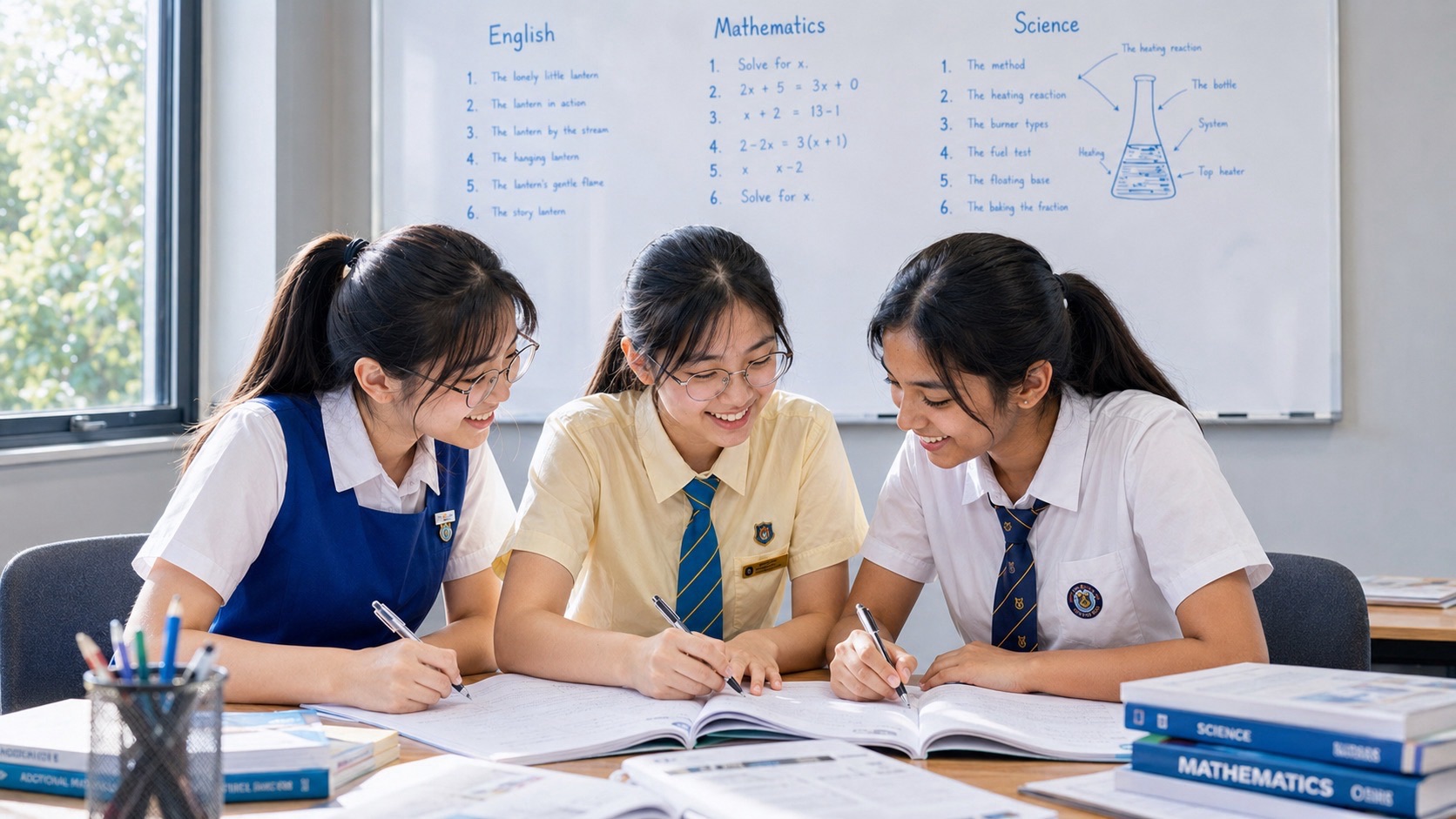
The 90-Second Answer
A mock examination is useful only when it simulates the parts of the real examination that matter and produces evidence that changes later training.
The goal is not to make practice frightening. It is to make the examination environment less novel while testing whether the student can retrieve, decide, pace, execute, check and recover without external rescue.
A useful mock cycle is Prepare → Simulate → Observe → Mark → Diagnose → Repair → Retest → Re-simulate. If a mock ends with only a score, ranking or emotional verdict, most of its training value has been left on the table.
Good simulation reproduces relevant constraints: realistic timing, current paper structure, no tutor prompting, no answer checking during the attempt, normal permitted equipment, realistic section transitions, uncertainty, fatigue and the need to recover after difficulty. It does not add artificial drama that will not exist in the real paper.
A mock should make the student more informed, not merely more nervous.
Saturday, 8:12 a.m. — The Living Room Becomes an Exam Hall
Adrian has moved the coffee table.
The dining table now contains only what Mira is allowed to use. Calculator. Pens. Pencil. Ruler. Water. The paper is face down. The answer key is in another room.
Ben finds the whole thing amusing. He asks whether Adrian is going to patrol the room like an invigilator. Adrian considers it.
Jo stops him.
“What exactly are we trying to simulate?”
The question changes the room.
They are not producing a school play about an examination. They are testing whether Mira’s current academic system survives the conditions that will matter later: continuous work, no immediate confirmation, time pressure, mixed questions, the temptation to overcheck, one or two genuinely difficult items and the need to finish without anyone telling her when to move.
Adrian does not need to look stern. He does not need to announce that this is “very important”. He does not need to create fear so the pressure feels authentic. The clock, the uncertainty and the independence are already enough.
Mira turns the paper over.
The mock begins.
Simulation Is a Measurement Problem
A mock examination should reproduce enough of the target environment that the student’s behaviour becomes informative.
If the student receives hints, the mock no longer measures independent decision-making. If the clock is paused during corrections, it no longer measures realistic pacing. If the student has already seen half the paper, it no longer measures unseen transfer in the same way. If the parent interrupts every ten minutes, it no longer measures sustained attention.
None of those altered conditions are automatically bad. A supported practice paper can be excellent teaching. A paused paper can be excellent diagnosis. A repeat paper can confirm correction. The mistake is calling every condition a mock and then treating every score as though it means the same thing.
Simulation must therefore begin by naming what is being measured.
The performance owner is How Examination Performance Works | Why Knowing Is Not the Same as Scoring. The annual training architecture is Exam Preparation in Singapore | A Punggol Family’s Training Year. This article owns the simulation layer.
The Five Things a Mock Can Simulate
- Time: the paper must be completed within a fixed window.
- Uncertainty: nobody confirms answers while the student is working.
- Integration: topics and methods are mixed rather than announced by chapter.
- Endurance: attention and execution must survive across the whole paper.
- Recovery: the student must respond to difficulty without external rescue.
These five conditions are enough to make a mock powerful. Other details should be added only if they affect the target performance.
For example, sitting at a school desk rather than a dining table may make little difference for one student. For another student who becomes distracted by family movement, environment may matter. Wearing a school uniform at home usually adds little information. Using the actual permitted calculator, on the other hand, can matter because equipment fluency affects time and error risk.
The best simulation is not the most theatrical one. It is the one that reproduces the constraints most likely to alter performance.
Mock Examinations Are Not Punishment
Some students experience mock exams as punishment for not being ready. That destroys much of their value.
A mock should be framed as an experiment. What happens when the current system is exposed to realistic conditions? Which parts survive? Which parts become unstable? What is the next repair?
This framing changes how mistakes are interpreted. A wrong answer in a mock is useful because it is cheaper than the same wrong answer in the national examination. A pacing failure is useful because there is still time to modify the strategy. A recovery failure is useful because it can be rehearsed again.
The National Institute of Education discussed PSLE bootcamps in 2026 and noted that such programmes commonly aim to reinforce concepts, sharpen examination techniques, target weak areas and address matters such as time management or resilience. Those are legitimate goals. Their value depends on whether the simulation is matched to the student and whether the evidence produced actually changes later training.
A mock should create a learning opportunity, not a fear ritual.
The Mock Ladder: Add Pressure in Layers
Not every student should jump directly from ordinary revision into a full examination simulation.
- Untimed mixed set: can the student identify methods without chapter cues?
- Timed mini-set: does accuracy survive mild time pressure?
- Timed section: can pacing and checking remain stable across a larger block?
- Half-paper simulation: can the student sustain attention and recover from one difficult item?
- Full-paper simulation: do all major performance controls survive together?
- Multi-paper day rehearsal where appropriate: can recovery between components remain stable?
The exact ladder depends on the actual examination architecture. Some papers are short. Some components are oral, listening or practical rather than written. Some examinations happen on different days. Always use current official paper formats and schedules from SEAB when designing final simulations.
The principle is progressive specificity: add only enough pressure to reveal the next weak state.
When Is a Student Ready for a Full Mock?
A full mock makes most sense when enough of the underlying subject system is stable that the paper can reveal performance problems rather than merely unfinished teaching.
Look for several conditions. Major content areas are mostly taught. Core prerequisites work. The student can retrieve older material without notes. Mixed questions are possible. The paper format is known. The student has already experienced some timed work. There is enough time after the mock to process what it reveals.
If half the syllabus is missing, a full paper may mostly tell you that half the syllabus is missing. If the student cannot yet complete a single timed section, a full paper may add fatigue without giving much new information. If the examination is tomorrow, an exhausting three-hour mock may create more cost than learning.
Readiness for simulation is different from readiness for the examination. The simulation is one tool used to estimate the latter.
The Mock Contract
Before the paper begins, everyone should know the conditions.
- What paper is being used?
- Has the student seen any of it before?
- What is the official or intended time?
- What equipment is permitted?
- Will there be any planned break?
- Can the student ask procedural questions?
- Will anyone give academic hints? For a true mock, normally no.
- What observations will be recorded?
The contract protects the evidence. If the parent gives three hints, that does not make the paper useless. It means the result should be recorded as supported rather than independent.
Honest labels are more valuable than impressive scores.
Use the Right Paper
A simulation is only as representative as the material being simulated.
Current-format official papers, specimen papers and carefully selected school or publisher materials are generally more useful for final simulation than random old papers whose structure no longer matches the target assessment.
Older papers can still be excellent learning material. The question is whether they are being used to train concepts or to simulate the current exam interface.
This distinction is explained more fully in Past-Year Papers for Exams | How to Use Them Without Wasting Them.
Preserve Unseen Material
A mock loses diagnostic power when the student already knows the questions.
That does not mean a familiar paper cannot train timing or execution. It can. But a student who remembers the structure has less method-selection work to do. The paper is no longer testing novelty in the same way.
Jo keeps several papers in a folder Mira is not allowed to browse. Adrian initially considers this excessive. Later he sees why. The reserved papers become checkpoints that answer a clean question: after weeks of repair, can Mira perform on material she has not rehearsed into familiarity?
Unseen material is not sacred. It is simply valuable because it preserves one important examination condition: uncertainty.
The Room: Remove Noise, Not Humanity
A home mock does not need to look like a military facility.
The room should be quiet enough that distraction does not dominate the result. The phone should be away. Family members should know not to interrupt. The student should use a desk or table that allows normal working. The clock should be visible in a way similar to the strategy the student intends to use.
Do not add irrelevant stressors. Playing recordings of coughing candidates, making siblings walk around deliberately, or having a parent hover over the desk can create difficulty that is unrelated to the target exam and may distort the result.
There is a difference between robustness training and theatre. Robustness training adds plausible variability after core performance is stable. Theatre adds drama because drama feels serious.
The Clock: Use Real Time, Then Study Where It Went
Timing is the most obvious feature of a mock and one of the most poorly analysed.
Recording only the finish time tells us too little. The student may have spent fifteen minutes too long on one question and recovered later by rushing. They may finish early because several subparts were missed. They may protect perfect checking on the first half and leave the final page incomplete.
Use one or two pacing checkpoints. Record approximately where the student is at those moments. Keep observation light. The mock should still feel like a paper, not a research study.
Afterward, ask where the first deviation occurred. “Ran out of time” becomes actionable only when the source is known.
The Parent Must Not Become the External Metacognition System
Parents often help because they can see the error coming.
Adrian notices Mira spending too long on question seven. He wants to say, “Move on.” He notices Ben miss the final condition and wants to cough meaningfully. He sees Ryan changing an answer for no clear reason and wants to ask whether he is sure.
During teaching, those interventions can be useful. During simulation, they remove precisely the self-monitoring the mock is supposed to test.
Record the moment. Let it complete. Discuss it later.
This can feel cruel because the mistake is preventable. It is actually cheaper now than later. The purpose of the mock is to reveal whether the student can run the control loop without an adult providing live corrections.
Observation Without Interference
A tutor or parent can record a small number of behavioural markers.
- Time of first major stall.
- Questions parked and whether they were revisited.
- Visible answer changes.
- Whether working becomes compressed late in the paper.
- Whether reading time noticeably shortens under pressure.
- Whether the student visibly loses state after one difficult question.
- Whether all pages and subparts are checked for completion.
Do not record everything. Excess measurement changes behaviour and creates analysis work that may not improve training.
The point is to catch the few events that a final script cannot explain by itself.
The First Five Minutes Matter More Than They Look
Students often treat the beginning of the paper as a trivial period before the “real questions”. It is actually where the operating state is established.
Ben tends to rush because an easy first item makes him feel that speed is available. Ryan can do the opposite and spend too long confirming simple answers because he wants to start perfectly. Mira sometimes compresses working before she has settled into her normal rhythm.
Mock exams reveal these entry patterns safely. The student can develop a start protocol: read the question fully, use ordinary working, do not chase speed, do not overinterpret early difficulty.
The first five minutes should feel almost boring. Boring is useful because it prevents adrenaline from rewriting the technique.
The Middle of the Paper: Where Endurance Becomes Visible
Many students are accurate for short practice sets. The mock reveals whether accuracy survives duration.
Watch for drift. Handwriting shrinks. Reading becomes shallower. Working skips steps. The student checks less or checks more anxiously. Aisha stops labelling intermediate values. Ethan begins choosing unnecessarily complex routes because cognitive fatigue makes simple discrimination harder.
If error rate rises late, the solution is not automatically “build stamina” through endless papers. Ask what kind of stamina is failing. Is the student physically uncomfortable? Is attention depleted by overchecking? Is basic execution too effortful? Is working memory overloaded because foundations are not fluent? Is pacing front-loaded?
Endurance is an emergent property of the whole system.
The Hard Question: The Most Valuable Moment in the Mock
A mock where every question feels comfortable may test fluency. A mock containing one well-placed difficult item can test something more valuable: recovery.
When Mira hits a question she cannot immediately solve, the important measurement is not only whether she eventually gets the marks. It is what happens to the next ten minutes.
Does she remain trapped? Does she begin solving faster and less accurately because she feels behind? Does she abandon good working? Does she carry the question emotionally into the next one? Or can she preserve a valid first step, mark the item, move, regain normal pace and return later?
The detailed recovery system is in Exam Techniques for Students | Read, Decide, Execute, Check and Recover.
A difficult question becomes valuable when it shows whether the student can protect the rest of the paper.
Pressure Should Be Authentic Enough, Not Maximum
There is a mistaken idea that if examination pressure matters, practice should be made as stressful as possible.
Maximum stress is not realistic simulation. It changes the task.
The national examination already contains authentic stakes. Practice cannot perfectly recreate those stakes, nor should it try. What practice can recreate are the controllable features associated with them: no live feedback, fixed time, unfamiliar sequencing, independent decisions and the need to recover.
If a parent threatens consequences for a mock score, the mock begins measuring family pressure as well as examination skill. If a tuition centre publicly ranks students after every simulation, the emotional environment may become substantially different from the target task. That might be useful in rare contexts, but it should not be confused with neutral exam rehearsal.
Use enough pressure to test control, not enough theatre to overwhelm the signal.
Nervousness Is Not Failure of the Mock
A student may feel nervous before a mock. That does not automatically mean the simulation is harmful or that the child is unready.
The useful question is whether the student can still execute trained behaviours while nervous. Can they read the condition? Keep working visible? Follow pacing checkpoints? Move after a stall? Avoid unsupported answer changes?
Pressure can affect working memory and complex performance. This is one reason mock exams should include recovery and control rather than simply more difficult questions.
Mira eventually learns a powerful distinction: “I feel nervous” describes her state. “I cannot perform” is a prediction. The mock lets her test whether the prediction is actually true.
The Score Is Not the Mock
The score is one output. The mock produces several others.
- Completion profile.
- Pacing profile.
- Error families.
- Accuracy under fatigue.
- Question-reading behaviour.
- Recovery behaviour.
- Checking quality.
- Confidence calibration.
- Transfer under unfamiliar presentation.
A 72 on a hard paper with stable pacing, clean recovery and fewer recurring errors can indicate better readiness than a 78 on an easy familiar paper completed with several unsupported answer changes.
Context protects interpretation.
Mark the Mechanism, Not Only the Answer
After the mock, classify why marks disappeared.
- Knowledge: concept or fact missing.
- Retrieval: known material unavailable without cues.
- Interpretation: demand or condition misread.
- Representation: poor model, equation, diagram or answer structure.
- Execution: correct route performed inaccurately.
- Control: time, attention, checking or pressure disrupted performance.
- Transfer: underlying idea not recognised in an unfamiliar form.
This classification prevents the automatic response “do another mock”.
If the problem is knowledge, teach. If retrieval, space and recall. If interpretation, train demand classification. If representation, compare models. If execution, repair the high-risk transition. If control, practise pacing or recovery. If transfer, vary the surface.
The next activity should follow the error family.
The Most Important Rule After a Mock: Leave the Mock
A full paper identifies system-level weaknesses. It is often not the most efficient place to repair them.
If Mira’s paper reveals repeated sign errors, extract the algebraic transitions. If Ben misreads final conditions, practise the reading gate. If Aisha loses state across structured questions, train intermediate labels. If Ryan changes correct answers, track evidence for answer changes. If Clara fails unfamiliar applications, run changed-surface sets. If Ethan overbuilds routes, impose method-cost constraints.
Then retest the repair on different questions.
Only after enough of those repairs appear stable should another full simulation be used to see whether the complete system changed.
Mock → mock → mock is measurement. Mock → diagnosis → repair → retest → mock is training.
The 48-Hour Debrief
A mock often produces too much information to process usefully in the first ten minutes after it ends.
Immediately after the paper, capture only fragile observations: where the student felt stuck, which questions felt uncertain, whether the pacing plan was followed, and any moment where attention visibly changed.
After the paper is marked, conduct the deeper review. Which errors were expensive? Which repeated? Which were new? Which appeared only under time? Which known corrections failed to survive? Which aspects were stronger than before?
The exact delay does not have to be 48 hours. The principle is to separate immediate experience from evidence-based diagnosis.
The Debrief Should Begin With What Held
Families often begin with the wrong answers because errors demand attention. But stability is also evidence.
What remained reliable under pressure? Did Mira maintain visible working? Did Ben read more carefully? Did Aisha preserve the chain? Did Ryan reduce unsupported answer changes? Did Clara recognise unfamiliar structures? Did Ethan choose shorter routes?
Naming what held prevents the next training block from unnecessarily redesigning successful behaviour. It also gives the student an evidence-based source of confidence.
A good debrief protects strengths while targeting weaknesses.
A Mock Report Card
| Dimension | Evidence | Status | Next Action |
|---|---|---|---|
| Knowledge | Core content performance | Green / Amber / Red | Maintain / Repair |
| Retrieval | Older topics without cues | Green / Amber / Red | Space / Retrieve |
| Transfer | Unfamiliar presentations | Green / Amber / Red | Vary surfaces |
| Timing | Completion and checkpoints | Green / Amber / Red | Adjust pacing |
| Execution | Recurring slips | Green / Amber / Red | Target transitions |
| Checking | Useful versus harmful checks | Green / Amber / Red | Risk-weight checks |
| Recovery | Behaviour after hard items | Green / Amber / Red | Train move-return loop |
| Endurance | Late-paper accuracy | Green / Amber / Red | Reduce cognitive cost / build duration |
The report card should not become bureaucracy. One page is enough if it changes the next week’s plan.
Mira’s First Mock: The Score Is 74
Adrian sees 74 and wants to know whether that is good.
Jo asks a different sequence.
Did she finish? Yes, with three minutes remaining.
Did the sign errors return? Two of them.
Did she get stuck? Yes, on one high-mark problem.
What happened afterward? She spent too long, rushed the next two questions and made an error she would normally avoid.
Did she return to the difficult question? No.
The most important problem in the paper is not necessarily the two sign errors. It may be that one difficult question created a chain reaction across the next page.
The next training block therefore focuses on recovery, not another full paper.
Recovery Training Between Mocks
Mira practises on short mixed sets containing one deliberately difficult item.
Her rule is: if the route stops producing information, preserve valid work, mark the question, move and return later. The tutor initially prompts the rule. Then the prompt disappears.
The first time, Mira moves too late. The second, she moves on time but forgets to preserve a valid equation. The third, she leaves clean partial work, completes the next questions normally and returns with enough time to recover part of the original problem.
Only after this local control improves does another full mock make sense.
That second mock tests whether recovery survives when attention is divided across the whole paper.
Mira’s Second Mock: Lower Score, Better System
The second paper is harder. Mira scores 71.
Adrian is disappointed for about thirty seconds.
Then the debrief begins.
She encounters two questions that she cannot initially complete. She parks both within the trained time-loss window. She completes the rest of the paper without accelerating wildly. She returns to both. One remains incomplete; the other yields several marks. The two sign errors from the previous mock are gone.
The score is lower. The system is stronger.
This is why mock results need interpretation rather than worship.
Ben’s Mock Problem: He Finishes Too Early
Ben completes a paper with fifteen minutes remaining and feels triumphant.
The script shows three missed subparts, two misread conditions and several easy errors.
His mock has identified a finishing problem disguised as speed.
The intervention is a finishing protocol. First, verify that every page and subpart has been attempted. Second, revisit uncertain items. Third, run his two personal high-risk checks. Fourth, stop changing correct work merely because time remains.
The next mock will measure not how much later he finishes, but whether the remaining time is converted into fewer preventable errors.
Aisha’s Mock Problem: The Paper Breaks at the Handoffs
Aisha’s paper looks strangely inconsistent. She earns early method marks and loses later parts, often after carrying an intermediate value into a new stage.
The mock reveals that her local skills are stronger than her multi-stage state control.
Between mocks, she practises writing what each intermediate result represents before using it. In Mathematics, quantities are labelled. In Science, causal chains are written explicitly. In English, paragraph purpose is stated before development begins.
The repair is not subject-specific at first. It is a general handoff skill expressed differently across subjects.
Ryan’s Mock Problem: Checking Makes the Score Worse
Ryan’s mock is stable until the final ten minutes.
Then he begins revisiting low-confidence answers. He changes six. Four of the six become wrong.
This is extraordinarily useful evidence because it gives checking a measurable cost.
His repair rule becomes: no answer change without new evidence. A failed substitution, contradicted condition, stronger passage evidence or unit mismatch counts. General discomfort does not.
The next mock records all answer changes again. The number falls. The usefulness of the remaining changes rises.
Ryan is not being taught to trust every first instinct. He is being taught to update when evidence changes, not when emotion changes.
Clara’s Mock Problem: Everything Familiar Works
Clara’s mock score is high, but the error distribution is revealing. Nearly every lost mark comes from unfamiliar presentation.
She succeeds when the method looks like her worksheets and hesitates when the same underlying relationship appears inside a new context.
Another mock tomorrow would likely reproduce the same pattern. Instead, her training becomes deliberately variable. Compare questions. Identify invariants. Change diagrams. Remove chapter labels. Mix topics. Ask which single condition would make the old method invalid.
Later, an unseen mock tests whether the transfer problem has actually changed.
Ethan’s Mock Problem: Expertise Has an Opportunity Cost
Ethan loses few marks through knowledge. He loses time through choice.
He sees an elegant alternative method and follows it. The route works. The cost appears fifteen minutes later when a final high-value question is rushed.
The mock has exposed a resource-allocation problem.
His new rule is shortest defensible route first. Complexity must buy accuracy, proof or necessary structure. Otherwise it can wait until after the examination.
For high performers, mock exams increasingly test judgement rather than simple knowledge.
Mock Exams and Confidence Calibration
Before marking, ask students to tag selected answers high, medium or low confidence.
Compare those tags with correctness. High-confidence wrong answers indicate misconceptions or overconfidence. Low-confidence correct answers can reveal unnecessary doubt and future overchecking. Medium-confidence items often show unstable but recoverable knowledge.
Over several simulations, confidence should become better aligned with performance. A student who knows when uncertainty is meaningful can allocate checking time more intelligently.
The deeper mechanism is calibration. In exam terms, it means knowing not only an answer but how much evidence supports it.
Mock Exams and Retrieval
Full simulations are powerful retrieval tests because the student cannot predict which topic appears next.
If old material disappears in mocks despite looking familiar in revision, the problem may be cue dependence. The student needs more closed-book cumulative retrieval and spacing, not simply more exposure.
Do not repair retrieval only by redoing the same paper immediately. The solution trace is too fresh. Use a different question after a delay, then reintroduce the topic in mixed work.
Mock exams reveal which knowledge is available under competition from other knowledge.
Mock Exams and Transfer
An unseen mock removes the topic label and forces the student to choose.
This makes simulation an excellent transfer test. The student has to recognise an underlying structure through unfamiliar numbers, wording, context, diagrams or combinations.
When transfer fails, do not simply reveal the method. Ask which cue should have triggered it. Then construct a family of changed-surface questions around that cue.
The next unseen mock then tests whether the routing pathway has become more robust.
Mock Exams and Working Memory
Long papers expose whether foundational operations consume too much cognitive capacity.
If basic algebra remains effortful, advanced problem solving becomes increasingly expensive as the paper continues. If sentence construction is not fluent, essay planning and argument can collapse late. If Science vocabulary is fragile, the student may spend so much attention searching for words that the causal model becomes incomplete.
Mock performance therefore helps identify where fluency is insufficient. The intervention may be foundational practice rather than more endurance training.
Long duration can expose hidden cognitive costs that short worksheets never show.
Mock Exams and Attention
A paper contains too much information to attend to everything equally.
Mocks reveal which cues win attention when the student is under time. Ben notices familiar numbers and misses the final condition. Clara notices familiar surface structure and misses the changed relationship. Ethan notices interesting complexity and underweights the mark allocation.
The debrief should ask what the student noticed first and what they should have noticed first.
This converts “focus more” into a trainable attentional rule.
Mock Exams and Checking
Checking becomes expensive only when time is scarce. That makes mocks one of the best places to evaluate it.
Does the student have enough time left? Which questions are checked first? Are checks independent or repetitions of the same method? Does checking improve answers? Does it create harmful changes? Is the student rereading every page equally despite having known personal error risks?
Build a checking profile. Which checks consistently save marks at low cost? Which are rituals? Which should be automated during execution rather than postponed to the final minutes?
The best mock may reveal that “check more” is the wrong advice.
PSLE Mock Examinations: Keep the System Child-Sized
Primary 6 students are still children. Simulation should prepare them for independence without making the entire household feel like an examination centre.
Use current PSLE formats and official requirements from SEAB. Start with sections when appropriate. Build up to full papers as knowledge and pacing stabilise. Teach the child a small recovery rule. Keep personal checking cues short.
Parents should avoid discussing the mock as a prophecy. A child who scores lower than expected should hear what the paper revealed, not that the national examination is now doomed. A child who scores highly should still review whether the performance was stable or lucky.
The local Punggol year routes are Primary 6 PSLE English, Primary 6 Mathematics & PSLE Mathematics and Primary 6 Science & PSLE Science.
PSLE English Mock: What to Measure Beyond the Score
For English, observe whether meaning survives time.
In comprehension, does the child read the question demand accurately? Can evidence boundaries be found without over-copying? Does the child convert textual evidence into an answer that states the relationship? Does pronoun reference remain clear when time is tight?
In writing, record planning time, prompt fit, paragraph architecture, sentence error rate and whether the child leaves enough time to close and edit the composition. A strong untimed writer may still need performance training if planning expands uncontrollably under the clock.
For narrower writing techniques, see Plan Fast Before Drafting Under PSLE Time and Control Story Pacing.
PSLE Mathematics Mock: Measure the Route
For Mathematics, do not look only at the final answer.
Trace representation, method selection, working, arithmetic, units and checking. Did the child understand the problem but choose the wrong model? Was the method correct but execution unstable? Did the child spend disproportionate time on one challenging problem? Were easy marks lost after fatigue?
Ben’s fastest improvements often come from reading and completion control rather than from learning another advanced technique. Mira’s come from keeping high-risk transitions visible.
Use the mock to decide what kind of Mathematics practice should happen next.
PSLE Science Mock: Test the Explanation Chain
Science mocks are useful because unfamiliar contexts expose whether the child has memorised language or built a model.
In open-ended questions, classify whether failure comes from concept, evidence reading, comparison, causal connection or answer expression. If the child states a keyword but omits the mechanism, another full mock is rarely the fastest repair. Practise short explanation chains and then retest inside mixed questions.
The reasoning owner is How Scientific Thinking Is Built | Observation, Models, Evidence and Explanation.
Secondary Mock Examinations: Use the Correct Year and System
Singapore’s Secondary examination system is in transition, so simulations must be year-specific.
The 2026 graduating cohort remains under the current GCE arrangements. From the 2027 graduating cohort, the Singapore-Cambridge Secondary Education Certificate combines the former N(T), N(A) and O-Level structures, with subjects taken at G1, G2 and G3 levels.
Use the current syllabus, specimen papers and official examination information for the student’s actual cohort. An older paper can still be excellent topic practice without being a perfect simulation of the current paper.
For current SEC information, use the SEAB SEC page. For the 2026 GCE cohort, use the relevant current GCE candidate pages.
Secondary English Mock: Time Exposes Selection
Secondary English students often know more content and vocabulary than they can use effectively under time.
A mock can reveal whether the student spends too long finding examples, whether essay planning remains proportional, whether comprehension evidence is selected rather than copied, and whether language accuracy deteriorates in the final third of the paper.
Ryan may overcheck interpretation. Clara may rely on familiar essay frames. Ethan may generate more examples than the argument needs. The mock shows whether subject knowledge has become selectable under performance constraints.
The local journey runs through Secondary 1 English to Secondary 4 English.
Secondary Mathematics Mock: Diagnose the First Invalid Step
Mathematics mock papers generate a visible reasoning trace when students show their working.
Use that trace. Where did the first invalid step occur? Was the equation wrong? The transformation? The arithmetic? The copied sign? The interpretation of the graph? The final rounding? The time allocation?
The headline topic is not always the cause. A graph question can fail because algebra was unstable. A geometry problem can fail because representation was poor. A correct method can lose marks through rushed execution.
The local Mathematics path is Sec 1 → Sec 2 → Sec 3 → Sec 4.
Additional Mathematics Mock: Stress the Dependencies
A-Math mocks are useful because later questions often consume several layers of prerequisite control.
A differentiation question may reveal weak indices. A trigonometric identity may reveal factorisation problems. Coordinate geometry may reveal poor algebraic organisation. A correct calculus idea may be lost because the student cannot maintain execution under time.
Trace backwards to the first weak link. Then leave the mock and repair that dependency.
The supporting exam route is Additional Mathematics Exam Strategy | Recognise → Represent → Execute → Verify → Recover, with the larger subject structure in the Additional Mathematics Hub.
JC and A-Level Mock Examinations: More Knowledge, More Routing
At JC, the challenge is often not merely recalling content but selecting among a larger set of available methods, examples and models.
A H2 Mathematics mock can reveal whether the student identifies an efficient route, whether advanced methods remain accessible late in the paper and whether checking survives fatigue. A GP mock can reveal whether evidence selection and argument architecture remain disciplined under time rather than expanding into everything the student knows.
Use current A-Level syllabus and paper information from SEAB. The local Mathematics journey continues through JC1 H2 Mathematics in Punggol and JC2 H2 Mathematics in Punggol | The A-Level Year.
Oral Mock Examinations: Do Not Rehearse Scripts Into Rigidity
Oral simulations should test responsive speaking, not merely memorised delivery.
Use realistic preparation time where the assessment provides it. Present unfamiliar prompts. Ask follow-up questions. Observe whether the student can listen, organise, answer, develop and recover when a word or idea is lost.
Memorised frameworks can support fluency, but the mock should deliberately vary the prompt enough to expose whether the framework serves the question or controls it.
A student who gives a polished irrelevant answer is not examination-ready. Responsiveness is part of performance.
Listening Mock Examinations: Recovery Happens in Real Time
Listening assessments contain a special recovery problem because the stimulus may continue while the student is thinking about a missed item.
A mock should therefore measure whether one missed detail steals attention from the next section. The student needs a rapid reset: make the best available response according to the format, release the previous item and rejoin the current audio.
Repeated listening simulations can make this transition less novel. The target is not perfect memory. It is sustained task attachment.
Practical Mock Examinations: Simulate Procedure, Not Just Theory
Practical examinations require physical procedure, observation, recording and scientific reasoning.
Simulation should therefore include appropriate equipment handling, timing, unit discipline, observation recording and the ability to distinguish expected results from actual observations.
Where school laboratories control the environment, home simulation may not be appropriate. Use school and authorised instructional settings. The principle remains the same: rehearse the actual demands that matter, not a decorative imitation.
Should a Mock Be Harder Than the Real Exam?
Sometimes a harder paper is useful, but harder is not automatically better.
A difficult mock can stress-test recovery, transfer and persistence. It can reveal whether a strong student maintains control when success is less frequent.
But if difficulty is so high that nearly every question fails, the signal becomes muddy. The paper tells us that the student struggles with the whole thing rather than revealing which mechanisms need priority.
For readiness prediction, use papers reasonably representative of the target. For robustness training, occasionally use harder material with a clearly different interpretation.
Do not compare the scores as though difficulty were identical.
Should a Mock Include Surprises?
Real examinations contain uncertainty, so some unfamiliarity is useful.
But surprise should come from legitimate variation within the syllabus and paper format, not from trick conditions invented by adults.
Changed contexts, unfamiliar diagrams, novel combinations and different evidence are appropriate. Deliberately withholding permitted equipment, changing the time unpredictably or inserting off-syllabus questions to scare the student are usually poor simulations.
The target is adaptability within the assessment contract.
Should Parents Reveal the Score Immediately?
Usually the score can be shared once marking is reliable, but the framing matters.
“You got 66, so you are not ready” compresses too much. “You got 66; let’s see where the marks went and whether the same patterns appeared as last time” preserves the diagnostic purpose.
For anxious students, it can be useful to begin with process evidence before the number. For overconfident students, the score may be useful early because it creates a concrete reason to inspect assumptions. There is no need to dramatise the reveal.
A mock score is information, not a verdict.
Should Tuition Centres Rank Mock Results?
Ranking can provide one form of comparative information, but it is often less useful for training than the individual performance trace.
A student may rank highly while carrying a dangerous recurring error. Another may rank lower on a difficult paper while showing substantial improvement in timing and recovery. The next teaching decision should follow the mechanism, not the social position.
Comparative data can be meaningful when the cohort, paper and purpose are appropriate. It should not replace the high-resolution question: what changed in this student, and what should be trained next?
Mock Frequency: Enough to Learn the System, Not Enough to Saturate It
There is no universal number of mock exams a student should complete.
The right frequency depends on readiness, subject, paper length, school load and what each mock is revealing. A student with major knowledge gaps needs more teaching and targeted work. A student with stable knowledge but unreliable pacing may benefit from more simulation.
If two mocks reveal the same error and nothing is changed between them, the second mock has mostly confirmed the first. If a repair block follows and the third mock tests whether the system changed, the sequence becomes valuable.
Frequency should be driven by information gain.
Mock Saturation
Students can become saturated with simulation.
Signs include rushed corrections, repeated unaddressed errors, declining sleep, emotional numbness to scores, increasing recognition of recycled question patterns and no time left for targeted repair.
At that point, another mock may produce less useful information than a focused repair session or recovery period.
The purpose of mock season is not to make the student maximally tired of examinations before the examination begins.
The Four-Week Mock Cycle
| Week | Simulation Job | Between Mocks |
|---|---|---|
| 1 | Baseline full-system diagnostic | Repair major error families |
| 2 | Timed sections around repaired weaknesses | Changed-surface retests and retrieval |
| 3 | Full mock to test integration | Shorten error ledger; refine pacing/recovery |
| 4 | Reserved unseen readiness simulation | Maintain stable systems and taper |
This is a model, not a compulsory calendar. Actual school assessments, subject schedules and examination dates should determine timing.
The architecture is the important part: simulation → evidence → repair → later re-simulation.
The Seven-Day Mini-Mock Cycle
During a busy school week, a full mock may be unnecessary.
Use one timed section on the weekend. Diagnose it the same day. Repair the top weakness in one or two short sessions. Retrieve it again after a delay. Use a mixed mini-set later in the week. Decide from that evidence whether a full mock is worth the following weekend.
This keeps examination training connected to ordinary school life instead of creating a second full-time school at home.
What to Do After a Bad Mock
Do not schedule another full mock immediately out of panic.
First establish what “bad” means. Was the paper much harder than expected? Did the student leave major sections incomplete? Did knowledge disappear? Did one difficult question damage pacing? Did fatigue cause late execution errors? Did the student recognise the methods but perform poorly?
Then identify the few highest-value repairs. A low score can result from one systemic problem or many local ones. The intervention depends on which.
A bad mock is expensive only if it teaches nothing.
What to Do After a Great Mock
Do not assume the job is finished.
Ask whether the conditions were honest. Was the paper unseen? Was the difficulty representative? Was timing realistic? Were there hints? Did the student know the question types unusually well?
If the performance is genuinely strong, protect the stable systems. Do not immediately double the workload because confidence is high. Use enough later retrieval and simulation to confirm stability, then taper appropriately.
A strong mock should reduce unnecessary intervention.
Mock-to-Mock Improvement Should Not Be Expected to Be Linear
Paper difficulty changes. Topic mix changes. Daily state changes. Some mocks contain more of a student’s weak areas than others.
Therefore do not expect 62 → 66 → 70 → 74 simply because training is working.
Instead track mechanism trends. Fewer unanswered questions. Better pacing. Lower recurrence of known execution errors. More accurate answer changes. Improved recovery. Better transfer. More stable performance late in the paper.
The mark still matters. It just does not travel alone.
The Final Mock
A final mock should not be scheduled merely because the calendar says one must exist.
Its purpose is to answer a specific readiness question: does the trained system remain stable under a current, unseen, realistic paper condition?
Use a representative paper. Use normal timing. Do not add extra difficulty for drama. Run the established pacing and checking system. Observe recovery. Mark and interpret.
If the result is broadly stable, resist the urge to redesign everything. The next phase may be maintenance and tapering.
The readiness owner is Exam Readiness | How to Know What Is Stable Before the Paper.
How Close to the Real Exam Should the Last Full Mock Be?
There is no universal number of days.
The final mock should be far enough away that any meaningful weakness can still be addressed and close enough that the conditions are relevant. The appropriate spacing depends on paper length, student recovery, school schedule and how much the mock is expected to teach.
For many students, a demanding full paper immediately before the actual examination creates more fatigue and emotional volatility than useful information. In the final days, short retrieval, targeted checks and familiar routines may have higher value.
Final-week work should protect performance rather than continuously test it.
The Day Before: Stop Simulating
The day before the examination is usually not the right time for another full mock.
The simulation phase has already done its job. Now the priority is keeping learned systems available. Use short familiar retrieval. Review personal error cues. Check official logistics. Protect sleep.
If Adrian suddenly finds an especially hard paper online, Jo does not allow it onto the dining table.
There is no meaningful training loop left for such a paper. It can create uncertainty that the family no longer has time to process.
Readiness sometimes requires declining new evidence because the time for major adaptation has passed.
The Parent’s Mock Checklist
- Use a paper appropriate to the current syllabus and intended job.
- Know whether the paper is genuinely unseen.
- Set realistic time and permitted equipment.
- Do not give academic hints during a true simulation.
- Record only a few useful behavioural markers.
- Interpret the score in context.
- Classify why marks were lost.
- Repair the highest-value weaknesses outside the full paper.
- Retest on changed questions before automatically scheduling another mock.
- Protect sleep and recovery.
- Reduce simulation volume once the system is stable.
- Use official SEAB information for current formats and requirements.
The Tutor’s Mock Checklist
- Define what the mock is intended to measure.
- Choose difficulty that produces useful discrimination.
- Preserve independence during the attempt.
- Observe process without rescuing.
- Trace errors to first weak links.
- Separate knowledge, retrieval, interpretation, representation, execution, control and transfer.
- Prioritise recurring and expensive failure modes.
- Design narrow repairs.
- Test repairs after delay and in changed contexts.
- Use the next full mock only when a full-system question needs answering.
In a three-student class, this process can be unusually high-resolution because the same paper can expose different bottlenecks in each child.
See Punggol Small-Group Tuition | What Should Happen in a 1.5-Hour 3-Pax Lesson?.
The Student’s Mock Checklist
- Know the paper format before starting.
- Use the same pacing system you intend to trust later.
- Read the actual demand before acting.
- Keep high-risk working visible.
- Use the trained rule when stuck.
- Change answers only with evidence.
- Use checking time on the highest-risk areas first.
- Afterward, describe what happened before looking only at the score.
- Own one or two repairs before the next simulation.
The Mock Examination Operating Manual
- Choose a defined simulation question.
- Select current, representative material.
- Confirm whether the paper is unseen.
- Set realistic timing and equipment.
- Remove live academic help.
- Observe lightly.
- Record pacing, stalls, returns and major behavioural changes.
- Mark the normal score.
- Diagnose why marks disappeared.
- Identify what held.
- Prioritise the few highest-value weaknesses.
- Leave the full paper.
- Repair locally.
- Retest on changed questions.
- Delay and retrieve again.
- Re-simulate only when a new full-system question needs answering.
The manual is deliberately cyclical. A mock is not an event. It is one stage in an adaptation loop.
The Punggol Return
At 10:04 a.m., Mira puts down her pen.
Adrian reaches for the answer key.
Jo stops him for thirty seconds.
“Before the score,” she says. “What happened?”
Mira thinks.
She started well. She lost time on one question. She nearly carried the panic forward but remembered to move. She finished. She checked the sign changes. She changed one answer because a unit did not make sense. She left another answer alone even though she felt uncertain because she had no new evidence.
Ben has stopped laughing.
The living room does not look like an examination hall anymore. The coffee table is still pushed aside. There is breakfast in the kitchen. Someone upstairs is vacuuming.
That is fine.
The purpose was never to reproduce every detail of the future room.
The purpose was to discover whether the important system would survive when the familiar supports disappeared.
When the answer is no, the mock tells us what to repair.
When the answer is yes, the mock tells us what to protect.
That is how simulation becomes training rather than theatre.
Continue the Examination Training & Performance Series
- How Examination Performance Works | Why Knowing Is Not the Same as Scoring
- Exam Preparation in Singapore | A Punggol Family’s Training Year
- Exam Techniques for Students | Read, Decide, Execute, Check and Recover
- Exam Readiness | How to Know What Is Stable Before the Paper
- Past-Year Papers for Exams | How to Use Them Without Wasting Them
- Next: Error Analysis for Exams | Turn Every Wrong Answer Into a Training Decision
Properly taught kids shine a bright light into the future.


