
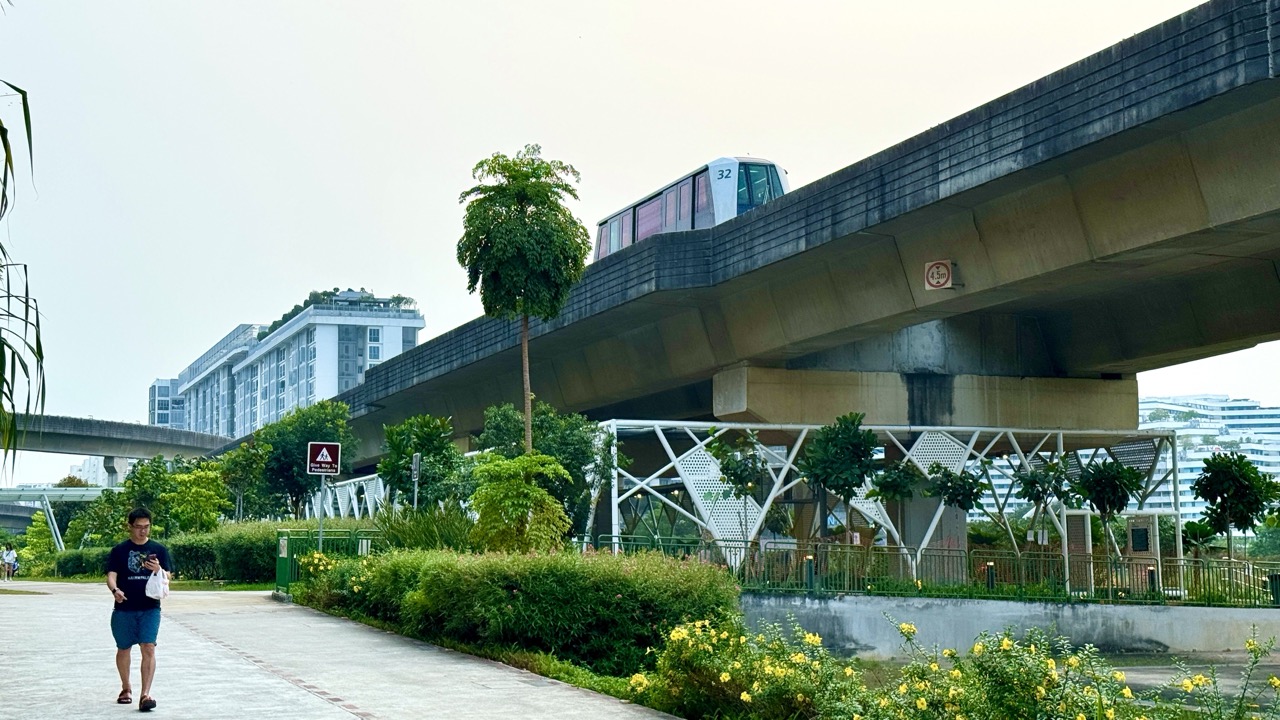
Why can Punggol LRT trains run without a person driving them from the front? The Light Rapid Transit system travels on a dedicated railway guideway with automated train-control and signalling arrangements. Unlike a car driver choosing among ordinary streets, the LRT follows a defined railway route, stops at designated stations and operates under a managed transport network. The routine task of moving the train can therefore be automated under the system’s design. Driverless does not mean unmonitored, unmaintained or free from safety rules.
The Land Transport Authority (LTA) explicitly describes Sengkang–Punggol LRT as fully driverless. Punggol LRT began service in 2005 and now connects 14 stations on its East and West Loops with Punggol MRT and the town-centre bus interchange. LTA’s 2 October 2026 update confirms that the network is still receiving major depot and signalling upgrades, with 41 two-car LRVs planned across SPLRT by 2030. The absence of a routine onboard driver changes how train movement is controlled, but trained operators, engineers, maintenance staff and authorised responders still support the service throughout its operating life.
- Where: Punggol LRT, part of the SBS Transit-operated Sengkang–Punggol LRT network.
- Why driverless: automated train control operates on a dedicated guided railway under defined operating rules.
- Opened: 2005, with later service and station changes as the town grew.
- Network: two loops and currently 14 Punggol LRT stations according to LTA.
- What still matters: signalling, safe train separation, door operation, electrical power, maintenance and passenger behaviour.
- Human role: trained railway teams supervise, repair, plan and manage exceptional conditions even when no driver is visible onboard.
- 2026 update: further signalling, depot and train-fleet work, with a planned 41 two-car SPLRT vehicles by 2030.
- Important limit: automatic operation does not guarantee zero delays, perfect safety or that every passenger should control the train during a fault.
- Distinct focus: why automated railway operation works, rather than why LRT has rubber tyres, two loops or a bigger depot.
The answer in 50 seconds
Punggol LRT is driverless because its trains operate in a controlled railway environment and use automated systems to manage routine movement. A dedicated guideway makes the route more predictable than a road used by pedestrians, cars and cyclists.
The system still has switches, signals, stations and equipment that can develop faults. Railway workers remain responsible for the operations surrounding the train.
A good explanation is therefore that the driver’s routine movement task is automated, not that the railway operates without people.
Why a dedicated guideway makes a difference
An LRT vehicle follows a physically defined path and cannot decide to drive through a random side street to avoid congestion. Its route is constrained by the engineered guideway and the permitted railway movements.
That reduces some road-style uncertainty, making an automated operating arrangement practical under the correct safety architecture.
It does not mean the train can travel anywhere without planning. Tracks, switches and operating permissions still determine the movements that are possible.
Why the train is not remotely driven like a toy
The term driverless can make people picture somebody elsewhere steering the vehicle with a handheld controller. Fully automated railway operation is not equivalent to continuous remote manual steering for every journey.
Routine movements are managed by railway control systems under their designed rules. Authorised staff may need to respond when normal conditions change.
The exact internal procedures should be learned from the appropriate operator, not invented by watching through the front window.
Why automation needs boundaries
Automated control is most reliable when it operates inside clearly defined conditions. It has to respect where trains are allowed to move, what speeds are permitted and how the system responds to relevant information.
A computer making a routine decision is not the same as an unrestricted machine doing anything it wishes.
The railway’s design and professional operation establish boundaries within which automation can provide a dependable public service.
Why signals still matter
Signalling helps coordinate railway movements in an approved manner. It is part of deciding which movements are permitted and managing interactions among vehicles on the network.
LTA’s October 2026 update specifically identifies signalling installation and testing among works supporting the enlarged SPLRT depot.
Automation does not make signalling obsolete. In an automated railway, the relationship between control and signalling is particularly important.
Why more than one train needs coordination
When two trains operate on a shared network, their movement must be organised so they do not conflict at locations where routes interact.
A passenger may only see one vehicle at a time, but the operator manages several services and the conditions under which they travel.
The concept can be taught using two classroom train symbols on a diagram, though actual railway safety logic is much more sophisticated than an exercise.
Why a railway needs dependable position information
A control arrangement must have appropriate knowledge about relevant train movements and the condition of the network. That helps it determine what action is permitted.
A diagram of a line with two loops can explain the geography but not disclose all the sensing and control arrangements in the actual railway.
Good technical reporting separates the broad engineering principle from unverified claims about specific hidden equipment.
Why a station stop requires precision
The train must arrive at the designated passenger area and stop under suitable operating conditions. Doors and passenger access then need to work with the station environment.
A stop involves more than a vehicle slowing near a sign. It is part of a coordinated passenger-service process.
The exact sensors and commands in the Punggol fleet are specialist details; the public explanation need only identify the controlled stopping requirement.
Why automatic doors still need safety rules
Passengers should allow others to alight, avoid blocking doors and obey warning indications. These habits matter regardless of whether a person sits at a driving console.
LTA’s newer third-generation LRVs include more visible door-closing indicator strips and clearer passenger information.
A warning is not a challenge to squeeze through at the last moment. Good passenger behaviour helps the designed equipment do its job.
Why a fixed route is not the same as one direction
Punggol LRT uses East and West Loops with services running according to the current operating arrangement. A fixed guideway can still contain different routes and directions.
Passengers need to choose the appropriate platform or service for the intended station, even though the train’s movement is automated.
The machine follows the authorised route; it does not automatically know the destination in an individual passenger’s mind.
Why driverless does not mean no timetable
The operator still plans train frequency and service levels. Times may depend on demand, maintenance and other operational conditions.
Automation controls routine movement but does not eliminate the practical need to decide how many vehicles should be available at different times.
A family planning a school journey should use current operator information rather than assume the absence of a driver means a train arrives instantly whenever someone appears.
Why Punggol LRT began in 2005
Punggol was a growing new town when the LRT began service in 2005. Its purpose was to link residential precincts with the broader MRT and bus network.
The system has subsequently developed as housing and travel demand changed. The driverless approach belongs to its wider automated railway design.
An opening date explains when the public service began, not the date of every later improvement to vehicles and stations.
Why the East and West Loops are not the whole answer
The loops provide the network’s local geography, connecting different residential areas with Punggol town centre.
That route arrangement is separate from the technology that operates trains. A manual or automated system could in principle use routes of different shapes.
The two-loop article explains the urban-planning choice; this guide explains why the trains need no routine onboard driver.
Why connection to MRT matters
Punggol LRT distributes local passengers to the North East Line at Punggol MRT. A person may take the LRT to a regional rail connection and then continue across Singapore.
The LRT’s role is neighbourhood distribution rather than replacing the long-distance MRT.
One trip can therefore include two automated rail systems with different vehicles, platforms and infrastructure. The passenger still has to navigate the transfer between them.
Why the LRT and MRT have different vehicles
The LRT uses relatively compact automated people movers on a specialised guideway, whereas the North East Line is a regional MRT with larger rail vehicles.
Both provide rail transport but serve different routes and capacity needs.
The fact that both are automated does not mean they can use the same track, equipment or station platform without major engineering differences.
Why rubber tyres are a separate technology
Punggol LRT vehicles use rubber tyres on a dedicated guideway. This affects contact with the running surface and aspects of ride and maintenance.
The mechanism allowing trains to operate without a routine onboard driver concerns control, signalling and operations rather than the rubber alone.
The rubber-tyre article handles the vehicle interface; the present article owns the driverless operating principle.
Why an elevated railway can be automated
Punggol’s LRT generally runs on an elevated guideway above the streets. That gives the railway a separated route rather than ordinary interactions with road traffic.
Elevation creates additional structural and maintenance requirements, but it also changes the movement environment.
A road vehicle on an elevated expressway and an LRT train on a dedicated guideway still follow different operating rules, so location above the street alone does not explain automation.
Why driverless rail differs from an autonomous road shuttle
Punggol has also hosted autonomous road vehicles under distinct LTA programmes. Such vehicles have to account for traffic situations within approved road-operating conditions.
The LRT’s railway guideway is a different environment with dedicated infrastructure and controls.
Both can be driverless, but comparing them responsibly requires naming what is shared—automation and safety oversight—and what differs: route, infrastructure and the way surrounding traffic is managed.
Why people still supervise operations
Running a public transport network involves monitoring services, responding to passenger needs, coordinating works and handling disruptions.
SBS Transit remains the professional operator of SPLRT. Trained staff manage tasks that cannot be inferred from the absence of a person in the cab.
The human workforce shifts to operational control, engineering and customer support rather than vanish from the system.
Why maintenance remains essential
Trains, signalling, power supply and guideway equipment need inspection and repair. Automation does not prevent physical wear or make components last forever.
LTA’s ongoing renewal programme is evidence that significant infrastructure investment remains necessary.
A driverless train is still a working machine. Its reliability depends on maintenance planning as much as on control software.
Why train power supply matters
Vehicles and controls need appropriate electricity to function. Power problems can affect services even if signalling software is otherwise working correctly.
The 2026 Rail Reliability Taskforce update discusses strengthening power supply for the North East Line and SPLRT.
This illustrates how an automated railway depends on several systems together. A disruption is not necessarily caused by an “AI error” simply because the train has no driver.
Why signalling and electricity are different
Power equipment supplies electrical energy, while signalling and control arrangements manage permitted railway movements.
Both are important but perform different jobs and may require different remedies when a fault occurs.
A useful local explanation names the actual affected system when an authoritative report exists rather than attribute every service interruption to one vague computer problem.
Why faults may cause a stop
A public transport system should respond appropriately when an important operating condition cannot be confirmed.
Stopping a train may inconvenience passengers but can be part of a safe response under the approved design.
A commuter who observes a stationary train should not assume the fault’s cause. Only the relevant operator or technical investigation can confirm what happened.
Why a fault does not make automation useless
No complex infrastructure is guaranteed to have zero faults. Vehicles, power systems and control equipment can all require repair during their operating life.
The correct evaluation considers safety, reliability, maintenance and actual service performance across appropriate periods.
One incident should be investigated seriously without turning it into an unsupported universal conclusion about every driverless train.
Why passengers still need staff help
During a disruption, some passengers may require instructions, reassurance or assistance.
The operator has human responsibilities for communicating and responding through the approved channels. The absence of a routine onboard driver does not mean passengers must diagnose or repair the railway themselves.
The safest response is to follow announcements and authorised instructions rather than operate restricted equipment.
Why a passenger cannot take over the train
A train control interface is not a public toy or an ordinary dashboard that any rider may use.
Emergency controls and staff-only areas belong to authorised railway processes. Improper interference can create danger or disruption.
Families can explore automation through models, books and official educational resources rather than testing actual public infrastructure.
Why maintenance staff need diagnostic tools
Newer SPLRT LRVs include an onboard touch-screen diagnostic panel intended to make fault identification during maintenance and testing quicker.
LTA announced this feature in 2025 and repeated it in its October 2026 fleet update.
The diagnostic panel is for professional support. It is not proof that a driver controls every ride from the screen or that passengers may access the equipment.
Why clearer displays matter
Passengers need to know the next station, service information and relevant warnings.
LTA’s third-generation LRVs have improved passenger information displays and visible door indicators.
These features address the human side of automation: a system must communicate its current operation to riders who are not directly controlling the vehicle.
Why air-conditioning improvements are unrelated to being driverless
LTA also describes upgraded air-conditioning in new LRVs. That can improve comfort under suitable operating conditions.
Air-conditioning and automated train control are separate systems with different purposes and maintenance requirements.
A comfortable ride may demonstrate good passenger-focused design, but it does not explain the mechanism that allows a train to travel without a driver.
Why inter-car doors are safety features
LTA says third-generation two-car LRVs have inter-car doors to support authorised passenger evacuation in emergencies.
Their design assists appropriate movement under specific instructions; it is not an invitation for passengers to alter the train or disregard barriers.
This illustrates how a growing automated fleet still needs conventional physical safety provisions and clear procedures.
Why more two-car trains can increase capacity
Adding appropriate vehicles can help carry more passengers during busy periods.
LTA has progressively upgraded SPLRT from older one-car fleets and is planning more two-car trains.
The capacity benefit is distinct from the driverless principle. Automation does not create more physical seats by itself, and longer vehicles still need suitable depot and network infrastructure.
Why the depot must grow
The SPLRT depot needs space for stabling, testing and maintaining the larger fleet.
LTA’s 2026 announcement describes ongoing works to enlarge it and alter reception tracks, supported by signalling installation and testing.
The depot is a behind-the-scenes part of the railway. A passenger may never see it, but the ability to store and maintain trains influences the service’s reliability.
Why a depot in Sengkang serves Punggol
The Sengkang and Punggol LRT systems share a wider network and depot arrangements.
Work physically carried out near Sengkang may affect the whole fleet’s support infrastructure, including trains used in Punggol.
A local article should distinguish the worksite location from its broader network benefits. “In Sengkang” does not mean “irrelevant to Punggol.”
Why the October 2026 upgrade has a special date
LTA announced on 2 October 2026 that full services on the Sengkang West Inner Loop would resume from 4 October, ahead of the earlier 18 October schedule.
The accelerated timeline followed safe reorganisation of the engineering work.
It is a useful example of how infrastructure works can change operating arrangements for a period without changing the fact that the network is designed for automated rail operation.
Why old closure advice can become misleading
A transport article written in April 2026 may correctly describe a temporary Sengkang loop closure or shuttle-bus arrangement.
After the published October resumption, that historical instruction should not be repeated without the date and context.
Readers planning a trip need current operator information. This is why absolute dates are essential for changing public transport advice.
Why 41 two-car trains is a future target
LTA’s October 2026 release says an additional eight LRVs are planned, bringing the shared SPLRT fleet to 41 two-car vehicles by 2030.
That is a future procurement and deployment target, not a verified count of vehicles operating today.
A previous release identified an earlier fleet programme with 33 two-car trains; later announcements can add to a plan. The date tells readers which version is being discussed.
Why rail control can require updating
New train types and depot connections may need compatible equipment, configuration and testing.
LTA’s upgrading programme demonstrates that signalling and infrastructure must be considered when rolling out additional vehicles.
The idea of driverless operation persists while the technical systems evolve. Automation is a maintained capability, not one permanent software file installed in 2005 and never changed.
Why an upgrade does not prove earlier trains were unsafe
A new train may include better displays, improved comfort or maintenance features.
The presence of those improvements does not automatically prove that every older train was defective or failed an applicable standard.
Technology changes because demand, design options and operating experience evolve. A useful comparison describes the actual new feature and its purpose.
Why station platforms still need attention
Passengers wait, board and alight in the same physical environment as operating trains. Platform edges and crossings require appropriate safeguards and behaviour.
Automation cannot guarantee safety if individuals disregard warnings or enter restricted railway areas.
The platform-barrier article explains the physical design separately.
Why driverless does not mean fully autonomous in every sense
A train may run without an onboard driver in ordinary service while its routes, maintenance and operating conditions are determined by the wider organisation.
It cannot independently decide to create a new station, alter a passenger fare or leave the guideway to avoid a closure.
The term fully driverless describes the mode of train operation, not unrestricted self-government by a machine.
Why route choice remains the passenger’s responsibility
A person still chooses which service or loop to board. Train automation does not know a traveller’s personal destination unless they act on the available route information.
A family travelling to a new precinct should confirm the direction and station before boarding.
A working control system can take a passenger efficiently along the wrong loop if the passenger selected it by mistake.
Why the station sign matters as much as the train
A clear platform display helps a person identify routes and understand instructions.
A train that operates accurately still creates a poor experience if travellers cannot work out which service they need.
Railway quality therefore includes accessible information and wayfinding, not only physical movement.
Why accessibility is part of the journey
Some travellers use wheelchairs, mobility aids or strollers and need suitable entrances or lifts.
The lack of a driver inside the train does not solve every route barrier or guarantee that station equipment is available at a particular moment.
A good journey plan accounts for the actual person’s mobility and current station arrangements, not an idealised passenger who can use every staircase.
Why automation changes career skills
Railway jobs include engineering, power systems, software integration, maintenance, station support and safety management.
An automated system may place more emphasis on certain technical and operational roles even though manual driving is not the routine onboard task.
For students, the useful question is what work remains necessary to keep the system safe and useful. Many important jobs are not visible to passengers.
Why measuring reliability is not simple
A train service can be assessed through appropriate measures of disruptions, passenger delay, maintenance performance and safety.
One perfectly smooth ride gives little information about the whole system’s long-term results.
A technical claim should be tied to the chosen measure and period, rather than declare that a particular technology is always the most reliable because it looks modern.
Why a good automated system needs fallback arrangements
Equipment or communication can fail under abnormal conditions. The operator needs authorised procedures to respond when ordinary automation cannot continue as planned.
The exact internal fallback processes are specialist operational information. A public article should not invent instructions for bypassing railway controls.
The general engineering principle is resilience: a service must be planned for exceptions as well as routine success.
Why safety and service frequency are different measures
A safe railway must respect operating constraints. A frequent service aims to minimise waiting under the available demand and capacity.
More frequent trains are not automatically safe unless the infrastructure and signalling can support the arrangement.
The correct solution balances passengers’ needs with the safe operation of the full network rather than treat one attractive frequency figure as an unlimited target.
Why humans still plan the fleet
LTA and the operator must consider demand, train supply, maintenance and infrastructure capacity when developing the service.
The plan to expand the SPLRT fleet to 41 two-car vehicles by 2030 is a management and procurement decision, not a choice made independently by a train.
Automation supports approved services; people and institutions set the broader public-transport objectives.
Why the guideway still wears
Even a rubber-tyred automated railway has mechanical and structural components that experience repeated use.
Track-related structures, guideway equipment and associated systems require appropriate inspections and upgrades.
LTA’s published depot and rail renewal programmes illustrate that reliable automation depends on a maintained physical foundation.
Why noise and control are different subjects
Residents may hear LRT movement near their homes and wonder how its tyres, guideway and operating speed affect sound.
Those questions concern acoustics and vehicle dynamics, not directly whether a driver is onboard.
The Punggol LRT noise guide is better suited to detailed noise considerations, while this article focuses on control and oversight.
Why automated operation is not permission to take risks
A person might assume the train can detect every danger and will always stop if someone behaves unpredictably.
That would be a dangerous and unsupported interpretation. Public transport requires passengers to obey platform signs and stay clear of operating areas.
Automation is one part of a larger safety system, and no passenger should test its limits.
A fictional two-train coordination exercise
Draw two classroom train symbols on tracks that lead towards one shared section. Ask which information a control system would need before allowing either vehicle to move through.
Students may identify train position, permitted direction and whether the section is available.
The exercise is a basic model only and not a representation of Punggol’s actual signalling or an instruction to operate railway equipment.
A fictional driverless-versus-remote-control question
A child says that a hidden driver must steer the train by radio each second. Another student identifies that automated operation uses designed train-control systems rather than continuous manual steering.
The class explains which routine tasks are automated and which human responsibilities remain.
The lesson clarifies vocabulary without claiming to reveal technical details that the public sources do not provide.
A fictional route-planning problem
A family wants to reach a station on the Punggol West Loop but boards a service for another loop. The train performs its automated route as intended.
The family learns that the correct platform and direction must still be chosen by the traveller.
A reliable automated service can carry someone along an unintended route when the human route decision is wrong.
A fictional power-and-signalling comparison
One model train has adequate electrical power but lacks permission to enter a shared section. Another has a permitted route but no propulsion power.
Students identify why both power and control must be available for normal operation.
The example illustrates system dependencies without suggesting that people can safely alter real railway power or signalling equipment.
A fictional fleet-target interpretation
A student reads “41 two-car trains by 2030” in LTA’s October 2026 announcement and writes that 41 are operating in Punggol now.
The class distinguishes a future combined-network procurement target from a present fleet count.
The corrected statement preserves the source date, relevant network and intended year.
A fictional passenger-safety situation
A door indicator begins warning of closure and a child wants to rush into the train. The adult explains why waiting for the next service is safer than forcing the doors.
The passenger follows actual warnings and operator directions.
The scenario shows why safety information is important even when train movement is automated.
A fictional maintenance finding
An engineer identifies a component that needs inspection before the next service period. A learner complains that no inspection should be necessary because the train drives itself.
The class explains that automation does not remove physical wear or the responsibility to verify equipment condition.
A maintained system is part of the explanation for dependable driverless travel.
A fictional disruption-reporting lesson
A passenger observes an unexpected stop and writes online that the train’s computer has definitely crashed.
The teacher asks what evidence supports the claimed cause. Without an operator report, only the stop is confirmed.
The revised account describes the observed event and waits for authorised findings. This is a transferable habit for reporting technology problems responsibly.
Teaching Guide: how a train can run without an onboard driver
Learning goal: explain fully automated Punggol LRT operation as a combination of a defined guideway, train control, railway infrastructure and human oversight.
Activity one: draw the LRT vehicle, station, guideway, signalling and operator, then label each job separately. Activity two: compare routine automated movement with fault response.
Activity three: explain why passengers still choose the correct loop. Activity four: use LTA’s 2026 announcement to distinguish an existing service from the future 41-vehicle fleet target.
Activity five: practise safe behaviour around doors and platforms. Activity six: compare an automated road shuttle with the dedicated LRT guideway without assuming they use identical equipment.
Transfer test: describe another automated transport system and list which safety and infrastructure questions would need new evidence.
Frequently asked questions
Is Punggol LRT fully driverless? Yes. LTA says the Sengkang–Punggol LRT is fully driverless.
When did Punggol LRT begin? In 2005.
How many stations does it serve? LTA’s overview states 14 across the two loops.
Who operates it? SBS Transit under the relevant rail arrangements.
Does no driver mean no staff? No. Operators, engineers and responders still maintain and supervise the railway.
Can a passenger take over control? No. Railway controls are for authorised use only.
Does automated mean no breakdowns? No. Equipment and systems still require maintenance and professional fault response.
Does the LRT use rubber tyres? Yes, but that is a different aspect of the system from driverless operation.
How many two-car vehicles are planned? LTA’s October 2026 update targets 41 across SPLRT by 2030.
What should a passenger do in a disruption? Follow current announcements and instructions from authorised staff.
Your Next Step
For primary sources, use LTA’s Sengkang–Punggol LRT overview, its 2 October 2026 depot and fleet update, and the 2026 Rail Reliability Taskforce update.
For different questions about the same public transport system, Why Punggol LRT Trains Use Rubber Tyres, Why Punggol Has Two LRT Loops and Why Two-Car Trains Need a Bigger Depot explain vehicles, layout and capacity.
The one idea to remember is that driverless trains are not ownerless trains. Punggol LRT uses engineered automation to run a routine railway service while trained people and maintained infrastructure remain responsible for safe public transport.


