
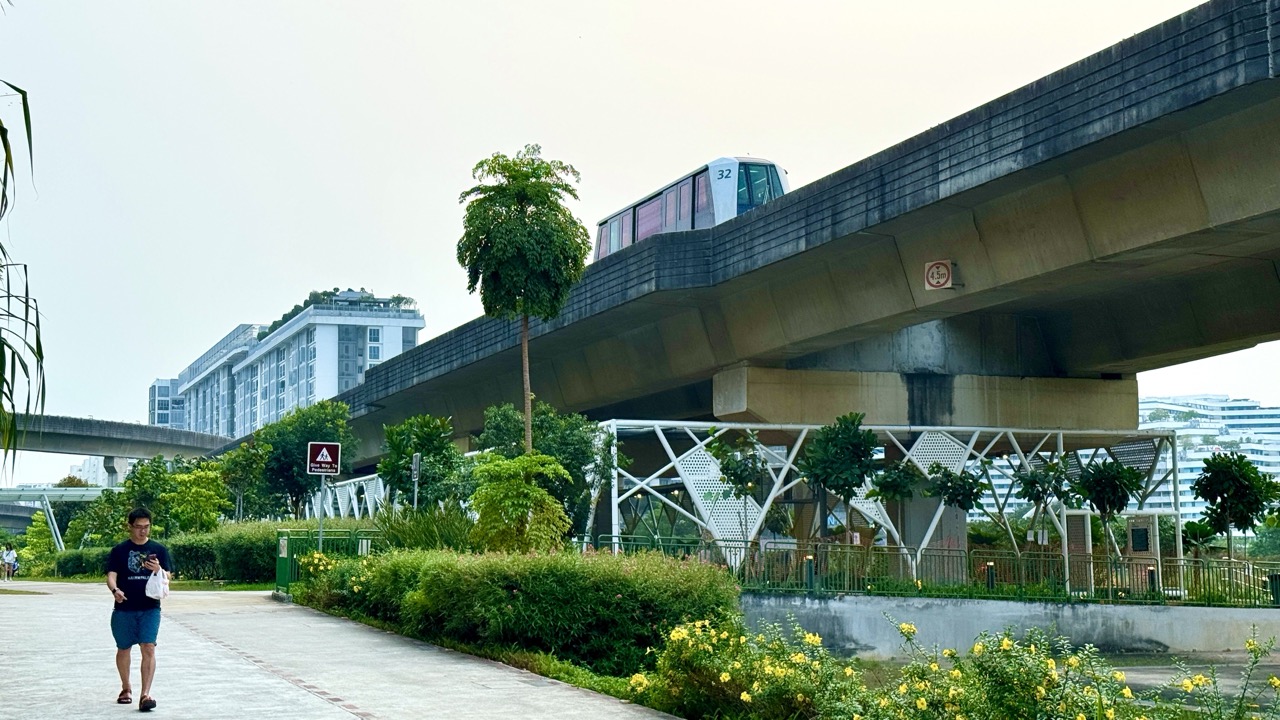
Why does Punggol need more two-car LRT trains when the tracks are already built and the East and West Loops already connect the neighbourhoods to Punggol MRT? It is tempting to think that more passengers can simply be handled by running the same trains more often. But railway capacity depends on far more than a timetable. Trains need enough room for passengers, safe spacing on the line, electricity, maintenance, storage and places where they can enter and leave passenger service.
The Sengkang–Punggol LRT is undergoing a major renewal programme that addresses those connected needs. New two-car light rail vehicles began carrying passengers in July 2025. The depot that supports both towns is being enlarged from 3.5 hectares to 11.1 hectares, and the Land Transport Authority announced in October 2026 that the longer-term fleet would grow to 41 two-car vehicles by 2030, subject to the procurement and deployment programme.
This means that improving a short neighbourhood train journey is not as simple as purchasing another vehicle. The trains, depot, reception tracks, signalling, power supply and operating arrangements must work together. The work may also create temporary inconvenience before the new capacity is available. Understanding that trade-off helps Punggol residents make sense of transport announcements without mistaking a future target for a service already operating.
This guide explains why two-car trains and a larger depot are needed, what the 2026 works actually changed, why the depot is located at Sengkang but serves Punggol, how to calculate capacity without inventing passenger counts and what families should check before relying on a promised improvement.
The answer in 50 seconds
LTA says the Sengkang–Punggol LRT is being renewed to meet growing passenger demand in both towns. It began introducing 25 new third-generation two-car light rail vehicles (LRVs) in July 2025 to replace the older first-generation fleet. Eight existing second-generation two-car LRVs will remain. In its 2 October 2026 announcement, LTA said it would procure another eight third-generation two-car LRVs, taking the planned fleet to 41 two-car LRVs by 2030.
The existing depot is being expanded from 3.5 to 11.1 hectares to provide additional stabling, workshops and reception tracks. Three new traction power substations will support higher demand from the two-car fleet. LTA’s target for the depot expansion remains 2027.
The central lesson is: passenger capacity is a property of the whole railway system. A longer train needs supporting infrastructure before its extra passenger room can be used reliably.
Why the LRT exists in the first place
Punggol’s LRT is a neighbourhood transport network. Its East and West Loops distribute passengers between housing precincts and the larger Punggol MRT and bus interchange. The North East Line then provides regional journeys to other parts of Singapore.
An MRT line and an LRT loop solve different travel problems. The MRT may move passengers across longer distances, while the LRT helps complete the first or last portion of a local journey. A person going to school, work or a community facility may depend on both.
When a neighbourhood grows, the number of people using the local feeder system can increase even if the geographic route stays unchanged. More homes, schools and destinations can create higher demand at some stations and times.
That is why a growing town can need more vehicle capacity without needing an entirely different LRT alignment. The issue may be the ability of the existing network to carry people comfortably and reliably.
What a two-car LRV actually means
An LRV is a light rail vehicle. On the Sengkang–Punggol system, a two-car vehicle has two connected passenger cars rather than one. It generally provides more space for passengers than a one-car equivalent, although the precise capacity depends on the vehicle’s specifications and operating rules.
Do not confuse a two-car LRV with two trains independently following one another. The cars are operated as one connected trainset. Their braking, doors, signalling interfaces and maintenance arrangements are coordinated.
The new third-generation two-car LRVs are manufactured by Mitsubishi Heavy Industries in Japan, according to LTA’s July 2025 announcement. They bring improved passenger information, lighting, seating, air-conditioning and other features.
The length of the train matters, but so does everything that allows it to operate safely. A two-car vehicle is not simply a larger cabin added without engineering consequences.
Why the older fleet needed renewal
LTA reported that the renewal programme would replace 25 first-generation one-car LRVs and eight first-generation two-car LRVs with 25 new third-generation two-car LRVs. Eight existing second-generation two-car LRVs are being retained.
This is a fleet replacement and capacity project, not only an increase in the raw number of vehicles. Older equipment eventually needs renewal, and newer vehicles can provide improvements in reliability, passenger comfort and maintenance support.
The number of vehicles alone can mislead. A fleet containing many one-car trains is not equivalent in capacity or operational characteristics to a fleet consisting of two-car trains.
For residents, the important measure is the service the entire fleet can provide, not simply the number of carriages shown in a headline.
Why the 2030 plan is different from the 2028 plan
LTA’s July 2025 statement described a target of 33 two-car LRVs by the end of 2028 after completion of the initial renewal programme. That was the planned composition at the time.
On 2 October 2026, LTA announced an additional procurement of eight two-car vehicles. This revised longer-term plan takes the target to 41 two-car LRVs by 2030.
Both statements belong to the same evolving programme, but they have different publication dates and time horizons. A 2025 article saying 33 by 2028 was not necessarily inaccurate when written. It becomes incomplete if it is presented as the entire latest plan after October 2026.
A strong local explainer should preserve the timeline: existing fleet, announced replacement programme, subsequent additional procurement and planned final target.
Why 41 does not mean 41 trains are running today
A procurement commitment is not the same as vehicles delivered, tested, commissioned and placed into passenger service. The new third-generation trains enter service progressively.
LTA reported that the first two new third-generation vehicles began passenger operations on 15 July 2025. Its February 2026 release expected seven of the new vehicles in passenger service by the end of that month, with the remainder following progressively.
The October 2026 announcement added a future procurement plan but did not mean all 41 were already available for commuters in October.
Residents should distinguish the planned fleet size, vehicles received, vehicles commissioned and vehicles actually deployed on a particular service. Those are separate statuses.
Why a railway depot matters to someone waiting on a platform
A depot is where trains are stored, inspected, prepared and maintained when they are not in passenger service. Commuters may rarely visit or even see it, yet its capabilities affect how many trains can operate.
Imagine purchasing ten additional vehicles but having nowhere safe to store or maintain them. They would not automatically create a reliable service. There must be enough suitable space for stabling, workshops, equipment and the movement of trains between the depot and line.
LTA is therefore expanding the Sengkang–Punggol LRT depot from 3.5 hectares to 11.1 hectares. That is a substantial increase in space supporting a shared railway network.
A depot is not leftover land. It is one of the facilities that makes passenger service possible.
Why the depot is in Sengkang but matters to Punggol
The Sengkang and Punggol LRT systems share supporting infrastructure, including the depot situated above the North East Line’s Sengkang depot. It is reasonable for residents to wonder why work in Sengkang affects trains in Punggol.
The answer is the shared operating system. Fleet storage, workshops, reception tracks and maintenance capacity support trains running across both towns.
The location of the workshop does not determine which town benefits. A bus depot located outside a particular estate can still support buses serving that estate. The same principle applies to rail.
This also explains why engineering works in Sengkang required coordination across the wider Sengkang–Punggol programme rather than being treated as an unrelated local construction project.
What a reception track does
A reception track allows trains to move between a depot and the operating railway under controlled conditions. Its configuration helps determine how vehicles are brought into and taken out of passenger service.
LTA said the expanded depot will include two new reception tracks, intended to reduce train launch times and improve operations. That is important because a larger fleet only helps if vehicles can be deployed efficiently when needed.
A commuter may experience a crowded platform during a busy period. Making more vehicles available at the right time requires planning long before the first passengers board.
The depot-to-mainline connection is therefore part of railway capacity, even though it lies outside the familiar loop stations.
Why tracks need signalling as well as steel
Two metal rails are not enough to run a safe passenger railway. A train network must control movements, spacing, routes and other operating conditions.
LTA’s 2026 upgrading announcements refer to significant modifications to track and the installation and testing of signalling systems and equipment while connecting new reception tracks to the existing mainline.
That means the new physical connection has to be integrated with the rules and technology that govern train movement.
A child can understand this by comparing a new road junction with traffic controls. Building the road surface is only part of the job. Vehicles still need clear and safe ways to enter and move through the network.
Why traction power must also be upgraded
Two-car vehicles require suitable electrical power to move, accelerate and operate onboard systems. A bigger fleet creates different demands on the railway’s power infrastructure.
LTA identified three new traction power substations as part of the depot and fleet upgrade. These support the increased power needs of the additional two-car vehicles.
Traction power is not the same as ordinary lighting in a station foyer. It concerns the supply needed to operate the trains, with engineering designed for the rail network.
The educational principle is that a bigger device may need more support from the infrastructure supplying energy. Adding passenger capacity without considering power would leave the system incomplete.
Why maintenance workshops need expansion
An LRV must be checked and maintained throughout its operating life. Components wear, faults occur and inspections must be performed by trained personnel.
A larger fleet requires sufficient space and equipment for those tasks. LTA’s depot expansion includes additional workshop and maintenance facilities, not only more parking for stationary trains.
This is a useful distinction. Storage is where a train can be kept. Maintenance is where it can be inspected, serviced and repaired. Both are essential, and one cannot replace the other.
Residents may not see the work, but service reliability depends on what happens when trains are not carrying passengers.
Why new vehicles need commissioning before use
When a train arrives from the manufacturer, that does not mean it can immediately be placed into ordinary passenger service. Testing and commissioning are required to verify its integration with the network.
LTA’s July 2025 announcement explicitly said the new vehicles would enter service after comprehensive testing and commissioning. The first two were initially introduced on Punggol loops over weekends for performance monitoring before weekday deployment.
That is evidence of a staged approach. The intention was to observe real network performance before introducing more demanding service patterns.
The correct lesson is that safety and reliability checks are part of delivering capacity, not evidence that the project has failed because every train was not immediately used.
Why passenger information is part of a train upgrade
LTA said the third-generation LRVs include clearer passenger-information displays, improved door-closing indicator light strips, better lighting, upgraded air-conditioning and ergonomic seating.
These features address aspects of the journey beyond the number of people the train can hold. A clearer display can make information easier to understand. Visible door-closing indicators can help passengers anticipate a transition.
The benefits depend on proper use and operation. Better indicator lights do not remove the need to follow announcements and avoid obstructing closing doors.
A railway upgrade is therefore both a capacity project and a passenger-experience project, although the two should be evaluated separately.
Why inter-car doors matter
LTA says the new two-car LRVs include inter-car doors designed to support safer and quicker passenger evacuation during emergencies.
This is an operational and safety feature, not simply a convenience for moving between sections during an ordinary trip.
Passengers should never interpret a feature description as permission to open emergency equipment or attempt evacuation without instructions. The operator’s procedures govern what to do during an incident.
The important principle is that a larger train needs a safety design suited to its layout. Capacity and emergency access must be considered together.
Why onboard diagnostic panels can help technicians
LTA also describes touch-screen diagnostic panels and improved access to equipment in the new LRVs. These features can help maintenance staff identify faults and perform work more efficiently.
A diagnostic display does not automatically repair a train. It provides information that trained technicians can use to investigate the problem.
The difference is between detecting or describing a condition and fixing its cause. Maintenance still requires tools, parts, training and safe procedures.
Students can compare this with a computer reporting an error message. The message may guide troubleshooting, but understanding and correcting the issue are separate steps.
Why some service disruptions occur during improvements
Major rail works sometimes require a temporary change to passenger service. Tracks and signalling equipment cannot always be modified safely while trains continue travelling through the same section under normal conditions.
In 2026, connecting the expanded depot’s reception tracks to the existing Sengkang–Punggol mainline required substantial works. LTA announced a temporary closure of the Sengkang West Inner Loop starting 19 April 2026.
This was a specifically defined service adjustment. It did not mean all Punggol East and West Loop services were closed for six months.
It is important to understand the exact affected route and the date of each announcement rather than copy a headline about “LRT closure” without its scope.
What changed in October 2026
LTA’s February 2026 plan originally indicated the Sengkang West Inner Loop would reopen on 18 October 2026. A later update published 2 October 2026 announced that full services would resume from the start of passenger service on 4 October.
That was two weeks earlier than planned. LTA attributed the change to more efficient sequencing of engineering work while maintaining safety requirements.
The accompanying weekday peak-hour shuttle services ended after the evening peak on 2 October. Old travel notices describing the closure as ongoing through 18 October are therefore outdated for the situation after the revised reopening.
This is an important lesson in public information: the latest official notice can supersede an earlier schedule, even when both were correctly published at the time.
Why shuttle buses were used
During the Sengkang West Inner Loop closure, LTA arranged shuttle bus services to help affected passengers maintain connections. Other regular bus and LRT options also remained available according to the service plan.
A shuttle is a temporary substitute for part of a route. It may involve different journey times and boarding arrangements compared with the normal rail service.
The purpose is to reduce inconvenience while essential work proceeds, not to guarantee that every passenger experiences no delay.
Because the specified shuttle services ceased in early October 2026 after the earlier reopening, a current article should not tell Punggol residents to board those old temporary shuttles as though they remain active indefinitely.
Why this upgrade serves two towns
The Sengkang–Punggol LRT network supports large residential areas with different neighbourhood layouts. Improvements to shared fleet, depot and power systems can affect both.
A new train entering service on the Punggol West Loop is part of a broader fleet used for the network, subject to operating arrangements. A depot project near Sengkang is similarly a system-wide investment.
This does not mean every traveller receives the same benefit at the same time. Passenger demand, service allocation, station conditions and phased deployment affect what individual commuters experience.
The correct conclusion is that railway infrastructure should be studied as one operating system with local outcomes, not as a collection of isolated station projects.
Why longer trains do not automatically mean twice as many departures
A two-car vehicle can carry more passengers per departure than a one-car vehicle of comparable design. But the number of departures per hour is a different measure.
Frequency depends on train availability, signalling, stopping patterns, safety separation and operating plans. A capacity upgrade may increase the number of people carried per train, improve frequency where practical or create flexibility for maintenance.
It would be irresponsible to promise that every LRT station will immediately see trains twice as often merely because vehicles now contain two cars.
The right calculation distinguishes capacity per vehicle, vehicles per hour and total capacity per hour.
A simple capacity calculation
Suppose a fictional one-car train holds 100 passengers under a stated loading standard, while a hypothetical two-car train holds 200. If six departures occur in an hour, theoretical capacity changes from 600 to 1,200 passengers per hour.
Those numbers are invented teaching values, not the published capacities of Sengkang–Punggol LRVs. Real calculations need actual vehicle specifications, timetable frequency and loading assumptions.
Now imagine only four two-car departures occur. The theoretical capacity would be 800, not 1,200. The train length alone did not determine hourly capacity.
The exercise shows why capacity announcements should be read as a system-level issue.
Why more vehicles can improve resilience
A railway requires some trains to be unavailable at times for maintenance or inspection. A fleet containing only the minimum number needed for service has less flexibility when a vehicle develops a fault.
A larger suitable fleet can provide additional operational options. It may support maintenance planning or allow more vehicles to be made available during high demand.
That does not guarantee zero breakdowns. Reliability depends on vehicle quality, infrastructure, maintenance and effective operating procedures.
The lesson is that spare capacity can support resilience, but it must be matched with facilities and skilled personnel able to maintain the fleet.
Why a bigger depot is not simply more parking
A depot must handle movement, inspection, repair, cleaning, equipment storage and safe access. More space may be required for additional workshop tracks and reception facilities as well as vehicle stabling.
LTA’s project is therefore a change to the railway’s operating capacity. It is not comparable to adding a few spaces to an ordinary car park.
The difference becomes clear when considering the specialised electrical, mechanical and signalling systems required to move trains around depot tracks.
Students can learn that some transport facilities are invisible to regular passengers but essential to the quality of the service they use.
Why the depot’s land area matters
The change from 3.5 hectares to 11.1 hectares is a measurable increase of 7.6 hectares. It is also a little more than three times the original area.
But land area alone does not tell us the final number of trains that can be serviced simultaneously. Workshop configuration, equipment and operating practices determine how that space functions.
A correct article uses the figures to explain the scale of the project without inventing a direct “trains per hectare” ratio.
The wider lesson is that a railway fleet increase can require substantial physical investment beyond the carriages themselves.
Why the fleet announcement should not be read as 41 extra vehicles
LTA’s October 2026 target of 41 two-car LRVs by 2030 refers to the planned resulting fleet total. It does not mean 41 additional vehicles are being added on top of every train already in service.
The programme includes replacements, retained second-generation vehicles and eight newly announced additional third-generation vehicles.
This is a common numerical mistake in infrastructure reporting. A final total and an incremental addition are different quantities.
Students should label the units and the time horizon before performing arithmetic: total future fleet versus newly procured vehicles.
Why the railway has a life cycle
Transport infrastructure does not remain at its original specification forever. Passenger demand changes, equipment ages and new technologies become available.
The Sengkang–Punggol LRT began as a network serving growing towns and has gone through changes in two-car operation, vehicle renewal and depot investment.
This is normal for a long-lived public system. An opening ceremony marks the beginning of service, not the end of planning or maintenance.
For students, the useful idea is that public infrastructure has design, construction, operation, upgrade and eventual replacement stages.
Why this is a Punggol housing story too
Rail demand is influenced by where people live and where they need to travel. A new residential precinct can create repeated journeys to MRT stations, schools and community facilities.
Punggol’s growth helps explain why LTA is investing in higher passenger capacity across the shared LRT system. The rail infrastructure must respond to a town whose needs have changed since the original opening.
This does not prove that every individual housing project creates a fixed number of LRT passengers. Demand needs actual observation and modelling.
The relationship between housing development and transport investment is nonetheless fundamental: a town’s infrastructure must evolve with its population and destinations.
Why work on a depot can affect a commuter far away
A resident may board at an East Loop station and never travel near the Sengkang depot. Yet the reliability of the shared fleet still depends on how well vehicles are stored and maintained.
If maintenance facilities are constrained, that can limit operational flexibility. Improvements at the depot may therefore matter to passengers across the network.
This resembles a public bus service. Travellers may never visit the bus depot, but its capabilities influence whether enough buses can be prepared and deployed.
The lesson is that support facilities are part of public service even when they are geographically separate from the customer.
What the October 2026 update does not prove
LTA’s announcement says the track-connection works made enough progress to reopen the Sengkang West Inner Loop earlier. It does not say that the entire depot expansion was finished on 4 October.
LTA continued to state 2027 as the target completion for the overall depot project. Likewise, the 41-vehicle fleet target belongs to 2030, not October 2026.
The completed reopening, ongoing construction and future procurement should therefore be described in separate sentences.
This is a valuable lesson for anyone following major projects: a milestone can be completed without the entire programme being finished.
Why travel guidance must be date-specific
A commuter reading a February 2026 notice might plan for a closure through 18 October. A commuter reading the revised October announcement would learn that normal Sengkang West Inner Loop service resumed on 4 October.
The appropriate travel decision depends on the current date and any further official notices.
A blog should not issue an undated instruction to board a temporary shuttle after its service has ended. Current journey planning should use LTA and SBS Transit’s official information.
The broader skill is distinguishing historical context from live operations.
Why greener rail does not mean impact-free rail
LTA says the new LRVs have brighter and more energy-efficient LED lighting, alongside improved passenger comfort and operational features.
A more efficient component can reduce energy use for its function, but a larger fleet and new infrastructure have their own construction and operating impacts.
Decommissioning older vehicles also creates a question about what can be reused. LTA has invited community partners to repurpose retired first-generation trains or components.
The responsible sustainability explanation looks at the whole life cycle rather than assuming “new” automatically means environmentally harmless.
Why reusing retired train parts can be useful
A retired LRV may contain components or structures that still have value for education, training or other authorised reuse.
LTA’s July 2025 announcement invited partners to consider whole-car or component repurposing, following earlier examples involving institutions and organisations.
That does not mean anybody may take parts from a depot or that every vehicle will become a public display. Disposal and reuse require operator approval and suitable handling.
For students, the idea is that material from an old technology can sometimes be given a new purpose when reuse is safe and practical.
How students can understand system capacity
Draw four connected components: passenger demand, trains, depot and power supply. Ask what happens if one component is too small.
If trains are long but the depot cannot store or maintain them, the plan may be constrained. If there is depot space but inadequate power infrastructure, deployment is still limited. If the network has capacity but passengers cannot reach stations, accessibility remains weak.
This exercise introduces a bottleneck: the part of a system that limits what the whole system can achieve.
The lesson is not to label one Punggol component as the current bottleneck without evidence. It is to understand how such limits can arise.
Three practical Punggol scenarios
Scenario one: the morning commuter
A commuter arrives at a busy Punggol LRT platform. They hear that new two-car trains are being delivered and assume crowding must immediately disappear.
A careful explanation notes that deployment is progressive and the timetable depends on more than one vehicle. They use current official service information for their journey.
The lesson is to distinguish a capacity programme from a guarantee about a particular departure.
Scenario two: the family reading about depot works
A parent sees news of a Sengkang West Inner Loop closure and assumes all Punggol services have stopped. They check the official announcement and identify the precise affected loop and dates.
They also note that the closure was shortened, with full service resuming on 4 October 2026.
The lesson is to read location and chronology before changing travel plans.
Scenario three: the student planning a railway
A student draws ten new two-car trains and assumes a system can operate them immediately. The teacher asks where those trains will be stored, maintained and powered.
The student adds depot space, workshop facilities, reception tracks and electricity infrastructure to the diagram.
The lesson is that a working network includes support facilities that may be invisible on a passenger map.
Frequently asked questions
Why does Punggol need more two-car LRT trains?
LTA says the renewal and expansion are intended to meet growing demand in Sengkang and Punggol and provide better capacity and passenger experience.
When did the new third-generation vehicles start operating?
The first two began passenger service on 15 July 2025.
How many two-car vehicles are planned by 2030?
LTA’s 2 October 2026 announcement targets 41 two-car LRVs across the shared Sengkang–Punggol fleet by 2030.
Is that 41 brand-new additional trains?
No. It is the planned total fleet after vehicle replacement, retention and additional procurement.
Why is the depot being expanded?
To accommodate more vehicles, stabling space, workshop facilities and the connections needed for reliable operations.
How large is the expanded depot?
LTA says it is being enlarged from 3.5 to 11.1 hectares.
When is the depot expected to be completed?
LTA’s October 2026 update maintained a 2027 target.
Did the Sengkang West Inner Loop reopen in October 2026?
Yes. LTA announced reopening from 4 October 2026, two weeks earlier than the previous 18 October target.
Does a two-car train guarantee twice the frequency?
No. Capacity per train and service frequency are separate considerations.
Where should I check current LRT services?
Use current LTA and SBS Transit service information, including station notices, rather than old construction-phase instructions.
A useful resident checklist
- Check the exact East or West Loop and service direction before boarding.
- Treat 2027 depot completion and 2030 fleet targets as future milestones.
- Distinguish the total vehicle fleet from additional vehicles purchased.
- Use current service notices when construction schedules change.
- Remember that two-car train capacity and train frequency are different.
- Do not rely on a superseded 2026 shuttle notice.
- Respect platform markings and door-closing warnings.
- Allow extra time during announced service changes.
- Consult LTA and SBS Transit for operational details.
- Recognise that trains, power, depot, track and signalling must work together.
Teaching Guide: why buying trains is not enough
Learning goal. Students explain how a railway’s passenger capacity depends on vehicles and support infrastructure, and distinguish planned targets from operating services.
Activity one: define the system. Draw a Punggol LRT loop and place a depot at another location. Add arrows for trains entering and leaving service.
Activity two: compare one car with two. Use hypothetical vehicle capacities to calculate passengers per hour under a stated departure frequency. Make the assumptions explicit.
Activity three: add a constraint. Imagine there is only enough depot room for five trains but ten have been purchased. Ask why not all ten can be used without more supporting infrastructure.
Activity four: add power. Explain that longer and more numerous trains need appropriately designed electricity infrastructure. Ask why new substations may be part of a capacity programme.
Activity five: add time. Make a timeline for July 2025 train introduction, October 2026 reopening, 2027 depot target and 2030 fleet target. Students label which milestones have happened and which remain planned.
Activity six: identify a misleading claim. “Forty-one new trains were operating in Punggol on 2 October 2026.” Ask why that is not what LTA announced.
Activity seven: discuss maintenance. A train develops a fault. Ask why depot workshops, diagnostics and spare operational capacity matter.
Transfer test. Compare the same reasoning with a school-bus company buying additional buses. What depots, drivers, maintenance and routes are still required?
Parent checkpoint. A strong explanation is: “More train space helps only if the railway can store, maintain, power and safely deploy the trains. The depot expansion is part of making the extra capacity usable.”
Where this article fits in eduKatePunggol
The existing Why Punggol | The LRT Has Two Loops Instead of One Line explains the basic route geometry. What to Expect for Punggol 2027 | LRT Depot Expansion, Two-Car Trains and Free Morning Rides provides a project and travel-oriented overview. Future of Punggol | 41 Two-Car LRT Trains by 2030 follows the published fleet milestones.
This article owns a different question: why must trains, stabling, workshops, reception tracks, electricity and operating procedures be upgraded together? It explains the engineering dependencies and how to read the changing project timeline without duplicating a commuter bulletin.
Official sources and further reading
- LTA: Sengkang–Punggol LRT Network
- LTA: First New Two-Car Trains, 15 July 2025
- LTA: Service Adjustments and Depot Works, 20 February 2026
- LTA: 4 October 2026 Reopening and Fleet of 41 by 2030
- eduKatePunggol: LRT Loops Explained
The one idea to remember
A longer train can carry more passengers, but it needs a railway capable of supporting it. Punggol’s two-car LRT programme involves not only vehicles but also more depot space, maintenance workshops, reception tracks, power and signalling. The benefit emerges when all those pieces operate together—not on the day a future train order is announced.


