
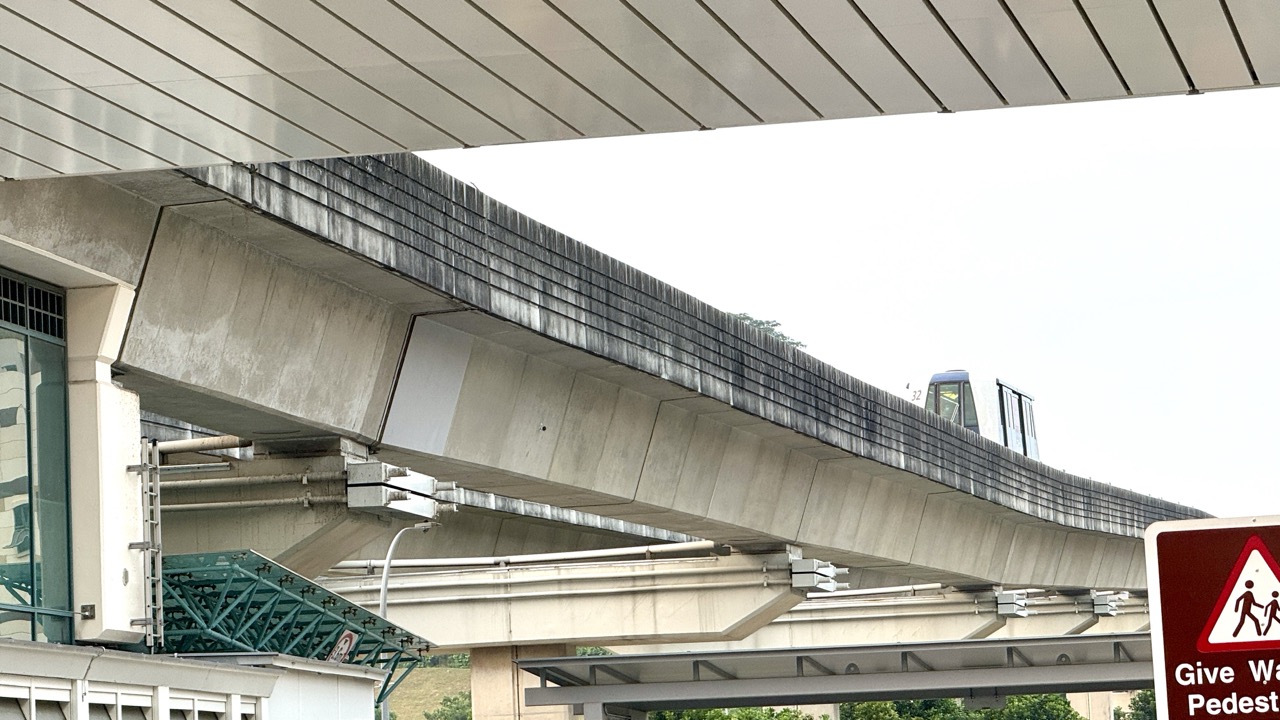
Why do Punggol LRT platforms have fixed barriers with openings rather than the powered platform screen doors familiar from many MRT stations? A passenger looking at both systems may think the difference is merely a cheaper or older style of fence. In fact, a powered platform-door system needs physical space, electricity, communications and safe coordination with approaching trains. Punggol’s LRT stations are much smaller than many MRT platforms, so the practical engineering problem is different.
Singapore’s Ministry of Transport (MOT) gave a clear explanation on 5 February 2025: installing conventional powered platform screen doors at LRT stations would require equipment that could substantially reduce the space available for waiting passengers. The existing safety system therefore uses fixed platform barriers, tactile warning features and video-analytics-based detection of track intrusions. These measures reduce certain risks, but MOT has expressly said fixed barriers are not a perfect substitute for full platform doors.
The safety discussion has continued. In July and September 2026, following a fatal incident at Segar station on the separate Bukit Panjang LRT network, MOT said the authorities were re-examining alternatives, including manually operated doors and automated rope barriers. As of the 10 September 2026 official update, those alternatives were still being evaluated, not confirmed as a completed installation at Punggol. The investigation of the Segar incident was also still ongoing at that date.
This guide explains why Punggol LRT platform protection differs from MRT protection, how the current layered system works, which limits an automated detector has, and why a seemingly simple proposal to install new doors requires careful engineering. It does not provide instructions for approaching tracks, bypassing barriers or testing emergency equipment.
The answer in 50 seconds
- MRT platform screen doors are moving systems that require power, communications and coordination with train doors.
- Punggol LRT platforms are smaller, leaving less room for the equipment and supporting infrastructure of conventional powered screen doors.
- LRT fixed barriers provide physical separation for substantial parts of the platform edge, but still leave openings through which passengers board and alight.
- Tactile warning studs help mark the approach to the platform edge; they are a warning feature, not permission to stand close to moving trains.
- Video analytics and track-intrusion detection can alert operations staff when a potential intrusion is identified.
- Further physical solutions remain under study in 2026. A proposal is not an operating safety feature until officially deployed.
The essential point is that platform safety is a system made of physical design, technology, operations and passenger behaviour. One barrier shape cannot be assessed without considering the entire station.
Why comparing an MRT photograph with an LRT platform is misleading
A photograph of an MRT station may show glass doors creating a continuous visual separation from the tracks. At a Punggol LRT station, a photo may show fixed metal or glazed panels and openings aligned with boarding positions.
The difference is real, but the photograph alone does not reveal the equipment spaces behind the panels, their connections to signalling systems, power supply or operating procedures.
A useful comparison must therefore begin with each system’s size and functions rather than conclude that identical-looking doors can simply be copied from one station to another. Visual similarity does not establish engineering compatibility.
What a fixed platform barrier actually does
A fixed barrier occupies a defined part of the platform edge and helps discourage or prevent a person from moving into the track area at that point.
Unlike a powered platform screen door, it does not move aside automatically every time a train arrives. The boarding positions remain open, so a passenger can step through when the train has safely stopped and boarding is authorised.
That makes it a partial physical safeguard. It can be beneficial without completely enclosing the edge, and acknowledging its limit is necessary for accurate safety education.
Why the remaining openings matter
The train must provide a route for passengers to board and alight. If the platform has fixed barriers rather than automatically opening doors, the arrangement necessarily includes spaces where boarding occurs.
Those spaces have different protection characteristics from the sections behind the barrier. A passenger must therefore pay attention to the waiting markings and the train’s arrival, rather than assume the entire platform edge is sealed.
The correct safety instruction is to remain within the designated safe waiting area, follow signs and announcements, and approach boarding positions only when appropriate. An opening is not an invitation to stand at the edge before the train stops.
What platform screen doors are
Platform screen doors are movable barrier systems separating passengers from track areas, with openings aligned to train doors.
The doors may be full-height or half-height depending on station design, but their defining characteristic is controlled movement coordinated with railway operation. A rigid panel that never opens is not the same system.
The distinction matters because adding motors, controls and communications introduces both capability and technical requirements. It is inaccurate to assume the difference between two systems can be measured solely by the height of their panels.
Why powered doors need electricity
A powered platform door must have energy for movement and for the associated control equipment. That requires suitable electrical supply, protection, maintenance access and appropriate behaviour during failures.
The equipment cannot be installed simply by drawing door outlines on an existing platform plan. Engineers need space for the machinery and its supporting infrastructure.
MOT explicitly cited power supply as one of the reasons standard screen doors are difficult to implement on smaller LRT platforms. That is a technical constraint, not an assertion that the LRT has no electricity anywhere.
Why communications matter
The platform-door system must exchange reliable information with appropriate railway equipment so that its operation is coordinated with train arrival, stopping and door status.
A communication link needs to be secure, dependable and compatible with the control arrangement. A fault must be handled without producing an unsafe opening sequence.
MOT specifically identified communications among the supporting systems that would be required. A door is therefore not only a moving object; it is a component participating in a safety-critical information exchange.
Why synchronising doors is difficult
Imagine a train stopping at a platform. The train doors and the corresponding platform openings must be appropriately aligned and operated in the intended sequence.
If a platform door opens when no suitable train is at the platform, it could expose passengers to a hazard. A mismatch between a train’s physical position and platform opening would create a different concern.
MOT and LTA’s descriptions recognise this synchronisation problem. Safe operation requires both the physical geometry and a reliable control relationship, not merely a button that seems to open the door at the right moment.
Why railway signalling cannot be an afterthought
Signalling and automatic train-control systems manage permissions, movements and protective conditions for trains.
Adding platform doors can require suitable interfaces with those systems and assurance that neither system creates unintended hazards for the other.
MOT’s February 2025 reply includes signal control equipment among the required components. That explains why upgrading the barrier is connected to the wider railway rather than being an isolated renovation.
For students, it is an example of a general engineering rule: a new component must fit the system it is joining.
Why the size of an LRT platform limits options
LRT stations are compact. Passenger circulation space, lifts, stairs, station furniture and waiting areas all compete for the available floor area.
Installing additional equipment could reduce how much usable space remains for commuters, particularly during busy periods. MOT said this is a central reason powered screen doors were not practical under the evaluated arrangements.
This is not a claim that the barrier itself is physically larger than the whole platform. The issue includes the associated power, communications and control infrastructure required to operate it safely.
Why waiting-area width is a safety issue
A narrow or crowded waiting area can make boarding, alighting and passing other passengers more difficult.
If engineers add equipment that further constrains the usable area, they need to consider whether the resulting platform can safely manage its expected passenger movements.
A door system intended to improve one form of safety should not inadvertently introduce another severe constraint. That is why the assessment must consider the total operating environment, not merely whether a proposed barrier looks stronger.
Why an existing station is harder to alter than a new drawing
A new station can sometimes be designed from the beginning around its intended equipment and maintenance space. An existing station already has a structure, circulation routes, services and operational commitments.
Retrofitting powered doors may therefore require more than replacing a guardrail. It can involve engineering interfaces, site works and disruption to services.
This is a general planning inference consistent with MOT’s stated constraints. It is not a claim about a specific approved construction programme at Punggol as of November 2026.
Why tactile warning studs are included
MOT says LRT platforms have tactile warning studs that alert people as they approach the edge.
These features can assist a traveller in recognising a boundary through contact underfoot, in addition to any visual marking. They support orientation but do not replace safe movement, supervision or the other design measures.
The studs should not be treated as a play area or a target to stand on while waiting for a train. Their purpose is to communicate a warning as people approach an edge.
Why tactile features and barriers serve different roles
A tactile warning feature supplies information about the edge. A fixed barrier provides a physical obstruction at its installed location.
Both can reduce risk, but neither accomplishes every task of the other. A warning does not physically close the opening; a barrier is not a complete navigation instruction for a person who needs directional information.
This demonstrates the value of layered protection. The system uses multiple measures because different failure pathways require different responses.
Why signs and announcements remain important
Passengers depend on information to know where to stand, when a train is arriving and how to board safely.
A platform may have fixed barriers and detectors while still requiring clear announcements, markings and instructions.
The equipment and information must work together. A sign cannot physically stop an accidental intrusion, but it can help users avoid risky positions. A barrier cannot explain every temporary disruption. Safe operation benefits from both.
Why video analytics are used at LRT stations
MOT said in 2025 and again in 2026 that LRT operators have implemented technology using cameras, artificial intelligence and video analytics to identify track intrusions and alert staff.
The system’s role is detection and communication. It helps the operations centre become aware of a potential hazard, allowing an appropriate response under established procedures.
That is different from an automatic physical barrier that prevents anyone from entering in the first place. Detection helps manage an incident but does not make intrusion harmless.
Why an alert is not the same as prevention
An alert can notify staff after an unsafe action or condition begins. Physical separation seeks to reduce the chance of that action occurring.
These are complementary roles. The first may shorten the time before a response. The second may prevent or discourage exposure in some locations.
A resident should not assume that video analytics eliminate the need to stay back from the platform edge. A detector is not a substitute for safe waiting.
Why ‘AI’ does not mean there is a robot driver watching every passenger
The term *artificial intelligence* in this context refers to video-analysis functions used to identify potential track intrusions.
It does not mean every person at a Punggol station is automatically identified by name, that every action is understood perfectly or that a robot can physically stop a fall.
The correct explanation focuses on the documented function: recognising a potentially dangerous situation and alerting the operations centre. Privacy and performance questions require specific official evidence rather than guesses about unseen algorithms.
What staff at the operations centre contribute
A train system needs trained people to monitor conditions and coordinate responses when alerts or faults occur.
MOT’s statements describe video-analytics alerts being sent to staff at the operations control centre so appropriate action can be taken quickly.
The relevant emergency procedures are controlled by the operator and should not be reconstructed from speculation. The educational lesson is that automation provides information while authorised staff remain accountable for operational response.
Why a video system needs testing
A detection system could miss something, or it could generate an unnecessary alert. Both possibilities matter in safety-critical operations.
Performance must be evaluated under relevant conditions. The choice of camera placement, software and procedures can influence how useful a system becomes.
A public article should not invent a detection percentage for the Sengkang–Punggol LRT. Performance figures from another system or test do not automatically describe Punggol.
The right conclusion is that detection technology requires validation, maintenance and continuing review.
Why an alarm should not be deliberately triggered
An alerting system is intended for genuine potential danger. Deliberately approaching or crossing a protected boundary to see whether cameras react would create unacceptable risk.
Parents and teachers should never treat a live platform as a classroom demonstration of AI detection. Use official diagrams or fictional scenarios instead.
Students can discuss the input–alert–response process without contacting tracks or interfering with railway equipment.
Why the discussion changed after May 2026
On 18 May 2026, a person died after falling onto tracks at Segar LRT station on the Bukit Panjang network. The incident prompted further parliamentary questions about protection.
MOT’s 7 July 2026 reply acknowledged that existing fixed barriers were not a perfect substitute for platform doors and directed further exploration of available physical solutions.
This is important context, but it must be stated accurately. Segar belongs to Bukit Panjang LRT, not Punggol. The facts of the individual incident should not be attributed to Punggol stations.
Why an investigation must not be turned into a guessed explanation
A death in a transport system is serious. It deserves factual reporting and respect for the people affected.
MOT’s 10 September 2026 statement said the Segar incident investigation was still ongoing. That means a public explainer should not present a definitive account of every contributing factor or declare a new solution proven before the authorities complete the relevant work.
The wider policy question can still be explained without inventing case details. Separate verified safety-system facts from unresolved incident findings.
What manually operated platform doors could mean
MOT said it was studying manually operated platform screen doors that would not require synchronisation with train doors in the same way as conventional powered systems.
That description explains the nature of an option under evaluation. It does not mean such a door has already been approved, tested successfully and installed at every Punggol LRT stop.
A proposal still requires assessment of how users and operators interact with it and whether it is safe under real conditions.
Why a manual door can introduce its own challenges
A manually operated barrier could avoid certain powered synchronisation requirements, but it would introduce different questions: who operates it, how it is handled during busy periods, whether it obstructs access and what happens during emergencies.
These are design considerations, not evidence of a particular failure or proof that the idea cannot work.
MOT said proposed alternatives need careful evaluation and trials to ensure they do not create new commuter risks. That is the correct engineering approach: compare the complete safety outcome, not just the presence of an extra panel.
What an automated rope barrier is
An automated rope barrier is an alternative kind of physical separation system that can be raised or lowered in a controlled manner.
MOT’s July 2026 discussion named such systems as among the options to examine. Their relevance is that they may occupy or operate differently from standard powered platform screen doors.
However, it would be misleading to claim they were formally adopted for Punggol or that their precise operating procedure is settled. The public evidence describes evaluation, not a completed local rollout.
Why an idea that was impractical before may be reconsidered
Technology changes. Smaller equipment, different operating concepts or revised layouts can sometimes alter what is feasible.
MOT explicitly said in July 2026 that a solution considered impractical in the past need not remain impractical forever. That is a reason to continue studying alternatives.
It is not an announcement that every previous engineering constraint has disappeared. New methods still need testing against actual platforms, passenger circulation, trains and operating procedures.
Why a proposed improvement might create new risks
A moving barrier could introduce pinch points, blocked circulation or other hazards if unsuitable for the operating environment.
That is why a safety upgrade must be examined as part of the complete station. Increasing protection at one location should not create a different unacceptable risk elsewhere.
The principle is called systems thinking: evaluate interactions between equipment, people and procedures, not only the intended benefit of one component.
Why installation and operation are different milestones
A photograph might show a prototype barrier standing on a test platform. That would not establish that it is already used for ordinary passenger boarding across Punggol.
Before public deployment, equipment must be appropriately designed, installed, tested and incorporated into operator procedures.
A responsible article keeps those milestones distinct. As of the latest cited September 2026 update, the alternatives were being studied, not declared standard installations.
Why safety cannot be expressed as one perfect score
A system can prevent many incidents and still have limitations. A design may be highly effective in one scenario and require a different control for another.
MOT’s descriptions of fixed barriers, warning studs and detection technology show several layers addressing different mechanisms. The debate about further improvements reflects the continuing need to reduce risk.
It is better to identify what each safeguard does than to give the railway an invented numerical safety score without a defined measurement.
Why passenger movement is part of platform safety
Passengers enter, wait, board, alight and sometimes transfer under varying conditions. The same platform may be relatively quiet at one hour and crowded at another.
A barrier design must account for the space people need to complete those activities safely. Narrow waiting areas can complicate circulation, especially for passengers who take longer to move.
This is why the platform width matters even when the proposal is intended to improve safety. A strong barrier is not useful if installing it creates an unsafe crowding arrangement.
Why a large MRT station is not a direct template
MRT and LRT platforms differ in dimensions, train characteristics and infrastructure.
A full door system that works well in a spacious MRT environment may need substantial redesign before it can be used on a compact LRT platform.
The correct comparison asks what the two platforms have in common and what constraints differ. Copying a photograph is not an engineering design.
Why train doors and platform doors are separate systems
The train has onboard passenger doors. The platform may have fixed barriers or, at other types of railway stations, powered screen doors.
Their roles are related because boarding occurs between them, but they have different physical locations and control arrangements.
Students should not confuse a statement about vehicle doors with one about platform doors. The newer Punggol LRT vehicles may have improved onboard door indicators without that implying that the platforms now have powered screen doors.
Why door-indicator upgrades do not solve every platform-edge problem
LTA’s later two-car LRT vehicles include improvements to onboard passenger information and door indicators.
Those features can help riders understand train-door operation, but they do not physically close every gap in a station’s fixed platform barrier.
Safety improvements can be valuable without being interchangeable. A clearer light on a train and a more substantial platform barrier address different elements of a journey.
Why maintenance matters after installation
Fixed barriers require inspection. Electronic detection systems need maintenance and technical checks. Any future moving barrier would introduce additional mechanical or control components to maintain.
A new installation should therefore be assessed over its operating life, not only during an opening demonstration.
The correct question includes whether the operator can support the system reliably for years under regular passenger use and environmental conditions.
Why emergency equipment should not become a children’s experiment
A student may be curious about an emergency stop button or track-intrusion system. Those devices serve serious operational purposes.
They are not educational controls to activate casually. Use the operator’s authorised training material or diagrams instead.
Understanding how the technology works is different from interfering with its operation. A respectful field trip can teach responsibility as well as engineering.
A fictional platform-width calculation
Imagine a fictional platform with a usable waiting strip measuring 2.4 metres across. Suppose a proposed equipment installation would occupy 0.5 metre of that width.
The resulting simplified width would be 1.9 metres, before allowing for other structures or safety clearance. Those figures are invented teaching numbers, not the dimensions of any Punggol station.
The purpose is to show why installing equipment can reduce the space for passengers. Actual rail-station design needs professional measurements and standards.
A fictional synchronisation problem
A train arrives at an imaginary station. The vehicle doors may open only when the train is appropriately stopped. A powered platform door system must also open at a compatible position and time under its designed controls.
Students identify why unsynchronised movement could be hazardous. They then discuss which inputs and checks a safe design would need.
No student should attempt such a test on a real platform. The learning activity is a paper diagram illustrating coordination.
A fictional layered-safety diagram
Draw a platform with a waiting zone, a tactile warning feature, a fixed barrier and a monitored track area.
Label which measure gives information, which provides physical separation and which may provide an operational alert.
The student should recognise that the layers have distinct responsibilities. They should not label the diagram “guaranteed safe under every possible condition”.
A fictional monitoring-error scenario
Suppose a demonstration detector reports an intrusion when no one has entered the track area. An operator would need suitable procedures to assess the alert.
Now consider the opposite possibility: a dangerous condition occurs but the detector fails to report it. This shows why physical safeguards and proper passenger behaviour remain important.
The exercise is about the limits of automated recognition. It does not claim that either failure has occurred at a named Punggol station.
Why a platform’s safety history should be read with care
Statistics require a defined network, time period and outcome. An isolated headline may not establish how one station compares with another.
MOT’s public statements provide background on safety efforts and their limitations, but a writer should not convert broad network statistics into a claim about one Punggol platform without appropriate data.
The correct focus is the documented design and current measures, supported by properly labelled official statements.
Why residents can ask difficult questions constructively
Commuters can legitimately ask whether barriers could be improved, how crowding is managed and what technology is being evaluated.
A useful question identifies the relevant station and a specific issue rather than assuming the answer must be identical for every LRT route.
Public debate can acknowledge the engineering constraints and still expect continuing work on passenger safety. Understanding those constraints does not require claiming the current solution is perfect.
What families should do while waiting
Keep children and personal belongings within designated safe areas. Stand back from the platform edge. Observe current signs and follow staff instructions.
Avoid leaning against fixed barriers, especially in crowded conditions. MOT has specifically warned that such behaviour presents risks.
If something falls into a track area, do not attempt to retrieve it. Inform station staff or use the appropriate official assistance channel instead.
Why a future barrier proposal should have a clear status label
An article about a technology option should state whether it is being studied, trialled, approved or actually operating.
The September 2026 statement describes continued study of manually operated doors and other approaches. It does not announce that Punggol passengers can already use them.
This is the same discipline used in reporting future MRT projects. A proposal becomes useful to a commuter only when it has reached the relevant operating stage.
Ten frequently asked questions
Do Punggol LRT stations have platform protection?
Yes. MOT describes fixed barriers, tactile warnings and track-intrusion detection as parts of the LRT platform safety arrangements.
Are fixed barriers the same as powered platform screen doors?
No. Fixed barriers leave boarding openings and do not operate as synchronised moving doors.
Why not copy MRT platform screen doors?
MOT cites the limited size of LRT platforms and the space required for power, communications and signal-control equipment.
Do tactile warning studs physically close the gap?
No. They provide warning information near the edge; they are not an enclosing barrier.
Does video analytics automatically make track entry safe?
No. It is a detection and alert system, not a guarantee that a dangerous event cannot occur.
Are Punggol LRT platforms equipped with AI intrusion detection?
MOT said video analytics were deployed on the Sengkang–Punggol LRT network in 2024.
Is the Segar incident a Punggol event?
No. Segar is on the Bukit Panjang LRT. Its investigation prompted broader safety review.
Are manual platform doors approved for all Punggol stations?
MOT’s September 2026 update described them as an option still under examination, not a completed rollout.
Can passengers lean on the fixed barriers?
They should not. MOT has warned that leaning on fixed barriers carries risks.
Where can commuters see new safety announcements?
Use current MOT, LTA and operator notices, not undated social-media renderings of possible future equipment.
A practical commuter checklist
- Stay behind the designated safe waiting markings.
- Do not lean on fixed platform barriers.
- Keep children and belongings away from openings near the track.
- Follow signs, announcements and authorised staff directions.
- Never enter a track area to retrieve an item.
- Distinguish an onboard train door from a platform-door system.
- Do not test video cameras, alarms or emergency equipment.
- Check official notices for genuine system upgrades.
- Treat a proposed barrier as uninstalled until an official operating announcement says otherwise.
- Report genuine hazards to the responsible railway operator.
Teaching Guide: why one safety feature cannot do every job
Learning goal. Students explain why a compact LRT platform requires a combination of physical safeguards, warnings, detection technology and operating procedures.
Activity one: compare photographs. Give students an authorised MRT platform image and an LRT platform image. Ask them to describe visible differences without inventing hidden equipment.
Activity two: define the components. Identify a fixed barrier, a powered door, tactile warning studs and a camera-based detector. Explain the primary function of each.
Activity three: consider space. Use the fictional platform-width calculation. Ask whether a safety component that takes up waiting space could create a second design problem.
Activity four: add synchronisation. Draw a train and a powered platform door. Ask which two openings must align and why movement requires coordination.
Activity five: introduce an alert. Explain how detection information reaches authorised staff. Ask why a notification differs from a barrier that prevents entry.
Activity six: evaluate a proposal. Consider manual doors or rope barriers without claiming they are installed. Ask what safety, access and maintenance questions must be answered.
Activity seven: check dates. Compare MOT’s 2025 explanation with its July and September 2026 review statements. Distinguish existing safeguards from options still being evaluated.
Activity eight: transfer. Compare the idea with an industrial machine that uses a guard, a warning light and an emergency procedure. Why might several safeguards be necessary?
Parent checkpoint. A strong answer is: “Punggol LRT uses fixed barriers because conventional powered screen doors need equipment and space that compact stations may not accommodate. Warning features and detection systems add protection, while safer alternatives are still being studied.”
Where this article fits in eduKatePunggol
The existing Why Punggol | LRT Trains Use Rubber Tyres on an Elevated Guideway explains rolling-stock and guideway technology. Why Punggol | More Two-Car LRT Trains Need a Bigger Depot covers capacity and maintenance infrastructure. Punggol LRT Noise and Rubber Tyres addresses another commuter concern.
This article owns a different question: why is platform-edge protection in a compact LRT station not identical to the powered doors used by MRT, and what must work together to manage the remaining risk? It does not duplicate a guide to vehicle mechanics or loop direction.
Official references
- MOT: Technical Limitations of LRT Platform Screen Doors, 5 February 2025
- MOT: LRT Platform Safety Measures, 7 July 2026
- MOT: Further Safety Review, 10 September 2026
- LTA: Sengkang–Punggol LRT
The one idea to remember
Punggol LRT’s fixed platform barriers reflect real constraints in compact stations, but they are not a complete substitute for moving screen doors. Safe travel depends on physical separation, warnings, detection, trained operators and responsible passenger behaviour. New protective ideas must be evaluated for the whole railway environment rather than judged by their appearance alone.


