
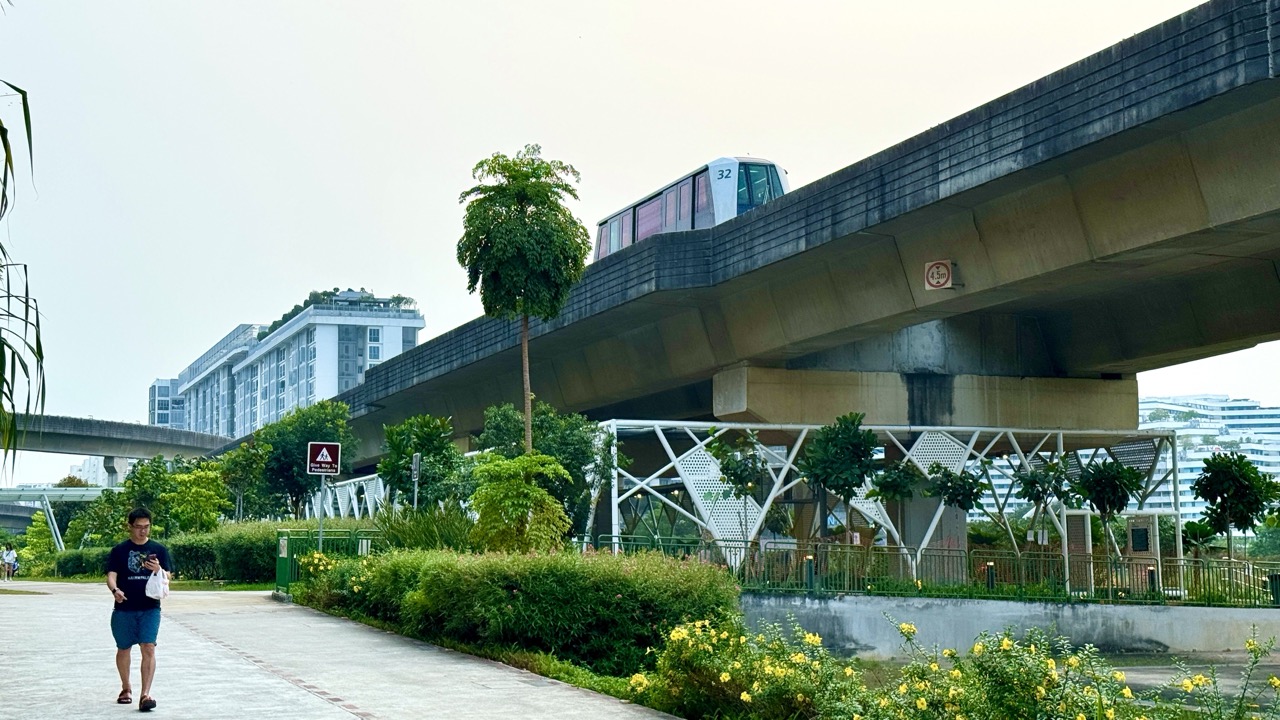
Quick answer: The Punggol LRT is not a miniature steel-wheel MRT line. Singapore’s Minister for Transport stated on 8 April 2025 that LRT trains use rubber tyres on concrete guideways, reducing noise compared with conventional MRT trains, and that LRT pass-by noise near housing was within NEA guidelines. LRT maintenance work can be noisier temporarily, particularly during overnight engineering periods; the ministry said LTA would use mitigation such as noise blankets. An individual sound complaint should record its actual location and timing, not assume MRT wheel-grinding methods, MRT noise-barrier requirements or an 85 dB in-cabin MRT guideline apply automatically to Punggol’s LRT.

Anyone standing beneath an LRT viaduct can hear how a train changes the local soundscape for a short time. A bus or delivery vehicle may be making noise below it, children may be playing on a court, and a train passes overhead. A resident upstairs might notice a different sound again, depending on the unit’s window position and whether the air conditioner is running. The ear hears a mixture; it does not automatically identify which source is responsible.
This article explains how Punggol’s rubber-tyred automated LRT differs acoustically from heavy MRT, what ordinary train and maintenance sounds can mean, and how residents can describe a legitimate concern. It is not a real-time noise survey, a comparison ranking of HDB blocks or an assurance that every person will find a particular location equally quiet. The distinction between official engineering evidence and a household’s subjective experience is central. Both matter, but neither should be exaggerated into a claim it cannot support.
Which noise are you hearing?
| Observed sound | Possible broad category | What to record |
|---|---|---|
| Brief recurring pass-by sound | Regular LRT movement, possibly mixed with road noise | Exact location and times of occurrence |
| Voices or beeps near a station | Station announcements or warning devices | Which announcement and how often |
| Mechanical work at unusual hours | Maintenance during engineering access | Date, visible notice and duration |
| Sudden new scraping or rattling | Unverified sound requiring technical assessment | Which train movement and where |
| Continuous road rumble beneath viaduct | Road traffic may be a separate source | Whether it occurs when no train is passing |
| Phone app shows a high dB number | Uncalibrated reading, not regulatory finding | Device, settings, distance and limitations |
1. Punggol’s LRT uses a different running surface from MRT
The most important factual distinction is the vehicle’s contact with its guideway. In April 2025, the Minister for Transport explained to Parliament that Singapore’s LRT systems use rubber tyres on concrete guideways. This arrangement permits LRT routes to run relatively close to residential developments while generating less noise than conventional MRT trains.
An MRT train typically uses steel wheels on steel rails, and that contact behaves differently, especially at curves and certain track conditions. It is therefore a mistake to hear an unfamiliar sound in Punggol and automatically say that steel rail grinding is required. The Punggol LRT’s rubber-tyred guideway has different mechanical components and maintenance needs.
Lower noise by design does not mean a completely silent system. Motors, ventilation, moving components, guideway interfaces, station activity and other surroundings may still contribute sound. The official comparison describes a technology choice and typical relative performance; it is not a promise that a person standing anywhere in town will hear nothing.
Punggol example
A child notices the LRT sounds unlike a large MRT train. The family can explain the rubber-tyred guideway principle and compare it with official sources rather than guessing about metal wheels.
2. Why the trains run so close to housing
LTA’s Sengkang-Punggol LRT page describes a fully driverless light-rail system serving residential estates and connecting them to MRT stations and bus interchanges. Punggol’s LRT opened in 2005 and operates two local loops. Its purpose is short-distance connection between parts of a town rather than the same role as a high-capacity cross-island metro service.
An elevated alignment can bring public transport within walking distance of housing while avoiding most street-level traffic conflict. That also makes it visible and audible from nearby paths. Designing a system for a dense new town involves trade-offs among access, land, capacity, visual effects and acoustics.
Do not infer the level of exposure inside a particular flat from the fact that the viaduct appears nearby on a map. Actual sound depends on distance, elevation, window direction, building form and other sources. Residents who need housing-specific information should inspect the actual situation rather than apply an invented townwide rule.
Punggol example
A family viewing a flat near a Punggol LRT station can visit the actual unit at representative times, while recognising one short visit cannot predict every future train or maintenance sound.
3. Noise is not a single thing
People use the word noise for unwanted sound, but different sources have different characteristics. A continuous rumble may come from road traffic; short pass-by events may coincide with trains; a beep may be a station warning; a repeated metallic sound may come from unrelated works. A recording without the surrounding context may not identify the source accurately.
The height and structure of a viaduct can also change how sound reaches an observer. Reflections from nearby buildings may affect what a person hears. Weather, wind and open or closed windows make perceptions vary across time. These general acoustic effects should not be converted into claims that one exact Punggol block must be noisier than another without measurements.
Useful reporting starts by separating a sound’s timing and character from a guessed cause. When a new sound occurs, note when it starts, how long it continues, whether a train is visible and which other activities are present. A concise observation helps investigators determine what deserves inspection.
Punggol example
A parent hears a low rumble near an LRT track but notices it continues when no train is passing. That observation suggests considering nearby traffic too, not only the railway.
4. A pass-by sound is different from continuous exposure
An LRT vehicle passing a location produces a time-limited event. A resident may also experience intermittent road traffic, air-conditioning equipment or a shop’s mechanical systems throughout the day. The proportion of time occupied by each source matters when describing the overall sound environment.
Two residents can reasonably report different experiences in the same building because they spend time in different rooms, keep different windows open and have different routines. The physical noise source is only part of the experience. A person working from home may notice short events more than someone who is away during the day.
Do not assume that a brief loud impression proves a long-term exposure threshold has been exceeded. Environmental assessment generally requires appropriate measurement methods and locations. Subjective disturbance is worth describing carefully, but a regulatory conclusion needs the relevant authority’s framework and evidence.
Punggol example
A resident hears several short train events during an evening study session. They record the pattern and impact without announcing a continuous noise-level figure they have not measured.
5. Rubber tyres reduce a particular source of sound
The April 2025 ministerial reply explicitly states that the use of rubber tyres on concrete guideways helps LRT trains produce less noise than MRT trains. This addresses the contact between the vehicle and its running surface, which differs from the steel-wheel-on-steel-rail arrangement of conventional MRT.
Rubber-tyred transport still needs tyres and guideways maintained, and other components can generate sound. A change in a passing noise does not automatically identify a worn tyre, a defective guideway or an imminent breakdown. Several possible sources would need to be considered by technical staff.
Families can understand the basic idea by comparing different materials in a safe tabletop explanation, without touching railway infrastructure. Rubber and steel interact with surfaces differently, but the performance of a real train depends on its complete engineering design rather than one simple material-property slogan.
Punggol example
A Secondary student writes that Punggol LRT uses rubber tyres and that this is an official reason for lower noise relative to MRT. They avoid claiming all sound is eliminated.
6. Steel-wheel MRT techniques must not be copied blindly
LTA described rail grinding and speed moderation to reduce noise at curved sections of the Thomson-East Coast Line in a 2023 reply. That statement concerns the MRT’s steel rail contact and specific underground train environments. It does not establish that rail grinding would be an appropriate solution for Punggol’s rubber-tyred LRT guideway.
The distinction is especially important for readers using online sound discussions. A complaint about wheel squeal on another rail system can be real, yet the proposed engineering fix may rely on a component not present in the same form on the local LRT. Similar sounds do not guarantee identical mechanical causes.
Use the correct technology and source scope. When citing a heavy MRT example, label it explicitly as a comparison rather than direct evidence about the Punggol LRT. If you want to know the reason for a local sound, ask LTA or the operator for assessment rather than import an unrelated diagnosis.
Punggol example
A neighbour shares a video of underground MRT wheel squeal and says Punggol’s LRT needs the same track grinding. A careful response points out the different wheel and guideway technologies.
7. What NEA’s noise guidelines actually establish
The 8 April 2025 parliamentary reply said noise generated by LRT trains passing near residential estates was within NEA’s guidelines. This is an official statement about the applicable environmental limits at that time. It does not mean residents are prohibited from describing a bothersome sound or that a later unusual event must be ignored.
Environmental limits are evaluated under defined contexts and methods. A person cannot prove a guideline breach from a telephone screen displaying one peak sound level. Nor should a local blog assert that an official limit has been breached at a named station without a qualified measurement and the relevant reference standard.
The most constructive approach is to preserve both facts. The public statement supplies important engineering context, and a new specific disturbance can be reported for assessment. If the responsible agency later issues a site-specific finding, the conclusion should reflect that evidence and its date.
Punggol example
A Punggol resident says a passing train seemed louder than usual. They can report the exact event while acknowledging that the general LRT design was described as meeting NEA guidelines in 2025.
8. The 85 dB MRT cabin reference is not a Punggol neighbourhood limit
In February 2026, the Ministry of Sustainability and the Environment answered a parliamentary question about noise inside MRT systems. It described an average in-cabin design level below 85 dB and noted that tight curves on certain MRT routes can produce temporary exceedances. The subject was passengers inside MRT train cabins.
That number should not be copied into a Punggol LRT outdoor complaint as if it were the allowed noise level at an HDB bedroom window. The measurement location, time averaging and type of system differ. An MRT cabin design criterion and an NEA environmental guideline for residential settings are not identical.
Noise articles often become misleading when a single impressive decibel number is detached from its reference. Whenever quoting one, identify whether it is a maximum, an average, a cabin value, an outdoor level or a laboratory figure. Without that context it does not answer a resident’s question.
Punggol example
A student researching acoustics finds ’85 dB’ in a government reply. They label it as an MRT cabin reference, not a Punggol LRT residential standard.
9. Why an elevated guideway changes the sound environment
An elevated LRT guideway places moving vehicles above nearby roads and walkways. The observer can hear a mix of vehicle movement, traffic below, voices, birds and the surrounding built environment. The relative contributions change with location and time. A train overhead may be easy to identify visually, but that does not prove every simultaneous sound comes from it.
Surrounding buildings and hard surfaces can reflect sound, while open areas may offer different propagation conditions. Distance and orientation matter. A resident on one side of a block may hear a sound differently from someone facing the viaduct directly. These are standard acoustic considerations, not a diagnosis of a particular facade.
Good local reporting describes exactly where the observation was made: at a public path, inside a closed-window bedroom, near a station entrance or under an elevated span. One location should not be used to represent the entire neighbourhood.
Punggol example
A family compares the sound under a viaduct with the sound inside an adjacent indoor space. They describe the locations rather than claiming a precise reduction without calibrated measurements.
10. Station announcements are another sound source
Platforms and transport facilities use announcements, door warnings and other audible information to guide commuters. These sounds can be useful for accessibility and safe boarding. A person near a station may notice them more often than someone along a mid-block viaduct where trains pass without stopping.
Not every repeated voice or beep heard from a residential window necessarily comes from the station. Nearby crossing equipment, commercial premises and road vehicles also generate warnings. A useful observation identifies the words heard, their timing and whether the person can actually associate them with a platform or train movement.
Requests to reduce an announcement should also account for its safety purpose. A sound that helps people board safely cannot simply be treated as meaningless noise without considering the needs of commuters with disabilities or people unfamiliar with the station.
Punggol example
A person living near a Punggol LRT station notices repeated door warnings. They distinguish these from tyre and guideway sound when describing their concern.
11. Overnight maintenance is not ordinary passenger operation
Rail systems require inspection and maintenance, and some tasks can only be performed when passenger trains are not running. The April 2025 Minister for Transport reply expressly referred to temporary LRT maintenance, including overnight engineering-hour works. This explains why a resident might hear a different type of sound outside ordinary service patterns.
The reply also stated that LTA would use necessary noise mitigation measures, such as noise blankets, to keep maintenance sound within NEA guidelines. It did not promise that every maintenance task would be inaudible or that all works use the same equipment. A night-time hammering or vehicle sound requires location-specific context before its source can be identified.
Residents should check for current works notices and describe the observed activity without trespassing into a maintenance area. Temporary works can involve safety restrictions that matter to both railway staff and the public.
Punggol example
A parent hears unusual work sounds after normal train operations and sees a dated railway notice. They identify the actual site and timing before sending a question to the operator.
12. What a noise blanket is meant to do
A noise blanket is a temporary noise-control measure used around certain construction or maintenance activities to reduce how much sound reaches surrounding areas. Its role is different from a permanent trackside barrier. The Ministry of Transport named noise blankets as one tool for LRT overnight works in its April 2025 reply.
A blanket cannot eliminate all sound, and its effectiveness depends on how it is installed relative to the source and the work. Residents should not interpret the visible absence of a blanket at one distance as definitive evidence of a regulatory breach; some tasks may use alternative controls. Equally, a visible blanket does not prove the sound is below a numerical limit without measurement.
The important distinction is between an agency’s obligation to mitigate and a resident’s ability to see the technical method. If a work period seems unusually disruptive, describe the location, dates, timing and duration so the appropriate team can review the actual measures.
Punggol example
A family notices temporary screening near an LRT maintenance site. They understand its likely purpose without claiming it will produce complete silence during the work.
13. Permanent MRT barriers do not establish LRT barrier plans
The Ministry of Transport described permanent noise-barrier programmes for elevated MRT viaducts in a November 2024 reply. These are assessed in relation to NEA environmental guidelines and the circumstances of the specific MRT alignment. The same statement described steel-wheel mitigation such as noise-dampening wheels and track maintenance.
That policy context is informative, but it is not an official promise to install permanent barriers along Punggol’s LRT. The LRT systems use a different vehicle technology, and the April 2025 response addressed LRT noise separately. Each corridor and form of mitigation needs its own assessment.
Readers should not mistake a photograph of an MRT barrier at Yio Chu Kang for evidence that a barrier is under construction near Sam Kee. A project announcement, works notice and engineering decision must be linked to the correct location before being presented as fact.
Punggol example
A neighbour requests a barrier after seeing one at an MRT site. The proper next step is asking LTA about the actual Punggol concern, not announcing that a similar wall is scheduled.
14. A louder sound does not automatically mean a defective train
A passing train can sound different depending on operating conditions, the nearby environment and what else is happening at the same moment. A change may be worth investigating, but an observer outside the railway cannot diagnose the state of a tyre, motor or guideway from a brief sound alone.
Technical teams use maintenance records and inspections that residents do not have. A short public audio recording may not capture the same sound level or frequency response as professional equipment, especially if the phone automatically processes microphone signals. An impression can justify a question without constituting a mechanical verdict.
Careful language prevents needless alarm: ‘A new high-pitched sound accompanies some passes at this location’ is a meaningful observation. ‘The train is about to derail’ is an unsupported safety claim unless an authority has established that fact.
Punggol example
A resident notices an unfamiliar brief squeak when a train passes near Punggol. They record the timing and direction, then seek an official assessment rather than declaring a serious fault online.
15. A train fleet upgrade is not automatically a noise reduction project
LTA’s October 2026 update on Sengkang-Punggol LRT described acquiring additional two-car light-rail vehicles and progressively deploying newer trains. It identified passenger comfort improvements, updated information displays and maintenance features, as well as depot-expansion work. These are confirmed fleet and operational improvements.
Some residents may hope that newer vehicles will feel smoother or sound different. But the official update does not supply a measured Punggol neighbourhood noise-reduction figure. It is therefore inappropriate to promise that a specific block will become quieter by a fixed decibel amount when the third-generation fleet grows.
New vehicles may have design features that alter the passenger experience, while exterior noise is influenced by many factors. Treat upgrades as dated announcements with particular purposes, and wait for direct evidence before claiming an acoustic outcome.
Punggol example
A prospective buyer sees a headline about new two-car LRT trains and asks whether the area will be ten decibels quieter. The information does not support that numerical claim.
16. The depot expansion is a different infrastructure question
LTA’s October 2026 notice also described work to expand the SPLRT depot, with the main project expected to complete in 2027. The work includes changes to tracks, reception facilities and signalling systems. Some service adjustments have been necessary while construction progresses. Those details concern capacity and operational support, not a standing promise about the sound from any one Punggol apartment.
A railway depot project can generate temporary construction or maintenance impacts at its own location. It is important not to attribute a noise near one Punggol station automatically to work at the depot without evidence. Source distance, dates and published project boundaries matter.
The appropriate report should identify whether the concern seems connected to a passing train, a particular construction worksite or another local activity. LTA and relevant operators can examine the correct operation only when the question is accurately located.
Punggol example
A resident reads about the 2027 depot expansion and assumes that every overnight noise in Punggol comes from it. The family instead checks the physical location and any applicable works notice.
17. Decibels describe sound level, not annoyance perfectly
Sound level is often reported in decibels, a logarithmic unit. A decibel figure can be useful in a professional measurement, but it is not a direct, universal score of how disruptive a sound feels to each person. Duration, repetition, pitch, time of day and the listener’s activity can all affect the experience.
Two sounds with similar measured levels may be perceived differently if one is a short predictable pass and the other is a repeated sharp event during sleep. This does not invalidate environmental standards. It explains why a complaint should describe the character and circumstances in addition to any available measurement.
A phone sound-meter app can teach the idea of relative levels, but it should not be presented as a certified regulatory test. Phone microphone response, calibration, case position, background sound and averaging method affect the result. Professional assessment needs the appropriate instrument and standard.
Punggol example
A Secondary student measures a brief rise on a phone while a train passes. They label it an uncalibrated observation, not a finding that NEA’s residential noise guideline was exceeded.
18. Sound frequency and repetition change how people notice it
A rumble, hiss, whistle and intermittent click are different acoustic experiences. Some sounds are concentrated at lower frequencies, while others have sharper high-frequency content. Homes and windows can also affect which parts of a sound remain noticeable indoors. These general principles help residents describe a sound without pretending to know its mechanical source.
Repetition matters. A single short event during a busy afternoon may pass unnoticed, while a similar sound recurring during a quiet study session may be more distracting. Record whether the sound coincides with most train passages or only an occasional event. That pattern can help distinguish routine operation from a new anomaly.
Do not substitute a guessed frequency or decibel figure for ordinary clear language. ‘Short high-pitched sound every few passes between these times’ is a better starting point than a fabricated engineering diagnosis.
Punggol example
A family reports a repeated high note near a station during the evening. They give the approximate frequency of events in everyday terms, not a claimed exact hertz value from memory.
19. Weather and room conditions affect what is heard
Outdoor sound travels through an environment that changes. Wind direction, rain and surrounding sources alter the soundscape; an open window allows more outdoor sound into a room than many closed-window conditions. Even the presence of people talking or appliances running indoors can change what stands out.
A one-time site visit therefore cannot establish a permanent noise level for a specific apartment. A family considering a home near a viaduct should observe representative conditions and ask what information is available, while recognising that maintenance and traffic patterns can vary.
Do not claim that a given number of metres from the LRT line guarantees quietness. Distance matters acoustically, but terrain, shielding, windows, building geometry and multiple sound sources prevent a universal household guarantee.
Punggol example
A visitor hears little LRT sound inside a Punggol unit on a quiet Sunday, but avoids promising the room will sound identical during every weekday or maintenance period.
20. How to make a useful observation log
Begin with the exact location and date, the room or public place where you heard the sound, whether windows were open and the time the event occurred. Note whether a train was visible, whether the sound coincided with a passage and whether nearby road traffic or construction was present. This creates a far more useful description than writing ‘the railway is always noisy’.
Record several genuine observations when appropriate, but do not remain in an unsafe place or monitor neighbours intrusively. A short log may reveal whether an issue is recurring or limited to a maintenance period. It also gives an authority a starting point for checking operational records or arranging an assessment.
Distinguish observation and interpretation in separate sentences. ‘Rattle heard at approximately 9.15 pm near this LRT span’ is observation. ‘The wheels are damaged’ is interpretation requiring technical support. Responsible reporting preserves that boundary.
Punggol example
A Punggol resident logs three evenings of a repeated sound, its approximate times and the nearest station. The pattern is detailed enough to submit without claiming a townwide failure.
21. Reporting railway sound should go to the appropriate party
LTA and rail operators oversee the rail network and its operations. The Ministry of Transport has directly stated that specific MRT noise feedback can be raised with LTA, while its LRT parliamentary response establishes that LTA is responsible for maintenance mitigation. A Punggol concern about a passing train should therefore begin with an appropriate LTA or rail-operator feedback channel.
An HDB Town Council may maintain nearby common spaces, but it does not automatically control train operation or guideway maintenance. A sound from a construction project, public roadway or commercial building may have a different manager. The location and apparent source determine how a report can be routed.
Do not enter railway property, climb a viaduct embankment or stand in traffic to obtain audio evidence. A concise description and safe recording are better than dangerous investigation. Where a situation poses immediate safety danger, follow emergency and rail-station instructions rather than filing only routine feedback.
Punggol example
A resident near Nibong hears an unfamiliar train-associated sound. They submit the location and timing to the proper rail channel instead of asking a Town Council cleaner to diagnose the train.
22. Do not diagnose a neighbourhood from a single recording
An audio clip can be affected by microphone position, compression, automatic gain and background noise. It may be useful to communicate the character of a sound, but it does not constitute a calibrated sound survey. A video with the train visible can show coincidence; it still may not establish which component generated the sound.
Comparing clips from different smartphones, floors or times can be particularly misleading. Automatic recording systems alter levels and frequency characteristics, so one clip sounding louder does not necessarily prove a higher sound-pressure level in the original environment. Label the limitations before sharing.
Local articles should therefore avoid ranking Punggol blocks by presumed LRT decibels or presenting a claim such as ‘all units facing the track exceed a national limit’ without an appropriate published study. Readers deserve specific evidence rather than impressive invented precision.
Punggol example
A resident comparing two clips from Sam Kee and Punggol Central resists claiming that one location is exactly twice as loud. The recordings are not a controlled measurement.
23. How families can reduce avoidable disturbance at home
If a household finds intermittent outside sound distracting, modest changes to daily routines can sometimes help without pretending to solve an engineering issue. Closing windows at certain times, moving a study position away from a particular facade or using available ventilation appropriately may change the indoor listening environment.
These are comfort choices, not substitutes for reporting an unusual or unsafe noise. Avoid creating new risks by blocking emergency ventilation or installing unapproved modifications to HDB external walls or windows. Home alteration work must follow applicable building and renovation rules.
Caregivers should be careful not to promise children that noise can be eliminated altogether. It may be more useful to select a study time or location with fewer distractions while any legitimate source issue is assessed by the responsible body.
Punggol example
A student studying near a Punggol LRT-facing window moves to a quieter room for an exam practice session. The family still reports a genuinely new abnormal sound rather than treating a room change as engineering repair.
24. A sound can be noticeable without breaking a guideline
The ministerial response provides a clear official position on ordinary LRT pass-by noise near residences: it was within NEA guidelines when the question was answered in April 2025. That does not mean everyone must experience it identically. Human attention and sleep can be affected by repeated or unusual events even when general design and environmental criteria are met.
A technical compliance question and a quality-of-life discussion are therefore related but different. Residents can ask about possible operational changes or an unusual maintenance period without alleging illegal noise pollution as an established fact. Authorities can then determine whether there is a site-specific issue to address.
Accurate language builds credibility. ‘I experience a bothersome new sound near this location and would like it checked’ is legitimate. ‘The government’s limits have certainly been exceeded’ needs evidence that an unauthorised home recording does not supply.
Punggol example
A family raises a repeated disturbance respectfully while citing the official 2025 LRT response accurately, rather than selectively quoting unrelated MRT cabin values.
25. The wider soundscape includes work, roads and people
Punggol’s town environment can contain road traffic, deliveries, construction and recreation near elevated tracks. A resident should avoid crediting or blaming the LRT for every sound in view of the viaduct. Several sources can overlap, and a nearby car may be louder than the train during one moment without describing a universal rule.
Separating sources makes a complaint more useful. If the sound continues for long intervals without trains, consider non-rail sources. If it occurs only during a specific night-time works period, examine project notices. If it coincides with almost every train pass, record that observation clearly.
The method works beyond Punggol. People can describe noise objectively without becoming acoustical engineers. A good local guide asks readers to notice timing, source candidates and current operating information rather than simply label every unexpected sound as a technical failure.
Punggol example
A family’s evening recording contains train movement, basketball and road traffic. They describe what was actually present instead of measuring the whole mix and assigning it to the railway.
26. Use local transport history with its proper date
LTA states that Punggol LRT opened in 2005 and serves its housing areas through two loops. Its system has changed with two-car operations and newer trains. The latest October 2026 update describes planned procurement leading to a larger fleet by 2030, as well as depot works scheduled toward 2027.
Those development facts help explain the transport system’s growth, but they do not provide a numerical household noise trend. A new train’s arrival, a new station connection or a depot enhancement may change activity patterns; any claim about a particular dwelling’s sound environment requires its own supporting evidence.
Timeline discipline matters. A planned 2030 fleet is a future target, an October 2026 service update is a dated operational fact, and a resident’s recording belongs to the time and location it was made. Mixing them creates stories that sound confident but do not answer a real question.
Punggol example
A student makes a timeline of Punggol’s LRT improvements and leaves a separate column for noise findings, including only measurements and official statements that are actually available.
27. A science project can study sound without disturbing the railway
Sound provides a good interdisciplinary lesson involving Physics, Mathematics and civic design. A child can learn that different surfaces, distances and barriers affect propagation. Older students can distinguish amplitude, decibels, frequency and human perception using controlled classroom demonstrations. None requires placing equipment close to trains or entering railway infrastructure.
To study the Punggol context ethically, use official photographs and public sources. An observational log from a safe public place can record when a train passed and whether a sound was heard, but such a log should not be presented as professional noise certification. In a classroom, compare sample sounds under controlled conditions instead of manipulating a public guideway.
The best student conclusion acknowledges limits: the LRT uses rubber tyres by design; ordinary pass-by noise was said to meet NEA guidelines in 2025; individual sound perception varies; and technical causes of a new sound need investigation. This is a richer lesson than trying to invent a decibel ranking of residential blocks.
Punggol example
A Secondary class writes a research poster comparing rubber-tyred LRT with steel-wheel MRT, highlighting the official sources and leaving unverified local measurements blank.
28. What Punggol residents should remember
Punggol LRT is a rubber-tyred automated system on concrete guideways, intentionally suited for operating near housing. The authorities have acknowledged noise as a design and maintenance question. The 2025 parliamentary response says ordinary passing LRT train sound near residential estates was within NEA guidelines, while temporary maintenance works are to use suitable mitigation.
The article should not turn that statement into a guarantee that no unusual event can happen, nor should it conflate the LRT with heavy MRT technical limits or barrier projects. A genuine new concern deserves clear observation, correct contact and professional assessment. Neither dismissiveness nor exaggerated alarm helps the resident.
Good place-based information begins with a precise source, time and location. The next time a train passes above a Punggol path, you can understand the basic technology without pretending to know every sound’s mechanical origin.
Punggol example
A family at Sam Kee listens as a train passes, then continues safely along the public path. They can identify the mode as rubber-tyred LRT and distinguish it from the vehicles and activity below.
Four worked resident situations
The home-buyer’s one-minute sound test
A buyer stands beside a Punggol LRT-facing flat for one minute and hears almost nothing. The buyer is tempted to promise that the home will always be silent. A more reliable approach is to note the visit time, the unit’s orientation, whether windows were open, and whether a train actually passed. The buyer can revisit under other representative conditions and ask about the location without claiming a certified noise level. One observation is useful; it is not a full environmental assessment.
An unusual sound after a timetable change
A resident notices more train activity during a particular period and assumes that a new vehicle is defective. Instead, they record the date, passage times and character of the sound, check official service or works announcements, and distinguish routine pass-by events from non-rail sound. If the concern remains, they contact LTA or the operator. The question is specific enough to assess without inventing an engineering diagnosis or implying that every upgraded train is noisier.
The overnight maintenance concern
A family hears intermittent mechanical noise at night and finds a railway work notice for the area. They check the notice’s scope and timing, and note what is actually audible from their residence. The April 2025 ministerial response says LTA uses appropriate noise mitigation for LRT overnight work, including noise blankets. The family can ask about the particular operation if needed, without claiming that every maintenance sound must be completely inaudible or using an MRT cabin limit incorrectly.
The inaccurate decibel social-media post
A short phone video circulates claiming that Punggol LRT has exceeded an 85 dB residential law. Another resident checks the source of the number and discovers the February 2026 statement concerned noise inside MRT train cabins. The phone’s microphone was also uncalibrated. Rather than sharing the unsupported conclusion, the resident explains the measurement-context error and suggests a site-specific report through the proper rail channel. Accuracy protects residents who need genuine issues investigated.
Frequently asked questions
1. Does Punggol LRT run on steel wheels like conventional MRT?
No. MOT states that LRT uses rubber tyres on concrete guideways.
2. Are rubber-tyred trains completely silent?
No. They reduce particular running noise compared with MRT but other vehicle and environmental sounds remain.
3. Did the government address LRT noise in Parliament?
Yes. The 8 April 2025 reply covered passing LRT train noise and temporary maintenance noise.
4. What did the reply say about residential noise guidelines?
It stated LRT train pass-by noise near residential estates was within NEA guidelines.
5. Does that mean I cannot report a new sound?
No. Specific unusual or recurring concerns can be reported to the relevant rail authority or operator.
6. Why might sound occur at night outside normal service?
Maintenance can take place during engineering hours; work notices and the actual site should be checked.
7. Are noise blankets used for LRT works?
MOT named them as one type of noise mitigation measure for LRT maintenance.
8. Should Punggol LRT rails be ground like the Thomson-East Coast Line?
Do not assume so. The TEL example involves conventional MRT steel wheels and rails, unlike Punggol’s rubber-tyred guideway.
9. Is 85 dB the residential limit beside the Punggol LRT?
No such conclusion follows. The 2026 figure referenced MRT in-cabin average design levels, not this outdoor LRT setting.
10. Will every new LRT train reduce outdoor noise by a fixed amount?
No official Punggol-specific numerical reduction was established by the cited 2026 fleet announcement.
11. Do all train noise problems require permanent barriers?
No. Technologies and site conditions differ; LRT and MRT programmes must not be conflated.
12. Can a phone app prove an NEA guideline breach?
An uncalibrated phone reading is not a regulatory noise assessment.
13. Who should receive feedback about LRT sound?
LTA or the relevant rail operator can assess site-specific railway concerns.
14. What should my report include?
Location, date, approximate times, nature of the sound, whether it coincided with train movement and any applicable works notice.
Official primary sources
MOT — 8 April 2025 Reply on LRT Noise, Rubber Tyres and Noise Blankets
MSE — 3 February 2026 Reply on MRT Cabin Noise and Its Limits
MOT — 11 November 2024 Reply on MRT Viaduct Noise Barriers
LTA — Sengkang-Punggol LRT System Overview
LTA — SPLRT Updates, 2 October 2026
LTA — Example of MRT Curve Noise Mitigation (not Punggol LRT)
Related Punggol ecosystem articles
Punggol LRT Photography at Sam Kee — Motion and Train Physics
Things to Know About Punggol — Sheltered Walkways and Routes
Things to Know About Punggol — Construction Hoardings and Safe Diversions
Things to Know About Punggol — Footpaths, Cycling Paths and Pedestrian-Only Markings
Punggol’s LRT is designed around rubber-tyred movement close to homes. The right way to understand its sound is to distinguish rail technologies, ordinary operation, temporary maintenance, environmental standards and a specific resident observation. That makes the town easier to understand—and any genuine concern easier to investigate.


