
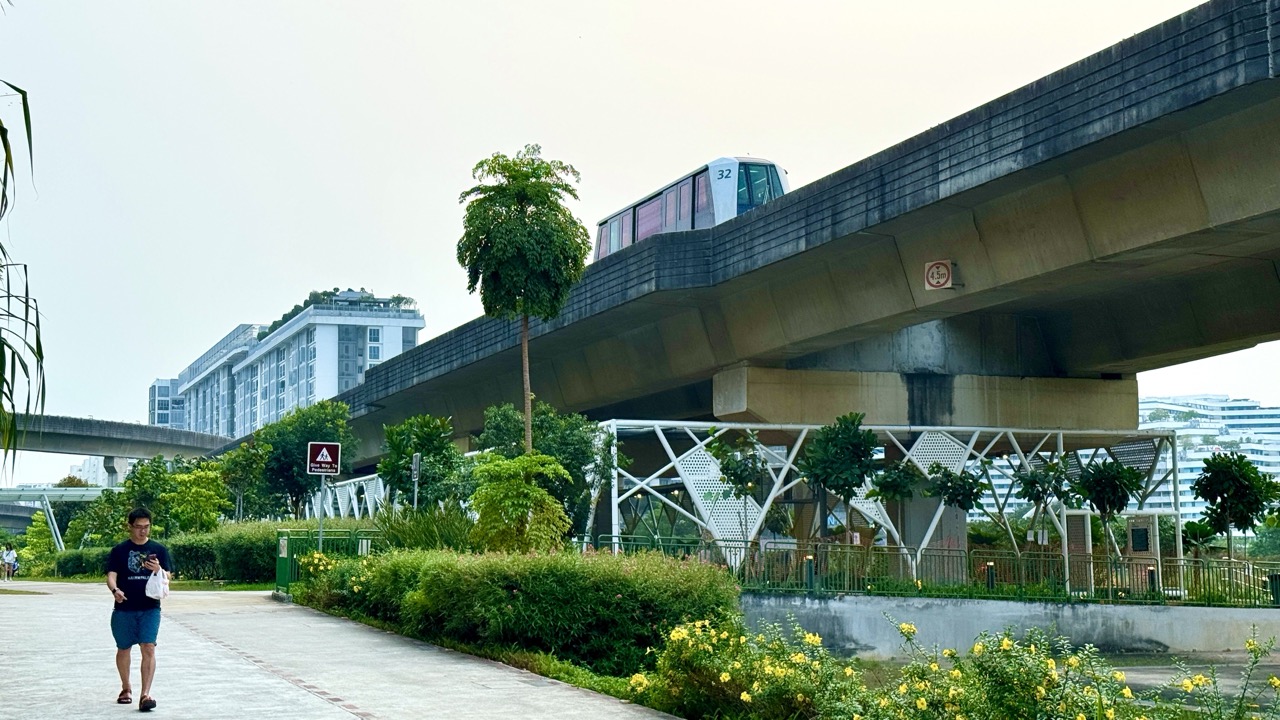
When a Punggol LRT train curves above a neighbourhood street, it may look like a smaller version of an MRT train. Yet an important part of its engineering is different: the train travels on rubber tyres, using a dedicated guideway rather than the conventional steel-wheel-on-steel-rail arrangement familiar from much of Singapore’s MRT network.
Why did Punggol’s LRT adopt rubber-tyred, automated guideway technology? The answer begins with the job the system was designed to perform. Punggol needs a local rail network linking residential precincts with Punggol MRT and its bus interchange. The trains must negotiate curves, stop regularly, run on a segregated elevated alignment and operate as a coordinated automated transport service.
The Land Transport Authority identifies the Sengkang–Punggol LRT as a fully driverless system, with Punggol’s two loops opening in 2005. The Mitsubishi Crystal Mover fleet—including the newer third-generation C810D vehicles introduced from July 2025—is a rubber-tyred automated people mover. That choice affects the way vehicles interact with the guideway, how traction and guidance work, and which maintenance tasks matter.
This guide explains why Punggol LRT trains have rubber tyres and elevated guideways, what those tyres do, why they should not be compared simplistically with private-car tyres, how automated control keeps vehicles moving and which trade-offs exist. It complements the earlier local guide on LRT noise but focuses on the engineering mechanism rather than complaints or current timetables.
The answer in 50 seconds
Punggol LRT uses rubber-tyred automated people mover technology. The trains run on a dedicated elevated guideway separated from road traffic. Rubber tyres provide contact with the running surface, while the guideway and associated steering or guidance equipment determine the permitted path. Automatic train control governs safe operations under the railway’s designed system.
LTA says the Sengkang–Punggol LRT is fully driverless and provides local access to the North East Line. Rolling-stock references identify the first-, second- and third-generation Mitsubishi Crystal Mover vehicles as rubber-tyred systems. The technology supports a compact, frequent-stop, urban people-mover application.
The essential distinction is this: the tyres help support and move the vehicle, but the track structure and railway control system still determine where the train goes. Rubber tyres do not mean the train may leave its guideway, travel on ordinary roads or steer freely like a car.
No technology is perfect. Rubber tyres wear, moving trains still generate sound, and automated operations still require trained people, maintenance and safety systems.
Why local LRT is a different transport task from MRT
The North East Line carries people across a relatively long regional corridor. The Punggol LRT circulates through local neighbourhoods and connects them with Punggol MRT and other interchange facilities.
These are related but different tasks. A neighbourhood line has frequent stops, a compact route and many daily journeys beginning or ending close to homes. A regional MRT line is designed for different lengths of travel, capacity and operating characteristics.
This distinction helps explain why engineers may choose different technologies. The best rolling stock and guideway depend on the route, passenger demand, curves, gradients, access requirements and maintenance strategy.
It would be inaccurate to claim that rubber tyres are automatically superior to steel wheels in every railway application. Singapore uses several rail technologies because different lines have different demands.
What an automated people mover means
An automated people mover, often abbreviated APM, is a transport system designed to carry passengers along a defined route with automated operation. Some systems connect airport terminals, while others serve urban districts.
The Punggol LRT belongs to a family of automated guideway transit technologies. Its vehicles run along a controlled, dedicated alignment, with signalling and train-control systems managing their movement.
The word *automated* refers to operational control. It does not mean there are no technicians, service staff, supervisors or incident-response procedures.
A good explanation separates three things: the physical vehicle, the route that guides it and the system that controls how it moves. The combination makes it a railway, rather than simply an unattended road vehicle.
Why rubber tyres can work on a guided railway
Rubber tyres are associated with road vehicles, but they can also support rail vehicles when the infrastructure is designed for them. On a people mover, the tyres provide traction against the running surface.
A railway guideway constrains the vehicle to its intended route. Guidance equipment directs the vehicle around curves and through the designed alignment.
That means the rubber tyre performs a different combination of tasks from a car tyre. A car’s driver can choose directions at ordinary junctions. An LRT train cannot turn into a side street. Its running path is controlled by the guideway.
The right picture is a vehicle on a fixed transport route with rubber running wheels, not a bus somehow suspended above the road.
Why the guideway matters as much as the wheels
Imagine placing a train with rubber tyres on a flat public road without any guidance. It would lack the fixed-path structure essential to the LRT service.
Punggol’s guideway provides that structure. The engineering includes running surfaces, guide elements, switches or other route components, power supply and safety systems.
The physical alignment is fixed by construction. When the train rounds a curve, it follows the path of the guideway rather than relying on a human steering wheel.
This distinction helps students understand systems engineering. The vehicle alone cannot perform the service; it must interact with infrastructure designed for the same technology.
Why an elevated route is useful in a dense town
Punggol LRT runs above many streets and pedestrian areas. A dedicated elevated alignment separates normal train movement from ordinary road vehicles and many ground-level conflicts.
This can help maintain predictable train operations. Unlike a street-running tram, an elevated automated people mover does not have to stop at every ordinary road junction for cars crossing its path.
However, elevation has costs and consequences. It requires viaducts, stations, access infrastructure, maintenance and careful design around nearby housing.
The choice therefore reflects a planning trade-off. Separation can improve operational control, but it is not free, invisible or suitable in exactly the same form everywhere.
Why the trains are not ordinary road buses
A bus runs on roads, stops at bus stops and is steered by a driver under ordinary road rules. An automated people mover runs on dedicated infrastructure under railway control.
The presence of rubber tyres does not convert it into a road vehicle. The LRT’s power supply, control, switching, stations and emergency arrangements belong to a specialised rail system.
A child might ask whether an LRT vehicle could drive to the market if removed from the track. That is not how the system is designed to operate.
The helpful distinction is between material used for wheel contact and the transport system’s operating environment. Rubber is a material choice; guided railway operation is the overall system.
Why traction is important
Traction is the ability to transmit a driving or braking force through the contact between a wheel and its running surface. Without appropriate traction, a vehicle cannot accelerate and stop as intended.
Rubber tyres can provide useful grip under the designed conditions. That is part of why rubber-tyred people movers can be suitable for routes with regular stopping and particular geometric requirements.
But high traction is not an unconditional advantage. Wheel wear, rolling resistance, conditions on the running surface and energy use also matter.
A scientifically responsible explanation avoids saying rubber tyres can never slip or that they always stop faster than steel wheels. Actual performance depends on engineering specifications and conditions.
Why braking needs more than a grippy wheel
A railway must stop reliably at platforms and under suitable emergency conditions. Wheel contact is only one part of braking.
Braking equipment, automatic train protection, vehicle condition and the guideway’s design all contribute. A train can have rubber tyres and still require sophisticated systems to manage speed and stopping distance.
The exact braking distance of a Punggol LRT train should not be invented from a simple classroom formula without its technical parameters.
For students, the useful lesson is that stopping is a combination of physics and controlled equipment. It is not enough to assume one tyre material guarantees safety.
Why tight curves influence a local transport design
Neighbourhood routes sometimes need to bend around buildings, roads and other development. The track geometry becomes a major design constraint.
Rubber-tyred automated guideway systems can be engineered for suitable curves within their specifications, making them an option for compact urban alignments.
That does not mean rubber tyres alone determine the minimum curve radius. Vehicle articulation, wheelbase, guidance equipment, running surface and safety requirements all matter.
A child can see the train turn and ask how it follows the path. The accurate answer points to the guideway and steering or guidance design, not to the train deciding which neighbourhood to visit.
Why it still makes noise
Rubber-tyred vehicles are sometimes described as quieter than conventional steel-wheel systems in certain conditions. The reason may involve differences in wheel–surface contact and vibration.
But any moving train produces sound. Motors, equipment, air-conditioning, structural vibration, guideway joints and contact with running surfaces can contribute.
A resident near an elevated route may hear the train differently depending on distance, building orientation, speed, curve geometry and local conditions.
That is why the statement “rubber tyres mean no noise” is false. The better claim is that tyre choice can influence the noise characteristics within a complete, engineered transport system.
Why noise depends on the structure too
Sound and vibration can travel through the vehicle, guideway and surrounding environment. The design of viaducts, supports and moving components matters.
A moving train on a curve may sound different from a train travelling straight. Equipment condition and maintenance can also affect noise.
The existing eduKatePunggol noise guide discusses these practical issues. This article’s focus is the engineering reason rubber-tyred APM technology is used, not a diagnosis of a particular resident’s complaint.
A photograph or short recording cannot establish the exact source of a noise without appropriate measurements and context.
Why tyre wear is part of maintenance
A rubber tyre is a working mechanical component. Repeated rolling, braking and loading can cause wear over time.
The railway operator must inspect and replace components according to appropriate engineering standards. The precise lifespan depends on service, load, material and maintenance arrangements.
This is a trade-off. Rubber tyres can offer suitable traction and operating characteristics but are not maintenance-free.
A good public explanation avoids claiming that tyre replacement occurs on one universal schedule across all vehicle generations unless the operator publishes that information.
Why guideway maintenance matters
The running surface must remain suitable for the tyres and guidance system. Debris, damage or equipment defects can create problems requiring specialist attention.
The guideway also incorporates important railway components such as power and signalling interfaces, depending on the design.
Maintenance cannot be performed casually by residents. Railway tracks and elevated structures are restricted infrastructure.
A child may observe the train from a public path but should never attempt to approach the guideway or retrieve an object from a railway structure.
Why the vehicles are driverless
LTA describes the Sengkang–Punggol LRT as fully driverless. Automated train-control equipment manages movement within the system’s design.
This provides a way to run a frequent, fixed-route local service without requiring a human operator in a driving cabin of every vehicle.
But driverless does not mean humanless. Control-room staff, technicians, station support and emergency responders remain essential.
The important idea is that some train-movement tasks are automated while accountability for operations remains with the railway’s responsible organisations.
Why automatic control needs signalling
Even with a fixed guideway, two trains cannot simply enter the same occupied section without safe separation.
Automatic train-control and signalling systems manage train movements, permissions and protective constraints. The precise implementation depends on the technology and network.
Rolling-stock information identifies Kyosan APM train-control technology associated with the Crystal Mover fleet. That illustrates the existence of specialised automated control rather than free-running vehicles.
The classroom principle is that a train needs to know whether movement is permitted under its operating system. Tyres and motors alone cannot provide safe network control.
Why speed is not only a property of the motor
The vehicle’s motor may be capable of a particular output, but the operating speed must also respect curves, stopping distance, signalling, infrastructure and passenger comfort.
A local LRT with frequent stations cannot be assessed by maximum motor power alone. The travel experience depends on acceleration, braking, dwell time and route geometry.
This is why comparing LRT with MRT purely through a top-speed number is incomplete. The two systems serve different travel patterns.
For students, the key lesson is to distinguish maximum technical capability from safe and useful operating conditions.
Why rubber tyres do not eliminate the need for electricity
The tyres are the wheel-contact material, not the power source. The trains still require electrical energy to operate traction motors and onboard equipment.
Specialised traction power infrastructure supplies the system under appropriate design. The newer third-generation vehicles also include lighting, air-conditioning and other electrical features.
A rubber wheel cannot generate useful transport energy simply because it turns. Power is supplied and converted by the vehicle’s propulsion system.
This distinction is useful for primary learners: a tyre can help a vehicle move, but it does not explain where the energy for movement comes from.
Why Punggol has two loops
Punggol’s LRT uses East and West loops to distribute passengers around the town. That network geometry is a transport-planning question separate from the choice of wheel material.
A rubber-tyred train could be used on different guided alignments if appropriately designed. The fact that Punggol has two loops does not follow from rubber tyres alone.
The earlier local article explains why the loops serve different neighbourhoods. This article explains the vehicle–guideway technology running on them.
Keeping the questions separate prevents a confusing explanation in which every feature of a railway is attributed to one design decision.
Why the depot still matters
The Sengkang–Punggol LRT shares depot facilities that support vehicle storage and maintenance.
Rubber-tyred vehicles need appropriate equipment, inspection and servicing. Upgrades to the fleet are linked with depot expansion and other infrastructure changes.
LTA is enlarging the shared depot and introducing more two-car vehicles to support demand. The vehicle’s tyre technology remains part of a much wider maintenance and operating system.
A useful lesson is that public transport depends as much on what happens between journeys as on the train visible during passenger service.
Why new two-car vehicles use the same broad technology family
The third-generation Crystal Mover C810D vehicles introduced in 2025 continue to use rubber-tyred automated people mover technology, even as their capacity and passenger features improve.
That continuity allows the railway to renew vehicles within an existing technical approach, subject to the necessary system upgrades and compatibility work.
It does not imply that a new vehicle is mechanically identical to a 2005 model. Equipment, control interfaces, passenger systems and maintenance requirements can change.
The more accurate interpretation is technological continuity combined with fleet renewal.
Why the number of cars is a separate question
A rubber-tyred vehicle can be designed in a one-car or two-car formation, depending on the system. Train length affects passenger capacity and infrastructure requirements.
The Sengkang–Punggol network began moving towards two-car operations in 2016 and is now expanding its two-car fleet.
A longer formation does not change the fundamental fact that the vehicles run on a guided rubber-tyred system. It changes another part of the capacity equation.
Students should not equate “rubber tyres” with “one car” or “driverless” with “small capacity.” These are different design dimensions.
Why every APM is not identical
Automated people movers operate in different places around the world, including airports and urban systems. They may share broad characteristics while using different vehicles, guideways and operating rules.
The Mitsubishi Crystal Mover family used in Punggol has its own specifications and history. It should not be assumed to be identical to another country’s driverless airport train.
A source describing a generic APM is useful for understanding the concept, but local claims should be checked against LTA and the relevant train specifications.
That is how good technical writing balances general engineering knowledge with accurate local details.
Why the technology was chosen for an urban setting
An automated, guided system can provide predictable fixed-route service separated from ordinary road traffic. Rubber-tyred rolling stock is one design approach suited to particular small-scale urban alignments.
The original engineering choice likely considered multiple constraints, including geometry, capacity, maintenance and cost. Unless a historical procurement document gives precise comparative reasons, a writer should not claim that one factor alone determined the decision.
A responsible article can explain the properties of the selected technology without inventing the exact private deliberations of the original designers.
The broader principle is engineering choice under constraints rather than a universal ranking of tyre materials.
Why maintenance workers still need access
A railway’s support teams need safe ways to reach vehicles and infrastructure for inspection. Dedicated guideways and depot equipment therefore have maintenance provisions.
Passengers cannot use those access routes simply because they appear to be walkways. Railway service infrastructure is controlled for safety.
If an object falls towards a guideway or a resident sees a potential hazard, they should report it through appropriate operator or authority channels rather than attempt retrieval.
This is a practical lesson in respecting specialised infrastructure: apparent physical access is not permission to enter.
Why the elevated line affects its neighbours
A guideway running near housing creates a long-lived relationship with residents. The viaduct’s location can influence views, shade, noise and how streets are organised beneath it.
This is not unique to rubber-tyred systems, but it is part of the broader trade-off behind elevated transport.
A resident’s experience may differ depending on their home and the route segment. It would be wrong to promise universal silence or claim every nearby flat has the same exposure.
For town planners, good infrastructure design considers both passenger benefits and the environment surrounding the alignment.
Why a good ride is more than a quiet ride
Passengers also value reliability, comfortable boarding, clear information, usable handrails, suitable temperature and safe operations.
LTA’s July 2025 announcement described several comfort and information improvements in the new two-car trains. These are separate from the tyre material but contribute to the overall journey.
A service could have a relatively quiet vehicle and still be inconvenient if transfers are poorly arranged or information is unclear.
The lesson is to judge transport through the entire passenger experience rather than focus on one interesting mechanical feature.
Why small wheels or tyre shapes cannot be inferred from a photograph
A distant photo of an elevated LRT train may show the body and windows but not the components beneath. It cannot establish the exact tyre dimensions, rubber compound or steering arrangement.
Technical claims should come from appropriate rolling-stock information and the railway operator’s descriptions.
This is a good media-literacy habit for students. Photographs show what is visible. Engineering details may be hidden and require other sources.
A high-resolution picture is not automatically a technical specification.
Why a rubber-tyred railway is still a railway
Some people associate the word *railway* with two visible steel rails. But rail transport can include guided systems with different wheel-contact technology.
The defining public-service characteristics include fixed-route guided movement, stations and controlled operation. A rubber-tyred automated people mover can meet those characteristics.
That is why Punggol’s system is correctly described as LRT rather than an elevated road bus service.
The lesson is to classify a system by how it functions, not by one familiar visual stereotype.
Why students can learn force and friction here
At Primary level, students can understand that different materials in contact can provide different amounts of grip. They can also discuss how wheels roll and how controlled forces change motion.
At Secondary level, they can examine friction, acceleration, braking and energy, while acknowledging that real vehicle performance requires more than simple textbook values.
A classroom demonstration may use safe toy wheels on a tabletop. It should not claim to replicate the traction performance of a passenger railway.
The important scientific habit is use a simplified model to explore a principle, but state what the model leaves out.
A fictional traction exercise
Imagine two toy wheels made from different materials rolling on a safe classroom surface. The teacher asks which has greater resistance to slipping under a controlled experiment.
Students may predict a result, then test under consistent conditions. They should not conclude that one material is universally superior on every surface or at every temperature.
This illustrates why the actual Punggol LRT traction properties depend on the designed tyre and running surface.
A small demonstration can explain a concept without pretending to certify railway engineering.
A fictional journey-time exercise
Suppose two imaginary trains travel the same distance, but one stops five times and the other stops twice.
Even if they share the same maximum speed, the journeys may take different times because acceleration, deceleration and dwell periods differ.
This helps explain why a neighbourhood people mover can have a different speed profile from an MRT service.
The example is deliberately hypothetical and is not a measured Punggol LRT timetable.
A fictional guideway diagram
Draw a curved elevated route and a small vehicle with rubber running wheels. Add arrows showing traction and label the guidance system that keeps the vehicle on the route.
Then draw an ordinary road junction below. Ask why the train does not simply turn onto the road.
The learner should explain that it uses dedicated infrastructure and fixed guidance rather than road steering.
This is a good introduction to the distinction between guided transport and driver-steered transport.
Why a failure cannot be diagnosed from sound alone
A commuter might hear a squeal, hum or vibration and conclude that rubber tyres are worn out.
That conclusion may be unjustified. A sound can have multiple sources, including machinery, guide elements and environmental reflections.
If a resident has a serious, recurring concern, the useful report includes the location, approximate time and observed behaviour without claiming an unsupported technical cause.
Professional technicians assess railway equipment, not passengers listening from the platform.
What Punggol residents should know when travelling
The train’s tyre material does not change the need to follow normal LRT travel rules. Stay behind markings, do not obstruct doors and use current service information.
Children should be supervised appropriately on platforms and in stations. No passenger should attempt to approach the guideway or machinery for a close look at the tyres.
For a practical journey, the route, station, loop direction and current operating notices matter more than knowledge of wheel construction.
Engineering curiosity is welcome, but transport safety takes priority.
What the upgrade programme does and does not change
New two-car LRVs and depot improvements are intended to provide additional passenger capacity and more reliable operations across Sengkang and Punggol.
The programme does not turn the line into a conventional steel-wheel MRT or eliminate its automated guideway design.
Different project milestones have different dates. Vehicle introduction, depot completion and later fleet procurement should not be treated as one event.
Readers seeking current progress should use LTA’s dated announcements, while this article remains focused on the underlying vehicle technology.
Common misunderstandings
The first is thinking rubber tyres make Punggol LRT a bus. The second is assuming the driverless train chooses a route like a self-driving car.
A third is believing rubber tyres make the journey completely silent. A fourth is assuming tyres never wear because the train runs on a protected guideway.
Another mistake is calling all driverless trains identical. A sixth is claiming rubber tyres alone explain the entire track layout, speed or passenger capacity.
Finally, do not assume that an enlarged fleet changes the tyre technology into conventional steel-wheel rail. Vehicle formation and running technology are separate dimensions.
Frequently asked questions
Does Punggol LRT really use rubber tyres?
Yes. The Mitsubishi Crystal Mover trains on the Sengkang–Punggol LRT are rubber-tyred automated people movers.
Why use them?
The technology is part of a guided, automated system suited to the local LRT application. Traction, route geometry and operating requirements are among the relevant design considerations.
Are the trains buses on an elevated road?
No. They operate on a dedicated guideway under specialised railway control and cannot travel freely on ordinary roads.
Does rubber eliminate train noise?
No. Wheel contact is only one potential source of sound. Motors, guideway equipment and structure can also contribute.
Are the trains driverless?
LTA describes the Sengkang–Punggol LRT as fully driverless, supported by professional operational and maintenance teams.
Do rubber tyres require replacement?
Yes. They are working components subject to inspection and wear under appropriate maintenance plans.
Can the train steer anywhere?
No. Its movement follows the engineered guideway and authorised routes.
Are the new C810D trains rubber-tyred too?
Yes. The third-generation Mitsubishi Crystal Mover vehicles continue the rubber-tyred APM technology.
Is this why Punggol has two loops?
No single tyre material explains the route layout. The loops are a transport-planning design serving different neighbourhoods.
Where can I learn about current service changes?
Use LTA and SBS Transit’s official network and operating information.
A practical learning checklist
- Distinguish the rubber running wheels from the guideway.
- Recognise that the LRT follows a fixed route rather than public roads.
- Explain what traction means without promising perfect grip.
- Understand that driverless operation still needs signalling and people.
- Avoid claims that rubber tyres eliminate all noise or maintenance.
- Separate train length, service frequency and wheel technology.
- Observe the elevated line only from safe public locations.
- Use official material for specifications not visible in photographs.
- Follow normal railway safety and passenger instructions.
- Check current service information for travel decisions.
Teaching Guide: why the train stays on its path
Learning goal. Students explain how wheel-contact material, guideway geometry, electrical propulsion and automated control work together in Punggol’s LRT.
Activity one: classify transport. Compare a road bus, an MRT train and a rubber-tyred people mover. Ask which follows a fixed guideway and which can steer along roads.
Activity two: discuss traction. Use a safe hypothetical wheel-on-surface model to explain why grip matters for movement and braking.
Activity three: draw a curve. Sketch an elevated guideway bending around a building. Ask what determines the path of the LRT vehicle.
Activity four: add signalling. Put two fictional trains on the same network. Ask why automatic control must manage their spacing even if both have good tyres.
Activity five: add maintenance. A tyre becomes worn. Ask why a professional inspection and replacement programme matters.
Activity six: investigate sound. List possible contributors to a passing train’s noise. Ask why a recording alone cannot identify one exact mechanical fault.
Activity seven: add capacity. Compare a one-car and two-car train and ask why passenger capacity is different from wheel type and service frequency.
Transfer test. Apply the vehicle–guideway–control model to an airport automated people mover, while checking which details differ between systems.
Parent checkpoint. A strong answer is: “Punggol LRT uses rubber tyres to run on its designed surface, but the guideway keeps the train on its route and automatic controls manage its movement. The whole system needs electricity, maintenance and safety rules.”
How this fits the Punggol learning library
The existing Things to Know About Punggol | LRT Train Noise, Rubber Tyres and Noise Management discusses the resident noise and operations angle. Why Punggol | The LRT Has Two Loops Instead of One Line explains route geometry. Why Punggol | More Two-Car LRT Trains Need a Bigger Depot explains system capacity and renewal.
This article asks a separate first-principles question: why do these guided, automated neighbourhood trains use rubber tyres and what jobs do the tyres, guideway and signalling each perform? It explains the mechanism without duplicating a timetable, noise complaint or fleet procurement bulletin.
Official sources and further reading
- LTA: Sengkang–Punggol LRT Network
- SGTrains: Mitsubishi Crystal Mover C810A
- SGTrains: Mitsubishi Crystal Mover C810D
- LTA: New Third-Generation Two-Car LRT Vehicles, July 2025
- eduKatePunggol: LRT Noise and Rubber Tyres
The one idea to remember
Punggol LRT is an automated guided transport system that happens to run on rubber tyres. The wheels help support and move the vehicle; the elevated guideway and train-control system keep it on the correct route. That combination makes the neighbourhood railway possible, while maintenance, power and safe operations remain essential.


