
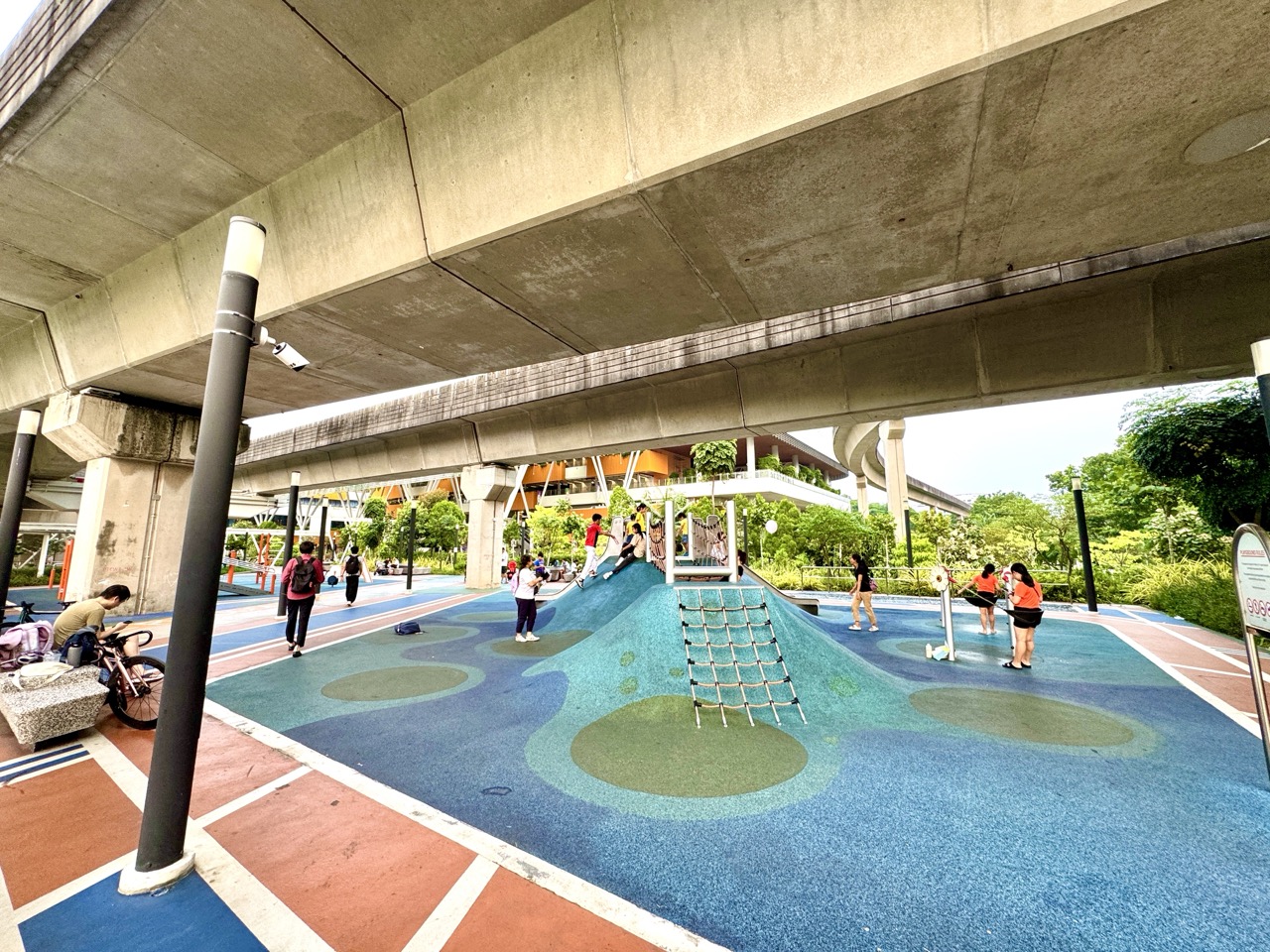
Punggol has several kinds of outdoor play spaces, and the safest way to use them is to distinguish who operates the space, who maintains the equipment and which age group it was designed to serve. A playground beside an HDB block may be maintained by the relevant Town Council. A playground or water-play area within an NParks-managed park follows the park operator’s directions. A condominium play area belongs to its private strata management system. These facilities may look similar to a child, but they have different maintenance contacts, permitted uses and sometimes opening or cleaning schedules.
Punggol Waterway Park is listed by NParks as open 24 hours, with four themed areas—Nature Cove, Recreation Zone, Heritage Zone and Green Gallery—and wheelchair-accessible, elderly-friendly visitor information. That does not mean every individual playground, water feature or amenity is staffed, lit, operating or suitable for children around the clock. The sign at the specific facility and its live operational notice matter. NParks also prohibits fishing in Punggol Waterway Park; its open park status is not permission to swim or enter reservoir water.
There is a significant design development: HDB’s new Play Values Framework, announced in 2025, emphasises age-appropriate physical, sensory, imaginative and social play, with elements supporting fundamental movement skills. HDB says the framework will also be extended to Town Councils, which maintain and upgrade play equipment in established estates. It is a design and renewal direction, not a promise that every older Punggol playground has already received the newest equipment.
This Understanding Punggol | Things to Know guide uses HDB, NParks, OneService and NEA primary sources checked in October 2026. It is for parents, grandparents, caregivers, older children and residents who want safe, inclusive shared facilities. It does not certify a particular structure as safe or replace medical advice after an injury. On-site signs, local closures and the actual maintaining authority take priority.
A fast playground decision map
- HDB precinct playground or fitness corner: usually maintained by the relevant Town Council; check the estate’s maintenance contact.
- NParks-managed playground or nature play area: follow NParks venue rules, signs and closure notices.
- Private condominium play space: contact the management corporation or managing agent and follow lawful estate rules.
- Punggol Waterway Park: NParks lists it as open 24 hours, but specific amenities may have separate conditions.
- Children’s play ages: use equipment matching the actual on-site age and ability guidance, not a blanket assumption that every slide suits every child.
- Adult supervision: young children need appropriate, active supervision, particularly near climbing structures and water.
- Damaged or unsafe equipment: keep away, prevent further use if safely possible and report the exact location to the proper operator.
- Municipal feedback: the OneService app can route many non-urgent estate and maintenance matters.
- Immediate danger or severe injury: obtain the appropriate emergency response; municipal feedback is not an emergency service.
- Wet equipment: slippery surfaces and lightning can change an otherwise reasonable play plan.
- Water safety: a waterfront park or water-play feature is not a supervised swimming pool.
- Inclusion: accessibility includes routes, seating, sensory needs and age-appropriate choices, not merely a wheelchair pictogram.
- Shared-space etiquette: leave corridors, cycleways and emergency access clear.
- New play values: HDB’s framework emphasises balancing challenge, exploration and safety, rather than making every playground identical.
1. Why a playground is part of the town’s operating system
A playground appears simple: an adult brings a child to climb, swing or slide. But the experience depends on several supporting systems. Someone plans and designs equipment, someone inspects and maintains it, someone manages landscaping and lighting, and another may handle municipal feedback or public safety concerns.
These responsibilities matter when a resident notices a loose bolt, missing rubber flooring or damaged handrail. A complaint to an unrelated shop may not reach the maintainer. Likewise, a family organising a private birthday gathering at a playground must check whether the shared area can be reserved or modified.
A useful guide explains the system behind the fun. It makes public facilities easier to enjoy and problems easier to report without turning every visit into bureaucracy.
2. HDB and Town Council responsibilities differ
HDB plans and develops housing precincts and supports upgrading frameworks, while Town Councils manage and maintain common property in HDB estates under the Town Councils Act. HDB’s official explanation identifies common property such as corridors, lifts, open spaces and other shared assets.
An HDB precinct playground is ordinarily part of estate shared facilities for which the relevant council has maintenance and improvement responsibilities. If the actual location is a separate NParks park or privately owned space, a different operator may be responsible.
The first question after noticing a fault is where exactly is this equipment situated? The answer can be more useful than the nearest block’s general postal address.
3. NParks manages different park spaces
The National Parks Board manages public parks, nature parks and related recreational facilities under its remit. Punggol Waterway Park is one such destination. Its official page includes opening, accessibility, directions, parking and park rules, with descriptions of the four thematic areas.
Do not assume every green space beside an HDB block is an NParks park. Some landscaped decks and common greens are within Town Council-managed estate property. A private development may include green common property of its own.
When unsure, use the official park directory, estate manager or OneService to identify the operator rather than make a confident accusation based on the colour of a sign.
4. Private play areas have their own management
Punggol condominiums can have children’s facilities, pools and function areas whose use is governed by the development’s management corporation and lawful by-laws. They may be for residents and their authorised guests rather than unrestricted public access.
A child seeing a slide through a condominium fence should not assume it is an open public playground. The parent should check access permission and respect residents’ security and privacy.
Our Understanding Punggol condominium MCST guide explains how strata owners fund and manage common-property facilities separately from HDB Town Councils.
5. HDB’s three-generation playground idea
HDB describes 3-Generation playgrounds as combining children’s play with fitness areas suitable for adults and older residents, supporting multigenerational activity in public housing estates. These arrangements can make it easier for families to spend time outdoors together without requiring everyone to use the same equipment.
The idea is socially useful, but a fitness machine designed for adults is not necessarily a toy for toddlers. A young child may be attracted to a moving handle whose range or force is unsuitable for small fingers.
Use the correct part of the space for the relevant age and ability. Intergenerational design works when people share proximity while respecting each activity’s safety requirements.
6. The 2025 Play Values Framework explains newer design
HDB’s announcement about new playgrounds describes a Play Values Framework that supports physical, imaginative, social and sensory exploration. It recognises that young children’s developmental needs vary, while older children can benefit from climbing, balancing, swinging and other active movement.
This is a meaningful design approach. A playground need not be only one ladder and one identical slide to offer good play. Different elements can invite cooperation, risk assessment, creativity and body control.
HDB says the framework will be extended to Town Councils for cyclical upgrading of older estate playgrounds. A framework announced in 2025 does not prove every existing Punggol structure has been renovated by October 2026.
7. Challenge and safety are not opposites
A child learns balance by balancing and gains coordination through appropriately challenging movement. A playground that removes every possibility of challenge may provide limited learning, while a structure far beyond a child’s competence can create unreasonable risk.
The goal is managed, age-suitable challenge. An adult can help a child assess height, handhold, space and how to descend, without placing the child on equipment they could not otherwise negotiate safely. HDB’s design framework reflects that distinction between engaging play and physical protection.
Children’s confidence develops more reliably through gradual experience than through either forced risk or permanent restriction.
8. Toddlers need a different plan from older children
A two-year-old and a ten-year-old may both enjoy a playground, but they have different reach, coordination, judgment and independence. Toddlers may need lower steps, clear sightlines and closer physical supervision. Older children may benefit from independent problem solving and more complex climbing elements.
Use the equipment’s posted intended age range where given. A toddler should not be placed on a very high structure merely because an older sibling wants to play together. A parent can choose adjacent, suitable activities so both children enjoy the visit.
The right choice also depends on the individual child’s abilities and comfort, not only chronological age.
9. Age signs are guidance to take seriously
Playground signs may identify a recommended age range, maximum users, prohibited activities or operating conditions. These are not decorative labels. They help caregivers understand what the operator and designers consider appropriate.
A child slightly outside a recommended age range may need a different facility, and an adult should never interpret the lack of a visible age sign as proof that every use is safe. The equipment’s size and movement requirements remain relevant.
If a sign is damaged or unreadable, report it to the maintainer. The public should not have to guess at safety conditions because information has faded.
10. Active supervision means watching the actual risk
Supervision is not merely being somewhere within the same park while looking at a phone. A toddler can move quickly toward a climbing structure, path or water edge. The adult should maintain suitable visual attention and physical proximity according to the child’s age and hazards.
Older children may have more freedom, but adults can still agree on boundaries, meeting points and how to seek help. Supervision should grow with ability rather than remain identical at every age.
The aim is to support independent learning while making sure foreseeable serious hazards are managed. A public playground is not an unattended childcare service.
11. The first minute of a visit can be a safety check
Before allowing a young child to climb, glance at the equipment, ground surface, nearby traffic, water, fallen debris and crowding. Look for obvious broken edges, detached panels, protruding fasteners, missing handrails or hazardous rubbish.
This does not mean a parent must perform an engineering inspection. The operator remains responsible for its maintenance duties. A short user-level look helps identify obvious reasons to choose a different activity that day.
If something looks unsafe, keep the child away and report the issue rather than attempt a makeshift repair. Improvised tape or tied rope on public equipment can create an additional hazard.
12. Playground surfaces have different purposes
The ground around equipment may include rubberised impact surfaces, sand or other designed materials. These are chosen with expected activities and risks in mind. A surface can deteriorate over time through weather, heavy use or damage.
A missing section beneath a climbing structure or a sharp exposed object deserves attention because falls and slips can occur even during ordinary play. Do not assume one soft-looking surface guarantees a child cannot be injured.
Use appropriate footwear, check for litter and report visible deterioration. Maintenance teams can determine whether the correct response is cleaning, repairing or temporarily closing an element.
13. Weather changes the practical safety of equipment
After heavy rain, steps, slides, ropes and nearby paths can be slippery. Sun-exposed metal or plastic surfaces can become uncomfortably hot. Lightning creates an outdoor risk even when a family is enjoying a sheltered-looking corner of a park.
A responsible adult checks conditions rather than relying only on the park’s nominal opening hours. Moving to a safer indoor activity or postponing the visit may be sensible. An open park is not a promise of safe play during a thunderstorm.
Use official weather and lightning information where relevant, and follow any park closure notices or operator instructions.
14. A 24-hour park does not mean 24-hour staffed play
NParks lists Punggol Waterway Park as open 24 hours. That describes general park access. It does not imply that every playground component is illuminated, cleaned, supervised or available at midnight. Individual areas may have separate operational arrangements.
A caregiver should plan activities appropriate to daylight, weather and the return journey. Poor visibility can conceal surface defects, water edges or other users on shared paths.
A late stroll can be enjoyable while still being a different activity from letting a toddler run across a dark playground. Read the on-site information for the actual facility.
15. Punggol Waterway Park has four themed zones
NParks describes Nature Cove, Recreation Zone, Heritage Zone and Green Gallery. These are part of a larger park landscape, not four identical children’s playground rooms. The park contains heritage, scenic, ecological and recreational elements.
A family should choose the area that fits the intended activity and the child’s ability. The Waterway can involve walking distances and bridges, so a visitor should account for return time and access to toilets or transport.
A park’s diverse roles are a strength, but also mean a parent must distinguish play equipment from ecological habitat, waterfront paths and ordinary shared walking routes.
16. Waterfront play requires a specific boundary
The water in Punggol’s managed Waterway is not an open-access swimming pool. Children should not enter it or climb railings to retrieve a toy. Fishing is also prohibited in Punggol Waterway Park under NParks’ listed rules.
Adults should establish clear boundaries before walking near the water. An exciting bridge or viewing point can draw a child toward an edge, especially when the family stops to take photographs.
Water-related recreation belongs only in facilities and activities authorised for that purpose. A scenic water feature should not be treated as permission for unsupervised immersion.
17. Water play features are not the same as reservoir water
Some park or neighbourhood play facilities may contain water-play equipment operated under separate opening, cleaning and maintenance arrangements. A family should follow the exact site’s rules, age guidance and operating status. Water-play areas may close for cleaning, maintenance or unsuitable conditions.
A child playing in a designated splash feature is participating in a different activity from approaching a reservoir. The two should not be conflated simply because both involve water.
A caregiver can bring a change of clothes and appropriate footwear where water play is allowed, and should ensure safe supervision and hygiene according to the operator’s instructions.
18. Inclusive play begins with accessible arrival
An inclusive playground experience starts before a child reaches the equipment. The route from home or station may involve uneven paving, stairs, long exposed stretches or heavy pedestrian flow. A stroller or wheelchair user may need a different entrance from a pedestrian who can climb steps.
NParks lists Punggol Waterway Park as wheelchair accessible and elderly friendly, but that does not mean every surface or specific piece of play equipment suits every individual. Identify the actual route and facilities.
Accessibility should be assessed across the whole journey: transport, paths, entrance, seating, suitable activity, toilet and return home.
19. Children with different sensory needs deserve choices
Some children enjoy busy social play and rapid movement. Others may find intense noise, crowds or unpredictable motion overwhelming. Inclusive planning allows families to choose quieter areas, take breaks and adjust duration without treating every child as having the same needs.
An outdoor nature walk or calm sensory activity can provide a positive visit even when a conventional climbing structure is unsuitable that day. Avoid diagnosing another child from brief public behaviour.
Respect for diversity includes allowing other families to use public spaces without unsolicited commentary about their children.
20. Caregivers benefit from nearby seating and shade
Grandparents, parents carrying babies and caregivers supporting a person with mobility challenges may need accessible seating, shade and toilets. A good visit is not measured only by the number of climbing frames. Practical comfort determines whether the family can return regularly.
Check the actual site rather than assume every playground has a sheltered bench. On a hot day, select a shorter visit or different time according to the family’s needs.
Public facilities work better when they support both the person playing and the people supervising. HDB’s intergenerational design direction recognises that wider household context.
21. Climbers and slides demand different attention
A climbing structure tests grip and balance, while a slide introduces motion and landing-space concerns. A child should learn to check whether the route is clear and descend safely. Standing at the exit of a slide can cause collisions.
An adult can coach simple behaviours: one person through a narrow section at a time, no pushing, look below before descending and wait for space. Avoid lifting a child to a point from which they cannot independently return safely.
This is not about forbidding energetic play. It is about teaching children to read the environment and respect others.
22. Swings require space around moving users
A moving swing creates a zone in which another child can be struck even if nobody intends harm. Teach children not to walk in front of or behind moving swings and to wait for a safe stop before approaching.
Caregivers should use swing seats appropriate to the child’s size and capability. A baby or toddler seat designed with restraints or supports is not interchangeable with a standard flat seat for older users.
Where swing equipment is damaged or improperly attached, do not test it by having a child try it. Keep clear and report the fault.
23. Shared play includes taking turns
Children learn cooperation when using popular slides, balancing elements and imaginative structures. Adult involvement can help when a crowd becomes impatient or a child is being excluded. The goal is not to force every child to befriend strangers but to manage common equipment fairly.
A queue or turn-taking expectation can be explained simply. A child who needs extra time because of age or disability deserves consideration, while other users also need access. Parents should avoid treating the equipment as a private family reservation.
Shared spaces are opportunities to practise courtesy, empathy and boundaries in real situations.
24. Keep food, rubbish and sharp objects off the play surface
Food packaging and discarded utensils can create slip, cut and hygiene problems. A family should clear its own rubbish and avoid leaving drinks on equipment where they can spill. Broken glass, needles or other hazardous items should not be picked up casually by a child.
If there is a potentially dangerous object, move children away and contact the responsible operator or appropriate authority. A trained maintenance team may need to handle hazardous waste.
Cleanliness is not merely aesthetic. It affects whether a public facility remains safe and pleasant for the next family.
25. Pests and mosquito breeding are public maintenance concerns
Stagnant water in discarded containers, drains or depressions can support mosquito breeding. NEA’s 2026 guidance emphasises eliminating breeding sources as a central dengue-prevention measure. A public playground’s landscaping and drainage can therefore require routine attention by the responsible operator.
A resident should report a visible recurring puddle or discarded receptacle with exact location and observations. They should not independently pour an insecticide into public drainage or trespass into a service enclosure.
Our Understanding Punggol dengue and mosquito-control guide explains the separate vector-control system.
26. Who receives a fault report from an HDB playground?
For playground equipment in Town Council-managed HDB common property, the relevant Town Council is ordinarily the direct maintenance contact. It can inspect the specific item and decide whether repair, contractor attention or temporary closure is required.
The resident should describe the block, playground location, equipment type and observed hazard. A message such as “swing chain at the north side is visibly detached” is more actionable than “this playground is rubbish”.
HDB’s official Functions of HDB Branches and Town Councils explains the division of roles.
27. What if the playground belongs to NParks?
If the facility is inside an NParks-managed park, use the park operator’s official enquiry, feedback or emergency route as appropriate. A Punggol Town Council hotline does not automatically control every tree, path or playground along the Waterway.
The resident can use the park name, nearest landmark, trail junction or mapped location to help staff identify the problem. If a particular section is closed, follow the notice rather than enter to photograph the damage.
Accurate reporting helps the right maintenance group take action without unnecessary forwarding between agencies.
28. OneService can route supported municipal feedback
The OneService app and digital channels support feedback about municipal issues, including various public infrastructure and estate-maintenance concerns. They can help route a non-urgent report to the relevant agency even when the resident is unsure which operator controls the site.
A useful report contains an exact location, observable issue, photograph taken safely, and why it appears hazardous. Keep the case reference for follow-up. Do not post other families’ faces or private details unnecessarily.
OneService is not an emergency rescue service. An immediate risk of serious injury requires suitable urgent response and on-site precautions rather than waiting for an app ticket.
29. A broken playground element should not be repaired by visitors
A helpful resident may be tempted to tighten a bolt, tie a rope around a broken rail or wedge a damaged panel in place. That can create unseen structural hazards and transfer risk to later users who assume the equipment is professionally safe.
The better action is to keep children clear, document the visible defect from a safe location and notify the responsible maintainer. Temporary closures or barriers should be installed by authorised people.
The maintainer can inspect the actual failure, obtain correct replacement parts and record completion. Good intentions should not become unapproved engineering work on shared equipment.
30. Repairs and replacement are not identical
An operator may tighten or replace a damaged component, remove a hazardous element temporarily or decide that the whole installation has reached the end of its useful life. These decisions depend on safety assessment, part availability, budget and the equipment’s original specification.
A family might be disappointed if a beloved structure is closed for a long period. Yet reopening an unsafe structure merely to avoid complaints would not serve children well.
When submitting feedback, ask what safety measure has been taken and whether there is an expected update. Avoid inventing a completion date when the operator has not confirmed one.
31. Cyclical upgrading matters for older Punggol precincts
HDB says Town Councils maintain and facilitate cyclical playground upgrades, and its Play Values Framework will support more varied, engaging play in established estates. This helps explain why two Punggol precincts of different ages may have different equipment even though both are public HDB developments.
A resident may see a new structure installed nearby and ask whether the older play area is scheduled for upgrading. The right contact is the responsible operator, which can explain actual works or planning where information is available.
Do not assume every playground receives a redesign in the same year. Announced design principles guide future projects; local implementation depends on real plans and budgets.
32. The best playground may not be the newest
A newer playground can offer more imaginative equipment, but a smaller familiar space close to home may better suit a toddler, caregiver or short after-school visit. Age suitability, access, cleanliness, shade and safe sightlines can matter more than the height of a climbing tower.
Choosing a playground is a household decision, not a ranking of prestige. Children may benefit from returning to a familiar place where they gradually master a new movement or social skill.
Families should evaluate what works rather than assume the most photographed location provides the safest or most meaningful experience.
33. Work and school schedules shape real visits
A family may have only twenty minutes after dinner or a longer Saturday morning. A short local play period can be worthwhile without travelling to a large destination park. The chosen place should fit daylight, supervision and the child’s energy level.
A schoolchild may enjoy active play after sitting for lessons, but an exhausted child may need rest. Parents should balance activity with sleep, homework and family responsibilities rather than treat every open hour as a requirement to play.
The real goal is repeatable, enjoyable movement and social experience over time, not completing a checklist of every Punggol facility in one weekend.
34. A short play visit can build useful motor skills
Age-suitable climbing, balancing, jumping and swinging can help children practise coordination and body awareness through play. A caregiver can observe what the child can do independently and offer gradually harder challenges under appropriate supervision.
Instead of constantly directing, adults may sometimes ask useful questions: “Where will you put your foot next?” or “How will you come down safely?” This encourages the child to think and assess the situation.
These are general learning ideas, not medical developmental assessments. A concern about a child’s motor development should be discussed with a qualified professional.
35. Imaginative play provides different benefits from equipment use
Not every useful play experience requires a big structure. A child may invent a story about a bridge, describe shapes in a garden or cooperate with friends in an age-appropriate game. HDB’s Play Values Framework recognises imaginative and social dimensions in addition to physical activity.
A parent can support play through curiosity rather than always prescribing the “correct” way to use a safe space. Children learn language, negotiation and planning during ordinary shared experiences.
The adult’s role is to keep boundaries and safety clear while leaving room for the child’s own ideas.
36. Waterfront wildlife deserves respectful distance
Punggol Waterway and surrounding parks can host birds, otters and other wildlife. Seeing an animal can be exciting for children, but feeding, pursuing or cornering animals is not appropriate. Families should follow NParks wildlife advice and protect both people and animals.
Do not offer snacks to animals because a child wants a closer photograph. Food attraction can create dangerous habits and conflict with other visitors. A person should never place a toddler between wild animals for a photo.
Our Punggol otter encounter guide explains the focused wildlife precautions.
37. Cycling paths and playground entrances can intersect
A park may contain paths used by cyclists and people walking toward a playground. Young children may run unexpectedly across a path, while a fast rider may misjudge the crossing. Caregivers should establish safe routes between equipment, benches, toilets and entrances.
Teach children to stop at path edges, look and cross with appropriate assistance. Cyclists should slow near pedestrians and busy family spaces under LTA and NParks rules.
Our Understanding Punggol Cycling and Shared Paths guide provides the device and path distinctions.
38. A playground is not necessarily bookable for a private party
Public play areas are shared amenities. A family celebrating a birthday can have a simple lawful visit, but setting up tables, tents or sound systems, selling tickets or occupying a public venue exclusively may require separate approval under the responsible operator’s rules.
At an NParks venue, event-booking conditions can depend on attendance, temporary structures and other details. HDB precinct common areas involve relevant Town Council rules. A private condominium has its own by-laws.
See our Punggol Community Events and Park Permit guide before advertising a private public-space event.
39. Worked scenario: a toddler’s first neighbourhood playground visit
Imagine a Punggol family with a two-year-old child. They choose a nearby low-height play area, check the on-site age guidance and examine equipment for obvious faults. The caregiver remains close enough to supervise climbing and the movement of other children.
The child plays for fifteen minutes, tries a small step independently and finishes before becoming exhausted. The adult does not force use of the tall slide designed for older children.
The outcome is a positive first experience, not an impressive photograph of the child at the highest point.
40. Worked scenario: a damaged swing at an HDB block
A resident notices a visibly loosened component on a swing beside an HDB block. They keep children clear and record a photograph from a safe position. They identify the block and playground position, then contact the relevant Town Council or use OneService for non-emergency municipal reporting.
The responsible maintainer inspects and decides whether to repair or isolate the equipment. The resident does not test it using a child or undertake their own improvised fix.
The example demonstrates why the legal maintainer and accurate location are more important than posting an angry video online.
41. Worked scenario: an outdoor visit interrupted by thunder
A family has reached the Waterway when thunder begins. Although the park is generally open around the clock, the family changes plans because lightning can make outdoor activity unsafe. They follow relevant weather guidance and move to genuinely suitable shelter rather than remain on an exposed bridge.
An opening-hours listing cannot override environmental risk. The decision to end the outing is not a failure or an overreaction.
The principle is to treat activity plans as adaptable to real conditions. Children learn sensible risk assessment by watching adults make such decisions calmly.
42. Worked scenario: mixed ages and abilities
A fictional household includes a preschooler, a ten-year-old and an older relative with mobility limitations. Instead of selecting the biggest climbing structure, they choose a venue with an accessible path, seating and different age-suitable activities nearby.
The children explore within clear boundaries, while the older relative has an appropriate place to rest and participate. If a specific area lacks accessible access, the family does not assume the entire park is unsuitable; it looks for a legitimate better route or alternative facility.
This approach treats inclusion as practical planning rather than a slogan.
43. Worked scenario: organising a neighbourhood play day
Residents want to host a large community play session. The organiser identifies whether the proposed area is HDB, NParks or private property, asks about booking and safe use, defines supervision responsibilities and checks whether equipment or attendance triggers additional permit requirements.
They do not take over the playground and block other children from ordinary use without lawful authorisation. They also plan rubbish collection, child pickup, wet-weather arrangements and accessible routes.
A good community activity makes shared space more useful rather than converting it into an improvised private facility.
44. Common mistakes with Punggol play spaces
Mistake one: assuming every playground is maintained by NParks. Many HDB precinct assets belong to Town Council maintenance. Mistake two: assuming a 24-hour park means 24-hour supervised play. Operational details differ. Mistake three: letting a toddler use equipment intended for much older children. Age and ability matter.
Mistake four: treating soft flooring as a guarantee against injury. Surface condition and supervision matter. Mistake five: testing broken equipment instead of reporting it. Use authorised maintenance. Mistake six: assuming waterfront access permits swimming or fishing. Park rules apply.
Mistake seven: using a cycleway as an extension of a playground. Shared-path rules still apply. Mistake eight: organising a commercial gathering in a public space without checking permission. The venue and event type matter.
45. Practical Punggol playground checklist
- Identify whether the space is HDB/Town Council, NParks or private strata property.
- Read the current opening, maintenance and age guidance at the actual facility.
- Match equipment to the child’s individual ability and developmental stage.
- Check obvious faults before use without attempting technical inspection.
- Supervise young children actively near heights, swings and water.
- Keep exits and moving-equipment zones clear.
- Slow down around cyclists, joggers and other path users.
- Check sun exposure, rain, lightning and slippery surfaces.
- Choose accessible routes and seating for the whole household.
- Do not climb barriers or enter reservoir water.
- Respect wildlife without feeding or chasing animals.
- Keep food and hazardous rubbish off play surfaces.
- Report faulty HDB equipment to the relevant Town Council.
- Report NParks park faults to its responsible operator.
- Use OneService for appropriate non-urgent municipal feedback.
- Do not carry out DIY repairs on public playground equipment.
- Follow lawful public-space booking rules for organised events.
- Let children explore and develop skills without forcing unsafe challenges.
- Keep records of important safety feedback and any official updates.
Frequently asked questions
Who maintains an HDB playground near my Punggol block?
Ordinarily the relevant Town Council manages and maintains HDB common-property play facilities, subject to the actual location. HDB’s official guide explains the division of responsibilities.
Does NParks maintain every playground in Punggol?
No. NParks manages its designated park facilities; HDB precinct playgrounds and private condominium play spaces can have different managing bodies.
Is Punggol Waterway Park open 24 hours?
NParks lists the park as open 24 hours. Individual amenities or play facilities may have separate closures or operating conditions, and outdoor safety still depends on conditions.
Can children swim in the Waterway?
A scenic managed waterway is not a designated supervised swimming facility. Follow the actual park rules and use authorised water recreation facilities only.
What is HDB’s Play Values Framework?
HDB’s newer playground design direction emphasises physical, imaginative, sensory and social play, with age-appropriate challenges. It is also intended to inform Town Council upgrades of older estate facilities.
Should children use the highest climbing structure if a parent helps?
Not automatically. Follow the equipment’s actual age and ability guidance, supervise appropriately and avoid putting a child where they cannot move or descend safely.
How should I report a broken playground item?
Keep users away and report the exact location and visible defect to the correct Town Council, NParks operator or relevant municipal feedback channel. Don’t attempt an unauthorised repair.
Can I reserve an HDB playground for a birthday?
Ordinary playgrounds are shared spaces. A private event with equipment, exclusive occupation or other features may need lawful permission from the relevant venue manager.
What if a playground is wet after a storm?
Assess actual conditions and avoid slippery or otherwise unsafe equipment. Thunder and lightning can require postponing outdoor activity regardless of park opening hours.
Can older residents and wheelchair users visit Punggol Waterway Park?
NParks lists it as wheelchair accessible and elderly friendly, but individual routes and equipment vary. Plan suitable paths, seating and the precise activity rather than assume all areas are identical.
Official sources and Punggol companion guides
- HDB: Responsibilities of Town Councils and HDB Branches.
- HDB: Facilities in Neighbourhoods and Three-Generation Playgrounds.
- HDB: New Playgrounds and Play Values Framework.
- NParks: Punggol Waterway Park, accessibility and park rules.
- NParks: Punggol Waterway Park Nature Walk.
- NParks: Parks and Places for Children.
- NParks: Therapeutic Garden Design and Accessibility.
- OneService: Municipal Issues and Footpath Maintenance.
- NEA: Public-Area Mosquito Breeding Sites.
- NEA: Town Council Vector Control.
- Understanding Punggol: Town Council and OneService.
- Understanding Punggol: Cycling and Pedestrian-Only Paths.
- Understanding Punggol: Community Events and Park Permits.
- Understanding Punggol: Neighbourhood and Waterway.
- Punggol Green Playground Beneath the LRT.
- Punggol Children: First Bike Skills and Safe Active Play.
- Understanding Punggol: Dementia, Seniors and Accessibility.
Bottom line: choose age-suitable play and identify the real operator of the space. HDB/Town Council, NParks and private MCST facilities are different systems, with different maintenance and access rules. A well-run playground combines appropriate challenge, responsible supervision, safe shared use and prompt reporting of defects.


