
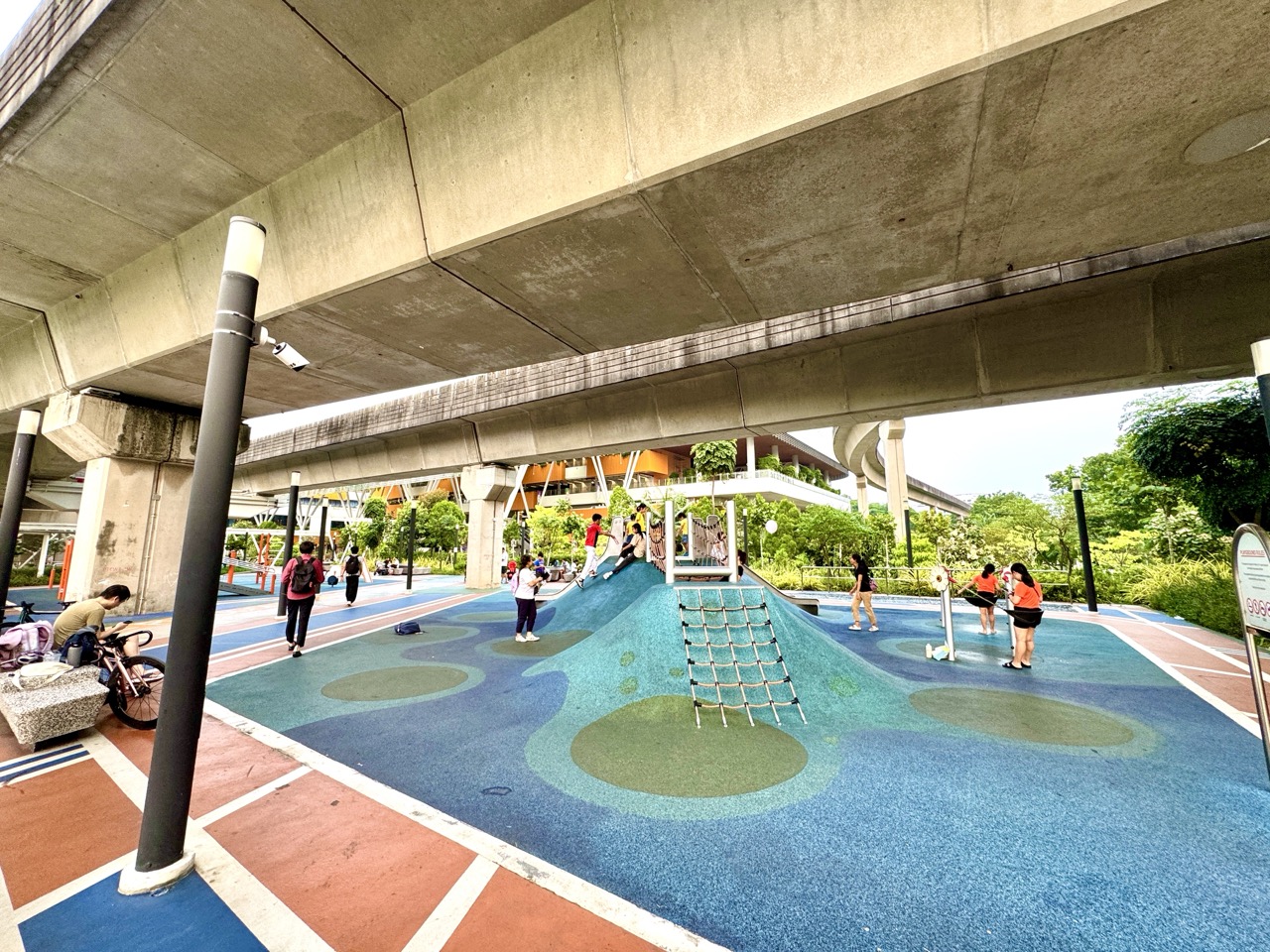
The playground beneath Punggol’s elevated LRT near Sam Kee is part of Punggol Green, the 1.2-hectare community space stretching along the viaduct corridor between Punggol MRT and Sam Kee LRT. URA describes how the formerly underused area became a public space for play and recreation after its completion in 2022. Our new October 2026 photographs show a children’s play area beneath the tracks and families using it. This guide is for parents and caregivers of younger children who want to understand what makes such an outing work, not just where the park is.
For a first visit with a toddler, keep the plan simple: use a safe public approach, inspect the equipment and surfaces before play, choose activities suited to the child’s ability, supervise closely, stay out of nearby shared movement routes and leave while the child is still comfortable. The LRT overhead makes the place distinctive, but it does not guarantee the entire area is rainproof, cool or safe in every condition. Current signage and the actual condition of the playground take precedence over a beautiful photo.

Quick guide: visiting the Punggol Green playground with young children
- Where: Punggol Green under the elevated LRT between the Punggol MRT area and Sam Kee LRT, next to the One Punggol area.
- What it is: a family play environment within a wider linear community park, not a private indoor play centre.
- Official context: URA describes a 1.2-hectare under-viaduct park completed in 2022 with varied recreation spaces shaped by community input.
- In the photos: playground equipment and families with children at the site in October 2026.
- Best first visit: short, supervised, flexible and focused on one or two age-appropriate play activities.
- Safety: check equipment condition, surfaces, heat, wetness, congestion and current signs. HealthHub recommends close supervision and age-appropriate equipment.
- Rail infrastructure: the LRT is overhead, but rail structures and restricted areas are not part of the play equipment.
- Path etiquette: keep active play within designated areas and leave nearby pedestrian or cycling paths usable.
- Facilities and hours: confirm current on-site information rather than assume toilets, water points, lighting or equipment access from the photos.
Primary sources: URA’s account of Punggol Green explains the community-space design; HealthHub’s playground safety guidance covers supervision, age-appropriate activities and hazards. Our general Punggol Green walking and courts guide covers the whole corridor. This page focuses tightly on a family with a young child at the particular photographed playground.
Why a playground beneath an LRT line is unusual
The defining image is simple: a place where people can stop to play exists below a structure used by trains travelling through the town. The rail service and the play area serve different purposes and operate at different speeds. A child may find the overhead track fascinating, while an adult notices how a space that once could have been empty is being used for community recreation.
URA’s official account explains that transforming the under-viaduct land was intentional. It is part of a broader approach to making public space from underused urban areas. That helps residents understand why a playground might sit here rather than in a conventional park between apartment blocks. It does not mean every space beneath an LRT is appropriate for play.
What URA says about Punggol Green
URA’s published account identifies a 1.2-hectare corridor between Punggol MRT and Sam Kee LRT stations, turned into a lively community park with multiple play and sports areas. The agency reports involvement from grassroots and community stakeholders and a design response to local needs. A companion URA publication places the work’s completion in 2022.
Those are useful planning facts, but they should not be confused with a current operations report. A facility can undergo maintenance or have particular areas temporarily closed after its initial opening. On a real visit, ground signs, closures and equipment condition matter. The planning story explains what the space was intended to achieve; it doesn’t guarantee an uninterrupted play session every day.
What the new October photographs show
The current media batch includes a view of the playground and two pictures labelled as parents and children using the space under the LRT. Together they establish that families were photographed in this environment during the October 2026 collection. They do not tell us the ages, names, relationships or development levels of the particular children pictured.
Use captions carefully. ‘Families at a playground below elevated Punggol LRT tracks’ is grounded. ‘These toddlers are learning to share after school’ is an invented interpretation. A good local article can discuss sharing as a general benefit of play without ascribing a lesson to an identifiable child in a photo.
Why this article is not another directory of Punggol playgrounds
The site already has a general guide to Punggol Green, a town-wide playground list and activity suggestions for families. Those answer questions about available places and possible outings. This page addresses the narrower practical situation of a parent who has arrived at the under-LRT play area with a small child and needs a low-stress way to use it.
That distinction matters to retrieval. A list of ten places cannot easily explain how to supervise a hesitant child, decide which climbing equipment is suitable or manage a sibling waiting beside an active court. This guide provides those decisions without pretending to replace HealthHub’s official safety advice.
The first two minutes: observe before play
When arriving with a young child, resist rushing directly to the most colourful equipment. Take a short look around. Where are the play boundaries? Are children moving rapidly near a narrow path? Is any equipment visibly damaged, wet or closed? Where can the supervising adult remain close without blocking other users? A little observation can prevent problems later.
HealthHub advises parents to inspect playgrounds for hazards and select age-appropriate equipment. The photographs show the broad setting, but cannot verify its condition today. If a piece looks unsafe or the play area is temporarily restricted, choose a different activity rather than assume the original construction approval guarantees present safety.
Toddlers need a different play plan from older children
A toddler may enjoy a few steps, a small climb or simply watching a train pass overhead. An older child may be ready for more complicated movement and longer games. The same play area can attract both, but equipment suitable for one is not automatically appropriate for the other. Follow displayed age guidelines and match activity to the child’s real ability.
Parents sometimes feel pressure to help a small child climb a structure that older children are using confidently. There is no need. A short successful exploration can be more enjoyable than a difficult challenge that ends in tears. Let the child progress at a comfortable pace with proper supervision.
Close supervision means active attention
Supervision is more than being somewhere in the same park. A young child can change direction suddenly, approach a moving swing or step into a nearby circulation route. The supervising adult should stay sufficiently close to respond and should not be absorbed in a phone conversation or a photography session. The appropriate distance changes with the child’s abilities and the equipment.
The park photographs include families, but we cannot determine how closely any individual adult was watching a child at that instant. This guide states a general safety principle from HealthHub, not a judgement of the people shown. For an actual family, decide in advance which adult is responsible for which child.
Let a hesitant child begin by watching
Some children walk into a new playground confidently; others need time to understand what is happening. A child may be interested in the moving LRT, the sounds around the play area or simply observing other children. A short period of watching is not failure to participate. It can be part of how they learn the environment.
A caregiver can say, ‘We can look first, then decide what you’d like to try.’ Don’t force physical contact, push a child into a crowded play structure or label the hesitation as a problem. A calm outing is shaped by the actual child, not the adult’s expectation that every playground must be used intensively.
Why a short visit may work best
A toddler’s energy, hunger and tolerance for noise can change quickly. A ten- or twenty-minute play period may be entirely satisfying. The numbers are illustrative planning options, not an official facility recommendation or an ideal duration for every child. Weather, travel and the child’s needs all influence the decision.
Rather than promise a long programme, let the family have a simple endpoint: enjoy one or two suitable activities, then leave when the child is ready. A calm departure can make the playground feel like a welcoming place for another day. Exhaustion is not a requirement for a successful outing.
An open space under rail tracks is not an indoor play centre
The LRT viaduct provides an overhead structure, and some parts of the area may be shaded. But it does not enclose the park with climate control. Rain can blow into spaces, surfaces may remain wet and ambient heat or humidity can still be uncomfortable. Do not interpret ‘under the LRT’ as an automatic guarantee of shelter.
This matters when deciding whether to visit in heavy rain or hot conditions. HealthHub cautions against using playgrounds during rainy weather and recommends avoiding unsafe equipment. Check real conditions. If the surface is wet or a storm is approaching, choose a suitable indoor alternative rather than treating the elevated track as a weatherproof roof.
Safety near play surfaces and edges
Playground surfaces are designed for particular activities, but a photo does not prove the condition, age rating or fall protection of every element. Check whether the ground is clear of debris, slippery patches and damaged sections. Watch where toddlers step, especially if they move between a padded area and a harder nearby path.
Do not assume the whole under-viaduct corridor is one continuous soft play surface. Courts, walking routes and landscaped zones may have different surfaces and rules. A child who runs from a playground into an active game can be at risk even if both areas are part of the same broad park.
Slides, climbing features and sensible limits
The exact equipment visible at a particular visit may differ from the photographs, but the general principle is stable: choose age-appropriate features and supervise use. HealthHub warns about loose clothing cords and stresses checking equipment for hazards. It also cautions against adults placing children on their laps when going down slides because limbs can get caught.
A parent can support a small child by helping them understand the equipment and wait their turn rather than lifting them to a height they cannot manage. Teach safe use in short, positive sentences. If something seems unsuitable, it is fine to choose a simpler game on the ground.
Waiting turns is a real learning opportunity
An unfamiliar playground gives children chances to observe how others use a shared space. A child may want to climb before another user has finished, or stay on a popular feature for a long time. The supervising adult can guide them with simple language: ‘Let’s wait until it’s free’ and ‘Now someone else can have a turn.’
This is not an invitation to police other families. Different children develop social skills at different rates, and crowded play can be difficult. Model patience and help your child move to another activity when necessary. A positive lesson is more effective than criticising strangers for not following your preferred routine.
A child who prefers parallel play
Young children often play near one another without necessarily joining a single organised game. One may explore shapes while another repeats a favourite movement. That is normal. Parents need not insist that every playground outing produce a new friendship or a group activity.
Respect the child’s comfort and other families’ boundaries. A caregiver can offer a friendly greeting without demanding conversation or photographs. Let the experience be about movement and discovery. The objective is not to document a social achievement; it is to give the child a safe chance to use public space.
When older children are playing nearby
An older child may run faster, climb higher or use the area in ways a toddler cannot match. This does not automatically mean the older child is misbehaving. But younger children may need more space and supervision. Look for play zones that suit the child’s ability and avoid placing a toddler directly in the path of energetic games.
If the area feels too busy, move to a different suitable feature or return another time. Adults can model polite requests rather than confrontational demands. The playground is shared. Safety and courtesy are best achieved by choosing appropriate spaces and communicating calmly.
Why the adjacent basketball courts matter
Other October photographs show basketball beneath Sam Kee LRT tracks. A busy court can make the wider corridor lively, but its ball games are different from small-child play. Parents should maintain an appropriate boundary between active sports and the playground. A child may be fascinated by bouncing balls, yet entering a live court unexpectedly can put players and the child at risk.
Use the designated play area rather than treat every open surface as a place to chase a ball. If a family brings its own toy, decide where it can be used without interfering with other users. The full Punggol Green courts and walking guide explains the larger layout.
Shared paths are for movement, not overflow play
Punggol Green includes routes people use to walk through the area. Some corridors may have distinct pedestrian or cycling rules. Do not assume that a wide-looking path is an extra playground simply because a child wants to run along it. Follow the current path markings and keep equipment, toys and groups out of moving traffic.
If a young child moves quickly toward a path, the supervising adult should be ready to intervene. Riders should follow the local rules, but parents still need an age-appropriate plan. A toddler cannot be expected to analyse a bicycle’s approach speed or understand every public-space boundary independently.
The overhead train as a natural conversation starter
A train passing above can prompt a child’s curiosity. They may ask where it goes, why it is elevated or whether they can ride it. The parent can explain simply that the LRT helps people travel between parts of Punggol. The answer does not require technical details or a long lesson on urban planning.
If an older child wants to learn more, consult LTA’s Sengkang–Punggol LRT overview. The moving train in a photograph is not proof of the exact service frequency or a timetable. A quiet moment of pointing out the railway can be enough for a small child.
Sound and sensory comfort
Trains, ball games and conversations may create an energetic sound environment. Some children enjoy it; others become uncomfortable. The photos cannot tell us the sound level when the child visits or how a particular child will respond. Check the actual setting and be flexible about how long the family stays.
If a child seems unsettled, reduce demands, move to a more comfortable place or leave. Don’t force the child to remain just because the park is free or another family appears relaxed. People process unfamiliar environments differently, and a successful outing respects those differences.
Why a child may watch the train instead of playing
A train moving overhead may be more interesting to a toddler than a slide. That preference can lead to a valuable shared moment of attention. The caregiver might name what is visible—track, train, wheel, sky—and describe direction. A small child does not need to complete a prescribed circuit of equipment for the visit to count.
Still maintain safety. Watching a train should happen from an appropriate public space, not by climbing barriers or approaching the rail infrastructure. The railway structure is a landmark and transport facility, not play equipment. Curiosity belongs with clear physical boundaries.
A gentle language game: above, below and beside
The playground offers a clear way to use spatial language. A parent might say, ‘The train is above us; the play area is below the track; the path is beside the court.’ These words help a child organise what they see. The game need last only a few moments and should not distract from supervising play.
An older child can sketch a simple picture with labels after returning home. Do not ask them to draw a precise engineering diagram from memory. The purpose is vocabulary and awareness of the neighbourhood. Playful learning can remain playful when adults resist making it a test.
Counting turns without turning play into homework
A young child may enjoy counting steps, turns or bounces during a safe activity. A parent can say ‘one, two, three’ naturally and stop when the child loses interest. This provides informal number practice while respecting that the playground’s main purpose is active enjoyment.
Older children might compare hypothetical numbers: if two friends take three turns each, how many turns altogether? It is better to work out the simple answer later than crowd a busy feature while explaining arithmetic. The learning should fit the situation, not interfere with other users.
A Social Studies lesson about making shared space
URA’s account shows that the under-viaduct area became a community park through deliberate planning and community input. For an older child, this raises a useful question: why would a town choose to put play and sports beneath a railway rather than leave the space unused? The answer involves land use, local needs and the possibilities of public design.
Do not claim to know every resident’s opinion from the photograph. A student can compare URA’s stated aims with what the site visibly provides and note what further research would be needed. The aim is understanding community design, not creating an unsupported popularity survey.
Why grandparents may enjoy a short visit
A grandparent might welcome a nearby place to watch a child play without committing to a long excursion. But comfort depends on the actual site conditions, available resting places, walking route and individual mobility. The photographs do not guarantee continuous benches, toilets, accessible ramps or comfortable shade at every point.
Ask the older visitor what arrangement works for them and check the current facilities. Do not assume every grandparent can supervise active climbing while remaining far away. Families should decide who is responsible for the child before arriving. Respecting the grandparent’s needs is part of making the outing enjoyable for all generations.
A visit with a stroller
A stroller can help on the approach, but it should not obstruct a play area entrance or a shared path. Select a suitable location where the supervising adult can stay attentive to the child and where pedestrians can pass. If the route requires kerbs or ramps, follow the available public accessibility features rather than improvise through restricted ground.
A photograph can make an area look spacious, but it cannot certify a continuous step-free approach from every station or bus stop. If accessibility is essential, check current mapping or ask the relevant venue management. A comfortable, safe approach is more valuable than the shortest-looking path.
Managing a visit with two children of different ages
One child may want to climb while another wants to watch trains or remain near the ground. An adult should not be expected to supervise incompatible activities in distant zones simultaneously. Decide whether the children can use suitable nearby features, bring another responsible adult or choose a simpler alternative.
Avoid asking an older child to act as the sole supervisor of a very young sibling while an adult takes photographs. Children can help with small tasks, but responsibility for safety belongs with an appropriate caregiver. A good plan accounts for the youngest child’s needs without treating the older child unfairly.
Heat, humidity and water breaks
A sheltered-looking playground can still be warm in Singapore’s climate. Younger children may not recognise when they need a break. Watch for discomfort, allow water and adjust the pace. Do not assume the temperature is low simply because the playground is beneath an overhead rail structure.
If the day is particularly hot or haze conditions are poor, consult official advisories and choose an appropriate plan. The photo is a past visual record, not a weather reading. Outdoor play is worthwhile when conditions are suitable; there is no need to insist on it regardless of the environment.
What to do if it rains
HealthHub advises avoiding playground use in rainy weather. Wet surfaces and equipment can increase slipping risk, and storms require appropriate precautions. A viaduct may shelter some areas partially but cannot be assumed to protect the whole site, especially during wind-driven rain or lightning.
If a planned play session is interrupted, leave safely and return another day. Families may choose the nearby One Punggol library or other appropriate indoor activities if open, but those venues have their own operating hours and rules. A rainy-day alternative should be confirmed, not improvised from a photo.
What if equipment appears damaged?
If a platform, handrail or other piece of equipment looks broken, do not let children use it. Move to another suitable activity and use the relevant managing authority’s official feedback channel. Parents should not attempt to repair public equipment on the spot, nor should they infer hidden structural safety from a photograph.
Explain simply to the child that the equipment needs checking. This can be an opportunity to teach a practical rule: public spaces are shared, so people report problems rather than ignore them. A child’s disappointment is understandable, but a brief change of plan is preferable to injury.
The Snakes and Ladders feature in earlier reporting
An earlier Little Day Out account of Punggol Green describes a snakes-and-ladders-style play graphic on a padded surface near the toddler playground. That is a useful historical account of the playground’s design, not proof that the graphic remains identical or currently unobstructed in October 2026. Our new photographs should not be captioned as showing it unless it is actually visible.
If the feature is present on a real visit and suitable for the child, a caregiver can use it for a simple counting game. If it has changed or is unavailable, enjoy other activities instead. A good local guide recognises design details without promising permanent maintenance of every graphic.
How to encourage imagination without props
Play does not always need equipment. A child might pretend that a low platform is part of an imagined journey or tell a story about a train in the sky. A parent can ask one open question: ‘Where do you think the train is going?’ There is no requirement for a correct answer during imaginative play.
Keep the pretend game within safe physical boundaries and avoid obstructing others. Imagination can be rich without climbing fences, approaching track columns or using the sports court as an unsupervised play field. A pleasant story is one the family can carry home without disturbing other users.
How to talk about turn-taking kindly
Children may struggle to wait when a favourite feature is busy. Use short statements: ‘Someone is using it now; we’ll wait here,’ or ‘Let’s try that other safe area.’ The adult models patience and supports the child without shaming them in front of strangers. A toddler is still learning rules of shared use.
Do not photograph another child to prove a disagreement or publish accounts of ordinary playground disputes. Most small conflicts can be handled by calm explanation, creating space and deciding whether to change activity. A public playground is not a competitive performance in manners.
An ordinary afternoon can teach neighbourhood belonging
Returning to the same suitable playground can help a child recognise local landmarks and routines. They may remember the train, a familiar shape or the path leading home. This kind of familiarity can contribute to a child’s sense of place without requiring a formal programme or expensive activity.
The photograph gives the family a way to talk about Punggol’s changing public spaces later. ‘We once played under the LRT’ is a concrete local memory. Good neighbourhood writing can preserve these everyday experiences while staying careful about privacy and the limits of the image.
A photo-reading activity for Primary pupils
Choose one wide photograph of the play area. Ask the pupil to write what they can directly see: equipment, tracks and people. Then ask what they cannot know: exact ages, current temperature, whether somebody is related to someone else or how long a person has been there. That difference builds evidence-based language.
The exercise needs no identifying details of the photographed children. A good student caption focuses on the public setting. This protects people while developing critical thinking. It is more useful than inventing dramatic events simply to make a short photo description entertaining.
A simple family play plan in three phases
Arrive with a clear supervised route, spend a minute checking the space and let the child choose an appropriate activity. During play, remain attentive, allow breaks and keep the child away from adjacent moving paths. End with a little time to collect belongings, wash or clean hands as appropriate and make the return trip calmly.
This is not a rigid timetable. Some children will want to watch trains; others will play briefly and move on. The plan succeeds when everyone remains safe and comfortable. A short visit that ends well is often more valuable than forcing a child through a long list of things to do.
What parents should not conclude from the photos
The images do not certify equipment inspection, prove the entire route is accessible, guarantee toilets or water points, show current opening times, or identify the children and adults. They also do not establish that the viaduct makes the playground lightning-safe or rainproof. These claims require different current evidence.
A responsible local guide can still be useful by explaining the place, the planning history and general safety decisions. That is the balance: enough reliable information for parents to prepare, without presenting a past photo as a live inspection report.
Where to read next
For the entire under-LRT corridor, basketball courts and walking route, go to the general Punggol Green photo guide. For pathway rules, use the Sam Kee shared-path article. For town-wide options, use the Punggol playground directory.
This page has a narrow job: make the new October playground photographs useful to parents preparing a small-child outing. It should complement—not repeat—those other resources. The main takeaway is simple: the best playground visit respects the child’s readiness, actual conditions and other people’s use of the shared space.


Frequently asked questions about the playground beneath Punggol LRT
Where is the playground?
Within Punggol Green’s under-viaduct corridor between Punggol MRT and Sam Kee LRT, near One Punggol.
What is Punggol Green?
URA describes it as a 1.2-hectare community park developed from previously underused land below the elevated rail tracks.
Is this the same as Punggol Green Primary School?
No. Punggol Green is a community space; the school is a separate institution.
When was the park completed?
URA’s account records completion in 2022.
Is the playground fully sheltered?
No continuous shelter or rain protection is verified. The presence of a viaduct does not make every part of the park weatherproof.
Can we play during heavy rain?
HealthHub recommends avoiding playgrounds in rainy weather. Check current conditions and follow official advisories.
Is it suitable for all toddlers?
Suitability depends on the child’s abilities, displayed equipment age guidance and the actual condition of the space.
Do parents have to supervise children?
Yes. HealthHub recommends close supervision and age-appropriate play.
Are there basketball courts nearby?
The Punggol Green corridor and October images include basketball activity, but courts are separate from small-child playground areas.
Can toddlers run into the shared path?
Keep active play within appropriate zones and teach children to stay clear of moving pedestrian or cycling traffic.
Can a parent place a child on their lap on a slide?
HealthHub cautions against this because the child’s limbs can become trapped, creating injury risk.
Is there a snakes-and-ladders play feature?
An earlier 2022 visitor account described such a surface graphic. Its current presence and usability must be checked on site.
Does a photograph prove equipment is maintained?
No. Inspect visible equipment for problems and obey current closures.
How long should a toddler stay?
There is no universal ideal duration in this article. Choose a comfortable, flexible visit matched to the child and conditions.
Can a stroller use the route?
Accessible approaches depend on current paths, ramps and conditions; do not assume every approach is step-free from photos.
Are toilets and water points guaranteed?
Specific amenities and hours are not verified from this photo set; check present signs or responsible management.
Is it near One Punggol?
Yes. URA places the corridor near the One Punggol community hub.
Do the photographs identify the children?
No. The article does not identify individuals or infer their age, family relationships or schools.
Can children watch the passing LRT?
From appropriate public areas with supervision, the train can be a simple learning prompt. Never approach or climb rail infrastructure.
What if the playground is crowded?
Choose a suitable quieter feature, wait respectfully or return another time.
Where is the complete Punggol Green guide?
Use the separate Punggol Green walking and courts article linked above.
Sources and related Punggol guides
- URA — How Punggol Green Became a Community Focal Point.
- URA — Playful Spaces, Joyful Places.
- HealthHub — Playground Safety for Children.
- Little Day Out — Punggol Green Playground Visit and Snakes-and-Ladders Feature (earlier description; not current operating status).
- Punggol Green Beneath the LRT — Main Photo Guide.
- Sam Kee LRT Shared Paths and Public-Space Rules.
- Top 10 Playgrounds in Punggol.
- Complete Punggol Guide
Editorial note, 23 October 2026: featured and supporting images are original October eduKatePunggol media IDs 99230–99232. They document a family play setting but do not verify individual identities, equipment inspections, current facilities or a guaranteed weatherproof route. Official URA planning information is distinguished from present-day ground conditions; HealthHub provides general safety guidance.


