
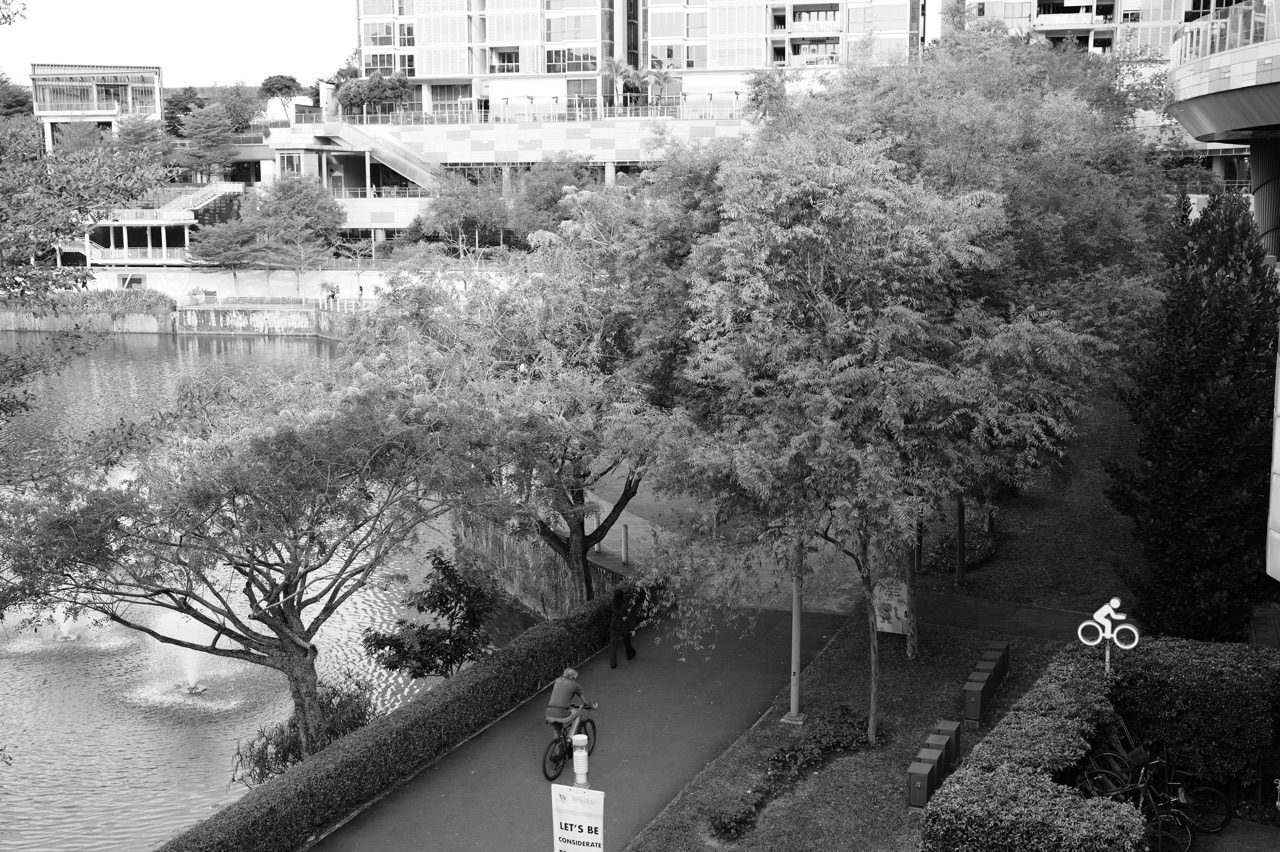
Cycling in Punggol is governed by the type of path and device, not simply by whether a route looks wide or appears in a cycling app. Singapore’s Active Mobility Act covers bicycles, personal mobility devices (PMDs), power-assisted bicycles (PABs) and personal mobility aids (PMAs). Each is subject to its own rules for footpaths, cycling paths, park connectors and roads. A bicycle may be allowed where an e-scooter is prohibited; a legitimate mobility scooter has different access rules from a recreational electric scooter.
The immediate operating rules are these: bicycles and permitted non-motorised PMDs have a 10 km/h limit on ordinary footpaths and 25 km/h on qualifying cycling or shared paths. Motorised PMDs and PABs must not ride on footpaths; PABs may use suitable cycling paths and roads under their regulations, while motorised PMDs are prohibited from roads. From 1 June 2026, motorised personal mobility aids are subject to a 6 km/h public-path speed limit. Mobility scooters also have medical-need certification and phased registration rules; a senior’s wheelchair must not be confused with a recreational hoverboard.
Punggol’s Waterway, HDB precinct routes and Park Connector Network make the distinction important. A route may change from a shared path to a Pedestrian-Only Path beside a dedicated cycling track, cross a bridge with a No Riding sign or pass through an Attention Zone requiring extra care. This Understanding Punggol | Things to Know article was checked against LTA, MOT and NParks sources available 20 October 2026. Actual signage, device approvals, road conditions and construction diversions must be checked at the place and time of travel.
Fast answers for cyclists and other users
- Manual bicycle: generally allowed on appropriate public footpaths, shared paths, cycling paths and roads, subject to device requirements, signage and road traffic rules.
- Footpaths: where cycling is allowed, 10 km/h is the applicable speed ceiling for bicycles and permitted relevant devices; ride considerably slower near pedestrians.
- Shared and dedicated cycling paths: 25 km/h ceiling for relevant bicycles and eligible PMDs/PABs, with local restrictions and attention zones.
- Pedestrian-Only Paths: LTA began converting footpaths beside dedicated cycling paths from 1 July 2025; cyclists and ordinary PMDs should use the cycling path instead.
- Motorised PMD/e-scooter: only on permitted cycling paths, not ordinary footpaths or roads; certification, registration and rider rules may apply.
- Power-assisted bicycle (PAB): approved, registered and used on cycling paths or roads; no footpath riding; rider must meet minimum age and theory-test conditions.
- Mobility scooter/PMA: supports people with walking difficulties; motorised public-path travel is limited to 6 km/h since 1 June 2026.
- Certification: eligible mobility-scooter users need an Assessment for Mobility Scooter Certificate of Medical Need unless an official exemption applies.
- Future registration: new mobility-scooter sales have registration requirements now; existing user registration is being phased in and universal path registration is scheduled for 1 January 2029.
- Road cycling: wear an appropriate helmet on roads and comply with traffic and lighting rules.
- No-riding signs: dismount and push the bicycle or relevant device where required; exceptions apply for legitimate PMA users.
- Parking: use authorised racks or sharing zones, secure the bicycle and do not block access routes.
1. Why Punggol needs a device-and-path decision before a route recommendation
The same Waterway corridor may be used for walking, jogging, riding a manual bicycle or moving with a wheelchair. Each user’s speed and stopping distance differs. It would be unsafe to treat a bridge or narrow crossing as a miniature expressway merely because bicycles are visible in photographs. Similarly, a wide promenade can contain segregated portions with different lawful uses.
Start by identifying the actual vehicle or aid. A conventional pedal bicycle is not the same as a PAB, even if both have pedals. A motorised scooter used for leisure does not become a mobility aid merely because someone has attached a seat. Legally relevant design and intended function matter.
Then examine the path type. LTA and NParks signage governs what is allowed at the precise location. Finally consider the vulnerable users around you—children, pedestrians, older residents and wheelchair users—and reduce speed appropriately. Compliance is a baseline; courtesy is the behaviour that makes the path comfortable for everyone.
2. Read the Active Mobility Act as a shared-space framework
Singapore’s Active Mobility Act, in force from 2018, provides rules for using public paths and relevant devices. LTA regulates safety standards, path usage and enforcement. The Ministry of Transport explains the broader policy goals, while NParks manages its park and park-connector routes under applicable arrangements.
The framework separates equipment design from user conduct. A machine might have passed technical standards but still be ridden in a prohibited place. A manual bicycle requires no motor registration, but the rider can still commit an offence through unsafe conduct or ignoring a road signal.
A person buying a device should therefore ask two questions: Is the model compliant? Where may it lawfully be used? A shop’s statement that an item is “LTA approved” does not authorise riding it in every Punggol park or on every footpath.
3. Footpaths have a 10 km/h ceiling where riding is allowed
The Active Mobility Regulations provide a 10 km/h maximum for bicycles and certain permitted devices on ordinary footpaths. But this does not mean riders have a right to travel at exactly 10 km/h through crowds. LTA’s code directs users to give way to pedestrians, slow around bus stops, and walk the bicycle in busy spaces.
A person cycling slowly to the supermarket may find a footpath appropriate where it has not been converted to Pedestrian-Only use. Near a preschool dismissal crowd, even that legal maximum may be too fast to pass safely.
The specific rule must also be interpreted alongside No Riding signs and local route restrictions. An ordinary bicycle’s permitted status on some footpaths does not override a prohibition at a particular bridge approach or facility entrance.
4. Shared paths and cycling paths have a different speed ceiling
For relevant bicycles, PABs and permitted PMDs, the 25 km/h ceiling applies on designated shared or cycling paths under the appropriate rules. NParks’ Park Connector Network guidance describes shared paths often marked with continuous red lines, with a dotted approach near an Attention Zone.
A path-limit figure is not a suggested training speed. Passing a dog on a short lead, a toddler near a bend or a group stopped for a photograph may require a near-walking pace or dismounting. An approaching pedestrian may not hear a bicycle until it is very close.
A sensible rider treats the speed ceiling as the upper boundary in suitable conditions, not a target throughout the trip. Safe overtaking depends on clear sightlines, space and a courteous warning.
5. Pedestrian-Only Paths changed the rules from July 2025
LTA started converting footpaths adjacent to dedicated cycling tracks into Pedestrian-Only Paths from 1 July 2025. Where this has happened, riders of bicycles and ordinary non-motorised PMDs should use the parallel cycling track rather than treating the pedestrian side as another cycling option.
The distinction is identifiable through symbols and signs. A user should not assume that yesterday’s general footpath rule continues unchanged after a permanent conversion. In some situations a cyclist may need to cross the pedestrian-only area carefully to reach a property entrance or avoid an obstacle, but LTA’s guidance requires returning to the cycling path as soon as feasible.
This is why local knowledge matters. A mapped cycling line does not replace observing the pavement markings under your wheels. People walking should also use the pedestrian side where available rather than blocking a dedicated cycling track unnecessarily.
6. Attention Zones are warnings about human movement
An Attention Zone generally indicates a location where pedestrians, cyclists or other path users need special caution. A bend, crossing, popular junction or narrow bridge may bring people into conflict even when each started on a separate track. NParks emphasises slowing down and being alert at such places.
A cyclist must not rely only on a bell. A pedestrian may have hearing difficulties or be caring for a child. Give adequate space, reduce speed and be prepared to stop. If safe passing is impossible, wait or dismount.
The best way to navigate the Punggol Waterway is often a short series of context-dependent decisions rather than riding every path at a constant pace. The section with the most people determines the safe pace.
7. What counts as a motorised PMD?
LTA’s device rules identify motorised PMDs such as e-scooters, hoverboards, certain unicycles and even some motorised luggage. These must meet applicable device criteria and are restricted to permitted cycling paths, rather than ordinary footpaths or public roads.
E-scooters must satisfy relevant UL2272 certification and registration requirements. LTA’s October 2026 guidance says keeping an e-scooter that is not UL2272-certified has been an offence since 1 June 2026, even before considering where it is ridden.
Do not buy a machine simply because its advertisement says “electric bicycle” or “personal mobility aid”. Check the actual classification, certification, approved model and legal use. Misleading product names can lead to unsafe or unlawful decisions.
8. Why an electric scooter is not an electric bicycle
A power-assisted bicycle has pedals and motor assistance that works under specified conditions. A typical recreational electric scooter has a different configuration, legal classification and permissible path access. LTA requires PABs to meet EN15194 criteria, type approval, sealing and registration, with motor power cutting off by 25 km/h.
A PAB can be used on appropriate cycling paths and roads, not footpaths. A motorised PMD likewise cannot be ridden on ordinary footpaths but also cannot ride on roads. The distinction can matter when crossing a town street and returning to the park-connector network.
A buyer should verify the LTA-authorised inspection or registration details and the owner’s documentation before transferring money. Modifying a compliant PAB to bypass technical controls can create serious consequences.
9. PAB riders have minimum age and theory requirements
LTA specifies that riders must be at least 16 years old to ride a PAB and must pass the mandatory PAB theory test before using qualifying public routes. PAB riders must not carry a passenger under 16 on public roads or cycling paths. The exact equipment and permitted-use rules should be checked with LTA.
A school-age teenager may be comfortable on a manual bicycle but not yet eligible for a PAB. An adult supervising a young rider does not automatically waive the minimum PAB age requirement.
For a family, the first question should be whether a manual bicycle and safe route are sufficient. The presence of a motor brings different safety and legal obligations, not merely extra speed.
10. E-scooter riders have separate test and age conditions
LTA requires e-scooter riders on permitted cycling paths to pass the appropriate mandatory theory test. Riders under 16 may ride only under defined adult supervision, with an adult at least 21. The legal position of a device also depends on its certification and registration status.
The rider needs to understand path classification, safe crossing, overtaking and device limits—not merely the location of the accelerator or brake. A family should not allow a child to ride an unsuitable e-scooter near Punggol’s busy bridges because another adult is walking somewhere nearby.
The technical and rider checks should happen before purchasing, not after discovering the machine cannot be used lawfully on the intended route.
11. Mobility scooters are not lifestyle PMDs
A personal mobility aid (PMA), such as an appropriate wheelchair or mobility scooter, is designed for someone who cannot walk or has difficulty walking. LTA specifies relevant dimensional, use and safety requirements. A mobility scooter differs from a recreational motorised scooter through its design and legitimate use.
A mobility scooter may use public paths under the appropriate PMA rules; it is not allowed on public roads. Treating it as a PAB or e-scooter is equally wrong. The device may be essential to someone’s independent daily travel to a clinic or grocery shop.
Other path users should not infer a person’s medical need from how they look. LTA has eligibility and enforcement mechanisms, while ordinary residents should focus on sharing space safely and respectfully.
12. The June 2026 6 km/h rule matters
From 1 June 2026, all motorised PMAs are limited to 6 km/h on public paths, reduced from the former 10 km/h allowance. This creates a different ceiling from the 10 km/h footpath and 25 km/h shared-path limits applicable to bicycles and other eligible devices.
The change aims to protect pedestrians, including people who themselves use mobility aids. It does not mean that a wheelchair user should be forced to travel faster or that every wheelchair must be registered immediately.
Be precise about what changes when: path operating speed already changed in June 2026, while certain device-design and existing-vehicle registration requirements have later phased dates.
13. Certificate of Medical Need and exemptions
LTA states that from 1 June 2026, mobility scooter users generally require a Certificate of Medical Need obtained through the Assessment for Mobility Scooter (AMS). Relevant exemptions include people aged 70 and above and specific beneficiaries of government assistive-mobility or disability schemes.
Exemption categories are defined, not casual exceptions that a retailer can invent. A person below 70 may still be exempt if a specified scheme record applies. Another person may need assessment even if a family member believes the device would be convenient.
Check the official LTA PMA regulations before buying. Do not share someone else’s confidential medical information in a public residents’ group to justify a device.
14. New and existing mobility scooters have different registration dates
LTA’s 2026 changes require retailers selling new mobility scooters to follow whitelisting and registration procedures from June 2026. Registration for existing mobility scooter users is planned from mid-2027, and all mobility scooters on public paths are required to be registered by 1 January 2029, according to the published phase-in.
A headline saying “mobility scooters require registration from June 2026” can mislead an existing owner who is waiting for the government phase-in programme. The correct rule depends on sale date and device status.
Preserve purchase and compliance documents; use official communications about later registration rather than paying a third party for an “early compulsory registration” that the official system has not yet offered.
15. Size and laden weight are part of PMA compliance
LTA’s 2026 guidance introduces public-path PMA dimensions of 120 cm long, 70 cm wide and 150 cm high, and a maximum 300 kg laden weight, subject to applicable exemptions. These limits also matter for public transport access. Some unusual devices marketed as mobility aids may not comply.
An owner should check the manufacturer’s actual specifications rather than judge by photograph. Added accessories or loads can change dimensions, and a device suitable for a private corridor may not be compliant on public paths.
The aim is a reliable public environment where mobility aid users can travel while preserving passage for other people. It is not a blanket criticism of larger-bodied users or people who need specialist equipment.
16. Cycling on roads has additional duties
Cyclists on public roads must comply with traffic lights, direction of traffic and appropriate lane use. LTA’s guidance requires a helmet on roads and proper lighting in darkness. Riders should remain as close to the far-left edge as practicable subject to safety and traffic rules.
A cyclist riding to a Punggol workplace should distinguish a road segment from a park-connector path. The transition can bring new risks from cars, buses and turning vehicles. The fact that someone can confidently ride beside the Waterway does not prove they are prepared for a busy road.
For novice cyclists or children, a controlled low-conflict path with suitable supervision is preferable to using a major junction as a place to learn road positioning.
17. Cycling helmets: where they are mandatory and where prudent
LTA’s road-cycling rules mandate helmets when cycling on roads. On other routes, helmets remain strongly recommended as protective equipment even where that particular road rule does not apply. PAB riders also have their own protective gear requirements.
A helmet must fit properly and be worn correctly. A decorative helmet carried on a handlebar does not protect a rider during a fall. Replace a damaged helmet according to manufacturer guidance, particularly after a significant impact.
Safety equipment complements, rather than replaces, speed control and awareness. A rider cannot justify aggressive overtaking by pointing out that everyone in the group is wearing a helmet.
18. Lights are required in darkness
LTA’s code requires riders to switch on a white front light and red rear light when riding in the dark, subject to the applicable device rules. Reflective clothing or accessories may also improve visibility. Punggol’s waterfront routes can look bright near retail buildings and much darker around landscaped sections.
Check the lights before leaving, not after the sun sets. A bicycle light with an almost depleted battery can fail when the rider needs it most. Avoid pointing unusually bright lights directly into other path users’ eyes.
For a child cycling with a parent, plan to return in daylight when possible, particularly on unfamiliar sections. Safe visibility matters more than squeezing one final loop into a short evening.
19. No Riding signs require compliance
NParks and LTA both emphasise that No Riding signs must be obeyed. Relevant cyclists and device users must dismount and push where specified; legitimate PMA users have specific exceptions reflecting their mobility needs. Bridge access, a narrow corner or busy promenade may have local conditions not obvious on a general cycling map.
A sign can change how a route should be used without changing its usefulness for walking. A family should be prepared to dismount, cross carefully and resume where permitted. Being able to ride up to a bridge does not prove permission to ride across every metre.
Our Punggol Waterway bridge guide explains this recurring location-specific decision.
20. What shared park-connector etiquette looks like
NParks’ October 2026 guidance asks users to keep left, give way to pedestrians, slow near junctions and avoid unnecessary obstruction. Riders should alert others gently before overtaking, not use a horn aggressively. People who are walking should use pedestrian routes when separate lanes are provided.
A group of cyclists should avoid spreading across the whole path. Their social conversation must not force pedestrians into landscaping or against the railing. Families using strollers should stay aware of bicycles approaching around bends.
A shared route works when people recognise that other users’ purposes are legitimate: commuting, rehabilitation, exercise and relaxed family walks all belong in the public network under the rules.
21. The Punggol Waterway is a system of crossings
The 4.2-kilometre Waterway helps connect precincts and provides recreational paths, but its banks and bridges can require detours. A distance quoted for the Waterway is not automatically the bicycle distance from a particular flat to an MRT station. You must still account for which bridges connect the actual endpoints.
Choose a route using official map information and on-site signs. A narrow or busy bridge may require pushing the bike, and a path near a food venue can be crowded even during an otherwise quiet morning.
For ordinary daily journeys, a slightly less scenic but lawful and predictable path may be preferable. Leisure riding and commuting use the same geography for different purposes.
22. Bike parking should be planned before leaving home
A ride is not complete until the bicycle can be stored lawfully and securely. LTA encourages parking at appropriate bicycle racks or approved yellow-box zones. Leaving a bike across a wheelchair ramp or narrow corridor can obstruct others, even if it is only meant to stay for a few minutes.
Secure the frame and suitable parts of the bike with an appropriate lock. Keep identifying information in a private record in case the bike is lost or stolen. A bicycle left unlocked beside a crowded shopping destination is not protected merely because it is near a security camera.
Our Punggol bicycle theft-prevention guide provides a more focused checklist.
23. Shared bikes have designated return zones
Public bike-sharing services use specific authorised parking areas and an app-based procedure to complete a journey. LTA’s code explains that shared-bike users must park in designated zones and may need to scan a QR code at the zone to end the session.
Leaving the bicycle at a Waterway viewpoint and assuming the operator will retrieve it is not an acceptable return method. A rider could face extra charges or restrictions, depending on the provider’s rules. A sharing app’s map and the pavement markings should agree before the session is ended.
Compare the total use and parking conditions with your journey. A shared bike is useful only when the start and intended finish areas actually support the service.
24. Foldable bicycles on rail have their own conditions
An otherwise lawful bicycle may have to be folded and handled according to public transport rules when carried onto a train or bus. Dimensions, covering protruding parts and crowded vehicle conditions can be relevant. A bicycle that fits in a home lift may not meet the allowed public transport size.
Before a multimodal trip, check the current LTA/transport operator guidance and confirm that the actual bicycle folds within the permitted dimensions. Do not unfold it on a crowded platform or block a passage while adjusting accessories.
Our Punggol foldable bicycle on public transport guide gives a focused process. The operator’s live conditions take precedence.
25. Bicycle maintenance is an everyday safety system
A short pre-ride inspection checks tyres, brakes, steering, lights and other components appropriate to the bike. A flat tyre or worn brake pad can change stopping distance and handling dramatically. Owners of motorised devices also need to check authorised batteries and charging conditions.
An ordinary cyclist should know how to notice a problem without attempting risky technical work outside their competence. If steering feels loose or the brakes fail to operate properly, do not continue riding to reach the next scenic landmark.
Safe devices and safe conduct are complementary. A bicycle can meet legal specifications and still be unsafe on a particular day because of neglected maintenance.
26. PMD and PAB charging need separate fire-safety attention
LTA warns against non-original or unsuitable batteries in motorised active mobility devices. The June 2026 prohibition on keeping non-UL2272 e-scooters emphasises that fire risk is not only a problem while riding. Charging and storage at home can affect neighbours and building safety.
Use approved equipment and the manufacturer’s safe charging instructions. Do not improvise chargers, modify cells, block escape routes or leave damaged batteries in ordinary recycling. A suspected battery fire or imminent danger needs appropriate emergency response.
Our Punggol PMD, e-bike and power-bank fire-safety guide addresses the residential-risk dimension separately.
27. A family learning route differs from an adult commute
A child learning to pedal needs space to practise braking, balance and looking ahead. A crowded park connector is not ideal for the first lesson simply because the view is beautiful. The supervising adult should choose a suitable permitted location, understand the child’s competence and provide age-appropriate guidance.
An adult commuting through the same network may need to make time-sensitive crossings and share space with faster traffic. The route should be selected for predictability and legal path access. A novice rider should not automatically copy a route chosen by an experienced adult commuter.
Our Punggol child cycling guide separates beginner instruction from road use.
28. A worked speed-and-distance example
Imagine a hypothetical straight 2.5 km shared-path segment with no crossings, stopping or other users. At a steady 10 km/h, the ideal travel time is 2.5 ÷ 10 hours = 0.25 hour = 15 minutes. At 20 km/h, the ideal time is 7.5 minutes.
Those are mathematical comparisons, not suggested real-world speeds for a specific Punggol path. Bridges, traffic lights, people, turns and weather require slowing or stopping. An adult responsible for a child should never use an ideal-time estimate to justify risky overtaking.
The practical lesson is that advertised cycling times should include realistic delays. A mapped route that promises seven minutes may not deliver that result legally or safely at busy hours.
29. Worked example: school-run cycling around a busy junction
Suppose a parent and a child are travelling from a residential block toward an LRT station. A dedicated cycling path runs alongside a Pedestrian-Only Path, then crosses a road. The parent first identifies the correct cycling track, slows before the crossing and observes the relevant crossing and dismount signs.
A nearby elderly pedestrian uses the pedestrian side. The child should not weave into that lane to bypass a slower cyclist. Where there is a No Riding sign, both dismount. The family arrives a little later but without creating danger for other users.
This scenario shows how path labels, legal requirements and considerate decisions combine. It is not a live route instruction for any particular school or junction.
30. Worked example: delivery rider with a PAB
A delivery worker uses a registered PAB for local jobs. The route includes an LTA-approved cycling path, an ordinary footpath and a public road. The PAB may be used on the qualifying cycling path or road, but not on the footpath. The rider must obey traffic laws and applicable PAB rider requirements.
The worker cannot justify unlawful footpath riding because a delivery time is tight. The right route is planned around lawful access and safe parking near the destination. If the route is impossible without a prohibited segment, the rider must use an appropriate permitted alternative rather than treat enforcement rules as optional.
For an employer or platform, realistic delivery-time expectations should not depend on unsafe or illegal behaviour.
31. Worked example: older adult buying a mobility scooter
An older Punggol resident with walking difficulty is considering a mobility scooter. The household checks whether the buyer falls within an exemption category or needs an AMS Certificate of Medical Need. It then selects an appropriate compliant model from a legitimate retailer under the post-June 2026 rules.
They consider real dimensions, lift access, storage and whether the device fits public transport requirements. They also distinguish the current retailer registration process from later registration for older already-owned scooters. Finally, they plan ordinary public-path travel within the 6 km/h operating limit.
This scenario protects genuine mobility support without rebranding a recreational PMD as a medical aid. Product suitability should also be discussed with qualified professionals when appropriate.
32. Worked example: a lost or stolen bicycle
A cyclist returns from shopping and discovers their bicycle is missing. The owner can preserve the exact location and time, a photograph, distinguishing features and any serial number previously recorded. If theft is suspected, contact the police through the appropriate non-emergency reporting route unless there is an immediate emergency.
Avoid confronting someone on the basis of a similar-looking bicycle photographed across town. An ordinary mass-market bike model may look identical to others. Accuracy and documented identifiers are far more useful than public accusations.
Preventive parking at designated racks and responsible locking do not guarantee against theft, but they improve the household’s security practice.
33. Rain, lightning and water make route choice dynamic
Punggol’s scenic waterfront encourages riding, but Singapore’s weather can change rapidly. During lightning warnings, heavy rain or flooding, an exposed bridge may be unsuitable. A cyclist should not continue because they are only one kilometre from a planned landmark.
Use official environmental updates and obey temporary closures. An electric scooter or PAB should not be ridden through standing water, and all riders should avoid water that conceals surface hazards. The safest route may be to postpone the trip rather than force a detour.
Our Waterway drainage and flood guide explains how infrastructure and weather interact.
34. Enforcement and penalties are real but not the full objective
LTA can take enforcement action against unsafe or unlawful active mobility use. Some offences concern equipment, such as non-compliant e-scooters; others concern where or how someone rides. Serious incidents may have consequences beyond an administrative fine, especially when people are injured.
A responsible reader should consult the current LTA offence and penalty information, not memorise a fine from an old news report and assume it applies to every offence. Classification, date and circumstances matter. A device can be confiscated or subjected to other processes under applicable rules.
The practical goal is to avoid injury and support a safe public environment, not merely to ride at a level where a fine seems unlikely.
35. Path accessibility needs respect, not suspicion
PMA users, including people in wheelchairs, may travel on Pedestrian-Only Paths and certain other routes under different rules from recreational cyclists. Their mobility needs might not be obvious to bystanders. A resident should not interrogate someone about a disability or assume an unusual device is automatically illegal.
LTA has the certification and regulatory process for mobility scooters, with defined exemptions. Everyday path etiquette remains the same: leave space, avoid sharp overtaking and help when requested and appropriate.
An inclusive Punggol transport network works when pedestrians, cycling commuters and people using mobility aids can make independent journeys with predictable access.
36. Misconceptions worth removing
Myth: all wheeled devices follow the same 25 km/h limit. No. Motorised PMAs have a 6 km/h public-path limit; other classes differ. Myth: an e-scooter can travel on the road if the footpath is crowded. Motorised PMDs are not permitted on roads. Myth: a PAB is allowed on footpaths because it looks like a bicycle. PAB footpath riding is prohibited.
Myth: all ordinary footpaths still allow cycling. Certain paths next to cycling tracks became Pedestrian-Only from July 2025. Myth: a motorised recreational scooter becomes a PMA when a seat is added. Classification involves the actual legal requirements. Myth: no gantry means no rule. Path markings and signs are legally and operationally meaningful.
Myth: every existing mobility scooter had to be registered on 1 June 2026. Registration is phased; the universal existing-device path requirement takes effect 1 January 2029 under the published schedule.
37. A 15-point Punggol active mobility checklist
- Identify whether your device is a bicycle, PMD, PAB or legitimate PMA.
- Verify technical compliance before buying an electric device.
- Check age, theory-test and registration requirements where applicable.
- Read the actual path symbol and any No Riding sign.
- Use the dedicated cycling track beside a Pedestrian-Only Path.
- Slow below legal maximums when people are close.
- Give way to pedestrians and more vulnerable users.
- Stop and look before crossing a road; obey traffic signals.
- Dismount where instructed and walk the device in crowds.
- Wear a helmet on roads and suitable protection elsewhere.
- Use required lights in darkness and inspect brakes before travel.
- Park in designated areas, lock the bike and keep paths clear.
- Do not improvise motorised-device battery charging or modifications.
- Check lightning, flood, construction and park access information.
- For mobility scooters, understand June 2026 certification and later registration dates.
Frequently asked questions
Can I cycle on the Punggol Waterway?
Eligible bicycles can use permitted park-connector and cycling paths, subject to signs, speed rules and local No Riding areas. A Waterway route is not automatically rideable end to end without dismounting.
What is the bicycle speed limit on a footpath?
10 km/h where cycling is permitted, with the obligation to ride slower when conditions require it. Certain converted Pedestrian-Only Paths do not allow ordinary cycling.
What is the limit on shared cycling paths?
Generally 25 km/h for relevant eligible bikes and devices, but users must follow on-site restrictions and slow near people, crossings and Attention Zones.
Can e-scooters ride on ordinary footpaths or roads?
No. Motorised PMDs such as e-scooters are restricted to permitted cycling paths and are not allowed on ordinary footpaths or public roads.
Can an electric bicycle use a footpath?
A power-assisted bicycle (PAB) cannot ride on footpaths. It must meet type approval, registration, age and theory-test requirements for permitted cycling paths and roads.
Must cyclists wear helmets everywhere?
Helmets are mandatory when cycling on roads under LTA’s rules and recommended as protection elsewhere. Different device classes also have their own equipment requirements.
What changed for mobility scooters in June 2026?
The public-path motorised PMA limit became 6 km/h, Certificate of Medical Need rules took effect subject to exemptions, and newly sold mobility scooters became subject to retailer registration procedures.
Must someone over 70 obtain a mobility scooter medical certificate?
LTA lists users aged 70 and above among the exemptions from the Certificate of Medical Need requirement, along with defined programme beneficiaries. Other technical and path rules still apply.
When do existing mobility scooters need registration?
LTA plans registration of existing devices from mid-2027, with all mobility scooters used on public paths required to be registered from 1 January 2029, under the published phase-in.
Where should I park a shared bike in Punggol?
At the provider’s designated parking area, completing the required app or QR process. Do not leave it on a bridge, in a corridor or blocking an accessible path.
Official sources and next reading
- LTA: Rules and code of conduct for all active mobility devices.
- MOT: Active mobility rules and June 2026 changes.
- LTA: Personal mobility aids and Certificate of Medical Need.
- LTA: February 2026 active mobility regulatory announcement.
- LTA: April 2026 reminder and full rules.
- OneMotoring: Power-assisted bicycle requirements.
- OneMotoring: Mobility scooter classification and compliance.
- NParks: Using park connectors safely.
- NParks: Shared, separated and Attention Zone paths.
- Singapore Statutes Online: Active Mobility Regulations.
- Punggol: Waterway bridge dismount and No Riding sections.
- Punggol: First-time bicycle training for children.
- Punggol: Folded bicycle public transport requirements.
- Punggol: Bicycle theft prevention.
- Punggol: PMD, PAB and power bank battery safety.
- Understanding Punggol: MRT, LRT, buses, walking and cycling network.
- Understanding Punggol: Waterway, reservoir and flood systems.
The practical principle: identify the device, then read the path. Punggol’s cycling network works for commuting and leisure when its users respect the different rules, share narrow places carefully and treat an inclusive public route as more important than maintaining a high riding speed.


