
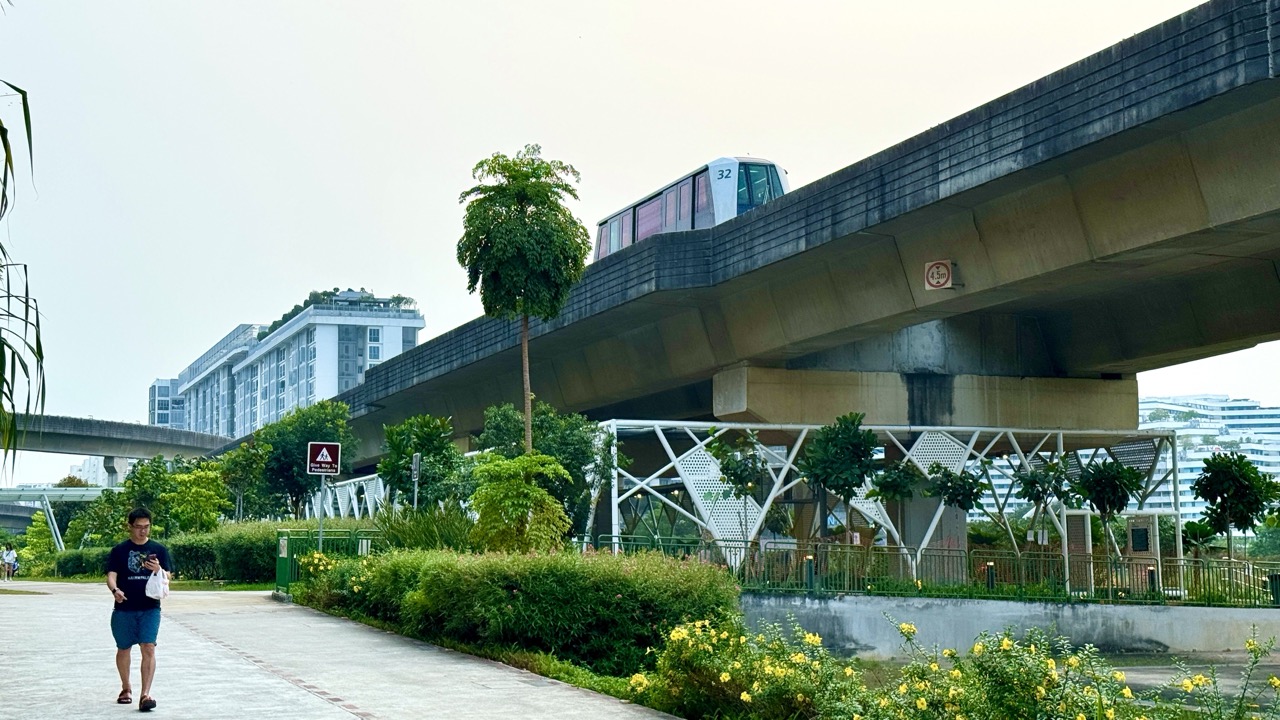
Photographing a Punggol LRT train near Sam Kee is a surprisingly good way to learn how cameras turn movement into a still image. Our new October 2026 photographs show a train above a neighbourhood basketball court, another view of a passing train and a shared path beside the elevated tracks. In one image, the camera recorded an exposure time of approximately 1/765 second; another train image records about 1/113 second. Those are genuine metadata values from the uploaded files, not guessed camera settings. The difference opens up a practical discussion of shutter time, motion blur, camera position and safe public-space photography.
The place itself has a wider story. URA describes Punggol Green as a 1.2-hectare community space beneath the viaduct between Punggol MRT and Sam Kee LRT, completed as a park in 2022. The train above and recreation below make an unusual local visual combination. This guide is about the photography and physics of that combination, not a new route directory or a claim that every spot under the viaduct is an approved photography location.

Quick answers: Punggol LRT photography and physics
- Subject: an elevated Punggol LRT train photographed near Sam Kee, with community basketball courts and paths below.
- First verified image: 1280 × 720 pixels; recorded shutter duration 0.001307 second (roughly 1/765 second), ISO 64, aperture f/1.78.
- Second verified image: another 1280 × 720 view; recorded shutter duration 0.008850 second (roughly 1/113 second), ISO 50, aperture f/2.8.
- Basic physics: movement during an exposure may create image displacement and blur; the effect depends on speed, distance, viewpoint and camera movement.
- Basic photography: shorter exposures can help freeze motion, but available light and digital image processing affect the result.
- Safety: photograph only from lawful, publicly accessible positions without blocking paths, approaching tracks or entering road and railway restricted areas.
- Permissions: LTA says non-personal or commercial transport photography may require prior written approval from the relevant public transport operator.
- Do not infer: train speed, timetable reliability or an exact shooting location from a single image.
The Land Transport Authority’s 5 August 2024 photography guidance is particularly important. Personal photography and video are generally allowed at public transport nodes if they do not interfere with operations, inconvenience others or violate privacy, but non-personal/commercial use needs prior written approval from the operator. Its guidance does not authorise anyone to cross barriers or film from dangerous places. The Punggol Green family guide handles court use and pedestrian routes separately.
Begin with what you can see, not a camera setting
A picture of a train above basketball players contains at least three subjects: rail movement, recreation and the structure separating them. Before thinking about shutter speed, decide which relationship you want the photograph to communicate. Is it the scale of the viaduct, the train’s movement, the court beneath or the shared use of land? A frame that tries to give all of them equal emphasis may feel confused.
Look at the supplied image and identify the dominant line, the position of the train and the court boundary. Then ask which detail would make the picture understandable even without a lengthy caption. This develops composition from the actual subject rather than from generic rules about placing objects on a grid.
A photograph is an exposure over time
People often describe a photo as one instant. Technically, a camera collects light over a nonzero interval, and a moving subject can occupy slightly different positions during that interval. The shutter or sensor exposure time determines one important part of this process. A short time reduces the distance travelled while light is collected; a longer time can increase apparent motion blur.
The effect is not simply ‘fast shutter equals sharp image’. Camera shake, autofocus, subject distance, lens focal length and computational processing also matter. A train moving mainly toward a camera can have different apparent movement across the frame from one travelling sideways. A responsible explanation keeps those variables visible.
What our first image’s metadata actually says
The October file titled ‘Moving Punggol LRT Train with Basketball Courts Below’ records a shutter time of 0.0013071895 seconds. Dividing one by that value gives approximately 765, so it is reasonable to describe the recorded exposure as about 1/765 second. The media metadata also lists ISO 64 and f/1.78, with the camera identified as an iPhone 15 Pro Max.
These values come from the stored image record, not from observing the scene. They do not independently tell us the train’s actual velocity, shooting distance or whether computational photography combined exposures. Smartphone image pipelines can process multiple frames. Treat the metadata as a useful recorded setting, not a laboratory instrument reading for every movement in the picture.
The second image used a different recorded exposure
The file titled ‘LRT Train Passing Sam Kee Station, Punggol — View 2’ records an exposure time of 0.0088495575 seconds, roughly 1/113 second, ISO 50 and f/2.8. Its 1280 × 720 pixel dimensions match the first image’s output dimensions, but matching image size does not mean the photos used identical lenses, focal lengths or viewpoints.
The second exposure duration is around 6.77 times the first. That difference matters for how far a moving image could travel across the sensor during capture. Yet a viewer should not automatically conclude that the second photograph must be more blurred. We would need to compare viewing geometry, camera motion and image processing as well.
What does 1/765 second feel like?
A fraction of a second can be hard to imagine. One second divided into 765 equal slices makes each slice about 0.00131 second. Human eyes do not consciously count such intervals in ordinary viewing. The camera collects light during one brief interval and turns the result into a still image. The short recorded time is one reason a moving object may look reasonably defined.
An older pupil can practise scientific notation: 0.001307 seconds is approximately 1.307 × 10⁻³ seconds. The reciprocal is about 765 per second. However, describing shutter time as a fraction does not determine how sharp the photo must be. The speed and direction of the train in the image plane still matter.
A simple distance–time calculation
Suppose a fictional moving object travels at 10 metres per second. During a 1/765-second exposure, it travels about 10 ÷ 765 = 0.0131 metres, or 1.31 centimetres. During a 1/113-second exposure, it travels about 10 ÷ 113 = 0.0885 metres, or 8.85 centimetres. These are hypothetical real-world displacements under constant speed.
Neither result is the number of pixels blurred in the Punggol images. Mapping physical motion to pixel motion depends on camera-to-subject distance, perspective, focal length and the direction of travel. The lesson is to use speed × time carefully, stating which quantity is being calculated. Do not claim the train was travelling at the invented 10 metres per second.
Why lateral motion can look faster than approaching motion
Imagine a train crossing a frame from left to right. It can move through many screen pixels in a short time. The same train moving toward a camera may grow in size while its position changes less dramatically across the image. Both are motion, but their projected appearances differ. Perspective turns three-dimensional movement into two-dimensional changes.
The Sam Kee photographs provide a good reason to discuss viewpoint. Without moving into an unsafe area, students can compare published views taken from different lawful public positions. They should avoid trying to produce a head-on train picture from an operational track area. Safe composition is never worth proximity to railway infrastructure.
Freezing the train is one creative choice
A photographer may want the carriage’s outline, doors or branding to be easily recognisable. A shorter exposure can reduce subject blur, especially for motion across the frame. In bright daylight, a smartphone may automatically select a short time, as our first recorded example suggests. Focus and stability still matter, and the train may occupy different places from moment to moment.
Do not promise one universal setting such as ‘always use 1/1000’. Light levels, focal length and processing differ. A sensible explanation offers a starting principle: shorten exposure when motion blur obscures the intended subject, then inspect the result. The exact exposure required depends on conditions that a blog cannot control.
Showing motion is another legitimate choice
Not every successful train photograph must freeze every edge. A longer exposure can show movement through streaking or blur while the viaduct and background remain relatively still. This may communicate speed or passage more vividly. The challenge is to create intentional blur rather than simply shake the whole frame.
For newcomers, it is safer to practise the principle using a toy train or a moving object at home before attempting public transport photography. You can experiment without crowding a platform, stepping into a cycle path or distracting anyone working near rail infrastructure. Understanding technique does not require shooting close to real trains.
Panning and the idea of relative movement
Panning means moving the camera to follow a subject as it passes. When done well, the subject may appear sharper relative to a streaked background because the camera’s movement partially matches the subject’s projected motion. That is not magic: it is relative motion between camera, subject and background during exposure.
Practise a pan with an adult walking across a safe open space where photography is permitted, with their consent. Keep the camera position stationary and never follow a subject by stepping backward into a road or path. The Sam Kee photo is a useful conversation prompt, but it does not prove the original photographer used panning.
Why camera shake is not the same as subject blur
If the entire image looks smeared or doubled, the camera may have moved during exposure. If stationary building lines remain relatively sharp while a train is blurred, subject motion becomes a stronger possible explanation. But modern phones add stabilisation and processing, making diagnosis more complex from a small uploaded image.
A learner can compare sharp static features—such as the viaduct supports or court lines—with the moving train. That is an observation-based starting point. Avoid presenting a definitive explanation when the full-resolution file, capture technique and original processing history are unknown.
ISO is not a speed measurement
Our image records list ISO 64 and ISO 50. ISO is associated with image brightness or sensitivity handling, not the vehicle’s velocity or the shutter duration itself. A high ISO can make a shorter exposure feasible under lower light but may affect noise and processing. A lower ISO often helps preserve clean tones in bright scenes.
Students sometimes treat three camera numbers as though increasing any one of them always improves quality. They have different roles. Exposure time affects collected light and motion; aperture influences light and optics; ISO influences signal amplification or brightness interpretation. Smartphone computational processing adds further complexity. Discuss them as interacting controls rather than separate guarantees.
What f/1.78 and f/2.8 describe
The metadata uses f-numbers that describe the lens aperture ratio. In conventional photography, a smaller f-number denotes a larger entrance-pupil diameter relative to focal length, allowing more light for a given scene under otherwise comparable conditions. But smartphone images may use different lens modules, and their actual focal lengths and optics can differ.
Comparing f/1.78 and f/2.8 alone does not tell us which original image is optically better or what the depth of field looked like. It is useful to recognise that cameras balance light collection with optics and processing. Avoid inferring that the photographer manually selected either aperture; many smartphone lenses have fixed apertures.
What the 1280 × 720 dimensions can and cannot tell us
Both featured train images are stored at 1280 × 720 pixels, a 16:9 aspect ratio. This describes the delivered image dimensions, not necessarily the full sensor resolution. Resizing or cropping may have occurred before upload. A small file can look sharp on a phone but reveal fewer fine details when enlarged.
For a school assignment, do not confuse pixel dimensions with physical length or train scale. Without known geometry, the number of pixels occupied by a carriage cannot be converted directly into metres. The image can support visual comparison, not an exact distance survey.
Framing the elevated train and the basketball court together
The most distinctive photograph shows two activities separated vertically. The train is a transport service; the court is recreational space. Placing both in the frame conveys a story about efficient urban land use without a single word. The camera does not need to show every part of Punggol to make that relationship legible.
However, keeping two subjects visible increases the chance of distracting elements. Decide which is primary and use the other as context. If the train is tiny and the court dominates, the photo becomes more about community sport. If the train fills the upper half, the sport may become context. Neither is wrong; the best choice follows the intended question.
The viaduct as a leading line
The elevated tracks create a strong directional line. A viewer’s eye may follow that line toward the train and into the depth of the scene. Architectural supports can add rhythm and scale. The geometry can help create visual order even when the scene contains pedestrians, courts, barriers and moving vehicles.
A useful exercise is to trace three major lines on a printed copy or digital image: rail, court edge and pedestrian route. Ask where they converge or separate. Do not stand in a real bicycle or pedestrian path to imitate a perspective angle. The photograph already provides enough evidence to study composition at home.
A court below does not make the area a photography platform
Punggol Green includes recreational and public walking spaces, but a basketball court is for permitted recreation, not a guaranteed staging area for tripods. The path beside it must remain usable by pedestrians and riders. A photographer occupying the playing edge or leaving equipment in a shared route could create a hazard.
Choose only a lawful, safe position where you are not obstructing others, and comply with actual venue and transport-operator policies. If there is no such position for the desired frame, abandon the shot. The fact that someone previously took a photograph does not grant access to their exact camera position or override subsequent changes.
What LTA actually says about photography
LTA’s August 2024 statement says personal photography and video are generally allowed at MRT stations, on trains and at bus interchanges if they do not interfere with operations, inconvenience commuters or violate privacy. It also says operators may check activities for security reasons and may stop photography when necessary. Those are real conditions, not a blanket licence to record in any part of the network.
For commercial or other non-personal transport photography, LTA says prior written approval must be obtained from the relevant public transport operator. A website publishing professionally intended footage should not assume casual personal-use permission covers every use. The safest advice is to check the intended activity’s rules with the operator before filming.
Why the outside path has its own rules
Photography near Sam Kee may involve park or pedestrian areas outside station property. Those spaces have their own access and path restrictions. LTA active-mobility guidance and NParks park-connector etiquette are relevant where cyclists, pedestrians and riders share space. A large camera bag, tripod or stopping group can obstruct movement even if nobody enters a railway facility.
The responsibility is practical: keep the circulation route clear, avoid standing on court boundaries and move aside before reviewing images. When photographing children or strangers, respect privacy and avoid identifying information. Getting a recognisable train does not require turning the public into background subjects without care.
Avoid photographing children in identifiable close-ups
Some supplied images include families walking and players using courts. That does not give every future photographer permission to publish identifiable photographs of children in the area. Focus on infrastructure and scene-level context where possible. If a photograph genuinely needs a recognisable person as its subject, obtain appropriate consent and follow applicable rules.
A good descriptive caption might say ‘A train above the Sam Kee neighbourhood court.’ It need not state which school any child attends or invent a family relationship. Photographic ethics are part of the quality of the record, not an optional extra after the composition is finished.
The illusion of speed from blurred backgrounds
A motion-blurred background can make an object appear to be moving rapidly, but the visual impression is not a calibrated speedometer. The blur can be increased by longer exposure, panning, longer focal length or subject proximity. Without those variables, the same blurred appearance can arise from very different physical speeds.
Students can compare two intentionally made photographs of the same safely moving toy object with different exposure times. They will see that apparent motion changes even when the toy’s actual speed stays similar. That is a clear scientific demonstration without measuring a real train’s operation.
A safer home demonstration with a toy train
Place a toy train on a flat, stable track or surface. Keep the camera fixed and record it passing with different exposure settings if your device supports them. Make sure the toy’s speed and lighting are reasonably consistent. Compare which images show clearer edges and which show streaks. If the phone does not expose manual shutter controls, experiment with available camera modes without promising exact control.
This gives a controlled setting for the central question: what happens when exposure time changes? It also allows repetition and avoids disturbing public transport. Students should not attempt to control, slow or interfere with real railway vehicles for a photograph or experiment.
A fair test needs more than two unrelated images
Our two Punggol train images have different recorded exposure times, but also different apertures and possibly different lenses and viewpoints. They do not form a controlled scientific experiment. A fairer test would hold the camera position, subject motion and lighting as similar as possible while varying one capture parameter at a time.
Even then, smartphone processing may change between frames. Students should record these limitations instead of claiming that one photo proves a universal law. The scientific strength lies in specifying what was controlled, what changed, what was measured and what uncertainty remains.
A practical error-analysis table in words
Start with a claim: ‘The train looks sharper in photo A.’ Record the visible evidence: edges, lettering or window boundaries. Then list possible explanations: exposure duration, focus, camera movement, subject speed, distance and processing. Finally identify the missing evidence, such as capture geometry and unprocessed originals. This prevents a single-factor explanation from sounding more certain than it is.
A teacher can turn the exercise into a structured discussion without requiring advanced equipment. It develops the same habits used in Science practical work: observation, hypothesis, comparison and limitation. A student who openly identifies uncertainty is demonstrating understanding rather than weakness.
Why the human eye and the camera produce different experiences
A viewer standing beside a passing train perceives continuous motion, while a photograph preserves one processed representation from a brief exposure. Video collects a sequence of frames, with its own shutter and frame-rate limits. This explains why a still image may make a moving vehicle appear suspended in place.
The difference is not that the eye is a camera with one simple fixed shutter. Vision involves continuous signals and neural processing. For a primary pupil, the accessible explanation is simply that a photograph keeps one moment while the real train continues moving. Older pupils can explore exposure and frame timing in more detail.
Connecting LRT physics to Primary Mathematics
Young children can compare ‘shorter’ and ‘longer’ time intervals without doing reciprocal calculations. An older primary pupil may multiply an assumed speed by a small number of seconds. For example, a hypothetical object moving at two metres per second travels one metre in half a second. The units and interpretation should be clear.
Do not give a Primary child the impression that they should calculate the actual train’s speed from a photograph. A single static image does not provide the time and distance observations necessary for that calculation. Use invented values openly and let the image motivate the question.
Connecting to Secondary Physics: speed, time and displacement
A Secondary student can start with speed = distance ÷ time, rearranged as distance = speed × time. If a fictional object moves at 12 m/s for 0.005 seconds, it travels 0.06 metres or six centimetres during that interval. The arithmetic is simple; choosing the correct displacement concept is the harder part.
A photo does not establish how this real-world displacement maps to pixels. Students may need perspective geometry, focal length and angular speed for that. The critical explanation is that a camera measures an image projection, not movement on a classroom ruler placed along the track.
A note on rolling shutter and phone processing
Many digital cameras read image data over time rather than collecting and reporting every pixel identically at one instant. Under some circumstances, fast movement or camera motion can create rolling-shutter distortions. Smartphones may also merge several captures computationally. These effects help explain why comparing two phone images can be more complex than comparing their EXIF shutter labels alone.
You do not need to identify a particular rolling-shutter effect in the supplied Punggol photos unless it is visible and supported. Treat the topic as an advanced extension. The practical starting point remains the exposure time, stable camera position, safe framing and careful observation.
The difference between an attractive photo and a transport claim
A beautiful train photo can make someone curious about Punggol. It cannot certify a timetable, average speed, service frequency, capacity or whether the next train will stop at a specific station. Those are operational facts that belong to LTA and the relevant operator. The image may include a moving vehicle while revealing nothing about the rest of the service day.
For transport routes, begin with Understanding Punggol Transport and current official displays. This photographic guide answers different questions about light, movement and visual storytelling. Separating the two prevents a creative learning article from becoming an unreliable travel directory.
What makes Sam Kee’s context photographically interesting
Many rail photos show little more than a train and track. The Sam Kee collection places the railway beside paths, courts and community spaces. That context gives the subject a sense of how residents actually use the surrounding town. A caption can describe the juxtaposition without claiming that every court underneath is publicly bookable at every time.
URA’s account of Punggol Green gives the planning background for this specific corridor. Students can contrast infrastructure designed primarily for movement with space adapted for recreation. The social story is visible in the composition; detailed policy conclusions still need planning sources rather than inference from one frame.
Do not turn a public path into a classroom
An interested family might want to talk about light, lens angle and movement while standing near a court. Keep the discussion short if the area is busy and move aside to an appropriate place. Avoid positioning a class or group in the middle of a cycling path or beside a moving ball game. People are there to use the space, not to become props in someone else’s lesson.
Most of the useful analysis can happen later with the existing photographs. At home, zoom into the train, compare the track lines, read the metadata and work through calculations. This respects public space while producing better thinking than a rushed explanation beside moving traffic.
Three observations, two inferences and one next source
An older student can create a concise report: three observations genuinely visible in the image, two cautious interpretations and one external source needed to verify a related claim. For example, the train, elevated tracks and court are visible. Their vertical coexistence suggests layered land use. To discuss why the park was created, consult URA’s explanation rather than guessing.
This is a transferable research routine. It prevents the image from bearing more evidentiary weight than it can support. The same discipline applies to school diagrams, news videos and local development photographs.
The calmest camera setting is sometimes putting the phone away
If the route is crowded, the court is in active use or the weather changes, stop photographing. A moment missed is not a failure. Do not climb barriers, step onto carriageways or distract transit staff to obtain a better composition. Be especially careful around children and mobility-aid users whose movements deserve unobstructed space.
Photography should fit the environment, not demand that the environment reorganise itself around the photograph. Learning to abandon an unsafe shot is a professional judgement. The existing October collection already provides strong material for education without requiring anybody to recreate the exact camera positions.
How the October images remain useful in later years
The photographs document Punggol’s viaduct, recreation and transport in October 2026. They may become historical records as the area changes, while the principles of exposure, motion and composition remain relevant. Captions should preserve the date and avoid describing temporary conditions as permanent.
A future reader might see a different path layout or transport pattern. The underlying Physics does not expire, but the exact public-access conditions and operator policies must be checked anew. That is why the best photo tutorial combines lasting explanations with dated local evidence.


Frequently asked questions
Where were the photographs taken?
The image library identifies the elevated Punggol LRT near Sam Kee, with Punggol Green community areas below. Exact camera coordinates are not verified.
What is shutter speed?
The duration over which a camera records light during exposure. Shorter times can reduce apparent subject-motion blur.
What shutter time was used in the first photo?
The WordPress media metadata records approximately 0.001307 second, about 1/765 second.
What was used in the second photo?
The second image records about 0.008850 second, or 1/113 second.
Were these shots taken on an iPhone?
The media records identify an iPhone 15 Pro Max, but the full computational processing history is not available.
Does 1/765 mean the train was travelling fast?
No. Exposure duration is a camera setting, not a direct measurement of train speed.
Can we calculate train speed from one still photo?
Not reliably without additional calibrated distance and time observations or other appropriate measurements.
Why might the train look sharper in one frame?
Exposure time, focus, camera stability, projection geometry, distance and image processing can all matter.
Can I use a long exposure to show motion?
Yes in principle, but practise first in safe settings and comply with location rules; do not obstruct public paths or railway operations.
What is panning?
Moving the camera to follow the subject during exposure so its relative image movement can be reduced.
Is a tripod allowed everywhere near Sam Kee?
No such blanket claim can be made. Check site, park, path and transport-operator rules, and do not obstruct access.
Does LTA permit rail photography?
LTA generally allows personal photography at transport nodes subject to safety and privacy, while non-personal or commercial use requires prior written operator approval.
Can I photograph passengers or children up close?
Respect privacy and obtain appropriate permission where required. Avoid intrusive or identifying images.
What can a Primary pupil learn?
The difference between still and moving scenes, short and long times, direction and careful description.
What can a Secondary pupil calculate?
Hypothetical displacement from distance = speed × time, and uncertainty in projecting movement into the image.
Does the image show a public sports court?
It depicts a community court in the Punggol Green corridor; actual activity and booking conditions require current checks.
Does a photo give live LRT frequencies?
No. Use the operator’s current schedule and service displays.
Why does the track make a useful composition?
The elevated line leads the eye through the frame and connects transport movement with public recreation below.
Can I reproduce the image’s exact viewpoint?
The camera coordinates and access conditions are not verified. Use only lawful, safe positions and do not recreate a hazardous shot.
What is a fair experiment for motion blur?
Use a controlled toy subject, a stable camera and a planned exposure comparison, noting changes and device-processing limitations.
Official references and related Punggol guides
- LTA — Photography and Videography at Public Transport Nodes (5 August 2024).
- URA — How Punggol Green Became a Community Focal Point.
- LTA — Sengkang–Punggol LRT Network.
- LTA — Active Mobility Rules and Conduct.
- Punggol Green Beneath the LRT: Paths and Courts.
- Punggol Public Transport Enthusiast Guide.
- Punggol in Pictures: October 2026.
Editorial and technical note: 23 October 2026. Shutter, ISO, aperture and pixel values were read from the original WordPress media records for photographs 99229, 99228 and 99222. Calculated shutter reciprocals are rounded; sample speeds are invented for teaching. Images do not establish rail operations, public photography permissions, exact shooting positions or the identities of people pictured. Follow official operator and public-space rules.


