
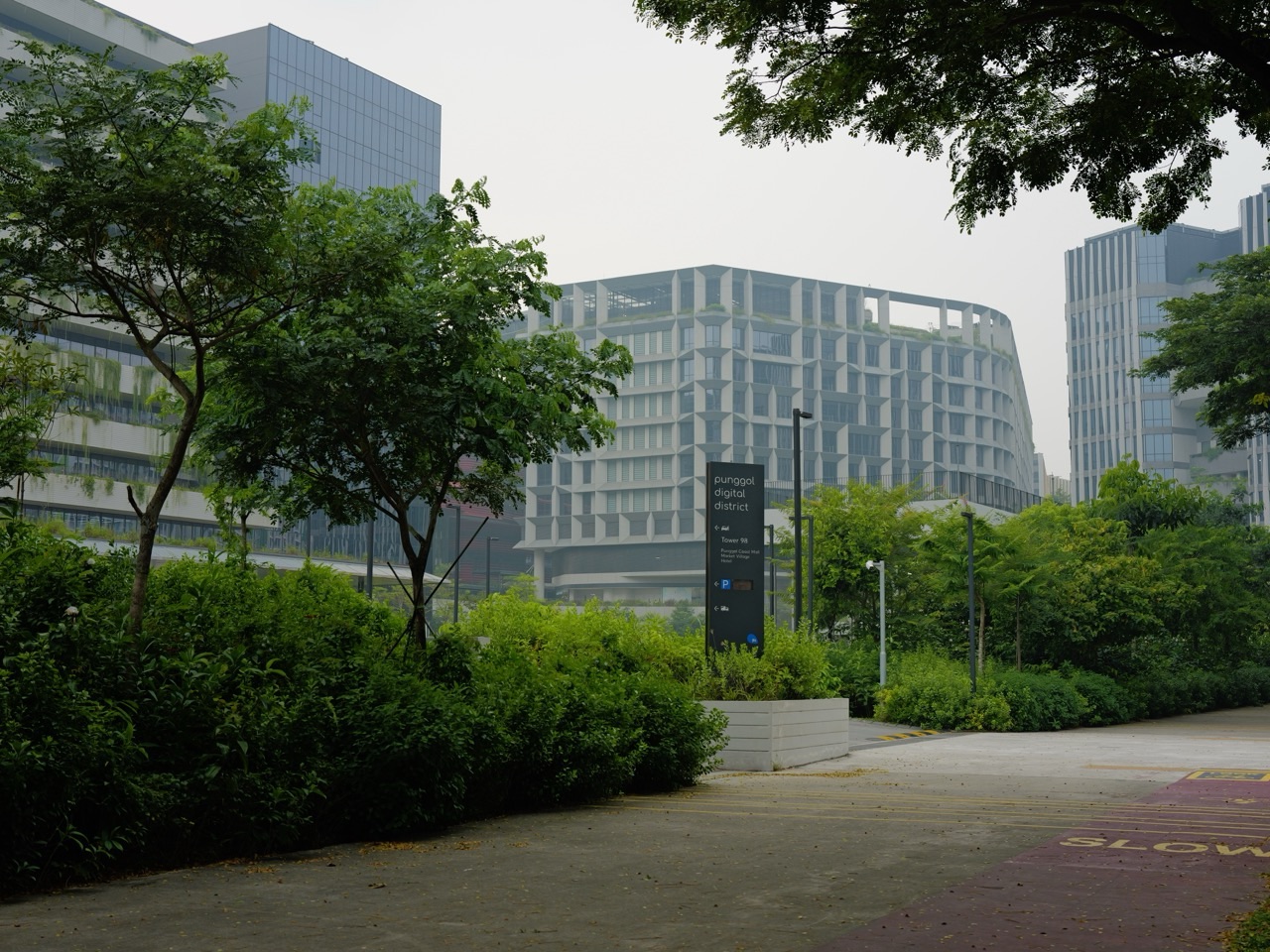
Punggol Digital District was designed to turn rain into a useful resource. JTC estimated that its water-sensitive landscape could save roughly 208,000 cubic metres a year through rainwater harvesting and related design features. The important future question is how that projection can be verified once the district is fully operating—and why a campus water figure should not simply be added to it.

The quick answer: 208,000 m³ is a projection, not a verified household bill saving
Updated 23 October 2026. JTC has described Punggol Digital District’s water-sensitive landscape as including bioswales, rain gardens and rainwater harvesting, with a planned saving of approximately 208,000 cubic metres of water annually. That is 208 million litres, equivalent in JTC’s published comparison to about 83 Olympic-sized swimming pools. It is a district-wide design estimate, not a measured 2026 annual result and not a deduction that can be applied to individual Punggol residents’ household water bills.
Singapore Institute of Technology separately states that its Punggol campus collects and channels stormwater from about 40% of the campus land area, potentially saving an estimated 85,000 cubic metres annually. The campus was awarded PUB’s ABC Waters Certified (Gold) in 2022. These are related but different geographic scopes. Readers must not add 85,000 to 208,000 as if they were automatically two independent water savings; the campus is part of the wider district and the figures may overlap.
The future question is how the integrated systems perform as more buildings, businesses and public spaces operate. A landscape can be designed to harvest rainwater, yet actual savings depend on rainfall, irrigation demand, storage, maintenance and monitoring. Punggol’s value as a demonstration district rests not only in the engineering but also in whether its announced outcomes can be explained and verified honestly.
The water journey: from rain to useful irrigation
Rain falls on rooftops, pathways and planted spaces. Some water runs across surfaces towards drains; some can be directed through vegetation and soil systems that slow and filter the flow. Where the development is designed to harvest water, suitable runoff may enter storage before being reused for non-potable purposes such as irrigation. The precise piping and treatment arrangement depends on each part of the development.
The water is not simply scooped from a decorative pond and served as drinking water. Water intended for irrigation has different requirements from potable water. Capture, storage and reuse need suitable separation and management so water quality and building hygiene are protected. A public article should not imply that PDD’s garden water is safe to drink, wash food in or play with without specific authorised facilities.
The sequence also illustrates why the project is more than a landscape feature. The planted area, drainage network, storage tanks and maintenance staff must function as one system. A blocked outlet or neglected planting bed can reduce performance even where the original design was sophisticated.
What exactly is a bioswale?
A bioswale is a landscaped channel designed to manage runoff, often slowing water and using vegetation and soil media to help treat it. It differs from a conventional hard concrete drain in appearance and, depending on the design, in treatment function. The feature may support biodiversity and visual comfort while playing a part in drainage.
Its ability to detain or treat water depends on dimensions, soil composition, plants, underlying drainage and the storm conditions for which it was designed. A narrow planted strip beside a pavement is not automatically a functional bioswale. Some planting areas serve other landscape purposes. Residents should rely on official site information rather than label every depression filled with grass as a stormwater system.
For detailed mechanics, our existing rain-garden and swale explainer should be treated as a separate topic owner where available; the present article focuses on the PDD savings projection and future verification.
What is a rain garden?
A rain garden is a planted basin configured to capture runoff temporarily, using soil and vegetation to filter water and control its movement. PUB’s ABC Waters guidance describes it as a bioretention feature. Depending on design, filtered water may infiltrate, be collected for reuse or continue to an approved drainage system. Different sites can implement distinct configurations.
The plants are not merely decoration. Their roots and growing conditions help sustain the system’s function, while maintenance prevents sediment and debris from reducing performance. A rain garden should not be treated as a public puddling or water-play area unless a specific area is designed and authorised for that use.
One purpose of PDD’s system is to make some water-management infrastructure visible in everyday spaces rather than hide every process underground. That visibility can be educational, but visitors should observe from appropriate public paths and avoid stepping into planted systems.
Why a district can reuse water without changing household taps
PDD’s collected rainwater is described for non-potable uses such as landscape irrigation. A resident’s water supply is managed through Singapore’s separate drinking-water infrastructure and normal public utility arrangements. The presence of rain harvesting in an adjacent business park does not prove the resident receives a separate supply or a lower tariff.
That boundary matters because sustainability claims can easily sound more personal than they are. A district-level reduction in purchased irrigation water may benefit the operator and the wider resource system. It is not a promise of a fixed rebate on every home bill or a new source of potable water for Punggol families.
Households can still learn relevant water-saving habits through official PUB resources, but those ordinary household decisions should not be confused with the technical performance of a university-business district’s landscape system.
What 208,000 cubic metres looks like mathematically
One cubic metre equals 1,000 litres. The published district figure of 208,000 cubic metres therefore corresponds to 208,000,000 litres in a year under the design assumption. The large number may sound precise, but it remains an estimate until a defined period and measurement system confirm actual savings. Significant digits and reported comparators should be interpreted in context.
For a classroom exercise, divide the annual estimate by 365 to obtain a rough daily average of approximately 570 cubic metres. That is a convenient arithmetic conversion, not a claim that PDD harvests the same amount every day. Rainfall is uneven, and stored water may be used at different times from when it is collected.
The most valuable lesson is that a yearly average can conceal strong variation. Singapore can have intense storms and dry spells. Designing storage to manage both conditions is not the same as supplying a constant daily flow.
The SIT figure of 85,000 cubic metres needs its own label
SIT’s official sustainability page says its Punggol Campus has water-management features that collect stormwater from approximately 40% of its campus land area and estimates water savings of 85,000 cubic metres a year. This campus figure is relevant evidence of a particular institution’s design, not an additional 85,000 cubic metres automatically outside the district-wide 208,000.
Two organisations may publish numbers using different geographic boundaries or assumptions. To compare them responsibly, a researcher needs site drawings, catchment definitions, what counts as a saving and how the calculation was made. Without that, adding the figures risks double counting.
The campus’s ABC Waters Certified (Gold) award in 2022 is a separate recognition of the design approach. It should not be recast as proof that 85,000 cubic metres was measured and saved in each year since 2022. Certification and ongoing metered performance answer different questions.
What PUB’s ABC Waters framework requires
PUB’s Active, Beautiful, Clean Waters programme promotes environmentally sustainable stormwater features that can cleanse runoff and improve the public environment. Its official guidelines give practitioners technical approaches for vegetated swales, bioretention swales and rain gardens. Detailed engineering review and maintenance form part of their proper use.
Such designs must work within the broader drainage system and avoid creating unintended safety or hygiene problems. A rain garden may have overflow arrangements for heavy storms, while a detention feature may hold water temporarily. Those mechanisms should not be inferred simply from a photograph. Competent professionals design the feature for actual runoff and site conditions.
The guidelines make PDD’s water landscape a serious engineering case study rather than an aesthetic trend. The next step is to evaluate how designed features operate when the district has real people, vehicles, landscaping demands and variable weather.
Where the landscape architects add detail
Landscape architect Henning Larsen describes PDD as a three-dimensional water landscape connecting roofs, streets, courtyards, ponds, irrigation and planting. The project’s design account says that at least 45% of stormwater runoff is treated through planted systems, with detention planned for specified storm conditions. These figures belong to the landscape design and should be interpreted in that context.
A percentage of stormwater treated is not automatically the same as a percentage of drinking water saved. Water can be treated and subsequently discharged, detained and reused, or flow through other parts of the system. The measurement boundary must be stated before comparing figures.
Together, the architectural account and JTC’s statement explain the ambition: combine useful drainage with green public spaces rather than build a completely separate invisible pipe network. Whether the measured outcome matches the ambition is a question for later operational data.
Why gardens can help even when no water is harvested
Planted stormwater features can slow runoff, capture some sediment and support vegetation and habitat. Those functions may have value even if no harvested water is reused on a particular day. Their contribution should not be reduced to only the litres stored. Public spaces can benefit from shade, biodiversity and a more pleasant walking environment.
At the same time, a planted feature is not a magical flood barrier. Heavy storms may exceed a local system’s storage or treatment capacity, with designed overflow required. The normal public safety rules around drains and intense rainfall remain essential.
This balanced view helps readers appreciate green infrastructure without assuming it solves every drainage problem. Its performance belongs to a larger network, just as the district’s offices belong to a larger transport and energy system.
The difference between water detention and water saving
Detention temporarily holds stormwater to slow its release, helping manage peak runoff under designed conditions. Water saving generally means replacing some purchased or otherwise supplied water with another suitable source for an identified use. A system can provide both functions, but they are not identical.
A raingarden may detain a storm and then let water flow onward, with little or no water retained for later irrigation. A harvesting tank may retain treated water for use on a dry day. The project needs a clear accounting definition so a reduction in peak drainage flow is not accidentally reported as an equivalent volume of potable water saved.
For the 208,000-cubic-metre claim, the relevant future verification requires understanding the capture, storage, irrigation and metering assumptions used in the projection.
What happens during a heavy tropical downpour
Water-sensitive design must accommodate intense rainfall without creating unsafe ponding along critical pedestrian paths. A rain garden may temporarily hold water within its designed profile, but overflow and drainage routes need to work when the system is full. Surface water in an unexpected location can create a slip or access hazard.
Residents should never enter a flooded basin or blocked drain to inspect it. During lightning, heavy rain or flash-flood warnings, use official weather and safety guidance. Infrastructure can reduce certain risks while the environment still demands caution.
For students, the useful question is how engineers choose design-storm assumptions and what happens beyond those conditions. This opens a discussion about resilience without falsely claiming that PDD is incapable of flooding.
Water-sensitive design is a maintenance obligation
PUB emphasises that ABC Waters features require regular inspection and maintenance to sustain their intended benefits. Sediment can accumulate; plants may die or become overgrown; litter can obstruct drains; filtration media can change in performance. The design may be excellent at handover and still deteriorate if responsibilities are unclear.
A maintenance plan should specify inspection routines, performance indicators, safe access and procedures for dealing with faults. Public landscaping and engineered water treatment are not always maintained in the same way as ordinary flowerbeds. The operator needs the right expertise and records.
For a resident, that creates a practical accountability question: if a public-facing planted basin becomes blocked, which responsible organisation manages it, and what reporting channel is appropriate?
How to avoid double counting water savings
Water can move through more than one subsystem. A campus rain garden may form part of a larger district stormwater design, while irrigation water may be counted by an estate operator. Simply adding figures from separate project brochures can count the same rainfall or reuse more than once.
A careful audit establishes boundaries and flow diagrams. It asks whether the 208,000 cubic metres is a district projection that already includes SIT’s 85,000, how actual use is recorded and what baseline is used to define a saving. Without the answers, the most responsible publication retains the figures separately with explicit scope labels.
This principle applies beyond water. District cooling, rooftop solar and waste processing can all have overlapping buildings and reports. Good environmental statistics require boundary clarity, not just arithmetic.
The role of data and the Open Digital Platform
JTC describes the Open Digital Platform as a means to integrate data from district systems and improve operational decision-making. Water consumption, storage conditions and related services could be monitored within appropriate permissions. But the existence of a digital platform does not establish that detailed water-flow records are automatically public or that every conservation objective has been independently validated.
A future performance dashboard would need units, time period, meter coverage, treatment of missing data and the definition of each measure. A colourful chart displaying a growing number is less useful than a clear explanation of which systems were actually measured.
Residents and students can learn from the method without gaining access to private infrastructure. A small school experiment using safe containers and a measuring jug can illustrate how data quality affects a water-budget conclusion.
How the design might reduce dependence on potable water
Landscape irrigation does not necessarily require water meeting drinking-water standards when an appropriate non-potable system is professionally managed. Reusing suitably collected rainwater for irrigation can therefore reduce the need to draw on treated potable supplies for the same purpose. That is the resource logic behind JTC’s projected savings.
The actual reduction depends on whether stored water is available when plants need irrigation. During extended dry weather, a harvested supply may become insufficient. Conversely, rain may arrive when irrigation demand is low. Storage size, operation and controls influence the amount of purchased water displaced.
The future evaluation needs to compare real irrigation demand and alternative supply over time rather than simply sum the rain falling onto a district.
What public visitors can observe safely
A visitor to PDD may encounter planted channels, rain gardens, ponds and green edges. Some are visible from public paths and can illustrate the design intent. But a visitor should not presume that every planted depression is a formal bioretention system or that every pool is safe for play. Access, signage and operating conditions matter.
A family can photograph a feature from a lawful public position, note its location and compare it with official descriptions. Avoid entering planting beds, collecting water samples from restricted systems or moving covers and grates. Water-management equipment may be connected to building services.
The purpose of a visit is understanding the built environment, not carrying out an unauthorised inspection.
A Punggol geography lesson in catchments
A catchment is the area from which rainfall drains to a particular outlet or system. Students can draw a simple model of sloping surfaces, tracing where water flows when rain falls. That model helps explain why two nearby rain gardens may receive very different amounts of runoff despite having similar visible sizes.
The classroom exercise can use a shallow tray and safe small amounts of water, away from electrical devices. Ask where water collects, what happens when a route is blocked and why overflow might be needed. Label it a model, not a reproduction of PDD’s engineered hydraulics.
Understanding catchments also clarifies why the SIT estimate refers to a percentage of campus area rather than the whole Punggol town.
A Mathematics activity: units and assumptions
Give students two figures: 208,000 cubic metres and 85,000 cubic metres per year. First convert them to litres. Then ask whether they can be added. The correct answer is not automatically yes, because the geographic and methodological boundaries are not established as disjoint. This is a rare numerical problem where the key skill is recognising missing information.
Next, ask students to explain how they would verify a year of savings. They need a baseline, measured reuse, adequate meter coverage and time records. The exercise strengthens mathematical communication by requiring a statement about uncertainty rather than only a large computed number.
Students should also distinguish an average from daily variability; annual rainfall is not distributed evenly across Singapore’s days.
A Science activity: filtration is not automatically purification
A safe classroom model can compare visible sediment in water before and after passing through an authorised filter medium, with appropriate hygiene precautions and without drinking the result. Students may see clearer water after filtering, but clarity alone does not prove that it is microbiologically safe or fit for consumption.
The lesson connects directly to planted treatment systems. Soil and vegetation can help treat runoff, but a real water-reuse system must meet requirements appropriate to the intended use. The word ‘clean’ in an urban design programme is not a permission to drink from a landscape feature.
This is an effective way to teach evidence limits and the difference between an observable improvement and a health claim.
What would prove that the target has been met?
A credible assessment would name a reporting year, identify which systems and buildings were counted and explain the baseline for purchased water. It should present measured reuse and perhaps the amount lost through evaporation, overflow or other processes, as relevant to the methodology. A design estimate cannot be verified simply by photographing the tanks.
Performance may vary between years because of rainfall and occupancy. The evaluation needs to distinguish changes caused by the system from changes in irrigation demand or weather. A claim of meeting or exceeding 208,000 cubic metres should have an intelligible measurement basis and avoid counting the same reused water multiple times.
If such data are unavailable publicly, the accurate statement remains that JTC projected a potential saving, not that the full amount has already been independently proven.
The broader future of Punggol’s green infrastructure
As PDD matures, landscape features will need to work alongside more offices, shops, campus activities and public visitors. The planted water systems are therefore living infrastructure, not a once-and-done construction item. Their long-term performance depends on maintenance, data, climate variation and responsible use.
This offers a useful model for future developments elsewhere in Singapore: design drainage and public greenery together, rather than treating them as completely separate systems. But replicating the idea requires local hydrology, soil, space and maintenance expertise. A successful approach in Punggol may need significant adaptation in another town.
The contribution of PDD will be strongest when operational evidence can guide later projects.
Frequently asked questions
Will PDD save 208,000 cubic metres a year? That is JTC’s published estimate for its water-sensitive design, not a verified 2026 measured result in the cited announcement. Is that 208 million litres? Yes. Does it mean Punggol household bills will fall? No, the estimate concerns district non-potable water reuse, not direct household tariffs.
What does SIT’s 85,000 cubic metres mean? It is the campus’s separately stated estimated yearly water saving. Can the two figures be added? Not without confirming that their accounting boundaries do not overlap. Can children play in rain gardens? Not unless a specific facility is designated and safe for that use.
Will the design prevent every flood? No such guarantee exists. Is collected rainwater safe to drink? Do not assume so; the cited use is non-potable irrigation. Why maintain bioswales? Their function can deteriorate when sediments, plants and outlets are not managed.
Sources and local links
The primary district source is JTC’s Green Mark District announcement, May 2024, with the 208,000-cubic-metre estimate. SIT’s Punggol Campus sustainability account specifies its different 85,000-cubic-metre and 40%-catchment figures. PUB’s ABC Waters design guidelines and PUB’s ABC Waters maintenance guide explain professional requirements.
The designers provide context in Henning Larsen’s project account. For the general mechanics of green stormwater features see existing eduKatePunggol articles about rain gardens; this page’s reader job is the future verification of PDD’s 208,000-cubic-metre savings claim. For the wider town planning system see URA’s PDD public-space and design rules.
Editorial boundary: All student examples are hypothetical. Official projected annual savings are not presented as audited operating results, and no public access or water-quality guarantee is implied.
Where the 208,000-cubic-metre design estimate might go wrong
A projection can be inaccurate for several legitimate reasons. There may be less roof runoff available than anticipated because of actual rainfall patterns. Storage tanks may reach capacity during intense storms, allowing additional water to overflow rather than be saved. Irrigation needs may differ from assumptions because planted areas mature, maintenance requirements change or weather varies. None of these possibilities can be resolved by counting visible rain gardens.
A rigorous assessment should separate an error in the original model from a change in operating conditions. If a measured result is below the estimate, the response should be to understand why and improve the system where feasible, not automatically declare the entire water-sensitive design a failure. A project can still provide meaningful drainage, biodiversity or public-space benefits despite lower-than-forecast reusable water volume.
How to build a useful water-budget diagram
A water-budget diagram identifies inputs, stores, outputs and losses. In PDD’s case, a high-level model could begin with rainfall over contributing catchments, then show some runoff reaching planted treatment systems, some retained in storage, some used for irrigation and some ultimately discharged or lost through other processes. It should not assume every litre of rain falling on 50 hectares is captured.
Students can build a simple example with invented numbers that balance: 100 litres enters the model, 30 is captured for later reuse, 60 exits through drainage and 10 is retained or lost under a clearly defined category. The calculation is illustrative. The lesson is that water cannot be counted as newly saved every time it passes another feature, and all flows must be assigned consistently.
A resident’s practical observation checklist
When visiting the publicly accessible parts of PDD, residents can observe whether water-sensitive landscaping is maintained, whether visible drainage points appear free of litter and whether public paths remain safe after rain. They should not open grates, climb into landscaped basins or attempt to collect water from equipment. A photograph with a date and exact public location may be useful when reporting an obvious maintenance concern.
The checklist should not be represented as a technical audit. Residents generally cannot see stored water levels, internal flows or water quality. Those require instruments, safe access and professional interpretation. Public observations can help identify issues worth reporting while recognising the difference between appearance and measured system performance.
What a business tenant can ask about water services
A company renting space at PDD may be interested in the district’s resource-efficiency systems. It should ask the building operator which water-saving measures are actually active, how charges and common services are allocated, and what maintenance responsibilities fall on tenants. A district-wide projection does not establish a particular reduction in the business’s water bill.
An office manager can still pursue ordinary resource efficiency by inspecting leaks, choosing suitable fixtures and using accurate meter readings where available. These actions should be coordinated with building management rather than modifying shared plumbing. The district’s integrated systems can be an enabling framework, but individual savings need local evidence.
Why environmental education needs more than a field trip
A well-designed school learning journey should begin with a question, such as: “How does this landscape help manage rainwater without turning it into drinking water?” The teacher selects public viewing points, checks current route access and provides primary-source material from JTC and PUB. Students can sketch the visible surface and identify what remains hidden or uncertain.
After the visit, students can compare their observations with the official design description. They should avoid claiming that a planted basin contains a particular treatment medium unless that information is provided by a reliable plan or sign. A good report states what could not be seen. That is the foundation of disciplined field investigation.
When the weather is dry, the system still matters
A harvested rainwater system is valuable only if it can help meet demand at appropriate times. During a prolonged dry spell, available storage may gradually fall. This means the system may need a suitable supplementary supply even if it performs well in wet months. A projected yearly saving should not be interpreted as guaranteeing complete independence from other sources.
Designers have to balance tank capacity against land and cost. A very large tank can store more but occupies space and costs money; a smaller one may overflow more often during intense storms. Determining the right size requires historical rainfall, expected use and acceptable reliability. The interesting engineering decision is not simply “store as much as possible.”
Comparing PDD water with Punggol Waterway’s broader function
Punggol Waterway and its surrounding reservoirs have broader water and drainage roles within Singapore. PDD’s planted harvesting systems operate at a more local site and campus scale. Although they are part of the same northeast landscape, readers should not assume that water collected for an office park’s irrigation is the same as household potable water or managed reservoir supply.
The distinction between scales is educationally useful. A small rain garden, a district-wide harvesting network and a national water system each address different problems. A local feature can contribute to sustainability without replacing the larger infrastructure. This also helps explain why a school source about Punggol Waterway should not be treated as proof of a PDD tank’s current output.
A design award is evidence of planning, not every future measurement
SIT’s ABC Waters Certified (Gold) award and PDD’s Green Mark Districts Platinum award are meaningful recognitions of design. They show that the organisations have addressed sustainability criteria within the relevant frameworks. Yet operational performance changes as systems are commissioned, used and maintained. The award date should not be presented as the start of an audited annual savings series without supporting data.
A thorough future report can put certificates, forecasts and measured outcomes into separate columns. For instance, a design-certified campus, a projected savings target and a later metered irrigation volume are three different types of evidence. Treating them separately allows the public to appreciate genuine achievements without overstating what has been proven.
A small business and a water-efficiency claim
Suppose a landscaping contractor working in the district advertises that a new irrigation method reduces purchased water by 40%. Before accepting the claim, a facilities manager asks what baseline was used, whether rainfall was comparable, how plant health was monitored and whether the percentage excludes losses or other supplies. Without those definitions, an impressive number may be difficult to compare.
A credible test would record water inputs and outcomes over sufficiently comparable periods, acknowledging weather and plant changes. This example is hypothetical and does not describe an actual contractor at PDD. It illustrates the professional scrutiny needed when a place presents itself as a living laboratory for sustainability.
The broader climate adaptation lesson
Water-sensitive landscapes can be part of climate adaptation, but their capacities are finite. Singapore may face intense rain as well as heat and changes in water demand. A robust district combines appropriate drainage engineering with landscaping, monitoring, contingency procedures and maintenance. No single rain garden can remove all storm risks.
The future contribution of PDD is the chance to learn whether integrated systems work at meaningful scale in an active campus and business park. The strongest lessons for other towns will come from measured operations and transparent design boundaries, not simply the presence of an attractive planted basin.
What an honest future update should include
A useful 2027 or later update would identify the reporting period, operating catchment, installed storage systems, harvested and reused volumes and baseline purchased water. It would explain whether the district-wide account includes the SIT campus and whether the numbers are metered, modelled or a mixture. The update would also report maintenance and major anomalies, such as exceptionally dry or wet weather.
If only some of that information becomes available, the article should state the limitation rather than manufacture the rest. Readers can still understand the project as an important urban-design experiment while waiting for a complete performance account. Accuracy is more valuable than a falsely precise savings scoreboard.
A practical parent–child project over a month
In the first week, the child learns to distinguish rainfall, runoff, storage and reuse using a drawing. In the second, the family records local rainfall days from a suitable official source rather than collecting potentially unsafe stormwater. In the third, the child builds a fictional small water budget with arithmetic that balances. In the fourth, they write a short explanation of why an annual saving cannot be assumed to occur evenly each day.
The project can finish with two lists: what JTC has officially estimated, and what additional measurements would prove the outcome. It requires paper, simple Maths and careful reading rather than advanced equipment or access to restricted drainage infrastructure. It is a practical example of learning to question evidence respectfully.
| Measure | Do not confuse with |
| 208,000 m³/year | JTC’s district estimate, not a verified 2026 measured result |
| 85,000 m³/year | SIT’s campus estimate; potentially overlaps district scope |
| 40% campus area | SIT runoff collection catchment, not reduction in all campus water use |
| ABC Waters Gold | Design certification, not evidence of yearly measured savings |
| Rain gardens and bioswales | Runoff management features; not authorised play water |
| Good verification | Metered use, defined baseline, catchment and time period |


