
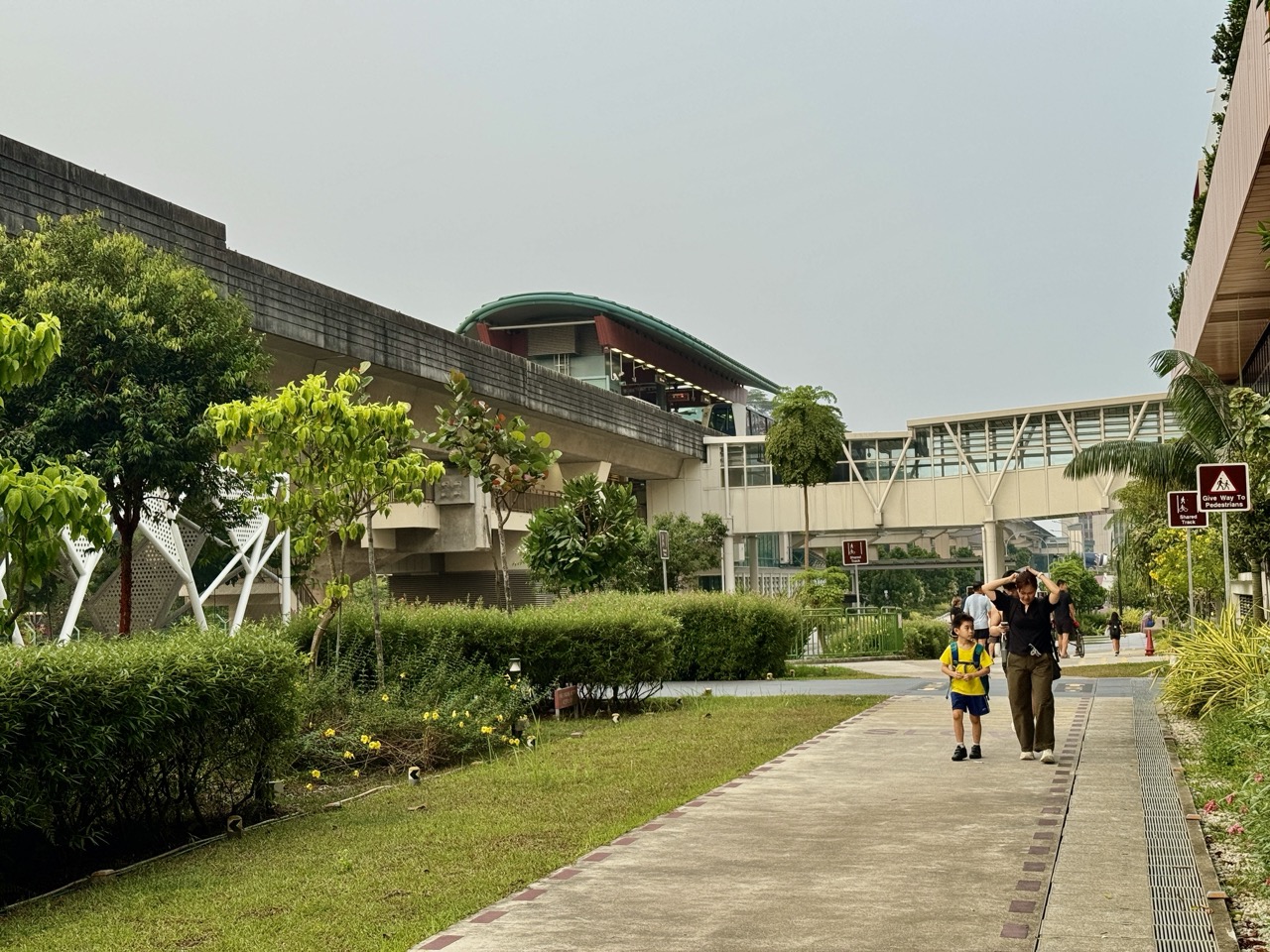
Quick answer: In Punggol, a path for pedestrians, a shared path and a dedicated cycling path do not necessarily allow the same devices. From 1 July 2025, LTA has enforced Pedestrian-Only Path restrictions on selected footpaths beside dedicated cycling paths: ordinary bicycles and personal mobility devices cannot be ridden on those converted sections. Standalone footpaths and marked shared paths continue to have different rules. Ordinary bicycles on a permitted footpath must observe the 10 km/h limit; cycling paths and shared paths generally have a 25 km/h limit for permitted devices, with separate rules for personal mobility aids. Follow on-site markings and give way to more vulnerable users.

A child learning to cycle at Punggol Waterway Park may encounter a wide red surface, a plain grey pavement and a narrow link to a housing block during a single outing. The surfaces look connected, yet the law does not treat every metre as an identical cycling route. That is why a parent can know the waterway very well and still need to look down at new pedestrian symbols or updated signs before deciding where a child should ride.
This guide helps families read the physical system: the meaning of path markings, who may use which route, relevant speed limits, when to dismount, and how to handle bends, bus stops, crossings and crowded spaces. It is different from our photograph-led Sam Kee route article and from bicycle-rental recommendations: the emphasis here is Singapore’s current rules and the decisions they require across Punggol’s different paths. If a particular path was recently changed, the signs and current official instructions take priority over an older route photo.
Read the path before you ride
| Surface or marking | What to understand | First safe action |
|---|---|---|
| Pedestrians-Only wording and walking-person logo | Converted pedestrian-only section | Do not ride a bicycle or PMD there |
| Bicycle logo on a dedicated cycling route | Device movement is the main design use | Ride considerately; watch for pedestrians |
| Shared path, often with dotted red edge markings | Pedestrians and allowed devices share space | Reduce speed near other users |
| Standalone footpath without conversion | Different riding permissions from pedestrian-only path | Check device rules and 10 km/h speed limit |
| No Riding sign | Riding restriction at that location | Dismount and push the device, subject to PMA rules |
| Bus stop or junction path intersection | People may cross the cyclist route suddenly | Slow and give way |
1. Punggol has several path types, not one continuous cycling lane
Punggol’s estates, waterway, park connectors and LRT surroundings bring different types of movement together. Some links serve pedestrians moving to shops; others connect cycling routes over longer distances. A surface may look uninterrupted while the path category changes at a boundary. Riders should not assume that a bicycle is permitted in every place that appears wide enough for two wheels.
LTA administers the Active Mobility Act and explains current permission categories on its official rules page. The path type, device type and user behaviour all matter. A manual bicycle, a power-assisted bicycle, a motorised e-scooter and a wheelchair cannot simply be placed into one category called ‘small vehicles’. The law recognises distinctions that are important for safety and enforcement.
Begin any unfamiliar route by looking for signs and pavement markings at transitions. If a resident needs a short connection from a dedicated cycling route to a home entrance, the proper choice may be to dismount rather than ride through a pedestrian-only segment. This is not a judgment about the rider’s skill; the route has a designated primary use.
Punggol example
A family leaving the shared path near Sam Kee approaches a link marked Pedestrians-Only. The cycling child gets off and pushes the bicycle while the family enters the housing area, instead of assuming the broad pavement stays a cycling route.
2. Why pedestrian-only paths were introduced
LTA announced the Pedestrian-Only Paths initiative to increase safety for pedestrians, particularly older adults and young children, where a footpath runs beside a dedicated cycling path. From 1 July 2025 it began enforcement on converted footpaths bearing pedestrian logos and Pedestrians-Only wording. Ordinary bicycles and motorised or non-motorised PMDs may not be ridden on these designated sections.
The objective is not to prohibit cycling throughout the town. It is to separate faster devices from people walking where there is enough space for parallel facilities. This reduces close overtaking and creates a more predictable path for prams and mobility aids. The cycling route remains available for appropriate riders immediately alongside in many such locations.
Do not confuse an ordinary standalone footpath with a converted Pedestrian-Only Path. LTA explicitly states that the initiative does not affect standalone footpaths and shared paths, where existing permitted-device rules apply. It is the actual markings and route classification that matter, not an assumption that all grey pavement has become pedestrian-only.
Punggol example
A resident sees a person walking beside a red cycling route. The parent points out the Pedestrians-Only logo and uses it as the reason the child should stay on the cycle side while riding, not as a rule against all cycling in Punggol.
3. How to recognise a shared path
LTA describes shared paths as routes where pedestrians and allowed active mobility device users continue to share space; these are typically marked by dotted red lines along path edges. The markings help distinguish shared use from a dedicated cycle path paired with a newly converted pedestrian-only footpath. However, an individual path’s onsite signs and any temporary restrictions should be checked.
Shared does not mean unrestricted. A cyclist cannot treat a shared route as a racing circuit simply because the surface is broad and a painted symbol allows bicycles. The speed limit is an upper bound, not a target. Walking children, a person with a white cane, and someone pushing a wheelchair can all use shared facilities and need considerate clearance.
On a shared path, predictability is more valuable than passing a person quickly. Keep left when appropriate, announce overtaking gently, allow room for changes of direction and slow significantly at corners. If a crowd forms, LTA advises walking the bicycle rather than weaving between people.
Punggol example
A Punggol family walking along a dotted-edge shared path meets a fast-approaching cyclist. The rider should reduce speed and give the walking family space rather than assuming the presence of cycling markings grants absolute priority.
4. A dedicated cycling path is not exclusive private space
A cycling path is designed primarily for permitted bicycles and other active mobility devices. Its bicycle symbol and distinctive surface or alignment help users identify it. LTA also allows pedestrians to walk on such paths, although it encourages them to use adjacent Pedestrian-Only Paths wherever available. This avoids unnecessary conflict without making a pedestrian who must cross the bicycle route an outlaw.
Cyclists must still look out for people crossing to bus stops, ramps, junctions or shops. A dedicated route improves organisation but does not remove the need for observation. The cyclist is usually travelling faster and has more responsibility to reduce speed as conditions become crowded.
Keep a reasonable overtaking margin and avoid squeezing past a pedestrian who has moved briefly into a cycling route to avoid an obstruction. The official code of conduct anticipates situations where path users must cross into the neighbouring route temporarily. Courtesy is part of how the design functions safely.
Punggol example
A person using a walking frame needs to cross a cycling route to reach a bus stop. A Punggol cyclist should yield and allow the person time to cross rather than using the painted bicycle icon as an argument.
5. The 10 km/h and 25 km/h limits refer to different routes
LTA’s active mobility material distinguishes a 10 km/h speed limit on footpaths for permitted devices from a 25 km/h limit on cycling paths and shared paths for the relevant categories. These are maximum speeds, not invitations to travel at that speed when pedestrians are nearby. Local lower limits, signs, device-specific limits and other applicable rules still matter.
A rider moving at ten kilometres per hour is travelling almost three metres every second. A child emerging from a blind corner may be only a short distance away. The practical response is to slow to a speed that permits a controlled stop well below the formal maximum when visibility is limited.
Do not apply 25 km/h mechanically to a mobility aid or assume every powered device may be used on any cycling route. Personal mobility aids have their own updated requirements, and powered bicycles or e-scooters have additional eligibility and certification conditions. Riders should verify the current device category before relying on a speed sign.
Punggol example
At a narrow link beside a Punggol play area, the rider slows to walking pace even if the route normally allows a higher maximum. Passing a child safely is more important than achieving the permitted speed.
6. Personal mobility aids are not simply e-scooters
LTA distinguishes PMAs such as wheelchairs and mobility scooters used by people with mobility challenges from recreational motorised PMDs. PMAs may use Pedestrian-Only Paths where other motorised devices cannot be ridden. Recent regulations were introduced to improve path safety, including a lower public-path speed cap and criteria for relevant devices and users.
Rules for PMA users must be read from LTA’s current page because implementation dates, medical-need requirements and exemptions have changed around 2026. It would be unsafe and disrespectful to assume that every mobility scooter is an illegal e-scooter, or that every seated electric device enjoys the same privilege without conditions.
Pedestrians and cyclists should give PMA users practical room to navigate. A sudden side-step into a wheelchair’s path can be as troublesome as a cyclist’s close pass. Look for accessible ramps and smooth transitions, and do not force a mobility aid onto a narrow or sloping shortcut just because the map shows a path.
Punggol example
An older resident uses a qualifying mobility aid on a pedestrian-only route. The family learns that this does not mean the child’s ordinary e-scooter is also allowed there.
7. E-scooters and power-assisted bicycles have extra rules
A registered and compliant motorised e-scooter is not the same as a non-motorised kick scooter. LTA sets different device requirements, certification, registration and riding permissions. Power-assisted bicycles also have their own technical standards and riding conditions, and both categories face age or theory-test rules in relevant circumstances.
Motorised PMDs and PABs must not be ridden on ordinary footpaths. Suitable cycling paths have their own permitted-device conditions, while roads have separate rules for bicycles and PABs. The legality of a device depends on its category and compliance, not just how slowly the rider promises to travel.
Families considering a new device should check LTA’s current published requirements rather than rely on a seller’s label of ‘family-safe’ or ‘footpath model’. A product’s physical size or the presence of pedals does not settle registration or permitted-use questions.
Punggol example
A teenager receives a second-hand e-scooter and assumes it can follow a bicycle through every Punggol walkway. The family verifies the device’s category, compliance and permissible route before any riding occurs.
8. Walking a bicycle is a useful option
Dismounting is sometimes the simplest response to a path transition or a crowd. LTA’s rules say riders should dismount and push their devices where No Riding signs apply, with the stated exception for PMA users. Walking also avoids close passes at dense pedestrian junctions where riding would be technically possible but inconsiderate.
Pushing a bicycle changes the speed and control demands, though the person must still leave enough room for other pedestrians. The bicycle should not be dragged across a tactile route, wheelchair ramp or narrow corridor in a way that blocks the intended users. Walk predictably and allow people to pass.
Parents can make dismounting a normal part of an outing instead of a punishment for poor cycling. A short pedestrian-only connector may be exactly how a household reaches the legal cycle route from home. The journey need not remain a continuous ride from doorstep to waterfront.
Punggol example
When a Punggol family reaches a crowded plaza beside the park, they push the bikes to the next suitable cycling route rather than threading between parents and young children.
9. Crossings are decision points, not opportunities to race
LTA requires active mobility device riders to stop and look out for traffic before crossing roads. The rider must obey applicable signals and use suitable bicycle crossings where available. A route painted with bicycle icons does not grant permission to cut across a red pedestrian signal or enter a vehicle lane without checking.
At path intersections, people may emerge from several directions: a pedestrian turning toward an LRT station, a child following a parent or another rider approaching a blind curve. Reduce speed before the intersection rather than braking at the last possible second. The design works only when users provide themselves with time to react.
For young cyclists, the easiest safe option at a difficult crossing may be to dismount and walk with an adult. This is especially useful if the child cannot confidently control the bicycle while checking traffic. It is better to choose a predictable crossing method than to treat uninterrupted pedalling as the goal.
Punggol example
A child on a Punggol park connector reaches a controlled road crossing. The adult has the child stop, assess the signal and walk if necessary rather than rolling straight across.
10. Bus stops create a specific pedestrian conflict
Passengers walking between a shelter and a bus need to cross any nearby cycling route. LTA has described designing bypass paths behind bus stops wherever feasible to reduce conflict, but not every existing stop has the same layout. Riders approaching a stop should expect people to change direction quickly when a bus arrives.
A person running from a sheltered bench toward a bus may focus more on the vehicle than a cyclist approaching from the side. That does not justify a fast close pass. LTA explicitly tells riders to slow when approaching bus stops and public-path intersections. Where a pedestrian-priority marking exists, respect it.
Parents can teach children to look both ways before stepping across the cycling section to board. Riders can help by reducing speed early rather than sounding an aggressive bell at the last moment. The goal is orderly sharing, not demanding that people collecting a bus stand perfectly still.
Punggol example
A bus approaches a Punggol stop and several commuters begin moving. A cyclist behind the stop slows enough to give boarding passengers priority.
11. Overtaking should be a conversation without confrontation
LTA advises active mobility riders to alert others gently before overtaking and keep a safe distance. A bell or spoken warning communicates presence; it does not require the pedestrian to jump out of the way immediately. The rider must choose whether there is enough room and time to pass safely.
Someone walking with children may not react quickly to a bell because the family is holding hands or negotiating a stroller. People with hearing difficulties may not detect the warning at all. It is up to the faster user to adapt to these possibilities by slowing or waiting rather than insisting the path be cleared instantly.
Pedestrians can contribute by avoiding abrupt changes of direction where possible and remaining alert. However, a walking person on a shared path is not obliged to maintain cycling speed or walk in a perfectly narrow file for the entire outing. Shared-space conduct requires flexibility on both sides.
Punggol example
A cyclist sees a parent and two children spread across a narrow waterway path. They ring once gently, slow and wait for room. They do not repeatedly honk or squeeze between the children.
12. Pets, prams and toddlers change the stopping distance
A dog on a short leash, a toddler learning to balance and a parent with a pram can all move unpredictably. The cyclist’s travel speed must reflect this. LTA’s requirement to give way to pedestrians and vulnerable users is especially relevant when a group includes people who cannot quickly dodge an approaching bicycle.
Owners also have responsibilities. A long leash stretched across a cycling path can catch a wheel and create danger. Parents should not allow a child to step suddenly off a pedestrian-only route onto the adjoining cycle path without checking. Good shared-path etiquette is a set of practical behaviours rather than a competition for legal priority.
At a busy point, the safer rider response may be to stop completely. Brakes, tyre condition and visibility affect how quickly a cycle can stop. Do not assume a bicycle with an electric assist or a large load has the same response as a lightweight child’s bicycle.
Punggol example
During a Punggol waterway walk, a toddler runs toward a painted bicycle route. The parents guide the child back, while the approaching cyclist slows rather than relying on the boundary line alone.
13. A cycle path may change category within one short trip
Town infrastructure develops in stages. New cycle segments may be connected to older links, including paths that remain shared or standalone footpaths. The route shown by an app can be useful for planning but may not reflect a recent construction closure or a newly converted Pedestrian-Only Path immediately.
Where markings change, stop and identify what is currently allowed. Painted pedestrian logos, no-riding signs and directional arrows have more immediate force than an outdated screenshot. Some users also cross briefly into adjacent pedestrian-only sections for permitted practical reasons such as avoiding an obstruction; LTA’s code calls for doing so carefully and returning immediately to the proper route.
Do not exploit these narrow allowances as an excuse to ride the entire pedestrian-only strip. The exception exists to handle real-world access needs, not to allow a faster shortcut through a designated walking area.
Punggol example
A Punggol rider encounters a blocked cycle lane and a parallel pedestrian-only route. They follow the actual temporary signs, slowing or dismounting as necessary and returning to the legal cycling route promptly.
14. Road cycling rules are different from path rules
LTA’s road rules impose a different set of requirements on people cycling on the road, including obeying road signals and riding with traffic. Where relevant, road cycling requires a helmet and lights under prescribed conditions. Roads do not inherit the 10 km/h footpath limit simply because a cycle track meets a junction.
Motorised PMDs are not permitted on roads, while bicycles and certain compliant PABs have other permissions and restrictions. A child moving from a park connector toward a roadway should not assume the continued presence of a bicycle means every surface is equally legal to ride.
Families can avoid difficult road segments by choosing appropriate cycling paths or walking bicycles through links. The safest family route is not necessarily the shortest straight line, especially with younger riders who are still developing braking, observation and balance skills.
Punggol example
An adult uses the road for a legitimate cycling journey, but the child uses a permitted cycle path rather than following directly into vehicle traffic.
15. Park connectors are part of the wider active-mobility network
Punggol’s park connector network helps link open spaces and waterfront routes. NParks publishes etiquette for parks and park connectors, while LTA administers active-mobility rules applying to public paths. A park connector may be an attractive recreational route, but it does not escape the underlying device and speed requirements.
On busy weekends, users can include runners, walkers, joggers, cyclists and people using PMAs. A route suitable for a quiet weekday ride may need a very different pace when families are out. Conditions also change after rain or during landscape maintenance. Signs and temporary barriers should be treated as current information.
Use official maps to plan the broad network, then assess the actual path. A beautiful waterfront scene is not enough to identify riding permission at a branching connector; the path logo and on-site restrictions tell a more reliable story.
Punggol example
A family heading toward Coney Island studies an NParks map and still checks local riding signs at each transition. They slow around walkers rather than treating the whole ride as a timed circuit.
16. Painted colour alone can be misleading
Red surfacing is commonly associated with cycling routes in Singapore, but LTA’s public education material also stresses symbols and designated paths. Different housing and park environments may use varied materials or colours. A red paving surface should not be interpreted as a complete legal rule without checking markings and context.
Temporary paint, wear, construction and redevelopment can also affect visibility. Pedestrian logos and Pedestrians-Only wording are much stronger indicators of the converted path category than a family’s memory that a particular path used to be ‘the bicycle side’. New markings can supersede an older habit.
When an area is genuinely unclear, dismount and use a safe route while seeking clarification from the relevant operator. There is no practical need to test an ambiguous path by riding at full speed to see whether somebody stops you.
Punggol example
At a Punggol development, grey and red paving merge near a plaza. The parent checks the visible symbols and chooses the permitted route rather than teaching a child that colour alone settles the law.
17. Darkness increases the need for care
LTA requires active mobility devices to have appropriate front and rear lighting when used in the dark, with specifications depending on the device. Lights help other people identify a rider’s presence. However, a very bright beam aimed directly into the face of an approaching pedestrian can impair their visibility.
At night, pedestrians may be harder to notice near shaded corners or an LRT structure. A cyclist needs more time to detect a person and respond to unexpected movement. Slowing down and maintaining brakes are especially important. A painted speed limit remains an upper bound even if the path appears empty.
Families should prefer well-lit, known routes and plan for the safe return trip. Avoid riding while looking at a phone or using earphones in a way that makes warnings difficult to detect. Good visibility protects both the rider and the people sharing the path.
Punggol example
A parent and child cycle home past Sam Kee after sunset. Both use compliant lights, keep a manageable speed and slow near people entering the path from side links.
18. Cycling conflicts are easier to avoid than argue about
A pedestrian startled by a fast bicycle may understandably feel unsafe. A rider who is suddenly blocked may feel frustrated. A confrontation in the middle of a busy path can itself create danger. The first response should be to create space, stop if necessary and move to a safe position before discussing what happened.
LTA’s code of conduct explicitly emphasises graciousness and the safety of vulnerable users. That emphasis is practical rather than merely polite. Faster users can change their speed quickly; parents can supervise children; everyone can pay attention at intersections. No one benefits when a local disagreement turns into an incident on a public path.
If a collision occurs, LTA’s rules include stopping, offering assistance, exchanging particulars and making appropriate reports. Do not turn a child’s minor near miss into a public accusation without evidence. Focus on welfare, safety and the correct channel.
Punggol example
A scooter and stroller nearly meet around a blind corner. Both parties stop. The rider gives the family room and continues slowly; the parent keeps the child close. The goal is preventing a collision, not proving who owns the path.
19. Reporting a damaged sign or confusing marking
A faded symbol, damaged path surface or confusing diversion can make it hard to understand where pedestrians and riders should travel. Report the exact location, the observed issue and the effect on safe movement. The relevant agency can then assess whether new signs, maintenance or a layout change is appropriate.
OneService routes many municipal issues involving paths and public facilities, while NParks and LTA have their own channels for assets under their care. Do not assume that a nearby LRT station means the railway operator maintains every adjoining footpath. The path’s location and managing party matter.
A useful report distinguishes a defect from a policy preference. ‘The Pedestrians-Only marking is worn away beside this crossing’ is specific. ‘Cyclists are always dangerous everywhere in Punggol’ is neither a description of one asset nor evidence for a practical repair.
Punggol example
The shared-path marking near a Punggol block becomes hard to read. A resident photographs the marking from a safe point and reports the correct path segment for assessment.
20. Practice with the family before a long ride
Children should first learn controlled stopping, observation and where to walk their bicycles. A short neighbourhood trip is better practice than immediately attempting a long waterfront loop. Check the brakes, bicycle size, lights and helmet fit before setting out, and choose a surface that matches the child’s skills.
Explain the rules through decisions rather than memorising a list of prohibitions. At a pedestrian-only logo, dismount. At a shared path, ride slowly around people. At a crossing, stop and check traffic. At a bus stop, expect passengers to move across the cycling route. Simple repeated habits are easier to apply when attention is limited.
Do not use busy public paths as a place to test unfamiliar motorised devices or to encourage competitive riding. Families can build cycling confidence in suitable conditions while respecting other users who are not participating in the lesson.
Punggol example
A child practises braking on a quiet permitted path, then walks the bicycle through a busy connector before joining the parent on an appropriate cycling route.
21. A small mathematics lesson about stopping and speed
Speed matters because distance travelled during reaction time rises as speed increases. A rider at 10 km/h moves about 2.8 metres each second, while one at 25 km/h moves almost 6.9 metres each second. These are unit conversions, not site-specific braking-distance promises. Reaction and stopping distances vary with tyres, ground conditions, braking skill and rider attention.
The numbers explain why reducing speed near pedestrians makes a real difference. Even one second spent recognising a child entering the path creates meaningful travel distance before any braking begins. That is why an official speed limit alone cannot guarantee safety at a blind bend or crowded bus stop.
Families can explore the arithmetic on paper rather than measuring stopping distances by conducting unsafe tests in a park. Use distance = speed × time, with compatible units, and discuss the assumptions. This makes the active-mobility rules a practical Mathematics example without turning a public path into an experiment.
Punggol example
A Secondary student calculates that a cyclist moving at 25 km/h travels nearly seven metres in one second. The lesson motivates slowing at a busy Punggol connector.
22. The durable rule is to read the environment
A cyclist cannot navigate the entire town on one remembered rule. Punggol contains paths built in different periods, temporary work diversions and updated markings. A route that was once treated as shared may now include a Pedestrian-Only conversion where a dedicated cycling route runs beside it. The correct decision follows the current classification and the actual conditions.
The legal boundaries matter, but shared courtesy makes the system work. Riders yield to pedestrians and vulnerable users; walkers use the appropriate side when available; all users stay alert at crossings and path intersections. A person who can slow or wait can often prevent a conflict without demanding an immediate redesign of the path.
The next time you approach a painted symbol, ask what function that stretch serves before entering. In a dense town, a safe journey is a series of small, correct choices rather than one continuous burst of speed.
Punggol example
A family moving from Punggol’s waterfront to the LRT checks each path transition, walks through a pedestrian-only link and completes the route safely.
Four complete household decisions
The stroller on a dual path
A parent pushes a stroller on a pedestrian-only side next to a dedicated cycling lane. Another adult is pushing a bicycle after dismounting, and a rider approaches the cycle side. The parent stays on the walking route while the cyclist yields at an intersection where the family crosses the bicycle lane. No one needs to treat the cycle lane as personal property. The path system is working as intended when the slower user can travel predictably and the faster user adjusts speed.
The forgotten rule on the way home
A child cycles safely for several kilometres but approaches a narrow Pedestrians-Only entrance to the family’s HDB development. The child assumes the permit from the waterway continues through the entrance. The parent points out the marking and asks the child to push the bike. This adds only a short pause and builds a durable habit: check the current path type instead of claiming that cycling is allowed anywhere a bicycle physically fits.
The bus-stop collision that does not happen
A bus approaches a Punggol stop next to a cycle link. Several people stand up and start moving toward the boarding area. A rider slows well before the shelter, yields as passengers cross and waits until the path is clear. The people boarding avoid stepping abruptly into the cycle route without looking. The scene works because both sides expect each other’s movement, not because one party wins an argument about priority.
The phone map and the new sign
A cyclist’s saved route crosses a recently converted pedestrian-only strip. A map has not yet displayed the change, but the path’s Pedestrians-Only symbols are clearly visible beside a dedicated cycling route. The rider uses the new cycling side and continues, rather than insisting the old map is legal authority. A good route planner is useful, but the current on-site designation decides which path to take.
Frequently asked questions
1. Can I ride a bicycle on every Punggol footpath?
No. Converted Pedestrian-Only Paths do not allow ordinary bicycle riding, while standalone footpaths and shared paths have their own rules.
2. When did the Pedestrian-Only restriction start?
LTA began enforcement of converted paths from 1 July 2025.
3. How do I recognise a converted path?
Look for the pedestrian logo and Pedestrians-Only wording alongside the dedicated cycling path.
4. Does a cycling path mean pedestrians are forbidden?
Not categorically. LTA says pedestrians may use cycling paths but should prefer adjacent walking paths when available.
5. Is the limit always 25 km/h?
No. Footpaths have a lower limit and device-specific rules apply. Ride below the maximum when conditions require.
6. Can a wheelchair or permitted PMA use a Pedestrian-Only Path?
Yes, subject to the relevant LTA conditions.
7. Are e-scooters and power-assisted bicycles the same?
No. They have different regulatory categories and conditions.
8. Does a bike bell mean pedestrians must jump aside?
No. It is a gentle warning. Riders must give way and overtake only when safe.
9. What should cyclists do near bus stops?
Slow down and expect passengers to cross the cycling line.
10. What if my map shows a route but the new sign says No Riding?
Follow the current sign and dismount where appropriate.
11. Can my child ride fast if the shared path looks empty?
Maximum speed is not a target. Visibility, stopping distance and other users require care.
12. Who handles damaged or confusing path markings?
Use the appropriate LTA, NParks or municipal channel with a specific location and photograph.
Official sources, checked October 2026
LTA — Rules and Code of Conduct for Walking and Active Mobility
LTA — Pedestrian-Only Paths Enforcement, 1 July 2025
LTA — Cycling Infrastructure and Path Design
NParks — Park and Park Connector Etiquette
OneService — Reporting Footpath and Common Area Defects
Continue reading in eduKatePunggol
Sam Kee LRT Shared Path — Walking, Cycling and Pedestrian-Only Rules
Things to Know About Punggol — Green Man and Pedestrian Crossing Signals
Things to Know About Punggol — Sheltered Walkways and Step-Free Routes
A path is safe when its purpose, markings and users are understood together. Pedestrians need reliable space; people using mobility aids need access; cyclists need a predictable route. Knowing when to ride, slow, yield or dismount is the everyday skill that makes Punggol’s connected paths work.


