
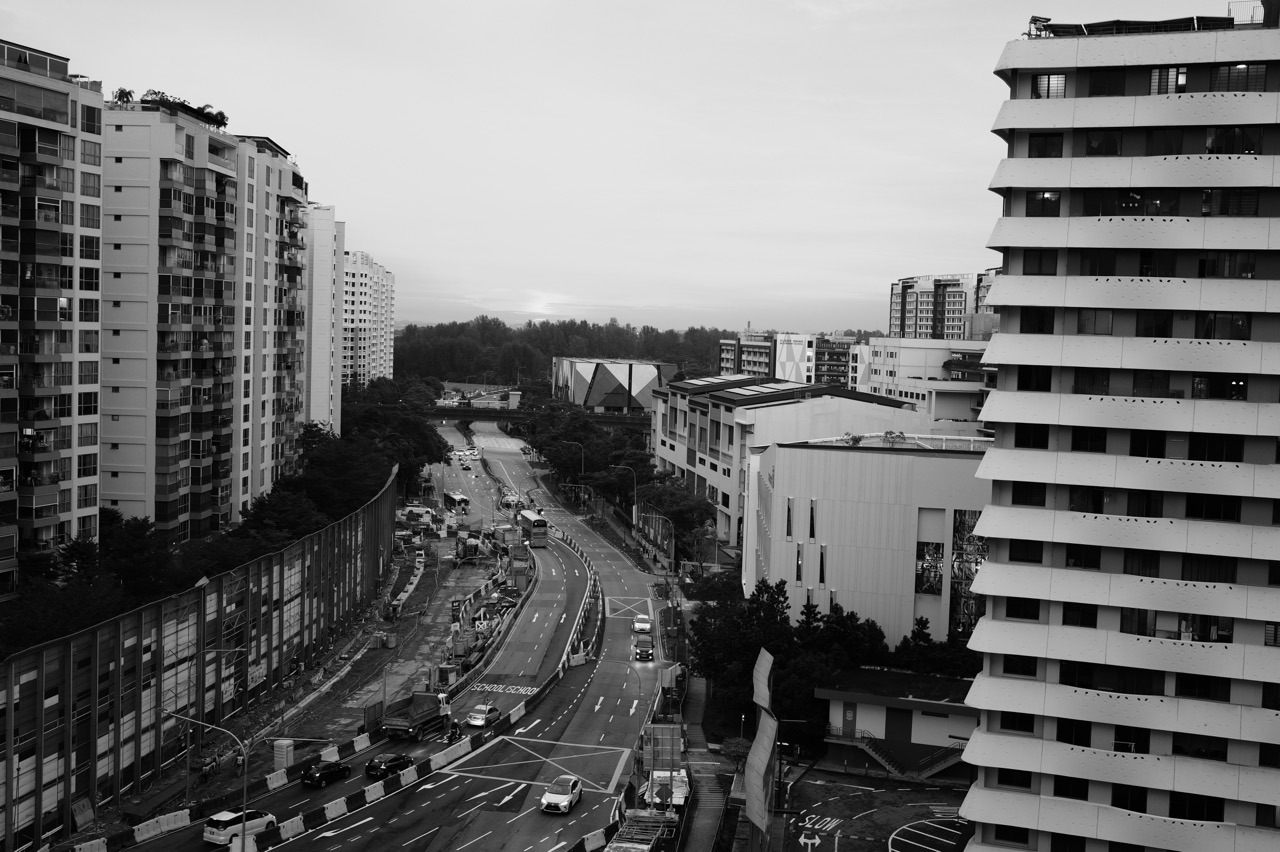
Quick answer: When you see hoardings, barriers or a diverted footpath in Punggol, read them as current safety and access instructions—not as a reliable prediction of when a new building, road or station will open. First locate the authorised pedestrian route, follow signs at crossings, keep out of work areas and check the relevant authority if you need updated information. A construction programme, a roadworks permit, a marketing board and a publicly open route are four different kinds of information.

If you have lived in Punggol for some years, you may know what it feels like to leave home through one familiar opening and return a week later to find temporary fencing, a shifted crossing or a new covered route. A construction site does not remain static: its boundary, access points and working activities can change as the project progresses. Even when the final development is intended to improve a neighbourhood, the temporary stages require careful decisions from residents.
This guide explains how to make those decisions. It focuses on construction hoardings, pedestrian diversions, roadworks and practical public safety in Punggol. The subject is not which contractor is building a particular project today, and it is not a forecast of opening dates. Those claims require project-specific primary evidence. Here we explain how to interpret what you see, how to choose a safer route, how noise rules actually work and how to report an obstruction accurately.
There are three questions to answer before continuing past a worksite: What part of the path is open? Which route has been designated for pedestrians? Is that route suitable for the person travelling with me? A parent carrying groceries, a cyclist, a schoolchild and a wheelchair user might all need different practical responses. The best information comes from the current notice at the affected location, backed by the responsible authority when a situation is unclear.
Three-minute guide to notices
| You see | What it probably concerns | What to do |
|---|---|---|
| Solid hoarding or secured gate | Physical separation between public space and worksite | Stay outside and use an authorised public route |
| Pedestrian diversion arrow | Temporary route around an obstruction | Follow the signed route; check accessibility |
| Lane closure or roadworks sign | Temporary changes to traffic or road occupation | Follow road signs and check LTA information |
| Construction project information board | Project identity or planned programme | Read dates as stated, with context; check latest official update |
| Noise complaint contact | A channel for worksite-specific feedback | Record when and where the disturbance occurs |
| Emergency or danger barrier | A section that may be unsafe to enter | Turn back; use the appropriate immediate safety channel |
The real distinction: a project can be progressing while a route remains unsafe
A development project has a programme, but the public usually experiences it as a changing series of boundaries. A hoarding might protect a structure being built, utility trenching, road resurfacing or a temporary storage zone. Once fencing appears, it is not a request for pedestrians to find any convenient gap. It marks an access boundary that should be treated as authoritative unless the responsible party has clearly opened a public route.
In Punggol, a pedestrian journey may cross residential HDB land, a road corridor, park connector and the frontage of a private or public development. A closure at one boundary can shift people to another path. That new path might be longer or require a different crossing. The physical project and the walking experience are related, but they are not the same thing. A project may be nearly complete while its public access still needs inspection, finishing or commissioning.
Do not infer current public access from a photograph of attractive new paving, a completed-looking facade or a sign naming a future opening year. Check whether barriers remain, which doors are open and whether the operator has confirmed public use. For a separate guide to evaluating announcement dates and claims about new projects, use eduKatePunggol’s dedicated verification article linked below. This article keeps ownership of the safe-diversion question.
1. What a hoarding does—and what it does not promise
A construction hoarding creates a physical boundary between an active work area and the surrounding public realm. It can reduce accidental entry, help control some worksite risks and make clear that a stretch of land is not available as an ordinary public walkway. Depending on the site, the hoarding may carry project details, contractor contact information, safety warnings or promotional imagery. These elements have different purposes, and a colourful picture of a future building is not a pedestrian-access instruction.
People sometimes treat a construction hoarding as an advertisement for what comes next. But the fence is first a sign of controlled access now. Its location can change during a multi-phase project. There may be a temporary pedestrian path just beyond one end, or the official diversion may be on the far side of the road. Do not decide that the closest visible gap must be the intended opening. Look for proper directional signs and safe crossings.
If a hoarding is loose, leaning, unlit near a busy walking route, or obstructing the clearly designated path, this is a concrete safety concern. Report the observed condition accurately. Avoid standing close to unstable panels to obtain dramatic photographs, and do not touch or move any panel. A good resident identifies a hazard without becoming part of it.
An everyday Punggol example
A parent walks beside a road near a fenced development and sees a narrow gap between two panels. The child wants to go through because the library appears close on the other side. The parent checks the official diversion sign instead. The correct route may be longer, but it avoids entering a place where vehicles, equipment or open trenches may be present.
2. Construction, utilities and roadworks are not interchangeable
One blocked pavement can have several possible causes. It may relate to a new building, utility installation, road maintenance, drainage work or structural repairs. Some works are conducted by the development contractor; others belong to public agencies or utility providers. The visible presence of workers and equipment does not identify the project owner by itself. Read the actual sign and official information before making a claim.
LTA’s OneMotoring roadworks information explains that works on public roads are needed for installation, upgrading, maintenance and repair of infrastructure and essential services beneath roads. A utility trench can therefore appear even where there is no new building being erected. Equally, a temporary road closure may be related to service work rather than the final opening of a nearby retail or transport project. Two visible activities happening side by side need not share an operator.
The contact route depends on what is affected. A footpath defect, a possible traffic hazard, building-site noise and a neighbourhood cleanliness complaint may go through different processes. Guessing the agency from a street name can delay the response. Describe the asset and issue, then use the current official contact or OneService routing if it is a routine municipal matter.
An everyday Punggol example
A resident sees fresh excavation outside a row of shops and assumes that the adjacent mall is expanding. The same excavation might involve a utility service. A responsible local article would identify only what the official notice confirms, avoiding an invented development narrative built from a photograph.
3. Read signs in the order a pedestrian needs them
At the edge of a worksite, the first sign to locate is the one that tells you where it is safe to walk. Look for a clear diversion arrow, a marked footpath or a properly provided crossing. Read closure signs before attempting to reach a gate. Project names and artist’s impressions are secondary to the immediate instruction affecting your journey. In a complicated junction, it is usually better to stop briefly in a safe position than to keep moving while trying to decode several signs.
The next task is determining whether the route is usable for your group. Does the diversion include stairs, a steep slope, a narrow turn or a crossing not suited to the traveller’s mobility needs? Signs do not always convey every practical detail at a glance. A person who needs a step-free route should inspect the beginning of the diversion and seek a verified alternative if it cannot be used safely.
Finally, note any dates or times, but avoid giving them more meaning than the sign supports. ‘Works from this date to that date’ may describe a particular activity, not the opening of the completed project. ‘Expected completion’ is a programme statement subject to revision. An operational announcement from the responsible organisation is stronger evidence of public availability than an old site board.
An everyday Punggol example
At a diverted footpath near Punggol Drive, a student first identifies the authorised crossing, then confirms whether the path returns to the correct side of the road. Only after sorting out the route does the student read the project information. This order puts immediate safety ahead of curiosity.
4. The pedestrian diversion is a temporary network
A diversion is more than an arrow. It needs an entry point, enough usable walking space, safe intersections, a way past the worksite and a return to the destination. The alternative path may be only a few metres from the original, or it may go around a block. If any part is missing, the apparent detour may fail in practice. This is why a good route description names the crossing and the destination-side connection instead of simply saying ‘go around’.
Temporary routes can be confusing when pedestrians emerge on a different side of the road. A person who had planned to enter a school or mall through one gate may arrive at a service entrance or closed boundary. Check the destination’s actual public entrance before following a long detour. Where information is inadequate, seek the responsible operator’s clarification rather than attempting a risky shortcut across vehicle movements.
Accessibility is part of safe diversion planning. People pushing strollers, using wheelchairs or walking with aids may require a continuous step-free alternative. Do not assume that a temporary route is suitable merely because most pedestrians can use it. Describe the actual obstacle if you report it: for example, stairs without a visible ramp or a temporary barrier narrowing the route at a specific location.
An everyday Punggol example
A grandparent reaches an unexpected footpath closure while walking to a bus stop. The signed route continues to a pedestrian crossing but involves steps on the far side. The grandparent returns to a safe resting place and checks for an accessible alternative. The inconvenience is real; stepping off a high kerb into traffic would be a worse solution.
5. Cross the road only at an authorised place
Roadworks can temporarily change lane widths, pedestrian sightlines and where motorists expect people to walk. Temporary signs, cones and barriers are not invitations to improvise. Use the crossing provided and obey traffic controls. If the normal signalised crossing is affected, follow the official replacement route; do not cross simply because a road looks quiet for a moment.
A narrow diversion beside moving traffic can feel more stressful with young children. Keep the group together, place supervising adults where they can guide children, avoid sudden lateral movement and allow extra time. A family should not feel pressured into rushing because the old route took only five minutes. Add a time buffer when a habitual journey has been changed by works.
Roadwork areas may involve construction vehicles turning across a path or entering through a gated site access. Even with appropriate controls, pedestrians should avoid lingering in a driveway or standing in vehicle blind spots. Follow markings and any authorised marshal’s directions. Do not assume a stopped truck has seen your child or pram.
An everyday Punggol example
A child and parent reach an intersection where the pavement has been fenced. They use the signed crossing to the opposite footpath and return only at the next authorised point. The detour is inconvenient, but it is based on real pedestrian infrastructure rather than an assumed gap between traffic lanes.
6. A temporary diversion must make sense in both directions
People often check a route while going toward their destination but fail to think about the return. A signed detour may be easier to understand from one end than the other. A person leaving a mall at night could face a different set of visual landmarks and signs. Before you rely on a route for a child or older relative, identify the return path and the point where it rejoins the normal walkway.
Nighttime visibility can make temporary directions harder to read. Rain, glare from vehicle lights or construction lighting and shadows from hoardings can reduce the clarity of pavement edges. Do not interpret a dimly lit gap as an approved pedestrian connection. Keep to designated paths, and report missing or inadequate lighting at the exact location if you notice a safety concern.
One practical approach is to use distinct landmarks: a marked pedestrian crossing, a bus stop identifier, a block number and the correct building entrance. These are easier to communicate than vague references to the ‘third hoarding panel’. Construction layouts can shift, so a route should be checked again when a project moves into a new phase.
An everyday Punggol example
A teenager goes to an evening lesson and knows the outward detour. On the way home the temporary signs look different from that direction. The teenager follows the recognised crossing and block markers rather than trying to reverse an uncertain shortcut through a car park entrance.
7. Temporary bus-stop changes need a separate check
Roadworks sometimes affect boarding locations, bus lanes or how pedestrians reach a stop. Do not assume that a familiar shelter will still be the active boarding point if notices indicate a temporary change. A diversion for cars is not necessarily the same as the pedestrian route to a temporary stop. Read the operator and LTA information relevant to the service in use.
For families, small differences matter. A relocated boarding point might lie on the opposite side of a junction or require another signalised crossing. A child who only knows the old stop’s colour and shelter shape can become confused. Update their route with a stop name, service number and a safe pedestrian approach rather than telling them simply to wait near the construction.
The safest information hierarchy is current transport-operator updates, on-site stop notices and official traffic information. Social-media photographs from earlier phases can help illustrate how an area looked, but they are not live boarding instructions. If information conflicts, contact the appropriate operator and follow active site directions.
An everyday Punggol example
A family taking a bus toward Punggol Point reaches its usual shelter but finds a sign that boarding has moved. They read the posted temporary-stop directions and use the designated crossing. They do not stand in a work zone hoping the bus will still stop where it used to.
8. Cyclists and active-mobility users need their own route decisions
A shared path beside construction can narrow unexpectedly. A cyclist may be able to ride along much of the original route yet need to dismount for a crowded temporary passage. The applicable path signs and current active-mobility rules govern what is permitted. Courtesy matters as well: people using prams or mobility aids should not be forced into an unsafe edge so somebody can keep moving at speed.
Be especially careful where a diversion brings pedestrians and cyclists into a smaller combined area near a road crossing. Speed, visibility and space become more important than maintaining the normal journey time. If a temporary sign instructs users to dismount or use another route, follow it. A new barrier does not justify riding through an unmarked construction access.
Do not move cones or worksite equipment to create a bicycle shortcut. A barrier may protect an open trench, electrical equipment or vehicle route that is invisible from the cyclist’s approach. A safe rider has an alternative plan, even if it requires walking the bicycle for a short distance or taking a different path.
An everyday Punggol example
A student cycling toward the waterway reaches a construction pinch point with many pedestrians. Instead of squeezing past at speed, the student slows, follows local signs and dismounts when appropriate. The travel time changes slightly, but the journey remains predictable for everyone.
9. Work vehicles are not ordinary neighbourhood traffic
Construction delivery vehicles may be large and slow to turn. A driver entering or leaving a worksite has to monitor several hazards, but blind spots can remain. Do not walk immediately in front of or behind heavy machinery because it appears stationary. Stay in pedestrian areas, allow room near entrances and wait for clear instructions where a marshal is managing movements.
Vehicle activity can be episodic. A stretch of path may be quiet for ten minutes and then busy with deliveries. That makes casual observation unreliable as a basis for deciding it is safe to cross a site access. The correct behaviour follows the formal pedestrian provision and traffic controls rather than the apparent frequency of trucks.
For parents and school groups, avoid standing with children directly next to a construction gate to watch cranes or lorries. Curiosity is understandable, and infrastructure can make an excellent educational subject, but observation should happen from safe public locations without blocking others. Do not use a live worksite as an improvised outdoor classroom.
An everyday Punggol example
A child is fascinated by a delivery lorry entering a site near a residential road. The parent watches from a public pavement well away from the entrance. They discuss why large vehicles turn slowly and why a person cannot assume the driver has complete visibility.
10. Construction noise has time bands and legal conditions
Noise is one of the most common reasons a resident notices nearby works. Yet the rules are more specific than ‘construction must stop at 7 p.m.’. NEA’s construction-noise guidance states that permissible noise levels become stricter in the evening and at night. Some work may continue after 7 p.m. on weekdays within the applicable limits. Whether a particular activity is allowed depends on the type and location of the site, time band and other conditions.
NEA’s published guidance also explains a ‘no-work’ rule for certain worksites within 150 metres of residential or other noise-sensitive premises, covering specified late-Saturday-to-Monday and public-holiday periods. Conditional permits and exemptions can apply, including quieter construction or public-interest and safety-critical works. Therefore, seeing activity on a Sunday does not by itself prove a breach. The appropriate question is which rule and permission govern that specific worksite.
A smartphone sound measurement may be useful for a personal impression but is not equivalent to NEA’s prescribed monitoring for enforcement. NEA’s FAQ explains that professional Class 1 sound meters are used for regulatory monitoring. A resident should record factual details—time, date, exact site and character of the sound—and submit feedback through official channels without inventing a decibel result.
An everyday Punggol example
A resident hears machinery at 8 p.m. and assumes all evening construction is illegal. A better response is to check NEA’s published rules, note the exact site and observation, and use the official feedback process if concerned. The authority can evaluate the activity against applicable conditions.
11. Construction dust and regional haze should not be confused
Dust rising near a worksite can look like smoke from a distance. Regional haze, road dust, soil disturbance and emissions from machinery have different sources and may call for different reporting or health advice. Do not identify a pollutant solely from a photograph taken through a window. Wind direction, time, weather, nearby activities and official air-quality information can help provide context, but professional investigation may be needed.
Simple observations can still be useful. Is dust visibly associated with a specific vehicle movement or cutting activity? Does the plume begin at a known site boundary, or does the sky look hazy across a wide area? Does the problem recur at similar times? These facts can help a complaint without making unsupported claims about the exact chemical composition of the air. The presence of a nearby construction site does not prove it caused every poor-air episode.
Residents who need detailed guidance can use the existing eduKatePunggol articles on haze versus construction dust, which address that topic as their primary subject. This article’s responsibility is the worksite boundary, public route and accuracy of observations. When a walking route is affected by obvious dust, choose a safer available route and report the concern rather than entering the site to investigate.
An everyday Punggol example
A family notices a brownish plume near an excavation during an otherwise clear afternoon. They record when and where they saw it, keep children away from the immediate area and consult reliable official information. They do not publish a claim that Punggol is experiencing hazardous regional haze based on the colour of one plume.
12. Weather changes the risk around temporary works
Heavy rain can make an ordinary path slippery, but temporary works introduce extra considerations. Water can hide small changes in pavement level, temporary cable covers or uneven ground. Hoardings and barriers may channel runoff differently from the completed street. A person walking in wet weather should keep clear of water collecting near excavations or equipment and avoid areas that appear unstable or cordoned off.
PUB’s flood-safety advice tells pedestrians to avoid flooded areas and move to safety rather than walk through dangerous floodwater. That applies near construction as much as anywhere else. Do not assume water is shallow because you can see a kerb or recognise a road beneath it. Drainage conditions during works may be different from what a resident remembers before the closure.
Strong wind and storms add a reason not to linger near visibly unstable panels, temporary signs or loose materials. If you observe a dangerous condition, move away and contact the relevant immediate safety channel. A photograph is optional; personal safety comes first. The useful report is the location, hazard and time, not a risky close-up image.
An everyday Punggol example
During a downpour, a pedestrian sees pooled water covering a temporary walkway beside an excavation. Rather than continuing because the destination is only a few minutes away, the pedestrian turns back to a safe route. Familiarity with the street is no guarantee of safe footing under opaque floodwater.
13. School travel deserves a rehearsal when works begin
One unexpected diversion can turn a predictable school journey into a confusing one. This is especially relevant for children who have learned a route by repetition. They may continue toward an old crossing or gate even after barriers have changed. Parents should walk the revised route with younger children where practical, showing the authorised crossing, the new approach and a safe place to stop if signage seems unclear.
The beginning and end of school also create concentrated vehicle and pedestrian movements. If works take up part of the roadside space, the remaining area can become crowded. Never treat a construction gateway or loading zone as a substitute drop-off point. Follow the school’s actual gate guidance and public traffic rules, and allow extra time instead of asking children to hurry through a difficult junction.
Teach a simple response to uncertainty: do not cross an unmarked road, do not enter a fenced site, return to the last known safe landmark and seek help from a trusted adult or appropriate staff member. A student should not improvise because the normal shortcut has disappeared. Confidence is useful only when it is paired with an orderly decision process.
An everyday Punggol example
A child accustomed to a direct path to a Punggol primary school discovers that the pavement is closed. The family rehearses a new crossing and a memorable block landmark. The child understands the new sequence, rather than only hearing ‘be careful near the works’.
14. Accessible diversions cannot be judged from a photograph alone
A posted diversion may meet some technical requirements while remaining difficult for a particular traveller. A wheelchair user might need clear turning space at corners, a pram user may need a smooth kerb ramp, and somebody with poor vision may be affected by confusing temporary boundaries. A photograph showing that the route is paved does not confirm the entire journey is step-free.
Observe the route continuously, particularly the beginning and end. Does it lead to a proper crossing? Are there stairs hidden around the next corner? Is a lift part of the connection? Is the route still available at the intended hour? If an accessible alternative is unclear, ask the site operator or responsible authority before committing to the journey. Do not expect every traveller to overcome the same obstacle in the same way.
Describe accessibility concerns precisely when raising feedback. ‘The temporary diversion ends at a staircase with no visible accessible alternative’ is more useful than calling every construction zone discriminatory without examining the actual layout. The management team can then identify what information or remedial measure is required.
An everyday Punggol example
A caregiver accompanying someone using a wheelchair reaches a fence that redirects foot traffic through an overhead bridge accessible only by stairs from that side. The caregiver stops and seeks the designated accessible alternative. They do not lift the wheelchair over the barrier or attempt to cross the road at an unmarked point.
15. How to find reliable current roadworks information
LTA’s OneMotoring platform provides traffic updates, road closures and roadworks information, including a map and listings. This is a useful official starting point for road users. It is particularly important when someone has seen an old roadworks photo and wants to know whether the same closure applies now. Current official listings and local signs should take precedence over undated social-media commentary.
Not every small footpath maintenance issue will be described with the detail a resident wants on a public roadworks map. That is where exact local observations, on-site notices and the managing agency’s information become important. Do not represent the absence of a project from a particular search as proof there is no work occurring. A site may fall under a different reporting system, or information may be updated later.
Similarly, a roadworks listing is not an official prediction that a nearby building will begin operations by that date. It may describe a service provider and expected date for a particular road occupation or activity. Verify broader opening claims separately through the project owner or regulator. Keeping these information categories separate is a basic form of good civic reasoning.
An everyday Punggol example
A commuter sees a picture of roadworks outside Watertown posted several weeks ago. Instead of using the image as a live traffic advisory, the commuter checks OneMotoring and looks for any active local diversion notice before choosing a route.
16. Report the physical hazard through the right channel
OneService’s current guidance explains that municipal feedback can be routed to agencies and Town Councils. Its September 2026 page on footpath maintenance specifically distinguishes urgent tripping hazards—where the relevant agency or Town Council should be called—from less urgent reports suited to the app. For a serious immediate danger, contacting the right emergency or agency hotline is more appropriate than submitting an ordinary case and continuing to wait at the hazard.
For a non-urgent case, include an exact location, a photograph if safely available, the time and a concise description of what is wrong. ‘Temporary fencing extends across the accessible pavement outside this specific block, forcing pedestrians close to traffic’ is reportable evidence. ‘Punggol construction is badly planned’ expresses frustration but does not tell a responding officer which defect to inspect.
After sending a report, distinguish acknowledgement from resolution. OneService explains that complex cross-agency issues may take longer and that updates can record planned follow-up actions. Save the case number and add a factual update if the condition changes. Repeating the same vague complaint in several places may complicate rather than accelerate understanding.
An everyday Punggol example
A parent notices a temporary ramp plate has shifted at an estate junction. The parent keeps children away, records the exact location and contacts the appropriate channel. The report focuses on the shifted plate and trip hazard, not an unsupported theory about why the contractor installed it.
17. Photograph public works as evidence, not as a rumour source
Construction photographs can be excellent records of urban change. Punggol’s rapidly evolving streetscapes make dated visual archives especially valuable. But a photograph should be captioned with only what it demonstrates: a location, visible structures, barriers, equipment and the observation date. It should not be used to invent project ownership, internal safety compliance, completion percentage or an opening month.
A good evidence photograph has a wider view establishing the location and a closer view showing the relevant public-side detail. Avoid photographing workers’ faces unnecessarily, looking through private windows or crossing a worksite boundary for a stronger angle. Public-interest reporting does not require exposing people or interfering with their work. The benefit is a clearer historical record, not sensational footage.
When comparing photos taken weeks apart, account for different camera positions, times and project phases. What seems like a removed barrier may have moved outside the frame. What looks like a finished road may lack operational clearance. If the user of a photograph cannot independently verify current status, the caption should say so plainly. This is a higher editorial standard than claiming certainty from visual excitement.
An everyday Punggol example
A teenager documents a pavement diversion on October 23 and compares it with a photograph from October 4. The report marks both dates and describes the visible difference without claiming that an entire development is complete. It becomes a useful local history exercise as well as an example of source discipline.
18. Give construction workers the same courtesy you expect as a pedestrian
Construction changes people’s daily routines, and frustration can be understandable. It does not justify obstructing workers, shouting at a vehicle marshal or entering a site to challenge somebody. Many people on the public-facing edge of a project are carrying out assigned roles, and they may not have authority to answer detailed scheduling or contract questions. Use the contractor or agency’s designated contact route for formal enquiries.
If a pedestrian cannot find the diversion, a polite question to an authorised worker or marshal can help, provided it is safe to approach. Do not crowd a site entrance or distract someone operating machinery. If there is a serious safety concern, move away and report through the proper channel. Courtesy and accountability can coexist: residents can be firm about hazards while remaining accurate and respectful.
Likewise, avoid posting identifiable workers’ photographs with accusations that have not been established. A visible problem with fencing or signage should be described as the observed problem. The process for investigating legal or technical responsibility belongs to the relevant authority. A clear factual report is more likely to lead to an effective response than public speculation about individual motives.
An everyday Punggol example
An older resident is confused by a newly shifted path. A marshal gives directions to a signed crossing. The resident thanks them and follows the route. Later, if the signs are difficult to read, the resident reports that design issue through an appropriate channel rather than turning the brief interaction into a personal complaint.
19. Use Punggol’s changes to teach better civic observation
Punggol can be a living classroom for geography, engineering, citizenship and communication. A child can learn how temporary routes preserve access while permanent infrastructure is changed. An older student can compare an official roadworks notice with what is visible from a safe public path. The meaningful learning task is not ‘guess when this project opens’. It is ‘separate what we can observe from what an authority has actually confirmed’.
Try a simple four-column field notebook: location, observation, official source and question still unanswered. Under observation, write ‘fence blocks former path’. Under source, record the diversion sign or LTA listing. Under uncertainty, ask whether a new crossing is permanent or temporary. This structure trains critical thinking because it does not let students fill gaps with imagined certainty.
At the end of the walk, ask how the family adapted. Did they choose a safer crossing, discover an accessible route or identify a better place to wait? That is an applied lesson about shared urban systems. The value is not collecting spectacular construction photographs; it is learning how to interpret changing information and act responsibly.
An everyday Punggol example
A Secondary school student prepares a local reporting assignment around Punggol Drive. They compare the current public-side signs with an official traffic notice, date their photos and mark unknown facts openly. Their report is more rigorous than one asserting that scaffolding proves a building will open next week.
Five practical worksite scenarios
A new footpath closure on the school run
The old route to school is fenced before the morning peak. The parent finds the designated crossing, checks the route on the destination side and rehearses it with the child. The child learns what to do if another unexpected closure occurs. The family does not attempt to bypass the fence through a service gate, and it allows more time during the adjustment period.
A wheelchair user meets an inaccessible temporary bridge
A signed route points to an overhead connection, but the approach visible from that side includes stairs. The traveller does not assume a ramp exists somewhere beyond the barrier. They remain in a safe public area and seek an accessible alternative from the responsible party. If the site provision appears inadequate, they document the exact obstacle rather than treating one photograph as a complete technical audit.
A resident hears late-evening construction work
The resident records the site, date, time and nature of the noise. They check NEA’s current information, including the time-dependent limits and qualified no-work rule, rather than assuming a universal 7 p.m. prohibition. If concerned, they use an official feedback route. A phone decibel app is not represented as proof of a regulatory breach.
A roadworks notice appears beside a nearly complete facade
Residents become excited that a new facility may open. The notice, however, concerns a specific utility or street work with its own expected completion date. A family preparing a visit checks the facility owner’s separate public-opening announcement instead of treating the street notice as proof of operational readiness.
A sudden downpour covers a temporary pedestrian route
A commuter sees water moving across the diversion near a road excavation. The person turns back to a safer route and follows PUB’s flood-safety guidance. They do not step into murky water to test the depth. Once safe, they can report the observed water hazard precisely if appropriate.
Frequently asked questions
1. Does a construction hoarding mean the public can walk beside it?
Only where there is an authorised public path. Follow the current barriers and signed pedestrian route; do not use gaps or service gates.
2. Does an expected completion date mean a new building will open then?
No. A construction programme and a public operating or opening announcement are different.
3. Can I cross a road where the old walkway has been removed?
Use the designated crossing and follow traffic controls. Do not assume a former direct line is now safe.
4. Do roadworks always mean a new development is being built?
No. Roadworks can involve utilities, maintenance, repairs and other infrastructure operations.
5. Is construction prohibited after 7 p.m.?
Not universally. NEA applies time-dependent noise limits and other site-specific requirements. Check the current rules and any applicable permits.
6. Is construction work always illegal on a Sunday?
No universal claim is justified. NEA has a no-work rule for certain nearby noise-sensitive sites during specified periods, with conditional permits and exceptions.
7. Can a mobile phone establish a construction-noise violation?
A phone measurement is not a substitute for the Class 1 monitoring equipment NEA uses for regulatory enforcement.
8. What if a diversion has stairs and I need a step-free route?
Do not use an unsafe shortcut. Seek an accessible alternative through the site operator or relevant authority.
9. Where can I check Singapore road closures and works?
LTA’s OneMotoring platform provides official traffic updates, closures and roadworks information; current on-site signs also matter.
10. How should I report a dangerous temporary footpath?
For an immediate safety hazard, use the appropriate agency or emergency channel. For ordinary municipal issues, provide an exact location, date, description and safe photograph through OneService or the responsible body.
Official sources
LTA OneMotoring: Traffic Updates, Road Closures and Road Works
NEA: Construction Noise Control
NEA: Frequently Asked Questions About Construction Noise
NEA: No-Work Rule on Sundays and Public Holidays
OneService: Footpath Maintenance and Routing Feedback (September 2026)
Read the connected Punggol guides
Things to Know About Punggol: How to Verify New Development Opening Dates and Construction Claims
Construction Noise in Punggol: Prepare Clear Feedback for NEA
Punggol Haze vs Construction Dust
Things to Know About Punggol: Sheltered Walkways, Ramps and Step-Free Routes
Things to Know About Punggol: Void Decks, Precinct Pavilions and Shared HDB Spaces
In a changing Punggol neighbourhood, a worksite boundary does not have to be frightening or mysterious. It is information about where the public should not go. A good detour tells you where to go instead. Read the signs, verify the right source, keep the route suitable for the people travelling with you and report precise problems when a connection fails.


