
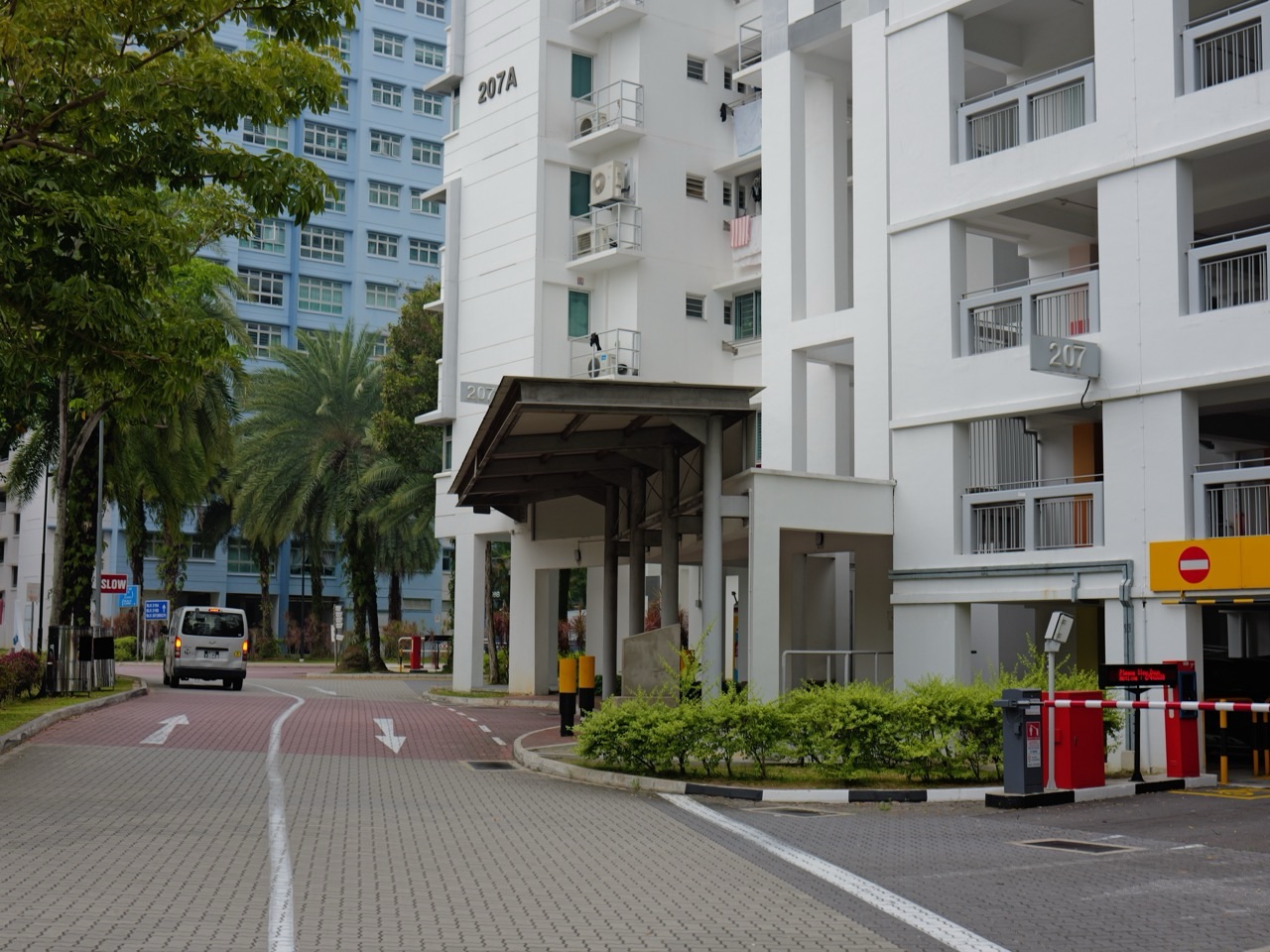

Quick answer: A loading bay, a passenger pick-up point, a parking space and the side of a public road are not the same thing. In Singapore, the distinction between stopping, waiting and parking matters even when a driver stays inside with the engine running. LTA’s guidance says a vehicle waiting for a passenger may count as parked, while a designated no-waiting point may allow immediate pick-up and drop-off only. Road markings and signs can prohibit stopping altogether. In Punggol, follow the actual site signs, parking conditions and safe pedestrian routes instead of assuming an apparently empty kerb is available.
A very ordinary day in Punggol can require several different vehicle movements. A taxi arrives for a grandparent. A parent drops a child at school. A delivery van brings furniture to an HDB block. A ride-hail driver waits for somebody coming down from a high floor. Each movement may take only a few minutes, but the space required is not interchangeable. A badly placed vehicle can block an exit, obstruct a pedestrian’s view or prevent someone with a wheelchair from using a proper drop-off area.
This guide examines how Punggol’s loading bays, passenger drop-offs, kerbs, HDB car parks and road markings work. It is not a location-by-location directory of taxi stands or an invitation to challenge parking wardens. A separate eduKatePunggol article covers where to find taxi stands and ride-hail pick-up points. Here the focus is understanding the rules and making good choices when an otherwise convenient place is not appropriate for stopping.
1. Four activities that look similar but are not
Parking means leaving a vehicle stopped in a way that is more than an immediate pick-up or drop-off operation. Waiting is the act of remaining in position for a passenger, courier or other purpose even if the driver stays inside. Immediate passenger pick-up or drop-off is a short, active transfer when the place and road rules permit it. Loading or unloading involves moving goods and may have specifically designated facilities and management conditions.
LTA explains that a waiting vehicle can count as parking even while the driver remains at the wheel or the engine runs. That is an essential correction to the familiar claim, ‘I’m not parking because I’m still in the car.’ The legal and operational question is what the vehicle is doing in that location, not just whether the ignition is on or a person is present.
A Punggol family can use this distinction before any trip involving a vehicle. Is somebody already at the pick-up point, ready to enter? Is the driver likely to wait several minutes for a child to collect a bag? Is a van unloading several heavy items? Each question may direct the driver toward a different appropriate arrangement. Planning ahead helps avoid treating all kerbs as general-purpose waiting areas.
Punggol example
A driver arrives early for a family member outside a community facility. The family member is still upstairs. The driver should not assume that keeping the engine running turns waiting into an immediate pick-up. They can use an authorised parking arrangement and approach the correct pick-up point when the passenger is ready.
2. A passenger drop-off point has a particular purpose
A signed passenger drop-off point provides a location intended for safe boarding or alighting, under the applicable conditions. Such a point may be useful near a transport station, shopping complex or community building. Its role is different from a loading bay designed for goods. The presence of a drop-off sign does not automatically create permission to queue indefinitely or leave a vehicle unattended.
LTA’s published driving rules distinguish ‘No Waiting’ signs from unrestricted stopping. Where immediate passenger transfer is permitted, the permission is limited to the activity specified by the road rules and site instructions. At some locations, CCTV enforcement and signs remind motorists not to wait. A driver should read the sign and use the point for a prompt, safe movement rather than converting it into a holding area.
Drop-off planning also concerns the passenger. Stopping where the door opens directly into bicycle movement, where a crossing is blocked or where a person must walk into traffic can undermine the purpose of the bay. Choose a legal, designated place with a practical pedestrian route. A driver who stops closer to a doorway at the expense of a dangerous crossing has not necessarily helped the passenger.
Punggol example
A parent is dropping an older relative near One Punggol. The parent identifies the authorised set-down arrangement and the usable path to the intended entrance, then leaves promptly. If the relative needs more time to exit, the driver should choose the proper accessible or parking option rather than create pressure or block circulation.
3. Loading bays are about goods movement
A loading or unloading bay is intended to facilitate the movement of items, deliveries or relevant commercial activities, according to its designation and posted conditions. It may need space for larger vehicles, a lift platform or movement of goods toward a building. A loading bay is not necessarily a visitor car park, passenger waiting line or informal meeting space.
HDB’s published parking information identifies selected loading and unloading bays with differential pricing to encourage vehicle turnover where demand is high. This shows the policy principle: such spaces are designed to remain available for their intended short-duration operations. But it would be wrong to generalise the charging schedule from one listed facility to every loading bay in Punggol. Check the actual signs and parking system at the location.
The same principle applies inside private developments. Their loading areas may be controlled by building management and subject to vehicle sizes, service timing and access procedures. A courier’s expectation that the bay will be available does not override a displayed closure or other restrictions. Motorists should arrange the appropriate place before arriving with heavy goods.
Punggol example
A household receives a large flat-packed cupboard. The delivery company checks the block’s authorised loading arrangements and coordinates the timing. The van does not automatically occupy the nearest passenger drop-off or a footpath because the delivery will take ‘only five minutes’.
4. A few minutes can still create obstruction
One motorist may reason that a very short stop is harmless. But the effect depends on where it happens. A vehicle stopped beside a crossing can reduce visibility for children; a van outside a narrow car-park exit can cause queues; a car beside a turning point can prevent larger vehicles from passing safely. The duration does not remove the physical obstruction while it occurs.
LTA’s illegal-parking guidance highlights the danger of obstructing public roads and the visibility of other road users. A driver should think about the intended function of each space. Is this a traffic lane, pedestrian crossing approach, loading access, emergency route or marked parking lot? If stopping would interfere with that function, the convenience of saving a short walk is not a justification.
The safest solution is often simple: choose an authorised waiting or parking area, coordinate by phone when the passenger is ready, and approach the designated pick-up only when the transfer can be completed. This reduces unnecessary circulating and waiting. It also makes access easier for people who genuinely need the limited set-down space.
Punggol example
A car stops beside an HDB driveway while a child runs upstairs for a forgotten item. Other vehicles now have to pass around it. The better response is to use an available legal parking space rather than insist that the engine running or hazard lights make the obstruction acceptable.
5. Hazard lights do not erase parking restrictions
Hazard warning lights serve a signalling function; they are not a general permission to park where stopping is restricted. A motorist sometimes turns them on while waiting in a bus stop, beside a school crossing or in a narrow lane. The flashing lights may make the vehicle more visible, but they do not create extra road space or cancel a regulatory sign.
This matters particularly in a busy town centre where many people arrive by taxi, ride-hail and private car. A hazard-light vehicle near a junction can block sightlines or create a bottleneck even when other motorists understand that its driver intends a short stop. The question remains whether the location permits that particular activity and whether the vehicle is safely positioned.
If an actual breakdown or emergency occurs, different safety actions may be needed, including following relevant traffic and emergency guidance. But an ordinary delayed passenger is not an emergency. Motorists should make a distinction between unforeseen vehicle trouble and self-created waiting at an unsuitable point.
Punggol example
A ride-hail driver arrives before the passenger and switches on hazard lights beside a junction. The responsible option is not to remain there indefinitely. Use a lawful place to wait and return to the proper pick-up arrangement when the passenger is ready.
6. Double yellow lines and single yellow lines are not identical
LTA’s official parking guidance distinguishes road markings. Double yellow lines indicate no parking at all times along the relevant side of the road. A single continuous yellow line generally restricts parking from 7 am to 7 pm, except Sundays and public holidays, under the published rule. This is the national framework; specific signs or other applicable rules may impose different or additional restrictions.
Do not interpret ‘no parking’ as universal permission to stop and wait. LTA distinguishes immediate pick-up or drop-off from parking where legally allowed, and the circumstances at a crossing, bus stop, junction or other restriction can prohibit stopping. It is necessary to read the full road environment rather than isolate one painted line as the only condition.
A useful family habit is to check the markings and signs before arranging a pick-up. If the route involves a turn, pedestrian crossing or busy school approach, use an authorised location. Small changes in the stopping position can have large consequences for people trying to see approaching traffic.
Punggol example
A driver sees double yellow lines along a Punggol road and says, ‘We won’t park; just wait two minutes.’ The correct response is to recognise that waiting can count as parking. If the passenger is not ready, use an appropriate legal waiting space instead of hoping the short duration will be overlooked.
7. Zig-zag markings deserve particular attention
LTA’s guidance identifies yellow zig-zag and white zig-zag markings with restrictions that are different from ordinary yellow parking lines. Double yellow zig-zag and white zig-zag markings can prohibit stopping and parking altogether, while a single yellow zig-zag has its own no-parking rule and limited immediate pick-up or drop-off distinction under the published guidance. These markings are not decorative variations.
The safety purpose often relates to visibility or the approach to pedestrian crossings. A stationary vehicle may hide children or adults from an approaching driver. Pedestrians are not made safer simply because the parked vehicle is large, well lit or has an adult watching from the window. Road markings are designed for the safety of multiple users, not just the occupant who wants the shortest journey.
When a driver is uncertain about a marking or the influence of an adjacent sign, the safer approach is to use a clearly designated legal parking or pick-up facility. Do not create a home-made interpretation based on a faded photograph from a different road. Up-to-date LTA guidance and the actual site signs should govern the decision.
Punggol example
Near a zebra crossing, a driver considers stopping for a child to get out. Zig-zag markings signal the need for greater care about the restrictions and crossing visibility. The family uses a suitable drop-off facility farther away and walks to the entrance by the designated pedestrian route.
8. White markings may prohibit both stopping and parking
LTA’s official information also explains continuous white-line restrictions and white zig-zag markings. These can govern where parking or stopping is not allowed. Drivers who remember only yellow lines may overlook an important instruction. Understanding the distinction matters when travelling through streets with various lanes, pedestrian crossings and turning points.
The safest way to use this knowledge is not to memorise every possible enforcement penalty. Instead, recognise that road markings form a system. A driver’s right to stop depends on the complete rules for that road segment and the activity intended. An apparently empty area is not automatically lawful simply because no other vehicle is using it.
Parents teaching teenagers about road safety can turn this into an observation exercise from a safe sidewalk. Identify signs, crossings and permitted passenger points. Do not encourage learners to test where a vehicle might stop or photograph moving traffic from the carriageway. Road markings should be read to support safe decisions, not treated as a challenge to find loopholes.
Punggol example
A teenager sees a white zig-zag line and suggests using it for a quick pickup because it is not yellow. The parent checks LTA’s actual guidance and explains that the colour difference does not make the location freely available for stopping.
9. A school drop-off has extra pedestrian considerations
At school arrival and dismissal, the number of children and vehicles can increase sharply over a short period. Drivers may be distracted by queues, rain or time pressure. A child may be shorter than the sightline over a nearby vehicle. That is why school-specific instructions and authorised pedestrian crossings matter, even if the shortest direct route to a gate looks convenient.
A family should follow the school’s current arrival and dismissal guidance rather than copy an arrangement from another school or a previous year. Where a school has a designated set-down point, use it as instructed. If a parent needs to spend time preparing a child or unloading equipment, they should consider whether a legal parking option is more suitable than holding up an active drop-off lane.
Singapore Police Force road-safety advice encourages the use of proper crossings and warns against crossing between stationary vehicles where visibility is limited. This applies to children walking from a Punggol car park or set-down point. Parents can model the right habits by choosing a safe route even when running late.
Punggol example
A parent cannot find space beside a school gate during morning arrival. Instead of stopping at a zebra-crossing approach, they use a lawful designated arrangement and accompany the child safely along the footpath. The final walking distance is less important than predictable visibility.
10. Ride-hail pickups require coordination, not kerbside waiting
A ride-hail booking gives a passenger and driver a way to meet; it does not override road rules or site restrictions. A passenger may select a location in an app, but the actual safe pick-up point can be on a different side or level of a building. In multi-storey or complex developments, a vague message such as ‘outside the mall’ may send the driver into the wrong circulation area.
The effective method is to agree on the authorised point before the driver arrives. Give the correct entrance or signed passenger bay, and wait where pedestrians are permitted. If the building has multiple access levels, confirm whether the chosen point is accessible for the person travelling. Drivers should not wait indefinitely in no-waiting areas because the passenger is delayed.
This article is not a live directory of ride-hail locations, which can change with construction and operating decisions. The separate Punggol taxi-and-pick-up guide provides place-finding context. Here, the enduring principle is to match the app’s meeting instruction to current local signs and safe pedestrian access.
Punggol example
A passenger books a ride near Waterway Point but stands beside a different entrance from the one shown in the app. The family checks the designated pickup and communicates the correct level or entrance. They do not ask the driver to stop across an active traffic lane to save a short walk.
11. Deliveries involve people, goods and sometimes heavy vehicles
Home deliveries can include small parcels, appliances, furniture and renovation materials. Their loading requirements differ. A courier carrying a lightweight package may need only a short lawful stop. A furniture mover may need access to a service bay, loading platform or lift, with enough room to handle the item safely. The existence of an HDB address does not grant permission to block a common corridor or service road.
When arranging a large delivery, provide the operator with the correct block, entrance and permitted vehicle access information. Ask the building manager where appropriate. Do not rely on the driver’s assumption that all Punggol estates have an identical loading facility. Newer and older developments can differ in the location of service roads, covered passages and lift access.
A sensible household plan also prepares the recipient. Ensure someone is ready to receive goods, keep the permitted path clear and avoid leaving packaging or furniture in shared space after unloading. Reducing delays at the actual loading bay makes the facility more useful to the next vehicle.
Punggol example
A washing machine delivery arrives at a block with a separate service area. The household has already confirmed the correct access point and lift route, so the driver can unload efficiently. The alternative—parking diagonally across a passenger bay while asking for directions—creates avoidable obstruction.
12. HDB loading bays do not all have the same fees
HDB publishes short-term parking charges and identifies a limited list of loading and unloading bays where differential pricing applies. The selected facilities are intended to encourage turnover where demand for loading and unloading is high. The published example includes a free initial period followed by escalating charges, with a stated exception at one listed location. These details are site-specific.
It would be misleading to write that every loading bay in Punggol offers the same initial free period, or that all loading bays throughout Singapore share that selected pricing model. Some Punggol facilities may have different arrangements or no such differential pricing. The appropriate charge and permission are whatever the current sign and applicable car-park system specify at that particular site.
The practical economics are straightforward: a facility intended for short turnover works better when users do not occupy it as long-term parking. The rules balance accessibility for goods deliveries and other vehicles competing for limited space. Motorists should check current conditions rather than rely on a screenshot taken at an unrelated market or town.
Punggol example
A driver reads online that a loading bay elsewhere offers an initial free period. Before using a Punggol bay, they check its sign and payment arrangement. They do not assume a nationwide entitlement based on a specific HDB schedule for other car parks.
13. Service access and fire-engine routes cannot become waiting areas
Some areas around residential blocks and developments are required for emergency access, maintenance vehicles or other operational purposes. These are not general overflow parking spaces. A large vehicle or emergency team may need turning and manoeuvring room that an ordinary car driver does not appreciate. Even if no emergency is occurring at the moment, obstructing the route can cause problems when immediate access is needed.
An empty service entrance therefore needs to be understood in context. The absence of a gate or a ‘No Parking’ board directly in front of the vehicle does not necessarily mean stopping is safe or authorised. Nearby signs, traffic rules, the layout and management instructions still matter. Drivers should not block hydrants, service cabinets, access doors or marked routes merely because they plan to remain nearby.
This is consistent with the broader principle of shared estate spaces: a location’s primary purpose may be emergency readiness or service access, not convenience for an individual driver. If a family needs a longer loading operation, arrange an authorised space in advance.
Punggol example
A visitor sees a broad clear lane beside an HDB block and thinks it is ideal for waiting. A sign shows that the area must be kept clear for service access. The visitor uses a legal car-park lot instead. Empty space can be necessary infrastructure.
14. Accessible passenger drop-off requires a complete route
An accessible drop-off is valuable only if the passenger can move safely from the vehicle to the intended entrance. A kerb may be too high, an adjacent path may have steps, or the lift needed for the destination may be unavailable. This is especially important for wheelchair users, people using walking aids and families with bulky strollers. A driver should plan where the passenger can alight, not just where the vehicle can stop.
Look for appropriate signage and the actual step-free route. A marked accessible facility may have conditions that need to be observed. Do not use an access-related bay for extended waiting when another person needs it. The best arrangement leaves enough room for boarding, mobility equipment and other pedestrians, without blocking the movement of additional vehicles.
A passenger’s needs can also change how long a transfer takes. Rather than rushing someone because another vehicle has arrived, use an appropriate authorised location and plan the necessary assistance. Where a venue has a designated accessible drop-off or management office, ask for its current instructions in advance.
Punggol example
A family brings a relative with a walking frame to a community hub. They identify a suitable drop-off and the nearest functioning step-free route. If the usual lift is closed, they arrange an alternative rather than stopping on a roadside crossing to get closer to a staircase.
15. Bus lanes, bus stops and taxi stands are not interchangeable
A bus stop serves scheduled public transport and passengers boarding or alighting there. A taxi stand has a particular function, and a ride-hail pickup may be directed elsewhere. A bus lane or other regulated road segment has its own applicable rules, including restrictions that can depend on the time and location. None is simply an empty kerb available to any car.
LTA’s driving-rules information explains the types of bus-lane restrictions and road signs. Drivers should read what applies on the road where they are, not rely on a memory of a different location. Blocking a bus stop to wait for a passenger can interfere with buses and increase risk for people trying to board. Stopping near a bus shelter can also make pedestrians step around the car.
The fact that a ride-hail app shows a broad meeting area does not grant permission to use a bus stop or taxi-only facility contrary to the applicable rules. Drivers and passengers should choose a designated permitted meeting point and coordinate timing. This reduces conflict between different transport services that use the same town.
Punggol example
A private car driver sees an empty bus stop beside an LRT connection. It is not a convenient waiting bay simply because no bus is present. The driver finds an appropriate passenger point or parking area instead of interfering with the public transport space.
16. Weather and construction alter practical drop-off decisions
Rain can make a short walk feel longer, especially with children or heavy bags. It may be tempting to stop directly at the most sheltered doorway even when the kerb is not designated for set-down. But water and darkness can also reduce visibility, making an improvised stop more dangerous. A safe designated drop-off with a modest sheltered walk can be better than an illegal manoeuvre beside a busy entrance.
Temporary construction can close an established pick-up route or redirect traffic around a development. Drivers should follow current signs and authorised diversions rather than insist that last year’s arrangement must still be valid. A GPS app or archived article may not show every temporary closure. The local sign and operator notice matter at the point of travel.
This is another reason to coordinate with passengers. Communicate the actual entrance or temporary meeting area and allow sufficient time. A family can have a backup pickup location that is safe and legal, rather than forcing a driver to circle dangerously or reverse into a restricted area.
Punggol example
During rain, a usual Punggol pickup area is fenced for works. The family reads the temporary wayfinding and uses the current authorised passenger point. They do not ask the driver to enter the workers’ zone or stop across the pavement merely because it is closer to the shelter.
17. Illegal parking feedback must be specific and timely
A vehicle that genuinely blocks a crossing, footpath or public road may merit an appropriate report. OneService’s June 2026 app FAQs explain that the illegal-parking category uses a live photograph taken through the app and prompt submission within the prescribed time window. This helps relevant officers respond to current conditions rather than old incidents. The exact category and procedure matter, so residents should use the current official instructions.
This is different from reporting a damaged pavement, broken lamp or abandoned object. The appropriate reporting channel may route those issues differently. A driver who is merely unfamiliar or lost is also not automatically guilty of an offence. Residents should describe what they see without inventing motive or escalating a routine disagreement into a confrontation.
Safety comes first. Do not step into the road to photograph a vehicle, block its exit to obtain a better image or argue aggressively with the driver. A report should contain the correct location and relevant facts gathered from a safe position. For immediate danger, seek the appropriate urgent response instead of treating a digital submission as a substitute for safety action.
Punggol example
A parked vehicle blocks a footpath and forces a person using a wheelchair toward traffic. The resident records the location safely and uses the applicable reporting channel. They do not post identifiable driver details online or attempt to remove the vehicle themselves.
18. A well-timed pickup can prevent half the problem
Many waiting problems begin with poor coordination. The driver arrives before the passenger has finished an errand, the passenger is at the wrong entrance or the family forgets to mention a bulky wheelchair or shopping trolley. All of these difficulties can be reduced before the car reaches the pickup area. The driver and passenger should agree on the authorised location and approximate readiness.
For trips involving children, an adult can ensure bags and belongings are ready before the vehicle stops. For trips involving a mobility aid, plan a suitable bay and allow proper assistance. For parcels, make sure the receiving person and service access are available. The objective is not to rush people unsafely. It is to arrange the right facility and avoid needless occupation of a scarce kerbside space.
Where the passenger is delayed, a legal parking or waiting option is the appropriate place for the driver rather than a no-waiting bay. LTA’s definition makes clear that remaining behind the wheel does not change the substance of waiting. Good timing is therefore a road-safety practice as well as a courtesy to other users.
Punggol example
A family has a taxi booked for a grandparent after a clinic visit. Instead of asking the taxi to wait outside for ten minutes, they confirm the grandparent is ready and communicate the authorised pickup. The transfer is calm because neither the passenger nor driver is improvising at the kerb.
19. Teach children the pedestrian side of loading areas
Children can understand that a delivery bay is a working vehicle space, not a playground. Trucks and vans may have limited visibility close to the body of the vehicle, and workers moving trolleys or bulky goods need room. Children should remain with an adult and use designated walking routes. Do not cut through a loading area simply because it appears quieter than the main entrance.
Singapore Police Force road-safety advice emphasises using crossings and avoiding crossing between stationary vehicles where drivers may not see pedestrians. That instruction is relevant to school arrival, mall pickups and residential service roads. Adults set the example when they decline shortcuts around idling cars and wait for a clear, authorised crossing.
An educational exercise can use a map or a safe observation point rather than a working loading bay. Ask a child to distinguish the car entrance, pedestrian path, loading area and passenger point. This teaches how urban design separates movements with different speeds and visibility needs. It is practical civic knowledge, not simply memorisation of road signs.
Punggol example
A child wants to walk between two delivery vans to reach the lift more quickly. The parent chooses the proper walkway and explains the limited view that a van driver may have. An extra short distance is preferable to emerging unexpectedly into vehicle movement.
20. The best rule is to match the space to the activity
Punggol’s roads and developments support a wide variety of everyday journeys. That variety works only when users respect the purpose of each part of the environment. Parking lots store vehicles for permitted periods. Loading bays support goods movement. Passenger set-down points facilitate prompt transfers. Bus stops and taxi stands have specialised transport functions, while service routes need to remain available for their intended operations.
No single rule about ‘a quick stop’ can replace those distinctions. The applicable road markings, signs, operating conditions and actual safety of the location determine what is appropriate. A vehicle may be convenient for one family and an obstruction for many other people. The most useful driver asks not just ‘Can I fit here?’ but ‘What is this space designed to serve, and whom would I be blocking?’
The practical method is brief: identify the activity, find the proper designated facility, check current rules, coordinate timing and keep pedestrian access clear. If there is a genuine offence or hazard, report it through the appropriate official channel without confrontation. Better information and courtesy can make daily life easier in Punggol without requiring every kerb to become a parking space.
Punggol example
A family plans a school pickup, supermarket collection and furniture delivery on one day. Each movement uses a different arrangement: authorised school set-down, suitable shopper parking or pickup, and a properly coordinated loading bay. The family does not treat the nearest available roadside gap as the universal solution.
Four worked Punggol scenarios
The early ride-hail driver
A ride-hail driver reaches a pickup point before the passenger is ready. The passenger is still paying at a shop. The driver cannot convert a signed no-waiting point into parking merely by leaving the engine on. Instead, they use a lawful holding arrangement if available and coordinate by phone, then approach the point for a prompt transfer. This is not only about avoiding an enforcement notice. It helps keep the space available for other vehicles, including those carrying passengers who need a short safe transfer.
The furniture delivery at an HDB block
A couple receives a wardrobe and a large appliance. The driver wants to unload from a narrow residential road, but the block has a different service arrangement. The couple confirms the authorised bay and access route, clears the path to the lift and coordinates with the delivery team. They avoid blocking a fire-engine access route or leaving packaging in a shared corridor. The extra preparation prevents disruption to other residents and helps the delivery finish efficiently.
The school gate during heavy rain
Rain begins near dismissal, and several drivers try to stop as close to the gate as possible. One parent chooses not to stop across a marked crossing or bus access. They use the permitted arrangement given by the school, communicate with the child and follow safe pedestrian movement. The child may need to walk under an umbrella, but the family has not increased traffic risk by improvising an illegal stopping point. The correct decision balances weather comfort with the safety of everyone near the school.
The blocked accessible ramp
A car is waiting beside a building entrance and partly blocks a step-free ramp. The driver says somebody will be down shortly. A wheelchair user now has no practical access. The immediate priority is safe passage and appropriate assistance, not a confrontation. A resident can report the exact location through the correct channel using the current official process and a safe viewpoint. The case shows why a car’s brief waiting period is still consequential: a scarce accessible route can become unavailable in seconds.
Frequently asked questions
Is staying in the driver’s seat different from parking?
LTA explains that a waiting vehicle can count as parked even with the driver present or the engine running. What matters is whether the vehicle is involved in an immediate permitted pickup or drop-off.
Do hazard lights allow me to stop anywhere?
No. They do not cancel applicable stopping and parking restrictions.
Is a loading bay the same as a passenger pickup point?
No. They are designed for different activities and may have different rules or access arrangements.
Are all HDB loading bays free for the first 15 minutes?
Do not assume so. HDB publishes differential pricing for selected loading and unloading bays; check the actual location’s current terms.
Do double yellow lines always permit waiting if the engine is on?
No. Double yellow lines prohibit parking at all times, and waiting may count as parking. Other restrictions may prohibit stopping as well.
What do double yellow zig-zag lines mean?
LTA’s parking guidance states no parking or stopping at all times on the relevant road or adjacent public footpath.
Can I pick a passenger up at a bus stop if no bus is there?
Do not assume so. Bus stops and their surrounding restrictions have specialised rules; use an authorised pickup facility.
Can I stop briefly on a footpath to unload groceries?
No general permission should be assumed. Obstructing pedestrian and shared paths creates hazards and may breach road rules.
Should a ride-hail driver follow the app or a road sign?
Current traffic rules, road signs and safe authorised vehicle access take priority over a vague meeting instruction.
Where should a furniture mover unload in Punggol?
Check the specific development’s permitted service access and loading arrangements with the relevant operator or building manager.
How do I report illegal parking through OneService?
The OneService App’s illegal-parking category requires a live photo and timely submission under its current guidance. Do not put yourself in danger to obtain evidence.
What if my normal pickup point is closed for works?
Follow temporary authorised traffic and pedestrian arrangements and coordinate a suitable alternative with the passenger.
Official guidance and sources
LTA: Parking, Waiting, Road Markings and Illegal-Parking Restrictions
LTA: Driving Rules, Signs and Road Markings
HDB: Short-Term Parking Charges and Selected Loading/Unloading Bays
Singapore Police Force: Road Safety Tips for Pedestrians
OneService App FAQs: Illegal-Parking Reports and Live Photographs, June 2026
OneService Chatbot FAQs, September 2026
OneService: Maintenance of Footpaths and Shared Areas
Related Punggol guides
Taxi Stands and Ride-Hail Pick-Up Points in Punggol
Things to Know About Punggol | Construction Hoardings and Roadworks
Things to Know About Punggol | Void Decks and Shared HDB Spaces
Things to Know About Punggol | Underground Utilities and Road Digging
An easy journey is not always the journey with the shortest possible stop. In a town full of homes, schools, shops and public transport, respecting the function of each space is what makes everybody’s movement easier.


