
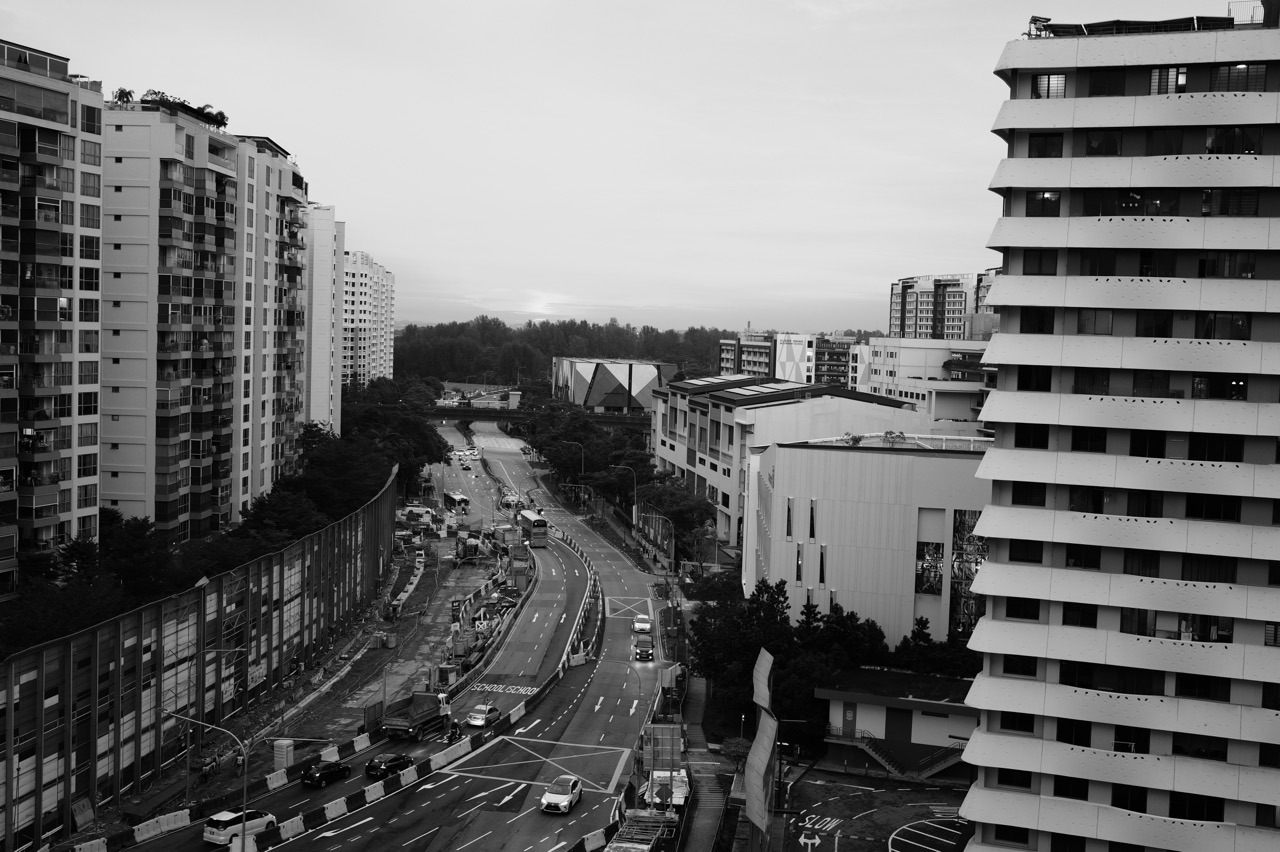

Quick answer: The covers, cabinets, trenches and marked surfaces seen around Punggol are signs of different infrastructure systems sharing limited urban space. Under and beside roads there may be water mains, drainage, sewerage, electrical supply and telecommunications networks, but a particular cover cannot be identified reliably by its shape alone. Road excavation is controlled work requiring the relevant permission and utility precautions. Residents should never open an inspection cover or cross a hoarding to investigate. To report a damaged cover, exposed wire, unsafe hole or blocked path, give the exact location and describe what is visible, without guessing which hidden network is at fault.
When a path is dug up shortly after it was repaired, it can be frustrating. A family wonders why workers are back, why a section is closed or why the service cabinet near a newly built HDB block has to remain accessible. The answer often lies in the town’s unseen networks. A road is also a corridor for infrastructure, and its buried assets can need construction, connection, maintenance, replacement and emergency work at different times.
Punggol is especially useful for understanding these systems because it contains different generations of housing and ongoing development. The presence of new digital infrastructure does not remove the need for traditional water and power services. But seeing a trench beside a road does not prove it is part of Punggol Digital District, nor does every disturbance indicate a system failure. This article explains how to think about the layers beneath everyday routes, what a cover or marking can and cannot tell a resident, and which questions to ask without entering a hazardous worksite.
1. A road is more than a surface for vehicles
A road corridor supports vehicles, pedestrians and in many cases the routing of pipes, cables, drainage and other equipment. Some utilities run below a carriageway, some beneath verges or footpaths, and others use separate service spaces. The exact arrangement changes with the road’s width, age, adjacent developments and engineering constraints. A person looking at smooth asphalt sees only the top layer of a much more complicated system.
These shared corridors create coordination challenges. A water main may need access for repair at a different time from a power cable or telecommunications line. Resurfacing a road does not mean every underground component has been renewed at once. Sometimes a later development requires a new connection that was not necessary when an earlier surface treatment was completed. Separate work programmes can therefore affect the same stretch of street.
It is understandable to ask why works cannot always be completed simultaneously. Coordination can help, but the actual answer depends on service demand, permits, construction sequencing, contractor availability, asset condition and urgent events. Without the project documentation, a passer-by cannot conclude that a repeated excavation proves waste or incompetence. A better question is which service and stage the posted works notice identifies.
Punggol example
A family sees fresh road markings and a repaired footpath outside a block. Two months later a nearby section is excavated. Rather than announcing that the original work was pointless, they check the new project’s sign and whether the activity concerns a different utility or a new connection. If access is unsafe, report the access issue separately from the construction explanation.
2. Different utility systems do different jobs
Potable-water pipes carry treated drinking water toward buildings. Sewers carry used water away for treatment. Stormwater drains manage rainfall runoff from surfaces. Electrical cables distribute power. Telecommunications cables carry communications services. These networks may share the general street environment but they do not all perform the same function or belong to one operator.
The distinction matters because a problem that looks like ‘water underground’ could concern several completely different processes. A surface drain overflowing after rain is not the same as a burst potable-water main, and a toilet backup inside one flat is not automatically a problem with a public roadside drain. A communications outage also does not prove an electricity cable has failed. The first task is to describe the symptom, not to choose a technical diagnosis.
PUB is Singapore’s national water agency and publishes separate information about its water supply and drainage functions. Telecommunications earthworks are addressed through IMDA’s requirements, while electricity supply has its own regulatory and operating arrangements. LTA controls relevant public-road work processes. A broad claim that one agency maintains ‘all the pipes under Punggol’ would erase these distinctions and send feedback in the wrong direction.
Punggol example
A resident notices water on a street after a dry morning. They can report a flowing leak and location without claiming that a specific water main has burst. If there is a nearby trench, the resident should not assume its purpose or enter it. The technical team can establish whether the water comes from supply, drainage, temporary works or another source.
3. Why an inspection cover exists
An inspection cover provides controlled access to an underground chamber or utility space. It may allow qualified workers to inspect, maintain or reach particular network components. Covers exist because certain parts of infrastructure need to be serviced without dismantling large stretches of pavement. In public areas, they are designed to form part of the walking or road surface when correctly installed.
A cover is not an invitation to the public to look inside. It can conceal a significant drop, harmful atmosphere, live equipment or flowing water. The condition and ownership of underground spaces vary considerably. A person cannot know from a photograph alone whether a chamber is deep, whether equipment is energised or whether the space is safe to enter. Do not lift a cover, push a tool through a slot or ask a child to explore an opening.
The word ‘manhole’ is used casually for many different covers, but residents should be careful about technical identification. The size, pattern and visible label may give clues, yet markings can be old, damaged or incomplete. Public descriptions should prioritise location and surface condition. An authorised worker uses asset records and procedures to establish the exact purpose of the chamber.
Punggol example
A metal cover beside a path makes a loud noise when people walk across it. The resident reports a loose or rocking cover near a specific block and supplies a safe exterior photograph. They do not pry it up to find out whether the noise is caused by its seating or by something below.
4. Why covers must sit correctly within the pavement
A service cover forms part of the usable ground surface, so its position matters to pedestrians, cyclists and vehicles. A raised edge can catch a wheel, while a sunken cover can produce a trip hazard. A damaged frame may move under load. These problems may appear small in photographs but have larger consequences on routes used by wheelchairs, walking aids or strollers.
Surface drainage also matters. A low point around a cover can hold water and make the difference in height difficult to see. Loose paving or damaged surrounds may require repair even if the chamber itself is functioning normally. The public should avoid diagnosing what is happening below the cover. The immediate, observable issue is the route surface and whether it remains safe.
If a cover appears open, missing or seriously displaced, move away and warn nearby people where safe. Contact an urgent relevant service channel rather than waiting for a routine cosmetic repair. Do not place an improvised object over the hole and then walk away as though it were secured. Trained responders need to assess and protect the site.
Punggol example
A parent pushing a pram notices that one inspection cover beside an HDB path is several centimetres below its surrounding paving. The parent chooses another safe route and reports the cover’s location and access risk. No investigation into its underground function is needed to justify that report.
5. Why maps are not enough to locate underground assets
Utility network owners maintain records and plans, but older services, changes and construction conditions can complicate the picture. PUB’s published technical discussion on underground utility mapping explains that contractors may need to verify actual locations and depths rather than rely solely on drawings. The risk of damaging a buried asset makes positive identification an important part of authorised works.
IMDA’s earthworks requirements for telecommunications likewise emphasise obtaining service plans, engaging licensed detection workers and carrying out controlled verification with the relevant licensee. This is a professional framework, not instructions for homeowners to locate cables with consumer gadgets. Even a contractor’s plan is not a public invitation to explore a corridor or guess where cables run.
The responsible lesson for residents is that hidden infrastructure cannot be inferred safely from a surface photograph. A line painted on the ground may relate to construction surveying or utility marking, but it does not reveal every relevant technical fact. Avoid reposting an annotated map of alleged service locations with confident claims that have not been verified. The public safety goal is understanding why excavation requires careful planning.
Punggol example
Coloured marks appear along a footpath before works begin. A neighbour says they must indicate a future MRT tunnel or a new internet backbone. The family checks the posted project notice instead of inventing a story from paint. If the area is cordoned, they follow the approved route without approaching workers to decode individual marks.
6. Telecommunications cables have specific protection rules
Damage to telecommunications cables can disrupt services far from the spot where the damage occurs. IMDA’s published earthworks framework addresses this risk through a defined set of requirements for contractors working near underground telecom infrastructure. Its nine-step process involves identifying affected licensees, qualified cable detection and authorisation before relevant excavation can begin.
These requirements exist because communications networks are important services, not simply wires that can be moved after a contractor encounters them. Some work may require staged coordination with several parties. A person watching from a pavement cannot tell whether a specific cable is live, redundant, temporary or being diverted. It is therefore inaccurate to describe every exposed conduit as a ‘new 5G cable’ or a ‘Punggol AI network’ without a verified project source.
For the general public, the practical rule is simple: leave cables and protective barriers alone. Never photograph inside a trench from an unsafe position or attempt to reconnect, move or cover a cable. If an exposed cable presents an immediate hazard in a public area, keep clear and notify the appropriate authority. Describe what is visible without assuming the service type.
Punggol example
A resident notices a narrow trench with cable ducts during nearby works. Instead of claiming the internet will be faster next week, they consult the project notice and published operator updates. Whether the trench is part of a telecommunications installation is a matter for verified information, not speculation.
7. Water mains require careful protection
Water supply pipes are essential infrastructure. Damage can interrupt water service and release large amounts of water rapidly. PUB’s advisory on preventing damage to water mains emphasises protective measures, accurate identification and keeping relevant chambers accessible during construction. These are requirements directed at professionals carrying out works, not a set of instructions residents should attempt to apply by digging.
The reason is straightforward: buried pipes may be under pressure and close to other assets. Unauthorised excavation or contact can cause injury and service disruption. Even temporary storage of materials over service access can interfere with emergency maintenance. A cabinet, marker or chamber near a path may look inconvenient, but access can be essential when a repair is needed.
PUB publicised a 2025 enforcement case after a contractor damaged a water main during works elsewhere in Singapore, causing substantial flooding and water loss. The example illustrates the severity of utility damage; it should not be misrepresented as an incident that happened in Punggol. The general lesson is why professional procedures and protection matter whenever construction and water infrastructure share space.
Punggol example
A construction notice mentions water-pipe diversion. A parent can explain to a child that ‘diversion’ means the infrastructure route may be changed as part of authorised works; it does not prove local tap water is unsafe. For actual discoloured tap water or supply interruptions, follow PUB’s separate consumer guidance.
8. Electrical equipment deserves distance and care
Street-level electrical infrastructure can include substations, distribution equipment and cabinets designed for authorised access. Some equipment is highly visible; much of the network is buried or enclosed. Residents should never open an electrical cabinet, tamper with a locked gate or put objects against warning signs. The apparent quietness of a cabinet does not establish that it is de-energised.
There is also a difference between a routine lighting fault and an immediate exposed-electrical hazard. A broken lamp on a public path usually calls for a maintenance report; exposed conductors, sparking equipment or another immediate danger need prompt urgent response and physical separation from people. Do not try to solve a suspected electrical fault by pouring water on it, touching a metal panel or probing an opening.
For households, a local electricity outage may be caused by the installation inside the flat, building-level distribution or broader network issues. A roadside excavation is not automatically responsible. The separate Punggol power-outages guide covers safe first checks and the role of SP PowerGrid. This article’s concern is why public electrical assets must remain under authorised management.
Punggol example
A child asks why a small fenced structure beside a block has warning signs. The parent explains that it is a service asset and not a shortcut or climbing structure. They do not claim to know its equipment layout from the outside. Respecting the boundary is the useful lesson.
9. Sewerage and stormwater drains are not interchangeable
Water from sinks, showers and toilets follows used-water infrastructure, while rainwater from roads and roofs is managed through drainage systems. Singapore’s water management depends on keeping the functions properly separated. An opening in the road surface is not automatically connected to a household toilet, and a ponding problem after rain does not establish a sewer failure.
In a residential area, a drain inlet may capture surface runoff and move it into a larger drainage network. A sewer chamber supports inspection of a different system. The public should not open either. Wrong assumptions can lead to dangerous behaviour, such as pouring paint, construction slurry or oil into a roadside drain because it is thought to be a universal waste route.
PUB’s stormwater information explains source, pathway and receptor approaches to flood resilience. Punggol’s documented rain gardens and swales are a further example of landscaping working with surface drainage. These are related to the built town but not identical to the pipes that carry potable water or used water. Distinguishing functions improves both resident understanding and environmental behaviour.
Punggol example
During heavy rain a roadside inlet appears blocked by leaves. The resident reports the visible drainage obstruction from a safe position instead of prying open a nearby metal cover. The cover may belong to a different service; its purpose should not be guessed from proximity.
10. LTA permissions govern relevant road occupation
Public-road works affect people beyond the immediate project. A trench can close a lane, change bus access, redirect pedestrians or introduce heavy vehicles at a familiar crossing. LTA’s road-occupation process includes permits or notifications for different work types, including the laying or repair of utilities and certain construction operations that occupy the road. The precise approval depends on the work and location.
This is not a claim that every small pavement repair has the same permit. Nor is an orange hoarding proof that a particular permit has been granted or refused. The correct procedure is determined by the relevant authority and project requirements. Residents can expect approved works to provide suitable public arrangements, but they should consult official project or agency sources rather than attempting to audit permissions from a passing photograph.
LTA’s public-road guidance also distinguishes works on or near roads from ordinary passage by pedestrians. A service company may occupy part of a public corridor temporarily under permitted conditions. That does not give a resident permission to move barriers, enter the trench or obstruct workers. It is still reasonable to report poor signage or an unsafe diversion with exact details.
Punggol example
A familiar route near Punggol Central narrows during utility work. The family takes the marked alternative and checks whether the crossing remains accessible. If a ramp is missing, the report should describe that problem and the actual route rather than make an unsupported allegation that the excavation was unapproved.
11. Utility diversions happen during new development
When land use changes, the network layout may need to change too. A new road, station entrance, building or public space can intersect an existing utility corridor. The project team may need to adjust service routes or provide new connections while preserving supply to current customers. Such work can occur before a new structure is visible and may continue after another construction milestone has been completed.
This is why excavation alone does not establish when a new development will open. Pipes can be installed long before tenants enter a building; other work can be part of maintenance unrelated to that development. Punggol Digital District and other projects have complex timelines, but residents should not use one trench as proof of a launch date. Official project updates and operating announcements are the right sources for opening status.
A useful distinction is between enabling works, building works, testing and actual service. The visual completion of a road surface is not the same as the commissioning of every underground system, and installing a conduit does not prove that its final service is already active. Town reporting improves when it respects these phases.
Punggol example
A new cable duct appears near a future commercial precinct. A neighbour says a particular business will open next month because ‘the fibre is ready’. The resident checks the actual announcement and treats the trench as evidence only that work took place at that location.
12. Temporary covers, plates and reinstated surfaces need inspection
Construction crews may use temporary surface treatments while work continues. A metal plate, patched asphalt or newly cast concrete may support a safe temporary route when installed according to the applicable requirements. Residents cannot judge all structural or load requirements from appearance. But they can recognise immediate practical issues such as unsecured edges, rocking surfaces, loose debris or obstructions to accessible movement.
Reinstatement means restoring a surface after the underground work. A patch may look different in colour or texture from the surrounding pavement, especially when materials are new. Appearance alone does not prove a defect. A raised lip, open joint, loose plate or dangerous change of level is a more concrete reason for a report. The distinction is between visual unfamiliarity and a functional safety concern.
Roadworks can involve subsequent checks and remediation. If an area is still fenced or signed for limited use, follow the restrictions. Do not step over a newly placed plate because you believe it has already been tested. The appropriate standard for residents is safe permitted passage, not an unauthorised technical inspection.
Punggol example
A temporary metal cover rattles beneath bicycle wheels on a shared path. The resident reports its precise location and effect on the route, avoiding assumptions about the pipe or cable underneath. The authority can then assess the plate or surrounding surface.
13. Why access chambers cannot be used for private storage
Utility chambers, cabinets and service rooms must remain accessible for authorised operation and maintenance. PUB’s water-main advisory explicitly addresses keeping relevant chambers and equipment available during works. Similar common-sense considerations apply to many public service assets: blocking a door or cover can delay the response when something fails. A quiet utility space is not an unused storage corner.
For households, this matters when moving furniture, renovating or arranging deliveries. A large object left against a service cabinet or above a covered access point may interfere with the path of a worker or vehicle. Parking near a service entrance may also affect access, depending on the signs and traffic rules. A homeowner’s convenient drop-off location is not automatically the place where infrastructure access may be blocked.
The safest habit is to keep service access and marked clearances unobstructed. Do not cover warning signs with decorations or event posters, fasten personal equipment to cabinets, or remove a temporary lock. Where the correct clearance is unclear, consult the site manager. Guessing a distance from another building’s layout is not a substitute for the applicable local instruction.
Punggol example
A family is organising a small ground-floor event. They notice a locked service cabinet beside the intended seating area. Rather than placing stacked chairs against it, they rearrange the layout and ask the facility manager about permitted use of that part of the space.
14. The person operating a cabinet may not own the path beside it
A water asset, telecom chamber, lighting column and HDB walking path can sit a few metres apart but be maintained by different entities. This makes many municipal problems appear administratively confusing. The actual repair may require coordination between an asset owner and the land manager. A resident does not need to resolve those contractual relationships before reporting an unsafe public condition.
HDB explains that Town Councils maintain common property in their estates, while LTA handles relevant road matters. PUB, electricity operators and telecommunications licensees have their own systems. OneService may route an ordinary municipal complaint where ownership is unclear. The crucial contribution from the public is precise location and observed effect, not a confident but incorrect assignment of responsibility.
When filing feedback, consider whether the problem is a damaged cabinet door, a broken footpath around a cover, a water leak or a blocked pedestrian route. The distinction helps direct the case. If there is an immediate hazard, use an urgent response rather than waiting for departments to debate which organisation owns the paint on the surface.
Punggol example
A cabinet sits within a landscaped strip next to a raised slab. The resident reports the slab as an access hazard and mentions the nearby cabinet as a landmark. They do not claim the cabinet is dangerous simply because it is close to damaged paving.
15. A road cut is not proof of an outage
A work crew near an electricity or communications route may be laying new infrastructure, inspecting a connection, diverting an asset or repairing an existing fault. Some works are scheduled while networks remain operational. Others address a service interruption. It is therefore inaccurate to infer that a townwide outage is occurring whenever a trench appears, or that an outage was caused by the nearest visible excavation.
For a verified service interruption, use the relevant operator’s official announcements and customer guidance. A fibre provider may report a local issue separately from an electricity distributor. The correct timeline depends on the cause and progress of the response; rumours about ‘workers digging the wrong cable’ should not be treated as fact without evidence. Photographs can prove that people were working there, not necessarily why.
Residents should also avoid sharing sensitive images of open equipment or staff identification unnecessarily. They can document the public impact from a safe distance: a path is closed, a water supply is interrupted, or a cabinet door is damaged. Evidence used responsibly supports problem-solving instead of speculation.
Punggol example
A family experiences slow home internet and sees workers near the road. They first check their provider’s official status channels and ordinary household troubleshooting. They do not assume a connection between the two events merely because they happened on the same afternoon.
16. Site markings and colours are not a universal public code
Contractors may use painted markings, pegs, labels and signs to manage works. Their meaning can depend on the project and the utility owner. A member of the public may recognise familiar symbols but still lack the context to identify an underground route. A surface marking can indicate a proposed alignment, an existing asset or another survey purpose, and it may not remain valid after work changes.
The temptation to turn this into a ‘decode every road marking’ chart should be resisted. A public guide that assigns a fixed underground service to every paint colour could mislead residents and even encourage unsafe exploration. Authoritative project plans and licensed detection processes are the appropriate means for locating utilities. A road marking is not a substitute for either.
It is nevertheless sensible to learn how to read notices meant for the public. A worksite sign can identify the project owner, the type of activity or the approved public diversion. A traffic sign has a direct behavioural instruction. An emergency warning tells you to stay clear. These are different kinds of information, and only the ones intended for public use should guide a family’s route.
Punggol example
A child asks whether coloured paint on the pavement marks an underground pipe. The parent explains that survey markings may relate to works but that their exact meaning should not be guessed. They then read the public project notice together from the safe side of the barrier.
17. The risks differ in rain and darkness
A surface opening that is clearly visible during daylight may be harder to recognise in rain or after dusk. Puddles can conceal uneven reinstatement or the edge of an excavation. Wet temporary surfaces may offer different traction from ordinary paving. A family should therefore choose safe official routes rather than attempting to navigate a closed area based on familiarity with how it looked the previous week.
Heavy rain can also affect ongoing utility works. Drainage provisions and worksite safety measures are matters for the contractor and authorities. Residents should not pump water out of a trench, pull apart coverings or remove barricades. Doing so may create danger for themselves or interfere with the equipment. A short detour is usually less costly than an avoidable injury.
A report after rain should explain whether the problem is standing water on a permitted path, a damaged plate, a barrier that has fallen or missing warning lights. Each is more actionable than the broad claim that ‘construction is unsafe’. An urgent hazard should be reported promptly, not just included in a later social-media discussion.
Punggol example
After a thunderstorm, the family finds water collecting against a utility-work barrier near a crossing. They choose the official alternate route and report any visible public hazard from a safe position. They do not step through water to inspect the trench’s depth.
18. Reporting a damaged cover without opening it
A useful report identifies the exact cover or service point: nearest block, road, direction of walking, pavement side and adjacent landmark. Then describe the condition, such as ‘loose and rocking’, ‘cover missing’, ‘edge raised’, ‘opening exposed’ or ‘water flowing from the area’. Where safe, a photograph of the whole location and one of the visible surface may help responders find the issue.
OneService’s 2026 municipal-feedback instructions explain the importance of a detailed description, location, time and photographs. For a pothole or a damaged footpath, LTA or an HDB estate manager may be relevant depending on the location. The eventual technical repair could involve a utility owner, but the public need not perform that investigation first. If the opening presents immediate danger, escalate through urgent channels.
Avoid trespassing or filming inside the chamber. Do not wedge an improvised stick into the opening to show depth. Do not let children stand on a loose cover for a photograph. Information gathered from ordinary safe passage is enough for a first report, and the hazard can be properly assessed by authorised staff.
Punggol example
At the junction of a footpath and a landscaped verge, a cover moves when pedestrians step on it. The resident records the precise location and warns others away when safe, then submits the report. They do not guess the utility or attempt to lift the cover to reveal a manufacturer’s name.
19. What a family can learn from underground infrastructure
An everyday Punggol walk can become a lesson in how cities operate. Children already understand that water arrives at a tap and electricity powers a light. The next question is how services reach thousands of homes without every component being visible. The answer introduces distribution networks, maintenance access, planning constraints and the difference between a service and the building that uses it.
A school exercise can be entirely paper-based. Draw a simplified cross-section showing a road surface, a footpath, a planting verge and hypothetical lines for water, drainage, electricity and communications. Label it as a conceptual diagram rather than a map of actual buried assets. Students can then discuss why these networks must be protected during construction and why surface covers have to remain accessible.
For older students, the exercise can explore coordination and reliability. What happens if several networks share one corridor? Why do repairs have different urgencies? What can a citizen reasonably verify, and which claims require engineering records? The discipline is to avoid presenting a classroom sketch as a factual underground map of Punggol. Conceptual understanding is valuable precisely because it does not encourage unauthorised exploration.
Punggol example
A Secondary student makes two drawings: one of the visible road, and another labelled ‘possible buried-service functions—not to scale’. The family discusses how public works are planned and how a damaged footpath can be reported. No ground probing or inspection-cover opening is involved.
20. The best habit is to distinguish surface evidence from hidden causes
Urban infrastructure invites plausible stories. A patched road suggests something happened below; a cabinet suggests equipment is nearby; a trench suggests services are being installed or altered. But these observations do not, on their own, establish the precise asset, ownership, fault, contract or future opening date. The invisible nature of the system calls for more careful language, not greater confidence.
This is especially important in a fast-changing town. Punggol’s development plans create interest in new digital systems, district infrastructure and transport connections. Yet an ordinary water-pipe repair may have nothing to do with those plans. The correct way to explain future developments is through official published status and operating announcements. The correct way to explain a current local hazard is through actual evidence at the site.
For residents, three practical rules are enough: keep out of service spaces, use authorised public routes, and report a precise observable problem promptly. If the issue is a utility outage, use the official operator channel. If it is a dangerous open chamber, use the appropriate urgent response. Understanding Punggol’s unseen networks should make everyday decisions safer, not tempt people to investigate equipment.
Punggol example
A person sees a new service cover beside the path and says it proves an underground high-speed rail line will open next year. A neighbour replies that the photograph establishes only a cover at that location. They check the official project information before making any wider claim. This is the kind of evidence discipline that protects the quality of local information.
Four worked household scenarios
A moving-day obstruction
A moving truck needs to unload furniture near an HDB block, and a family finds a convenient empty space beside a locked utility door. The absence of a parked vehicle does not make it a storage bay. They check the site’s loading instructions and keep service access clear. Furniture is moved through an authorised route and not left over an inspection cover or against electrical equipment. A minor increase in carrying distance is preferable to obstructing essential infrastructure.
A temporary trench across a familiar shortcut
A parent normally walks directly toward an LRT station, but works now close the path. The parent checks the posted pedestrian diversion and whether it accommodates the stroller. If the detour forces a dangerous road crossing or steps where a continuous route is needed, they report that exact problem. They do not cross the barrier because they believe the trench is shallow. The useful complaint concerns the public route, not a speculative accusation about the buried cable.
Water flowing beside a cover
Following a dry morning, a resident notices water flowing across a road near a utility cover. They avoid the slippery area and report the flow and location. They do not claim the cover must belong to a burst drinking-water main. Depending on the real cause, the appropriate team could investigate supply infrastructure, drainage, a nearby worksite or another system. A careful report gives the professionals a usable starting point.
The connectivity rumour
A group chat says internet outages across Punggol were caused by the visible digging outside one building. Residents are frustrated, but no official operator statement connects the events. One person checks the service provider’s status updates and distinguishes confirmed outages from construction photographs. A dated picture of roadworks proves that workers were there at that moment; it does not establish an underground cable-cut incident. The group shares verified information rather than a story that may be compelling but incorrect.
Frequently asked questions
Does every roadside metal cover lead to a sewer?
No. Covers may be associated with different systems. Do not determine their purpose by shape alone or try to open them.
Can I open a loose cover to photograph what is inside?
No. Treat it as a potential hazard, keep clear and report its exact location to the appropriate authority.
Why is Punggol’s road dug up again after resurfacing?
Possible reasons include new connections, planned utility work, repairs or a separate project stage. Check the specific posted project notice rather than assuming the earlier work was unnecessary.
Does a trench mean the internet or water has failed?
Not necessarily. It may be for installation, diversion, planned maintenance or repair. Check official service-status information before connecting two events.
Who protects telecom cables during digging?
IMDA has an earthworks framework for contractors, including detection and coordination with telecommunications licensees.
Who manages public water mains?
PUB is Singapore’s national water agency, with requirements governing protection and access during authorised works.
Can I put furniture beside an electrical service cabinet?
Do not obstruct service access or ignore warnings. Use designated storage and loading arrangements.
Does the paint colour on a path identify a precise pipe?
Do not rely on colour alone. The meaning depends on the project and professional asset records.
Should a damaged cover be reported through OneService?
OneService can route many ordinary municipal issues. For an immediate open-hole, electrical or serious hazard, contact an appropriate urgent channel.
Can students make underground-network maps of Punggol?
They can make clearly labelled conceptual diagrams from public educational sources. They should not claim to map actual cable or pipe positions without verified authority records.
Does every new utility trench relate to Punggol Digital District?
No. Ordinary town services are maintained and expanded for many reasons. Check project evidence.
What should I photograph when reporting a defect?
Record the visible surface condition and sufficient surroundings to identify the location, from a safe public position. Avoid looking inside a chamber.
Primary sources and official guidance
IMDA: Earthworks Requirements and nine-step telecommunications protection framework
IMDA: Licensed Telecommunications Cable Detection Work
PUB: Mapping of Underground Utilities and the need to verify buried assets
PUB: Water-main damage and why excavation protection matters (2025 case elsewhere in Singapore)
LTA: Road safety, defects and obstructions
OneService: Reporting location, photo and time, updated September 2026
OneService: Footpath repairs and agency responsibilities
HDB: Roles of Town Councils and HDB Branches
Related reading on eduKatePunggol
Things to Know About Punggol | Construction Hoardings and Pedestrian Diversions
Understanding Punggol | Power Outages, SP PowerGrid and Lift Safety
Things to Know About Punggol | Sheltered Walkways and Step-Free Routes
Things to Know About Punggol | Tree Roots and Uneven Footpaths
The pavement is not the entire town. Beneath it lie services with different owners, purposes and maintenance needs. The better we distinguish a visible surface hazard from an invisible technical explanation, the more useful our reports and decisions become.


