
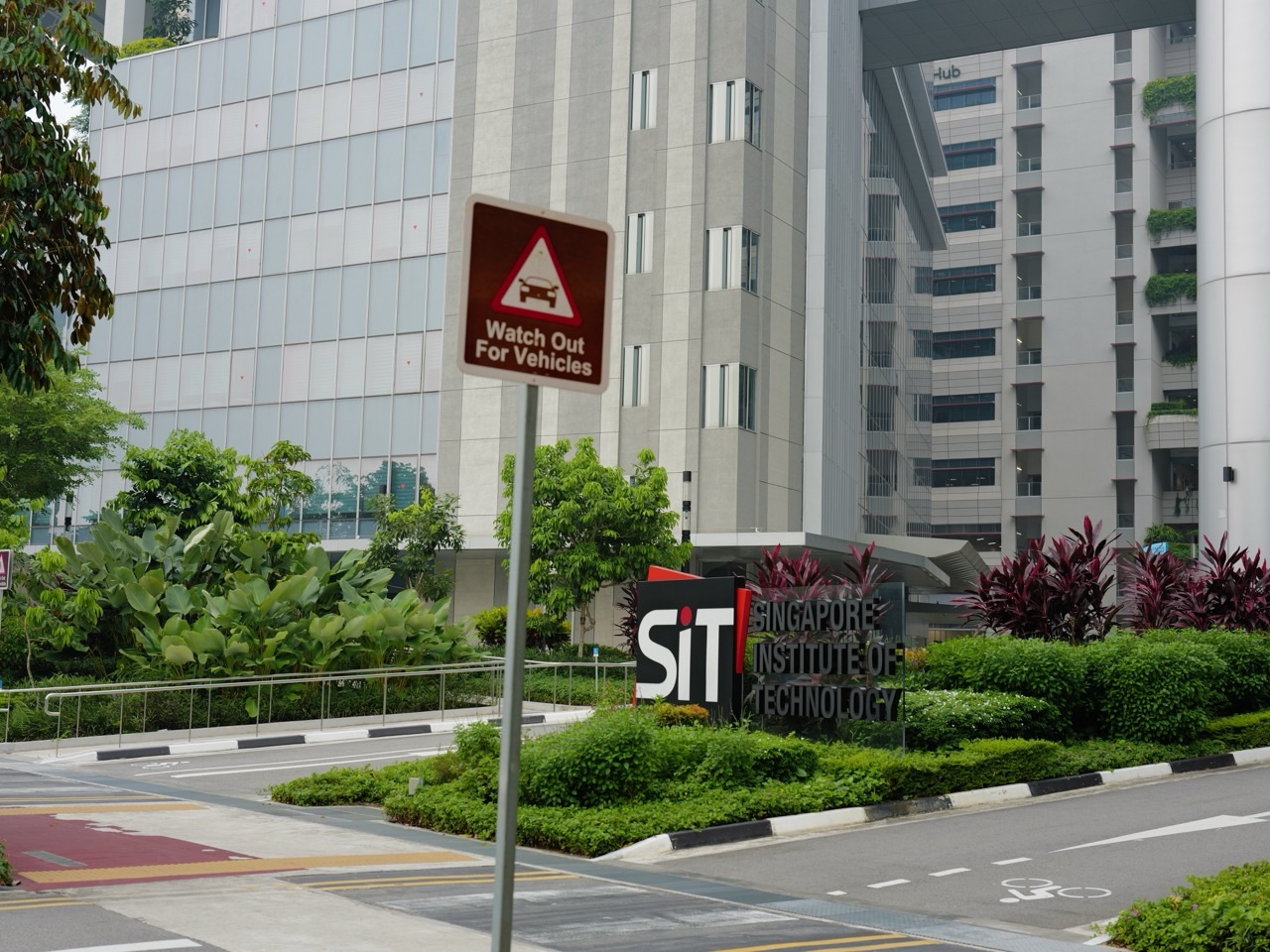
How does Science education work at the Singapore Institute of Technology’s Punggol campus? SIT is an applied university where Science, Engineering, data and supervised industry learning connect in degree programmes. In 2026, its Punggol-campus examples include the four-year Bachelor of Food Technology with Honours, the four-year BEng (Hons) Pharmaceutical Engineering and the four-year joint SIT–Technical University of Munich BEng (Hons) Chemical Engineering. They are different degrees with distinct modules, assessment and admission conditions, not interchangeable labels for one general Science course.
What makes this genuinely local? SIT officially opened its Punggol Campus on 16 September 2025 within JTC’s Punggol Digital District. It describes the campus as a living laboratory connecting students, industry and infrastructure. Its Living Lab Network announcement covers an Integrated Building Management System, a multi-energy microgrid and district cooling, with layered access to operational data. These real systems can provide authorised students with learning opportunities; they do not grant any member of the public uncontrolled access to sensors, private data or industrial equipment.
Immediate parent decision: compare the student’s actual academic background with the official degree’s published admission requirements, not with a neighbour’s assumption about a nearby university. Then inspect the curriculum, the programme’s Integrated Work Study Programme (IWSP), laboratory prerequisites and capstone expectations. Food Technology lists 8–12 months of relevant industry work, while the current SIT–TUM Chemical Engineering programme lists a 12-month IWSP. Employment during work-study does not guarantee permanent hiring, and different programme structures should not be collapsed into one standard duration.
Quick answer: which Punggol SIT Science-related degree does what?
| SIT Punggol degree | Official duration | What the science is used for |
|---|---|---|
| Bachelor of Food Technology with Honours | 4 years | Food chemistry, microbiology, engineering, safety, formulation and product systems. |
| BEng (Hons) Pharmaceutical Engineering | 4 years | Drug manufacturing, biologics, processes, validation and pharmaceutical operations. |
| BEng (Hons) Chemical Engineering (SIT–TUM) | 4 years | Chemical process design, sustainability, data analytics and industrial manufacturing. |
The precise programme details for academic year 2026/27 and future admission cycles belong to SIT’s current course pages. A Science-related Bachelor’s degree is not a medical degree, a professional pharmacy registration or an unrestricted authorisation to operate a pharmaceutical facility.
The learning stages from secondary Science to a Punggol applied degree
| Stage | Learner focus | Gate to verify |
|---|---|---|
| Secondary G-level / SEC | Core concepts, mathematics, laboratory reasoning and subject qualifications. | Actual SEC results and next-route eligibility. |
| JC / Polytechnic / ITE | H1/H2/H3 or technical courses, labs and applied projects as appropriate. | Specific degree’s accepted qualifications and prerequisites. |
| SIT degree years | University modules, simulations, experimental work and disciplinary depth. | The programme’s latest curriculum and assessments. |
| Industry work-study | Work with approved employers and supervisors on relevant tasks. | IWSP rules, duration, employment arrangement and evaluation. |
| Final-stage project | Integrate knowledge, evidence, technical practice and communication. | Assigned capstone or thesis requirements. |
| After graduation | Seek employment or further education based on qualifications and interests. | Employer or postgraduate admissions requirements. |
Thirty-four parts of Punggol’s applied university Science education
1. The campus is open; the degrees still have separate rules
SIT Punggol Campus officially opened in September 2025. Its existence should not be confused with the opening of every possible degree or professional facility to every nearby resident. Programmes have specific enrolment and access arrangements.
Applied example. A child who sees a campus building from a Punggol walkway has found an inspiring place, not proof that the child can join a laboratory project tomorrow. The university’s current admissions and programme websites determine what is offered.
Independent diagnostic. Record the exact degree title and intake rather than treating ‘SIT Science’ as one generic admission destination.
2. Food Technology is a full degree combining several sciences
SIT’s Bachelor of Food Technology with Honours is a four-year direct honours programme combining food science, engineering, design and business perspectives. Its modules include Food Chemistry, Food Microbiology and Safety, Food Processing, Packaging and Legislation, as well as data analytics.
Applied example. A student who enjoys cooking may also need to learn material balances, product formulation and the evidence required for a safe shelf-life claim. Enjoying food preparation is not by itself the programme’s technical prerequisite.
Independent diagnostic. Read the whole module list and identify the quantitative and laboratory parts before deciding the degree matches a learner’s interest.
3. Pharmaceutical Engineering is not the qualification of a pharmacist
SIT describes its Pharmaceutical Engineering degree as an engineering programme concerned with development and manufacture of biologics and small-molecule medicines, including process development, operations, validation and regulation. It is not a pharmacy degree or clinical prescription authority.
Applied example. A fictional plant may need a validated mixing process, controlled cleanroom conditions and product testing. A student must distinguish manufacturing process competence from a doctor’s or pharmacist’s patient-facing professional role.
Independent diagnostic. Verify the official programme and any regulated professional requirements separately; do not choose a degree solely because it contains the word pharmaceutical.
4. Chemical Engineering integrates Chemistry, Mathematics and design
SIT’s joint Chemical Engineering programme with TUM is a four-year direct honours degree. It includes data processing, industrial automation and sustainable manufacturing, with options in Data Engineering or Sustainability Engineering in the programme description.
Applied example. A student comfortable with reaction equations may still need to learn transport phenomena, process balances and how a manufacturing system responds to changes. Chemical engineering does not simply involve working through longer pure-Chemistry worksheets.
Independent diagnostic. Ask which part of engineering the student finds motivating: quantitative modelling, physical equipment, sustainability or industrial data.
5. Work-study is part of a designed curriculum
The Integrated Work Study Programme links academic learning and work responsibilities in industry. SIT says IWSP is compulsory in SIT-conferred and SIT-joint degrees, with placement structure adapted to the programme. A general description does not determine every individual degree’s exact period.
Applied example. A learner may apply thermodynamic or analytical ideas during an employer project, then return to explain limitations or results for academic assessment. This is different from an informal holiday job merely because both involve an employer.
Independent diagnostic. Read the specific programme’s IWSP details, student obligations and supervision arrangements; do not promise a particular company or job offer.
6. SIT Food Technology describes 8–12 months of IWSP
SIT’s current Food Technology page states students gain eight to twelve months of relevant work experience through its Integrated Work Study Programme. It also describes the opportunity to solve industry problems, not a guaranteed project type for every student.
Applied example. A student could gain exposure to quality, product development or food manufacturing, depending on placement. The actual role and university assessment determine which scientific skills are practised.
Independent diagnostic. Ask what students must demonstrate during IWSP, which workplace evidence may be used and which data must remain confidential.
7. SIT–TUM Chemical Engineering lists a 12-month IWSP
The current joint Chemical Engineering programme identifies a twelve-month work-study component and an overseas immersion element. Those are course-specific arrangements, not a universal description of all SIT programmes.
Applied example. A parent comparing it with Food Technology should note the difference and confirm the module sequence and work arrangements for the student’s own admission year. The longer-sounding route is not inherently superior; suitability depends on learning goals.
Independent diagnostic. Use the programme’s own page to confirm any work-study details rather than extrapolate from a general university brochure.
8. A living lab is an authorised learning ecosystem
The Campus as a Living Lab approach uses actual campus systems and data for teaching, testing and research under governance. The phrase living lab does not mean any member of the public can control operational equipment or access restricted data.
Applied example. SIT’s announced network has a multi-layer access model for students and approved collaborators. That matters because live systems involve safety, privacy, resilience and responsible experiments.
Independent diagnostic. A good student explanation names what is accessible under an approved project and what would require additional institutional permission.
9. Sensor data do not interpret themselves
The Living Lab Network was announced with planned connectivity to more than 20,000 IoT sensors. Sensors can report measurements, but readings still require calibration, metadata, units and an understanding of what a device actually observes.
Applied example. A fictitious building-temperature sensor reports an increase over an hour. It would be wrong to conclude immediately that more students caused it without occupancy and operating data. External weather and controls may also matter.
Independent diagnostic. Begin with the quantity, sensor position, times and likely confounders before telling a causal story.
10. Building-management systems combine controls and feedback
An Integrated Building Management System can integrate observations from occupancy, energy and building operations. A real building responds to multiple needs and constraints, including comfort, safety and efficiency. A student should not treat one sensor reading as an entire building’s condition.
Applied example. A hypothetical cooling system adjusts after a room’s temperature rises. To evaluate effectiveness, the investigator needs comparable before-and-after data with relevant controls, not merely a screenshot of a set-point change.
Independent diagnostic. Teach the difference between an intended command, an instrument reading and the observed outcome.
11. The multi-energy microgrid makes Physics operational
SIT’s campus includes a multi-energy microgrid developed with SP Group, integrating solar panels, batteries and other power-system elements. The learning value lies in understanding energy flows, storage and stability under appropriate supervised access.
Applied example. A hypothetical graph shows solar generation increasing while grid import decreases. This association may be consistent with an energy contribution from solar power, but an accurate energy balance needs defined metering boundaries and times.
Independent diagnostic. A student should use units such as kW and kWh correctly and recognise that power and energy are different quantities.
12. District cooling connects thermal physics with sustainability
SIT’s campus district cooling system provides a real context for heat transfer, energy use, operational control and performance measurement. Students can analyse approved data but should not infer exact energy savings from one photograph of a chiller.
Applied example. An illustrative dataset might show chilled-water temperatures before and after a process. The temperature change alone is not sufficient to determine cooling power without flow and relevant fluid properties.
Independent diagnostic. Ask which additional variables and calibrated instruments would allow a sound heat-transfer calculation.
13. Digital twins are models, not perfect replicas
A digital twin uses data and modelling to represent aspects of a real system. It can help test scenarios and understand operational response, but model validity depends on calibration, assumptions and comparison with observations.
Applied example. A student builds a simulated electricity demand curve based on historical data. If actual demand changes because occupancy patterns shift, the earlier model may no longer predict accurately.
Independent diagnostic. Require the student to record what the model includes, what it omits and how its outputs were tested against independent evidence.
14. Engineering Mathematics is essential across degrees
Food, chemical and pharmaceutical engineering use Mathematics for rates, proportions, modelling, statistics and process calculations. A learner strong at qualitative school Science may need to stabilise algebra and quantitative interpretation before university modules become comfortable.
Applied example. A concentration calculation might involve moles divided by litres; a process-energy calculation could involve rates and time; an experimental result might require uncertainty propagation. The mathematical methods are not separate from the physical systems.
Independent diagnostic. Ask the child to explain why a formula applies and check units before interpreting an answer.
15. Process mass balance prevents imaginary material creation
Manufacturing analysis often accounts for matter entering, leaving and accumulating in a defined system. A high product-output claim needs evidence about the inputs, rejected material and system boundary.
Applied example. An imaginary process receives 100 kg of raw material and produces 85 kg of acceptable output plus other accounted streams. A student who labels the remaining 15 kg ‘all waste’ without information may misrepresent the process.
Independent diagnostic. Teach the difference between total balance, product yield and quality acceptance.
16. Energy balance requires real units and boundaries
Energy cannot be inferred reliably from a device’s appearance. A quantitative model considers power, time, heat transfers and losses, with defined system boundaries and relevant conditions.
Applied example. A hypothetical electrical load draws 4 kW continuously for three hours, consuming 12 kWh in that idealised interval. The number is not the measured energy consumption of SIT or any Punggol building.
Independent diagnostic. Ask which measurements would be needed to verify the result and what operational changes could affect actual consumption.
17. Pharmaceutical validation is more than one successful test
A manufacturing process requires dependable evidence that it performs within defined controls and specifications. One visually acceptable batch or attractive instrument graph is insufficient to establish validated operation.
Applied example. A fictional process makes one sample meeting concentration requirements, but cleaning and contamination controls are undocumented. A student should not declare the entire process compliant.
Independent diagnostic. Teach evidence categories and missing documentation rather than repeating broad claims that the factory is safe.
18. Biologics differ from small-molecule medicines in production context
SIT’s Pharmaceutical Engineering programme explicitly addresses biologics and small-molecule drugs. Their manufacturing considerations can involve different production and analytical methods, and both require strong quality and regulatory discipline.
Applied example. A learner should compare process control, purification and testing conceptually, without manufacturing biological drugs or culturing microorganisms independently. Those activities require specialised facilities.
Independent diagnostic. Ask which scientific or engineering principle is central to the described production challenge and what must remain professionally supervised.
19. Chemical process design is a chain of linked decisions
Reaction, separation, flow, heating, cooling and quality operations can interact in industrial processes. Optimising one part without considering others may shift a problem downstream. This is why Chemical Engineering includes systems and quantitative modelling.
Applied example. Suppose a fictional process increases throughput but also raises energy consumption and changes impurity levels. A claim of improvement must state which objective improved and what trade-offs were measured.
Independent diagnostic. A good capstone identifies multiple relevant criteria rather than relying on one attractive percentage.
20. Food product design is chemistry plus consumer and regulatory questions
A food product’s taste or appearance matters, but so do hygiene, nutrition, safety, packaging, cost and applicable labelling requirements. A formulation cannot be called successful from one sensory preference test alone.
Applied example. An invented trial compares two recipes for texture and stability. The data might support a relative texture result, but not a claim that the product is safe for people with specific allergies.
Independent diagnostic. Teach learners to connect each claim to a suitable measurement and to acknowledge where regulatory review is required.
21. Microbiological learning has biosafety responsibilities
Food microbiology and pharmaceutical manufacturing may involve living organisms or their products. Safety rules and institutional approvals determine appropriate experiments; students must not collect and incubate unknown microbes from public surfaces at home.
Applied example. A written problem with microbial count data can teach logarithmic reasoning, controls and contamination checks without handling biological material.
Independent diagnostic. The student’s scientific integrity is visible in method choice as well as final conclusions.
22. Calibration makes sensor readings interpretable
Calibrating a meter involves relating its readings to appropriate references. A system can report precise-looking values and still have a systematic bias, an unsuitable range or incorrect installation.
Applied example. An imaginary temperature sensor is consistently 2°C higher than a reference under particular conditions. That observation suggests an error needing investigation but does not prove the same offset at every temperature.
Independent diagnostic. Teach a multi-point verification and a record of calibration conditions rather than an arbitrary correction.
23. Data analytics is not the same as scientific causation
Statistical analysis and AI can reveal patterns in large datasets, yet correlation is not proof of mechanism. Campus infrastructure data are especially affected by operating schedules, weather and occupancy.
Applied example. A hypothetical model predicts cooling energy from outdoor temperature. If performance degrades after major system changes, the model needs revalidation rather than a more confident chart title.
Independent diagnostic. Ask what was predicted, what was measured, how error was assessed and which alternative explanations remain.
24. Industrial data may be confidential or restricted
A workplace or living-lab dataset may contain operational details or information about people. Authorised student access does not make those data unrestricted for public posting or personal reuse.
Applied example. A learner can describe an approved method or publish aggregated anonymised results if permitted, but should not expose raw access credentials or sensitive operational details.
Independent diagnostic. Before adding material to a portfolio, consult the supervisor and apply data-governance rules.
25. The practical lesson is to preserve raw observations
Engineering laboratories and industry projects require traceable records. An unexpected observation should be checked and explained, not quietly deleted because it makes the chart look imperfect.
Applied example. A process dataset contains a single reading far from the rest. The student should investigate whether it was an instrument fault, genuine event or transcription error before deciding how to interpret it.
Independent diagnostic. A beautiful graph is weaker evidence than an honest record with a defensible analysis.
26. Work-study uses teamwork and professional communication
Technical skills matter, but students also need to coordinate with supervisors, document decisions and present results to different audiences. This is not separate from scientific competency; poor communication can distort an otherwise valid finding.
Applied example. A student reports ‘efficiency improved’ without stating the unit, baseline and test period. A manager cannot evaluate the claim from that sentence alone.
Independent diagnostic. Practise a concise result–evidence–limitation summary using fictional data, then adapt it for a technical and nontechnical reader.
27. A capstone project is not necessarily the same as research publication
A university capstone can solve a practical problem by designing and testing an approach. Academic research may focus on producing new generalisable knowledge. The project can share scientific method without automatically becoming a published paper.
Applied example. An imaginary packaging design might improve moisture retention under a stated lab test. A credible report preserves controls and uncertainty, even if the result has no broader commercial proof.
Independent diagnostic. Ask what the project contributes, how it was checked and what evidence would be necessary before scaling the idea.
28. Applied research still needs ethics and supervision
Experiments using people, restricted data, hazardous materials or live industrial equipment involve approvals and trained supervision. A student should be able to identify those boundaries before proposing an ambitious project.
Applied example. A class exercise may analyse a hypothetical healthcare dataset, but a real clinical study cannot be initiated by simply asking classmates for personal diagnoses.
Independent diagnostic. Work with authorised supervisors, approved sources and responsible reporting.
29. Eligibility differs by degree and prior qualification
SIT publishes programme-specific admission requirements for A-Level, polytechnic and other eligible applicants. The relevant diploma list, subject preparation and selection procedures can vary by degree; a Science-sounding qualification is not automatically sufficient.
Applied example. A student with an Applied Chemistry diploma might be interested in Food Technology or Pharmaceutical Engineering, but should check its exact accepted qualifications, Mathematics requirements and current admissions process.
Independent diagnostic. Keep a dated course-eligibility table and avoid promises of admission based on one brochure success story.
30. The university campus is not a public teaching laboratory
Visitors can admire the Punggol Campus and public-facing district areas without gaining unrestricted access to specialist rooms, sensors or research facilities. Different parts of a university are governed by safety and access permissions.
Applied example. A parent seeing a campus living-lab announcement should not assume their primary-school child can run experiments on a grid, chilled-water plant or industrial system.
Independent diagnostic. Use authorised tours, public academic events and age-appropriate models where available, checking current access terms.
31. Studying near home can help without determining the course
A Punggol resident may benefit from shorter travel if enrolled at SIT Punggol, but residential proximity does not grant admission priority or make every degree better suited to that learner. Course requirements and interests remain central.
Applied example. A student interested in fundamental astrophysics may consider a different university, while another interested in manufacturing operations might value SIT’s applied route. Both can be thoughtful Science decisions.
Independent diagnostic. Compare actual degree content, career pathways, study methods, admissions and wellbeing rather than only distance.
32. A workplace project is evaluated by the work done
The IWSP offers real-world practice under supervision, but simply spending months in a company is not evidence that a learner mastered a skill. The student should be able to describe a problem, explain actions permitted, and connect results to scientific principles.
Applied example. A work-study project reports a reduction in an operational measurement. The student must define the baseline, measurement method and remaining limitations without revealing confidential data.
Independent diagnostic. Ask for supervisor feedback and an independently reasoned summary rather than only a photo of a workplace badge.
33. Professional careers have further requirements
Food technologist, process engineer, pharmaceutical manufacturing specialist and other roles differ in responsibilities and entry requirements. Certain regulated practices require specific training or registration beyond possession of a degree.
Applied example. The title Pharmaceutical Engineering does not confer authority to prescribe medicines. Similarly, a Food Technology graduate should not automatically be described as a registered dietitian.
Independent diagnostic. Use employers’ and professional bodies’ actual requirements, not course-name associations.
34. The route is a sequence of evidence-based decisions
A secondary student can aspire to applied university Science without treating that aspiration as a guaranteed chain. SEC, JC, polytechnic or ITE, degree selection, IWSP and employment each have independent requirements.
Applied example. An effective family plan documents the next immediate qualification and the prerequisite foundations. It is reasonable to change direction as interests and evidence develop.
Independent diagnostic. Review the plan after school reports, diploma projects or internships rather than assuming one early exam fixes an entire career.
Five original applied Science worked examples
Example A: engineering mass balance
A hypothetical food process receives 150 kg of ingredients and produces 120 kg of acceptable packaged product and 18 kg of known secondary material. If no material accumulates in the system, the remaining 12 kg must be accounted for by other output streams or measurement error. It is incorrect to claim automatically that those 12 kg evaporated. A complete mass balance needs defined boundaries and measurements.
Example B: energy use
A fictional campus device draws an average 3 kW of electrical power for four hours. Idealised energy use is 3 × 4 = 12 kWh. This does not describe measured SIT campus consumption; operational schedules and device power can vary. The student must not confuse power in kW with energy in kWh.
Example C: concentration
An imaginary product has 0.060 mol of solute in a total solution volume of 0.750 L. Its molarity is 0.060/0.750 = 0.080 mol/L. The numerical result does not establish whether the product is safe or meets legal specifications without additional testing.
Example D: comparative energy
A fictional cooling system uses 180 kWh of electricity during a defined baseline period and 150 kWh after a change. The observed reduction is 30 kWh, or 30/180 × 100% = 16.7% to one decimal place. To attribute the change to an engineering modification, the test would need to control or account for weather, occupancy and operating conditions.
Example E: sensor bias
A fictional sensor records 24.6°C against a traceable 25.0°C reference in one test and 29.4°C against a 30.0°C reference in another. Errors are −0.4°C and −0.6°C. They do not demonstrate one universal fixed correction across the working range. The engineer should inspect the calibration curve and method before relying on an adjusted value.
Five-week progression and degree-comparison plan
| Week | Action | Evidence |
|---|---|---|
| 1 | Confirm SIT programme names, duration, provider and intake. | Official three-course comparison with source dates. |
| 2 | Audit Chemistry, Physics, Biology and Mathematics prerequisites. | Two actual conceptual gaps identified for repair. |
| 3 | Study IWSP, modules, academic assessment and approved practicals. | Realistic understanding of workload and industry learning. |
| 4 | Use hypothetical energy, process or analytical data for new-context explanations. | Correct calculations with units and justified limitations. |
| 5 | Review current admission criteria, transport, fees and other university options. | One defensible shortlist and unresolved questions to verify. |
Frequently asked questions about Science at SIT Punggol
Did SIT’s Punggol Campus open already?
Yes. SIT officially opened it on 16 September 2025. It is not a future campus awaiting 2034 completion.
Are Food Technology and Pharmaceutical Engineering the same degree?
No. Food Technology is a food-science degree; Pharmaceutical Engineering concerns engineering aspects of pharmaceutical development and manufacturing.
Is Chemical Engineering offered jointly with TUM?
The listed SIT Chemical Engineering BEng (Hons) is a joint four-year programme with Technical University of Munich.
What is IWSP?
SIT’s Integrated Work Study Programme combines degree learning with supervised relevant industry work, with structure and duration dependent on the programme.
Is IWSP eight to twelve months?
The general SIT information and Food Technology page describe eight to twelve months; the SIT–TUM Chemical Engineering course specifically lists twelve months.
Is the campus Living Lab Network an open public dataset?
Not automatically. SIT describes layered access for authorised educational and industry uses; no unrestricted access should be assumed.
What campus systems support applied learning?
SIT describes an Integrated Building Management System, multi-energy microgrid and district cooling as living-lab contexts.
Does a Food Technology degree qualify someone as a dietitian?
No automatic professional qualification can be inferred from the degree title. Check regulated professional requirements.
Can a Pharmaceutical Engineering graduate prescribe drugs?
No. A manufacturing-focused engineering degree does not itself grant clinical prescribing rights.
Will all degree students use the same living-lab data?
No universal access is promised. Specific classes, projects and permissions determine what data can be used.
Can any polytechnic diploma graduate automatically enter SIT?
No. Programme-specific qualification relevance, admissions and selection conditions apply.
Is a degree from SIT guaranteed employment?
No. IWSP provides valuable learning and industry exposure but does not guarantee permanent hiring or a particular salary.
How to understand the difference between laboratory Science and engineering design
A degree in Food Technology can use chemical analysis to identify the properties of a food ingredient, while a Food Engineering question might ask how to process that ingredient reliably at industrial scale. The first task requires sound measurements and knowledge of substances; the second introduces equipment, material flows, heat transfer, safety, costs and process constraints. Both are part of an applied degree, yet neither substitutes for the other. A student who describes an ingredient accurately but cannot balance inputs and outputs still needs engineering reasoning. Another who draws an efficient factory layout but ignores microbiological criteria has not established that the resulting product is safe.
This is why a family should read individual module descriptions and not decide solely from the words Food, Chemical or Pharmaceutical in the degree title. SIT’s Food Technology page explicitly brings food science, engineering, data analytics, microbiology and regulatory considerations together. Its Pharmaceutical Engineering programme similarly connects pharmaceutical knowledge with operations, validation and manufacturing design. Ask the student which relationship between experiments and technical systems appeals to them. A useful university choice is one whose real learning tasks match both the student’s curiosity and willingness to acquire unfamiliar quantitative skills.
Why a campus living lab still needs good experimental design
Live university infrastructure produces useful data, but every dataset has a measurement boundary. A sensor may indicate electrical power at one location while another reports temperature or occupancy. Comparing their values requires synchronised periods, valid units, calibrated instruments and an awareness of what the sensors actually measure. It is not enough to observe that campus electricity consumption fell after a public sustainability announcement and claim that the announcement itself caused the change. Weather, academic calendar, equipment operation and building occupancy are plausible confounding factors. A strong investigation explains how these will be accounted for.
SIT describes a layered access model for its Living Lab Network precisely because operational systems cannot be treated as uncontrolled public experiments. In an authorised student project, instructors and system custodians can define what may be accessed and how findings are reported. The student should preserve source details, permissions and a clear distinction between observed sensor readings, simulated scenarios and inferred causes. The same discipline applies to a fictional model built at home: label values as hypothetical, then test the reasoning without presenting them as real Punggol Digital District performance results.
How a relevant diploma or JC education prepares different students
A student arriving from a polytechnic Science diploma might bring laboratory competency, applied project experience and familiarity with quality-control procedures, while a JC graduate might bring broad H2 conceptual work in Mathematics, Physics, Chemistry or Biology. Neither background establishes every prerequisite for a particular SIT programme. University modules can demand both disciplined practical work and more advanced mathematical reasoning, so preparation must identify the learner’s actual strengths rather than favour one route by reputation.
For example, a diploma holder may need to refresh algebra, calculus or physical modelling, whereas a JC student may need to become comfortable with equipment records, documentation and industrial process context. The appropriate support follows a diagnosis of genuine gaps. Families can review SIT’s current admission conditions, relevant diploma lists, published course structure and the student’s own academic record. Do not promise that a Polytechnic Common Science Programme or one H2 Science subject automatically satisfies all requirements. The real intake’s official admission decision remains separate from educational readiness.
Building a credible portfolio without exposing workplace or campus data
A technical portfolio should demonstrate how the learner framed a problem, chose evidence, tested a model, interpreted results and revised an explanation. It does not need to include company confidential records, sensitive operational readings or identifiable data from colleagues or customers. Students in an industry work-study project may be constrained by agreements and employer policies, even when the work is intellectually their own. Describing a method at an appropriate level and documenting permitted learning outcomes can be more responsible than publishing screenshots of a restricted dashboard.
A strong entry can state the scientific question, the model chosen, why it was suitable, the main category of error discovered and what was learnt after supervision. Any specific result should be disclosed only when authorised and accurately sourced. If a student claims a campus energy improvement from a simulation, it must be labelled simulated; if a real experimental result is approved for publication, its method and limitations should be clear. This kind of honest record is useful for university study, professional communication and subsequent applications, without pretending every school project is publishable research.
Official SIT sources and connected eduKate Science guides
- SIT Punggol Campus official overview
- SIT — official Punggol Campus opening in September 2025
- SIT — Living Lab Network, 2025 announcement
- SIT — Bachelor of Food Technology with Honours
- SIT — BEng Pharmaceutical Engineering
- SIT–TUM — Chemical Engineering degree
- SIT — Integrated Work Study Programme
- SIT — undergraduate programme directory
- SIT — admissions information
- Singapore Polytechnic — Chemical & Life Sciences
- eduKatePunggol — primary to university Science route
- eduKatePunggol — SIT Punggol campus, applied degrees and IWSP
- eduKatePunggol — Polytechnic Applied Science
- eduKatePunggol — ITE Applied Food and Chemical Technology
- eduKatePunggol — SIT Engineering Mathematics
- eduKatePunggol — H2 Chemistry and A-Level preparation
Evidence date: 21 October 2026. SIT’s current programme pages establish degrees and teaching structures; university and JTC announcements establish campus and living-lab facts. Sensor/data access is permission-controlled. All numerical exercises are original hypothetical models, not verified Punggol campus operational readings, clinical data or admission guarantees. Verify degree intake rules and module arrangements again when applying.


