
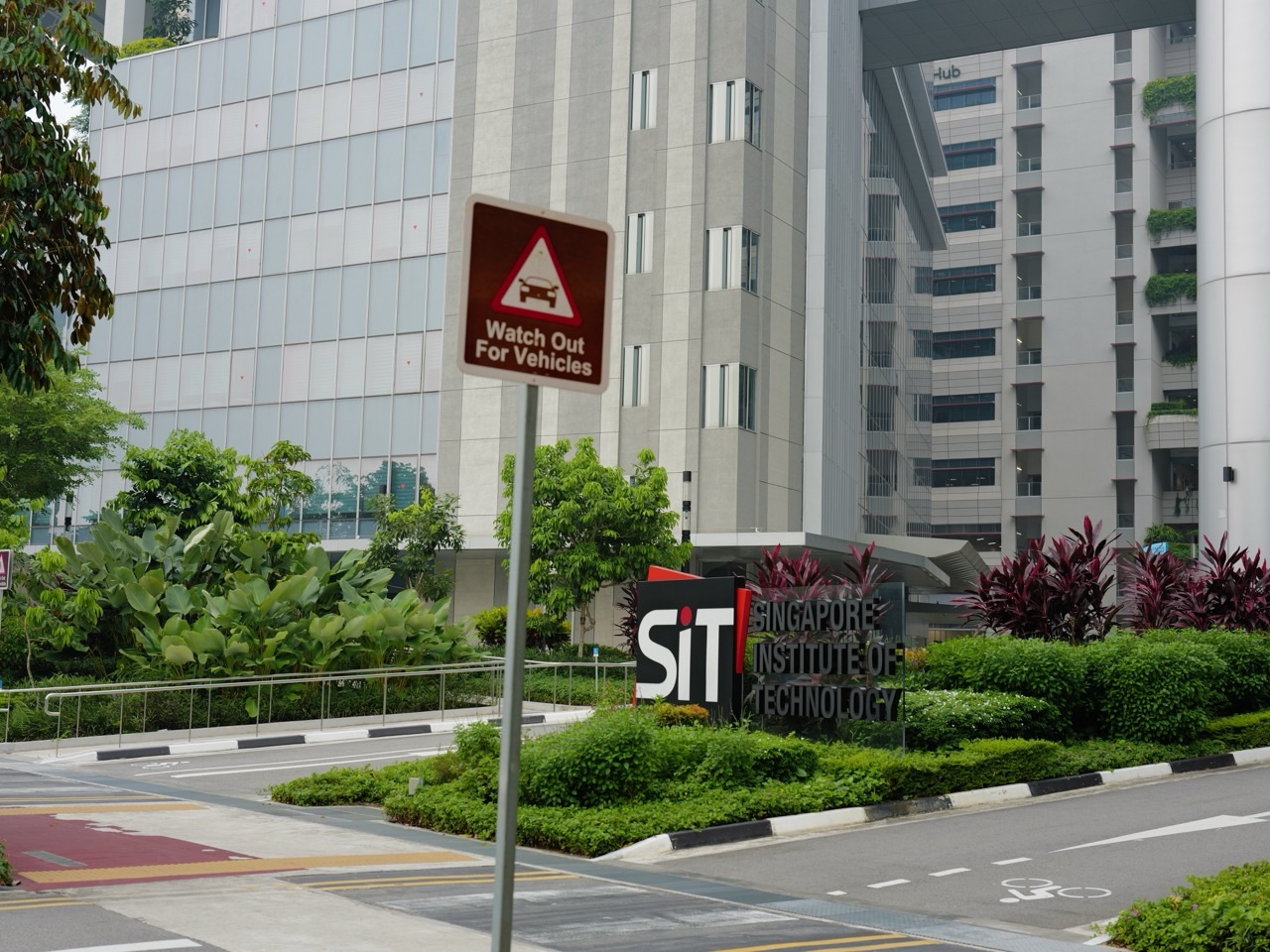
Answer first. SIT Punggol teaches Mathematics inside specific degree programmes, not through one Punggol-only national exam. Official AY2026/27 degree outlines for SIT Engineering Systems, Mechanical Design and Manufacturing Engineering, Applied Artificial Intelligence and Computing Science include named Engineering Mathematics 1/2 or Mathematics 1/2 modules. These connect algebra, calculus, vectors, probability and computational thinking to technical subjects, projects and work-study programmes. A family’s next action is to check the selected degree’s actual modules and prerequisites.
The Singapore Institute of Technology campus at 1 Punggol Coast Road is a major educational anchor within Punggol Digital District. This guide explains which mathematical ideas are useful for its engineering, computing and artificial intelligence routes; how school Mathematics progresses into degree-level models; and how to diagnose the difference between a missed calculation and a misunderstood physical or computational relationship. It includes original solved examples, a cross-topic study route and official sources.
Fact-checked 20 October 2026. SIT’s programme structures are marked as subject to change, and module exemptions are evaluated case by case. The current campus page places SIT’s main operations at Punggol, with a separate location exception for its CIA culinary programmes. The worked examples below are educational scenarios, not descriptions of private campus lab projects, guaranteed placements or official assessment items.
SIT Punggol Mathematics: one-minute orientation
- Campus: SIT Punggol Campus, 1 Punggol Coast Road, Singapore 828608.
- National status: an autonomous university with degree-specific academic programmes, not an estate-run tuition syllabus.
- Engineering examples: Engineering Mathematics 1 and 2 appear in named Mechanical Design, Engineering Systems and other degrees.
- Computing examples: Mathematics 1 and 2 in Applied AI, Computing Science and Fintech programmes.
- Applied mathematics: algebraic modelling, trigonometry, vectors, calculus, statistics and computation.
- Work-study: a substantial Integrated Work Study Programme is included in relevant degree programmes, with the specific structure set by each course.
- Admissions: programme-specific criteria and evaluations, not automatic enrolment for local residents.
- Best diagnostic: an original algebra question, graph, vector, probability model and unit-conversion task, each attempted independently.
Fast contents: exact skills and examples
- 1. SIT Punggol is a university campus, not a local Maths syllabus
- 2. Academic programme names tell you which mathematics matters
- 3. Engineering Mathematics 1 often carries several later technical topics
- 4. Engineering Mathematics 2 can extend the foundational calculus
- 5. Vectors give direction to engineering calculations
- 6. Matrices describe several connected relationships at once
- 7. Trigonometry connects coordinate axes to actual forces
- 8. Units matter even more when software performs the arithmetic
- 9. Differential equations model systems that change
- 10. Statistics begins with valid measurement and sample definition
- 11. Probability supplies the language of uncertainty
- 12. Applied AI degrees still require mathematics beneath the software
- 13. Applied computing and fintech combine statistics with modelling
- 14. Computing Science uses discrete mathematics and algorithms
- 15. Graphs and networks describe connections without assuming distances
- 16. Algorithm efficiency grows from mathematical functions
- 17. Calculus also appears in optimisation for computing
- 18. Partial derivatives treat other input variables as temporarily fixed
- 19. Linear algebra is a structural foundation for AI
- 20. AI evaluation needs separate evidence from training success
- 21. Engineering modelling is different from a physical safety sign-off
- 22. Engineering systems use feedback and error signals
- 23. Digital District location creates opportunities, not admission rights
- 24. SIT work-study is part of named degree designs
- 25. Course credits are not interchangeable school marks
- 26. Module exemptions depend on individual institutional evaluation
- 27. The application route differs from local secondary admissions
- 28. A six-week bridge can be more useful than two years of generic papers
- 29. The right learning outcome is reproducible reasoning
What becomes different at university?
Secondary students may learn how to differentiate a polynomial, find a matrix product or simplify a fraction. University learners must increasingly state why these operations describe a measurement, algorithm, system or decision. A perfect calculation attached to the wrong unit is not a usable engineering result. An AI classifier that performs well on its training data cannot be presented as proven reliable on unseen data. The shift is therefore from performing mathematics to explaining, validating and applying mathematical models under stated assumptions.
The Clementi instructional floor provides a useful general teaching method: identify the earliest wrong mental step, rebuild the underlying representation, and test transfer without displaying the solution. That method scales from lower-secondary algebra to university-level calculus. It does not mean that a university student must always begin from Primary Mathematics. It means the educator diagnoses only as far back as the evidence requires.
1. SIT Punggol is a university campus, not a local Maths syllabus
Concept and institutional context. Singapore Institute of Technology operates its main campus at 1 Punggol Coast Road, in the Punggol Digital District. Its academic programmes are defined by degree and intake, not by whether students live in Punggol. The main campus hosts the university’s five academic clusters, although specific culinary programmes have a separate venue. Mathematics is embedded differently in engineering, computing, health and business.
Worked original example. A Punggol resident applies to an engineering course and a student from outside Punggol applies to the same course. Both follow the published degree curriculum if admitted. The neighbourhood changes transport and proximity but does not create different Engineering Mathematics examinations. The reader should be able to name what was assumed, what the output represents and what further validation would be needed in a real project.
Typical error. A family treats ‘SIT Punggol mathematics’ as a single university-wide subject with one textbook, or assumes only Punggol residents can enrol. Neither describes the institution’s degree-based system. Diagnose the first incorrect decision, and avoid treating a copied correct line as proof that the underlying idea has been mastered.
Teaching, checking and transfer. Read the selected SIT undergraduate degree page and its AY2026/27 programme structure. Record required Mathematics module titles, credits, prerequisites and later applications before choosing preparation. Ask the student to solve a changed version after the model is hidden, stating units, dimensions or assumptions where appropriate.
2. Academic programme names tell you which mathematics matters
Concept and institutional context. SIT publishes distinct Engineering Systems, Mechanical Design and Manufacturing Engineering, Electrical Power Engineering, Computer Engineering, Applied Artificial Intelligence and Computing Science programmes, among others. Several named engineering degrees list Engineering Mathematics 1 and 2; computing degrees often list Mathematics 1 and 2. Similar labels do not prove every module has identical content.
Worked original example. A student considering Mechanical Design and Manufacturing Engineering sees both Engineering Mathematics 1 and Engineering Mathematics 2 alongside statics, dynamics and materials. A student considering Applied Artificial Intelligence sees Mathematics 1, Mathematics 2 and Machine Learning in that programme’s module list. The reader should be able to name what was assumed, what the output represents and what further validation would be needed in a real project.
Typical error. The student assumes a course called Mathematics 1 must be exactly the same at every SIT degree or matches a generic polytechnic workbook without consulting the current course description. Diagnose the first incorrect decision, and avoid treating a copied correct line as proof that the underlying idea has been mastered.
Teaching, checking and transfer. Make a two-column comparison of the actual degree programmes. Mark module titles and their stated credit weights; separate mathematical prerequisites from the engineering or computing tasks that use them. Ask the student to solve a changed version after the model is hidden, stating units, dimensions or assumptions where appropriate.
3. Engineering Mathematics 1 often carries several later technical topics
Concept and institutional context. Engineering systems must describe quantities, forces, motion, energy and change. Algebra, vectors, trigonometry and calculus provide an underlying language. The exact outcomes should come from the actual module, but the common mathematical bridge is from numerical answers to equations with physical interpretations.
Worked original example. A hypothetical sensor follows y=1.2x+0.5. An input x=10 gives y=12.5. If the recorded output is 6.5, solve x=(6.5−0.5)/1.2=5. The inverse problem demands algebraic rearrangement, not just substitution. The reader should be able to name what was assumed, what the output represents and what further validation would be needed in a real project.
Typical error. A new undergraduate can substitute an input into a formula but cannot recover an unknown from a measured output. That gap may block more complicated laboratory calculations. Diagnose the first incorrect decision, and avoid treating a copied correct line as proof that the underlying idea has been mastered.
Teaching, checking and transfer. Ask for both a forward and inverse numerical example, keeping variable names and units explicit. After solving, reconstruct the observed output to check the model. Ask the student to solve a changed version after the model is hidden, stating units, dimensions or assumptions where appropriate.
4. Engineering Mathematics 2 can extend the foundational calculus
Concept and institutional context. Published SIT Engineering Systems and Mechanical Engineering programme structures list a second Engineering Mathematics module. Engineering mathematics at degree level may connect differentiation, integration and other mathematical methods to actual discipline modules. A reader should not infer every named module teaches exactly the same advanced methods.
Worked original example. Suppose a vehicle’s idealised velocity is v(t)=3t² metres per second for t measured in seconds. Distance accumulated over 0 to 2 seconds is ∫₀²3t²dt=[t³]₀²=8 metres. Its velocity at the endpoint is 12 metres per second, a different quantity. The reader should be able to name what was assumed, what the output represents and what further validation would be needed in a real project.
Typical error. A student writes twelve metres as the accumulated distance because twelve was the final velocity displayed by the model. The numerical calculation is correct for the wrong question. Diagnose the first incorrect decision, and avoid treating a copied correct line as proof that the underlying idea has been mastered.
Teaching, checking and transfer. Write an input-output table with position, velocity and time units; draw the velocity-time area and calculate the integral as a separate operation. Recheck with a different end time. Ask the student to solve a changed version after the model is hidden, stating units, dimensions or assumptions where appropriate.
5. Vectors give direction to engineering calculations
Concept and institutional context. Vectors represent magnitude and direction, and their components make physical relationships calculable. Engineering and robotics regularly need coordinate frames, displacement and relative direction. A vector answer requires interpreting axes and signs rather than adding lengths indiscriminately.
Worked original example. Let a=(3,4) metres and b=(−1,2) metres. Net displacement is a+b=(2,6) metres. Its magnitude is √(2²+6²)=√40≈6.32 m. Adding the separate magnitudes five and √5 would not describe the same resultant direction. The reader should be able to name what was assumed, what the output represents and what further validation would be needed in a real project.
Typical error. A student adds vector lengths rather than corresponding components and obtains a larger but unjustified net displacement. Another drops the negative horizontal component of b. Diagnose the first incorrect decision, and avoid treating a copied correct line as proof that the underlying idea has been mastered.
Teaching, checking and transfer. Draw a coordinate grid and two tip-to-tail arrows. State which direction each signed component represents, then calculate magnitude using Pythagoras and compare with the picture. Ask the student to solve a changed version after the model is hidden, stating units, dimensions or assumptions where appropriate.
6. Matrices describe several connected relationships at once
Concept and institutional context. A matrix packages a linear transformation or collection of equations. Multiplication order matters because applying transformation A then B is not generally equivalent to applying B then A. Computing or engineering students should know which operation the columns and rows represent.
Worked original example. Let A=[[2,0],[0,1]] double horizontal coordinates, and B=[[0,−1],[1,0]] rotate a point 90° anticlockwise. Starting from (1,0), apply A then B to get (0,2). Apply B then A to get (0,1). The order changes the result. The reader should be able to name what was assumed, what the output represents and what further validation would be needed in a real project.
Typical error. A learner believes all matrix multiplication is commutative because ordinary number multiplication is, or performs elementwise multiplication while claiming it is the same as linear transformation composition. Diagnose the first incorrect decision, and avoid treating a copied correct line as proof that the underlying idea has been mastered.
Teaching, checking and transfer. Use a simple point and calculate each stage in order. Label the two operations in words before multiplying matrices. Check with a second starting point. Ask the student to solve a changed version after the model is hidden, stating units, dimensions or assumptions where appropriate.
7. Trigonometry connects coordinate axes to actual forces
Concept and institutional context. Engineering work can use triangles to resolve a magnitude into perpendicular components. Which side receives sine or cosine depends on the reference angle. The exercise establishes mathematical meaning, not a professional safety design.
Worked original example. A fictional 20 N force acts 30 degrees above the horizontal axis. The horizontal component is 20cos30°=10√3≈17.32 N; the vertical component is 20sin30°=10 N. Their squared sum reconstructs the 20 N magnitude. The reader should be able to name what was assumed, what the output represents and what further validation would be needed in a real project.
Typical error. A pupil swaps the components because they always write sine first or enters degrees while their calculator is set to radians. Diagnose the first incorrect decision, and avoid treating a copied correct line as proof that the underlying idea has been mastered.
Teaching, checking and transfer. Sketch the force, draw an x-y coordinate frame and label opposite and adjacent sides relative to the specified angle. Reconstruct the magnitude to check the components. Ask the student to solve a changed version after the model is hidden, stating units, dimensions or assumptions where appropriate.
8. Units matter even more when software performs the arithmetic
Concept and institutional context. Physical calculations must be dimensionally meaningful. The same displayed number can describe a distance, speed, area or energy, but those quantities cannot simply be added or compared. Correct units are a first defence against a wrong model.
Worked original example. A shuttle travels 18 km in 30 minutes. Thirty minutes is 0.5 hour, so average speed is 36 km/h, equivalent to 10 m/s. In five seconds at that constant speed it travels 50 m. The reader should be able to name what was assumed, what the output represents and what further validation would be needed in a real project.
Typical error. A student divides eighteen by thirty, writes 0.6 km/h and trusts the calculator because it completed a valid arithmetic division. Diagnose the first incorrect decision, and avoid treating a copied correct line as proof that the underlying idea has been mastered.
Teaching, checking and transfer. Write the intended output unit before starting, convert the time input to hours and compare the result with a plausible travel speed. Keep units beside every intermediate value. Ask the student to solve a changed version after the model is hidden, stating units, dimensions or assumptions where appropriate.
9. Differential equations model systems that change
Concept and institutional context. A differential equation relates a state to a rate of change. It is a useful mathematical idea behind temperature regulation, signal processing, fluid systems and many technical models, although the exact SIT course and module determine whether a student studies it formally.
Worked original example. Consider a purely illustrative cooling model dT/dt=−0.2(T−25), where time is in minutes and 25°C is the surroundings. With T(0)=75, solution T(t)=25+50e^(−0.2t). At t=0 it is 75, and the rate is −10°C/min. The reader should be able to name what was assumed, what the output represents and what further validation would be needed in a real project.
Typical error. A learner subtracts 0.2°C every minute as if the decline were linear, ignoring that the right side depends on the current temperature difference. Diagnose the first incorrect decision, and avoid treating a copied correct line as proof that the underlying idea has been mastered.
Teaching, checking and transfer. Differentiate the proposed exponential solution, substitute into the original relation and check the initial condition. Explain why the rate slows as T approaches the surroundings. Ask the student to solve a changed version after the model is hidden, stating units, dimensions or assumptions where appropriate.
10. Statistics begins with valid measurement and sample definition
Concept and institutional context. Applied engineering and computing projects collect data, but a mean or probability model is meaningful only if the underlying observations and sampling methods are sensible. Averages, spread and data collection bias are not optional concerns.
Worked original example. Five test readings are 4,5,5,6,10. Their mean is 30/5=6 while their median is five. The value ten pulls the mean up; a report should present that observation rather than silently deleting it. The reader should be able to name what was assumed, what the output represents and what further validation would be needed in a real project.
Typical error. A student averages only the four distinct readings and obtains a different result, or assumes the mean describes every observation equally well. Diagnose the first incorrect decision, and avoid treating a copied correct line as proof that the underlying idea has been mastered.
Teaching, checking and transfer. Count all records, calculate mean and median, draw a simple dot plot and describe a possible reason to investigate an unusual reading without asserting its cause. Ask the student to solve a changed version after the model is hidden, stating units, dimensions or assumptions where appropriate.
11. Probability supplies the language of uncertainty
Concept and institutional context. Reliability, forecasting and machine learning use probabilities rather than certainty. The meaning of a calculated probability depends on assumptions about independent events and the sample space. A neat numeric output is not an absolute prediction of what happens next.
Worked original example. Suppose independent components each have a 1% hypothetical failure probability. For ten such components, probability none fails is 0.99¹⁰≈0.904, so probability at least one fails is roughly 0.096. This does not mean exactly 0.096 of a physical component must fail. The reader should be able to name what was assumed, what the output represents and what further validation would be needed in a real project.
Typical error. A student multiplies 1% by ten and treats 10% as an exact probability without considering multiple events, or ignores correlation between components. Diagnose the first incorrect decision, and avoid treating a copied correct line as proof that the underlying idea has been mastered.
Teaching, checking and transfer. Write the complementary event and independence assumption before calculating. Ask when a shared manufacturing defect could make the independence model unreliable. Ask the student to solve a changed version after the model is hidden, stating units, dimensions or assumptions where appropriate.
12. Applied AI degrees still require mathematics beneath the software
Concept and institutional context. SIT’s published Applied Artificial Intelligence degree programme includes Mathematics 1 and 2, Machine Learning, Computer Vision and Deep Learning, Natural Language Processing and other computing modules. Mathematics is not replaced by a model interface; it helps explain how model outputs are trained, compared and tested.
Worked original example. A simple linear predictor is ŷ=2x+1. For x=3 it predicts seven. If the observed target is nine, the prediction error is two and squared error is four. Training adjusts parameters to reduce an appropriately chosen loss over data, not to declare every prediction certain. The reader should be able to name what was assumed, what the output represents and what further validation would be needed in a real project.
Typical error. A student assumes that an AI system’s generated answer proves the data was correct, or treats one successful prediction as evidence of universal accuracy. Diagnose the first incorrect decision, and avoid treating a copied correct line as proof that the underlying idea has been mastered.
Teaching, checking and transfer. Calculate predictions and errors for a tiny hand-built dataset. Explain what a loss function measures and why separate testing data is needed before a real deployment. Ask the student to solve a changed version after the model is hidden, stating units, dimensions or assumptions where appropriate.
13. Applied computing and fintech combine statistics with modelling
Concept and institutional context. SIT’s Applied Computing (Fintech) programme lists Mathematics 1 and Mathematics 2 alongside programming and financial technology modules. Quantitative reasoning supports forecasts, data quality and financial models, but degree curricula and regulations govern the exact assessed work.
Worked original example. A hypothetical investment of S$1,000 earns a constant 4% each year for two years under a simplified compound model. The final amount is 1000×1.04²=S$1,081.60. The second year’s interest is on S$1,040, not the original thousand. The reader should be able to name what was assumed, what the output represents and what further validation would be needed in a real project.
Typical error. A student adds 4% of the original sum twice and gets S$1,080, missing compounding. The difference seems small here but grows over more periods. Diagnose the first incorrect decision, and avoid treating a copied correct line as proof that the underlying idea has been mastered.
Teaching, checking and transfer. Draw a stage table with beginning amount, multiplier and end amount. Reverse by dividing by 1.04² and state the modelling assumptions. Ask the student to solve a changed version after the model is hidden, stating units, dimensions or assumptions where appropriate.
14. Computing Science uses discrete mathematics and algorithms
Concept and institutional context. The SIT–University of Glasgow Computing Science programme expressly describes Boolean logic and discrete mathematics alongside programming, algorithms, IoT and software engineering. Counting, sets, logical statements and graphs are mathematical even though they do not resemble a continuous calculus problem.
Worked original example. A basic Boolean rule grants access only if a user is verified AND a resource is approved. With V=true and A=false, V∧A=false, so access is denied. Changing AND to OR changes the permission rule even when the variable names stay the same. The reader should be able to name what was assumed, what the output represents and what further validation would be needed in a real project.
Typical error. A learner treats ‘and’ and ‘or’ as everyday loose synonyms rather than different operators or confuses a mathematical statement with a programming assignment. Diagnose the first incorrect decision, and avoid treating a copied correct line as proof that the underlying idea has been mastered.
Teaching, checking and transfer. Write a four-row truth table for the two variables, then describe in ordinary language what each outcome authorises. Confirm the policy, not only the syntax. Ask the student to solve a changed version after the model is hidden, stating units, dimensions or assumptions where appropriate.
15. Graphs and networks describe connections without assuming distances
Concept and institutional context. A graph in discrete mathematics consists of nodes and connections; it is not the same as a plotted curve of y against x. Networks may model data routes, transport stops or dependencies. Path length depends on whether edges are weighted and what those weights mean.
Worked original example. Three nodes A, B and C have edges A–B of cost two, B–C of cost three and direct A–C of cost six. The cheapest weighted route from A to C is A–B–C, cost five, even though the direct route has fewer edges. The reader should be able to name what was assumed, what the output represents and what further validation would be needed in a real project.
Typical error. A student optimises the number of stops when the task asks to minimise weighted cost. Another assumes cost is distance when the edges actually represent time. Diagnose the first incorrect decision, and avoid treating a copied correct line as proof that the underlying idea has been mastered.
Teaching, checking and transfer. Label edge weight units and the objective before comparing routes. Solve the same network once for fewest edges and once for lowest weighted cost to show the difference. Ask the student to solve a changed version after the model is hidden, stating units, dimensions or assumptions where appropriate.
16. Algorithm efficiency grows from mathematical functions
Concept and institutional context. Computer science uses functions to describe how operations increase as an input gets larger. Algorithmic complexity is not just a code performance claim; it is a mathematical comparison under assumptions about input size and operations.
Worked original example. A linear scan checks up to n records; a simple nested pairwise comparison can perform roughly n(n−1)/2 pair checks. At n=10, that is 45 pairs; at n=100, it is 4,950 pairs. Scaling input by ten changes these workloads very differently. The reader should be able to name what was assumed, what the output represents and what further validation would be needed in a real project.
Typical error. A student expects execution cost to grow by the same factor for every algorithm or treats big-O as an exact stopwatch measurement. Diagnose the first incorrect decision, and avoid treating a copied correct line as proof that the underlying idea has been mastered.
Teaching, checking and transfer. Write operation counts for small n, compare rates of increase and distinguish asymptotic growth from hardware or implementation-specific timing. Ask the student to solve a changed version after the model is hidden, stating units, dimensions or assumptions where appropriate.
17. Calculus also appears in optimisation for computing
Concept and institutional context. The derivative gives a direction and rate of change of a differentiable objective. Optimisation selects parameter values that reduce an error or cost. This is an educational bridge to machine-learning algorithms, not a claim that every undergraduate project uses gradient descent.
Worked original example. Consider L(w)=(w−3)². Its derivative is 2(w−3), which is zero at w=3, the minimum. Starting from w=0 with learning rate 0.1, one gradient step gives w_new=0−0.1×(−6)=0.6; the loss decreases from nine to 5.76. The reader should be able to name what was assumed, what the output represents and what further validation would be needed in a real project.
Typical error. A student subtracts a positive step regardless of derivative sign, moving farther from the minimum when the gradient is negative. Diagnose the first incorrect decision, and avoid treating a copied correct line as proof that the underlying idea has been mastered.
Teaching, checking and transfer. Sketch the loss function, mark current w and derivative, then calculate one or two update steps. Explain why the sign of the gradient matters. Ask the student to solve a changed version after the model is hidden, stating units, dimensions or assumptions where appropriate.
18. Partial derivatives treat other input variables as temporarily fixed
Concept and institutional context. A model with multiple variables needs tools to describe how its output changes with one variable while others remain fixed. A partial derivative answers that particular directional question; it is not an unconditional total effect in a changing real system.
Worked original example. Let f(x,y)=x²+3xy+y². Holding y fixed, partial f/partial x =2x+3y. Holding x fixed, partial f/partial y =3x+2y. At (1,2), these are eight and seven respectively. The reader should be able to name what was assumed, what the output represents and what further validation would be needed in a real project.
Typical error. A pupil differentiates the y term with respect to x as if y were itself a function of x, despite no such relation being specified. Diagnose the first incorrect decision, and avoid treating a copied correct line as proof that the underlying idea has been mastered.
Teaching, checking and transfer. Write the ‘other variable fixed’ condition beside every partial derivative. Check using small finite changes in one input at a time. Ask the student to solve a changed version after the model is hidden, stating units, dimensions or assumptions where appropriate.
19. Linear algebra is a structural foundation for AI
Concept and institutional context. Vectors and matrices express datasets, weights, transformations and gradients. A matrix operation can represent a whole layer of a model. Knowing dimensions prevents apparently valid symbols from being multiplied incompatibly.
Worked original example. A two-feature input vector x=(2,3) and weight vector w=(4,−1) have dot product w·x=8−3=5. If a bias of two is added, the model’s linear output is seven. The calculation shows how each feature contributes. The reader should be able to name what was assumed, what the output represents and what further validation would be needed in a real project.
Typical error. A learner adds the two vectors coordinatewise and reports a vector when a dot-product scalar was requested, or forgets to align feature order. Diagnose the first incorrect decision, and avoid treating a copied correct line as proof that the underlying idea has been mastered.
Teaching, checking and transfer. Write dimensions, label feature order and perform the dot product term by term. Then permute input coordinates deliberately to see how mismatched feature order changes the result. Ask the student to solve a changed version after the model is hidden, stating units, dimensions or assumptions where appropriate.
20. AI evaluation needs separate evidence from training success
Concept and institutional context. A machine-learning model can fit the observations it trained on but perform poorly on unseen data. Evaluating on separate appropriate data is one way to assess generalisation. Performance measures must match the problem type and risk, not be chosen solely because they give a flattering number.
Worked original example. A toy classifier predicts nine out of ten training items correctly but only six out of ten new items. Training accuracy is 90%; test accuracy is 60%. Neither alone tells the full story if some classes are rare or the errors have unequal consequences. The reader should be able to name what was assumed, what the output represents and what further validation would be needed in a real project.
Typical error. A student cites training accuracy as proof of production readiness or reports six divided by ten as 0.6% rather than 60%. Diagnose the first incorrect decision, and avoid treating a copied correct line as proof that the underlying idea has been mastered.
Teaching, checking and transfer. Construct a confusion table and compute a relevant metric with the correct denominator. Discuss class imbalance and the cost of false positives and false negatives before recommending deployment. Ask the student to solve a changed version after the model is hidden, stating units, dimensions or assumptions where appropriate.
21. Engineering modelling is different from a physical safety sign-off
Concept and institutional context. Mathematical models are simplified descriptions and must be tested against actual constraints, measurement error and professional standards. Even a correct undergraduate calculation is not automatically a certified design or a safe operational instruction.
Worked original example. A fictional beam load model gives F=ma for mass 50 kg and acceleration 2 m/s², leading to a net force magnitude 100 N in the model. That result does not establish structural adequacy, safety factor, loading complexity or compliance with building codes. The reader should be able to name what was assumed, what the output represents and what further validation would be needed in a real project.
Typical error. A student extrapolates from a clean textbook formula to a claim that a real building or machine is safe, ignoring conditions excluded from the simple model. Diagnose the first incorrect decision, and avoid treating a copied correct line as proof that the underlying idea has been mastered.
Teaching, checking and transfer. Write the model assumptions separately from the result, and seek the applicable professional design or laboratory requirements for any real-life use. Ask the student to solve a changed version after the model is hidden, stating units, dimensions or assumptions where appropriate.
22. Engineering systems use feedback and error signals
Concept and institutional context. Many engineering systems compare an observed output with a target and adjust an input. The error sign must be defined and the response checked; uncontrolled feedback can create oscillation or instability. The mathematics underlies sensing and control problems in appropriate degree courses.
Worked original example. A system has target temperature 25°C and measured 23°C. If error is defined as target minus measurement, e=2°C. With a simple proportional law u=0.5e, the control signal is +1 in the model’s chosen control units. The reader should be able to name what was assumed, what the output represents and what further validation would be needed in a real project.
Typical error. A learner switches the error definition midway and applies a negative response, making the correction head away from the target. The arithmetic is consistent with an inconsistent convention. Diagnose the first incorrect decision, and avoid treating a copied correct line as proof that the underlying idea has been mastered.
Teaching, checking and transfer. Write the error convention above the equation and test both above-target and below-target cases. Explain the response direction qualitatively before trusting a numerical controller. Ask the student to solve a changed version after the model is hidden, stating units, dimensions or assumptions where appropriate.
23. Digital District location creates opportunities, not admission rights
Concept and institutional context. SIT sits within Punggol Digital District, an environment intended to connect university study, industry and applied innovation. Geography can offer project or employment context, but residents do not gain an automatic right to courses, placements or institutional partnerships.
Worked original example. A student might study a hypothetical digital-building sensor dataset as a project, calculating hourly averages and identifying a faulty reading. That illustrates a potential applied context without claiming access to any particular private district data. The reader should be able to name what was assumed, what the output represents and what further validation would be needed in a real project.
Typical error. A parent assumes living nearby guarantees the student’s admission, capstone sponsor or job. None of those follows from the campus address. Diagnose the first incorrect decision, and avoid treating a copied correct line as proof that the underlying idea has been mastered.
Teaching, checking and transfer. Use SIT’s admissions and programme pages for entry requirements and its published partnerships for opportunities. Avoid implying that a public place grants access to restricted research systems. Ask the student to solve a changed version after the model is hidden, stating units, dimensions or assumptions where appropriate.
24. SIT work-study is part of named degree designs
Concept and institutional context. SIT describes its Integrated Work Study Programme (IWSP) as a substantial workplace learning component. For example, the published Applied Artificial Intelligence programme describes an eight-month IWSP. Individual course curricula specify credits, timing and conditions.
Worked original example. A student uses an IWSP report to compare a predicted machine reading with actual output, reports the residual and recommends further testing. The mathematical lesson is connecting theoretical models to documented observation. The reader should be able to name what was assumed, what the output represents and what further validation would be needed in a real project.
Typical error. A family imagines an IWSP is an optional holiday job of identical duration and structure for every course, or that completing it guarantees a particular employer’s future offer. Diagnose the first incorrect decision, and avoid treating a copied correct line as proof that the underlying idea has been mastered.
Teaching, checking and transfer. Check the actual programme IWSP module, academic requirements and partner arrangements. Distinguish assessed learning from subsequent employment selection. Ask the student to solve a changed version after the model is hidden, stating units, dimensions or assumptions where appropriate.
25. Course credits are not interchangeable school marks
Concept and institutional context. SIT degree programmes publish credits attached to modules, often alongside separate capstone and internship requirements. Credits indicate curriculum workload and structure, not an automatic percentage equivalent to a secondary school examination mark.
Worked original example. A published 6-credit Mathematics 1 module and a 20-credit IWSP module are distinct learning commitments. It would be wrong to multiply a student’s Secondary Maths AL by six and call it degree credit or grade weight. The reader should be able to name what was assumed, what the output represents and what further validation would be needed in a real project.
Typical error. Parents sometimes treat school grading categories, university module credits and admission prerequisites as interchangeable numerical systems. Diagnose the first incorrect decision, and avoid treating a copied correct line as proof that the underlying idea has been mastered.
Teaching, checking and transfer. Use each institution’s handbook for assessment, credit and progression details. Keep course credits, admission requirements and grades in separate columns in family planning. Ask the student to solve a changed version after the model is hidden, stating units, dimensions or assumptions where appropriate.
26. Module exemptions depend on individual institutional evaluation
Concept and institutional context. SIT’s degree descriptions say module exemptions may be evaluated using relevant diploma achievements or professional certifications in some programmes. A named module or a prior high grade does not automatically grant an exemption in the receiving degree.
Worked original example. A polytechnic graduate has studied calculus and matrices. They submit the required transcript or syllabus for evaluation rather than removing SIT Mathematics 1 from their study plan without approval. The reader should be able to name what was assumed, what the output represents and what further validation would be needed in a real project.
Typical error. A student counts unapproved credits as completed and later discovers that the university still requires the module. Diagnose the first incorrect decision, and avoid treating a copied correct line as proof that the underlying idea has been mastered.
Teaching, checking and transfer. Read the programme’s current exemptions guidance and request an official decision. Keep the mathematics bridge ready even if prior learning overlaps. Ask the student to solve a changed version after the model is hidden, stating units, dimensions or assumptions where appropriate.
27. The application route differs from local secondary admissions
Concept and institutional context. SIT undergraduate admission is a university process involving programme eligibility, qualifications and evaluation. It is not determined directly by which Punggol secondary school a student attended, and it should not be confused with the 2028 post-secondary PSE application for JC, polytechnic and ITE.
Worked original example. An applicant holding a polytechnic diploma compares the published Applied AI degree prerequisites and eligibility. A JC applicant reads the separate A-Level/IB condition. Both then follow SIT’s actual application process for the intake. The reader should be able to name what was assumed, what the output represents and what further validation would be needed in a real project.
Typical error. A family assumes a good G3 Mathematics SEC result is itself a guaranteed SIT offer, or expects the future PSE centralised ranking list to cover SIT bachelor’s degrees. Diagnose the first incorrect decision, and avoid treating a copied correct line as proof that the underlying idea has been mastered.
Teaching, checking and transfer. Check the selected SIT degree page and current admissions portal. Treat minimum eligibility and competitive selection as separate questions, and verify the intake date. Ask the student to solve a changed version after the model is hidden, stating units, dimensions or assumptions where appropriate.
28. A six-week bridge can be more useful than two years of generic papers
Concept and institutional context. A future engineering or computing undergraduate needs independence across algebra, functions, graphs, vectors, unit reasoning and statistics. Pre-entry preparation is strongest when it is short, specific and verified with changed questions. An endless bank of generic exam papers can miss a student’s actual weaknesses.
Worked original example. In week one sample an equation, a derivative, a vector, a probability question and a reading of a graph. Weeks two and three repair the two widest gaps. Week four mixes representations. Week five adds a tiny computing or physical model. Week six tests an unseen integrated question. The reader should be able to name what was assumed, what the output represents and what further validation would be needed in a real project.
Typical error. A student may reproduce an advanced calculus procedure from a tutorial video but remain unable to explain which variable is being differentiated or whether the result is physically plausible. Diagnose the first incorrect decision, and avoid treating a copied correct line as proof that the underlying idea has been mastered.
Teaching, checking and transfer. Keep the first independent attempts and revisit altered problems without prompts. Use course-specific material when known, not a generic claim about every engineering degree. Ask the student to solve a changed version after the model is hidden, stating units, dimensions or assumptions where appropriate.
29. The right learning outcome is reproducible reasoning
Concept and institutional context. University mathematics is not only obtaining an answer. A reliable solution identifies assumptions, notation, derivations, numerical limitations and the interpretation of a conclusion. This is essential when another person must inspect the work or a program must implement the formula.
Worked original example. A short technical report might state a linear model, fit parameters to observed data, plot residuals, explain an unusual point and give a limit on the prediction range. Another student can reconstruct the result from that record. The reader should be able to name what was assumed, what the output represents and what further validation would be needed in a real project.
Typical error. A learner reports only the final chart and cannot explain which rows were removed, what units were converted or how a coefficient was obtained. Diagnose the first incorrect decision, and avoid treating a copied correct line as proof that the underlying idea has been mastered.
Teaching, checking and transfer. Write a self-contained explanation of one small calculation with labelled variables and a verification example. Have someone else follow it without asking for missing steps. Ask the student to solve a changed version after the model is hidden, stating units, dimensions or assumptions where appropriate.
Three full worked bridges into applied university mathematics
Case 1: sensor calibration, uncertainty and a recommendation
A fictional laboratory sensor follows the model y=1.2x+0.5. For an observed y of 6.5 units, its inferred x is (6.5−0.5)/1.2=5 units. If the sensor output has measurement uncertainty of ±0.12 output units and the coefficients are treated as exact for this simplified illustration, the inferred input uncertainty from this component is ±0.12/1.2=±0.1 input unit. A reasonable simplified statement is x≈5.0±0.1 input units. This is not a complete instrument uncertainty model, because coefficient uncertainty and systematic bias are omitted. A strong student says what the calculation includes and does not include, rather than presenting a false claim of laboratory precision.
Case 2: a training model can fit perfectly and still generalise badly
Take three toy training points (x,y)=(0,1),(1,3),(2,5). The line y=2x+1 fits every training point. Suppose a later independent observed point is (3,20). The original model predicts seven, giving residual 13. This does not prove the new record is fabricated or the model is universally wrong; it demonstrates that the training fit alone did not anticipate this observation. The student should check the data source, units, context and whether the relationship changed. An applied AI project requires a documented evaluation plan rather than assuming that zero training loss establishes deployment readiness.
Case 3: a university calculus result needs a physical unit and boundary
A hypothetical reservoir receives liquid at q(t)=3t² litres per second for 0≤t≤2 seconds. The total volume received is ∫₀²3t²dt=8 litres. Its endpoint flow rate is q(2)=12 litres/second. The average rate over the interval is 8/2=4 litres/second. A student must not report twelve litres as the total simply because twelve is the largest visible value. Next suppose the reservoir can hold only six litres; the model would imply an overflow before the end, but solving the physical overflow time and ensuring safe operation require additional assumptions. This distinguishes a mathematical integral from an engineering operating instruction.
A six-week plan for SIT Mathematics readiness
Week 1 — select the actual degree and modules
Open the degree’s AY2026/27 outline and list its first required mathematical modules. Attempt an unseen equation, function, unit conversion, vector and basic probability question. Keep all original working.
Week 2 — repair two high-leverage prerequisites
If algebraic rearrangement is weak, rebuild inverse operations and fractions. If vectors fail, work through signs and coordinate axes. If rates fail, use physical units and dimensional checks. Avoid rushing ahead to an advanced topic whose prerequisite is missing.
Week 3 — compare models with data
Use a small table to estimate a linear rule, produce a prediction and interpret a residual. Ask what assumptions justify the chosen fit and when the data would be insufficient to support an inference.
Week 4 — bridge to calculus or discrete reasoning
For engineering, connect a rate graph to a derivative or integral. For computing, construct a truth table, small graph problem or matrix transformation. Keep the bridge relevant to the actual degree.
Week 5 — build a reproducible explanation
Write one miniature technical report with variables, units, derivation, a check and a limitation. Ask another reader to reproduce the result without verbal assistance. Repair any missing steps.
Week 6 — independent integrated transfer
Combine algebra, data, geometry or programming in an unseen problem. Record which decisions were independent and which required cues. Use those results to inform further study, not to predict a degree outcome or employment offer.
Questions Punggol families ask about SIT Mathematics
Is SIT Punggol a different mathematics examination from Singapore’s A-Levels?
No. SIT’s degree modules are university coursework, not a separate Punggol national school examination. The relevant programme controls module content and assessment. Check the current academic year and specific degree’s official requirements before making any enrolment or exemption decision.
Where is SIT’s main campus?
1 Punggol Coast Road, Singapore 828608, within Punggol Digital District. Its official locations page describes the main campus and any exceptions. Check the current academic year and specific degree’s official requirements before making any enrolment or exemption decision.
Does every degree use the same Mathematics 1 and 2 modules?
No. Engineering, Computing Science, Applied AI and other programmes publish distinct curricula. Similar module names do not prove identical syllabuses. Check the current academic year and specific degree’s official requirements before making any enrolment or exemption decision.
Does SIT Applied AI include mathematics modules?
Its published programme structure lists Mathematics 1 and Mathematics 2 along with machine learning and other computing courses. Check the current academic year and specific degree’s official requirements before making any enrolment or exemption decision.
Does SIT Mechanical Design and Manufacturing Engineering teach Engineering Mathematics?
Its course page lists Engineering Mathematics 1 and 2 as six-credit core modules in the published structure. Check the current academic year and specific degree’s official requirements before making any enrolment or exemption decision.
What mathematics underlies machine learning?
Common foundations include vectors and matrices, probability, statistics, calculus, optimisation and algorithmic reasoning. A particular degree decides which are mandatory. Check the current academic year and specific degree’s official requirements before making any enrolment or exemption decision.
Are matrices only useful for engineering?
No. Matrices represent coordinate transformations, linked equations, data and machine-learning operations, with applications in several fields. Check the current academic year and specific degree’s official requirements before making any enrolment or exemption decision.
How long is the SIT Applied AI IWSP?
SIT’s published programme description describes an eight-month Integrated Work Study Programme. Check the selected degree for its own schedule. Check the current academic year and specific degree’s official requirements before making any enrolment or exemption decision.
Can a polytechnic graduate skip Mathematics 1 automatically?
No. Exemptions are assessed under each degree’s stated process, where available. Similar prior content alone is not a confirmed exemption. Check the current academic year and specific degree’s official requirements before making any enrolment or exemption decision.
Does living beside the campus guarantee admission?
No. University admission depends on programme eligibility, assessments and available places, not simply the applicant’s local residence. Check the current academic year and specific degree’s official requirements before making any enrolment or exemption decision.
Can a Secondary SEC result alone guarantee an SIT degree?
No. Students must follow the applicable pathway and university admission process; a school Mathematics result does not bypass other requirements. Check the current academic year and specific degree’s official requirements before making any enrolment or exemption decision.
Do applied degrees require proof-style mathematical reasoning?
They require reasoned use of models and valid methods; exact proof requirements differ by programme and module. A student should not assume every applied course has the same pure-maths proof syllabus. Check the current academic year and specific degree’s official requirements before making any enrolment or exemption decision.
How should parents compare engineering and computing degrees?
Compare published modules, prerequisites, practical applications, work-study arrangements, student interest and current admissions details. Ask which mathematical skills are already independent. Check the current academic year and specific degree’s official requirements before making any enrolment or exemption decision.
Is Punggol Digital District the same as a university entrance scheme?
No. It is a development and industry ecosystem containing SIT’s campus. Admissions remain institutional. Check the current academic year and specific degree’s official requirements before making any enrolment or exemption decision.
What’s a good short preparation plan?
Test the actual prerequisites, repair two weak ideas, then attempt an unseen applied problem with labelled units, assumptions and independent checking. Check the current academic year and specific degree’s official requirements before making any enrolment or exemption decision.
Official source shelf: SIT programme facts
Institutional facts, campus location, module lists and programme examples are sourced to SIT’s own current pages. The calculations and project scenarios are original learning illustrations and are not university examination questions.
- SIT Punggol campus locations and current address
- SIT 2026 Annual Report and academic clusters
- SIT Applied Artificial Intelligence AY2026/27 programme
- SIT Computing Science programme (SIT–Glasgow)
- SIT Mechanical Design and Manufacturing Engineering programme
- SIT Engineering Systems programme and core mathematics
- SIT Applied Computing (Fintech) programme
- Immutable Clementi Mathematics editorial baseline
Continue through the Mathematics education ecosystem
- SIT Punggol: the Mathematics University and Career overview
- ITE Higher Nitec applied numeracy and 2028 PSE
- Polytechnic engineering Mathematics and diploma route
- University proof, calculus and linear algebra foundations
- Data science, statistics and AI mathematics from Secondary to University
An applied university education demands more than the ability to press a calculator button or receive an AI-generated formula. The mathematical skill is to choose an appropriate representation, preserve units and assumptions, verify a result and explain its limits to someone who needs to use it. That is the foundation on which engineering, computing and responsible artificial intelligence are built.


