
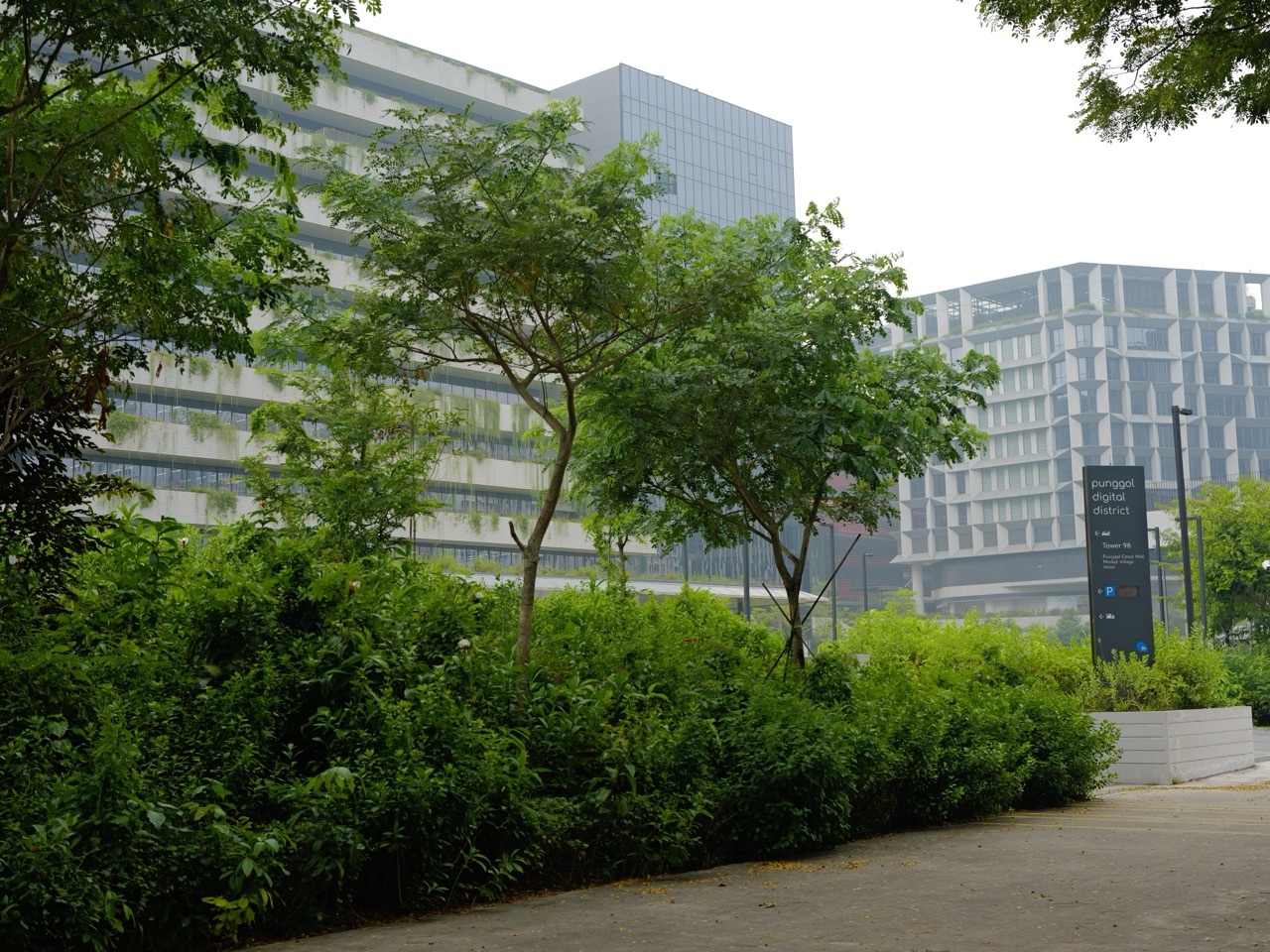
Punggol’s strongest attraction for technology enthusiasts is the Punggol Digital District, developed by JTC beside Singapore Institute of Technology’s Punggol campus. It is a working mixed-use district with smart infrastructure, public amenities and a developing technology business ecosystem—not a science museum where visitors can enter laboratories at will. For a practical hands-on experience, the NLB MakeIT makerspace at Punggol Regional Library offers authorised digital-making sessions with booking and equipment rules. Start by choosing whether you want to observe real infrastructure, learn its design or make something yourself.
The top ten things to do in Punggol for tech enthusiasts are to walk the public Digital District, study its Open Digital Platform, explore the district digital-twin concept, examine how a solar-plus-battery smart grid works, understand the district cooling system, observe passive design and sensor-informed building strategies, investigate pneumatic waste-system design, learn about robotics businesses without expecting a private tour, book a MakeIT digital-fabrication experience, and explore technology-mediated storytelling or self-service reading at NLB venues. Each is a genuine learning activity. Several involve reading authoritative diagrams rather than entering operational plant rooms.
Punggol Coast MRT connects to the public-facing Digital District, Punggol Coast Mall and its Comics & Games Library. Punggol MRT is the separate town-centre anchor for One Punggol and the Regional Library. JTC lists the first 400 metres of Punggol Heritage Trail’s main alignment as open; the wider district contains private business offices and campus spaces with their own access policies. A visitor can enjoy the public streets, mural and retail amenities without claiming access to robotics facilities, the university’s teaching labs or a data-centre control room.
One technical fact-check matters more than a futuristic headline: official webpages describe systems at different development stages. Some give initial targets and estimated energy savings, while newer articles discuss deployments and capabilities. Do not publish an old ambition as if a passer-by measured it today. We distinguish verified public-space observations, operator-described systems, forecasts and opportunities that require permission. This approach turns Punggol into a useful technology case study without inventing live experiments.
Ten Punggol technology experiences at a glance
- 1. Walk the public Punggol Digital District as an urban technology case study — Public JTC Punggol Digital District streets and community spaces near Punggol Coast MRT.
- 2. Study how the Open Digital Platform connects separate smart systems — JTC’s Open Digital Platform public explainers, paired with a lawful district walk.
- 3. Understand the digital twin without expecting public login access — Public Digital District viewpoints plus JTC digital-twin descriptions.
- 4. Map the solar, battery and smart-grid energy system — Lawful exterior observations of Punggol Digital District and its official smart-grid pages.
- 5. Explain the district cooling network and why it uses chilled water — JTC’s district cooling public explainer and public Punggol Coast precinct surroundings.
- 6. Compare passive solar shading with active smart building systems — Public shaded walkways and façade views in Punggol Digital District.
- 7. Investigate the concept of pneumatic waste conveyance and sensing — JTC’s public stories on Punggol Digital District environmental systems.
- 8. Learn which robotics businesses are building in the district — JTC public business directory and lawful public spaces of Punggol Digital District.
- 9. Book an NLB MakeIT session for digital making or coding — MakeIT at Punggol Regional Library, Level 4, One Punggol.
- 10. Explore self-service reading technology and interactive digital literature — Comics & Games Library at Punggol Coast Mall or Words That Move at Punggol Regional Library.
The list includes public field observations, operator-explained infrastructure, a conditional maker workshop and interactive library experiences. They are different forms of discovery, not ten laboratories that sell walk-in tickets. The correct decision is to choose one technology question and the legitimate way to investigate it.
Before visiting: what makes a responsible tech field trip?
Choose an observation, study or booked hands-on format
Decide whether your outing is a public field observation, an online infrastructure reading task, a scheduled maker workshop or a booked technical event. These are different permission levels. A JTC webpage showing a 3D digital twin does not entitle a tourist to log into the operating platform; an operating business park does not grant entry to every company laboratory. Make the activity useful with available public evidence rather than searching for unauthorised access.
Attribute every performance number to its source and date
Treat operator data as attributed information. JTC’s sustainability pages describe solar generation, storage, district-level energy optimisation and design simulations. A numerical estimate from JTC is not a figure that a visitor measured by looking at a roof. Check the date and specific wording of a claim before repeating it; earlier capacity, emissions and efficiency targets may have changed during development.
Use the right Punggol station and site access
Understand the geography. Punggol Coast is where the Digital District’s public realm and mall sit. One Punggol at Punggol MRT is the best anchor for NLB MakeIT and the main regional library. They are different locations. A tech itinerary mixing the two needs a planned transfer, whereas a short Digital District study can remain entirely near Punggol Coast MRT.
Consider privacy and security before data collection
Make data ethics part of the discussion. Sensor networks and smart operations raise questions about collection, aggregation, security, access control and how managers use information. Do not assume public access to real-time occupancy data, and avoid photographing security-sensitive systems. A responsible technology enthusiast wants to understand architecture and governance, not discover or exploit vulnerabilities.
Follow MakeIT equipment eligibility and safety
Use accessible maker services legitimately. NLB’s MakeIT site advertises robotics and coding, 3D printing, digital cutting, sewing and upcycling learning areas. Sessions, self-service booking and specific equipment access have separate conditions, including certification for some machines. A visitor should not claim that every person can turn up and operate a laser cutter without orientation.
Keep weather and return transport manageable
Keep a clear return and weather plan. Punggol’s Digital District is outdoors between buildings, with exposed and shaded public areas. Thunderstorms, heavy rain, heat and haze can affect comfort and safety. A public gallery, library or mall is an alternative only under its own opening and entry rules. A technology outing should never require entering restricted facilities or enduring unsafe conditions for a photograph.
The ten activities for tech enthusiasts
1. Walk the public Punggol Digital District as an urban technology case study
Where: Public JTC Punggol Digital District streets and community spaces near Punggol Coast MRT.
What is technically documented
JTC describes a 50-hectare mixed-use district developed for emerging technology sectors such as AI, cybersecurity, robotics and fintech, integrated with SIT’s Punggol campus. It also provides public amenities including Punggol Coast Mall, a hawker centre, part of the Heritage Trail and a community mural. These are actual public-facing features, distinct from private laboratories or commercial offices.
A practical and lawful way to explore it
Arrive at Punggol Coast MRT and choose one signed public path. Identify three visible systems: a sheltered pedestrian route, a public amenity connected to transit and an architectural detail that could support energy efficiency. Read JTC’s official district overview rather than assigning unknown technical purpose to every façade. Keep the walk short enough to discuss the findings and return comfortably.
Worked technology example
A visitor expects a ‘robot city’ with demonstrations on every corner. Walking through the area, they see modern buildings, public space and working shops instead. They use JTC’s overview to explain why a living innovation district is fundamentally different from a theme park and identify which technologies are documented but not directly visible.
Access, privacy and fact-checking limits
Do not enter SIT teaching rooms, private offices, data rooms, service corridors or construction areas without explicit permission. The community-facing district does not create universal entry rights. Construction and tenant listings may change, while a future project is not automatically operating today.
Who will find this worthwhile?
Best for tech visitors who want an accurate physical orientation to a real smart urban precinct. Pair it with official reading about one system rather than trying to inspect ten invisible technologies in an afternoon.
A small original technical result
Make a two-column card: observed public feature and officially documented technical role. Mark design features that cannot be identified from the outside as questions rather than facts.
Good technology writing distinguishes a device’s purpose, the architecture of the system, the data it would need, and any claimed outcome. A visitor who can describe a design accurately without inventing access to the underlying controls has learned something valuable. If the evidence describes a proposal or estimate, keep that qualification. Accuracy matters more than a futuristic claim that sounds impressive but cannot be checked.
The official technology or visitor reference is here. It explains the operator’s system or service, not a promise of public laboratory access, individual technical-data rights, a reserved workshop or a specific robot demonstration today.
2. Study how the Open Digital Platform connects separate smart systems
Where: JTC’s Open Digital Platform public explainers, paired with a lawful district walk.
What is technically documented
JTC and GovTech developed the Open Digital Platform, or ODP, to support interoperability between different technologies and building systems at Punggol Digital District. The public explanation describes open-standard multiprotocol middleware and integrated management of functions such as lighting, lifts and cooling. Access to its internal interfaces is separate from public reading about how it works.
A practical and lawful way to explore it
Read JTC’s ODP story and draw boxes for two systems that normally speak different technical protocols, then add the platform as an integration layer. Ask why different manufacturers use different interfaces and what a secure middleware layer must account for. Use the physical district only as context; you do not need to enter control rooms or request live credentials.
Worked technology example
A student thinks an automated lift should communicate automatically with any access-control system. They learn that two systems can use different protocols and data models, then draw an adapter that translates permitted events. The activity becomes a clear explanation of interoperability instead of vague praise for a smart city.
Access, privacy and fact-checking limits
Do not attempt to access sensors, control endpoints, private devices or networks without permission. Operator illustrations are not instructions for penetration testing. ODP features and data availability can change as the district develops; distinguish a planned example from a confirmed public function.
Who will find this worthwhile?
Best for software engineering, IoT, systems architecture and smart-city enthusiasts. It can be studied indoors on a rainy day using JTC’s public explanation, with an optional short site walk.
A small original technical result
Write a six-sentence explanation defining an input, a system boundary, a translation step, a security check, an authorised action and a way to monitor errors.
Good technology writing distinguishes a device’s purpose, the architecture of the system, the data it would need, and any claimed outcome. A visitor who can describe a design accurately without inventing access to the underlying controls has learned something valuable. If the evidence describes a proposal or estimate, keep that qualification. Accuracy matters more than a futuristic claim that sounds impressive but cannot be checked.
The official technology or visitor reference is here. It explains the operator’s system or service, not a promise of public laboratory access, individual technical-data rights, a reserved workshop or a specific robot demonstration today.
3. Understand the digital twin without expecting public login access
Where: Public Digital District viewpoints plus JTC digital-twin descriptions.
What is technically documented
JTC’s more recent smart-district stories describe the ODP’s 3D digital twin as a way to integrate district information and support management. A digital twin combines a model and data reflecting selected aspects of a real system; the operator’s public description is evidence of the technology concept, not a guarantee that tourists can operate the live twin or view sensitive building telemetry.
A practical and lawful way to explore it
Choose one public building or streetscape element and sketch a simple model of its physical parts. Then list which information a digital twin would need to represent its operation: geometry, occupancy trends, energy use and maintenance events. Compare this conceptual list with JTC’s public description. Discuss how different update rates and data quality affect the model’s usefulness.
Worked technology example
A university student draws a beautiful 3D representation and calls it a digital twin. A classmate points out that an ordinary 3D drawing has no live state or updated data. They add hypothetical but clearly labelled sensor fields and note which observations they would need to validate rather than claiming access to JTC’s system.
Access, privacy and fact-checking limits
Avoid implying every datum from 20,000-plus sensors is public or that the visitor can inspect individual occupant behaviour. The number quoted in JTC’s materials belongs to its description and publication context, not the visitor’s own audit. Respect information-security and privacy limitations.
Who will find this worthwhile?
Best for software, architecture and data-modelling learners. This is an evidence-based conceptual activity, not an advertised public digital-twin exhibit with walk-in tickets.
A small original technical result
Create a table with physical asset, model attribute, possible update source, access permission and risk of incorrect data. Keep hypothetical values labelled.
Good technology writing distinguishes a device’s purpose, the architecture of the system, the data it would need, and any claimed outcome. A visitor who can describe a design accurately without inventing access to the underlying controls has learned something valuable. If the evidence describes a proposal or estimate, keep that qualification. Accuracy matters more than a futuristic claim that sounds impressive but cannot be checked.
The official technology or visitor reference is here. It explains the operator’s system or service, not a promise of public laboratory access, individual technical-data rights, a reserved workshop or a specific robot demonstration today.
4. Map the solar, battery and smart-grid energy system
Where: Lawful exterior observations of Punggol Digital District and its official smart-grid pages.
What is technically documented
JTC states that Punggol Digital District’s district-level smart grid integrates rooftop photovoltaic generation, battery energy storage and data-driven controls. Its sustainability page reports estimated renewable generation and emissions benefits, while an earlier technical story describes a design phase and a 2026 target. Readers should not mix planning estimates with measured present-day performance without knowing the source and date.
A practical and lawful way to explore it
Draw generation, storage, distribution and consumer loads as four separate blocks. Explain why solar panels produce electricity under appropriate daylight conditions while a battery stores it for later use. Read JTC’s current description and look for publicly visible rooftop or canopy features only from lawful ground-level viewpoints. Do not claim that a particular solar panel’s output has been measured by your phone.
Worked technology example
A student assumes battery capacity is the same as instantaneous power generation. After reading the official smart-grid material, they separate kilowatts, kilowatt-hours and demand shifting. Their revised diagram explains why supply and demand timing matters even when two installations both use renewable energy.
Access, privacy and fact-checking limits
Do not climb rooftops, enter substations, touch electrical equipment or photograph sensitive controls. Any emissions-savings figure needs its own assumptions, reporting period and attribution; this article does not certify real-time savings. JTC materials from different stages may use differing forecasts.
Who will find this worthwhile?
Best for electrical engineering and energy enthusiasts interested in sustainability with a strong digital component. The public operator material gives more learning value than simply photographing rooftop equipment.
A small original technical result
Create an hour-by-hour hypothetical supply-and-demand table with explicitly fictional numbers, then explain which real meter readings would be required to check performance.
Good technology writing distinguishes a device’s purpose, the architecture of the system, the data it would need, and any claimed outcome. A visitor who can describe a design accurately without inventing access to the underlying controls has learned something valuable. If the evidence describes a proposal or estimate, keep that qualification. Accuracy matters more than a futuristic claim that sounds impressive but cannot be checked.
The official technology or visitor reference is here. It explains the operator’s system or service, not a promise of public laboratory access, individual technical-data rights, a reserved workshop or a specific robot demonstration today.
5. Explain the district cooling network and why it uses chilled water
Where: JTC’s district cooling public explainer and public Punggol Coast precinct surroundings.
What is technically documented
JTC describes a district cooling system developed with ENGIE, where a central underground plant distributes chilled water through pipes and transfer stations to buildings. It is linked conceptually with the district’s Open Digital Platform for monitoring and optimisation. A public description of the plant’s design is not permission to visit the underground facility or a measurement of the system’s energy-saving effect today.
A practical and lawful way to explore it
Read the technical overview and draw a loop: central cooling plant, supply, building heat exchange and return. Compare how a shared district network differs from each building operating fully separate equipment. Ask what efficiency could depend on: plant load, occupancy, pipe losses and controls. Use only public district spaces and the operator’s published diagrams.
Worked technology example
A learner initially labels the ‘cold air pipeline’ from one building to another. Reviewing JTC, they correct the explanation: chilled water is distributed and heat exchange is managed within buildings. The correction makes the diagram technically meaningful without needing to enter an equipment room.
Access, privacy and fact-checking limits
Do not trespass into plant rooms, tunnels or service corridors. Cooling capacity statements belong to the operator’s technical narrative and may refer to design stages; do not claim an unverified live number. Mechanical equipment can be hazardous even when visible behind barriers.
Who will find this worthwhile?
Best for mechanical-engineering and energy-management enthusiasts. It is possible to complete the conceptual activity entirely from legitimate public JTC information during unsafe outdoor weather.
A small original technical result
Create a system diagram and list three operational measurements that would be necessary to test whether a central cooling arrangement is more efficient in a given setting.
Good technology writing distinguishes a device’s purpose, the architecture of the system, the data it would need, and any claimed outcome. A visitor who can describe a design accurately without inventing access to the underlying controls has learned something valuable. If the evidence describes a proposal or estimate, keep that qualification. Accuracy matters more than a futuristic claim that sounds impressive but cannot be checked.
The official technology or visitor reference is here. It explains the operator’s system or service, not a promise of public laboratory access, individual technical-data rights, a reserved workshop or a specific robot demonstration today.
6. Compare passive solar shading with active smart building systems
Where: Public shaded walkways and façade views in Punggol Digital District.
What is technically documented
JTC says district building design uses advanced simulations to make use of daylight, reduce solar heat gain and improve airflow. This passive approach is distinct from active smart-grid control or mechanical cooling. It is visible in the form of shade, building massing and pedestrian-space layout, though a person cannot establish actual energy savings just by standing beneath a canopy.
A practical and lawful way to explore it
Choose a comfortable daylight time and a clearly public route with contrasting shaded and exposed areas. Note changes in light and apparent airflow, remembering that weather itself is variable. Read JTC’s sustainability explanation before assigning purposes. If measuring temperature for a student project, use controlled methods and label instruments and conditions rather than presenting a feeling as numerical proof.
Worked technology example
Two visitors argue that the most shaded path automatically has the lowest air temperature. They notice the difference between radiant exposure, airflow and measured air temperature. Their final explanation identifies the design goal but avoids a precise unsupported cooling figure.
Access, privacy and fact-checking limits
Sun and heat may make prolonged observation unpleasant. Do not enter private terraces or rooftop spaces to measure a façade. One observation cannot establish a year’s energy performance, and a published rendering may include proposals beyond what has opened.
Who will find this worthwhile?
Best for anyone interested in how physical design and computing complement one another. The public walking task is short and can be combined with nearby food at Punggol Coast Mall.
A small original technical result
Draw a street cross-section labelling shade, possible airflow and the location of sensors or controls as hypothetical unless JTC documents them specifically.
Good technology writing distinguishes a device’s purpose, the architecture of the system, the data it would need, and any claimed outcome. A visitor who can describe a design accurately without inventing access to the underlying controls has learned something valuable. If the evidence describes a proposal or estimate, keep that qualification. Accuracy matters more than a futuristic claim that sounds impressive but cannot be checked.
The official technology or visitor reference is here. It explains the operator’s system or service, not a promise of public laboratory access, individual technical-data rights, a reserved workshop or a specific robot demonstration today.
7. Investigate the concept of pneumatic waste conveyance and sensing
Where: JTC’s public stories on Punggol Digital District environmental systems.
What is technically documented
JTC’s smart-city sustainability article describes a planned pneumatic waste conveyance system that would automate waste collection and enable more resource-efficient treatment. Some JTC materials were written during development, so this is best approached as a case study in the intended system, not a claim that every section is operating or visible to visitors today. Waste-handling technology is not a tourist facility to enter.
A practical and lawful way to explore it
Read the operator’s explanation of the proposed automation. Draw an abstract process from collection point to transport network and destination, noting where sensors or control rules might be needed. Compare the potential advantages with maintenance, contamination and sorting constraints. Label features that are described as plans or goals rather than current verified operations.
Worked technology example
A technology enthusiast reads about automated waste systems and assumes every bin on the Punggol Coast street is vacuum-connected. On inspection the bins are unlabelled, so they revise the claim: JTC has described this technology as part of its planning approach, but they cannot verify that specific bin’s connection from the public street.
Access, privacy and fact-checking limits
Do not open waste chutes, inspect utility tunnels, interfere with public bins or create false claims about a system’s commissioned status. A public explainer is not an invitation to test critical municipal infrastructure. Hygiene and operational safety matter.
Who will find this worthwhile?
Best for systems-thinking learners curious about automation beyond flashy robots. This task works entirely with official materials if no confirmed public exhibit exists.
A small original technical result
List a potential sensor, a decision rule, one safety exception and one piece of data needed to evaluate a waste system. Mark the diagram as conceptual.
Good technology writing distinguishes a device’s purpose, the architecture of the system, the data it would need, and any claimed outcome. A visitor who can describe a design accurately without inventing access to the underlying controls has learned something valuable. If the evidence describes a proposal or estimate, keep that qualification. Accuracy matters more than a futuristic claim that sounds impressive but cannot be checked.
The official technology or visitor reference is here. It explains the operator’s system or service, not a promise of public laboratory access, individual technical-data rights, a reserved workshop or a specific robot demonstration today.
8. Learn which robotics businesses are building in the district
Where: JTC public business directory and lawful public spaces of Punggol Digital District.
What is technically documented
JTC’s current business page lists companies and technology partners across the Digital District, including robotics-related names such as LionsBot and QuikBot, alongside public-sector and financial-technology organisations. The list documents an innovation ecosystem; it does not guarantee that visitors can tour companies, see an autonomous vehicle on a specific day or handle a prototype.
A practical and lawful way to explore it
Select one robotics company from the official JTC business list and research its publicly described application. Write down the real-world problem it addresses, the likely sensing and actuation challenges, and how safety and deployment rules might matter. Visit the district’s public areas only for geographic context; arrange any private company event solely through a genuine public invitation.
Worked technology example
A student wants to watch a delivery robot at Punggol Coast but cannot find a confirmed public demonstration. Rather than filming random service equipment, they study a listed company’s public product material and sketch the sensors and control decisions a robot would need to navigate safely around people.
Access, privacy and fact-checking limits
Do not follow staff through security doors, film restricted test areas or claim a named company is operating a particular robot in public right now. Startup and tenant lists can change, and a company being based in the district is not evidence of a free walk-in showroom.
Who will find this worthwhile?
Best for robotics and startup enthusiasts who want to understand actual industry rather than a spectacle. The task is a research-and-observation exercise, with deeper visits possible only if openly offered and booked.
A small original technical result
Create a product analysis with user need, environment, sensors, actuators, human oversight and one plausible failure mode. Verify each real product claim with the company’s own source.
Good technology writing distinguishes a device’s purpose, the architecture of the system, the data it would need, and any claimed outcome. A visitor who can describe a design accurately without inventing access to the underlying controls has learned something valuable. If the evidence describes a proposal or estimate, keep that qualification. Accuracy matters more than a futuristic claim that sounds impressive but cannot be checked.
The official technology or visitor reference is here. It explains the operator’s system or service, not a promise of public laboratory access, individual technical-data rights, a reserved workshop or a specific robot demonstration today.
9. Book an NLB MakeIT session for digital making or coding
Where: MakeIT at Punggol Regional Library, Level 4, One Punggol.
What is technically documented
NLB’s MakeIT service offers 3D printing, robotics and coding, digital cutting, sewing and upcycling. It lists Punggol’s service as Wednesday–Sunday, noon–8.30pm, with Monday, Tuesday and specified holiday closures. Starter sessions, tinkering and bookable self-service equipment have different access requirements; certain machines require relevant MakeIT certification.
A practical and lawful way to explore it
Choose one achievable project, such as a simple 3D object, a paper digital-cutting design or a microcontroller concept. Read NLB’s current programme and age guidance and register for a legitimate starter session or equipment slot. Arrive prepared to learn equipment safety and file requirements. If booking is unavailable, research the concept from library books and attend another day.
Worked technology example
A beginner wants to print an elaborate model immediately. The session they see online is full, and a machine may require training. They revise the plan to create a tiny test object, study the digital workflow and register for a suitable session rather than asking to operate unfamiliar equipment unsupervised.
Access, privacy and fact-checking limits
A public library does not become a private fabrication laboratory. Machine access, certification, age, safety and materials rules apply. The operating window is not a guarantee that a particular workshop is available. Keep expectations realistic about what can be completed in one visit.
Who will find this worthwhile?
Best for people seeking genuine hands-on technology rather than passive district observation. It is also a useful indoor alternative in poor weather, but only when a suitable approved session is available.
A small original technical result
Prepare a design brief with user need, dimensions, material constraints, what could fail and how to test the first prototype. A clear brief often matters more than the finished object.
Good technology writing distinguishes a device’s purpose, the architecture of the system, the data it would need, and any claimed outcome. A visitor who can describe a design accurately without inventing access to the underlying controls has learned something valuable. If the evidence describes a proposal or estimate, keep that qualification. Accuracy matters more than a futuristic claim that sounds impressive but cannot be checked.
The official technology or visitor reference is here. It explains the operator’s system or service, not a promise of public laboratory access, individual technical-data rights, a reserved workshop or a specific robot demonstration today.
10. Explore self-service reading technology and interactive digital literature
Where: Comics & Games Library at Punggol Coast Mall or Words That Move at Punggol Regional Library.
What is technically documented
NLB’s self-service Comics & Games Library uses digital entry with a compliant ID, eCard or QR day pass and supports browsing and loans through the NLB Mobile app. The separate Words That Move installation at Punggol Regional Library uses animated poetry, projection, light and sound, and its specific hours are 5pm–7pm. These are two legitimate public-facing ways to discuss interaction design; they are in different districts and need separate timing.
A practical and lawful way to explore it
For a self-service library interface, check your legitimate credential and experience one ordinary permitted entry or browsing workflow at Punggol Coast. Note the steps a reader takes and what happens if eligibility fails. For digital storytelling, schedule Words That Move in its stated 5pm–7pm window and observe one animation as a design response to text. Choose one, not both, for a short trip.
Worked technology example
A visitor sees a QR entry instruction and assumes every digital service is anonymous. Reading NLB’s guidance shows the day pass requires a compliant registration method. Another visitor watches animated poetry and realises that accessibility, language, movement and sound design can all shape the same literary experience. Neither needs access to a back-end system to learn from the interaction.
Access, privacy and fact-checking limits
Do not attempt to bypass QR authentication, capture others’ identifiers or test security without authorisation. Graphic-novel availability and interactive rooms can change. Respect copyright, library conduct, room capacity and any restrictions on photography.
Who will find this worthwhile?
Best for readers interested in human–computer interaction, digital inclusion and self-service service design. Choose one NLB node based on the time, credentials and the intended learning question.
A small original technical result
Draw a user journey of four steps, identify one inclusion barrier and suggest an improvement. Keep it a usability observation, not an unauthorised security audit.
Good technology writing distinguishes a device’s purpose, the architecture of the system, the data it would need, and any claimed outcome. A visitor who can describe a design accurately without inventing access to the underlying controls has learned something valuable. If the evidence describes a proposal or estimate, keep that qualification. Accuracy matters more than a futuristic claim that sounds impressive but cannot be checked.
The official technology or visitor reference is here. It explains the operator’s system or service, not a promise of public laboratory access, individual technical-data rights, a reserved workshop or a specific robot demonstration today.
Three Punggol technology outings that genuinely work
Public Digital District tech walk: one location, three systems
Arrive at Punggol Coast MRT and select clearly public streets and amenities. Begin with observing passive design and the physical district, then use JTC’s online information to discuss the ODP and smart-grid or cooling architecture. Stop at a legitimate food or transit point. Do not enter business offices, SIT laboratories or fenced works in search of technology. The best output is a diagram and one informed question.
Indoor MakeIT exploration at One Punggol
Check the current NLB calendar and MakeIT requirements, then attend one approved starter or self-service session. Choose one realistic prototype instead of planning to use every machine. If the desired appointment is unavailable, spend the visit reading about fabrication and prepare your design file for another day. The regular library is a separate public facility with its own operating conditions.
Human–computer interaction in two NLB environments
Choose either the self-service Comics & Games Library at Punggol Coast or the timed Words That Move poetry installation at One Punggol. Observe how digital entry, content discovery or interactive projection guides the user. A short usability note with a clearly described user journey can be more informative than attempting to inspect the back end. Do not try to bypass identity, content or network restrictions.
How to avoid confusing plans, estimates and measured results
First record the publication date and author of the authority statement. A JTC article written before commissioning may say a system ‘will’ provide a service; a later article may report a technology’s deployment or operating role. These statements can both be historically accurate at their respective moments while supporting different current conclusions. Prefer recent direct descriptions for present status, and leave uncertainty visible when official materials differ.
Second, distinguish measurement units and boundaries. A solar generation estimate expressed in megawatt-hours over a year is not the same as instantaneous power in megawatts. A district cooling design capacity is not automatically the amount used during your visit. An energy-saving percentage requires a baseline. Readers are better served by one precise statement with the right context than an impressive string of numbers stripped of assumptions.
Third, separate visible equipment from its performance. A roof with solar panels does not allow a tourist to measure energy produced. A shaded path cannot prove a precise reduction in air temperature or annual electricity demand. A smart-building brochure cannot reveal a building’s live sensor readings. The correct field activity is to observe visible features and use the published technical explanation to form a testable question.
Fourth, remember that smart-city infrastructure has privacy and security requirements. Access-control systems, occupancy analytics, electricity management and robotics may affect real people and essential services. Treat any non-public interfaces as off-limits without explicit authorisation. A useful visitor activity does not involve credential sharing, security probing, traffic interference or publicising operational weaknesses.
Ten-point technology outing checklist
- Choose one technical concept you want to understand.
- Start at Punggol Coast MRT for the Digital District, or Punggol MRT for MakeIT.
- Check which public routes are open and avoid private campus spaces.
- Read an official JTC or NLB source rather than a speculative technology blog.
- Date any performance figure, target or deployment claim.
- Keep visible observations separate from estimated system outcomes.
- Do not touch operational controls, electrical assets or technical equipment.
- Book and satisfy certification rules for NLB MakeIT activities.
- Follow library privacy, identity and photography requirements.
- Finish with a clear conceptual diagram and a safe homeward route.
Five misleading assumptions about technology in Punggol
The first is treating the district as a public science museum. Punggol Digital District is a business, education and community precinct. Public-facing spaces are useful to explore, but laboratories, private offices and infrastructure rooms have separate access. The official public information provides more than enough material for a responsible learning visit.
The second is assuming a digital twin gives everybody public control of the city. A model and its data may support authorised operators, maintenance teams and partner businesses. It does not follow that a visitor can log into live data or issue commands to lifts, lights or cooling systems.
The third is mixing operator estimates with visitor measurements. Different JTC articles may describe targets or capacities from different phases. Without real operational data and a definition of the comparison baseline, a tourist cannot certify energy savings or annual emissions reductions. Accurate qualifiers make the guide stronger.
The fourth is exaggerating robotics visibility. A technology business can have its office in the district without staging public demonstrations every hour. Visitors should research actual announced programmes rather than filming workers or entering secure areas in search of robots.
The fifth is claiming that an NLB public makerspace means unrestricted device use. MakeIT has starter sessions, tinkering and bookable services, with certain machines needing certification. A good maker respects training and safety and is happy to return when an authorised slot is available.
Frequently asked questions
What is the best tech attraction in Punggol?
Punggol Digital District is the strongest real-world technology setting, and NLB MakeIT offers authorised hands-on learning. The district is a working business and education precinct, not a free-admission technical museum.
Can visitors tour Punggol Digital District?
Visitors can use legitimate public streets and amenities such as Punggol Coast Mall and the public heritage or mural areas. Private offices, SIT laboratories, service plants and restricted rooftops require separate permission.
What is Punggol’s Open Digital Platform?
JTC describes the ODP as the digital integration infrastructure linking district systems and supporting data-driven building management. Reading its public explanation is different from being granted access to live controls.
Does Punggol Digital District have a digital twin?
JTC describes the use of a 3D digital twin through its ODP. This is an operator-managed system and not a promise of walk-in public interactive access.
What is a smart grid in Punggol?
JTC describes a district-level system combining solar generation, battery storage and data-driven energy management. Source dates and estimates matter; a visitor cannot establish real-time energy performance by looking at rooftop equipment.
Can I enter the district cooling plant?
Not as an ordinary visitor. JTC explains the central chilled-water system through its public materials. Plant access must not be assumed or attempted.
Can I see a robot operating in Punggol?
JTC lists robotics-related companies in the district, but that does not confirm a particular public demonstration or robot encounter. Check for a legitimately announced event rather than inventing a live showcase.
Is pneumatic waste conveyance operating everywhere?
JTC describes the system in its development materials. Do not claim every public bin is connected or that all functions are commissioned without a current system-specific confirmation.
Where is MakeIT at Punggol?
Level 4 at Punggol Regional Library within One Punggol. NLB lists Wednesday–Sunday, noon–8.30pm as ordinary service hours, with separate workshop and certification rules.
Can I use a MakeIT 3D printer without training?
Not necessarily. NLB says certain equipment requires relevant certification and distinguishes starter sessions, tinkering and bookable self-service slots.
How do I try the Comics & Games Library’s self-service entry?
Use the current NLB-compatible ID, eCard or eligible QR day-pass process. Never attempt to bypass registration or use somebody else’s identity.
What is an evening digital-literature experience?
NLB’s Words That Move animates poems with projection and sound at Punggol Regional Library. Its published 5pm–7pm window is separate from general library hours.
Official technology references and related eduKatePunggol guides
The links below are the operator-owned public documentation for Punggol Digital District and NLB services, supplemented by relevant local guides. They document technologies, estimated benefits and programme frameworks as published; always check the current status of a system or session before travelling.
- JTC Punggol Digital District overview
- JTC Punggol Coast community amenities
- JTC Open Digital Platform explainer
- JTC digital twin and sustainable mixed-use design
- JTC smart grid and passive features
- JTC district cooling system
- JTC waste automation design discussion
- JTC technology businesses
- NLB MakeIT at Libraries
- NLB Comics & Games Library
- NLB Punggol Stories digital literary exhibit
- Punggol science lovers’ companion
- Punggol student activity companion
- Punggol atlas
The best first tech outing
Begin at Punggol Coast MRT and learn one visible design feature, then read JTC’s explanation of the ODP, smart grid or district cooling. On another day, arrange a legitimate MakeIT session if you want to prototype or code. Punggol becomes a far more interesting technology destination when readers ask precise questions and respect the difference between a working district and an open exhibit.


