
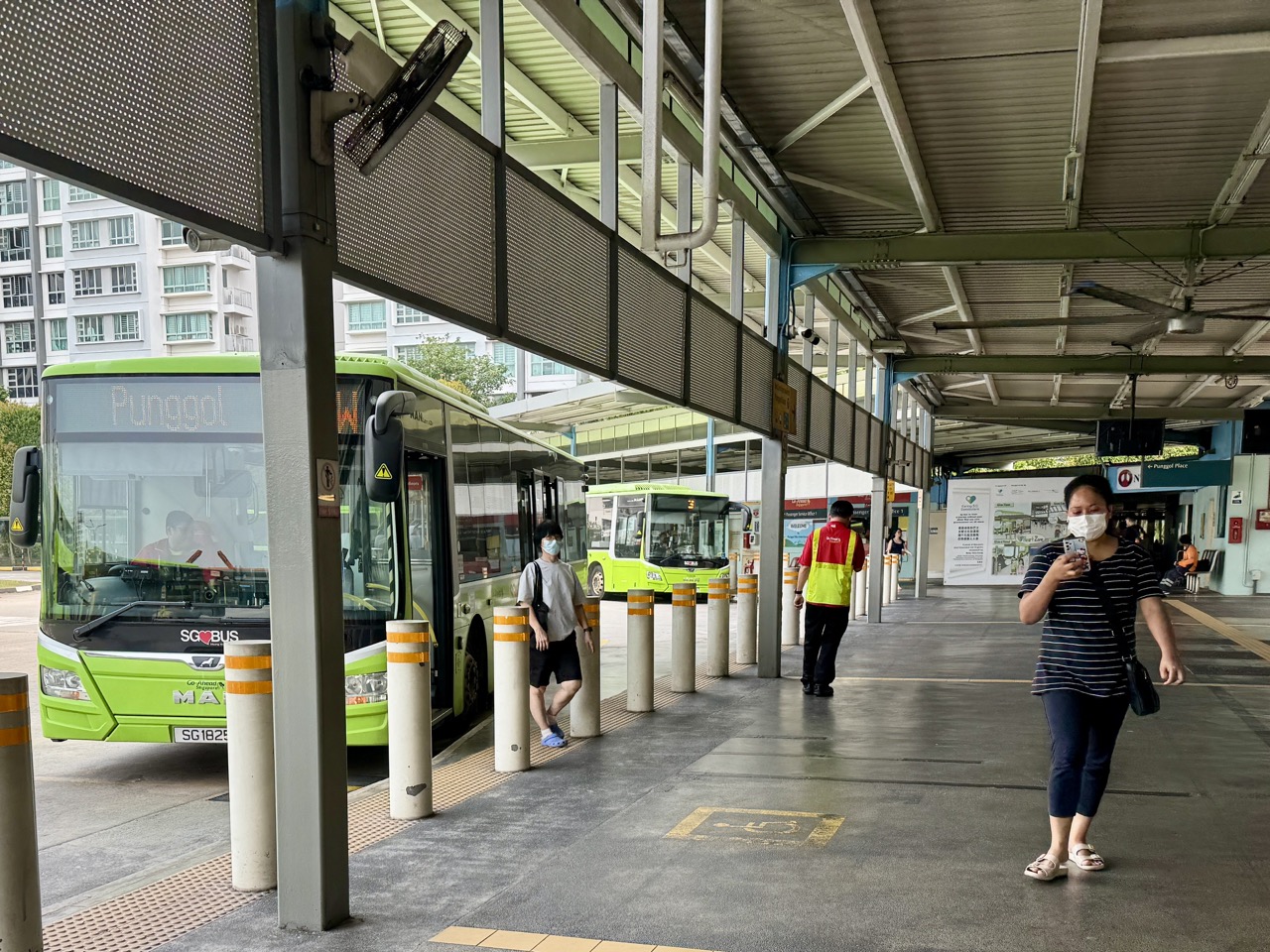
Want to explore Punggol by bus instead of making a long walk? Choose one real bus journey that serves an ordinary destination you would enjoy—perhaps a meal, a public library browse, or a visit to a friend—and use the ride to notice how streets, HDB neighbourhoods and transport interchanges fit together. The most useful starting points are Punggol Bus Interchange, near central Punggol MRT/LRT, and Punggol Coast Bus Interchange, which opened on 29 June 2025 in the Digital District, integrated with Punggol Coast MRT and Punggol Coast Mall. These are different bus interchanges; confirm which one your actual service uses.
Things to do in Punggol by bus can be an accessible change from a generic Waterway itinerary for families, teens who are learning public transport, new residents and visitors who enjoy Singapore’s neighbourhoods. A first outing can involve one bus, one confirmed open destination and a straightforward return. An adult might notice how the bus network serves housing and healthcare, while a child reads a route display or recognises a landmark. The purpose is ordinary travel with a little curiosity, not a claim that the bus itself is a sightseeing tour with reserved seats or a fixed scenic route.
18 October 2026: NEA’s advisory issued on 17 October forecasts PSI 150–220, unhealthy to very unhealthy, for 18 October. The bus is a public-transport service, not a guarantee that the waiting, transfers or outdoor destination are safe for everybody in haze. Follow current NEA/MOH advice and the operator’s actual service information. The first version of this activity can be completed entirely at home by comparing LTA and OneMap information and planning a future journey when conditions are suitable.
Quick answer: choose a bus exploration by purpose
| Who is going? | Use one realistic goal | What to verify | What to avoid |
|---|---|---|---|
| Family with young children | Ride to one known food or public service cluster | Correct stop, boarding and return | Making every interchange a destination |
| New Punggol resident | Learn one useful bus connection for real errands | Actual bus route and nearest stop | Assuming every route is unchanged |
| Teen learning transport | Plan a family-approved route and destination | Fare, safe stop, contact plan | Unsanctioned detours |
| Visitor curious about urban design | Compare central and Coast transport hubs on separate visits | Service changes, correct station | Assuming a direct one-bus link without checking |
| Older visitor | Use a comfortable route with suitable facilities | Seating, walking and accessible boarding | Long unexpected transfers |
| Rain or unhealthy haze | Research one route indoors and defer leisure travel | NEA/MSS guidance | Staying outside solely to finish the task |
Five chapters with one clear purpose each
- Chapter 1 — Why a bus ride is a useful Punggol activity
- Chapter 2 — Two Punggol interchanges and an honest route method
- Chapter 3 — Four worked outings and a route checklist
- Chapter 4 — Twenty transit observation ideas and problems to avoid
- Chapter 5 — FAQs, related local guides and official sources

Chapter 1. Why a bus ride is a useful Punggol activity
A commuter service becomes interesting when there is a reason to ride
Singapore buses are designed primarily to help people get somewhere. Treating a normal route as an attraction without considering passengers can lead to standing in the aisle, filming strangers or occupying seats for a social media project. A better idea is to ride a valid service to a real public destination and notice what the journey reveals about Punggol’s design.
Choose a purpose before boarding: a library visit, a nearby meal, a meeting or a return route you would like to learn. An observation game should be quiet and respectful. You do not need to travel to an unknown terminal merely for novelty.
Your home is not always near the famous interchange
Some residents depend on neighbourhood bus stops, while others live near an LRT station. A visitor starting at Punggol Coast may sensibly use the northern bus interchange; a central-town visitor may find Punggol Bus Interchange more convenient. Neither hub is universally better. The actual origin, destination and current route determine the choice.
Search the full destination in the LTA journey planner or current bus operator system. Confirm the stop code, boarding side and actual route. Do not assume a bus that passed your block last year still uses precisely the same stops today.
Punggol’s two interchanges tell different stories
LTA describes Punggol Coast Bus Interchange as an integrated hub within Punggol Digital District, connected with the Coast MRT and mall. The older central Punggol Bus Interchange serves the established MRT/LRT town-centre network. Their relationship shows how new transport capacity supports housing, education, workplaces and public facilities as the town grows.
A family can compare the official maps without making a cross-town tour. When actually visiting, use one hub at a time, identify an appropriate food or rest point and keep away from operational or staff-only areas. The presence of a large bus interchange does not grant access to its bus-control rooms or service lanes.
A route diagram cannot promise travel time
A public transport diagram can show stops and connections, but live traffic, traffic lights, bus frequency, road works, crowding and actual waiting conditions affect the journey. Some routes may be changed or diverted during events and construction. A bus service number alone is not a useful time estimate unless the date and specific boarding point are known.
Use current operator arrival and disruption information for the trip itself. Leave a generous return margin when travelling with children or to an appointment. This article deliberately does not invent bus headways or claim that the next bus arrives in a particular number of minutes.
Fare and concessions belong to actual rules
Some children, students or older commuters use concession arrangements, while adults may pay by a standard contactless fare method. A family should not assume everyone rides free or that the cost is the same regardless of distance. A useful outing budget includes the actual fare as well as any meals or ticketed activities.
Refer to LTA/SimplyGo for the applicable current fares and rules. Ensure each person has an accepted travel/payment arrangement before boarding. A bus ride is not an unofficial free sightseeing service.
Observation should never obstruct a bus
A child may love reading the stop announcements, watching junctions from the window or naming landmarks, but the bus remains a shared moving vehicle. Standing for photographs, crowding doors, distracting the driver and filming other passengers are inappropriate. Parents remain responsible for supervising children.
Choose a safe seat if available, keep belongings under control, and use normal passenger etiquette. If a child cannot see a feature, it is better to discuss it afterward from a safe public location than lean over another passenger or stand where boarding is occurring.
One transfer is sometimes enough to change the plan
A trip to one food centre may be pleasant, while a string of four bus transfers can tire a family before the actual outing begins. Mixed-age groups may need toilets, accessible boarding or a predictable return. It is normal to choose a closer venue when the public transport chain looks complicated.
Make the first outing one bus route with a destination that matters. Add an MRT or LRT transfer only if it meaningfully improves the experience. The car-free Punggol guide owns broader mixed-mode itineraries.
Accessibility is end-to-end, not one label on a bus
Public buses can have accessibility features, but an entire journey also includes the bus stop, kerb, path, crossing, building entrance, lift and a suitable place to rest. Individual needs vary. An interchange having accessible facilities does not establish that every possible walking approach is practical for every wheelchair or stroller user.
Check the complete route and actual service where accessibility is essential, using operator resources and the person’s own preferences. A one-stop trip to a confirmed accessible destination may be better than an ambitious tour across two hubs.
Weather matters even when the bus is air-conditioned
Travellers wait at bus stops, walk between the bus and venues, and may need to queue outside. A long bus excursion cannot be declared safe in unhealthy haze merely because some minutes are spent in a vehicle. Thunderstorms and heavy rain can also affect walking approaches.
Follow NEA and MSS advice. When outdoor exposure is inappropriate, complete the map-and-route planning exercise indoors and travel on another day. A short bus journey is a choice, not an essential health intervention.
Local history gives a bus route meaning without inventing an old service
Punggol’s transport history reaches back before the present town, with documented early bus services and former Punggol Road. Today’s buses run on a network shaped by redevelopment. A historically curious rider can compare old photographs or route descriptions with modern maps, but should not presume a 1930s service follows today’s alignment.
Read the historic Ponggol bus service article and its underlying evidence. An old bus company, an archival name and a present-day interchange are distinct objects. Their relationship is a fascinating research question, not permission to invent continuous service history.
Chapter 2. Punggol’s two interchanges and how to select a real bus
The modern town has a central Punggol Bus Interchange near Punggol MRT/LRT and a newer Punggol Coast Bus Interchange integrated with the Coast MRT and Punggol Coast Mall. LTA’s integrated-transport-hub page identifies the northern facility as opening in June 2025 and serving the growing Digital District and SIT vicinity. This is a firm place-and-history fact. It is not an instruction to assume an unchanged service-number list or to board at a station whose name looks similar.
If a reader asks, ‘Which bus should I take from Punggol to a destination?’ the correct next step is to enter the origin, destination and actual travel time into a current official journey planner or operator app. A static lifestyle article cannot confirm live departure boards, diversions or accessible boarding status. Do not pick a bus simply because its route passed a desired landmark in an old photograph.

Central Punggol Bus Interchange: a service hub, not a theme park
The central facility sits beside the established Punggol rail interchange, making it a logical place for residents connecting to bus routes. A reader can use the public passenger area to check wayfinding, understand how boarding berths work and identify a real route. The area is operational, so safety and etiquette override photography ambitions.
Stay behind passenger boundaries, follow live berth signs and keep pathways clear. A family can meet near an appropriate signed public entrance and then ride to a legitimate destination. Driver areas, bus lanes and restricted operational sections are not visitor attractions.
Punggol Coast Bus Interchange: a newer integrated hub
LTA describes the new hub as connected to Punggol Coast MRT and Punggol Coast Mall, improving access for SIT and the Digital District. That makes it an interesting real example of how public transport is planned with workplaces and public amenities. A visitor who already wants a Coast food or retail stop can choose a route serving this interchange, subject to current schedules.
The bus interchange itself is not a museum. Choose a current lawful public approach, avoid obstructing passengers and use actual service displays. A planned future feature elsewhere in Punggol should not be described as already open simply because the interchange is operating.
Three checks that prevent the wrong-bus problem
First, confirm the stop name and code. Second, confirm the service number and direction from the actual boarding side. Third, look at the destination and selected stop on a current journey planner. A bus can use similar street names or pass through several neighbourhoods; direction matters as much as the route number.
If still unsure, use the official app or ask authorised staff or the driver at an appropriate time without delaying service. An adult should manage navigation for young children. Do not assume a bus travelling toward Punggol Coast stops at the exact door of every Digital District attraction.
Passenger signs teach useful spatial thinking
Bus berths, route maps, MRT connections and bus-stop codes provide real examples of location, sequence and direction. An older student can compare a schematic service diagram with a geographic base map and explain why the spacing is different. That does not require riding a bus for no reason: the task can be done while planning a legitimate journey.
Keep the lesson observational and compact. The Punggol map-making challenge and eduKateSG scale-and-distance guide handle the detailed mathematics and geography. A bus ride is leisure first, not an unexpected test.
Change and construction are real parts of transport
As Punggol develops, roads, interchanges, public walking routes and bus services can change. Temporary diversions can affect a familiar journey, and new facilities may add route options. A date-stamped article is useful background but not a guarantee that today’s boarding berths match a previous month.
Follow operator notices when travelling and use the current bus interchange signage. If a child has memorised an old service route, compare it with the new information as a learning opportunity instead of insisting the old map must still be correct.
Chapter 3. Four realistic bus-based Punggol discovery plans
The half-hour route-planning exercise at home
Open LTA’s current transport resources and Singapore OneMap. Choose one household destination, such as a confirmed public food venue or Punggol Regional Library. Find the nearest bus stop, a valid service, its direction and the return option. Draw a three-step plan: boarding, destination, return. If the bus does not serve it directly, decide whether the trip is worth the transfer.
This is the recommended starting version during the 18 October haze forecast. You can still learn how Punggol’s neighbourhoods connect without outdoor exposure. Do not invent real-time service frequency or claim that a map’s straight-line distance gives an actual bus journey time.
A one-bus trip to a familiar meal destination
On a future suitable day, choose a real public bus service to a suitable open food centre or shopping destination that the group actually wants to visit. Ride politely, note how the bus links housing streets to public facilities, have a meal, then return using the actual route. Keep the activity focused on the destination and the bus journey rather than creating several extra errands.
A family with children might ask one child to identify the next stop on the passenger display while an adult manages safety. If the expected stall is closed, choose an approved alternative or end the outing. A food stop is not a guarantee of a free seat or vendor opening.
A central Punggol interchange observation and library day
Travel to central Punggol by a genuine route that fits your origin. Use the normal public passenger area to understand how the interchange connects buses with Punggol MRT/LRT, then visit an appropriate open area of One Punggol’s Regional Library or community hub. Finish with one meal and a clear transport return. This can be a small outing even without travelling across the whole town.
The library is for ordinary permitted reading, not a bus-tour debrief party; special rooms and events may need booking. When the traveller has mobility requirements, check the complete paths between the interchange and chosen facility. The One Punggol guide owns venue specifics.
A northern Digital District transport-and-food visit
Use an appropriate current public transport route to Punggol Coast Bus Interchange or Punggol Coast MRT, then choose a confirmed open public food venue or retail destination. A short lawful public observation of district design may be included if weather and personal comfort allow. Return from the same known transport hub instead of seeking an unverified coastal shortcut.
JTC’s current community page identifies public food, mall and phased heritage spaces. Do not assume every SIT building, office or future 1.3km heritage connection is open. The Punggol Digital District guide owns the present-versus-future status.
A teenager learns one approved journey
A responsible adult and teen agree on a specific public destination, route, latest return time, fare method and communication plan. First, an adult can accompany the teen while the teen reads directions. Later, if the family agrees that the route and individual are ready, a short independent journey may be appropriate. The activity is planning, not pressure to travel alone at a particular age.
Do not define independence by the number of bus routes attempted. Changes to service, a low phone battery or a missed stop should trigger a safe contact plan, not an improvised route to an unknown location.
A two-generation transit conversation
A grandparent and child may be interested in how Punggol transport has changed since earlier decades. They can review a documented old bus history page, compare it with an official current map and perhaps visit one suitable public transport hub on a future appropriate day. The discussion can remain indoors when mobility, heat or haze makes outdoor travel unsuitable.
Ask what the relative personally remembers; do not imply they witnessed a documented event simply because it was historical. Separate a memory from an archive date. A child’s questions may be playful rather than academic, and a ten-minute conversation can be complete.
An accessible easy-return outing for a visitor
Choose a destination with an end-to-end suitable route, seating and facilities. Confirm the bus stop and accessible bus arrangements through the operator and consider whether the traveller would prefer MRT, LRT or another permitted form of transport. The itinerary can be one meal or library browse without extra transfers.
Do not infer universal accessibility from a hub’s general label. Discuss the person’s actual needs, check current lifts and public paths, and leave enough time to finish without rushing.
A genuinely short Punggol neighbourhood observation
A resident near a bus stop can take a normal planned journey to one useful service and notice the shelter, crossings, greenery or facilities along the way. This is no less valuable than a longer outing, especially for somebody balancing family and work. A single route that becomes familiar can help the town feel easier to navigate.
No one needs to ride the same bus in a complete loop for the sake of a checklist. Use valid fares and a practical destination; the enjoyment comes from seeing familiar everyday life a little more carefully.
A sample 90-minute budget with no invented bus arrival times
| Component | Illustrative allowance | Change when needed |
|---|---|---|
| Travel to public destination | 20 minutes including possible wait | Use current real route data, not this example |
| Public venue and meal | 40 minutes | Allow for queues, accessibility and food needs |
| Observation or book browse | 10 minutes | Remove this optional item if delayed |
| Return and buffer | 20 minutes | Increase based on actual distance and timing |
| Total | 90 minutes | Illustration only; not a timetable |
This example is a planning method, not a promised Punggol journey time. If a real service requires more than the time allocated, choose a different destination or a longer window. It is better to enjoy one close neighbourhood centre than spend most of the outing on transfers.
Chapter 4. Twenty transit discoveries and what can go wrong
1. Bus-stop code
Notice: Read the real stop code and compare it with the app. Keep it accurate: Codes identify actual stops, not tourist ranks. The observation is optional and can be discussed from official maps at home instead of travelling during poor conditions.
2. Route direction
Notice: Check the final destination and service direction. Keep it accurate: Do not board solely on the route number. The observation is optional and can be discussed from official maps at home instead of travelling during poor conditions.
3. Interchange function
Notice: Notice how rail, bus and public walking routes meet. Keep it accurate: Passenger space is not a private tour venue. The observation is optional and can be discussed from official maps at home instead of travelling during poor conditions.
4. Housing streets
Notice: Observe how stops serve residential areas. Keep it accurate: Do not photograph private household routines. The observation is optional and can be discussed from official maps at home instead of travelling during poor conditions.
5. A public crossing
Notice: Notice where people safely reach the stop. Keep it accurate: Do not invent a direct shortcut across a road. The observation is optional and can be discussed from official maps at home instead of travelling during poor conditions.
6. One food stop
Notice: Choose a suitable open place for a meal. Keep it accurate: Operating hours and prices vary. The observation is optional and can be discussed from official maps at home instead of travelling during poor conditions.
7. A library destination
Notice: Learn which stop serves your chosen public library. Keep it accurate: A programme can require registration. The observation is optional and can be discussed from official maps at home instead of travelling during poor conditions.
8. The Coast transport hub
Notice: Compare official descriptions with a current map. Keep it accurate: Do not assume all new district facilities are open. The observation is optional and can be discussed from official maps at home instead of travelling during poor conditions.
9. A historic route name
Notice: Research older Ponggol bus records from a source. Keep it accurate: Do not call a historic service a current route. The observation is optional and can be discussed from official maps at home instead of travelling during poor conditions.
10. Bus announcement
Notice: Listen for the confirmed next stop and exit appropriately. Keep it accurate: Avoid distracting the driver. The observation is optional and can be discussed from official maps at home instead of travelling during poor conditions.
11. Concession rules
Notice: Check which payment category applies to the rider. Keep it accurate: Do not guess fares. The observation is optional and can be discussed from official maps at home instead of travelling during poor conditions.
12. A safe meeting point
Notice: Choose a recognisable public entrance. Keep it accurate: Do not meet in a bus lane. The observation is optional and can be discussed from official maps at home instead of travelling during poor conditions.
13. Family budget
Notice: Account for fare and food rather than admission alone. Keep it accurate: Normal bus rides are not automatically free. The observation is optional and can be discussed from official maps at home instead of travelling during poor conditions.
14. Accessibility feature
Notice: Check the real stop, vehicle and destination. Keep it accurate: One feature does not prove all steps suit everybody. The observation is optional and can be discussed from official maps at home instead of travelling during poor conditions.
15. A service change
Notice: Find the official alert or diversion notice. Keep it accurate: An old timetable can become wrong. The observation is optional and can be discussed from official maps at home instead of travelling during poor conditions.
16. Public transport etiquette
Notice: Give way and keep doorways clear. Keep it accurate: Don’t record other riders intrusively. The observation is optional and can be discussed from official maps at home instead of travelling during poor conditions.
17. A safe return
Notice: Name the homeward boarding stop before departure. Keep it accurate: Endless detours are not the goal. The observation is optional and can be discussed from official maps at home instead of travelling during poor conditions.
18. Weather decision
Notice: Consult current MSS and NEA advice. Keep it accurate: Bus air-conditioning does not erase outside exposure. The observation is optional and can be discussed from official maps at home instead of travelling during poor conditions.
19. Map comparison
Notice: Compare schematic connections and actual geography. Keep it accurate: Drawn distances may not be scaled. The observation is optional and can be discussed from official maps at home instead of travelling during poor conditions.
20. One repeatable errand
Notice: Choose a bus journey you could use again. Keep it accurate: Useful familiarity can be a complete achievement. The observation is optional and can be discussed from official maps at home instead of travelling during poor conditions.
Common route failures and practical repairs
The bus you expected does not appear
A changed route, temporary diversion, frequency variation or mistaken boarding point may explain the problem. Do not keep waiting indefinitely simply because a dated article listed that service. Review the actual public displays and operator notices, then select a safe appropriate alternative or cancel the outing.
If a group is waiting, update its members and prioritise children and older people who may need a seat or shelter. Ending the outing is acceptable.
You arrived at the wrong Punggol interchange
Central Punggol and Punggol Coast have similar town names but are different hubs. This is a common geographic confusion in a growing town. Rather than walking through unfamiliar roads or construction to recover the original plan, consult the current journey planner and decide which legal transfer is suitable.
A short trip that becomes too complicated may be better moved to another day. A clear meeting message should include the exact public hub and entrance next time.
The intended public facility is closed
A shop, class, programme or park path can be unavailable even when the bus itself operates. Choose a nearby confirmed open alternative in the same district, have a meal or return. An LRT connection, bus service and venue admission are three separate conditions.
Do not present a closed facility as a public attraction or treat a future construction rendering as current access. Verify essentials before paying fares for a one-purpose trip.
The weather or air quality becomes unsuitable
A bus ride can still include outdoor waits and walking between stops. During haze, prolonged exposure and vulnerable passengers require caution. In heavy rain or lightning, exposed movement between public places can be unsafe. Follow the current official advice and choose an indoor or postponed version when necessary.
An observation assignment should never override health or travel safety. The next day’s activity can always use another date.
The family becomes tired before the return
A route may feel pleasant when everybody is fresh but difficult after queues, a large meal or a restless toddler. Do not add another stop just because the bus fare is already paid. Find a lawful comfortable place to pause if needed and take the simplest appropriate route home.
The best travel plan is one that lets people end without guilt. A single learned route is more useful than an unfinished round trip through several estates.
Chapter 5. Punggol bus discovery FAQs, network links and sources
Are there two bus interchanges in Punggol?
Central Punggol Bus Interchange and Punggol Coast Bus Interchange are separate facilities serving different areas of the town.
When did Punggol Coast Bus Interchange open?
LTA dates its opening to 29 June 2025. It is integrated with Punggol Coast MRT and Punggol Coast Mall.
Which bus serves my exact destination?
Use the current LTA journey planner or relevant operator’s route information with a real origin, destination and date. This guide does not guess a service number.
Can we take a bus just for sightseeing?
Use a legitimate fare-paying journey that follows the operator’s rules, with a real destination and no interference with other passengers.
Is the bus interchange a tourist attraction?
It is a functioning public transport facility. Observing normal public wayfinding is fine; operational areas are restricted.
Is Punggol Coast MRT the same as Punggol MRT?
No. They are separate North East Line stations. Punggol MRT is the central MRT/LRT interchange.
Where is Punggol Coast Bus Interchange?
Within the Punggol Coast integrated transport hub in Punggol Digital District, connected with the Coast MRT and mall according to LTA.
Is every bus accessible?
Accessible facilities and arrangements differ; check the actual service and full journey for the person’s needs, including stop, vehicle and destination.
How much is the bus fare?
It depends on applicable current fares and concessions. Use LTA/SimplyGo for the person and trip.
Can a Primary school child plan the route?
Yes as an adult-supervised map-reading activity; adults remain responsible for navigation and road safety.
Can teens ride buses independently?
Families decide based on readiness, permissions and route complexity. A clear contact, fare and return plan is important.
Does a rail map show walking distance?
No. Schematic rail or bus diagrams show service connections, not exact pedestrian distance.
Can I find live arrival timing here?
No. Check official operator or transport information, which can change in real time.
Can we visit both interchanges in one afternoon?
You can plan a legitimate transport journey if a current route supports it, but doing so is not necessary for an enjoyable day.
Will the same bus always use the same berth?
No guarantee is made here. Follow current operational signage and notices.
Does Punggol Coast serve SIT and Digital District?
LTA describes the hub as improving connectivity for SIT and Punggol Digital District. Specific buildings still have their own entry rules.
Can the family stop for food?
Yes at a suitable actually open venue. Stall hours, seating and menus differ by provider.
Can we go to Coney Island during this trip?
That is a separate deliberate nature visit with rustic paths and 7am–7pm operating hours. It is not a compulsory bus-day add-on.
Is the full Heritage Trail open?
JTC confirms the first 400m open and later phases pending; do not assume a continuous current route.
What if my planned bus is diverted?
Follow operator notices, choose a suitable updated route or postpone. Do not invent a shortcut.
What if there is heavy rain?
Check MSS weather and lightning guidance, shelter appropriately and avoid exposed movement when conditions are unsafe.
What about October haze?
NEA’s 17 October advisory forecasts unhealthy to very unhealthy PSI for 18 October. Follow current guidance and reduce, avoid or postpone unnecessary outdoor activity as appropriate.
Is an indoor map activity enough?
Yes. Comparing a current bus route with local public facilities can be an enjoyable and useful family task without travel.
Where are Punggol’s LRT station guides?
Use the existing Punggol LRT East and West Loop guide rather than assuming bus routes and LRT loops are identical.
Can we learn about old Ponggol buses?
The site’s historical bus-service guide connects documented early route records to town history, but that material is not a modern bus timetable.
How can we make the first outing shorter?
Use one genuine route to one familiar destination and return without adding optional stops.
Where should we check accessibility?
Ask the relevant operator and verify the complete path, including lifts, kerbs, boarding and destination facilities.
Can we film passengers?
Respect privacy, venue rules and other people’s consent. Do not intrusively record or obstruct riders.
Does this replace LTA route planning?
No. It is a leisure planning guide; real service details remain with the transport operators.
Where can we explore more Punggol neighbourhoods?
Use the Punggol town hub and the connected car-free, LRT, history and food guides linked below.
Related guides in the eduKate Punggol ecosystem
- LTA current public transport information
- Punggol LRT East/West loops
- Punggol without a car
- First weekend in Punggol
- Make a Punggol family map
- Punggol Digital District
- One Punggol community and library
- Punggol food guide
- Punggol Waterway Park
- Historic Ponggol bus services
- Punggol lifestyle planner
- Punggol haze indoor alternatives
- eduKateSG mapping and distance thinking
Official sources and 2026 update discipline
Check LTA integrated transport hubs, LTA rail map, LTA public transport portal, SBS Transit live bus information, SBS Transit mobile app information, NEA haze updates, MSS lightning and weather, JTC Punggol Digital District public facilities, OneMap Singapore. These official pages support the actual integration of transport facilities, current route-checking tools and general safety decisions. Individual bus services, boarding berths, arrival times, fares, events and pedestrian access can change. Updated 18 October 2026; no live arrival, seat or accessible-vehicle booking is claimed.


