
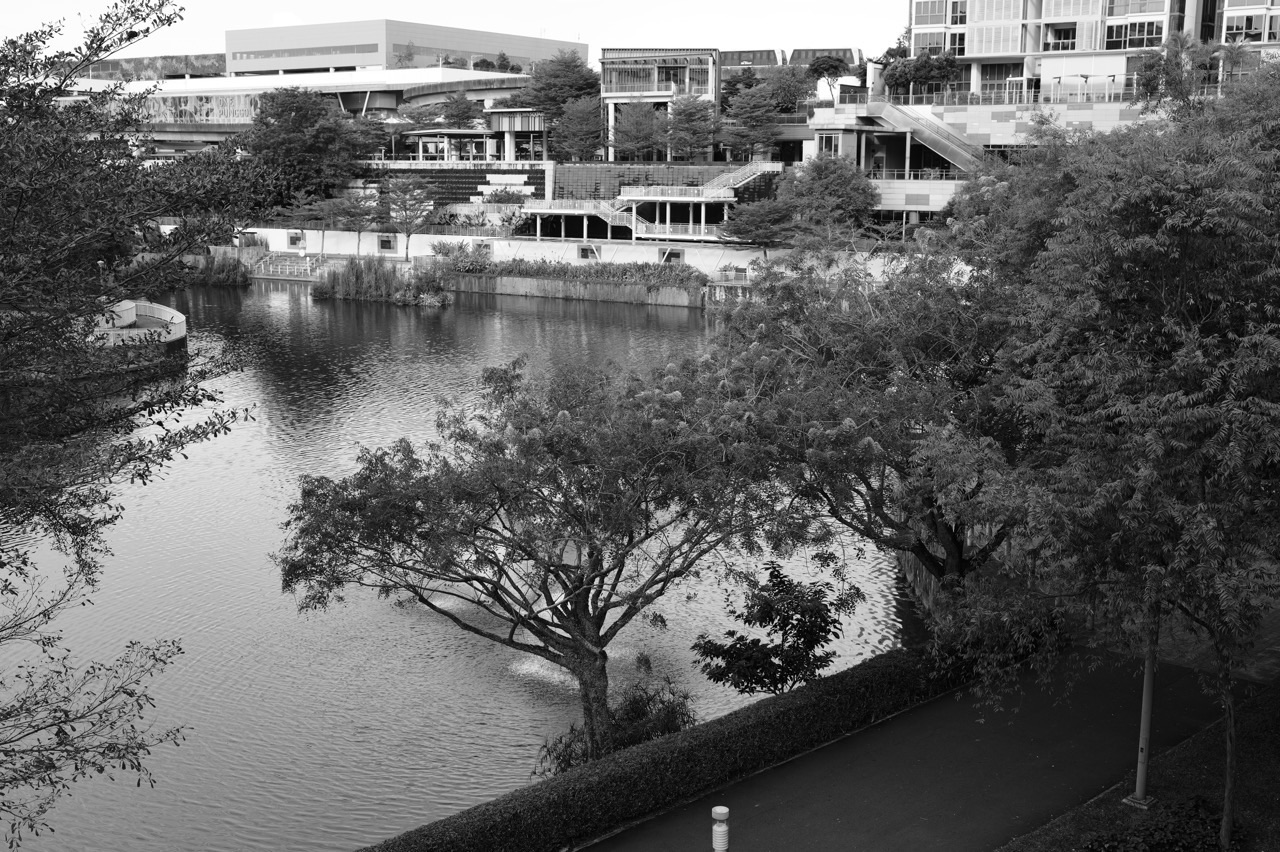
Punggol Waterway is more than a beautiful local landmark. For a Science student, it can become a living laboratory.
Water moves. Surfaces heat and cool. Plants grow under different conditions. Birds and insects use different habitats. Rain changes flow. Human activity changes how spaces are used. Every one of these observations can become a scientific question when the learner moves from noticing to measuring.
This article continues the Journey of Learning Advanced Science in Punggol by using a place students already know to connect Physics, Chemistry, Biology, Mathematics, English and systems thinking.
For the wider local idea, see Punggol as a Classroom and Punggol Science Inquiry.
Why the Waterway Is Such a Good Science Classroom
A strong learning environment contains many variables but still allows students to ask simple questions. Punggol Waterway does exactly that.
| What students can observe | Science ideas underneath |
| Water moving after rain | flow, gravity, channels, resistance, drainage |
| Shaded and open areas | thermal energy, radiation, evaporation, microclimate |
| Plants near water | adaptation, transport, habitats, ecosystems |
| Water clarity or surface conditions | suspended matter, water quality, observation limits |
| Bridges and paths | forces, materials, structures, friction |
| Human activity | systems, environmental impact, sampling, behaviour |
The point is not to turn every family walk into homework. It is to show students that Science is already present in the environment around them.
Question 1: How Does Water Move?
A student may first notice that some parts of the waterway appear calmer while other sections move faster. That observation can lead to questions about channel shape, slope, obstruction, rainfall and flow.
At a beginner level, the learner describes what is seen. At a stronger level, the learner asks what variable could be measured and what mechanism might explain the pattern.
- How could flow speed be estimated safely without entering the water?
- How might recent rainfall affect the result?
- Would channel width change the observed movement?
- What sources of error would affect a simple timing method?
The advanced skill is not knowing one correct answer. It is designing a reasonable way to find out.
Question 2: What Does Water Quality Mean?
“Clean water” sounds simple, but scientifically it can involve many different measurements: temperature, turbidity, dissolved oxygen, pH, conductivity, nutrients, microorganisms and visible pollutants.
Students should learn that one measurement does not describe the entire condition of a water system. A clear-looking sample may still differ chemically from another sample. A single reading may also change with time, weather and location.
This is an excellent lesson in evidence: conclusions should match what was actually measured.
For a deeper local connection, read Floating Wetland Science — Water Quality, Habitats and Bioengineering.
Question 3: Why Does Biodiversity Vary From Place to Place?
A student walking along the waterway may see different plants, insects or birds in different sections. That variation can lead to questions about shade, food, water, shelter, disturbance and habitat structure.
This is where Biology becomes systems thinking. An organism is not simply “present”. It occupies a set of environmental conditions and interacts with other organisms.
A useful field notebook can record location, time, weather, observable species, shade and nearby human activity. Even simple observations become more scientific when the context is recorded consistently.
Question 4: How Does Heat Change the Local Environment?
Open concrete, vegetation, water and shaded paths can feel very different under the same Singapore sun. That difference is an opportunity to study thermal energy.
Students can compare surfaces and ask how colour, material, exposure, evaporation and airflow affect temperature. The same idea later connects to buildings, urban heat and energy efficiency.
This becomes the bridge to the next article in the journey: Urban Heat and Materials in Punggol.
The Waterway Teaches Measurement Discipline
Outdoor investigations are useful because they are messy. The temperature changes. Clouds move. People pass by. The wind changes. Measurements are not perfectly repeatable.
That is not a weakness. It teaches students why scientists record conditions, repeat readings and avoid overclaiming.
- Define one question.
- Choose one variable to change or compare.
- Choose one response to measure.
- Record the method consistently.
- Repeat where practical.
- Note environmental conditions.
- Graph or tabulate the results.
- State only what the evidence supports.
Photography Can Become Data
A phone or camera can help students document changes in vegetation, shadow length, surface condition or repeated viewpoints across time. But photographs should be treated as evidence with limits.
A photograph records what was visible from one position at one moment. It does not automatically explain why the scene looks that way. The student still needs context, comparison and scientific reasoning.
From Observation to Explanation
A powerful Advanced Science habit is to move through four stages:
- Notice: something appears different.
- Measure: turn the difference into evidence.
- Model: use Science to explain the pattern.
- Test: look for another observation that could confirm or challenge the explanation.
This connects directly to model thinking and systems thinking.
How eduKate Can Use Punggol Waterway in Learning
The actual tuition lesson can remain structured and syllabus-aligned while local examples make the ideas easier to remember. Flow can support rate reasoning. Shade can support heat transfer. Plants can support adaptation. Water systems can support ecology and environmental Science.
In a three-student class, each learner can take a different role: observer, modeller and challenger. One describes the evidence, one proposes the scientific explanation, and one asks what alternative variable may matter.
What Parents Can Do Without Turning It Into Extra Homework
- Ask one “why do you think that happens?” question during a walk.
- Let the child photograph something scientifically interesting.
- Compare two places rather than trying to measure everything.
- Encourage the child to say what evidence would be needed to know more.
- Do not demand a polished project every time.
Curiosity survives better when it is allowed to remain enjoyable.
Continue the Journey
- Next: Urban Heat and Materials — Shade, Surfaces, Buildings and Energy.
- Then: The Science of Movement and Transport in Punggol.
- Then: Smart Town Science — Sensors, Buildings, Data and Energy.
- Return to the Punggol Science Tuition hub.
Advanced Science does not always require a distant laboratory. Sometimes the laboratory is the path beside the water that a student has walked past for years.
Browse more learning guides
Use the Punggol Science article index to find another topic, or return to Learning Routes to choose a subject or school-year guide.


