
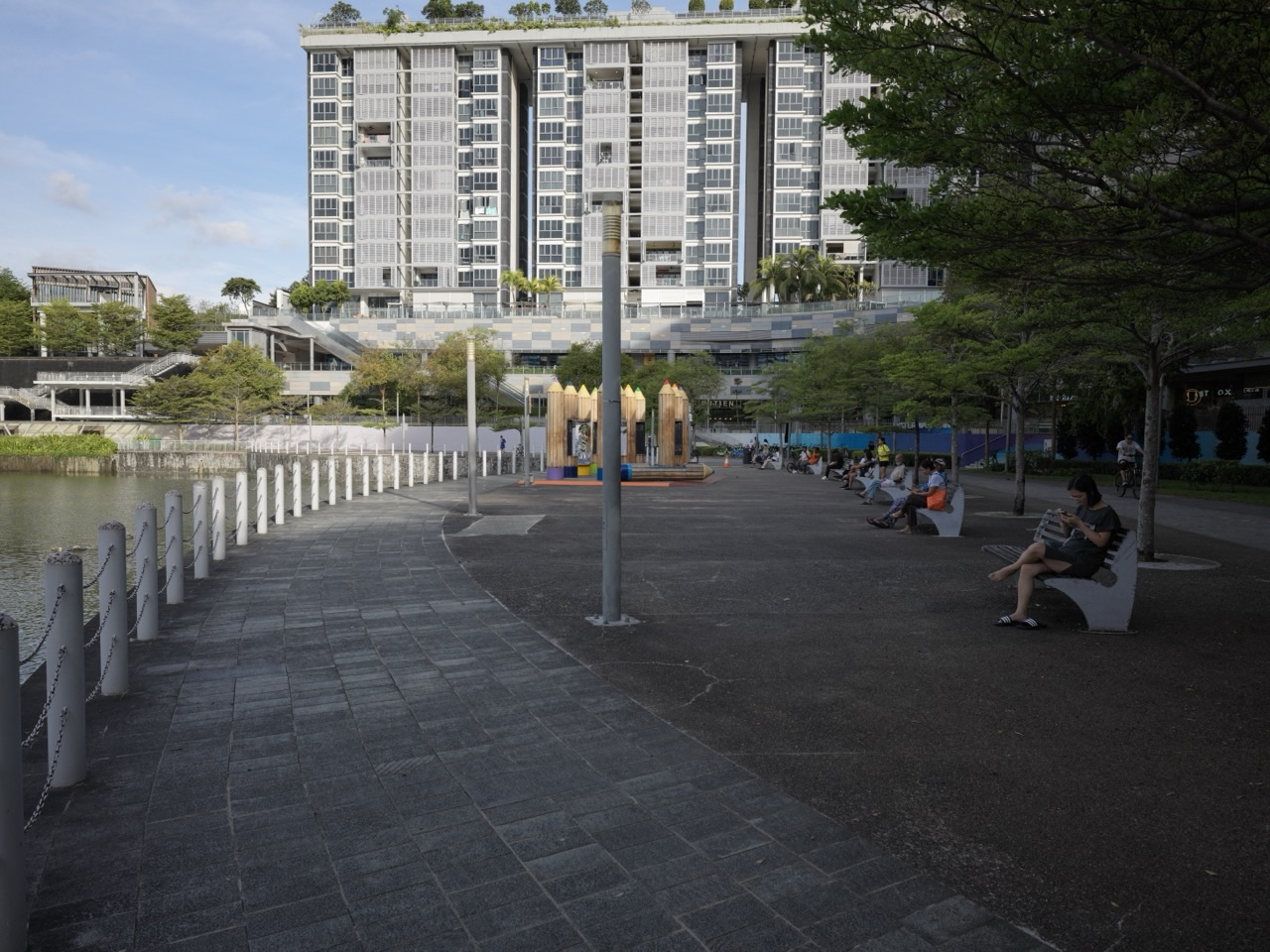

Science tuition in Punggol can use the wider Punggol Reservoir system to make water quality, ecology and evidence feel real. PUB’s Sengkang Floating Wetland sits in Punggol Reservoir and is an official learning site. PUB states that the floating wetland helps improve water quality, provides habitat for birds and fishes, and supports a self-guided Waters Learning Trail with Primary and Secondary resources.
Parents searching for Punggol Science tuition, water quality Science, wetland Science, Primary Science environment questions, PSLE Science application or Secondary Science fieldwork can use this guide as a study/reference route. The learning goal is not to turn a family outing into a laboratory. It is to show how a real engineered-natural system can generate questions about habitats, variables, measurements, evidence and responsible claims.
This page does not claim that eduKate runs activities at Sengkang Floating Wetland. If families or schools want hands-on water-quality testing, use PUB’s official learning-trail resources and follow the relevant instructions, access rules and safety guidance. Do not enter the water, collect samples without permission or improvise testing around reservoir infrastructure.
What PUB Officially Says About the Floating Wetland
PUB describes Sengkang Floating Wetland as a wetland in Punggol Reservoir that helps improve water quality and provides a natural habitat for birds and fishes. PUB’s self-guided learning trail also covers water sustainability, the Four National Taps, water-cycle and treatment concepts, ABC Waters design features, bioengineering, biodiversity and hands-on water-quality testing.
Official source: PUB — Sengkang Floating Wetland.
The Science Model: Living Things Inside an Engineered Water System
The floating wetland is useful educationally because it sits at the boundary between ecology and engineering. Students can ask:
- What parts of the system are living?
- What parts are engineered?
- What evidence would show a change in water quality?
- How could habitat and water conditions affect one another?
- What claims can be supported by observation alone, and what claims require measurements?
These questions are stronger than “What plants can you see?” because they turn description into scientific inquiry.
Primary 3–4: Habitat, Diversity and Observation
Younger students can use the public boardwalk and official learning materials to practise careful observation.
- How many different visible plant forms can be distinguished?
- Where are birds observed relative to water, vegetation or open space?
- Which features appear to provide shelter?
- What changes from one observation point to another?
The child should record only what is actually seen. “This plant cleans the water” is not an observation. “This plant is growing on the floating wetland structure” is an observation.
Primary 5–6: Variables and Fair Comparison
Upper-Primary students can move into comparative thinking. Suppose a child asks: “Are more birds seen near dense vegetation than near open water?”
The child now needs variables:
- Independent comparison: observation location type.
- Dependent measure: number of birds observed during a fixed time.
- Controls: similar observation duration, similar time of day where possible, similar counting rules.
This is not a perfect experiment because the family cannot control the environment. That limitation is itself valuable Science. Fieldwork often uses observational comparisons rather than fully controlled laboratory experiments.
Secondary Science: Move From Observation to Measurement
Secondary students can distinguish between qualitative and quantitative evidence.
- Qualitative: water appears clearer at one observation point than another.
- Quantitative: a measured property differs by a recorded amount.
The key scientific lesson is that visual appearance alone cannot establish water quality. Claims about water quality require appropriate measurements. PUB’s official learning trail is therefore a better route for hands-on testing than improvised family sampling.
Water Quality: What Students Need to Understand
Water quality is not one thing. It can be described using multiple properties. Depending on the context, scientists may consider measurements such as temperature, pH, dissolved oxygen, turbidity or other chemical and biological indicators. A single measurement cannot automatically describe the whole system.
This is an important examination habit: when the evidence measures only one variable, the conclusion should stay bounded to that variable.
Worked Example: “The Water Looks Clear, So It Is Clean”
This is a classic overclaim.
Observation: the water appears visually clear from the observation point.
Unsupported claim: the water is clean.
Better conclusion: “The water appeared visually clear at this location and time. This observation alone is insufficient to determine overall water quality.”
That sentence shows scientific restraint.
Worked Example: Bird Counts and Sampling
A family observes five birds during ten minutes at one point and one bird during ten minutes at another point. The child should not conclude that one place “has five times more birds”. Two short observations are small samples. Weather, time, movement and chance may change the count.
A better conclusion is: “More birds were observed at Point A during this observation period. Repeated observations are needed before making a stronger claim about the locations.”
How This Connects to PSLE Science
- diversity and classification;
- adaptations and habitats;
- cycles and systems;
- variables and fair comparisons;
- evidence-based conclusions;
- open-ended answer precision.
How This Connects to Secondary Science
- ecology;
- sampling;
- fieldwork;
- measurement;
- water chemistry;
- uncertainty;
- environmental systems;
- engineering and sustainability.
Use the Official Learning Trail When You Want Hands-On Testing
PUB provides Primary and Secondary student booklets and trainer guides for the Sengkang Floating Wetland learning trail. That is the appropriate source for families or schools wanting a more structured field-learning experience.
PUB also lists Sengkang Floating Wetland in Punggol Reservoir as one of its geographical field-study sites: PUB — Geographical Investigation Field Studies.
A Safe Public-Space Mini Investigation
- Choose two legal public observation points.
- Use the same observation duration at both.
- Define one thing to count or compare.
- Record weather and time as context.
- Repeat the observation if practical.
- State the result.
- State the limitations.
This gives a student an inspectable method without requiring contact with the water or infrastructure.
From Field Notes to a Science Report
A useful one-page output can contain:
- Question
- Method
- Observations
- Data table
- Pattern
- Conclusion
- Limitations
- Next question
The broad local inquiry route is Punggol Science Inquiry.
Study/Reference Boundary
This page is a study/reference owner. It does not claim an eduKate fieldwork class, wetland programme, water-testing session or partnership with PUB. For official field-study access, activity instructions and testing resources, use PUB’s own materials and booking routes.
The scientific value of the wetland is not that the student can repeat facts about it. It is that the student learns to ask a bounded question, gather evidence, measure carefully and make a claim no stronger than the data allows.
Use the wetland as an inquiry system, not a fact list
A floating wetland becomes educational when the student asks a bounded question that can be answered with evidence. “How does a floating wetland help the environment?” is too broad for one local observation. “Do two public observation points show different visible plant or animal activity during the same time window?” is narrower and more inspectable.
The local value of Punggol is that a real engineered ecological feature gives the child something to observe, measure and question. The deeper ecological mechanisms should still be checked against reliable Science sources rather than inferred from appearance alone.
Separate engineered function from visible appearance
A student may see vegetation, water, birds, insects or changing surface conditions. Those observations do not by themselves prove water-quality improvement, nutrient removal or habitat performance. Engineering function often depends on mechanisms that require published evidence or formal measurement.
This distinction protects the child from a common Science error: assuming that because a system looks “natural”, its function is obvious.
Use one question, one variable and one comparison
A simple public-space inquiry can compare two observation points, two time windows or two visible categories while keeping everything else as similar as practical.
- Count visible bird activity for the same duration at two points.
- Compare the number of visible plant types in two bounded sections.
- Record surface conditions at the same time on two different days.
- Compare shaded and exposed public observation positions where safe and permitted.
The goal is not to claim ecological causation. It is to train controlled comparison.
Use operational definitions
Words such as “activity”, “cleaner”, “more diverse” and “healthier” are too vague unless the student defines what will actually be counted or observed.
For example, “bird activity” might mean the number of separate bird sightings during five minutes. “Visible plant variety” might mean the number of visibly distinct plant forms within one framed section. The definition should be simple enough to repeat consistently.
Keep observation duration constant
If one location is observed for three minutes and another for fifteen, the comparison is weak. Time is part of the method and should remain controlled where possible.
This is a small methodological decision with a large effect on data quality.
Record weather and time as context, not noise to ignore
Cloud cover, rain, heat, wind and time of day can influence what the student sees. Record these conditions because they may help explain differences between observations.
The learner does not need to control every environmental variable. They need to notice which variables were not controlled and avoid making claims stronger than the method allows.
Use sketches when photographs are not enough
A photograph freezes a scene but may hide spatial relationships. A quick sketch can show the observer’s position, the wetland feature, nearby vegetation, water edge and where counts were made.
Sketches become especially useful when the child later explains the method to another person.
Teach the difference between habitat observation and habitat quality
Seeing organisms in a place shows that organisms were present during the observation. It does not automatically establish that the habitat is high quality, stable over time or caused by one engineering feature.
Students should learn to write, “We observed…” before writing, “This may suggest…” and to reserve stronger ecological claims for stronger evidence.
Use data tables before graphs
A graph should not appear before the student has a clean table with units, categories and comparable observations. Tables make missing values, inconsistent definitions and uneven duration easier to spot.
Once the table is stable, Mathematics can help the learner choose an appropriate graph or summary if the data supports it.
Teach replication with a second visit
One observation can be interesting but fragile. Repeating the same method on another day helps the child see whether the pattern is stable or whether the first result may have depended heavily on temporary conditions.
The lesson is not that two visits prove a scientific law. The lesson is that repeated evidence is stronger than a single impression.
Use anomalies as questions, not mistakes to erase
If one count is very different from the others, ask why. Was the method applied differently? Did weather change? Did a group of birds pass by briefly? Was the observer distracted?
Anomalies can reveal weaknesses in method or genuinely interesting variation. They should be investigated before being removed.
Use the 3-pax lesson to compare field notes
Three students observing the same public area may record different things. That difference is educational. One learner may be more systematic, another may use vague categories, and another may notice context but forget to count consistently.
The tutor can compare the records and ask which method would be easiest for another person to repeat.
Move from observation to mechanism carefully
After the local observation, the student can consult reliable material about floating wetlands, water quality, habitat or bioengineering. The task is then to connect the sourced mechanism to the observed feature without pretending the field observation proved the mechanism directly.
This two-step reasoning is stronger than either pure memorisation or unsupported local inference.
Use English to strengthen the field report
Scientific reporting depends on precise language. “There were lots of birds” is weaker than “Seven separate bird sightings were recorded during a five-minute observation.”
If the evidence is good but the report remains vague, route the language-control problem to the English owner rather than changing the Science method.
Build a wetland inquiry card
| Layer | Student question |
|---|---|
| Question | What exactly am I comparing? |
| Definition | What counts as one observation? |
| Method | How will I keep the comparison fair? |
| Context | What weather/time conditions matter? |
| Data | What did I record? |
| Claim | What does the data support—and not support? |
| Source | What mechanism needs external verification? |
The return test is method independence
After guided practice, the learner should be able to design a simple safe comparison elsewhere: choose a bounded question, define the variable, keep the duration consistent, record context and make a proportionate claim.
That is when the Punggol wetland example has transferred into general scientific inquiry rather than remaining one memorable local case.
Sampling quality matters more than sample size alone
A larger number of observations does not automatically make an investigation stronger. If the student changes position, duration or counting rules between observations, more data can simply reproduce an inconsistent method.
The first priority is comparability. Keep the observation rule stable, record context and make the sample large enough to support the modest claim being made.
Use a pilot observation before the real count
Spend one short trial period testing whether the categories are clear. If the learner cannot decide what counts as one sighting or one plant type, revise the definition before collecting the main data.
A pilot prevents the child from discovering halfway through that the method cannot be applied consistently.
Report what the method cannot see
A public-space observation is limited to what is visible from the chosen point and time. It cannot establish what happened earlier, at night, underwater or in inaccessible parts of the system.
Writing these blind spots strengthens the report because the conclusion remains proportional to the observation window.
The best inquiry ends with a better next question
After the first comparison, ask what would improve the evidence: a second time window, another public observation point, a longer duration or a reliable external dataset. The learner should be able to explain which extra evidence would reduce the most important uncertainty.
That is a mature scientific habit: one investigation closes with a bounded conclusion and opens a more precise next question.
Continue Through the Science System
Explore the Punggol Science reading library for related guides.


