
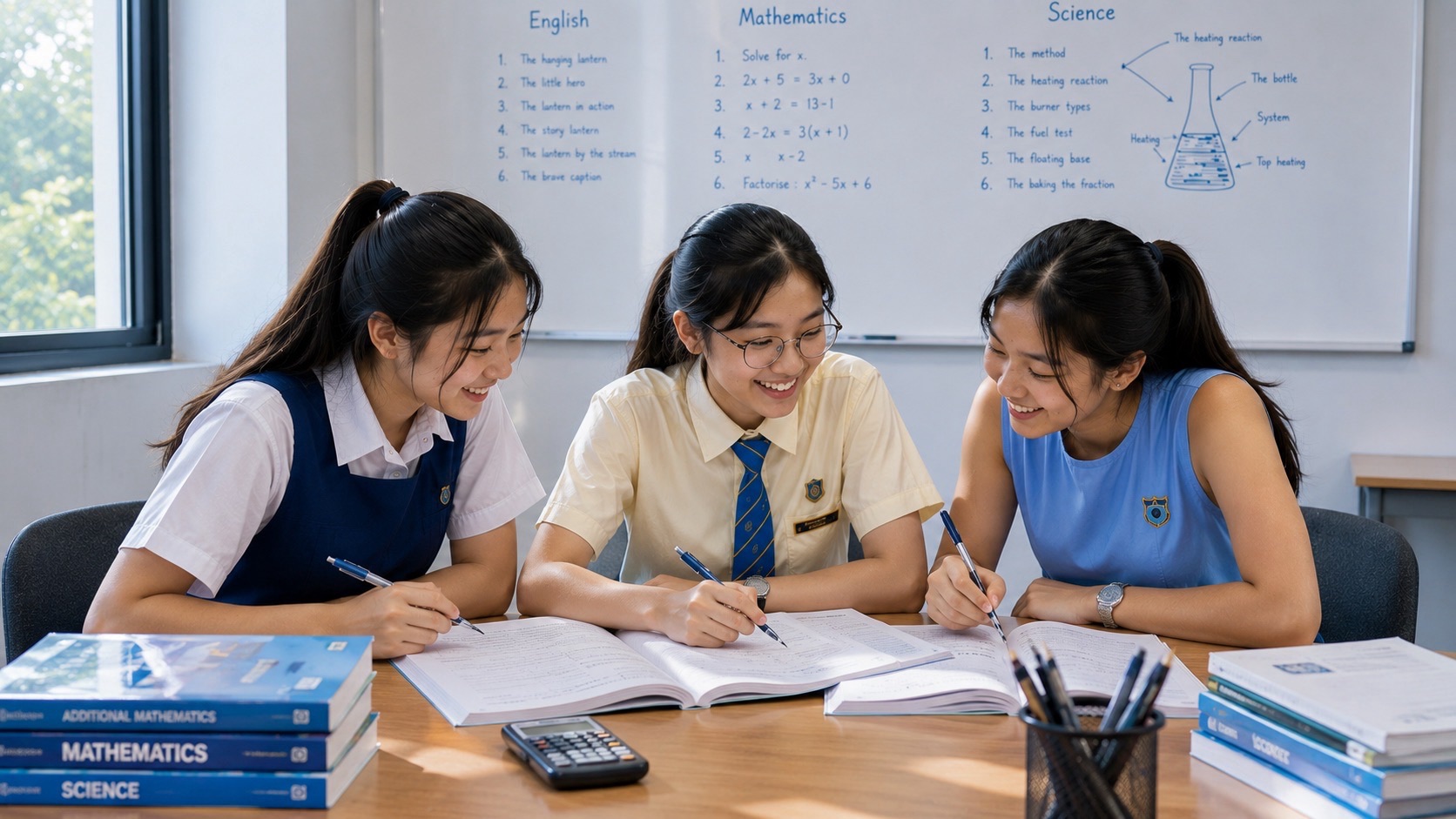
Mathematics tuition in Punggol online or in person is not a question with one universal answer. Parents searching for online Math tuition, in-person Mathematics tuition, Math tutor near me, Primary Mathematics tuition or Secondary Math tuition in Punggol are usually balancing several things at once: teaching quality, travel time, child attention, access to manipulatives and diagrams, screen fatigue, schedule flexibility, tutor visibility, homework support and whether the student actually participates when the lesson begins.
Strong international tutoring providers increasingly offer both online and in-centre Mathematics because each format can work when the instructional design is sound. The search language around both formats repeatedly returns the same educational priorities: personalised learning plans, live tutor interaction, problem-solving strategies, homework help, test preparation, progress tracking, confidence and independent learning. The delivery channel matters, but the teaching system matters more.
At eduKatePunggol, our core Mathematics format is focused small-group teaching of up to three students in 1.5-hour lessons near Punggol MRT. For Punggol families comparing online and in-person options more broadly, the useful question is not “Which format is modern?” It is: which format lets this particular child understand, practise, receive feedback and become more independent with the least unnecessary friction?
The short answer: online vs in-person Math tuition
In-person Mathematics tuition is often a strong fit when the child:
- benefits from physical manipulatives, printed working and face-to-face cues;
- is young and easily distracted by a screen;
- needs the tutor to inspect working layout closely;
- responds well to a separate study environment;
- benefits from peer presence in a small group; or
- lives close enough that travel does not consume the value of the lesson.
Online Mathematics tuition can be a strong fit when the child:
- works comfortably on a screen;
- can upload or share written work clearly;
- responds well to digital whiteboards;
- needs greater scheduling flexibility;
- has a long commute to suitable teaching; or
- is sufficiently independent to remain engaged without the physical classroom setting.
The format should be chosen around the learner, not around a slogan.
The real comparison is not screen versus classroom
Parents sometimes compare tuition formats by looking only at where the tutor and child are physically located.
That misses the important variables.
A weak in-person lesson is still weak.
A strong online lesson can still be strong.
The better comparison asks:
- Can the tutor see the student’s reasoning?
- Can the tutor diagnose the first wrong decision?
- Can the student show working clearly?
- Can the tutor respond in real time?
- Can the student ask questions naturally?
- Can the lesson use diagrams, models and mathematical notation efficiently?
- Can the tutor fade support instead of doing the thinking?
- Can progress be observed across schoolwork, tests and independent practice?
If the answer to these questions is no, the delivery format is not solving the educational problem.
Why in-person Mathematics tuition remains powerful for young learners
Primary Mathematics is visual and physical before it becomes fully symbolic.
A young child may need counters, fraction strips, number lines, coins, rulers, shapes, diagrams, bar models and handwritten working. These tools can be used online too, but physical presence often makes it easier for the tutor to see exactly how the child handles them.
In-person teaching also makes some behaviours easier to observe:
- whether the child tracks a line while reading;
- whether digits are reversed while copying;
- whether columns are aligned;
- whether the student starts calculating before reading;
- whether a model is drawn from understanding or imitation;
- whether attention drifts before an error; and
- whether the child waits for adult reassurance after every step.
These are small signals, but small signals often reveal the mechanism behind repeated mistakes.
Why online Mathematics tuition can remove useful friction
Online tuition has a different advantage: it can reduce logistical friction.
Families do not need to travel. Students can often transition from home or school commitments more easily. Digital whiteboards can preserve worked examples. Screens can display graphs, geometry, tables and dynamic representations clearly.
For older students, online tuition can also encourage a useful kind of independence. The student may need to upload work, explain a method verbally, annotate a digital page and manage files in a way that resembles later academic work.
But the convenience only helps if the student remains cognitively present.
A child who quietly opens another tab, disengages from the camera or waits passively for the tutor to screen-share every step is not receiving the full value of the format.
Primary Mathematics: when in-person usually has an advantage
For Primary 1 to Primary 4, in-person tuition often has practical advantages when the child needs:
- concrete-pictorial-symbolic transitions;
- physical manipulatives;
- close observation of handwriting and working layout;
- attention support;
- help with reading word problems aloud;
- frequent micro-feedback; or
- a clear physical boundary between home and lesson time.
This does not mean online Primary tuition cannot work. It means the online lesson must deliberately recreate enough visibility and interaction for the tutor to see the child’s process.
Parents can continue through the current Primary 1, Primary 2, Primary 3 and Primary 4 Mathematics tuition guides.
Upper Primary and PSLE: the deciding factor is exam-transfer quality
By Primary 5 and Primary 6, the format question changes.
Students need strong work on fractions, ratio, percentage, rate, speed, geometry, multi-step problem sums, Paper 1, Paper 2 and examination execution.
The important question becomes:
Can the lesson reproduce the demands of the student’s actual assessment environment closely enough to reveal real performance?
For example, if the child will sit a handwritten paper, some handwritten full-paper practice remains important even if tuition is delivered online.
A digital lesson should not accidentally train only digital performance.
Continue through Primary 5 Mathematics Tuition, Primary 6 PSLE Mathematics Tuition and Surviving PSLE Mathematics.
Secondary Mathematics: online can work well when the symbolic system is visible
Secondary Mathematics often adapts well to digital teaching because algebra, equations, graphs, geometry and statistics can be shared clearly on a digital whiteboard.
The risk is not the screen itself.
The risk is losing sight of the student’s own working.
A tutor needs to know whether the student:
- understands signed numbers;
- expands brackets correctly;
- preserves equality when solving equations;
- can sketch and interpret graphs;
- uses geometric properties rather than appearance;
- keeps algebraic working organised; and
- can start a mixed question without being told the chapter.
If the digital setup lets the tutor observe these processes reliably, online instruction can be effective. If it does not, the convenience may conceal weak learning.
Continue through Secondary G1, G2 and G3 Mathematics Tuition in Punggol.
The attention test: where does this child actually think better?
Some students become more focused when they sit in a tuition room away from home distractions.
Others become tired by travel and learn better when that commute disappears.
Some children are highly expressive face to face but quiet online.
Others find it easier to ask questions through a digital environment.
The format decision should therefore include a simple attention test:
- Does the child stay engaged for the full lesson?
- Does the child ask questions?
- Does the child attempt before waiting for help?
- Can the tutor see the child’s working?
- Does the child remember what happened after the lesson?
- Can the child use it independently in school?
The technology test for online Mathematics tuition
Online Math tuition is only as good as the interaction channel.
A workable setup should allow:
- clear audio;
- a stable connection;
- easy sharing of worksheets;
- visible handwritten or digital working;
- annotation of graphs and diagrams;
- rapid switching between explanation and student practice; and
- minimal technical interruption.
If ten minutes of every lesson disappears into scanning, camera angles and file confusion, the format is charging an educational tax.
The travel test for in-person Mathematics tuition
In-person tuition has its own friction.
Parents should count the whole door-to-door cost, not only the 1.5-hour lesson.
A 90-minute class with a 50-minute journey each way is not a 90-minute commitment.
For a Punggol family, a centre near home can change that calculation substantially.
eduKatePunggol is located at 83 Punggol Central, Singapore 828761, near Punggol MRT and Waterway Point. When teaching quality and student fit are appropriate, shorter travel can make in-person learning much more sustainable.
Homework help is not the same as Mathematics tuition
Both online and in-person providers often advertise homework help.
Homework support can be useful, but it should not consume the entire lesson.
The tutor’s larger job is to improve the capability that produced the homework difficulty.
If a child cannot solve fraction word problems, finishing tonight’s worksheet is only one objective.
The deeper objective is to strengthen fraction understanding, representation and strategy so future homework can be completed with less help.
A five-question online-vs-in-person decision rule
- Where is the student’s attention stronger?
- Where can the tutor see the student’s working more clearly?
- Which format creates less weekly friction?
- Which format better matches the child’s age and independence?
- Which format produces better transfer to school and exams?
The last question is the most important.
The purpose of tuition is not to produce excellent tuition performance.
It is to improve independent Mathematics elsewhere.
Frequently asked questions about online and in-person Math tuition
Is online Math tuition as effective as in-person tuition?
Either format can work when the student is engaged, the tutor can observe the student’s reasoning, feedback is immediate and the programme produces transfer to independent schoolwork. The better format depends on the child and the quality of implementation.
Is in-person tuition better for Primary students?
It can be especially useful for younger learners who benefit from physical manipulatives, closer attention support and direct observation of handwritten work. Some Primary students still work very well online when the setup and tutor are strong.
Is online tuition better for Secondary Mathematics?
Online delivery can suit older, more independent students and works well for algebra, equations and graphs when the tutor can see the student’s own working clearly. It is not automatically better or worse.
Should convenience decide?
Convenience matters because a sustainable weekly routine improves consistency. It should be considered after teaching quality, student fit and learning visibility.
Mathematics Tuition in Punggol: choose the format that makes learning visible
Online versus in-person is not a technology contest.
It is a learning-design decision.
Choose the format that lets the student think.
Choose the format that lets the tutor see that thinking.
Choose the format that the family can sustain.
Then judge it by transfer.
Families who want to discuss the current in-person Mathematics small-group classes in Punggol can WhatsApp eduKatePunggol.
Continue through the Punggol Mathematics route
- Mathematics Tuition at eduKatePunggol
- How to Choose a Primary Mathematics Tutor in Punggol
- Inside a 3-Pax Tuition Class in Punggol
- Once a Week or Twice a Week?
- When Tuition Is Not Working
Explore the Punggol Mathematics reading library for related guides.


