
eduKate Punggol · Mathematics Starting Point
Mathematics: choose the help you need
Find help by school year, topic or repeated mistake. Choose a starting point or go straight to the guide.
Two Mathematics routes to begin
eduKatePunggol · Full Mathematics Tuition Reasons Edition
Primary 1–6, PSLE, Secondary 1–4 G1/G2/G3 Mathematics and Additional Mathematics Tuition With eduKatePunggol
Parents usually arrive through one visible concern: number sense is weak, problem sums feel impossible, careless errors keep returning, algebra has become confusing, examination marks are falling or Additional Mathematics is moving faster than the student can absorb. The deeper question is not simply whether the child needs more practice. It is which part of the Mathematics system is failing to carry the learner—and whether tuition can diagnose, teach, practise, transfer and stabilise that part before the next school stage depends on it.
Mathematics tuition becomes useful when effort no longer produces stable independent performance. A child may finish routine sums yet freeze when the wording changes. A Primary student may know the four operations but cannot see the relationship inside a problem sum. A Secondary student may understand an algebra lesson but lose signs, omit steps or choose the wrong route in a test. An Additional Mathematics student may follow differentiation in class but cannot connect functions, graphs and algebra when questions become mixed.
These are not one problem. They are different breaks inside a cumulative system. Number sense supports fractions. Fractions support ratio and percentage. Arithmetic fluency supports algebra. Algebra supports graphs, geometry, trigonometry, statistics and calculus. Working discipline supports examination control. When an earlier carrier remains fragile, the next stage often makes the weakness look sudden even though it has been accumulating quietly.
eduKatePunggol therefore reads Mathematics as one connected route from Primary 1 to Secondary 4 rather than a collection of unrelated topics. One student needs quantity, place value and confidence. Another needs model drawing and multi-step problem solving. Another needs the Secondary algebra bridge at G1, G2 or G3. Another needs upper-secondary paper control. Another needs the deeper structure of Additional Mathematics. The reason for tuition determines the design of the tuition.
Catch Up
Rebuild number sense, arithmetic, fractions, units, model thinking, algebra or working habits that the current syllabus now assumes are already available.
Keep Up
Consolidate the present topic, correct recurring errors and organise practice before unfinished work accumulates into a wider confidence and performance problem.
Move Ahead
Extend reasoning, transfer, unfamiliar problem solving and topic connections so a stronger learner develops mathematical independence rather than only finishing familiar questions.
A student may move between these routes during the school year. The route should follow evidence from actual working, corrections and tests—not a permanent label placed on the child.
The First Principle
Mathematics tuition should solve a defined mathematical problem.
A weekly tuition slot is not yet an educational purpose. Neither is a larger pile of worksheets. Tuition becomes meaningful only when something specific changes: the child sees quantity more clearly, selects the correct operation, draws a useful model, manipulates algebra safely, connects topics, shows working or completes a paper with greater accuracy and control.
Similar marks can come from different causes. One student does not understand the concept. Another understands it but cannot identify which method applies. Another knows the method but makes arithmetic or sign errors. Another can work accurately without time pressure but loses control during an examination. These students should not receive identical repair work.
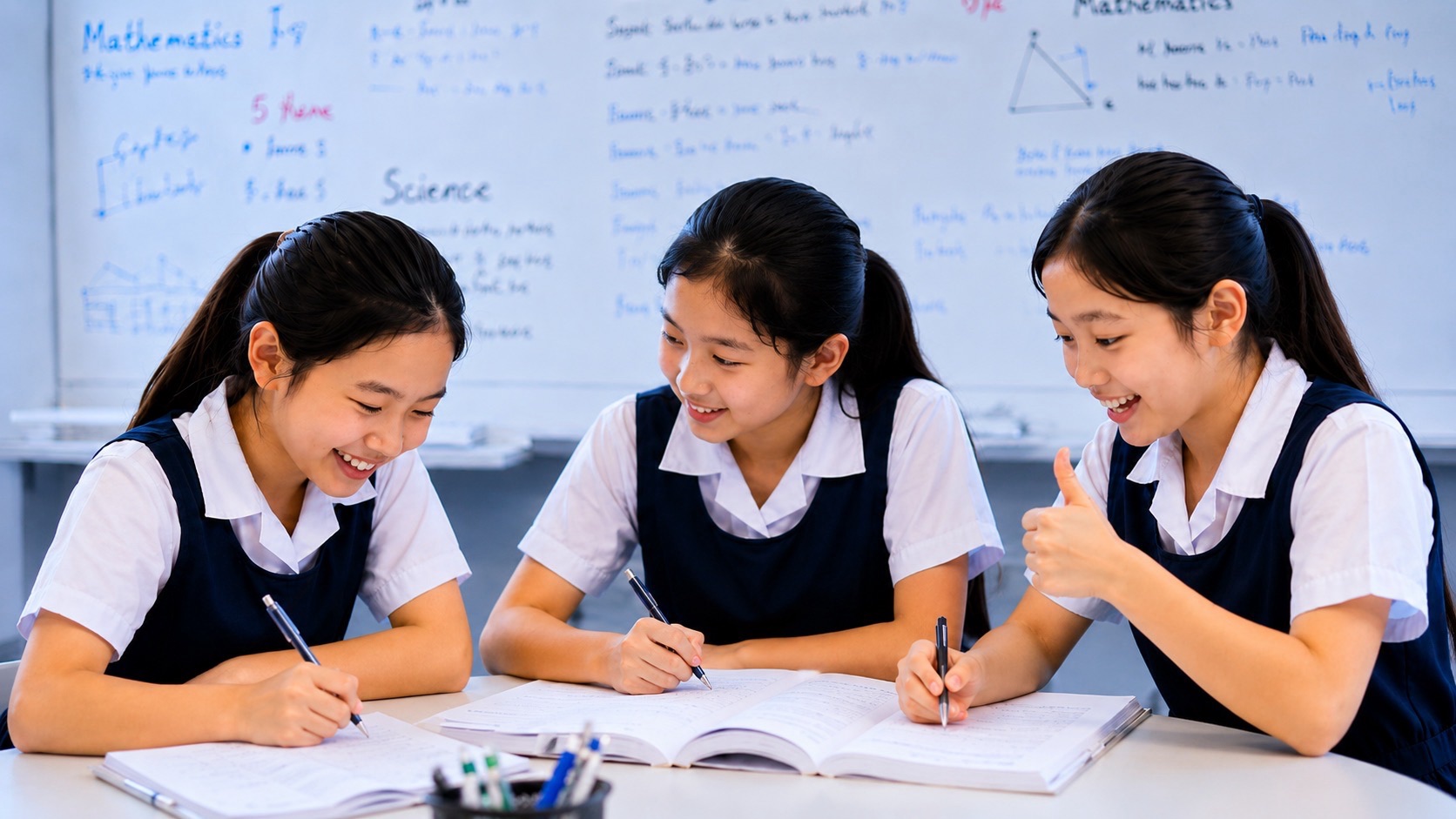
Small-group Mathematics tuition is useful when it makes the student’s process visible. The tutor needs to see how the child reads the question, what representation is chosen, where the route begins, which line introduces the error, whether checking occurs and what happens when the student must continue independently.
The goal is not dependence on model solutions. The goal is a stronger internal mathematical system: interpret the task, identify the structure, choose the route, execute the method, verify the answer and explain enough working for the reasoning to remain visible.
Check quantity, relationship, definitions, diagrams, symbols and whether the child can explain the idea without copying a procedure.
Check whether the learner can translate words, identify the topic, select a representation and begin without waiting for a tutor to name the method.
Check working sequence, accuracy, notation, recovery from an error and whether the same structure is recognised when the question changes its surface appearance.
When the concept and route are correct, practice builds fluency. When they are wrong, practice can make the wrong method faster and more familiar.
Reason One · The Cumulative Route
Mathematics grows as one connected system from Primary 1 to Secondary 4.
School years divide the curriculum for teaching, but the learner’s mathematical system does not reset every January. Place value, operations and number relationships support fractions and decimals. Fractions support ratio, rate and percentage. Models and diagrams support problem translation. Arithmetic patterns become algebra. Algebra becomes the language of graphs, geometry, trigonometry, statistics, functions and calculus.
This is why a difficulty can appear in a new chapter while its cause sits several years earlier. A percentage problem may expose weak fractions. A graph question may expose weak substitution. A trigonometry question may expose weak algebra. An Additional Mathematics calculus problem may fail because factorisation and functions were never fluent enough to carry the new work.
S4 Abstraction and execution
Understand quantity
Number sense, place value, operations, fractions, measurement and spatial relationships give later Mathematics something stable to stand on.
Represent the relationship
Words, models, tables, diagrams, equations and graphs allow a student to convert the question into a form that can be worked on.
Generalise the pattern
Algebra, functions and formulae allow one relationship to be understood beyond a single set of numbers or one familiar example.
Perform independently
Accuracy, notation, working, time management and checking allow mathematical understanding to survive an unfamiliar or timed task.
Reason Two · Primary 1–3
The early primary years build number sense before problem-solving pressure becomes heavy.
Primary 1 to Primary 3 Mathematics should make numbers and relationships increasingly visible. The child learns place value, operations, comparison, money, time, measurement, simple fractions, patterns, shapes and the first forms of problem solving. The aim is not only to calculate. It is to understand what the numbers describe.
Early tuition may be useful when counting remains insecure, operations are memorised without meaning, number bonds are slow, word problems are avoided, units are mixed up or the child needs an adult to begin every question. These are not reasons to frighten a young learner. They are reasons to make the Mathematics concrete, representational and understandable before the work becomes denser.
Use objects, pictures and comparison to make the number relationship real.
Move into number bonds, bar models, diagrams, tables or organised working.
Use the operation with increasing fluency while keeping place value and units visible.
State why the operation or representation answers the relationship in the question.
Estimate, reverse the operation or compare the result with the original situation.
Why tuition may be useful before Primary 4
Primary 4 increases the load of fractions, decimals, measurement, geometry and multi-step problems. A child who has spent the earlier years guessing operations may suddenly appear careless or slow. The kinder response is to repair the representation and number meaning, not merely demand faster completion.
Praise the child for seeing the relationship, choosing a useful representation and checking the work—not only for producing the final answer quickly.
Reason Three · Primary 4–6 and PSLE
PSLE Mathematics requires the mathematical system to work together under time.
Upper-primary Mathematics changes the central task. Students are no longer only following a recently demonstrated example. They must identify the hidden relationship, choose a model or route, connect several topics, maintain units and accuracy, and sustain the working across multi-step questions.
PSLE preparation becomes useful when it separates knowledge from execution. A child may understand ratio but fail to translate the wording. Another may know the model but make arithmetic errors. A third may solve accurately at home but lose time and confidence in a paper. More papers are not automatically the answer. Each paper must reveal which part of the system needs teaching or stabilisation.
Control
Read accurately. Represent relationships. Choose the route. Show working. Manage time. Check without panic.
Maintain fluency with whole numbers, fractions, decimals, ratio, percentage, rate and units while solving longer tasks.
Convert wording into bar models, diagrams, tables, equations or another representation that exposes the relationship.
Identify useful strategies such as working backwards, before-and-after comparison, assumption or systematic listing.
Preserve units, labels, intermediate working, arithmetic and answer form so understanding is not lost through avoidable leaks.
Allocate time, move when a question stalls, return strategically and preserve enough attention for checking.
Reason Four · Secondary 1–4
Secondary Mathematics is a mode switch from arithmetic familiarity to algebraic control.
Secondary 1 and Secondary 2 introduce a new mathematical language. Letters can represent changing quantities. Expressions must be manipulated according to rules. Equations describe relationships. Graphs make patterns visible. Geometry, data and probability require more formal reasoning. A student may have done well in Primary Mathematics and still need time to reorganise how Mathematics is read.
Secondary 3 and Secondary 4 increase topic density, abstraction and examination pressure. Under Full Subject-Based Banding, Mathematics may be taken at G1, G2 or G3, and the tuition design should respect the actual syllabus and level of demand. Additional Mathematics, where offered and appropriate, adds a second upper-secondary route built on stronger algebra, functions, trigonometry and calculus.
| Stage | Central Mathematics Work | Common Hidden Break | Useful Tuition Response |
|---|---|---|---|
| Primary 1–3 | Number sense, operations, measurement, simple fractions, patterns and first problem solving. | Counting or operation rules without quantity meaning; dependence on prompting. | Make the relationship concrete, represented, verbalised and increasingly independent. |
| Primary 4–6 / PSLE | Fractions, ratio, percentage, models, geometry, data and multi-step problem solving. | Weak translation, route guessing, arithmetic leaks, poor units or paper pressure. | Repair the mechanism, then practise transfer, timing, accuracy and checking. |
| Secondary 1–2 / G1–G3 | Algebra, equations, graphs, geometry, statistics, probability and abstract relationships. | Primary habits carried into algebra; weak signs, notation, substitution or graph meaning. | Teach algebra as meaning and structure before increasing question volume. |
| Secondary 3–4 / G1–G3 | Level-appropriate topic links, problem solving, formal working and examination execution. | Unstable algebra, fragmented topics, method selection failure or timed-paper collapse. | Align teaching to the actual G-level and build deliberate paper control. |
| Additional Mathematics | Functions, equations, logarithms, trigonometry, coordinate geometry, differentiation and integration. | Insufficient algebra fluency, weak function thinking or failure to connect chapters. | Rebuild the algebraic carrier, teach topic architecture and train mixed-question transfer. |
A familiar procedure can fail when the question combines topics, changes representation or requires the student to decide where the method begins. Stronger performance comes from structure, route recognition, accuracy and transfer.
Reason Five · Repeated Evidence
The strongest reason for tuition is a pattern that is not repairing itself.
One difficult chapter, one careless test or one unfamiliar problem does not define a student. Mathematics performance naturally varies with topic, fatigue and confidence. The case for intervention becomes stronger when the same breakdown repeats across homework, corrections, school tests and independent practice.
Concept
Meaning- Rules are remembered without understanding.
- Diagrams or symbols do not carry meaning.
- The student cannot explain why the method works.
Concrete examples, representations, definitions and conceptual links.
Route
Method- The student waits to be told which chapter applies.
- Word problems are answered by operation guessing.
- Changed wording makes a familiar structure look new.
Question translation, representation, classification and route selection.
Execution
Accuracy- Signs, units, arithmetic or notation repeatedly leak marks.
- Working is too compressed to locate the error.
- Checking is absent or performed without a method.
Working discipline, error coding, checking routines and fluency.
Performance
Pressure- Homework is possible but tests collapse.
- The student spends too long on one question.
- An unfamiliar appearance causes panic or abandonment.
Timed transfer, question triage, recovery routines and paper strategy.
Reason Six · G1 / G2 / G3 Fit
Mathematics tuition must meet the actual mathematical demand of G1, G2 or G3.
Full Subject-Based Banding allows students to offer subjects at different levels according to their strengths, needs and school arrangements. This means Mathematics tuition should not treat G1, G2 and G3 as one identical course with only different worksheet difficulty. The central concepts may connect, but the depth, abstraction, pace, question demand and expected independence differ.
One mathematical system, three levels of demand
Teach the level · Protect the route · Build the next capabilityUsable numerical and practical control
Teaching should make everyday quantity, measurement, data, financial and practical relationships visible and dependable.
- Clear representations and concrete contexts
- Stable procedures with understood meaning
- Confidence, accuracy and usable transfer
Structured reasoning and growing abstraction
Teaching should connect numerical, algebraic, geometrical and statistical ideas while building reliable problem-solving routes.
- Algebra and representation control
- Multi-step problem-solving structure
- Increasing examination independence
Deeper abstraction and unfamiliar transfer
Teaching should strengthen formal reasoning, topic links, efficient methods and control across demanding examination tasks.
- Fluent algebra and functional thinking
- Greater abstraction and topic integration
- Preparation for mathematically demanding routes
Additional Mathematics is a separate upper-secondary demand.
Additional Mathematics should not be treated as “more of the same”. It compresses a large amount of algebraic and functional reasoning into functions, equations, logarithms, trigonometry, coordinate geometry and calculus. A student who is continually one chapter behind often needs the algebraic carrier repaired before further acceleration becomes useful.
It is a decision about the present learning demand and the next capability to build. Tuition should help the student function successfully at the offered level while keeping future progress visible.
Reason Seven · Tuition Fit
The tuition environment must match the reason the student is there.
A child who needs a concept rebuilt requires enough explanation and enough visible working for the misconception to surface. A student who needs examination control requires timed transfer and correction. A stronger student needs unfamiliar problems and richer connections. The same classroom can support these routes only when the teaching is attentive to actual work rather than organised around worksheet completion alone.
The student needs visible diagnosis.
The tutor must see the attempted route and the exact line where concept, translation, method or accuracy fails.
Useful evidenceSchool work, corrections, spoken explanation and independent attempts.
The student needs usable feedback.
“Careless” is too broad. Feedback should name the error, show the repair and change what the student does on the next question.
Useful evidenceError codes, corrected working, check routines and tutor questioning.
The student needs structured repetition.
Practice should repeat the underlying relationship across varied forms until the student recognises the route independently.
Useful evidenceSpaced retrieval, variation, interleaving and cumulative review.
The student needs appropriate stretch.
Work should be difficult enough to grow reasoning without being so far beyond the foundation that every question becomes guessing.
Useful evidenceGradual release, unfamiliar transfer and increasingly independent work.
Four tuition choices that often miss the real reason
Choosing only by worksheet volume. More questions can create activity without repairing the concept, route or error pattern.
Choosing only by the promised grade. A target is useful, but the capability needed to reach it must be defined and taught.
Choosing only by acceleration. Moving ahead can be productive only when the earlier mathematical carriers remain stable.
Choosing only by convenience. Schedule matters, but the teaching environment must still allow the student’s actual working and misconceptions to be seen.
The eduKatePunggol Route
The reason is converted into a five-stage Mathematics repair route.
eduKatePunggol small-group tuition is designed around the student’s visible mathematical process. With a maximum of three students in a class, the tutor can inspect working, question the route, correct an error early and vary the next task without losing the shared energy of a small group.
The Mathematics repair and transfer route
Diagnose → Teach → Guide → Transfer → StabiliseLocate whether the break sits in concept, representation, algebra, route selection, accuracy, checking or timed performance.
Explain the mathematical meaning, connect it to prior knowledge and make the representation and method visible.
Use questioning, worked examples and immediate correction while the student learns the route without automating the mistake.
Vary wording, numbers, diagrams and topic combinations until the student recognises the structure without a prompt.
Use cumulative review, timed work, checking routines and paper strategy so the method survives school and examination conditions.
The Parent Consultation
Bring the repeated mathematical pattern to the consultation—not only the target grade.
A useful consultation begins with evidence. The target grade matters, but it does not reveal why the present system is not reaching it. Bring the student’s year, subject level, recent work, repeated errors, pace, confidence and the capability needed at the next junction.
Current school evidence
Worksheets, tests, corrections, teacher comments, unfinished questions, recurring arithmetic or algebra errors and paper timing.
Why it mattersThe written trail shows where the Mathematics is leaking.
The repeated parent observation
Homework taking too long, avoidance, guessing operations, “I know it in class”, emotional shutdown or continual dependence on help.
Why it mattersThe home pattern shows how the school problem is being lived.
The student’s own explanation
“I do not know how to start,” “I always lose signs,” “I understand the example but not the test,” or “I run out of time.”
Why it mattersThe child often points directly towards the fragile stage.
The capability needed next
Stable number sense, PSLE problem-solving control, a stronger G-level fit, algebra fluency, SEC paper control or Additional Mathematics readiness.
Why it mattersA defined outcome makes tuition accountable to a real purpose.
This opening article has answered why tuition may be useful across Primary 1–6, PSLE, Secondary 1–4 G1/G2/G3 Mathematics and Additional Mathematics. The current eduKatePunggol article continues immediately below with the Primary route, Secondary algebra bridge, Additional Mathematics, diagnosis, examinations, tuition as a booster and the wider education frame.
The Page Continues
First understand the reason. Then enter the complete Mathematics tuition route.
The parent decision becomes clearer when the order is correct. Identify where the mathematical route breaks, define what tuition should repair, then continue into the existing eduKatePunggol Mathematics article to see how Primary Mathematics, PSLE, Secondary G1/G2/G3 Mathematics, Additional Mathematics, diagnosis, practice and examination preparation connect as one system.
Read “Mathematics Tuition at eduKatePunggol” immediately below this block. For a consultation, message eduKatePunggol at +65 8823 1234.
Continue: The Full Mathematics Tuition RouteOfficial references
The route terminology in this article was checked against current Ministry of Education and Singapore Examinations and Assessment Board information in July 2026. Schools may sequence learning and subject offerings differently, and examination details should always be checked against current official guidance.

How this page fits into PunggolOS
Mathematics is the structure-and-method route inside PunggolOS. It connects number sense, representation, algebra, method selection, checking and transfer from Primary school into Secondary Mathematics and Additional Mathematics.
Where to go when the Mathematics question changes
This page owns the local Mathematics tuition route. Move away from it only when the reader’s job changes.
- Need local teaching support: Book a Punggol tuition consultation.
- Not sure which learning problem comes first: use the Punggol Parent’s Education Map.
- Stay local or choose another Punggol route: use the eduKatePunggol Atlas V2.1 or Contents & Learning Routes.
- The issue is now learner-specific rather than Mathematics-specific: use the eduKate Sengkang Education Runtime to decide what this learner should practise, verify or do next.
Primary Mathematics practice: Explore the Mathematics in Punggol study guide for twenty lessons with worked examples, common mistakes and practice answers. Choose a topic to work on quantities, measurement, data or multi-step reasoning.
Mathematics tuition should make the method visible, then make the tutor less necessary.
A Punggol parent often sees the symptom before the mechanism: homework takes too long, word problems trigger guessing, algebra suddenly feels impossible, careless mistakes return, or a student can follow a worked example but cannot begin a fresh question. These are useful signals, but the next step is not automatically more practice. Mathematics tuition is most useful when it identifies the earliest unstable mathematical operation, repairs it explicitly and then tests whether the student can reconstruct the method when the surface of the question changes.
The local Punggol job is implementation. Specialist mathematical depth belongs with BukitTimahTutor; this owner translates that depth into the family journey: what is breaking now, what prerequisite supports it, what representation makes the structure visible, how much practice is useful, and what evidence shows that the student is becoming independent.
Start with structure, not chapter labels.
A student who appears weak in a current chapter may actually be carrying an older instability. Fractions can reappear inside ratio and algebra. Weak place value can damage estimation and multi-step arithmetic. Sign errors can travel through equations, graphs and coordinate geometry. A student may know a formula but fail because the diagram, variable or reference quantity was never organised correctly. The visible chapter is therefore not always the first repair.
A useful diagnosis asks the learner to explain the first step, represent the information and justify why a method fits. The tutor watches where the reasoning stops being reliable. That point becomes the repair target. This is different from assuming that every wrong answer is carelessness or that a low mark means the entire topic must be retaught.
Representation is the bridge between the story and the mathematics.
Many Mathematics problems become manageable when information is represented well. A Primary student may need a bar model, number line, table or labelled diagram. A Secondary student may need an equation, graph, coordinate system, algebraic identity or function notation. Representation reduces the amount the learner must hold mentally and exposes relationships that were hidden inside words.
Tuition should therefore teach students to choose and build representations, not merely read completed ones. The transfer test changes the context while preserving the mathematical relationship. If the learner can still create an appropriate model and explain what each part represents, the structure is beginning to become portable.
Arithmetic fluency should support reasoning rather than consume it.
Number facts, multiplication, division, fractions, percentages and proportional reasoning matter because later Mathematics assumes they can be retrieved and manipulated with reasonable stability. When every small calculation consumes attention, the learner has less capacity left for planning a multi-step solution. But fluency is not the same as rushing. Speed without reliable structure creates fast mistakes.
A better sequence is accuracy with understanding, then retrieval, then controlled speed. Short practice can strengthen frequently used operations, while mixed problems check whether the learner knows when to use them. Estimation and inverse operations provide valuable error checks because they help the student notice an answer that is mathematically possible on paper but unreasonable in context.
Word problems require language, representation and method selection to cooperate.
A student can be numerically capable and still struggle with word problems. The difficulty may lie in identifying the quantities, distinguishing what changes from what remains fixed, understanding comparison language, recognising the target, or choosing a representation before calculation. Simply circling keywords can fail when the same word appears in different mathematical relationships.
A stronger routine is to restate the situation, identify quantities and units, draw or symbolise the relationship, decide what must be found, select the operation or equation and then check the result against the story. This makes the reasoning inspectable. Where language itself is the limiting factor, the route can hand off to English support without turning Mathematics into an English lesson.
Algebra is a language of relationships, not a collection of letter tricks.
The Secondary transition becomes easier when students understand that a variable represents a quantity and an expression preserves relationships. Expanding, factorising, solving and rearranging are transformations that must keep the mathematical statement equivalent. When students memorise moves without that invariant, signs and operations become fragile.
Tuition can make algebra safer by requiring line-by-line reasoning: what changed, why it is allowed and what remains equivalent. Substitution and graphical checks can then verify the result. As algebra becomes more automatic, attention is freed for functions, coordinate geometry, trigonometry, calculus and the longer chains of Additional Mathematics.
Geometry and measurement need diagrams that carry meaning.
Geometry becomes difficult when a student treats the picture as decoration. Labels, equalities, parallel lines, right angles, radii, bearings, dimensions and scale relationships are mathematical information. The learner should know what is given, what can be inferred and which theorem or measurement relationship connects the two.
A useful habit is to annotate before calculating. In mensuration, identify whether the question concerns length, boundary, area or volume and keep units visible. In trigonometry, establish the triangle and reference angle before choosing a ratio. In circle geometry, distinguish observed appearance from a property that can actually be justified. These habits reduce formula hunting and make checking possible.
Functions and graphs teach students to see change as a system.
A graph is not only a picture to copy. It shows how one quantity changes with another, where values are possible, where behaviour changes and how an equation becomes visible. Functions connect algebraic rules, tables, coordinates and shapes. Students who can move among those representations gain a more flexible mathematical model.
Tuition should ask both directions: given the rule, predict the graph; given features of the graph, infer what the rule must do. Changed scales, translated graphs and unfamiliar contexts test whether the student understands the relationship rather than one memorised drawing.
Additional Mathematics raises connection density.
A-Math is demanding not merely because individual questions are harder but because earlier skills must remain available while new ideas are added. Algebra supports functions; functions support graphs; trigonometry interacts with identities and equations; differentiation and integration depend on symbolic control. A small weakness can therefore propagate across several chapters.
For a Punggol family, the practical decision is whether the student needs prerequisite repair, current-topic instruction, examination control or a deeper specialist route. The Secondary 3 A-Math and Secondary 4 A-Math owners handle the school-year journey; BukitTimahTutor can carry specialist depth where required.
Practice should vary the decision, not merely repeat the surface.
Blocked practice is useful while a new method is being learned because it reduces unnecessary switching. But if every question announces the method, the student can succeed by imitation. Later practice should mix question families, change representations and alter irrelevant surface details so the learner must identify the structure independently.
Spacing matters too. A method that works only immediately after tuition is not yet durable. Revisit it after time has passed and inside another topic. Retrieval under these conditions gives better evidence of learning than a perfect page completed while the worked example is still visible.
Error analysis turns mistakes into a map.
Not all errors deserve the same response. A conceptual error means the underlying relationship is wrong. A representation error means the information was organised badly. A procedural error means the method was selected but executed incorrectly. A calculation error may reflect weak fluency. A reading error can distort the whole problem before Mathematics begins. A time-control error may appear only under examination conditions.
An error log becomes useful when it records the type of error, the correction and the prevention rule—not merely the question number. The student should later meet a fresh problem where the same underlying decision appears. If the error does not return, the correction has begun to transfer.
Examination Mathematics is a performance layer built on mathematical capability.
Timed papers matter because examinations require pacing, selection, recovery and checking. But they should not become a substitute for learning. A student who cannot solve an equation accurately when untimed does not primarily have a speed problem. A learner who understands every method but repeatedly leaves the final section unfinished may genuinely need pacing work.
Once the distinction is clear, exam craft can be trained deliberately: allocate time by marks and difficulty, recognise when to move on, preserve working for method marks, estimate before accepting an answer, return to flagged questions and protect the final minutes for high-value checks. The paper then measures a system that has been prepared rather than creating the system by itself.
The Primary-to-Secondary route is a continuous mathematical chain.
Primary 1 and Primary 2 establish number, operations, comparison and early problem representation. Primary 3 and Primary 4 widen multiplication, division, fractions, measurement, geometry and multi-step reasoning. Primary 5 and Primary 6 increase proportional thinking, problem complexity and PSLE performance demands. Secondary 1 and Secondary 2 introduce greater abstraction, algebraic control and connected geometry. Secondary 3 and Secondary 4 add upper-secondary Mathematics, examination craft and Additional Mathematics for students on that route.
A weak link does not make the child a weak mathematician. It tells us where the chain needs repair. The year-level owners exist so families can enter at the current school demand while this canonical Mathematics owner preserves continuity across the whole journey.
A workable Punggol Mathematics week leaves room for thinking.
More practice is not automatically better practice. A family week must still contain school, sleep, meals, travel, CCAs and unstructured recovery. Mathematics homework that expands indefinitely can reduce attention and create conflict without improving the underlying method. The useful dose depends on the learner and the repair.
Short retrieval, one carefully reviewed error, a small mixed set and one fresh transfer problem can sometimes produce more information than another long worksheet. Parents do not need to reteach the chapter. They can protect the routine, ask the child to explain the first step, notice repeated breakdowns and bring that evidence back to the tutor.
Measure progress through independence, transfer and error recovery.
Marks remain important, but progress is visible before the next examination. Can the student begin without a prompt? Can the learner choose a representation? Can the method be explained? Does the student notice an unreasonable answer? Can a previously corrected error be avoided in a changed question? Can the learner recover after getting stuck instead of abandoning the paper?
These signals tell us whether support can fade, whether the difficulty should increase or whether the repair must go deeper. The objective is not permanent guided success. It is a student who can reconstruct Mathematics when the tutor is absent.
Know when tuition is not the missing mathematical ingredient.
One disappointing test does not prove that another class is needed. Sometimes the student already understands the Mathematics and needs sleep, organisation, independent practice or time to settle into a new school demand. Sometimes a difficulty is temporary. Sometimes the relevant support lies outside ordinary academic tuition.
The responsible route uses evidence before escalation. Tuition is justified when explanation, guided practice, feedback and transfer checks address a real learning bottleneck. If the bottleneck is elsewhere, adding more Mathematics activity can hide the actual problem.
Return through the correct mathematical owner.
For specialist Mathematics and Additional Mathematics depth, continue with BukitTimahTutor. For learner-state diagnosis and transfer architecture, use eduKateSengkang Learning Atlas. For the Punggol family journey, return to the Punggol Atlas, the Primary Pathway, the Secondary Pathway or the exact year-level Mathematics owner.
Browse the Mathematics Article Index when the reader already knows the exact topic or question.
Read the Mathematics error before prescribing practice.
A low mark can come from question reading, representation, prerequisite retrieval, method selection, algebra or arithmetic execution, checking or time control. Collect a small sample and locate the first step where the solution becomes unreliable. The earliest wrong decision is usually more informative than the final wrong answer.
Record what the learner can do independently and what appears only after prompting. That difference creates a repair target instead of the broad conclusion that the student is simply weak in Mathematics.
Scenario: copies a model but cannot start a fresh question.
This often means recognition has been mistaken for method selection. Hide the example and ask: What is given? What must be found? Which relationship connects them? What representation would make that relationship visible?
Use contrasting examples, not only more of the same. Put similar-looking questions with different underlying methods beside each other and ask why the routes differ. Later mix question families. Progress is visible when the learner can choose the method before calculation begins.
Scenario: repeated careless mistakes.
Careless is a description, not a diagnosis. Separate copying errors, sign errors, skipped units, arithmetic slips, premature rounding, calculator-entry mistakes and failures to check. Errors late in a paper may indicate pacing; errors throughout algebra may indicate weak symbolic control.
Give each recurring error a prevention action: mark negative signs, estimate before calculator entry, preserve units, or substitute a solution back. Recheck the rule in fresh work. If the error returns, refine the system rather than repeating 'be more careful'.
Scenario: word problems trigger panic despite good arithmetic.
Remove the arithmetic temporarily. Ask the learner to tell the story, identify quantities, state what changes, draw the relationship and write an equation or model without solving it. If this is difficult, the bottleneck lies before calculation.
Once representation is stable, restore calculation. Use several contexts with the same relationship and several relationships with similar language. The learner is learning to see mathematical structure through the story rather than hunt for an operation word.
Scenario: algebra collapses after Secondary 1 seemed manageable.
Check the algebra engine: negative numbers, fractions, substitution, expansion, factorisation, equations and equivalent transformations. A weakness can surface later inside graphs, simultaneous equations, trigonometry or A-Math.
Repair the smallest active rule and reconnect it immediately to the current topic. A later mixed set should contain both the repaired operation and the current chapter so transfer is tested in context.
Scenario: knows the topic but runs out of time.
First confirm representative questions can be solved accurately when untimed. If not, the primary problem is not pacing. If accuracy is stable, inspect where time goes: rewriting, repeated checks, slow retrieval, getting stuck or inefficient question order.
Use short timed sections before full papers, stop-loss rules for stuck questions, marking and returning, and preserved working. Time control is a trainable examination skill once the mathematics underneath is dependable.
Primary 2 to Primary 3: multiplication changes the scale.
Primary 3 expands multiplication, division, fractions and multi-step problem solving. Weak number bonds or place value become expensive because the learner must hold more steps at once.
Check whether the child can explain multiplication as equal groups, connect multiplication and division, estimate a result and represent a word problem. These foundations allow later algorithms to remain understandable.
Primary 4 to Primary 5: proportional thinking connects the curriculum.
Fractions, decimals, percentages, ratio and rate increasingly describe related quantities rather than isolated chapters. A student who memorises procedures separately may struggle when a problem combines them.
Use common representations such as bar models, number lines, tables and equivalent forms. The PSLE runway becomes stronger when the learner can move among representations and explain why two forms express the same relationship.
Primary 6 to Secondary 1: abstraction increases.
Secondary Mathematics uses symbols more heavily and expects generalisation. Fractions, negative numbers, ratio, percentage, simple algebraic thinking and problem representation should be stable enough to carry the transition.
Bridge work should emphasise meaning: what a variable represents, why an equation remains balanced, how coordinates encode position and how a graph represents a relationship. The aim is intelligibility, not racing through the syllabus early.
Secondary 2 to Secondary 3: the prerequisite network matters more.
Upper-secondary Mathematics increases topic depth while some students begin Additional Mathematics. Algebra, functions, graphs and geometry support several later topics, so a small instability can affect multiple chapters.
Use a diagnostic mixed set rather than one chapter test. Look for algebra control, equation solving, graphical interpretation, geometry reasoning and problem decoding. Decide whether the next phase needs repair, consolidation or stretch.
School to tuition to school: Mathematics must survive outside the example.
Bring a school error into tuition, locate the mechanism and teach it with enough scaffolding for understanding. Vary numbers, wording and representation. After a delay, use another problem where the learner must decide independently, then watch for the capability in later school work.
If the method exists only in the tuition notebook, investigate whether prompts are too strong, practice is too blocked, school uses a different representation or the prerequisite was not actually repaired. Transfer is the criterion joining teaching to performance.
A Mathematics evidence ledger.
Record the task, topic, first unstable step, error type, support used, correction rule and recheck date. Keep examples of both failure and successful transfer. A small ledger reveals whether the same algebra sign error, representation problem or pacing issue recurs across weeks.
Once an error class no longer appears in fresh work, move on or increase complexity. When a pattern persists, return to the mechanism instead of adding another undifferentiated worksheet.
Repair, consolidate, stretch or fade.
Repair when a prerequisite or core method is unstable. Consolidate when the learner understands but cannot retrieve or execute reliably. Stretch when familiar work is stable and richer transfer is needed. Fade when independent method selection, checking and recovery are dependable.
A learner can occupy different positions in different topics. Support should follow the active mathematical need rather than a fixed label about the student.
Four Mathematics journeys: catch up, keep up, move ahead or prepare for examination performance.
Catch-up repairs a prerequisite that is actively damaging current Mathematics. Keep-up stabilises school learning and prevents small gaps from accumulating. Move-ahead increases mathematical depth, connection and unfamiliar problem solving after current work is reliable. Examination-year support adds timing, selection, recovery and checking to a system that must still remain mathematically sound.
The correct route can differ by topic. A student may be moving ahead in geometry while catching up in algebra. Treating the whole learner as one fixed level hides useful information.
Catch-up journey: repair the smallest prerequisite that unlocks current work.
Weeks 1–4 identify the earliest recurring break—perhaps fraction operations, negative signs, equation balance or problem representation—and reconnect it to current school questions. Avoid sending the learner through an entire earlier textbook when one specific mechanism is responsible.
Weeks 5–8 mix the repaired skill into other topics and reduce prompts. Weeks 9–12 check whether current school work now moves with less friction. If the same breakdown persists, reconsider whether the true prerequisite was found or whether fluency, language or working-memory load is also involved.
Keep-up journey: synchronise with school without cloning school.
Use tuition to clarify difficult ideas, inspect errors and provide deliberate practice, not to reproduce every exercise. The learner should arrive at school increasingly able to follow new lessons because prerequisite relationships and current methods are stable.
At four weeks, unresolved confusion should be easier to name. At eight weeks, familiar methods should require fewer cues. At twelve weeks, school homework and tests should show more independent starts, cleaner working or better checking. If not, the plan needs review.
Move-ahead journey: deepen structure before accelerating syllabus.
Moving ahead can mean proofs, multiple representations, non-routine problems, generalisation and connections between topics. It does not have to mean racing into the next school year. A Primary student can explore why a method works; a Secondary student can compare solution routes or investigate parameter changes.
Good stretch creates productive uncertainty while leaving the learner responsible for decisions. If the tutor must demonstrate every advanced problem, difficulty has increased but mathematical agency has not.
Examination-year journey: convert mathematical capability into reliable performance.
Weeks 1–4 identify high-value mark leaks and separate knowledge from performance. Weeks 5–8 introduce timed sections, question triage and deliberate checking. Weeks 9–12 combine fuller papers with targeted repair so repeated errors are not simply rehearsed under a clock.
A paper should generate a repair list, not only a score. Classify errors and choose the smallest intervention likely to change the next paper. This keeps examination preparation analytical rather than volumetric.
Four-week Mathematics review.
Ask whether the target mechanism is clearer, whether working has become more organised and whether one recurrent error class is reducing. A four-week review is not a guarantee of grade movement; it tests whether the chosen repair is producing useful evidence.
If no movement is visible, inspect prerequisite choice, representation, practice design and support level. Do not respond automatically by assigning more questions of the same kind.
Eight-week Mathematics review.
Look for retrieval after delay, method selection in mixed work and transfer to changed representations. Can the learner decide how to begin without the chapter heading announcing the method? Can a correction survive when numbers and context change?
If success depends on blocked worksheets or immediate tutor cues, increase variation and spacing. If transfer is stable, reduce scaffolding or increase complexity.
Twelve-week Mathematics review.
Compare early and current work for independence, method selection, error frequency, checking and examination control where relevant. Decide whether the learner needs further repair, consolidation, stretch, exam-specific work or reduced support.
A twelve-week checkpoint should be allowed to change the programme. Continuity is valuable only when the current plan remains the best response to the evidence.
When the Mathematics plan should change.
Change the plan when the same error persists despite appropriate practice, when the student can perform only with prompts, when school transfer is absent, or when current work has become so stable that repetition no longer adds useful challenge.
Change one major variable at a time where possible. This makes the teaching response interpretable and helps the student understand what is being tested.
A simple Mathematics family review.
Ask: Which problems can the learner now start alone? Which error keeps returning? Does the learner know why the method works? Does improvement appear in school work? What is the next mathematical decision the learner should own?
The review should reduce family anxiety by replacing a vague judgement with a visible next step. It also prevents one test score from becoming the whole story.
Mathematical independence is reconstruction.
A mathematically independent learner can recover a method from relationships, not merely remember the appearance of a worked example. The student can represent the problem, choose a route, monitor working, notice unreasonable results and try another approach when stuck.
Catch-up, keep-up, stretch and examination training all serve this outcome. The tutor's success is increasingly visible in what the learner can do when the tutor is absent.





