
Mathematics tuition in Punggol once a week or twice a week is not a question that should be answered by habit, fear or a package size. Parents searching for how often should my child have Math tuition, weekly Mathematics tuition, twice-weekly Math tuition, Primary Mathematics tutor in Punggol or Secondary Mathematics tuition in Punggol usually want to know something more practical: how much teaching is enough to create progress without crowding out school, homework, reading, sleep, family time and the child’s own independent practice?
The strongest answer is usually not “more is better”. Mathematics improves when the student receives the right combination of diagnosis, explanation, guided practice, independent retrieval, spaced revision, error correction, mixed problem solving and enough time between lessons for learning to become the student’s own. A once-weekly lesson can be sufficient for a student whose foundations are reasonably stable and who practises independently between lessons. Twice-weekly support can be useful during a repair phase, transition, examination season or when one weekly lesson cannot contain both foundation repair and current school work.
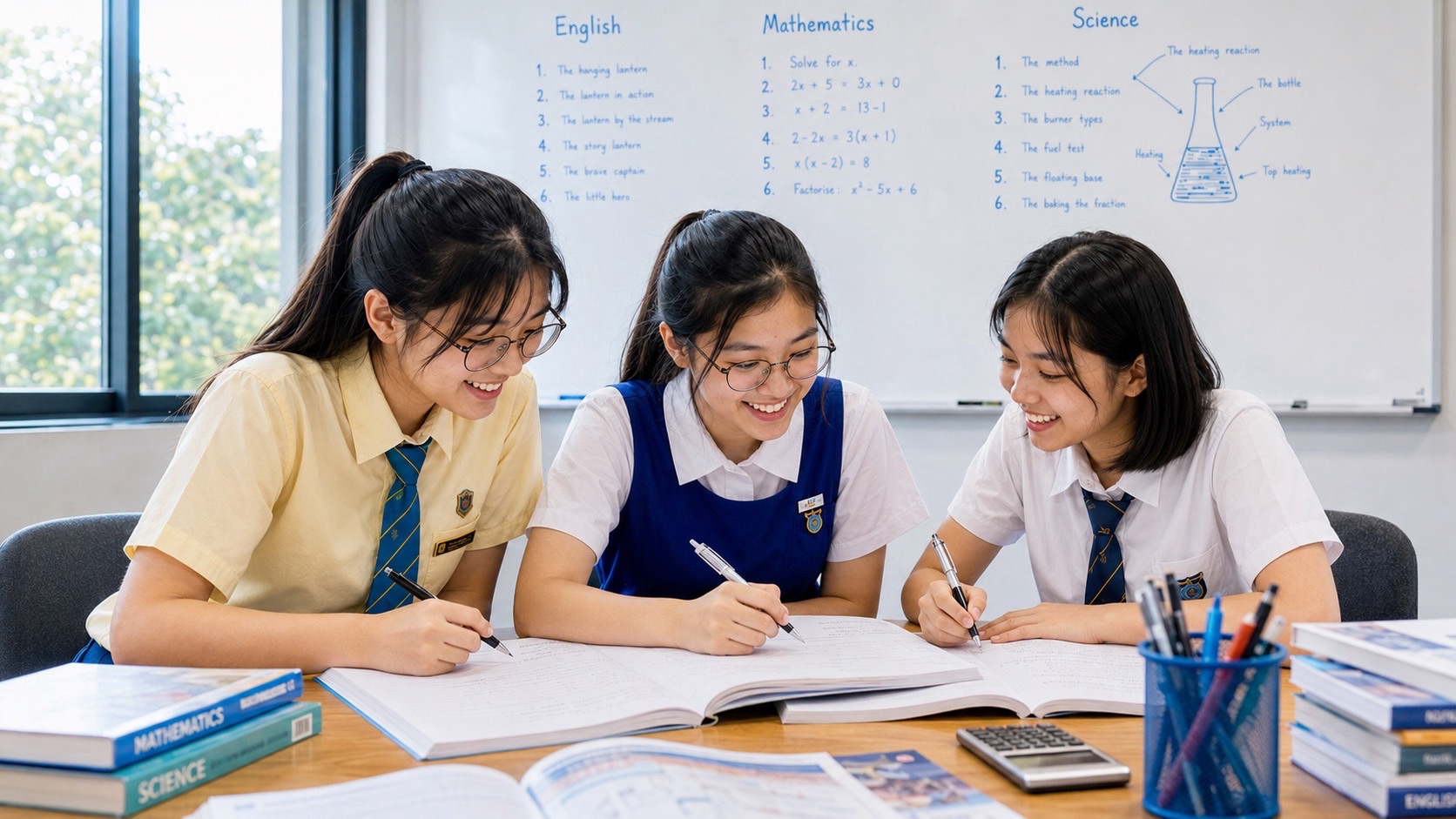
At eduKatePunggol, Mathematics tuition is taught in focused small groups of up to three students in 1.5-hour lessons near Punggol MRT. Frequency is therefore treated as a teaching decision rather than a default sales decision. The useful question is: what problem are we trying to solve, how quickly does it need to change, and what evidence would show that the current tuition frequency is enough?
The short answer: once a week or twice a week?
Once a week is often enough when the child:
- understands most current school Mathematics;
- has only a small number of recurring weaknesses;
- can practise independently between lessons;
- retains corrections from one week to the next;
- does not need constant adult prompting;
- has enough school and home practice already; and
- is improving at a reasonable rate.
Twice a week can be useful temporarily when the child:
- has several unstable prerequisites;
- is significantly behind current school work;
- needs one lesson for repair and one for current curriculum;
- forgets most corrections before the next week;
- is entering a demanding transition such as Primary 5, Primary 6 or Secondary 1;
- is approaching PSLE, SEC or another major assessment and needs both repair and paper rehearsal;
- has missed substantial school time; or
- needs a short intensive phase with a clear exit condition.
The key word is temporarily. More frequent tuition should have a purpose, a measurable target and a point at which the frequency can be reduced again.
Why tuition frequency is really a learning-system question
Parents often frame tuition frequency as a scheduling question.
“Is one lesson enough?”
“Should we add a second lesson?”
“Would three sessions speed things up?”
But frequency only makes sense inside the larger learning system.
A child learns Mathematics through repeated cycles:
- encounter a concept;
- understand the relationship;
- practise it accurately;
- make errors;
- receive feedback;
- correct the process;
- retrieve it later;
- apply it in changed questions; and
- use it independently under school or examination conditions.
Tuition occupies only part of this cycle.
If every stage occurs only while the tutor is present, the student may become highly supported but not independent.
That is why the space between lessons matters.
The space between Mathematics lessons is part of the teaching
Learning needs time.
A student may understand a concept on Tuesday and feel fluent by the end of the lesson. The real test comes later.
Can the student retrieve the method on Thursday?
Can the student recognise the same relationship on Saturday when the numbers and wording have changed?
Can the student use it in school without the tutor’s voice?
Spacing creates evidence.
It shows what actually remained.
A lesson schedule that is too dense can sometimes hide weak retention because help arrives again before the child has to retrieve anything independently.
This does not mean twice-weekly tuition is bad. It means the second lesson should not simply repeat the first lesson with more pages.
One lesson a week can work very well when the child practises independently
A well-designed once-weekly Mathematics tuition system can be powerful.
The 1.5-hour lesson can diagnose the week’s most important weakness, teach or repair the concept, practise it enough to stabilise the method and set up independent retrieval before the next lesson.
The week then becomes part of the intervention.
- school lessons provide additional exposure;
- school homework provides application;
- short home retrieval strengthens memory;
- corrections reveal what did not transfer;
- the next tuition lesson begins with evidence from the previous week.
For many students, this is enough.
The child does not need the tutor every time Mathematics appears.
The tutor’s job is to improve what happens when the tutor is not there.
When a second weekly Mathematics lesson becomes useful
A second weekly lesson is most useful when the first lesson has too many competing jobs.
1. Foundation repair plus current school work
Suppose a Primary 5 student is currently learning percentage but still has unstable fraction foundations.
One weekly lesson may be forced to choose between repairing fractions and keeping up with percentage.
A temporary second lesson can separate the work:
- Lesson A: repair the prerequisite;
- Lesson B: apply it to current school Mathematics.
This can accelerate recovery because the new school topic no longer keeps landing on an unrepaired foundation.
2. Exam preparation plus topic repair
Near PSLE or SEC, a student may need both full-paper rehearsal and targeted correction.
If one lesson is consumed by reviewing a paper, there may be insufficient time to rebuild the ratio, algebra, graph or geometry weakness exposed by that paper.
A second lesson can create a clean separation:
- paper execution and review;
- targeted concept repair and retesting.
3. Re-entry after a long gap
A student returning after illness, relocation, a long break or a period without structured Mathematics may need a short period of higher-frequency support.
The goal is not to make twice-weekly tuition permanent.
The goal is to restore enough continuity that normal frequency becomes sufficient again.
4. Major school transition
Transitions such as Primary 3 to upper-primary Mathematics, Primary 5 to the PSLE runway, Primary 6 examination preparation and Secondary 1 algebra can reveal old weaknesses quickly.
A temporary frequency increase can be useful when the student is simultaneously adapting to new content and repairing old foundations.
When twice a week is too much
More tuition can become counterproductive when it consumes the very conditions learning requires.
- the child is sleeping less;
- school homework is always rushed;
- there is no time for independent practice;
- the student is exhausted before tuition begins;
- every free afternoon becomes structured;
- the child stops reading, exercising or resting;
- the tutor is repeatedly reteaching because the learner has no consolidation time; or
- motivation is deteriorating because Mathematics now occupies too much of the week.
For a broader family-capacity framework, read How Much Tuition Is Too Much?.
Tuition should support the child’s learning system.
It should not consume it.
Frequency should change when the problem changes
Parents sometimes choose a tuition schedule once and then treat it as permanent.
A better approach is to review frequency as the student’s needs change.
Maintenance phase
One lesson a week may be enough when the student is keeping up, retaining corrections and practising independently.
Repair phase
Two lessons a week may help when several prerequisites need rebuilding while school continues moving forward.
Exam phase
A temporary increase may be useful when the student needs both paper rehearsal and targeted correction.
Independence phase
Frequency should reduce when the student can maintain performance with less support.
This final phase is important.
A tuition programme should have a concept of graduation.
For more on reducing support, read When Should Tuition Become Less Frequent?.
The five questions to ask before adding a second Mathematics lesson
- What exact problem will the second lesson solve?
- Why can the current lesson not solve it?
- What will the second lesson contain that the first one does not?
- What evidence will show that the extra frequency is working?
- When will we review whether twice a week is still necessary?
If nobody can answer these questions clearly, the second lesson may be schedule expansion rather than educational design.
Primary 1 and Primary 2: frequency should protect the child’s first relationship with Mathematics
Young children often benefit from consistency more than intensity.
A once-weekly small-group lesson can be enough when the child is building number sense, place value, number bonds and early word-problem confidence while still receiving normal school exposure.
A second lesson should have a strong reason.
Examples include a genuine foundational gap, a prolonged absence from school, significant difficulty retaining basic number relationships or a need for short-term catch-up.
At this age, fatigue can erase the benefit of additional teaching surprisingly quickly.
Parents can continue through Primary 1 Mathematics Tuition in Punggol and Primary 2 Mathematics Tuition in Punggol.
Primary 3 and Primary 4: frequency should respond to widening complexity
Primary 3 and Primary 4 widen the mathematical system.
Multiplication, division, fractions, decimals, factors, multiples, measurement and multi-step word problems create more opportunities for an old weakness to become visible.
Once-weekly tuition is often enough when the student is broadly keeping pace.
Twice-weekly tuition may be useful for a defined repair period if the tutor needs to rebuild multiplication fluency, division relationships or fraction foundations while still keeping the student aligned with school.
Continue through Primary 3 Mathematics Tuition in Punggol and Primary 4 Mathematics Tuition in Punggol.
Primary 5: frequency should protect the PSLE runway
Primary 5 introduces or deepens fractions, percentage, ratio and rate—the proportional reasoning that Primary 6 will use heavily.
This is one of the years where a temporary second weekly lesson can make sense if the student has an obvious backlog.
But the goal should be to repair early enough that Primary 6 does not become an emergency year.
Continue to Primary 5 Mathematics Tuition in Punggol.
Primary 6 and PSLE: when twice-weekly support can be useful
Primary 6 creates a special scheduling problem.
The student may simultaneously need:
- topic repair;
- mixed problem-solving practice;
- Paper 1 and Paper 2 preparation;
- timed full papers;
- error review;
- calculator discipline;
- checking routines; and
- recovery practice.
If one weekly lesson cannot reasonably contain both repair and rehearsal, a second lesson may be justified for a defined period.
But adding lessons immediately before PSLE can also backfire if it reduces sleep or overwhelms the student’s week.
The correct question is not “How many tuition hours can we fit?”
It is “What combination of teaching, practice, rest and school work produces the most reliable performance?”
Continue to Primary 6 Mathematics Tuition in Punggol and Surviving PSLE Mathematics.
Secondary G1, G2 and G3: frequency should match the actual subject-level problem
Secondary Mathematics becomes more symbolic.
A student can fall behind quickly if signed numbers, fractions, algebra, equations or graphs are unstable.
Once-weekly tuition can be enough when the student is broadly aligned with school and needs explanation, practice and assessment review.
Twice-weekly tuition can help temporarily when the student is simultaneously repairing prerequisites and handling current G1, G2 or G3 work.
The extra lesson should be aligned to the student’s actual subject level rather than used simply to add harder worksheets.
Continue to Secondary G1, G2 and G3 Mathematics Tuition in Punggol.
How to tell whether the current frequency is working
Do not judge tuition frequency only by whether the timetable feels full.
Look for evidence.
- Are repeated errors becoming less frequent?
- Are corrections surviving into the next week?
- Can the student begin more questions independently?
- Can the student solve changed questions, not only familiar ones?
- Is school homework becoming easier to manage?
- Are test marks becoming more stable?
- Is the student using less tutor prompting?
- Is confidence becoming more evidence-based?
- Is the family week still sustainable?
If these indicators are improving, the current frequency may be enough.
If they are not, do not automatically add another lesson.
First ask whether the teaching method, diagnosis, practice design or tutor fit needs to change.
For that broader audit, read When Tuition Is Not Working.
More frequent tuition should have an exit condition
If a child moves from once-weekly to twice-weekly Mathematics tuition, define why.
Examples:
- repair fraction operations before Primary 5 percentage work;
- stabilise multiplication facts before Primary 4;
- catch up after six weeks of absence;
- repair algebra foundations before upper-secondary equations;
- prepare for PSLE with one repair lesson and one paper lesson.
Then define the exit condition.
- the prerequisite is stable;
- the child can keep pace with school;
- retention across a week is reliable;
- full-paper performance is stable enough;
- independent practice is working again.
This prevents an intensive phase from quietly becoming permanent.
What parents should bring when discussing tuition frequency
A frequency decision is easier when the tutor has evidence.
- recent school Mathematics papers;
- one or two marked worksheets;
- the current school topics;
- the child’s weekly timetable;
- how long homework takes;
- whether corrections are remembered;
- whether tests are finished on time;
- how much adult help is currently needed; and
- what has changed recently.
The purpose is not to prove that the child needs more tuition.
The purpose is to decide what level of support is actually justified.
Frequently asked questions about Mathematics tuition frequency in Punggol
Is once-a-week Mathematics tuition enough?
Often, yes. Once a week can be enough when the child has reasonably stable foundations, practises independently and retains corrections between lessons.
Is twice-a-week Math tuition better?
Not automatically. Twice-weekly tuition is useful when the second lesson has a distinct job, such as foundation repair, exam rehearsal or catch-up. If both lessons simply repeat similar worksheets, the extra frequency may add workload without solving the bottleneck.
How long should twice-weekly tuition last?
It should last as long as the defined repair or preparation phase requires, then be reviewed. The goal should normally be to return to the lowest frequency that still sustains progress.
Should my child have extra Math tuition before PSLE?
Only when the extra lesson has a clear purpose and the weekly schedule can absorb it without damaging sleep, school work or recovery. A second lesson may be useful for combining targeted repair with paper practice.
What if my child is already doing well?
A strong student may not need greater frequency. Challenge can come from deeper reasoning, non-routine problems, alternative methods and greater independence rather than additional hours.
What if my child’s marks are falling even with tuition?
Audit the cause before adding sessions. The problem may be method, tutor fit, weak prerequisites, poor transfer, school stress, insufficient sleep or an overloaded schedule rather than insufficient tuition frequency.
How large are eduKatePunggol Mathematics classes?
Classes are kept to up to three students. Lessons are 1.5 hours. Parents should confirm the current timetable, fees and available places directly.
Mathematics Tuition in Punggol: use the lowest frequency that still produces reliable progress
The goal is not the maximum number of tuition hours.
The goal is reliable mathematical independence.
Use one lesson when one lesson is enough.
Add a second lesson when there is a clear second job.
Measure whether the extra frequency works.
Reduce it again when the child can carry more of the system independently.
That is a healthier definition of effective tuition.
Families who want to discuss whether their child currently needs once-weekly or twice-weekly Mathematics tuition can WhatsApp eduKatePunggol with a recent paper, current year level and the main difficulty they are seeing.
Continue through the Punggol Mathematics route
- Does My Child Need Mathematics Tuition?
- How Much Tuition Is Too Much?
- When Tuition Is Not Working
- When Should Tuition Become Less Frequent?
- Mathematics Tuition at eduKatePunggol
- How to Choose a Primary Mathematics Tutor in Punggol
- Mathematics Tuition in Punggol | Surviving PSLE Mathematics
- Secondary G1, G2 and G3 Mathematics Tuition in Punggol
Explore the Punggol Mathematics reading library for related guides.


