
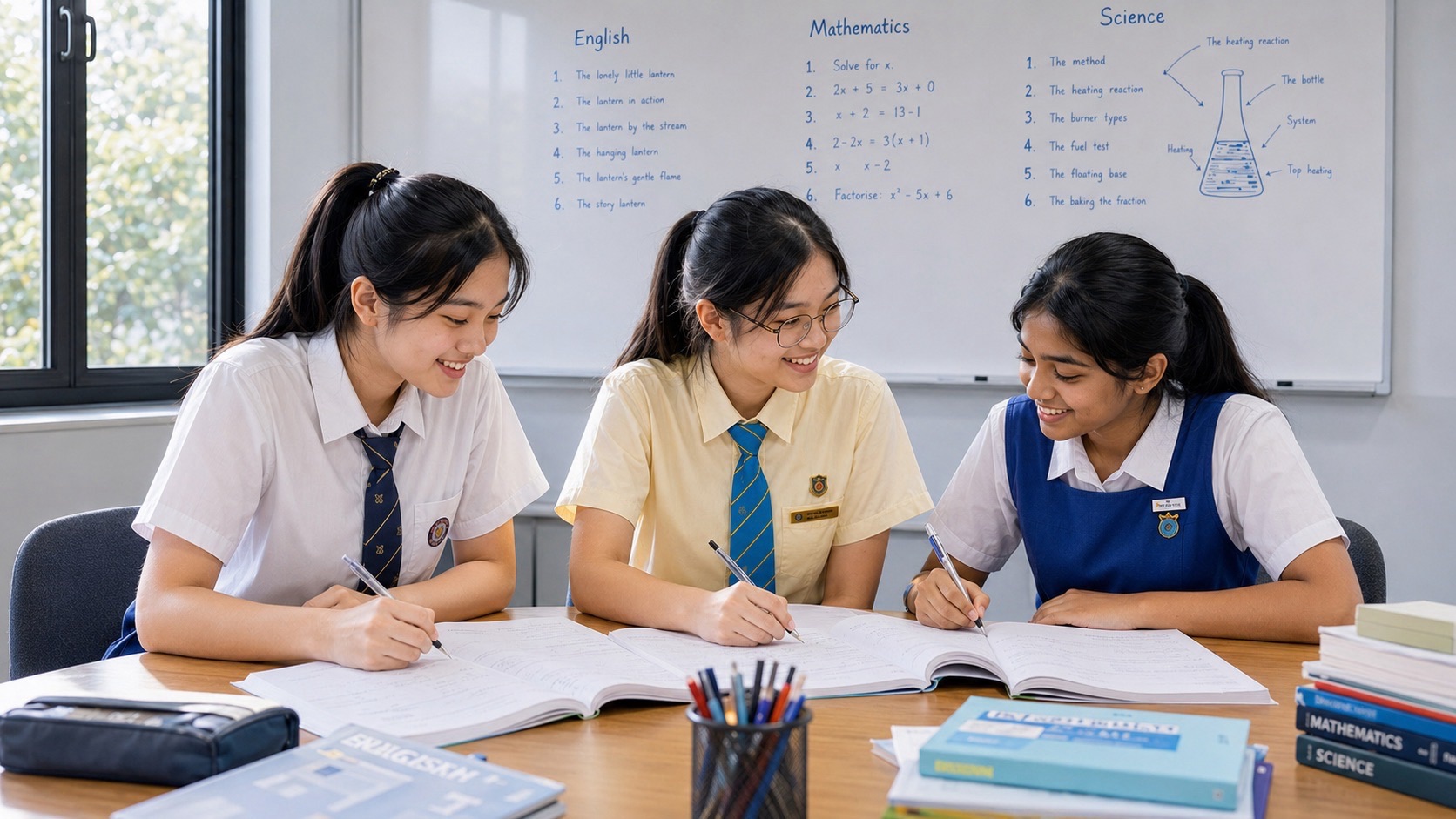
Mathematics tuition in Punggol for Primary 3 becomes important when a child has to move beyond basic arithmetic and begin coordinating several mathematical systems at once. Parents searching for Primary 3 Math tuition in Punggol, a P3 Math tutor, multiplication and division help, fractions tuition, bar model practice or Math word problems are often seeing the same transition: calculation is no longer enough. The child must recognise relationships, select operations, handle larger numbers, use multiplication facts, interpret remainders, understand fractions and solve longer word problems without being told exactly what method to use.
The strongest Primary 3 Mathematics preparation therefore combines place value, four operations, multiplication tables, division with remainders, fractions, money, time, length, mass, volume, area, geometry, data, bar graphs, mathematical reasoning, bar models and multi-step word problems. These ideas recur across Singapore Primary 3 curriculum mappings and major international Grade 3 Mathematics resources because this is the year Mathematics becomes noticeably more connected: multiplication links to division, fractions become numbers rather than pictures alone, measurement requires unit reasoning, and word problems require more than one decision.
At eduKatePunggol, Primary 3 Mathematics is taught in focused small groups of up to three students in 1.5-hour lessons near Punggol MRT. The commercial details matter—class size, timetable, fees and convenience matter to families—but the educational question comes first: has the child built enough Primary 1 and Primary 2 number control to use Mathematics flexibly, or is Primary 3 exposing weaknesses that were previously hidden by small numbers and familiar worksheets?
The short answer: why Primary 3 Mathematics feels different
Primary 3 is often the first year where a child who previously seemed “fine at Maths” can begin to struggle.
The reason is not simply that the syllabus becomes harder. The structure of the work changes.
The student now has to manage more of the following at once:
- Larger numbers. Place value must stay stable while calculations expand.
- More multiplication and division. Facts need to become retrievable enough to support problem solving.
- Remainders. Division answers must be interpreted in context rather than treated as a final number only.
- Fractions. Equal parts, numerators, denominators and fraction comparison begin to require stronger conceptual control.
- Measurement and area. Numbers must remain attached to quantities and units.
- Longer word problems. The child may need more than one operation and must decide the order.
- Less obvious topic cues. The question may not announce which method is required.
- Greater independence. The student is expected to begin, organise and check more without adult prompting.
If you are looking for the direct class owner rather than this parent guide, continue to Primary 3 Mathematics Tuition at eduKatePunggol. For the broader Mathematics pathway, use Mathematics Tuition at eduKatePunggol.
Primary 3 is the bridge from arithmetic to problem solving
In the first two primary years, a child can often succeed by learning basic number relationships and applying them to relatively direct questions.
Primary 3 begins to ask for something more demanding.
The student must decide what kind of mathematical situation is present.
That shift matters.
A worksheet titled “Multiplication” has already removed one important decision. The child knows before reading the question that multiplication is expected.
A mixed word problem does not provide that help.
The student may need to decide whether the situation requires addition, subtraction, multiplication, division or a combination.
This is where Mathematics begins to feel less like executing a procedure and more like choosing a strategy.
Multiplication tables: fluency becomes a working-memory issue
Multiplication tables are one of the most searched Primary 3 Mathematics topics for good reason.
At this stage, multiplication facts are no longer just a chapter. They become infrastructure for many other chapters.
If every multiplication fact requires slow reconstruction, the child has less attention available for:
- understanding a word problem;
- remembering intermediate results;
- interpreting a remainder;
- handling fractions;
- working with area;
- checking an answer; and
- solving multi-step questions.
Fluency therefore matters.
But fluency should rest on structure.
A child should understand that 7 × 6 describes seven equal groups of six or six equal groups of seven, depending on the context. Arrays, skip counting, repeated addition and known facts can support recall.
The goal is not only to answer 7 × 6 quickly.
The goal is to use 7 × 6 inside a problem without spending so much attention on the fact that the rest of the reasoning disappears.
A useful multiplication-fluency ladder
- Understand equal groups.
- Represent the groups with objects or arrays.
- Connect repeated addition to multiplication.
- Notice useful patterns.
- Practise retrieval.
- Mix known and less-secure facts.
- Use the facts inside word problems.
- Return after a delay.
Fact recall is valuable when it remains connected to mathematical meaning.
Division: quotient, remainder and the meaning of the answer
Division becomes more demanding in Primary 3 because the child must handle larger quantities and increasingly interpret remainders.
This is where a correct calculation can still produce a wrong final answer.
Suppose 29 students are going on a trip and each car can carry 4 students.
29 ÷ 4 gives 7 remainder 1.
But the context may require 8 cars, because the remaining student still needs transport.
Now change the question.
There are 29 sweets and each bag holds 4 sweets. How many complete bags can be filled?
The same division calculation produces a different interpretation.
Seven complete bags can be filled, with one sweet remaining.
The arithmetic is the same.
The final answer depends on the situation.
This is why Primary 3 division should not be taught as an isolated algorithm.
Multiplication and division should become one connected system
A strong Primary 3 learner does not store multiplication and division in separate mental boxes.
The child begins to see fact families.
If:
8 × 6 = 48
then:
48 ÷ 6 = 8
and:
48 ÷ 8 = 6.
This connection reduces memorisation load and improves error checking.
If a student calculates 48 ÷ 6 = 7, multiplication can be used as a check:
7 × 6 = 42, not 48.
Inverse relationships become one of the child’s first powerful self-checking tools.
Fractions in Primary 3: from shaded pictures to actual numbers
Fractions are another major Primary 3 search and teaching cluster.
Early fraction work may begin with shaded shapes, but the concept is much larger than colouring one part of a pizza.
The child needs to understand:
- the whole;
- equal partitioning;
- the denominator as the number of equal parts in the whole;
- the numerator as the number of those parts being considered;
- unit fractions;
- equivalent-looking representations;
- comparison of simple fractions; and
- fractions as quantities that can be placed on a number line.
This last idea is important.
A fraction is not merely a shaded picture.
It is a number.
If a child understands one-half only when half of a circle is shaded, the knowledge is still tied to one representation.
The student should gradually recognise one-half in a bar, a number line, a set, a measurement and a real-life quantity.
Why equal parts matter
If a whole is divided into four unequal pieces, those pieces are not quarters merely because there are four of them.
The equality of the parts is fundamental.
This seems small, but misunderstanding it can create later confusion in equivalent fractions, ratio and percentage.
Multi-step word problems: where Primary 3 thinking begins to widen
Multi-step word problems are one of the clearest signals that the child is moving into a more mature form of school Mathematics.
A one-step problem may ask the child to identify one relationship and perform one operation.
A two-step problem requires the child to find an intermediate result and then use it correctly.
This creates several new failure points:
- the child may answer the intermediate question instead of the final question;
- the first operation may be correct but the second relationship may be misunderstood;
- the child may lose track of what the intermediate number represents;
- a unit may disappear between steps;
- the child may calculate before building a representation; or
- the student may know both operations but perform them in the wrong order.
This is why clear working begins to matter more.
Working is not decoration.
It is external memory.
A well-organised page lets the child see what has already been found and what still needs to be found.
A stronger process for Primary 3 word problems
- Read the whole question. Do not begin calculating after the first sentence.
- Identify the target. What must be found at the end?
- Identify the quantities. What does each number represent?
- Find the relationship. Is this part-whole, comparison, equal groups, sharing, change, repeated groups or another structure?
- Represent if useful. Bar model, diagram, table, number sentence or annotated working.
- Plan the first step. What intermediate result is needed?
- Carry the meaning forward. Label what the intermediate answer represents.
- Solve the final step.
- Check the answer against the story.
Notice what is missing from this sequence.
“Look for a keyword and immediately choose an operation.”
That shortcut becomes increasingly unreliable as questions grow more complex.
Bar models: useful when they reduce the thinking load
The bar model method is internationally associated with Singapore Mathematics because visual representation can make relationships easier to inspect.
In Primary 3, bar models can support:
- part-whole relationships;
- comparison;
- missing parts;
- equal groups;
- multiplication and division;
- fraction relationships;
- simple multi-step problems; and
- before-and-after changes.
But a bar model should not become a compulsory ritual.
If the relationship is already obvious, a number sentence may be enough.
If the child draws bars mechanically without understanding which quantity each bar represents, the model has become extra work.
A good tutor therefore asks whether the representation reduces confusion.
Area and measurement: why units become a reasoning skill
Primary 3 measurement work expands the child’s understanding of quantity.
Length, mass, volume, time and area all require numbers to remain attached to units.
Area is especially useful because it connects geometry and multiplication.
A rectangle arranged as rows and columns can be understood as an array.
That means multiplication is no longer only repeated groups of objects. It also describes the structure of space.
This is another reason multiplication fluency matters.
Estimate before measuring
Estimation is one of the easiest ways to build mathematical judgment.
Before measuring a table, ask whether its length is likely to be closer to 1 metre or 10 metres.
Before accepting an answer, ask whether the unit and magnitude are reasonable.
This habit later becomes part of examination checking.
Money and time: the arithmetic is not the whole problem
Money and time continue to look familiar in Primary 3, but the questions can become more complex.
A money problem may require several operations, comparison or change.
A time problem may require reading a clock, understanding a duration and deciding whether the answer crosses an hour boundary.
The challenge is often not calculation alone.
It is keeping the unit and situation stable while calculating.
This is the same broader skill used in word problems: numbers must remain attached to meaning.
Graphs and data: read first, calculate second
Primary 3 data work develops interpretation.
Picture graphs and bar graphs can ask the child to:
- identify the scale;
- compare categories;
- find totals;
- find differences;
- answer multi-step questions; and
- draw conclusions from displayed information.
The most common mistake is starting arithmetic before understanding what the graph represents.
A disciplined student reads the title, labels, scale and legend before calculating.
This is a small habit with a long future.
Primary 3 careless mistakes often reveal an overloaded process
As Mathematics becomes denser, “careless mistakes” can increase even when the child understands more.
This is because the child is coordinating more information at once.
Common patterns include:
- forgetting a multiplication fact halfway through a multi-step problem;
- writing the wrong remainder interpretation;
- losing the unit;
- copying an intermediate answer incorrectly;
- misreading a graph scale;
- switching operations in the second step;
- failing to label what a number represents;
- drawing a model that does not match the story;
- rushing after one difficult question; and
- checking by simply repeating the same calculation without checking the relationship.
These mistakes should be classified, not merely criticised.
If the error is working-memory overload, simplify the working.
If the error is fact retrieval, strengthen fluency.
If the error is representation, repair the model.
If the error is reading, slow down the question analysis.
Specific error, specific correction.
Why Primary 3 students sometimes understand tuition but fail school tests
A child can appear strong in a lesson and still underperform in a school assessment.
This often happens because tuition has provided invisible support.
The tutor may have:
- selected the topic;
- chosen the representation;
- grouped similar questions together;
- given a small verbal cue;
- corrected the first error immediately; or
- confirmed that the chosen method is right.
School tests remove many of those supports.
The student must decide what to do.
This is why tuition should include cold starts.
Give a question without announcing the topic.
Do not confirm the method immediately.
Let the student retrieve the strategy.
Independence is measured after the cue disappears.
A better Primary 3 practice cycle
Random practice is less useful than a deliberate sequence.
- Teach the concept. Make the relationship visible.
- Practise accurately. Stabilise the procedure.
- Vary the surface. Change numbers, wording or representation.
- Mix the topic. Force operation and strategy selection.
- Retrieve after delay. Check whether learning survived time.
- Use a timed or school-like set. Test performance under constraint.
- Classify errors. Identify the first failing decision.
- Repair and retest.
The cycle matters because immediate success can be misleading.
A child who solves five identical questions after watching one example may be imitating the pattern.
A child who can solve the idea three days later in a mixed set is showing stronger evidence of learning.
Primary 3 to Primary 4: the readiness gate
Primary 4 usually feels easier when the Primary 3 system is stable.
Useful signs of readiness include:
- place value remains stable across larger numbers;
- addition and subtraction are accurate enough not to consume excessive attention;
- multiplication facts are increasingly fluent;
- division is conceptually connected to multiplication;
- remainders can be interpreted in context;
- fractions are understood as numbers and equal parts;
- measurement units are handled carefully;
- bar graphs and simple data displays are read accurately;
- one-step and two-step word problems can be represented;
- the child can choose among the four operations;
- working remains clear enough to inspect;
- errors can sometimes be caught independently; and
- the student can begin unfamiliar questions without immediate adult rescue.
For a dedicated transition check, read Primary 3 Mathematics Readiness Audit | Ready for Primary 4 Problem Solving?.
Three Primary 3 students can need completely different tuition
Student A: weak multiplication fluency
This child understands word problems but calculations are so slow that multi-step questions overload working memory. The first job is to strengthen multiplication and division fact networks while preserving meaning.
Student B: strong calculation, weak representation
This child can calculate quickly but starts every problem by grabbing numbers. The first job is to slow down interpretation, label quantities and choose representations before calculation.
Student C: good in tuition, weak independently
This child succeeds with prompts but struggles in tests. The first job is to reduce support, introduce mixed sets and use delayed retrieval.
The mark alone cannot tell the tutor which child is present.
The process must be observed.
What a three-student Primary 3 Mathematics class changes
A three-student class gives the tutor enough visibility to see the route, not only the answer.
The tutor can observe:
- whether multiplication facts are retrieved or reconstructed;
- whether division meaning is secure;
- whether a remainder is interpreted correctly;
- whether a fraction model represents equal parts;
- whether the child can identify the target in a two-step problem;
- whether the bar model matches the story;
- whether the working keeps intermediate quantities clear;
- whether the student checks the answer; and
- how much help is actually required.
That allows the tutor to give one child a fact-retrieval drill, another a representation prompt and another an independent extension question inside the same broad lesson.
Small group should create precision.
It should not simply create a smaller audience for the same generic worksheet.
What a useful 1.5-hour Primary 3 Mathematics lesson can contain
1. Retrieval
Return to multiplication facts, division relationships, place value or a recently repaired concept.
2. School alignment
Check current school topics, worksheets, tests or repeated error patterns.
3. Concept teaching
Explain the relationship clearly with the lightest useful representation.
4. Guided application
Work through examples while keeping the important decisions with the student.
5. Independent work
Remove immediate cues and observe whether the child can begin alone.
6. Changed or mixed questions
Change the surface so the student must recognise the underlying structure.
7. Correction
Repair the first failing decision rather than simply provide the final answer.
8. Exit check
Confirm what the child can now retrieve, explain or solve with less help.
How parents can help Primary 3 Mathematics at home
Parents do not need to reproduce tuition at the dining table.
A small number of habits are enough.
Protect multiplication retrieval
Short, regular retrieval is better than occasional marathon drilling. Keep the practice calm and brief enough to repeat.
Ask what the number means
When a child writes an intermediate answer, ask what that number represents. This helps prevent multi-step problems from becoming disconnected arithmetic.
Ask for an estimate
Is the answer likely to be around 20, 200 or 2,000? Estimation develops error detection.
Use real measurement
Measure lengths, compare masses, discuss capacity, read clocks and notice area in everyday objects.
Do not rescue too quickly
A short productive struggle helps reveal what the child can retrieve. Give the smallest useful hint rather than the entire method.
When does a Primary 3 child need Mathematics tuition?
Not every Primary 3 child needs tuition.
Additional support may be useful when:
- multiplication facts remain highly unstable;
- division is treated as an unrelated rule;
- remainders are not understood;
- fractions are confused when the representation changes;
- the child cannot choose among the four operations;
- multi-step word problems consistently collapse;
- bar models are copied without understanding;
- measurement units are repeatedly lost;
- corrections do not survive into later work;
- school tests are much weaker than supported practice;
- confidence is deteriorating; or
- the child is strong but needs deeper transfer and challenge.
Before increasing tuition load, inspect the whole week. Sleep, health, school transition and schedule overload can affect performance. More tuition is not automatically the correct answer to every temporary dip.
Why local Punggol tuition matters more as the school week gets busier
By Primary 3, the child’s school week is fuller than it was in Primary 1.
More subjects, more homework and more independent responsibility compete for attention.
eduKatePunggol is located at 83 Punggol Central, Singapore 828761, near Punggol MRT and Waterway Point.
For a Punggol family, a nearby 1.5-hour lesson can reduce unnecessary travel load and make the weekly Mathematics routine easier to sustain.
Location is not a substitute for teaching quality.
But when the teaching fit is appropriate, reduced friction helps consistency.
Frequently asked questions about Primary 3 Mathematics tuition in Punggol
What are the most important Primary 3 Math topics?
Place value, the four operations, multiplication facts, division, remainders, fractions, money, time, measurement, area, geometry, data and multi-step word problems all matter. The right tuition emphasis depends on what the child already controls.
Should my Primary 3 child know multiplication tables fluently?
Multiplication facts should become increasingly retrievable because they support division and multi-step problem solving. Fluency should remain connected to equal groups, arrays, repeated addition and inverse relationships.
Why can my child multiply but not divide?
The connection between the operations may not yet be stable. Use fact families and equal-group situations so multiplication and division become two views of the same relationship.
Why are fractions suddenly difficult?
Fractions require the child to understand the whole, equal parts and the meaning of numerator and denominator. If the child only recognises fractions through one familiar picture, changed representations can reveal the weakness.
Should P3 students use bar models?
Yes, when a bar model makes the relationship clearer. The child should understand what each bar represents and should not draw models mechanically when a simpler representation is enough.
Why does my child fail multi-step problems after getting the first step correct?
The child may lose track of what the intermediate answer represents, choose the wrong second relationship or stop before answering the actual question. Clear labelled working can reduce this failure.
How should careless mistakes be reduced?
Classify them. A multiplication-fact error, copied-number error, unit error, reading error and operation-selection error require different corrections. “Be more careful” is too broad to teach from.
Can a strong Primary 3 student benefit from tuition?
Yes, when tuition increases depth: harder transfer, multiple methods, mathematical explanation, non-routine problems and greater independence rather than simply rushing into later-year chapters.
How large are eduKatePunggol Primary 3 Mathematics classes?
Classes are kept to up to three students so the tutor can observe the student’s method closely and still require independent thought.
How long is each lesson?
Lessons are 1.5 hours. Parents should confirm current timetable, fees and available places directly because these can change.
A parent checklist before choosing Primary 3 Mathematics tuition
- How do you build multiplication fluency?
- How do you connect multiplication and division?
- How do you teach remainder interpretation?
- How do you teach fractions across different representations?
- How do you teach multi-step word problems?
- When do you use bar models?
- How do you prevent keyword guessing?
- How do you diagnose careless mistakes?
- How do you test whether corrections are retained later?
- How do you remove tutor prompts?
- How do you challenge a strong Primary 3 student?
- How do you know whether the child is ready for Primary 4?
A strong Primary 3 tuition programme should be able to explain its diagnostic and teaching logic more precisely than “we do more questions”.
Mathematics Tuition in Punggol: Primary 3 should widen the system without breaking the foundation
Primary 3 is where Mathematics gets wider.
Multiplication facts become working tools.
Division becomes more than sharing.
Remainders require interpretation.
Fractions become numbers.
Area links geometry to multiplication.
Graphs require interpretation.
Word problems require more than one decision.
Working becomes external memory.
Checking becomes a strategy.
Tutor prompts should gradually become the child’s own internal questions.
That is the Primary 3 job.
Families who want to discuss a child’s present P3 Mathematics position, multiplication fluency, division, fractions, word problems or current small-group availability can WhatsApp eduKatePunggol.
Continue through the Punggol Mathematics route
- Primary 3 Mathematics Tuition at eduKatePunggol — direct P3 tuition service owner.
- Primary 3 Mathematics in Punggol | The Year the System Gets Wider — the full P3 parent journey.
- Primary 3 Mathematics Readiness Audit — check readiness for Primary 4 problem solving.
- How to Improve Primary 3 Mathematics in Punggol — the broader improvement owner.
- Primary 3 Mathematics | From Arithmetic Fluency to Choosing the Right Operation — operation-selection guide.
- Primary 2 Mathematics Tuition at eduKatePunggol — return to prerequisite foundations where needed.
- Primary 4 Mathematics Tuition at eduKatePunggol — continue into the next year level.
- Mathematics Tuition at eduKatePunggol — broad Mathematics route.
- eduKatePunggol — English, Mathematics and Science tuition in Punggol.
Official curriculum reference: Ministry of Education Primary Mathematics Syllabus
Explore the Punggol Mathematics reading library for related guides.


