
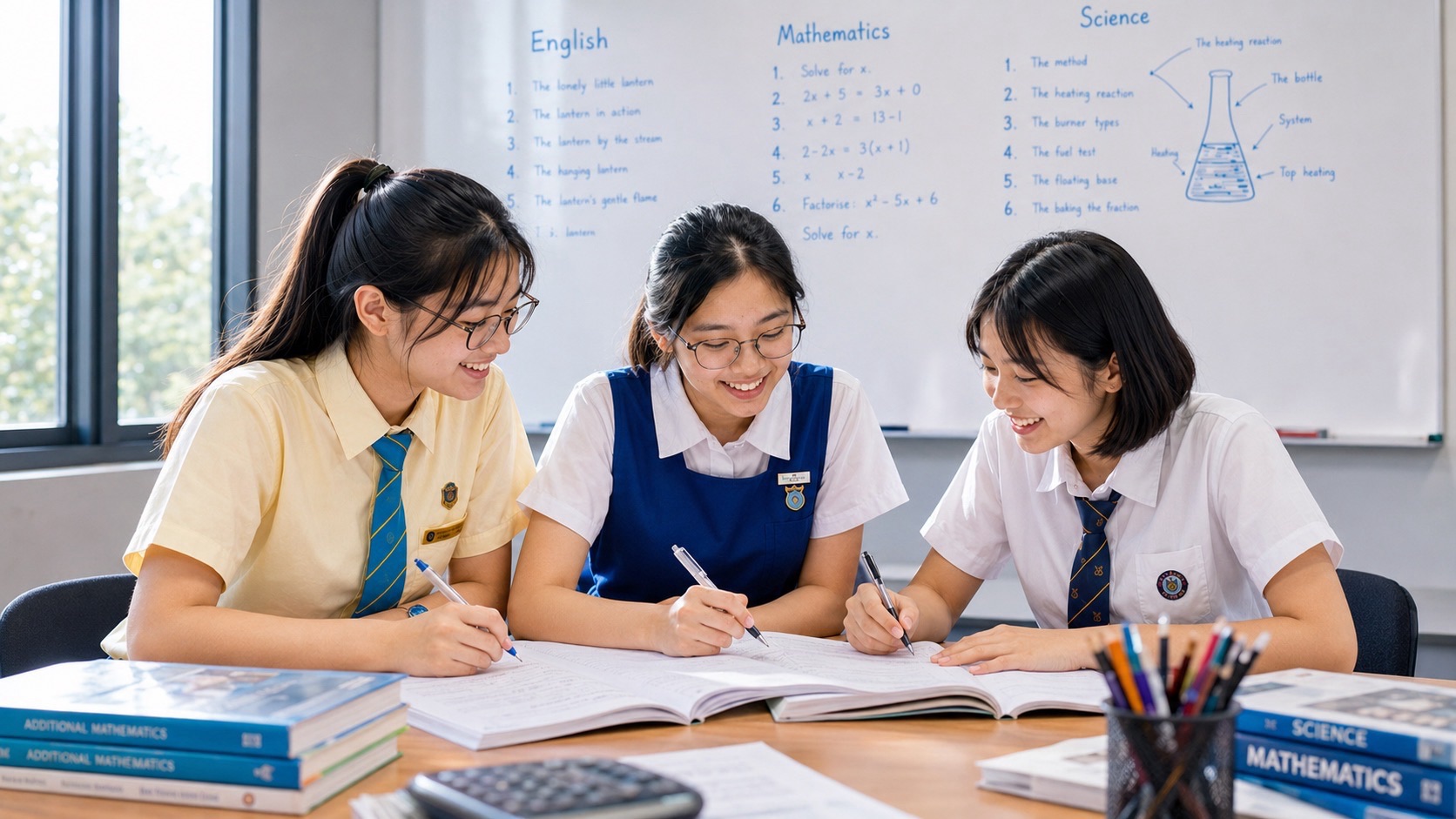
Mathematics tuition in Punggol for Secondary G1, G2 and G3 should help students manage the transition from arithmetic-heavy Primary Mathematics into a more symbolic subject built around integers, algebra, expressions, equations, graphs, geometry, statistics and mathematical reasoning. Parents searching for Secondary Math tuition in Punggol, a Secondary Mathematics tutor, G1 Mathematics tuition, G2 Mathematics tuition, G3 Mathematics tuition, algebra help or linear equations tuition are often seeing the same shift: the student can no longer rely on arithmetic intuition alone because Mathematics is now increasingly expressed through variables, general rules and abstract relationships.
From the 2027 Singapore-Cambridge Secondary Education Certificate (SEC), Mathematics is examined at G1, G2 and G3 subject levels under Full Subject-Based Banding. The levels are not one identical syllabus with three different labels: they differ in depth, demand and examination requirements. What they share is a common need for strong number control, algebraic language, equation solving, graphical interpretation, geometry, data handling and problem solving. International lower-secondary resources emphasise the same broad areas because they form the foundation for later algebra, functions, statistics and additional mathematics.
At eduKatePunggol, Secondary Mathematics is taught in focused small groups of up to three students in 1.5-hour lessons near Punggol MRT. The commercial details matter—class size, timetable, fees and convenience matter to families—but the educational question comes first: which mathematical layer is actually failing at the student’s current subject level, and what must be repaired so the student can progress independently?
The 50-second answer: what changes after Primary 6?
- Numbers expand. Negative numbers, powers and more demanding numerical relationships enter the picture.
- Algebra becomes a language. Letters represent quantities and relationships, not mysterious decorations.
- Equations become processes. Students must preserve equality while transforming expressions.
- Graphs become representations. A relationship can be shown symbolically, numerically and visually.
- Geometry becomes more formal. Properties, constructions, angle reasoning and measurement become more connected.
- Statistics requires interpretation. Students must read, compare and reason from data rather than simply calculate.
- Subject level matters. G1, G2 and G3 require teaching aligned to the actual syllabus and depth expected.
For year-level service owners, continue to Secondary 1 Mathematics Tuition, Secondary 2 Mathematics Tuition, Secondary 3 Mathematics Tuition or Secondary 4 Mathematics Tuition.
G1, G2 and G3: same subject name, different depth and assessment demand
Parents should avoid treating G1, G2 and G3 as a simple ranking of students.
They are subject levels. A student’s Mathematics tuition should therefore match the content, pacing and examination demand of the level actually taken.
From 2027, SEAB lists separate SEC Mathematics syllabuses for G1, G2 and G3. The qualification records the subject level sat.
That has a practical tuition consequence:
The tutor should not teach a G1 student as though the goal were simply “do G3 worksheets”, and should not teach a G3 student with material that never reaches G3 depth. Challenge should be appropriate to the student’s pathway and next step.
Integers: the first Secondary Mathematics language shock
Negative numbers create one of the first major transitions because arithmetic rules now extend beyond the positive quantities children are most familiar with.
Students must understand:
- number-line direction;
- opposites;
- absolute magnitude;
- addition and subtraction of signed numbers;
- multiplication and division of signed numbers; and
- the difference between a negative sign and a subtraction operation.
Memorising “two negatives make a positive” is not enough if the student cannot distinguish contexts.
Algebra: letters should make Mathematics more general, not more mysterious
Algebra is often where students first say, “I was good at Math until letters appeared.”
The problem is usually not the letter itself.
The student must learn several new conventions:
- a letter can represent an unknown or variable quantity;
- 3x means three times x;
- like terms can be combined;
- unlike terms cannot be combined merely because they are nearby;
- brackets change structure;
- substitution replaces variables with values; and
- an expression is not automatically an equation.
Good algebra tuition therefore teaches syntax and meaning together.
For a focused route, read Linear Equations and Algebra Basics for Secondary G1, G2 and G3.
Equations: equality must remain true
Equation solving becomes much easier when students understand the equal sign as a statement of balance.
If 3x + 5 = 20, every valid transformation must preserve equality.
The student is not “moving 5 to the other side and changing the sign” by magic.
The student is performing an equivalent operation on both sides.
This conceptual language prevents many later algebra mistakes.
Graphs: one relationship, several representations
Graphs connect algebra to visual reasoning.
A student may meet the same relationship as:
- a table of values;
- an equation;
- a coordinate graph;
- a word description; or
- a real-world relationship.
Strong graph work requires the student to move among these forms.
If the student can plot points but cannot explain what the graph means, the skill is incomplete.
Geometry: diagrams must be read as information systems
Secondary geometry becomes more demanding because students must use properties rather than rely on appearance.
A diagram may not be drawn to scale.
The learner must identify given information, known properties and relationships before calculating.
This habit is closely related to algebra and problem solving: distinguish what is given from what must be inferred.
Statistics and data: calculation without interpretation is incomplete
Secondary Mathematics asks students to work with data more formally.
The student may need to:
- read tables and graphs;
- calculate summary measures;
- compare distributions;
- interpret trends;
- identify misleading presentations; and
- state conclusions that match the evidence.
These are reasoning skills as much as arithmetic skills.
Why Secondary Mathematics students often fall behind quietly
Secondary Mathematics is cumulative.
A weak skill can hide for months before becoming expensive.
- weak signed-number control damages algebra;
- weak fractions damage algebraic fractions and ratio work;
- weak expansion damages equations;
- weak equations damage graphs;
- weak graph interpretation damages applications;
- weak working layout makes multi-step solutions difficult to audit.
This is why the tutor should locate the earliest unreliable prerequisite rather than simply re-teach the latest school worksheet.
What a three-student Secondary Mathematics class can diagnose
- Does the student understand signed numbers or memorise sign rules?
- Does the student distinguish expressions from equations?
- Can the student expand and simplify accurately?
- Can the student preserve equality while solving?
- Can the student connect a table to a graph?
- Can the student explain a geometry property?
- Can the student interpret data in context?
- Can the student start a mixed question without being told the chapter?
Small-group value comes from visibility and responsive teaching.
SEC preparation: build subject-level control before exam technique
From 2027, the SEC framework brings G1, G2 and G3 subject levels into the same certificate system. Examination preparation should therefore be aligned to the syllabus the student is actually taking.
Across levels, a useful preparation cycle is:
- secure prerequisite concepts;
- practise procedures accurately;
- mix topics so selection is required;
- use school and exam-style questions;
- classify errors;
- repair the first weak decision;
- retest after delay; and
- rehearse complete papers when appropriate.
Exam technique cannot compensate indefinitely for missing algebra or number skills.
Frequently asked questions about Secondary Mathematics tuition in Punggol
What is the difference between G1, G2 and G3 Mathematics?
They are different subject levels with different syllabus depth and assessment demand. Tuition should be aligned to the student’s actual subject level rather than using one generic Secondary Mathematics programme.
Why is Secondary 1 Mathematics such a big transition?
The subject becomes more symbolic. Integers, algebra, equations and graphs require students to work with general relationships rather than only concrete quantities.
When should a student start Mathematics tuition?
When there is a persistent gap that school and independent study are not resolving, or when the student needs structured support, greater depth or examination preparation. The best timing depends on the actual problem.
How large are eduKatePunggol Secondary Mathematics classes?
Classes are kept to up to three students. Lessons are 1.5 hours. Parents should confirm current timetable, fees and available places directly.
Mathematics Tuition in Punggol: Secondary G1, G2 and G3 should build symbolic control
Secondary Mathematics changes the language of the subject.
Numbers become signed.
Quantities become variables.
Relationships become equations.
Equations become graphs.
Diagrams become property systems.
Data becomes evidence.
Subject level shapes depth and assessment.
Independence still matters most.
Families who want to discuss a student’s Secondary Mathematics subject level, algebra, equations, graphs, SEC preparation or current small-group availability can WhatsApp eduKatePunggol.
Continue through the Punggol Secondary Mathematics route
- Secondary 1 Mathematics Tuition at eduKatePunggol
- Secondary 2 Mathematics Tuition at eduKatePunggol
- Secondary 3 Mathematics Tuition at eduKatePunggol
- Secondary 4 Mathematics Tuition at eduKatePunggol
- Mathematics Improvements in Punggol | SEC G1, G2 and G3
- Linear Equations and Algebra Basics for G1, G2 and G3
- Mathematics Tuition at eduKatePunggol
Official SEC references: SEAB 2027 G1 Syllabuses · SEAB 2027 G2 Syllabuses · SEAB 2027 G3 Syllabuses
Explore the Punggol Mathematics reading library for related guides.


