
For a quiet or nervous Punggol child entering Secondary 1 in 2027, the best school is not automatically the smallest, nearest or most prestigious. It is a school where the pupil is eligible to apply, can manage the daily journey, feels reasonably safe asking for help, and has opportunities to develop friendships and confidence at a sustainable pace. After 2026 PSLE results on Tuesday, 24 November at 11.00am, investigate Edgefield Secondary, Greendale Secondary, Punggol Secondary and Yusof Ishak Secondary, as well as other eligible schools beyond Punggol where necessary. Compare their actual pastoral support, transition arrangements, school culture and individual subject-level offerings—not assumptions based on a historical cut-off.
Some pupils enjoy observing before speaking; some worry about losing primary-school friends; others are frightened by the new timetable, travelling alone or being called on in class. These are different concerns and require different practical solutions. This parent guide provides a school comparison method, questions to ask at open houses, historical PG1/PG2/PG3 Punggol cut-offs, a family checklist for six S1 school choices, and a realistic December-to-January transition plan. The ordinary S1 Portal closes on Monday, 30 November 2026 at 4.30pm, so families should combine thoughtful research with timely action.
Quick parent summary
• Being quiet does not necessarily indicate a problem, and an expressive child is not automatically better prepared for Secondary 1.
• Ask the child what is difficult: meeting friends, speaking up, school travel, subjects, or a crowded environment.
• Evaluate each school’s actual orientation, class support, peer culture, CCA options and communication channels.
• Check the child’s official Posting Group before comparing school COPs; previous results are not 2027 guarantees.
• Use real journey tests from the Punggol family home, including a late CCA return.
• Give the child a voice in ranking six genuine preferences and include historically less stringent choices where suitable.
• Seek support from the current school or a qualified professional if distress seriously affects daily functioning.
Quietness and distress are not the same thing
A child may be thoughtful, reserved and comfortable with a small circle of friends. Such a pupil might contribute very well after preparation and prefer one-to-one conversation to speaking spontaneously in a noisy group. There is no need to transform every reserved child into a loud leader. School fit can include opportunities for calm reflection, clear routines and gradual participation.
Another pupil may seem quiet because they are worried about making mistakes, fear being teased, have difficulty understanding instructions or are overwhelmed by an unfamiliar environment. The parent needs to understand which experience is occurring before comparing schools. Asking ‘Which school is good for shy children?’ is a useful starting query, but no generic label replaces knowing what this particular student needs.
During the PSLE transition, anxious feelings can be temporary. A child might be disappointed by the score or fearful that primary-school friends will attend different secondary schools. Others may experience persistent problems that deserve attention from trusted school staff or health professionals. Avoid giving the child a diagnosis based on a few worried conversations; focus first on observations, support and what helps.
Ask three questions before opening SchoolFinder
What does the child feel comfortable doing now?
Ask where the pupil already experiences competence. They might read independently, enjoy drawing, play in a sports team, work well with one close friend, or excel at Mathematics but dislike spontaneous presentations. These strengths suggest ways a receiving school can help the pupil participate. A child who likes science experiments may find small-group problem-solving an easier social entry point than a large performance; another may make friends through music or a service CCA.
Which part of Secondary 1 seems most intimidating?
Choose the specific issue rather than saying ‘school is scary’. Is it a new uniform, travelling alone, an unfamiliar group of classmates, a stricter teacher, more subjects, a faster Mathematics pace or a CCA trial? Each concern leads to a practical question for the school. A travel worry needs a safe route and rehearsal; a subject worry needs learning feedback; a friendship worry needs orientation and peer support.
What support has helped before?
Think back to Primary 6. Did the child settle when a teacher described the day’s plan? Did a helpful classmate make a difference? Did arriving early help? Did the pupil become more comfortable after repeated visits to an unfamiliar place? These strategies are useful to share appropriately with the receiving secondary school. The aim is not for parents to control the entire environment, but to make the first transition steps manageable.
What to look for in an ordinary Secondary 1 school
| School feature | Question for parents | What to observe |
|---|---|---|
| Orientation and belonging | How do new pupils meet others and learn routines? | An understandable introduction, not only a one-off celebratory event |
| Form class culture | What happens if a student is quiet or hesitant? | Patient teaching and reasonable ways to participate |
| Academic feedback | How can a pupil ask for help with English, Mathematics or Science? | Clear help channels and specific learning feedback |
| Peer relationships | How are teasing, exclusion and conflict reported and addressed? | A process children can understand and use |
| CCA participation | Can beginners try activities, and are places allocated fairly? | Actual choice and access, not a promotional photograph |
| Travel | Can the pupil reach school and return safely? | Real door-to-gate route and late CCA option |
| Family communication | Who responds when a student is struggling to settle in? | Named or clearly described school contact and procedures |
An open-house guide may be friendly, but that alone cannot prove every pupil experiences the same culture. A school’s values statement may sound attractive, but the family should ask how those values are used when a new student is quiet in class, misses a deadline or has trouble with peers. Look for practical procedures and evidence in the ordinary school day.
Punggol’s four schools: different opportunities, similar questions
Edgefield Secondary: initiative, entrepreneurship and collaboration
Edgefield Secondary is at 36 Punggol Field, Singapore 828814. Its Growing the Edgefield Mindset applied-learning programme includes initiative and problem-solving. A reserved child might enjoy participating in a group project when roles are clear, while finding open-ended presentation tasks stressful at first. Ask whether teachers scaffold group work, provide feedback and let beginners build communication skills gradually.
Edgefield’s sport-based character activities may also offer practice in discipline and teamwork. Parents should distinguish compulsory school-wide experiences from selective sports CCAs. A child who is quiet may still enjoy activity-based friendships, but do not assume every sports experience will suit every pupil.
Greendale Secondary: practical design and outdoor adventure
Greendale Secondary is at 51 Edgedale Plains, Singapore 828866. Design, technology and engineering activities can give a student concrete tasks around which to talk with classmates. Outdoor adventure programmes may build teamwork and confidence, but some children will need to understand the safety procedures and the preparation for unfamiliar settings. Ask what ordinary Secondary 1 pupils experience and how staff support children who are nervous initially.
A pupil who enjoys solving design problems may not be keen on a camp immediately. That does not mean the school is unsuitable; nor should parents promise that every activity can be skipped. Discuss the actual timetable, expected participation and supportive ways to approach a new experience.
Punggol Secondary: environmental learning and community leadership
Punggol Secondary is at 51 Edgefield Plains, Singapore 828870. Its sustainability and community leadership themes may connect with a child who likes Science, nature, service or working with a familiar group. Ask how pupils practise speaking, organising projects and contributing at an appropriate level for their stage. A child who is not ready to lead a large group can still build useful confidence through smaller responsibilities.
The school’s historical admission numbers should not be interpreted as evidence that its social environment is automatically more or less demanding than another school. Investigate real student support and the child’s reaction to the campus.
Yusof Ishak Secondary: sustainable STEM and student leadership
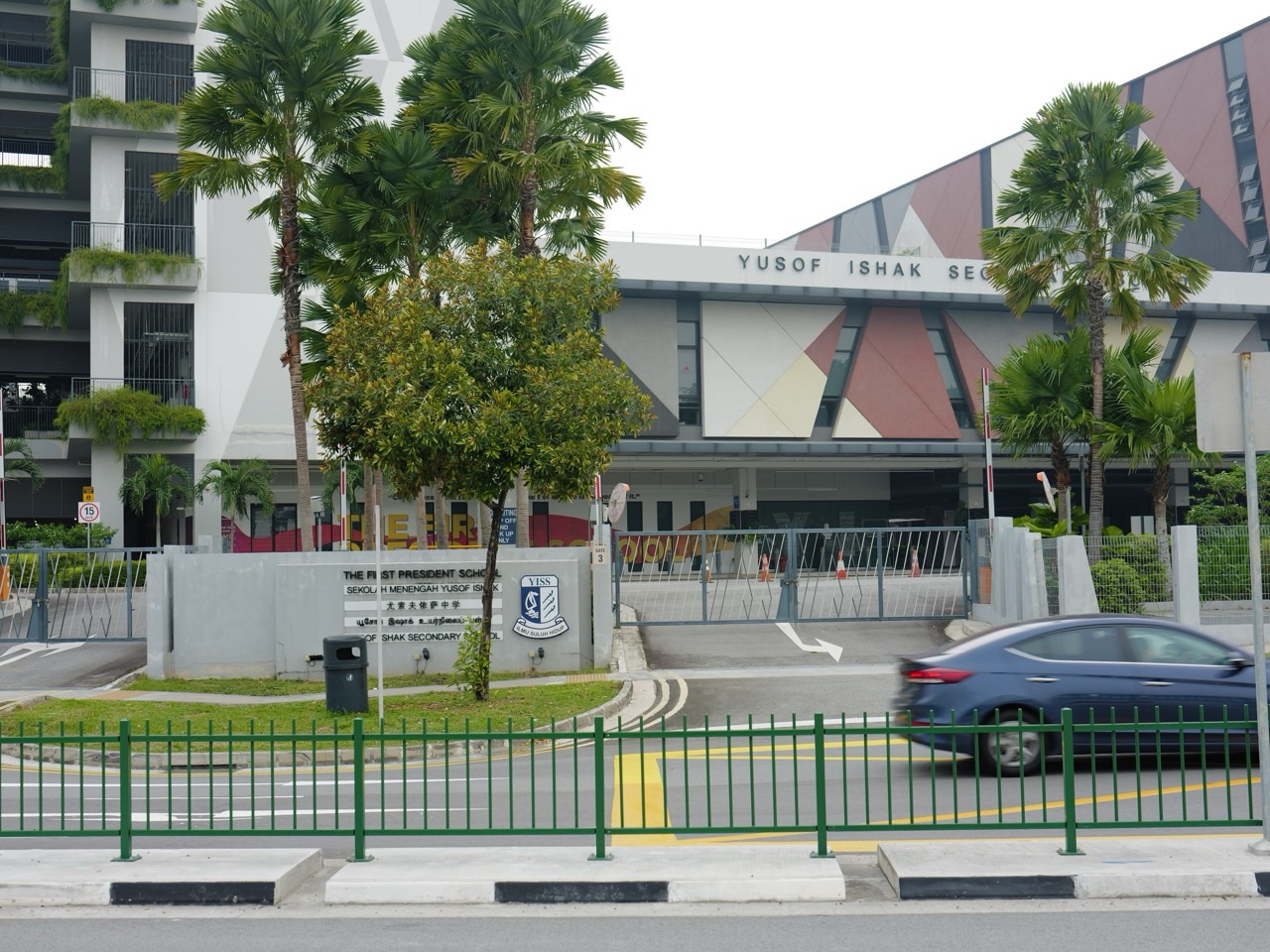
Yusof Ishak Secondary is at 8 Sumang Walk, Singapore 828676. Its smart-city STEM projects and leadership experiences may interest a child who prefers to engage through a shared task before speaking socially. Ask how students are introduced to STEM projects, whether club access requires selection and how a shy pupil obtains help during a complex activity.
For some families in Sumang or western Punggol, this location may also ease the daily journey. For others nearer Oasis, Riviera or Edgedale, the trip could be less convenient. A school that reduces travel stress may help a child conserve energy for new friendships, but travel alone cannot decide the entire choice.
The correct cut-off comparison still matters
Parents must distinguish school atmosphere from formal S1 eligibility. The following figures are historical cut-offs for the completed 2026 Secondary 1 intake, based on the 2025 PSLE, not guaranteed admission figures for 2027. The lower the PSLE Score, the stronger the aggregate PSLE performance; the chosen Posting Group tells you which column matters.
| Punggol school | Past PG3 COP | Past PG2 COP | Past PG1 COP |
|---|---|---|---|
| Edgefield Secondary | 14 | 23 | 27 |
| Greendale Secondary | 16 | 23 | 27 |
| Punggol Secondary | 19 | 24 | 27 |
| Yusof Ishak Secondary | 15 | 22 | 27 |
A quiet pupil with PG3 score 17 might strongly prefer Greendale’s design projects, but Greendale’s previous PG3 endpoint was 16, which was numerically more competitive. Punggol Secondary’s earlier PG3 endpoint was 19 and is historically less stringent than 17. This is not a quality comparison and not a reason to force a school on the child. It means the family can identify genuine preferences while building a balanced six-school list.
A pupil scoring 21 or 22 may be offered a PG2/PG3 choice. That can dramatically change which local schools have historically relevant cut-offs. A score of 25 may offer PG1 or PG2; the local PG1 endpoints of 27 differ from the PG2 endpoints of 22–24. These are academic route decisions to discuss using the official personalised form, not an attempt to label a quiet child as belonging to a particular group.
If the chosen group and score make local schools historically more competitive, expand the research to eligible options in Sengkang, Hougang and other reachable areas. A school beyond Punggol might be a better day-to-day fit than a local school the pupil does not want, but the household should check actual routes and not invent travel times.
Do we need a school where the child already has friends?
One familiar peer can make the first week feel safer. That matters, but it cannot guarantee a school allocation. Friends who choose the same school may be posted differently because they have different eligible scores or choices. Some primary-school friends may also form different class or CCA groups after entering the same secondary school.
A thoughtful response is to ask why that friend matters. Does the child want someone to travel with, someone to eat lunch with, or someone to talk to when nervous? Those needs might be met through a travel buddy, an orientation group, a suitable CCA or a reliable school adult. Do not promise that a particular peer friendship will continue unchanged for four years.
If the child strongly wants to follow a friend to an eligible school, include that preference as one factor alongside the school’s real programme and daily fit. A family should not dismiss friendship, but should not sacrifice all six meaningful school options for an uncertain shared posting.
A school visit that works for a quiet pupil
- Let the child know what the visit will involve rather than arriving without any plan.
- Choose one or two things the child wants to see, such as classrooms, the library, a CCA booth or an example lesson.
- Prepare one simple question in advance, but do not insist that the pupil speak publicly if they are not ready.
- Ask staff how new Secondary 1 pupils settle in, learn routines and find help when confused.
- Distinguish a school-wide ALP or LLP from a selected CCA place.
- Ask about the ordinary timetable and homework feedback rather than only competition trophies.
- After the visit, ask the child for one thing they liked, one concern and one unanswered question.
- Record the actual school journey and discuss whether the route could be completed independently.
The family may be unable to attend an open house because of work or caregiving. That does not disqualify the child from S1 posting. Use the school’s official website, recorded resources and contact channels. A child who finds a crowded open house overwhelming might benefit from looking at quiet school information first and making a more focused enquiry.
The first month: what will help a quiet child adjust?
Before school begins
A predictable morning routine can help. Check the route to the actual assigned school, practise packing the bag, discuss how to find the form teacher and review where to seek help. Choose a comfortable introduction rather than telling the child they must immediately become popular. Set one simple goal for the first week, such as learning two classmates’ names or asking a teacher one question.
During the first week
Ask about concrete moments rather than using only ‘Was school good?’ A question such as ‘Who did you sit with at lunch?’ or ‘Which lesson was easiest to follow?’ may draw a more useful answer. Give the child time to settle before asking for a detailed account. Many pupils need a quiet period after a busy school day.
After the first few weeks
Look for patterns. A pupil may gradually become comfortable, while another continues to struggle with attendance, sleep, loneliness or a particular class. If difficulties persist or intensify, contact the appropriate school personnel and consider qualified support if needed. Avoid labelling ordinary reserved behaviour as failure, but do not ignore sustained distress.
A parent should also protect time for rest, play and non-academic interests. More tuition is not necessarily the solution to school anxiety. If the child has a specific Mathematics or English learning gap, targeted help may be valuable, but confidence also grows through good relationships, manageable expectations and repeated success with daily routines.
When a child is nervous because of academic pace
Under Full Subject-Based Banding, Posting Groups guide the usual starting subject levels; students may take individual subjects at G1, G2 or G3 levels when eligible. A pupil who is strong in Science but needs more time with English should ask the receiving school about actual subject options and support. Avoid telling the child that PG1, PG2 or PG3 permanently defines their intelligence or career.
A parent who worries about the child’s academic confidence should ask how teachers identify specific gaps and what happens when a new pupil falls behind. A child may be afraid of asking questions because they do not know the right words. Role-play a brief help request at home: ‘I understood the first step but not the second. Could you explain it?’ Such a small skill can make classroom participation easier.
For Mathematics, check fluency in fractions, negative numbers, algebra and reading word problems. For English, check comprehension and clear written explanation. Stronger foundations can reduce academic uncertainty regardless of school, but school fit still includes social comfort and travel.
Six preferences: a parent-child method that respects both
| Question | What the parent contributes | What the child contributes |
|---|---|---|
| Which schools can we apply to? | Official PSLE eligibility, correct Posting Group and school conditions | Their preferred learning environments |
| What makes school manageable? | Travel, cost, support and household routine | What feels comfortable or worrying |
| Which activities are meaningful? | Actual school-wide programmes and CCA recruitment rules | Interests they want to explore |
| How should the list be ordered? | A balanced score-range check and deadline | Genuine preference ranking |
| How will we prepare? | School contacts, safe route and practical schedule | Small goals for independence and friendships |
MOE encourages six genuine school preferences and two or three schools whose prior cut-offs were less stringent than the child’s score, where suitable options exist. For a score-17 PG3 pupil, a previous PG3 endpoint of 19 is less stringent; an endpoint of 14 is more stringent. The difference is a historical planning reference, not an admission guarantee or an objective school quality rating.
The ordinary S1 tie-breakers after academic merit include citizenship, school-choice order and computerised balloting where applicable. A first choice does not overcome every better-score applicant, and physical proximity does not itself guarantee a place at a contested school. Rank the schools in the child’s genuine preference order, with realistic alternatives that the child would actually attend.
The 2026 timeline for a calm family decision
| Step | Date or timing |
|---|---|
| PSLE results released | Tuesday, 24 November 2026 at 11.00am |
| S1 Portal opens | 24 November at 11.30am |
| School choice submission closes | Monday, 30 November at 4.30pm |
| Posting result | Tentatively Friday, 18 December; final confirmation to follow |
| Secondary 1 preparation | After actual posting, using receiving-school instructions |
If online submission is difficult, contact the child’s primary school before closing. One parent with valid Singpass normally submits the ordinary S1 choices. A confirmed DSA-Sec case may have separate instructions. The family should not delay a valid submission in the hope that a school will guarantee particular classmates, a specific CCA or a future cut-off.
Frequently asked parent questions
Is the most academically competitive school best for a quiet child?
Not necessarily. A historical COP measures a previous admission outcome, not pastoral support or the child’s comfort. Compare actual teaching, culture, activities, travel and the pupil’s feelings.
Should we choose the nearest school so the pupil is less anxious?
Proximity can make daily routines easier but is not the only factor. A slightly farther school with a clear route and suitable support may also be a good fit. Test actual travel and discuss it with the child.
Will a child who has no friends in a new school settle in?
Many pupils make new connections through orientation, class and CCA activities. It can take time. Ask about the school’s peer support and how pupils can seek help if they feel excluded. Do not promise an immediate friendship outcome.
Does a quiet child need to be pushed into a leadership programme?
No generic rule applies. Leadership, collaboration and speaking skills can develop gradually through suitable opportunities. Ask what choices are available and how teachers support a student who needs time to gain confidence.
Should we select PG2 instead of PG3 because the child is nervous?
Posting Group choice should follow official eligibility, academic readiness and actual school options, not a personality label alone. Where an option band is offered, compare both routes and relevant subject supports carefully.
When should parents seek extra help?
If the child has persistent distress affecting attendance, sleep, relationships or ordinary functioning, speak with trusted school staff and consider qualified professional advice. This article cannot assess an individual child’s condition.
Official sources and related eduKate reading
- SEAB: PSLE 2026 results and Secondary 1 posting timetable
- MOE: Full Subject-Based Banding and secondary school transition
- MOE SchoolFinder: school profiles and previous Posting Group cut-offs
- eduKate Punggol: four local schools, actual programmes and historical COPs
- eduKate Punggol: resolving parent-child school-choice disagreements
- eduKate Punggol: choosing a school based on actual CCA interests
- eduKate Punggol: additional learning needs and support questions
- eduKateSG: Secondary 1 Mathematics transition and small-group support
Final parent move: Ask what makes the child feel able to learn, participate and ask for help. A quiet personality is not something to rank below a school name; a serious difficulty should receive appropriate attention. Confirm eligibility, investigate the actual Punggol school experiences, involve the child in six choices and prepare small, practical steps toward a confident Secondary 1 start.


