
If your Punggol child cannot return to primary school to collect the 2026 PSLE results at 11.00am on Tuesday, 24 November 2026, contact the primary school promptly and follow its collection instructions. The Singapore Examinations and Assessment Board (SEAB) has explicitly said that candidates unable to return may appoint a proxy to collect results on their behalf by Thursday, 26 November 2026. Do not assume that absence on results day cancels your child’s eligibility or extends the separate Secondary 1 school-choice deadline.
Parents still need to read the official result documents and prepare a realistic Secondary 1 application for the 2027 school year. The online S1 Portal opens on 24 November at 11.30am and closes on Monday, 30 November at 4.30pm. One parent with valid Singpass can submit the ordinary school options; a family that needs help with online submission should contact its primary school before closing time. In Punggol, the four mainstream secondary schools to research are Edgefield, Greendale, Punggol Secondary and Yusof Ishak Secondary, along with eligible schools beyond the estate where the child’s score calls for a wider search.
Quick parent summary
• PSLE results: 24 November 2026, Tuesday, 11.00am.
• If the candidate cannot attend, contact the primary school about a proxy; SEAB specifies Thursday, 26 November, as the proxy-arrangement deadline.
• Obtain the actual PSLE Score, subject results and personalised S1 options; do not build the final list from an estimate.
• S1 Portal: opens 24 November at 11.30am, closes 30 November at 4.30pm.
• One parent needs valid Singpass for ordinary online submission; ask the primary school for help if necessary.
• Use the correct PG1, PG2 or PG3 historical cut-offs and six meaningful school preferences.
• A missed collection appointment is different from missing the S1 submission deadline.
The two separate deadlines parents must not confuse
The first is a results-collection arrangement: the 2026 PSLE results are released on Tuesday, 24 November. The official press release explains that individual primary schools will communicate collection details and that a candidate unable to return can appoint a proxy by Thursday, 26 November. The second is the school-choice submission window: 24–30 November, ending at 4.30pm. These are distinct administrative steps, and the household should plan for both.
A parent might be travelling for work, a pupil might be ill, or a household might face a caregiving emergency. The correct first action is to contact the pupil’s own primary school rather than ask an unrelated secondary school to release examination information. Explain that the pupil cannot attend in person, ask what the school needs to authorise the proxy and confirm how the result slip and S1 information can be collected securely.
Do not publish a child’s examination slip, identity number or authorisation details in a public messaging group. The result slip and option information are personal documents. Share them only with people who need them, using the school-approved process. If a relative or trusted adult will collect the documents, make sure that person knows whom to contact at school and that the family has agreed on secure handover.
A simple results-day action sequence
| When | Family action | Why it matters |
|---|---|---|
| Before 24 November | Read the primary school’s own collection notice; arrange contingency contact | Local collection instructions are school-specific |
| 24 November, 11.00am | Collect results in person or work with the school on the authorised alternative | The actual score and subject outcomes replace predictions |
| By 26 November | If absent, settle the proxy arrangement according to SEAB and school guidance | Protects timely access to official documents |
| 24–29 November | Study the personalised S1 route and build six genuine choices | Avoids last-minute, unsuitable school lists |
| By 30 November, 4.30pm | Submit through the S1 Portal or obtain school assistance; retain confirmation | The posting application has a separate closing time |
The family can prepare a list of questions before the release, but it should not finalise school eligibility based on predicted ALs. A child’s total may be different from expectations, and scores 21–22 or 25 can create option-band decisions requiring special attention. Even a one-point difference can change which historical school comparisons are most useful, although no previous COP is a guaranteed 2027 outcome.
What the authorised proxy should ask the primary school
- Which instructions must be followed to appoint or identify the proxy for this particular school?
- What identification or authorisation does the school require? Follow the school’s answer rather than uploading documents to an unofficial website.
- Where and when should the authorised person report, and whom should they ask for?
- Will the package include the result slip, examination certificate and personalised Secondary 1 option information?
- How will the school handle a collection difficulty if the child remains unwell or is overseas?
- Whom can the parent contact for clarification about Posting Group eligibility or online school-choice submission?
- How should any original documents be handed over securely to the parent?
This checklist is deliberately not a fabricated national proxy form. SEAB has announced the proxy option, while the candidate’s primary school provides the practical collection arrangements. A school may require a particular request method or evidence. Confirm directly rather than relying on a forwarded screenshot. If the school is temporarily unreachable, use its official published contact details and keep a record of the enquiry.
What if the parent is overseas or working shifts?
The parent may be unable to stand at a primary-school gate at 11.00am even when the child is in Singapore. Start with the school: ask whether the child can collect directly under the school’s normal process, or whether an approved proxy is needed. A family should not assume that every adult in the household can automatically collect a controlled examination document without authorisation. Arrange for an approved adult and secure transfer of the documents.
For the S1 Portal, SEAB says only one parent needs a valid Singpass login. This is about submitting school choices; it is not a replacement for following the school’s official results-collection instructions. If the parent cannot access Singpass, should not use another person’s credentials or has technical difficulty, contact the child’s primary school before the S1 deadline. Do not share passwords or one-time codes with a relative or an informal helper.
Families with separated caregiving responsibilities or households in which a grandparent usually accompanies the child should decide in advance which authorised adult will obtain the documents and which parent will complete the portal submission. The school, not this article, can advise on any unusual authorisation issue. A calm plan is easier for the pupil than having adults argue over access at the last moment.
Once the result arrives: read three different pieces of information
1. The four subject Achievement Levels
The individual results in English, Mathematics, Science and Mother Tongue explain more about a child’s learning profile than a total alone. A pupil might have strong Mathematics reasoning but need help reading long English explanations. Another might be confident in language but find multi-step calculations difficult. These distinctions are useful for selecting a school with appropriate subject-level opportunities and academic support.
2. The overall PSLE Score
The PSLE total is formed from the relevant subject Achievement Levels. In the ordinary scoring interpretation, a smaller numerical total represents stronger aggregate performance. That is why a school with a past PG3 cut-off of 14 was historically more selective than one with a past PG3 cut-off of 19. Do not confuse the PSLE Score with a percentage mark or assume that a previous school number is a 2027 promise.
3. The personalised S1 Posting Group options
The child’s actual option information controls which school route is available. The usual score-to-group pattern is shown below for orientation, but a special case or Foundation-subject combination must be checked against the child’s official records. If the school documents differ from a generic online chart, follow the personalised instructions and ask the primary school for help.
| PSLE Score | Usual posting implication | What the parent checks |
|---|---|---|
| 4–20 | PG3 | Compare PG3 school ranges |
| 21–22 | Option band: PG2 or PG3 | Consider the two routes, choose one for six ordinary preferences |
| 23–24 | PG2 | Compare PG2 historical ranges |
| 25 | Option band: PG1 or PG2 | Compare the actual school lists and initial subject pace |
| 26–30 | PG1 subject to English and Mathematics eligibility conditions | Check individual ALs and personal form |
| 31–32 or unusual case | Do not assume ordinary PG1 | Seek the primary school’s authorised pathway advice |
The chosen Posting Group ordinarily applies across all six mainstream school choices. It does not mean the child must permanently study every subject at the same level. Under Full Subject-Based Banding, individual subjects may be studied at G1, G2 or G3 levels when the student meets the applicable criteria. Families can discuss individual academic strengths with the receiving school later.
The four Punggol secondary schools: historical score reference
For the completed 2026 Secondary 1 intake, based on PSLE 2025, the four Punggol mainstream schools had the following historical final admitted totals. The figures are confirmed in the local school comparison and should be rechecked against current MOE SchoolFinder profiles before applying. They are not the future 2027 cut-offs.
| Punggol school | Past PG3 COP | Past PG2 COP | Past PG1 COP |
|---|---|---|---|
| Edgefield Secondary | 14 | 23 | 27 |
| Greendale Secondary | 16 | 23 | 27 |
| Punggol Secondary | 19 | 24 | 27 |
| Yusof Ishak Secondary | 15 | 22 | 27 |
A PG3 child who scores 16 has a different historical comparison from a PG3 child who scores 20. At 16, Greendale was at the earlier PG3 endpoint, Punggol Secondary’s 19 was less stringent and Edgefield’s 14 was more competitive. At 20, none of the four local PG3 endpoints was numerically less stringent than the child’s score. The family should widen the research to schools in Sengkang, Hougang and other reachable areas instead of filling a six-choice list with only historically ambitious local schools.
For a pupil with PG2 score 24, Punggol Secondary’s earlier PG2 endpoint was 24, while Edgefield and Greendale were 23 and Yusof Ishak was 22. That is not four equally strong backup options. The family’s final list should contain schools it genuinely likes, with a balanced historical range wherever suitable options exist. A collection delay must not become an excuse to rely on generic, mismatched cut-off lists.
A brief school-finder checklist for Punggol families
Edgefield Secondary
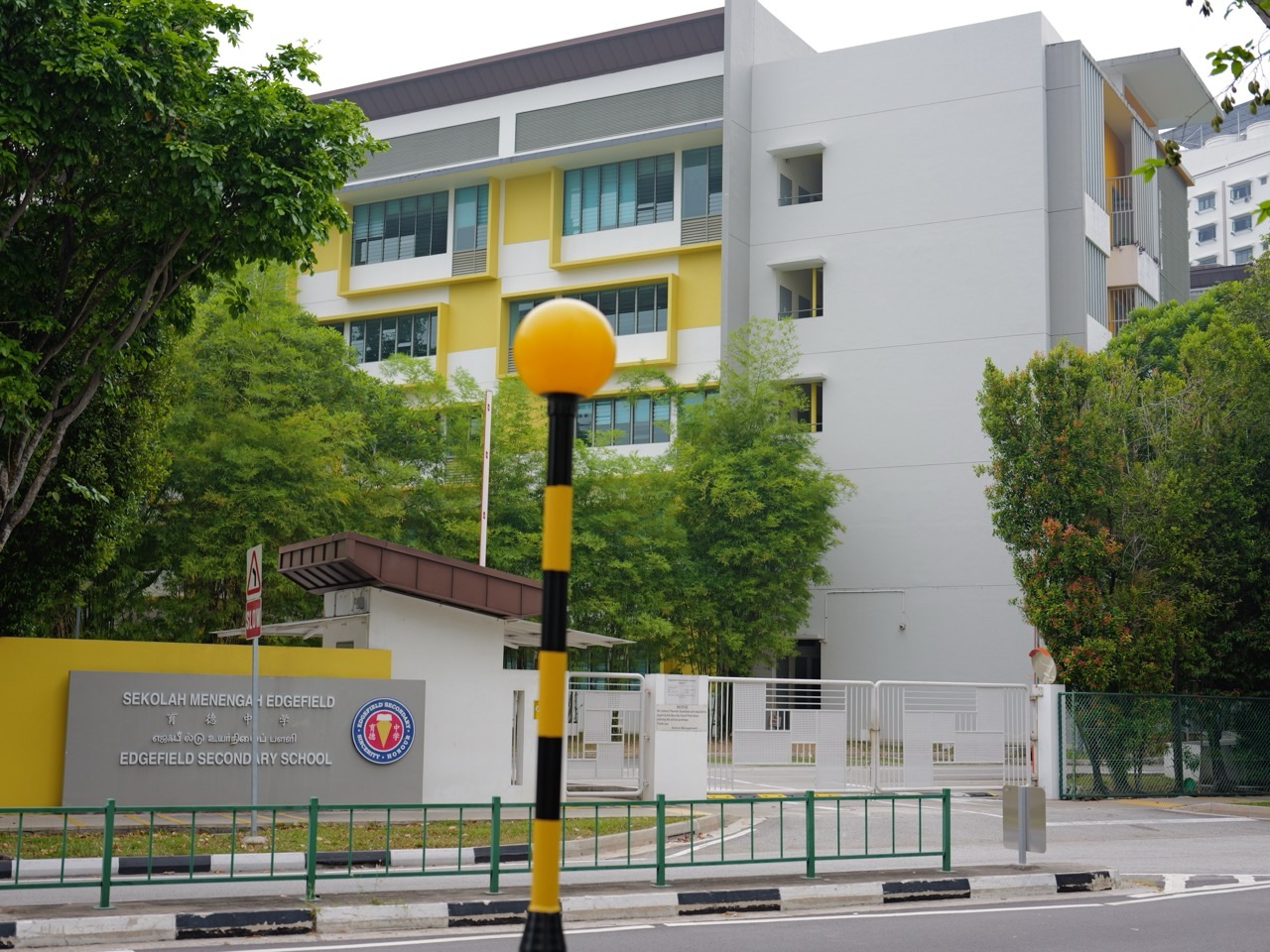
Edgefield Secondary at 36 Punggol Field focuses on initiative, enterprise and collaborative learning through its Growing the Edgefield Mindset approach, with sport-based character learning. Ask how ordinary Secondary 1 students take part, which subject supports are available and whether a specific CCA requires selection. Do not choose the school solely because it is visible from the family’s HDB block.
Greendale Secondary
Greendale at 51 Edgedale Plains has design, technology and engineering experiences, alongside outdoor adventure. A child who enjoys coding, building or practical problems may find these motivating. Confirm the actual current programme, student support and after-CCA journey. The ALP is not an automatic guarantee of a robotics CCA place.
Punggol Secondary
Punggol Secondary at 51 Edgefield Plains highlights sustainability, environment and youth leadership. Parents may explore how its activities develop science and communication skills. A previous score of 19 in PG3 or 24 in PG2 should be treated as a historic admission outcome, never a measurement of the child’s future potential or the school’s quality.
Yusof Ishak Secondary
Yusof Ishak at 8 Sumang Walk highlights smart-city STEM, sustainability and student leadership. It may be convenient for some western Punggol households. Families should test the actual route and ask whether the pupil’s individual subject-level options and interests are well served. A score near its old COP is not a promised place.
How to make the six-school list when you are short on time
- Write down the child’s official score, individual ALs and eligible Posting Group options.
- Use SchoolFinder for each school’s current type, programmes and the correct historical COP column.
- Ask the child which school environment, activities and teaching approach they actually prefer.
- Check real school-day travel, not only straight-line distance from a Punggol map.
- Use a separate draft list for each offered Posting Group option before choosing one route.
- Include two or three suitable schools with previous cut-offs less stringent than the child’s score where feasible, following MOE’s guidance.
- Arrange six schools in genuine preference order, checking any school codes or specific admission conditions.
- Submit through the official S1 Portal with the authorised parent and save the confirmation.
Academic merit is the first principle of the ordinary S1 allocation, followed by the applicable tie-breakers for equal-score competition: citizenship, school-choice order and computerised balloting. Living next to a secondary school does not normally provide extra priority in that main comparison. A historically less stringent school may be a sensible part of a balanced list, but it must still be somewhere the child can reasonably attend.
If the family is struggling to prepare a complete list, its primary school is the appropriate first contact. Staff can direct the family to official procedures and relevant school information. It is better to seek school assistance before the deadline than to leave the final submission until the last minutes.
What if the result is not what the child hoped?
A difficult result does not become less important because a proxy collects it. The child may still feel disappointed or anxious about missing friends. The parent should communicate the result privately, without dramatic comparisons with relatives or classmates, and concentrate on the next decisions: what schools are available, which route suits the pupil and what practical support will help.
Ask what concerns the child most. For some, it is a particular school name. For others, it is changing friendships, an unfamiliar journey or worry about English and Mathematics. The adult should handle the paperwork and technical rules while giving the child a genuine role in choosing a setting where they can learn and settle in.
Tuition is not automatically required because a result was collected by a proxy, because a score disappointed a family or because the child enters PG1 or PG2. Identify any particular learning gaps and ask the receiving school about support. A focused reading or numeracy plan may be more valuable than an overloaded holiday schedule.
The date after submission: receiving the posting result
The 17 November 2026 SEAB announcement says the S1 Posting Results are tentatively expected on Friday, 18 December 2026, with an update to follow. It lists the S1 Portal, SMS through a provided local mobile number and the pupil’s primary school as channels for obtaining the outcome. Parents should wait for the confirmed date rather than treat tentative timing as a promise.
After the school is confirmed, follow that secondary school’s registration, reporting, booklist, uniform and school-day instructions. Some families may need to contact the receiving school about illness or an inability to report on the first day. That is a different issue from results collection and should be dealt with through the school actually assigned, not assumed in advance.
Frequently asked questions
Can a parent collect a child’s PSLE results instead of the child?
SEAB has announced a proxy collection arrangement for candidates who cannot return to school. The precise collection and authorisation requirements come from the child’s primary school. Contact it directly rather than assuming every adult can turn up without notice.
What is the proxy deadline for 2026?
The official release states that candidates unable to return may appoint a proxy to collect their results on their behalf by Thursday, 26 November 2026. Confirm how the school implements that arrangement.
Does missing 24 November give us extra days to submit schools?
No automatic extension is stated. The announced S1 submission deadline remains 30 November at 4.30pm. Contact the primary school promptly if the family cannot access the documents or online system.
Can a grandparent use the parent’s Singpass password?
Do not share Singpass credentials or one-time codes. The official release says one parent with valid Singpass can submit; families needing help should contact their primary school for proper assistance.
What if we have only two or three possible Punggol schools?
The ordinary preference form allows six choices. Use SchoolFinder to look beyond the town to eligible schools in neighbouring estates, comparing historical COPs, fit and practical travel. Do not invent a place at a school whose correct Posting Group range is substantially more competitive.
Can the school tell us the 2027 admission cut-off on result day?
No reliable final 2027-entry COP exists until after the current posting exercise. The completed 2026-intake values are historical references only.
Official and eduKate source links
- SEAB official 17 November 2026 release: results, proxy, six-school guidance, portal and posting dates
- SEAB: what the PSLE result slip and examination certificate contain
- MOE: Secondary 1 Posting and S1 Portal
- MOE SchoolFinder: group-specific historical score ranges and school details
- eduKate Punggol: the four local secondary schools and historical COPs
- eduKate Punggol: whether to list all four local schools in six choices
- eduKateSG: immutable Secondary 1 Mathematics learning transition reference
Parent conclusion: Missing the school collection ceremony need not mean missing the child’s educational next step. Contact the primary school for the official proxy procedure, obtain the real result and eligibility, build six choices grounded in the correct Posting Group, and submit before 30 November at 4.30pm. Protect the child’s privacy and focus on a supportive Secondary 1 transition rather than on the circumstances of collecting the slip.


