
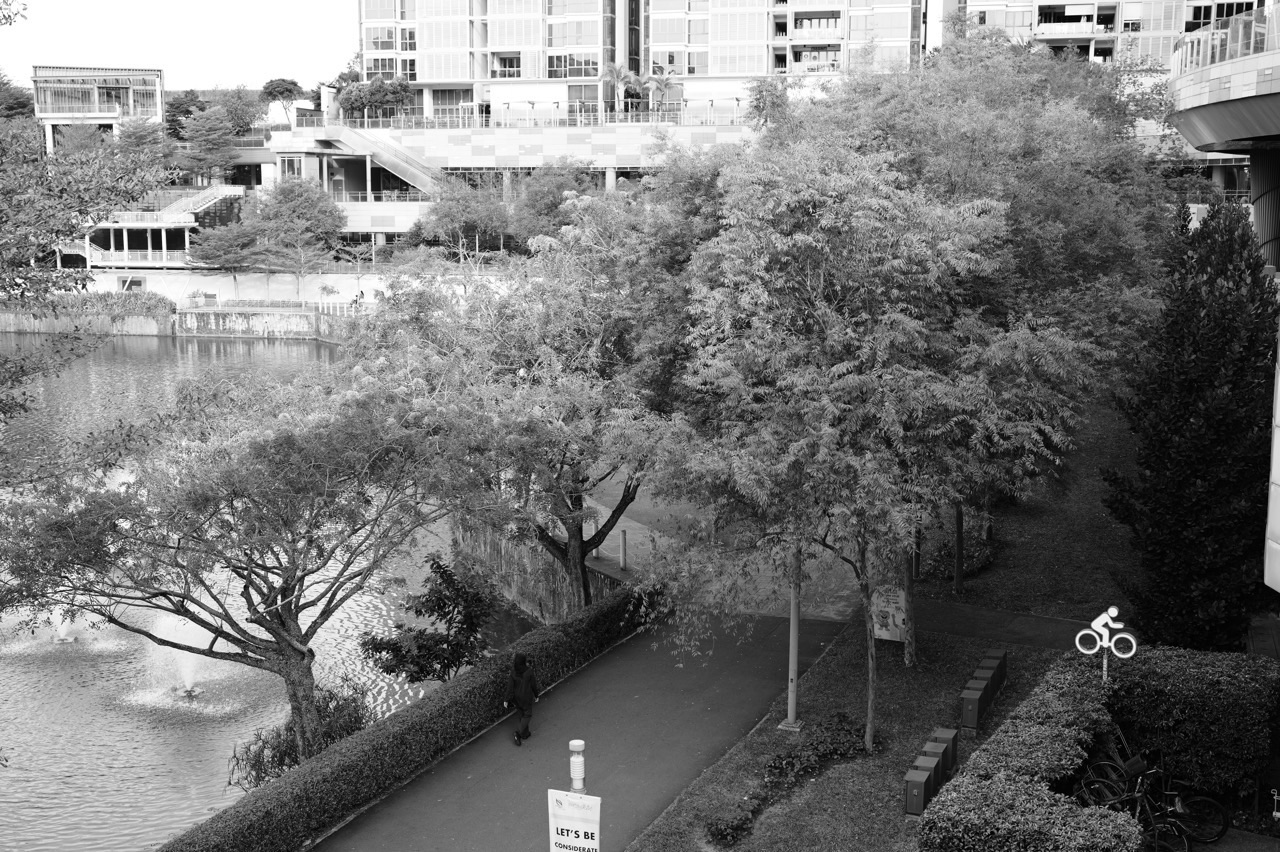
What to do in Punggol when a family wants a simple outdoor learning activity that does not involve collecting plants, touching wildlife or buying a gadget? Make a ten-minute soundscape map from a permitted, safe place. Listen, notice where ordinary sounds seem to come from, and sketch their approximate direction around a central mark representing the listener. The activity turns a familiar waterway or neighbourhood stop into a lesson about observation, attention, language and the limits of what one sense can establish.
Punggol Waterway Park offers a useful setting because the National Parks Board describes it as a public park on the North Eastern Riverine Loop, with nature-walk and recreation areas running through Punggol Town. Its official guidance supports enjoying nature while leaving wildlife undisturbed. You do not need to record audio or identify a bird from one unfamiliar call. A sound’s apparent direction is an observation; a claim about the exact animal, machinery or person producing it may require evidence you do not have.
This is a supervised ten-minute exercise, not a scientific noise survey, an official acoustic map, a verified wildlife census or a reason to listen to private conversations. The family can complete it from home or another legitimate public area. Choose a comfortable place, remain outside restricted or dangerous locations, follow current weather and path guidance, avoid recording identifiable strangers, and stop if anyone becomes uncomfortable.
The six-step ten-minute soundscape plan
- Choose an authorised safe listening spot away from roads, moving bicycles and water edges.
- Set a short observation window of about ten minutes, with breaks whenever needed.
- Draw a centre point for the listener and mark rough directions, not exact coordinates.
- List only sounds actually noticed, using neutral labels such as footsteps or distant traffic.
- Mark changes over time without pretending to measure decibels or identify hidden sources.
- Compare the sketch with a partner’s interpretation and record what remains uncertain.
Why the soundscape is different from a nature walk
A nature walk often begins with what the eyes can see. A soundscape exercise asks the listener to notice the layers of activity surrounding a place: perhaps leaves moving, a distant vehicle, footsteps or a short bird call. The sounds may help people appreciate how a neighbourhood is shared, but they do not automatically explain the history or physical source of every noise.
Set an observation goal that can be completed in one place. For example, identify three distinct kinds of sound and describe their apparent directions. A child does not need to cover the full park or find a rare species. Careful listening and honest description can be more useful than collecting as many names as possible.
Choose a location that is legitimate and comfortable
NParks identifies Punggol Waterway Park as an open public park with themed areas including Nature Cove and the Green Gallery. A family can select an ordinary permitted rest point along a public route, taking care not to obstruct pedestrians or cyclists. Choose shade and access that meet the participants’ needs instead of seeking the most isolated location.
A similar activity can be completed in a private living room with the family’s permission. That alternative is valuable during rain, high heat or when somebody prefers lower sensory stimulation. The method depends on attending to sound, not on claiming that one particular public venue is scientifically superior.
An ordinary park location is not a reserved classroom
A bench or public seating area may be shared with other visitors. Do not claim it as a private teaching station, move fixed furniture or block a path while drawing. If other people need the space, the family can finish standing safely or choose another permitted spot. Respect for the space is part of the activity.
Parents should not ask bystanders to be silent so the child can hear nature more clearly. Public places naturally contain multiple activities. The observations become interesting precisely because the family can distinguish sources without controlling everybody else’s behaviour.
A ten-minute boundary prevents an endless survey
Choose a manageable start and end. Ten minutes is a teaching suggestion rather than a prescribed scientific sample length. If a young child can focus for four minutes, the observation can be shorter. If an older student wants to repeat the task later, treat the later period as another sample instead of extending the first without record.
Do not assume ten minutes represents a park’s average daily sound environment. Traffic, birds, maintenance and visitors can change throughout the day. The resulting map is a dated snapshot of one listener’s experience, and this limitation should accompany any conclusion.
The central point represents the listener
Place a dot at the centre of a paper circle and label it ‘where I listened’. The dot is a simple reference point, not a GPS reading or a publicly disclosed home location. Around it, the learner can place symbols for sounds that seemed to come from different directions.
A sound’s position should be described as approximate. Reflections from buildings and water, changing movement and hearing differences can complicate direction. Do not turn a hand-drawn mark into a precise measurement. If the direction is unclear, write ‘uncertain’ or use a broader region.
Agree on a simple symbol key
Use a small number of marks: a short curved line for traffic, a leaf for rustling foliage, a note for an unidentified call and a footprint for walking. The exact drawings are less important than explaining what each one means. A shared key helps another reader interpret the map without guessing.
Do not force every sound into a nature category. The sound of a rolling trolley or an LRT can be part of the observed environment. If the learner cannot confidently distinguish footsteps from another rhythmic sound, label it ‘repeated taps’ rather than fabricate the source.
Begin with broad sound categories
A simple first classification is natural, human activity and machinery or transport. These headings help a learner group observations, but their boundaries are not perfect. A human voice is biological and human-related; a moving branch could have been disturbed by an animal or wind.
Treat the headings as an organisational aid rather than a scientific taxonomy. What matters is recording the audible feature before deciding on its likely cause. A statement such as ‘brief high-pitched call’ can remain useful even when the source category is uncertain.
Do not identify birds from a single unknown call
NParks advises birdwatchers to observe without disturbing wildlife and specifically warns against playing bird calls because playback can cause stress. A soundmap needs no playback device. If a call is unfamiliar, write down its rhythm or rough direction instead of trying to lure the bird closer.
A bird species identification may require a reliable sighting, experienced knowledge or appropriate reference material. Do not post a supposed nesting location online simply to seek confirmation. The soundscape exercise is about listening ethically, not making a rare-species claim.
Keep wildlife and nesting locations private
Even a genuine wildlife sound may come from an area where animals rest, feed or nest. The family should not pursue it into planted areas, climb a fence or identify a concealed location on a publicly shared map. NParks advises giving wildlife space and not sharing nesting bird locations.
Use a general description such as ‘bird calls heard from vegetation’ without a precise pin. A learner can explain the type of sound and the reason for uncertainty. That protects both habitat and the integrity of the observation.
A loud noise does not identify its source
A sudden metallic sound might come from construction, a vehicle, maintenance or something else. The listener may know only that it was brief and metallic. Recording ‘construction accident’ or ‘dangerous machinery’ without supporting evidence turns an observation into an alarming unsupported claim.
Separate the sound from your hypothesis. You might write: ‘one short metallic impact from beyond the visible path; source not identified.’ If there is a genuine safety concern, follow the appropriate staff or authority response rather than conducting an independent investigation.
Sound levels are not decibel measurements
Words such as loud, soft, close and distant describe a listener’s impression. A decibel reading requires suitable measuring equipment, an appropriate method and interpretation. An ordinary mobile phone’s casual reading should not be passed off as an official calibrated measurement of neighbourhood noise.
A child can still compare perceived loudness honestly: one sound dominated the short interval, while another was barely audible. Say what the listener experienced rather than assign a fabricated numeric value. The map remains a descriptive learning artefact.
A quiet moment does not prove a permanently quiet place
At one moment, the family may hear little traffic. Ten minutes later, a maintenance vehicle or another group may pass. Neither observation establishes what normally happens at every hour. A map should name its observation period rather than claim a fixed property of the location.
If the household wants to compare busy and quiet periods, repeat the same simple method at two appropriate times and label the samples separately. Do not average subjective impressions into a precise acoustic rating or rank neighbourhoods without reliable data.
Distinguish human speech from private content
Voices may be audible in a public place, but a soundscape project does not require listening to conversations or writing down somebody’s words. ‘Distant conversation from the seating area’ is enough. Do not identify individuals, record phone calls or publish a child’s overheard private information.
This is both a privacy boundary and a methodological improvement. The task is to understand the arrangement of sound sources in a shared space, not to learn what strangers are discussing. The family should redirect attention if the exercise begins intruding on people.
No recording is needed
A pencil and small notebook are sufficient. Audio recordings can include identifiable conversations, personal information and other content the family never intended to collect. Avoiding recording reduces these concerns while still allowing strong observations about rhythm, direction and changes over time.
If someone later wants to create a real sound recording for a separate purpose, they should assess applicable law, venue rules and consent. That is outside this beginner exercise. Do not describe an unrecorded soundmap as a verified audio archive.
Do not point a camera at listeners or strangers
Photographs are optional and often unnecessary. A public-space image may reveal people’s faces, routines or exact location. The family can draw a simple abstract map instead, keeping the observation independent of identifying visual details.
A parent can take a photograph of the child’s own sketch after the activity if they have the necessary permission and have checked that no private information is displayed. A good lesson does not need a social-media post to prove it took place.
Punggol’s paths are shared with moving users
Waterway and park connector routes can contain runners, children and cyclists. The family’s stationary observation should take place outside the movement flow. Do not stand in a cycling lane while trying to hear a distant bird over a passing bicycle bell.
NParks’ park connector etiquette asks users to respect shared access and respond carefully near crossing or attention zones. A soundmap never takes priority over the immediate safety of other path users. If the spot becomes crowded, stop and relocate safely.
Do not approach the water edge to hear more
Water moving against a bank may be interesting, but there is no need to climb a railing, lean over a slope or enter a drainage channel. Listen from an established safe public route. The learner can record ‘water-like sound, source uncertain’ if the sound cannot be clearly located.
The purpose is observation, not collecting evidence that requires dangerous proximity. Weather and water conditions can change. A parent should choose a safe viewpoint and abandon the exercise if the place becomes unsuitable.
Weather changes what the family hears
Wind can move leaves, rain can mask other sounds, and thunder should trigger appropriate safety action rather than curiosity about a sound source. An observation note may include weather as contextual information where genuinely observed or checked through a legitimate forecast.
Do not remain outside during lightning or a severe weather warning to complete ten minutes. Use current Meteorological Service Singapore and NParks guidance for outdoor plans. A safe unfinished notebook is better than a complete hazardous activity.
Shade and hydration matter to a listening task
A stationary activity can involve more time under sun exposure than a short walk. Choose a suitable shaded location, take breaks and use ordinary heat-safety precautions. The official UV advisory discusses protecting skin and eyes, particularly during high-UV periods.
Do not ask a child to stand motionless in direct sun to improve concentration. If shade is unavailable or someone is uncomfortable, move or finish at home. The exercise can support wellbeing without requiring any particular exposure level.
Use headphones only when the context is appropriate
Soundmapping generally benefits from hearing the real surroundings, but there is no need to amplify street noise or wear headphones that isolate the listener from cyclists and vehicles. A family should remain alert to ordinary safety cues and communicate comfortably.
Do not play bird sounds to elicit responses, and do not create loud sounds as test signals. The exercise is observational. A device may help with notes, but it should not turn the activity into a sound source that disrupts visitors or wildlife.
A child should have a clear adult role
An accompanying adult chooses the listening location and handles route, weather and safety decisions. The child can choose symbols, write descriptions and ask questions. A younger participant should not be sent behind bushes or across a road to identify a noise.
Explain the boundary before beginning: ‘We stay here, listen without following sounds, and stop if we need to move.’ This makes it easier for a child to explore independently within a safe supervised activity rather than treating curiosity as permission to chase every new sound.
Respect people with different listening experiences
People may hear different frequencies, process sound differently or find certain environments uncomfortable. One family member might notice a low hum that another misses. That difference is not a test failure and should not be used to diagnose a hearing condition.
Ask what kind of participation works for the person. Someone may prefer observing through vibration, visible motion or written descriptions, or may decline a listening exercise altogether. The activity’s goal is respectful awareness, not declaring whose senses are better.
An accessible alternative is a shared description
If a person cannot comfortably hear a sound, another participant can give a brief neutral description with consent, while the person chooses whether and how to contribute. The map can use a label such as ‘reported by my companion’ rather than pretending the learner personally heard it.
This preserves source accuracy and makes the activity more inclusive. No one must reveal a diagnosis or take part in a simulation of someone else’s disability. The family can work together while being truthful about where each observation came from.
Record rhythm before guessing a source
Some sounds repeat steadily, some arrive in bursts, and others occur only once. A child can write ‘three quick taps’ or ‘a continuous low sound’ without knowing the source. Rhythm is observable and can help distinguish sounds that are easy to confuse.
Do not make the notation more complicated than the learner can use. A few words and marks are enough. The aim is communicating the observation to another reader, not producing formal music notation or an electronic signal analysis.
Near and far are impressions, not measured distances
A passing person’s footsteps might sound nearer than a low train rumble, but buildings, vegetation, volume and echoes can affect perception. The sketch should use approximate labels such as near, middle and distant rather than invent exact distances in metres.
An older student can discuss why a loud distant source may sound nearer than a quiet one. That becomes a good science question, but the family should not convert its rough classifications into precise measurements without the appropriate method.
The difference between direction and location
An arrow on the soundmap expresses the direction a sound seemed to come from during the observation. It is not proof of where the source was physically located. A sound can reflect from a wall, move during the interval or arrive from behind an obstacle.
Write ‘seemed to come from the right’ where the evidence is uncertain. If a source is visually confirmed and identification is relevant, record that separately. Separating perceived direction from verified location prevents the drawing from becoming a false geographical map.
Make the key easy for another person to read
A soundmap may contain arrows, marks and initials that only the author understands. Add a small key and one sentence explaining what the central point represents. The test is whether another person can interpret the record without a long private explanation.
A map that uses one symbol for both birds and traffic may be pretty but unclear. A child can repair it by choosing distinct shapes or written labels. More colours and decorations are optional; clarity and accuracy matter more than appearance.
Worked example: a fictional park bench
Imagine a learner sitting at a permitted bench. They notice occasional footsteps to the left, a sustained low sound in the distance and a brief high-pitched call from vegetation. They mark three regions around a central dot and note that the source of the low sound is unknown.
A weak description might announce that rare birds were calling and a factory was polluting the park. The observations do not support those claims. A stronger one is: ‘I heard a brief call on the right and a low distant sound from beyond the path; I could not identify either source.’ This fictional example demonstrates restraint.
Worked example: an ordinary transport-edge setting
A family may hear train-related sounds near a legitimate public route, alongside conversation and footsteps. The map can describe the rhythm or apparent movement without identifying a specific train model, technical fault or exact decibel level.
Do not stand at platform edges, behind station barriers or near a busy crossing to improve the observation. Transportation safety and operator rules always come first. The family can choose a quieter permitted location and still notice how transport is part of the neighbourhood’s soundscape.
Worked example: a home window
A child completes the exercise from an appropriate indoor area, hearing a fan, voices from their own household and distant traffic. The central dot represents the listening place, while the labels distinguish continuous household sound from irregular outdoor sound.
Do not lean out of a high-rise window or open a safety fitting. Do not attempt to identify neighbours from what is heard through walls. Home listening may be easier to manage because the adults can control privacy and comfort without creating a public disturbance.
Worked example: a rainy afternoon indoors
Rain against a window, a low mechanical hum and footsteps inside the home can form a useful comparison with a sunny-day record. The learner notes the indoor location and approximate time and explains that rain may have masked sounds they heard previously.
The family should not conclude that the neighbourhood became inherently quieter or that traffic vanished. Changed conditions can alter audibility. A clear contextual note is stronger than a dramatic claim about the place based on one short sample.
A simple comparison between two listeners
Two people can make independent maps from the same safe place and compare them afterwards. They may label the same sound differently or notice different events. Ask what each person actually heard before deciding whether either map is wrong.
This exercise teaches that observation involves attention, interpretation and uncertainty. Do not force agreement by telling one participant that the other’s hearing must be better. A second round may clarify a difference, but a legitimate result can also be that the source remains unknown.
Primary English learning: verbs and position
The exercise gives children a reason to use verbs such as rustles, hums, clicks, passes and fades, together with near, behind and to the left. Ask the learner to write three sentences that position sound relative to the listening point.
Do not reward unusual vocabulary that the child cannot explain. ‘A short tapping sound came from behind us’ is better than an elaborate description with the wrong direction. Understanding and useful sentence order are the intended outcomes.
Primary Science learning: sources and evidence
A younger learner can sort notes into natural, human and transport-related sounds, then mark a question beside uncertain sources. Ask which details were heard and which were guessed. An accurate unknown is a valid science observation.
Do not turn the activity into species identification, machinery inspection or a wildlife chase. The child can learn that sounds carry information while accepting that one sense may not prove the complete cause. This is foundational scientific reasoning in a low-risk setting.
Secondary Science learning: sampling limitations
A secondary student can compare a ten-minute soundmap with another one made at a different time. The two samples may differ because of weather, activity, observer position or simple chance. Ask which variables changed and which were kept reasonably similar.
Do not compute a neighbourhood noise average from drawings or label the difference statistically significant without proper data. Instead, write a conditional conclusion: ‘More footsteps were noted during the second observation, but two short periods cannot establish a daily pattern.’
Geography learning: shared urban space
The family can ask how paths, greenery, transport connections and places to sit contribute to the sounds heard at a chosen permitted point. A map of nearby public features from OneMap may supply general context, but it does not identify an unseen noise source automatically.
Do not infer land ownership, working hours or a business’s operation from the soundmap. A place can contain multiple nearby sources. The activity becomes a stronger geography lesson when the learner explains what the spatial sketch does and does not establish.
Mathematics learning without false measurement
A child may count how many times a particular sound was noted, or make a simple frequency table of descriptive categories. This is counting observations, not counting all sounds in the environment. Many overlapping sounds may go unnoticed.
An older learner can calculate the proportion of notes assigned to a category but should state that the denominator is the recorded notes, not all acoustic events. A precise percentage derived from incomplete subjective observations can mislead if its meaning is not explained.
A source of sound is not always a nuisance
One person may enjoy bird calls while another finds a nearby repetitive sound tiring. The same sound may be relevant to a place’s character and a person’s comfort in different ways. The soundmap does not have to rank sounds as good or bad.
Allow participants to give their own responses, then separate the feeling from the observation. ‘I found the repeated noise distracting’ is an honest personal statement. ‘This whole park is unsuitable for everyone’ is a much broader claim the observation cannot support.
A soundmap is not a noise complaint
A descriptive record does not establish that a sound violates legal noise limits or that a particular organisation is responsible. Official noise assessment and complaint routes have their own categories and evidence needs. If a resident has a genuine persistent concern, they should identify the correct responsible authority separately.
Do not post allegations about named neighbours or construction workers based solely on a rough arrow and one perceived noise. This activity is designed for observation and explanation. A real public-safety or nuisance issue deserves the proper factual reporting process.
Avoid turning the exercise into surveillance
The family should not repeatedly observe the same private dwelling to infer who comes home, whether someone is away or what conversations occur inside. Those are not necessary to understand a public sound environment and may intrude on people’s privacy.
Choose general sources such as traffic and foliage rather than named households. Keep precise private locations out of publicly shared sketches. A good community learning activity leaves other residents free to enjoy ordinary life.
The role of pauses and silence
A learner may notice that one sound ends before another begins, or that an interval feels quiet after a loud event. Record that sequence without treating silence as complete absence of sound. Your hearing and attention have limits.
Use the notebook to mark change: repeated, intermittent, fading or continuous. These words help organise time in the same way near and far organise space. The result can remain simple and readable without an audio waveform.
Build one clear paragraph from the sketch
Begin with the chosen spot and time, then name the most noticeable sound and its apparent direction. Add one or two other sources in a logical sequence. Finish with a sentence explaining uncertainty or a change over the interval.
An example might be: ‘During a short supervised observation beside a public path, footsteps were heard nearby and a low continuous sound seemed to come from farther away. A short call interrupted them once. The source of the call was not verified.’ The pattern is more useful than an exhaustive poetic catalogue.
A checklist for truthful public sharing
Before sharing a family soundmap, remove private addresses, identifiable conversations, nesting locations and unsupported labels. State that it represents one short observation at an approximate time. Include the symbol key and distinguish heard sounds from inferred sources.
Do not present the image as an NParks assessment or an official acoustic survey. A family’s handmade sketch can be valuable as an original learning artefact precisely because its scope is clear. Respect other people’s information and public-space rules.
The most useful second attempt
On another suitable day, use the same symbols at a permitted and comparable location, then ask how the soundscape changed. Perhaps the learner notices a source they previously overlooked or becomes better at describing direction. Record the change in method alongside any change in sound.
Do not pretend improvement means hearing more events every time. A better observer may produce fewer labels because they have stopped guessing. The outcome is careful, explainable attention and a small map that another person can understand.
Continue exploring Punggol
These companion guides cover three different practical Punggol activities. Check the relevant official sources and current conditions before using their information for a real decision.
- Read a Construction Notice Without Mistaking Work Dates for Opening Dates
- Compare a Refrigerator Energy Label Without Mistaking Ticks for Dollars
- Compare Path Shade Safely Without Looking at the Sun
Related Punggol learning activities
Explore these three other original Punggol family activities. Each has a separate learning goal and explains why its own observations must not be mistaken for official reports or live access guarantees.
- Try One Accessible Reading Format at the Regional Library
- Test a Public Direction Sign’s Clarity on Paper
- Draw One Living Leaf Without Picking It or Guessing Its Species
Frequently asked questions
Do I need to record the sounds?
No. A paper soundmap uses listening and simple labels without recording strangers, private speech or wildlife.
Where can a Punggol family try it?
An ordinary permitted, safe location in Punggol Waterway Park or a suitable indoor household setting. Follow current access and safety conditions.
Is the map a calibrated sound survey?
No. It is a short subjective observation, not a legal noise measurement or scientific acoustic assessment.
Must the activity last exactly ten minutes?
No. Ten minutes is a suggested boundary. Shorten, stop or move indoors if safety or comfort requires it.
Can children use a phone’s decibel app?
It is not necessary; an uncalibrated casual reading should not be presented as an official measurement.
Should we play bird calls to identify birds?
No. NParks discourages playback because it can stress birds. Avoid pursuing or revealing nesting locations.
Can I name a bird species from one call?
Not confidently without appropriate supporting evidence and knowledge. A neutral description of the sound is sufficient.
Can I write down a stranger’s conversation?
Do not. The project observes general sound categories, not private words or identifiable people.
Are near and far exact distances?
No. They are the listener’s rough impressions and can be affected by echoes and source loudness.
What if someone hears a sound that I missed?
Record the different observations and discuss them without treating one person’s hearing as an examination result.
What if the route becomes crowded?
Stop or relocate to a permitted place without obstructing cyclists, pedestrians or other visitors.
Can we listen from the water’s edge?
Use a safe public viewing area and never cross barriers or approach unsafe slopes and drains.
Should I remain outdoors during a thunderstorm?
No. Follow appropriate weather and shelter guidance and abandon the activity if conditions are unsafe.
What if we cannot identify the source?
Write source unknown. A truthful uncertainty is better than a guess presented as evidence.
Can this diagnose a hearing condition?
No. Differences in what participants report are not a clinical test. Seek professional guidance for personal health concerns.
Should we post the exact observation location?
Avoid private dwellings, wildlife nesting positions and sensitive places. Use general descriptions when sharing.
What does a strong soundmap show?
A clear listening point, approximate sound directions, labels, a readable key and an honest statement of uncertainty.
What is the key learning skill?
Separating what was actually heard from what the family inferred about its cause.
Official sources and connected Punggol guides
- NParks: Punggol Waterway Park and visitor information
- NParks: responsible birdwatching, avoid playback and nests
- NParks: park connector sharing and safety
- NParks: birdwatching etiquette and park guidance
- Singapore Land Authority: OneMap public location context
- MSS: current weather and warnings for outdoor activity
- NEA: UV Index safety guidance
- eduKate Punggol: public art interpretation with evidence
- eduKate Punggol: one photograph described for a listener
- eduKate Punggol: wildlife observation without disturbance
Editorial check: 1 November 2026. This is a supervised family observational activity, not a current sound measurement, wildlife survey, noise complaint or medical assessment. The hypothetical examples are not reports of verified Punggol sightings or measurements. Follow the actual NParks, weather and site safety conditions; do not record private speech, disturb wildlife or obstruct shared public paths.


