
PG3 is Posting Group 3, a Secondary 1 school-admission route under Full Subject-Based Banding. It is not a separate fitness category and does not determine how fast a child must run or whether they belong in a sports CCA. Physical Education (PE) develops movement skills, health-related fitness, game understanding, safety, teamwork and habits that support active living. NAPFA—the National Physical Fitness Award—is a distinct school fitness assessment conducted at applicable levels; parents of a new Secondary 1 pupil should check the school’s actual schedule instead of assuming a compulsory NAPFA test will occur immediately.
For Punggol families, a practical PE plan begins with the child’s present confidence, regular movement, adequate recovery and willingness to learn unfamiliar skills. Published 2026 school information from New Town Secondary states its NAPFA testing is for Secondary 2, 4 and 5, while schools also teach fitness and games at other levels. Singapore’s physical-activity guidelines encourage an average of 60 minutes of moderate-to-vigorous activity each day across the week for ages seven to seventeen, adapted to individual circumstances. The aim is lifelong participation, not an extreme training schedule driven by PG3 status.
- PG3 concerns Secondary 1 posting; PE is part of the common school experience under Full SBB.
- NAPFA is a fitness assessment, not a G3 English, Mathematics or Science examination.
- Do not assume a Secondary 1 NAPFA date; verify the receiving school’s actual tested levels and schedule.
- School-published NAPFA stations include sit-ups, inclined pull-ups, standing broad jump, shuttle run, sit-and-reach and 2.4 km run/walk.
- Develop movement technique, safe participation, aerobic fitness, appropriate strength and recovery rather than cramming for one test.
- HealthHub guidelines support regular varied activity and suitable sleep for school-age youths.
- Use Punggol parks and community facilities as optional family settings, checking safety and current access.
- Discuss injury, disability or health-related needs with the school and a qualified professional when appropriate.
Definition lock: movement skills, health and fitness tests
| Term | What it is | What not to assume |
|---|---|---|
| PG3 | Secondary 1 school Posting Group | Not a NAPFA category |
| PE | Common school movement and health education | Not only competitive sport |
| NAPFA | Structured physical fitness assessment at applicable levels | Not necessarily tested in Secondary 1 |
| Sports CCA | Co-curricular sport with school rules | Not compulsory for every PG3 pupil |
| Active living | Regular, varied and safe movement habits | Not the pursuit of one maximal test score |

Guide chapters
- Physical Education is more than a break between academic lessons
- Definition lock: PG3, PE, CCA and NAPFA
- What MOE’s current PE curriculum emphasises
- Why NAPFA should not become a Secondary 1 panic
- Understand the six NAPFA test components
- Sit-ups: technique and control before repetition count
- Inclined pull-ups: avoid using one station to judge strength
- Standing broad jump: coordination is part of the outcome
- The shuttle run teaches controlled changes of direction
- Sit-and-reach: flexibility is not a personality trait
- The 2.4 km run/walk develops endurance and pacing
- Physical activity guidance is about habits across the week
- Sleep and rest are part of physical learning
- Do not use NAPFA to judge appearance or body size
- A new Secondary 1 pupil can start with movement confidence
- PE develops thinking through games
- Fair play belongs alongside technical skill
- Sports CCA and PE lessons are different commitments
- Punggol Waterway Park as a familiar activity setting
- Public courts can support play, but access matters
- Active travel can add movement without extra sessions
- Injury and health needs should be discussed early
- What to do when a PE result disappoints a child
- A sustainable four-week physical activity reflection
- What to ask a Punggol secondary school’s PE department
- The longer-term objective is active independence
Physical Education is more than a break between academic lessons
A new PG3 pupil may arrive with a heavy academic timetable and regard PE as either the easiest part of school or a class to worry about. Both views miss its educational purpose. PE teaches students to move competently, understand basic principles of health and fitness, cooperate during games and manage safety. The learning can be challenging even when it is not assessed through the same written examinations as Mathematics.
Some students are experienced athletes; others have had little opportunity to try team sport or unfamiliar movement skills. A good school experience helps pupils develop from their starting points. That may involve learning to pass accurately, move into space, control balance, manage exertion or communicate with teammates. Progress deserves attention even when no competition is involved.
Parents should ask what the child learned to do and why the technique matters. ‘We practised how to create space in a game’ is a clearer learning outcome than ‘We just played sports.’
Definition lock: PG3, PE, CCA and NAPFA
Posting Group 3 facilitates entry to secondary school and generally guides many starting academic subjects to G3. Physical Education is a curricular subject with practical movement and health learning. A sports CCA is a separate co-curricular commitment, often involving selection or additional training. NAPFA is a specific fitness assessment framework. Those terms refer to different responsibilities and should not be used as synonyms.
A student may take G3 Mathematics and prefer a performing-arts CCA, while enjoying PE. Another may be a strong basketball player but need additional help with English comprehension. Neither profile is contradictory. Full SBB recognises that strengths are not identical across subjects and experiences.
Parents can help by keeping conversations specific. If the child finds a game difficult, ask which movement or rule needs explanation. If the child is anxious about NAPFA, check whether testing actually applies this year before designing any preparation.
What MOE’s current PE curriculum emphasises
MOE’s Physical Education syllabus implemented at secondary level from 2025 addresses physical activity and sports, physical health and fitness, and outdoor education. Students progressively encounter movement challenges, game concepts, safety and opportunities for responsibility. Outdoor camps are one component, but they do not replace ordinary PE lessons or the learning that occurs in school games.
The curriculum is not a promise that every campus teaches exactly the same sport in the same term. Schools make programme choices within the broader framework. A lesson might focus on a territorial game, a net-and-barrier activity or a fitness concept. Parents should read the current school’s programme before buying specialised equipment.
One important goal is a physically literate young person: someone who has enough confidence and knowledge to choose suitable activity and continue learning through life.
Why NAPFA should not become a Secondary 1 panic
Families often remember taking NAPFA themselves and assume a new Secondary 1 pupil faces the full test immediately. Recent official school pages show a more specific practice. New Town Secondary’s 2026 PE information lists NAPFA testing for Secondary 2, 4 and 5, while fitness learning continues throughout the school programme. Other campuses issue their own level notices and schedules.
The sensible parent therefore checks the actual school. Is NAPFA conducted for this cohort this year? Are there school-based fitness activities or diagnostic tasks? Which rules apply if the pupil is unwell? No generic article can supply the reporting date, venue or specific evaluation method for every Punggol school.
Even when a formal NAPFA test is not imminent, regular movement remains valuable. The objective should be steady fitness habits and technique, not a sudden burst of exhausting practice triggered by a rumour.
Understand the six NAPFA test components
Recent official secondary-school notices describe six NAPFA components: sit-ups, inclined pull-ups, standing broad jump, 4-by-10-metre shuttle run, sit-and-reach and a 2.4-kilometre run/walk. Together they sample different aspects of fitness such as muscular endurance, power, speed and agility, flexibility and aerobic endurance. The actual permitted technique, scoring standards and requirements depend on the applicable guidelines.
These tasks are not interchangeable. A child may perform well in a short agility test yet struggle with longer-distance endurance. Another may have good endurance but need more practice with an unfamiliar movement technique. The family should not label the student generally ‘unfit’ based on one weak component, especially before confirming proper instruction and the relevant level.
Use the station list to understand the types of fitness involved. Avoid inventing score cut-offs or testing pupils at home under unsafe conditions. School staff can explain the current procedures.
Sit-ups: technique and control before repetition count
Sit-ups are commonly used to assess aspects of trunk muscular endurance. Performing the movement with control and according to the test protocol matters more than accumulating random repetitions. A pupil who rushes with poor technique may learn an unhelpful movement pattern or experience discomfort. Appropriate instruction should come from qualified PE staff.
Parents can discuss why a strong trunk supports balance and movement in everyday sport. General physical activity can include age-appropriate exercises that develop strength without attempting maximal tests every day. Training is more effective when the child understands technique and allows recovery rather than treating discomfort as proof of progress.
If a pupil has pain or a relevant condition, stop the activity and seek appropriate professional guidance. A blog cannot determine whether an individual should perform a particular exercise.
Inclined pull-ups: avoid using one station to judge strength
Inclined pull-ups assess an aspect of upper-body muscular endurance under a defined protocol. Students may differ substantially in previous experience, body proportions and technique. The task can be intimidating when peers compare counts. Parents should instead focus on whether the child has learned the required movement and is improving safely over time.
General strengthening activities can be age-appropriate when supervised and progressively developed. A pupil who is unable to complete many repetitions should not be pushed into hazardous improvised equipment or excessive training. Schools can explain the permitted technique and offer a safer learning environment for practice.
The aim is confidence and gradual development, not public embarrassment. Encouraging a child to ask the teacher for feedback is a constructive response to difficulty.
Standing broad jump: coordination is part of the outcome
The standing broad jump samples lower-body power and coordinated movement. A student needs to understand the starting position, how to use the arms and how to land with control. A longer distance is not useful if the child attempts it with unsafe technique or loses balance. School instructions and the prescribed test method should guide practice.
Students sometimes improve as they understand timing and coordination rather than simply becoming stronger. Parents can ask what the child changed between attempts and whether the feedback made sense. This reinforces the idea that physical skills can be learned through observation, practice and correction.
Do not measure success against a random video of an older athlete. Age, technique, training history and the official test standard matter. The child should work toward safe, meaningful progress.
The shuttle run teaches controlled changes of direction
The 4-by-10-metre shuttle run requires acceleration, deceleration, turning and awareness of the running surface. It is an agility task, not merely a short straight sprint. A pupil who approaches the turning point without control may lose time or balance. Teachers can show how to change direction effectively within the prescribed protocol.
Parents can connect this to other movement games where players adjust speed and direction. The skill can be practised through suitable play and sports rather than repeatedly timing maximal shuttle tests. Good instruction encourages body control and a thoughtful response to feedback.
Use appropriate footwear and safe surfaces under supervision. If conditions are slippery or the child is unwell, high-intensity running may be inappropriate. Safety decisions take priority over a practice target.
Sit-and-reach: flexibility is not a personality trait
The sit-and-reach station assesses a particular measure of flexibility. Results are influenced by several factors, including movement range and individual physical characteristics. A lower number does not mean the child is lazy or lacks character. Flexibility develops differently from endurance or power, and safe movement matters more than forcing a dramatic change.
Students should learn to warm up and follow teacher instructions. Sharp pain or forceful stretching is not a sign that a session is effective. A family should not insist that a pupil match an adult’s range of motion or imitate risky stretching demonstrations online.
Where a movement is uncomfortable or the child has a medical condition, speak to the school or an appropriate professional. The goal is safe functional movement and awareness, not a public comparison.
The 2.4 km run/walk develops endurance and pacing
The longer run/walk assesses aerobic endurance and pacing in an age-appropriate school assessment context. A student who sprints too quickly at the beginning may find it difficult to maintain effort later. Learning to choose a steady pace can be as important as general conditioning. PE staff guide testing and preparation under the school’s actual arrangements.
Families can support general endurance through regular walking, age-appropriate sports or other enjoyable activity without immediately asking a young teen to run the full test distance at maximum effort. Progressive activity and recovery are safer than sudden intensive training for an unconditioned child. Individual needs differ.
Do not use peer times or unofficial scoring charts to shame a pupil. The school has the current test guidance and any legitimate medical or access procedures.
Physical activity guidance is about habits across the week
Singapore’s physical-activity guidance for school children and youths aged seven to seventeen recommends an average of sixty minutes of moderate-to-vigorous aerobic activity per day across the week. It also encourages varied vigorous, muscle- and bone-strengthening activity on multiple days. The recommendation addresses health and regular habits, not a specific exam result.
Students can accumulate activity through different settings, including school, home, organised sport, recreation and suitable active travel. A child does not need to be a competitive athlete to benefit from moving regularly. Families should consider the pupil’s present fitness and any relevant conditions when planning changes.
The point is sustainable enjoyment. Pushing a child far beyond their capacity in one session does not replace steady movement across the week.
Sleep and rest are part of physical learning
A teenager can practise diligently but struggle when sleep is inadequate. HealthHub’s guidance recognises that younger teenagers and older teenagers have substantial sleep needs and benefit from consistent routines. Rest supports attention, recovery and everyday wellbeing. A packed timetable of homework, CCA training and late-night fitness drills can work against the purpose of physical education.
Parents can examine what time the pupil leaves home, returns from CCA, eats and begins homework. If the schedule leaves little opportunity for sleep, adjust commitments rather than treating exhaustion as laziness. A consistent bedtime and manageable device use may make a larger difference than another late practice session.
Individual sleep requirements vary; persistent fatigue or concerning symptoms should be discussed with an appropriate health professional. This article provides general guidance, not a personalised medical plan.
Do not use NAPFA to judge appearance or body size
Physical performance is not a direct measure of a child’s worth, attractiveness or moral character. Adolescents develop at different rates, and fitness testing samples certain abilities under specific conditions. Parents should avoid commenting on body size as though it predicts intelligence or guarantees a result. Shame can make pupils withdraw from enjoyable activity.
Discuss functional goals instead. Can the pupil move comfortably, participate in games and build endurance safely? What feedback from the PE teacher would help? Are there small improvements in confidence or coordination? These questions lead to actionable learning rather than hurtful labels.
Where a child is distressed about physical assessment, listen and involve appropriate school staff. Healthy participation should be encouraged without turning exercise into punishment or a way to control body weight.
A new Secondary 1 pupil can start with movement confidence
Before worrying about any future fitness test, help the student feel comfortable with ordinary physical tasks: warming up, following game rules, moving into space, cooperating and asking for help when unsure. A pupil who has not played a particular sport may need to learn its basic grip, footwork or safety rules before enjoying a full game. That learning is normal.
Ask which PE activity felt unfamiliar and what the teacher demonstrated. If the child likes running but struggles with ball games, a small amount of appropriate practice can build confidence. If the student has a negative memory from primary school, provide an opportunity to try again without a public audience.
Secondary school can expand physical interests. The goal is not to arrive already expert at every sport, but to participate and learn.
PE develops thinking through games
Invasion and territorial games involve creating space, defending zones and making decisions while moving. Net-and-barrier games emphasise positioning, timing and anticipating an opponent’s actions. Striking-and-fielding games have another set of rules and tactics. Schools choose activities within curricular expectations, and the actual sport sequence can vary.
A student may perform a skill mechanically yet struggle to use it in a game. Teachers can ask when the skill is useful and how teammates should communicate. This mirrors academic transfer: knowing a method is not the same as recognising when to apply it. A thoughtful player learns to adapt rather than repeat an isolated drill.
Parents can ask, ‘What decision did you make during the game and why?’ That question values intelligence within movement and helps the child articulate tactical learning.
Fair play belongs alongside technical skill
A student who scores points but repeatedly ignores teammates or disputes every rule is missing part of the PE experience. Sport can teach responsibility, respect and handling disagreement. Mistakes and contested decisions occur, and students need to learn appropriate responses. Winning is one possible outcome, not the only reason a school teaches games.
Parents can model constructive comments after sport: ‘You supported your teammate after an error’ or ‘You followed the rule even when it cost a point.’ These observations emphasise repeatable conduct. They also connect PE with Character and Citizenship Education.
A child who is less skilled can still be a valuable team member through communication and consistent effort. Avoid ranking classmates as people based on sporting performance.
Sports CCA and PE lessons are different commitments
PE is part of the regular curriculum; a sports CCA is a co-curricular activity with its own selection, attendance and training expectations. A student may enjoy basketball lessons but choose art or a uniformed group for CCA. Another may train competitively outside school while participating in the ordinary PE curriculum. PG3 does not make a sports CCA compulsory.
Parents should check the receiving school’s current offerings, trials, schedule and transport. A team may involve intensive training and competitions, while an introductory PE module aims to teach broader participation. These should be evaluated separately when planning the child’s week.
Participation in a sports CCA may contribute to LEAPS 2.0 under relevant criteria, but PE attendance or an unofficial fitness practice session should not be automatically converted into imagined award points.
Punggol Waterway Park as a familiar activity setting
Punggol Waterway Park and nearby public paths can provide opportunities for walking, observing safe routes and enjoying movement outside school. A family can discuss how to share paths courteously with cyclists, pedestrians and other users. This is a public recreational example, not a claim that any Punggol secondary school holds a particular NAPFA test there.
Before setting out, check conditions, suitable footwear, hydration needs and the route. Do not attempt risky exercises on crowded paths or use public fixtures as improvised equipment. Young people may benefit from simply walking with family while discussing the day’s learning.
A familiar environment can make movement enjoyable and convenient. The activity should fit the child’s current capacity and the family’s safety judgement, not a social-media training challenge.
Public courts can support play, but access matters
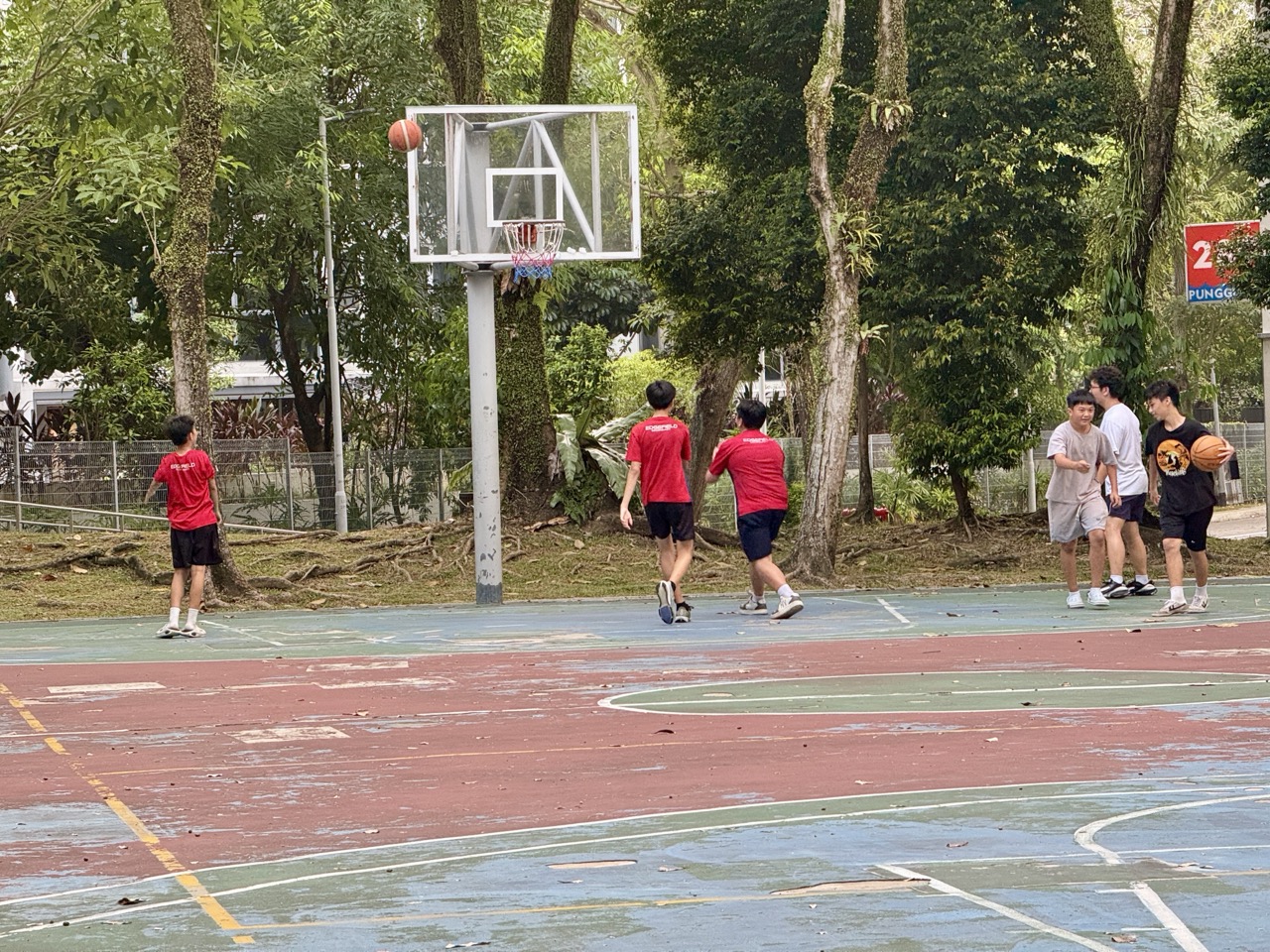
Punggol has public sports spaces where residents play games such as basketball and badminton. The actual courts may be busy, subject to local rules or require appropriate booking in some locations. Families should not assume the mere presence of a court means a private session can take over the space. Sharing fairly is itself an opportunity to practise civic responsibility.
For a beginner, informal play with a trusted adult or friend can develop enjoyment and basic movement confidence. Avoid creating competitive conditions beyond the child’s ability or using unsafe equipment. A short, pleasant activity is often more sustainable than an elaborate regimen designed to mimic elite training.
Schools and sports providers offer their own programmes, but a child does not need a paid sports course solely because they entered PG3. Review genuine interests and safety needs first.
Active travel can add movement without extra sessions
A pupil who walks part of a safe route to school may build regular activity into an ordinary day. Walking and cycling require attention to traffic rules, visibility, suitable infrastructure and the student’s experience. Travel should not be used as an opportunity to force a child into an unsafe or overly long journey for fitness points.
Parents can practise a route together and agree on how to respond when paths are closed, weather changes or transport is delayed. A reliable route supports punctuality and reduces anxiety. The family should not assume a map’s shortest line is the safest or most accessible journey.
Active travel is one option among many. Students with mobility or other needs may require different arrangements, and everyone deserves the opportunity to participate in school within safe, appropriate conditions.
Injury and health needs should be discussed early
A student who experiences pain, dizziness, breathlessness beyond the expected activity response or other concerning symptoms should not be urged to continue for the sake of a score. The school needs accurate information about relevant medical restrictions, and families should follow qualified professional advice. The appropriate response depends on the individual situation, not a generic online training guide.
If the child has a disability or health condition, discuss PE access and any school-based arrangements confidentially with the relevant staff. The school can explain how activities and assessments are managed. Do not assume that every condition automatically means complete exemption or that every pupil must undertake identical tests.
Respecting an individual need is compatible with meaningful physical education. The goal is safe participation and development, not avoiding all challenge or ignoring genuine risk.
What to do when a PE result disappoints a child
A disappointing test or game result may feel public and personal. Parents can help separate the result from identity. Ask whether the pupil understood the technique, had suitable preparation, was well enough to participate and received helpful feedback. A poor outcome can reveal a teachable skill, but not every difference can be resolved through more repetition.
Agree on one safe, specific improvement goal instead of an extreme schedule. It might involve understanding pacing, better coordination or feeling comfortable asking the PE teacher a question. Review progress through practice and confidence rather than comparing the child with the fastest classmate.
If the student seems distressed or physically unwell, speak with appropriate adults and professionals. Support should be proportional to the situation.
A sustainable four-week physical activity reflection
Week one can focus on noticing what movement the child already enjoys and what feels unfamiliar. In week two, practise one suitable basic skill with attention to technique under appropriate supervision. Week three can explore a different activity for variety, such as safe walking or an age-appropriate recreational game. In week four, review the pupil’s confidence, enjoyment and ability to explain a safety rule.
This is a family reflection framework, not an official fitness prescription. Do not use it to demand maximal exertion, rapid body changes or a specific NAPFA grade. The relevant intensity and activity should fit the child’s current ability, needs and professional advice where applicable.
A student who finds a sustainable way to enjoy movement has made progress that may endure long after the next school assessment.
What to ask a Punggol secondary school’s PE department
Ask what sports and movement skills are taught at Secondary 1, how participation and feedback are organised, and when NAPFA testing applies under the school’s current programme. Also ask which outdoor-education events, school sports days or CCA opportunities are relevant to the child. The information from New Town or another school should not be copied as an Edgefield, Greendale, Punggol or Yusof Ishak timetable.
Where medical or access support is needed, contact the appropriate school staff before the activity. Ask what documentation or procedures apply rather than guessing. Families can also enquire about required clothing or equipment without buying costly items beforehand.
The strongest question is, ‘How can my child participate safely, learn useful skills and develop positive habits?’ That is more informative than asking whether PG3 pupils are expected to run faster.
The longer-term objective is active independence
A teenager who can choose a suitable activity, follow safety principles, cooperate with peers and recover responsibly is learning skills that matter beyond school. NAPFA can provide one structured snapshot of particular fitness components, but it does not capture every aspect of health, enjoyment or capability. A sporting medal or test result is never a complete description of a person.
Families can support lifelong activity by making movement accessible and varied, protecting sleep and listening when a child reports difficulty. A pupil who dislikes one sport may enjoy another; a student who begins with low confidence can gradually improve. Development does not need to follow the timeline of a competition.
PG3 identifies the child’s entry route into secondary school. Physical Education helps the young person build a relationship with movement, health and teamwork that can continue long after the Posting Group label has ceased to matter.
Frequently asked questions
Does PG3 mean a harder NAPFA test?
No. PG3 is a school-posting group, not a separate NAPFA category.
Do new Secondary 1 students automatically take NAPFA?
Do not assume so. Recent school guidance lists testing at Secondary 2, 4 and 5 in some schools. Verify the receiving school’s current testing levels.
What are NAPFA’s six components?
School guidance lists sit-ups, inclined pull-ups, standing broad jump, shuttle run, sit-and-reach and a 2.4 km run/walk.
Does a poor NAPFA result mean poor academic ability?
No. Fitness tests sample physical components; they are not measures of intelligence or G3 subject competence.
How much activity is recommended for school-age youths?
Singapore guidance recommends an average of 60 minutes daily across the week at moderate-to-vigorous intensity for ages 7–17, adapted to individual circumstances.
Can a child prepare by doing maximal tests every day?
That is not a sensible universal plan. Appropriate technique, gradual activity, variety and recovery are safer than sudden overload.
Are PE and a sports CCA the same?
No. PE is curricular, while CCAs are additional activities with school-specific arrangements.
Do Punggol schools teach identical games?
No. Check each school’s current PE programme and timetable.
Can an injured child be exempted from testing?
Medical and access arrangements depend on the school and qualified advice. Communicate relevant conditions promptly.
Does all activity require expensive equipment?
No. Suitable walking and safe recreational play can build activity habits without a premium fitness programme.
Can we use Punggol Waterway Park to practise school PE?
It can be an informal family activity setting, but it is not an official school NAPFA venue unless the school says so.
Where can parents verify fitness standards and dates?
Use the receiving school’s current PE and NAPFA notices and relevant official health and MOE guidance.
Continue the PG3 Punggol series: PG3 Reading and Research at Punggol Regional Library | PG3 Character, Citizenship and National Education | PG3 Education and Career Guidance
Official health and school PE information
- MOE Physical Education syllabus implemented at secondary level from 2025
- New Town Secondary 2026 PE programme: NAPFA Secondary 2, 4 and 5
- Dunman Secondary 2026 PE programme and NAPFA resources
- HealthHub: physical activity guidance for teens
- HealthHub MindSG: sleeping well for teens
- Punggol PG3: Secondary 1 Outdoor Education and cohort camps
- Punggol PG3: LEAPS 2.0, leadership and sports CCAs
Your next step
Confirm which PE modules and NAPFA levels actually apply at the receiving secondary school. Help the child identify one safe and enjoyable activity to practise regularly, build the habit gradually and protect adequate rest. Ask the PE teacher for technique or assessment clarification, and seek qualified advice for any health condition that affects participation.


