
PG3 is Posting Group 3, a Secondary 1 admission route under Full Subject-Based Banding. It is not a separate History syllabus or a licence to treat every remembered story as historical fact. Lower-secondary History at G3 helps students ask questions about the past, construct accurate timelines, examine primary and secondary sources, explain causes and consequences, and evaluate how different accounts are produced. The key skill is to make claims that fit evidence rather than simply memorise names and dates.
Punggol provides a local case study. The National Library’s BiblioAsia research on Kampong Wak Sumang draws on historic maps, newspaper reports, photographs and oral-history interviews to reconstruct a fishing-village community and its later transformation. These records show why historians compare sources: a personal recollection can illuminate everyday life, while an official map can clarify locations and a dated government announcement can establish a planning decision. Families should distinguish this optional heritage inquiry from a school-assigned project and verify the actual Secondary 1 History texts and assessment requirements.
- PG3 is an admission category; G3 History develops historical enquiry at an individual subject level.
- Start with chronology: what happened, when, in what sequence, and which dates remain uncertain.
- Examine source origin, purpose, audience, date, context and content before using a document as evidence.
- Primary sources are produced within the relevant period; secondary accounts interpret available evidence later.
- Corroboration compares specific claims; two sources disagreeing does not automatically make one useless.
- Historical causation, change and continuity, significance and empathy require explanations, not slogans.
- NLB research on Kampong Wak Sumang offers carefully documented Punggol archival examples.
- Historic maps and oral histories illuminate different aspects of the past; present-day photographs cannot by themselves establish past conditions.
Definition lock: six historical thinking moves
| Historical concept | What the student asks | What to avoid |
|---|---|---|
| Chronology | What happened, when and in what order? | Confusing source date with event date |
| Evidence | What does this source actually establish? | Calling all personal accounts false or all old maps complete |
| Accounts | Who reconstructed the story and for what question? | Assuming only one account can exist |
| Causation | Which supported factors contributed? | Confusing sequence with proof of cause |
| Change and continuity | What changed, what remained and for whom? | Assuming everyone experienced change identically |
| Significance | Why might this event matter to this group? | Using fame alone as the criterion |

Guide chapters
- What History is—and why it is not simply a list of dates
- PG3 is not a shortcut into upper-secondary History
- Chronology is the skeleton, not the entire explanation
- Historical questions should be narrow enough to investigate
- What makes a source primary or secondary?
- Source origin matters because it gives context
- Purpose and audience influence what is recorded
- Reliability is not a one-word verdict
- Corroboration means comparing details, not counting websites
- Historical empathy is not the same as approving every action
- Historical significance depends on the question
- Change and continuity are both part of a town’s story
- Punggol’s Kampong Wak Sumang as a documented case study
- Old maps show one kind of evidence about Punggol
- Oral histories preserve voices that maps cannot capture
- Everyday work is part of Punggol’s historical record
- Education history appears within local community history
- Land reclamation and relocation require nuanced explanations
- The origin of a place name may involve competing accounts
- Old Punggol Road’s preserved features are interpretive clues
- Photographs are windows with boundaries
- Compare two accounts without forcing them to agree
- Causation requires more than what happened first
- A strong source-based answer has a clear chain of reasoning
- Timelines should contain qualified dates and sources
- Historical research and ethical use of archives
- Use modern Punggol as a question, not as evidence for the past
- A four-week lower-secondary History practice sequence
- What parents should ask their Punggol school
What History is—and why it is not simply a list of dates
Dates establish sequence, but historical understanding asks why developments occurred, how people experienced them and which evidence supports the explanation. A pupil may remember a year accurately yet be unable to explain the forces behind an event. History as a school discipline trains students to ask well-defined questions and interpret accounts, recognising that records are incomplete and that perspectives can differ.
The MOE lower-secondary History syllabus identifies key concepts including chronology, evidence, accounts, causation, change and continuity, significance, empathy and diversity. The combination matters. A historical narrative that contains dates but ignores causes is incomplete; a moving story about an individual without any source check may be equally problematic.
Parents can encourage a child to ask two questions after reading a History passage: What is the central claim, and what evidence would allow us to verify it? This is a stronger starting point than demanding memorisation of every paragraph.
PG3 is not a shortcut into upper-secondary History
Posting Group 3 determines the route into secondary school and normally guides starting levels of several subjects. The receiving school decides the lower-secondary History programme and later explains which upper-secondary subjects can be selected under its criteria. A PG3 entrant is not automatically entitled to a specific History or Humanities combination at Secondary 3.
Students may find historical enquiry interesting even when they do not eventually choose an examination subject with the same name. They can still develop the ability to assess sources and understand how societies change. Conversely, a pupil who plans to pursue History later needs to build accurate reading, explanation and evidence habits early rather than rely solely on enthusiasm.
Treat the first two years as a period of learning and discovery. The exact 2027 SEC syllabus belongs to that year’s graduating cohort, not a child beginning Secondary 1 in 2027.
Chronology is the skeleton, not the entire explanation
Chronology places events in time and identifies their order. Without it, a student may accidentally claim that a later decision caused an earlier development. A timeline can reveal patterns of change, intervals of stability and moments where several events occurred close together. Yet the order alone does not demonstrate a causal relationship.
An original classroom exercise might list four hypothetical events in a town: a new road was proposed, residents discussed access, construction began, and a bus route changed. The pupil should place them in order and identify which connections need additional evidence. It would be incorrect to claim that the discussion caused the route change solely because it happened first.
Ask the child to label each date as confirmed, estimated or uncertain where relevant. Historical accuracy includes being explicit about the quality of dating evidence.
Historical questions should be narrow enough to investigate
‘How did Singapore change?’ is an enormous question. A smaller one might ask how a particular community made a living during a defined period or how a named area was represented on maps at two dates. The second kind is more manageable because the student can identify relevant records. A good historical question connects a subject, a time frame and a problem that evidence may help answer.
Punggol offers useful examples: how did people living near Punggol Point describe their work, or how did the depiction of the area change between two official maps? These are learning prompts, not claims that a school has assigned those topics. They can be explored through reliable published archives without interviewing strangers or entering private land.
Parents can help reduce an ambitious topic to one question and two or three defensible sources. Scope is a form of intellectual discipline.
What makes a source primary or secondary?
A primary source is material produced in connection with the period or event under study. It might be a contemporary map, photograph, letter, newspaper report or recorded statement from a person who experienced the event. A secondary source interprets or synthesises such evidence later, such as a historian’s research article. The categories depend on the question and the source’s relationship to it.
For instance, an interview recorded in the 1980s with someone describing earlier village life is primary evidence for the person’s recollection at the time of the interview, but it is not a time machine proving every earlier detail. A later NLB research article drawing on many records is a secondary account of that history. Both can be valuable when used appropriately.
Teach the student that ‘primary’ does not mean automatically true and ‘secondary’ does not mean unreliable. The usefulness of a source depends on the claim it is being asked to support.
Source origin matters because it gives context
Before quoting a document, identify its creator, date, type and circumstances. A map drawn by a government surveyor may be useful for location and boundaries but not for how residents felt about their homes. A newspaper report may describe a decision close to the time it happened yet omit some perspectives. A memoir can offer personal experience while reflecting memory and later interpretation.
Students often skip this step and judge a source only by whether its sentence sounds convincing. A better answer begins with the source’s origin and asks how that origin affects the evidence. The analysis should be connected to the precise question, not a universal statement that all official sources are flawless or all personal recollections are biased.
Parents can practise with a modern school notice: who issued it, when, and what can it establish? The habit transfers naturally to historical work.
Purpose and audience influence what is recorded
Sources are created for reasons. A government announcement may explain policy, a family photograph may preserve a memory, and an advertisement may promote a service. Their purposes shape which details are emphasised or omitted. Historians ask how these decisions affect what the evidence can tell them. They do not automatically reject every source that has a purpose.
Suppose a fictional 1980s tourist brochure praises a seaside place as relaxing. It may provide evidence of how the destination was presented to visitors. It is weaker evidence for the everyday working conditions of all residents. A resident interview could offer another perspective. Comparing them helps reveal the different questions each source can answer.
A strong pupil learns to say that a source is useful for a particular claim and limited for another. That is more precise than writing ‘this is biased so it is useless’.
Reliability is not a one-word verdict
A source may contain accurate details alongside incomplete interpretation. Historians therefore examine claims rather than stamp an entire document ‘reliable’ or ‘unreliable’ in one sentence. A photograph can accurately show a building at a particular moment while leaving uncertain what happened before or after. A witness can recall a feeling sincerely even while misremembering the exact date.
Students should compare what the source actually states with independent evidence and relevant context. If a source uses a strong claim without supporting records, that is a reason for caution, not proof that every other statement in it is false. The purpose is calibrated judgement.
Ask the child which part of an account can be tested and what additional material would help. This produces practical source evaluation instead of memorising a generic sentence about bias.
Corroboration means comparing details, not counting websites
Two websites repeating a claim do not necessarily provide two independent pieces of evidence. Both may have copied one older article. Historical corroboration requires examining the origins of the records and comparing the relevant details. A map, a dated report and an oral recollection may each offer different information about one place.
If two records agree on a date but differ in their description of motives, the agreement may strengthen the chronology while leaving causation uncertain. A student should state exactly what has been corroborated. Saying ‘the sources agree’ is too broad if only one part matches.
Parents can teach this by tracing a local-history claim back to the National Library article’s references. The bibliography reveals the different kinds of evidence used in the reconstruction.
Historical empathy is not the same as approving every action
Historical empathy involves understanding people’s choices within the circumstances, knowledge and values of their time. It does not require excusing harm or pretending that everyone thought alike. A pupil should ask what options people perceived, what pressures mattered and which sources reveal their concerns. Judgements can still be made, but they should be informed rather than anachronistic.
Imagine a fictional family debating a move from a familiar neighbourhood to a new housing development. One member values better facilities; another worries about losing community ties. The pupil can consider both views without inventing an identical experience for every household. Historical questions frequently involve such competing priorities.
Good empathy begins with attention to evidence. It is not a license to write a first-person diary as though a student’s imagination were an archival record.
Historical significance depends on the question
Not every event is equally significant for every question. A local road opening may have mattered intensely to a particular community while appearing only briefly in a national overview. Historians consider consequences, scale, duration, distinctiveness and what later generations remember. An event’s significance can be argued with evidence rather than announced as a self-evident fact.
Ask a pupil why the history of a fishing community might matter to residents of a modern town. The answer could involve local identity, work, relocation and the connections between physical landscapes and human lives. These are plausible areas of enquiry that should be supported by records.
Do not teach children that only famous national leaders or battles count as History. Ordinary people’s experiences can illuminate larger transformations when examined carefully.
Change and continuity are both part of a town’s story
A place can change physically while retaining names, memories or social relationships. Students should ask what altered, what remained and whether different groups experienced change similarly. A map comparison may reveal new roads or housing, while an interview may show that a resident continued to visit an old community site long after moving away.
Change is rarely uniform. An improved transport link could benefit some users sooner than others; relocation might create opportunities and losses simultaneously. A thoughtful historical response identifies the evidence for each consequence without assuming the past was either uniformly wonderful or uniformly difficult.
Parents can use a present-day local view alongside an archival account to start a discussion. The difference between the two is a question for research, not proof of every intermediate event.
Punggol’s Kampong Wak Sumang as a documented case study
The National Library’s BiblioAsia article by Hannah Yeo, published in 2023, examines Kampong Wak Sumang, also known as Kampong Punggol, near Punggol Point. It draws on maps, newspapers, oral histories and archival images. Rather than offering one simplistic origin story, the article documents community life and the complexity of reconstructing an older settlement from scattered evidence.
Readers can investigate how the village’s name and memory appear in present-day Punggol through places such as Sumang Walk, Sumang Lane and Sumang LRT. A surviving place name is evidence that a connection is being commemorated, but it does not by itself settle every disputed detail about the settlement’s origins. Historical enquiry requires the supporting records.
This case is especially suitable for parents because the public article provides references to explore. It should be used as an optional learning resource, not as a replacement for the receiving school’s assigned History topics.
Old maps show one kind of evidence about Punggol
The BiblioAsia study identifies historical maps from different periods, including a nineteenth-century depiction of the area and twentieth-century survey maps. Maps can help locate settlements, coastlines, routes and landmarks within their survey conventions. Their value increases when the student reads the date, scale, labels and purpose. A name appearing on a map is meaningful, but its absence does not necessarily prove that no community existed.
Maps can also reflect different naming practices and surveying accuracy. A child comparing two should avoid assuming every line refers to the same physical boundary or that a later spelling simply corrects an earlier one. The proper comparison asks what is shown, how it was created and which other record could confirm the interpretation.
Use the original archival map or a clearly attributed reproduction with permission where needed. Do not crop away its source details simply to make a school slide more attractive.
Oral histories preserve voices that maps cannot capture
Oral history interviews can offer descriptions of work, family life, relationships and memories that may be absent from official plans. The BiblioAsia article refers to interviews preserved by the National Archives of Singapore concerning Kampong Wak Sumang and its residents. Such material helps historians recover experiences beyond buildings and dates.
Memory, however, is shaped by the passage of time. A narrator may recall an event vividly without giving its exact chronology, or different people may remember the same change differently. The historian should consider when the interview was conducted, what was asked and whether related documents support important factual claims.
A student should listen respectfully to lived experience while still practising verification. Compassion and critical thinking are partners, not opposites.
Everyday work is part of Punggol’s historical record
The NLB research describes fishing and mussel-related work in Kampong Wak Sumang, including people who depended on nearby waters and local trade. These occupational details offer insight into the economic and social conditions of the community. They are not merely colourful anecdotes: work shaped household routines, relationships with the coast and exposure to particular risks.
Students can compare that documented economy with present-day Punggol’s residential, educational and commercial functions. The point is not to claim that every earlier resident was a fisherman or that the modern district has no connection to maritime activity. A serious comparison identifies the scope of the evidence and recognises diversity within communities.
Ask what sources could establish how many people performed different jobs, or how earnings changed over time. A single interview cannot answer every statistical question, but it can direct the enquiry.
Education history appears within local community history
One documented detail in the BiblioAsia article concerns Sekolah Melayu Ponggol, a Malay school established in Kampong Wak Sumang in 1955 through community and donor support. The story helps pupils see education as a social institution shaped by local needs and resources, rather than something that has always existed in its present form.
Students should ask why a community might establish a school, who organised it and what evidence records its development. A dated opening account, a photograph and subsequent administrative records could contribute different perspectives. Avoid inferring the daily curriculum or every child’s experience from the simple fact of an opening.
This example connects local History with a broader question: how do communities build institutions, and how do those institutions change? It invites curiosity without inventing classroom scenes from the past.
Land reclamation and relocation require nuanced explanations
The National Library account describes a government announcement in 1983 about reclamation near Punggol for future housing needs and the relocation of community activities and residents during the following years. It records personal responses and continued attachments to the area. These details help pupils distinguish official development goals from the lived consequences of physical change.
A student should not explain a major transformation by one slogan alone. Housing demand, planning decisions, economic circumstances and individual family situations can all be relevant, but each claim needs proper evidence. A later modern estate does not prove that every resident benefited equally or experienced the move in the same way.
Ask the pupil to write one paragraph about the documented policy decision and another about a documented personal perspective. The contrast helps explain why historians consult several kinds of sources.
The origin of a place name may involve competing accounts
BiblioAsia discusses different stories about the origins of the name Punggol, alongside old maps and local memories. Some explanations are traditions or later interpretations rather than established facts with a single incontrovertible origin. This makes place-name history a strong example of why an engaging story cannot automatically be elevated into a definitive answer.
The student can identify which forms appear in older records, which narrative appears in a later book and what the NLB author says remains uncertain. A careful account might state that one explanation is commonly repeated while another has documentary support. It should not invent certainty simply because a short answer seems easier to memorise.
Parents should enjoy the stories while modelling calibrated language. ‘One account suggests…’ can be more historically accurate than ‘This definitely happened…’ when evidence is incomplete.
Old Punggol Road’s preserved features are interpretive clues
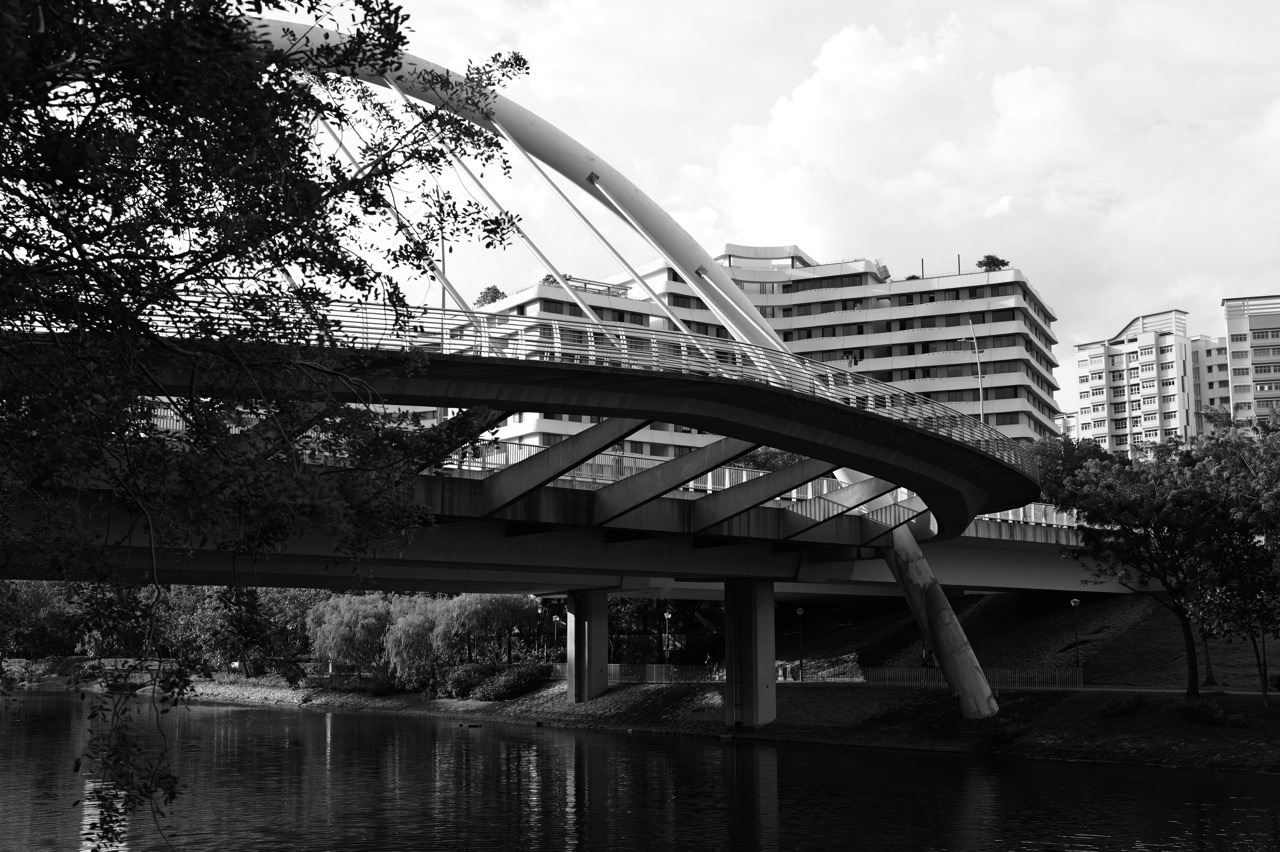
NParks’ official Punggol Waterway Park page describes the preserved Old Punggol Road bus stop and a short section of road, as well as heritage-inspired features such as Kelong Bridge. These present-day elements provide prompts for asking about older transport, fishing and settlement histories. But a preserved or symbolic feature must be understood in context.
Kelong Bridge was designed to evoke offshore fishing structures; it is not itself an original fishing platform from the nineteenth century. A heritage marker helps visitors remember the past while a historical source is needed to describe the original structure’s operation. Students should distinguish preservation, reconstruction, commemoration and original artefact.
A safe family visit may introduce the question, but it is not an official school investigation unless the receiving school assigns it. Follow park rules and avoid treating the site as a place to collect private or restricted material.
Photographs are windows with boundaries
An archival photograph can show how a particular scene looked when the image was made. It may include clothing, architecture, tools or social interactions. Yet photographs are framed by a photographer, can be staged and omit what lies outside the view. A student must check the date, location, creator and caption before drawing a broader conclusion.
A picture of one family in a kampong cannot establish the living conditions of every resident or prove what happened before the photograph was taken. A modern photograph of a newly built park cannot reveal precisely which structures stood there decades earlier. Both images can be useful when their limitations are understood.
Parents can ask the child to list what is visible, what is inferred and what another source would need to verify. This exercise teaches disciplined visual evidence analysis.
Compare two accounts without forcing them to agree
One source may emphasise the benefits of new housing while another remembers the loss of a close-knit community. The claims can coexist because they answer different questions or reflect different experiences. Historical comparison should identify the precise points of agreement and difference and the evidence available for each. Simply declaring that one account is ‘biased’ contributes little.
Suppose a policy report lists infrastructure improvements while an oral interview describes a person’s grief at leaving a home. The first may establish official plans and implementation data; the second may establish an individual’s reported feeling. Neither automatically invalidates the other. A historian needs both the material and human dimensions of change.
Teach the pupil to write ‘Source A is useful for…’ and ‘Source B adds…’ before deciding what remains unanswered. The response becomes more informative and fair.
Causation requires more than what happened first
Historical events usually emerge from multiple conditions, decisions and interactions. A pupil should distinguish long-term background, immediate triggers, intended effects and unintended consequences. Chronology helps organise the explanation but does not prove each causal link. A later housing estate may follow a reclamation decision, but the wider reasons and consequences should be supported by planning and historical records.
Ask the child to create a small diagram with a documented decision at the centre and arrows labelled only where sources support a connection. Unverified assumptions should be written as questions. This prevents an attractive causal flowchart from pretending to know more than the evidence permits.
Parents can apply the same discipline to modern news: events occurring close together are not necessarily in a simple cause-and-effect relationship.
A strong source-based answer has a clear chain of reasoning
School History responses often require pupils to explain what a source suggests, compare accounts or judge usefulness for a specific question. A strong answer states a focused claim, identifies relevant content and explains why the content supports the claim in its context. When origin or purpose matters, discuss those factors specifically rather than append a generic statement about bias.
Imagine a fictional photograph showing several people unloading items from a small boat near a market. It supports an observation about the activity pictured at that moment. With further contextual information, a student might infer something about trade. It does not establish total annual sales or the occupations of all nearby households.
Ask the pupil what each sentence contributes. Remove unsupported exaggeration and add the exact evidence needed. Clear reasoning matters more than a long answer filled with textbook terminology.
Timelines should contain qualified dates and sources
A useful History timeline can label events with dates, evidence sources and uncertainties. Some events are documented to the day, while others are dated only by a decade or remembered retrospectively. Forcing every event into an exact date may create false precision. The pupil should match the date label to the quality of available evidence.
For a local case, the child might create a short timeline of documented maps, school openings, planning announcements and later memories using the NLB article’s references. They should clearly distinguish when a source was produced from when the event it describes occurred. An interview conducted in 1995 may recount experiences from decades earlier.
Revisiting the timeline when new evidence appears is part of historical learning. A revised sequence based on better sources is an improvement, not a failure.
Historical research and ethical use of archives
Archives and libraries preserve records for public learning, but individual photographs, recordings and documents may have usage conditions. Students should follow access and copyright requirements, acknowledge creators and avoid presenting borrowed images as personal discoveries. A citation should help readers locate the record, including the collection or identifier when available.
Privacy and sensitivity also matter. Oral histories may discuss family circumstances and painful experiences. Pupils should not seek out strangers for unsupervised interviews or post identifiable personal stories without consent. A school historical investigation may have additional guidance on ethical research and reporting.
The best projects use authentic evidence transparently and treat historical subjects as people rather than characters invented for dramatic effect.
Use modern Punggol as a question, not as evidence for the past
A current walk beside the waterway may inspire questions about fishing, land use and older communities, but modern buildings are not direct evidence of how every earlier resident lived. The student must turn from observation to archival sources. A place may preserve names and commemorative features while its landscape changes substantially.
Families can visit public heritage features responsibly and later explore the NLB article and National Archives references. Ask the child to explain what was observed today, what was documented historically and which connections need further evidence. The exercise becomes a respectful dialogue between place and record.
Do not label a modern park photograph as ‘Kampong Wak Sumang in 1985’. Accurate captions are an important part of historical integrity.
A four-week lower-secondary History practice sequence
Week one can focus on chronology using a short set of dated events. In week two, compare a primary source description with a later researched account and identify their different functions. Week three can introduce origin, purpose, audience and limits through a historical photograph or map. Week four can ask for a short evidence-based explanation of change and continuity.
Keep every exercise narrow. A teenager should be able to discuss why a source is useful without memorising long passages from an article. Use school work as the first reference point and choose optional local-history material only if it supports the actual skill being taught. A short discussion may be more revealing than an elaborate poster.
After several days, give the pupil a different source and ask whether the reasoning transfers. Fewer unsupported claims and more precise source references indicate progress.
What parents should ask their Punggol school
Ask which History periods and enquiry questions are taught in the actual lower-secondary year, how sources are introduced and what assessment formats are used. Schools may use discussions, written tasks, portfolios or investigations, depending on their programme. Do not assume that the Kampong Wak Sumang case study belongs to every local school’s required syllabus just because the community is nearby.
If the child struggles, identify whether the difficulty lies in recalling chronology, reading an unfamiliar source, distinguishing viewpoints, explaining causation or structuring an argument. Each problem deserves a different lesson. Simply demanding more memorisation may fail to repair a source-analysis weakness.
The strongest result is a student who can tell the difference between an engaging story and a defensible historical explanation. That habit extends well beyond a future SEC examination.
Frequently asked questions about PG3 History
Does PG3 give a different History syllabus from every other student?
PG3 is the entry group, while subject levels and the school’s actual History programme determine the learning arrangements.
Why are historical dates important?
Chronology establishes sequence and helps investigate change, but dates alone do not prove causes.
Are primary sources always correct?
No. Primary sources may be incomplete, mistaken or shaped by the creator’s perspective and purpose.
Can oral histories count as evidence?
Yes. They can provide firsthand recollections, but dates and broader claims should be checked where possible.
What is corroboration?
Comparing specific claims across relevant, sufficiently independent sources to determine what is supported and what remains uncertain.
Does source disagreement make one source useless?
Not automatically. Sources may answer different questions or represent different experiences.
Can pupils study Punggol history without a school trip?
Yes. NLB and National Archives resources provide material for safe, desk-based historical enquiry.
Who were people connected with Kampong Wak Sumang?
NLB’s documented article discusses residents and a fishing-village community near Punggol Point, drawing on maps and oral histories.
Does a modern Kelong Bridge prove an original kelong stood there?
No. NParks says its design pays tribute to a fishing past; a heritage-inspired structure is not the original artefact.
Is the origin of ‘Punggol’ beyond dispute?
Different historical and traditional explanations exist. Use the NLB research and old records rather than asserting a single unsupported story.
Does a PG3 pupil automatically take History K330 at SEC?
No. K330 is a 2027 graduating-cohort G3 subject; later school choices and eligibility govern an individual pupil’s pathway.
What is a useful first habit for History?
Ask what the claim is, when the source was produced and exactly what evidence supports the interpretation.
Continue the PG3 subject skills series: PG3 Science laboratory practical skills | PG3 Prose, Poetry and Drama | PG3 Geography fieldwork and map skills
Official lower-secondary History and local archive sources
- MOE Lower Secondary History teaching and learning syllabus (May 2024 version)
- National Library BiblioAsia: Remembering Punggol’s Kampong Wak Sumang (2023)
- NLB Punggol Stories: Words That Move image and archive credits
- NParks Punggol Waterway Park: preserved road and heritage-inspired bridges
- SEAB 2027 G3 SEC subjects including History K330 and combined Humanities K336
- PG3 Science and Humanities foundations
- PG3 Reading, Research and Punggol Regional Library
Your next step
Choose one carefully documented Punggol history question, read the NLB account with your child and record the source for each date or claim. Compare a historical map, a published recollection and a modern observation, explaining what each can and cannot establish. Follow the receiving school’s actual History tasks and keep uncertain facts labelled honestly.


