
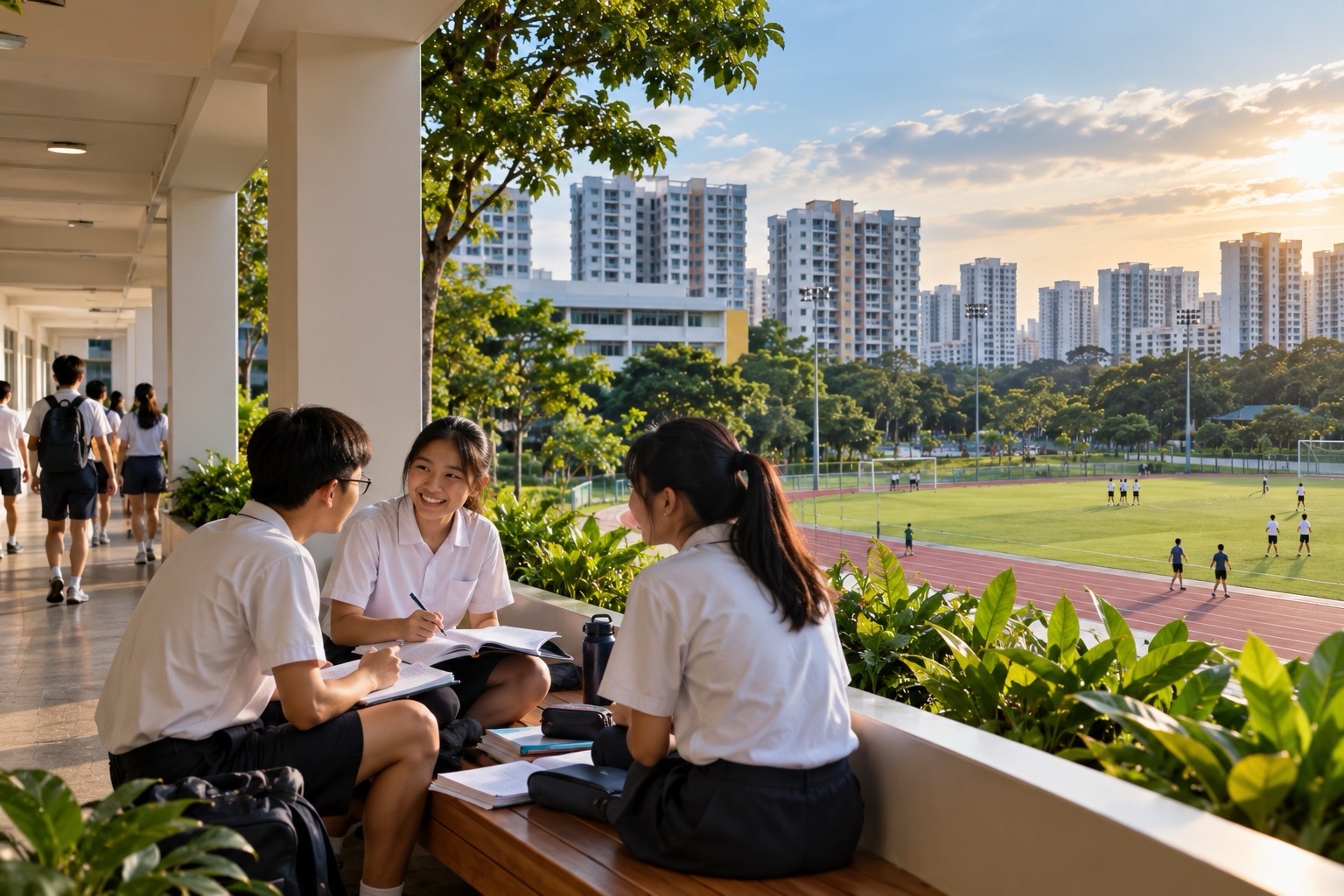
Xinmin Secondary School at 11 Hougang Avenue 8, Singapore 538789, is a co-educational government autonomous secondary school that eligible Punggol families can consider through Posting Group 2 (PG2). Xinmin’s own official Secondary 1 posting page records the completed 2026 intake PG2 PSLE Score range as 21–23, with 23 the last admitted score. This is a historical outcome for pupils who sat the PSLE in 2025, not a guaranteed 2027 cut-off. Parents should check the actual MOE SchoolFinder and current posting instructions, and avoid promising a place merely because the child’s result matches a previous-year number.
Xinmin’s 2026 school curriculum pairs MAKERS@Xinmin—hands-on design, digital and analogue making and responsible artificial intelligence—with RefleXions@Xinmin, a lower-secondary drama experience that develops empathy, creativity and communication. The school’s broader student development includes XinminCares and the Xinmin Academy of Leaders, with the vision of nurturing Curious Learners, Compassionate Contributors and Confident Leaders. Xinmin has also announced a 2026 open house for Saturday, 14 November, 7.45am to 11.45am, with the principal’s talks scheduled for 8.00am and 9.45am. A PG2 pupil can investigate those real school experiences while academic subjects remain individually levelled at G2 or other eligible levels under Full SBB.
- School: Xinmin Secondary School, 11 Hougang Avenue 8, Singapore 538789.
- School type: Government autonomous, co-educational, mainstream Full SBB secondary school.
- Official 2026 historical PG2 range: 21–23; last admitted 23, not a fixed 2027 admission promise.
- 2026 open house: Saturday 14 November, 7.45am–11.45am; principal’s talks at 8.00am and 9.45am.
- School vision: Leading Hearts, Leading Minds, supported by Respect, Responsibility and Resilience.
- Signature programme: MAKERS@Xinmin, Making with Agility and Knowledge for Empowered, future-Ready Students.
- MAKERS experience: Two years of analogue and digital making, AI ethics, prototyping and eco-sustainability challenges for lower-secondary pupils.
- Signature drama programme: RefleXions@Xinmin, offered to every lower-secondary pupil under the published 2026 curriculum.
- XinminCares: School-wide Values-in-Action supporting sincere community contribution.
- Xinmin Academy of Leaders: A tiered development framework; formal leadership roles remain selective.
- Academic subjects: PG2 is an admission category; actual English, Mathematics, Science and other subjects may have G1/G2/G3 levels according to eligibility.
- Parent action: Confirm actual posting category, programmes, co-curricular commitments, transport and realistic subject-level readiness.
Definition lock: Xinmin PG2 is not a whole-student academic ceiling
Posting Group 2 is used for Secondary 1 admission under Full Subject-Based Banding. It is an administrative route through which a child may enter a school and a broad starting reference for academic levels. G2, in contrast, is the standard of an individual academic subject. A pupil can have eligible subjects at different levels within one timetable, while sharing form-class experiences with students of varied academic profiles.
Xinmin’s official Lower Secondary Programme page, updated in October 2026, explains this structure explicitly. Core subjects include English, Mother Tongue, Mathematics, Science and Humanities, with common curriculum subjects such as Art, Music, Physical Education, Design and Technology, Food and Consumer Education and Character and Citizenship Education. Its two lower-secondary experiential signature programmes sit alongside these subjects rather than replacing them.
A child may show strong creative ability during a maker challenge while still needing help interpreting English comprehension questions. Another may be confident with algebra and reluctant to speak during drama. Neither learner should be defined by one label or assumed to have identical needs.
The educational question is whether the school can support the pupil’s actual subject profile and help them participate meaningfully in its wider curriculum. A school name or old cut-off cannot answer that on its own.
The official 2026 PG2 21–23 range
Unlike some third-party school profiles, Xinmin’s own official Secondary 1 Posting page provides its historical 2026 group ranges. It lists PG3 8–13, PG2 21–23 and PG1 25–28 for that completed intake. The last admitted PG2 score of 23 is a useful reference for families preparing the 2027 shortlist, but should not be described as a future confirmed threshold.
If the student’s PSLE Score is 23, the family can consider that the previous cohort admitted pupils with the same number. Yet the new exercise involves new applicants, preferences, vacancies and official tie-break conditions. The school cannot guarantee the result in advance. An applicant whose score is outside the historical range may still need to understand the possibility that ranges change.
The family must also compare the correct Posting Group. A pupil with a permitted PG2/PG3 choice should not simply use the lower cut-off from one group to predict a result in another. The actual application and academic fit matter.
A good school-choice table states “Xinmin 2026 PG2 21–23, source: official Xinmin Secondary posting page” and adds a separate space for the actual 2027 outcome when published.
Government autonomous status: what it means for parents

Xinmin describes itself as an autonomous school. This supports its development of school-designed experiences and talent programmes alongside the national curriculum. It does not mean the school has abandoned MOE’s Full SBB requirements, that all pupils enter an Integrated Programme or that a PG2 child can skip formal subject prerequisites.
The school’s total-curriculum framework includes academic subjects, common cohort experiences, CCAs, talent development and signature programmes. A family should investigate how these elements work together instead of assuming autonomous status automatically means harder examinations or a uniformly more demanding timetable.
A child interested in making may enjoy the hands-on programme; another interested in performing may benefit from drama. The school also offers other student development opportunities, but particular advanced roles or specialist courses can have selection criteria. Parents should ask what the ordinary cohort receives and what is optional.
Autonomous status is a feature of school governance and curriculum design, not a personal ranking of children. The best fit depends on the actual pupil and educational environment.
A school founded in 1945
Xinmin’s principal’s foreword explains that the school was founded in 1945 and has grown from a community school into its current government autonomous institution. Its heritage combines a longstanding focus on learning and service with modern experiences in technology, drama, leadership and community contribution.
The motto Strive, Excel, Serve can be discussed as a sequence of habits. Strive asks the pupil to work constructively; Excel invites care and improvement; Serve encourages the use of skills for others. These are broader educational objectives than winning one academic ranking.
History is not proof of universal school fit. Parents should still examine current subject options, teacher feedback, school culture, student wellbeing and travel. A pupil must experience the present school rather than simply admire its past achievements.
Ask how current projects connect with the school’s stated values. A student who designs an eco-friendly prototype should explain the evidence supporting its benefit, while a student in XinminCares should show respect for the people involved. Those connections make identity practical.
Leading Hearts, Leading Minds
Xinmin’s current learning framework places Leading Hearts, Leading Minds at its centre, anchored by Respect, Responsibility and Resilience. It aims to develop curious learners, compassionate contributors and confident leaders. Those three outcomes can provide a helpful way to discuss the school with a child.
Curiosity involves asking questions and being willing to test a new idea. Compassion requires considering other people’s needs and responding sincerely. Leadership involves making decisions and communicating responsibly, whether or not the pupil holds a formal student-council title.
A parent should not simply accept that every school value is automatically achieved. Ask for examples of what ordinary lessons look like. Do pupils receive useful feedback? Can a shy student contribute to a group? How are errors handled? What happens when classmates disagree?
The school’s current programme pages offer examples, but the learner’s everyday experience is the final measure of fit.
MAKERS@Xinmin: the two-year foundation
MAKERS@Xinmin is an acronym for Making with Agility and Knowledge for Empowered, future-Ready Students. The official August 2026 page describes a two-year curriculum in analogue and digital making, real-world problem-solving and the ethics and applications of artificial intelligence. All lower-secondary students participate under the published programme.
The word “making” should not be mistaken for simply assembling a kit. A meaningful project requires understanding a problem, designing a solution, creating a prototype, testing assumptions and revising after feedback. Pupils should learn to explain why a component is useful and what limits the system has.
This can give students with different strengths opportunities to contribute. A practical builder may need help writing a coherent report, while a strong communicator may need to understand the mathematics behind a device. Both can develop through the project.
A PG2 pupil does not need to arrive with advanced robotics certificates to begin understanding design. The family should ask what foundational teaching is provided and which specialist opportunities require extra selection.
Analogue making: learning without screens
Digital technology is attractive, but analogue making can teach spatial reasoning, measurement, structure and material judgement. A cardboard prototype may reveal whether two parts fit or whether a user can operate a design. These lessons are valuable even before coding enters the project.
A student might begin with a simple object intended to organise items on a desk. The child should identify the required dimensions, test whether the object is stable and consider who will use it. A beautiful drawing cannot prove physical usefulness until an appropriate model is examined.
Parents can ask what the pupil changed after the first attempt. Did a part break? Was a measurement wrong? Was the object difficult to use? The explanation reveals whether the teenager has learned to revise rather than defend an unsuccessful idea.
The school should determine safe handling of equipment and materials. A pupil does not need to purchase specialist cutting tools at home merely because analogue making appears in the curriculum.
Digital making: code should express a decision
Digital making can include programming and designing a system that responds to inputs. The educational objective is to understand the logic rather than reproduce a working script without explanation. A pupil should be able to predict an output, test the system and identify the first incorrect instruction.
Suppose an imagined project uses a sensor reading to trigger an alert. The student needs to understand what is measured, what threshold is sensible and what happens if the reading is unreliable. A technically functioning alert could still be confusing to users or triggered too often.
This is an opportunity to connect Mathematics, Science and digital thinking. A variable in code relates to a quantity; a conditional statement expresses a logical comparison; a test reveals whether the implementation matches the intended purpose.
Parents can ask the teenager to change one part of a program and predict the result before testing it. Independent reasoning provides better evidence of learning than the screen simply displaying success.
Artificial intelligence and the responsibility to verify
MAKERS@Xinmin includes learning about AI tools, applications and ethics. Its published examples involve sustainability-related models, eco-themed coding games and environmental data. This is useful because teenagers increasingly encounter AI-generated information that appears fluent and authoritative even when it is wrong.
A student needs to distinguish using an AI tool from understanding its output. If a model categorises an image, the pupil should test how it behaves on unfamiliar examples and ask whether the data are representative. If a chatbot suggests an explanation, the student should check it against reliable sources and school instructions.
Responsible AI work also involves consent and privacy. A class project should not upload identifiable classmates’ information without authorisation. The desire to make an impressive demonstration cannot override safeguarding rules.
A parent can ask one simple question: “What would tell you this AI result is wrong?” A student who can identify the answer is beginning to think critically about the technology.
Eco-sustainability as a maker challenge
Xinmin’s MAKERS programme describes projects involving environmental sustainability. This can make technology meaningful because resource use, waste and energy involve real decisions with trade-offs. A pupil may be inspired by an eco-friendly device but should learn that an attractive label does not prove the proposed design is actually better.
A useful investigation defines the goal and collects appropriate evidence. If the team claims that a device reduces waste, what was measured? Over what period? Did other factors change? What resources are needed to maintain the solution? Honest questions prevent exaggerated conclusions.
The project can connect G2 Science observations with Mathematics data and English explanations. A student who understands those links gains more than one who memorises technical terms without applying them.
Parents should not assume a classroom prototype will become a commercial product or that every pupil receives a competition award. Learning to evaluate and improve a design is itself worthwhile.
Iteration: the educational value of failure
A prototype that fails can provide useful evidence when the student examines why. It may have been built with an incorrect dimension, programmed with a wrong condition or based on a mistaken assumption about users. Identifying the cause allows an informed revision.
Xinmin’s MAKERS description emphasises adaptive thinking and iteration. The child should learn to change one relevant part, test again and record what happened. Randomly altering many components can conceal the actual explanation.
This habit connects with academic study. A Mathematics pupil should identify the first invalid step in an equation; an English pupil should find where an inference lacks evidence; a Science learner should distinguish an observation from a mechanism. The structure of good problem-solving transfers even when subject content differs.
Parents can praise accurate diagnosis instead of treating every unsuccessful first attempt as a failure of ability.
RefleXions@Xinmin: lower-secondary drama for everyone
RefleXions@Xinmin is a signature lower-secondary drama programme offered to every student under the school’s August 2026 description. It uses drama-based activities, purposeful play, performance, creative thinking and discussion to help learners understand how other people think, feel and communicate.
This is not the same as requiring every pupil to audition for an elite drama competition. The foundational programme involves classroom participation appropriate to the lesson, while a formal English Drama CCA is a separate activity with its own membership and performance opportunities.
A child who is naturally outgoing may enjoy performing, but a quiet pupil can also develop confidence through gradual practice. Drama can provide a reason to interpret language, listen to another viewpoint and communicate an idea.
Parents should ask the school how it supports beginners and what ordinary Year 1 drama tasks involve. A shy teenager need not become a professional performer to gain useful skills.
Purposeful play as a way of learning
Purposeful play differs from unstructured entertainment because the activity has a clear educational aim. Students may explore a scenario, assume a role or respond to a situation in ways that reveal choices and perspectives. After the activity, reflection helps them connect experience to an idea.
For example, a group might act out a disagreement about a shared classroom responsibility. Pupils can explore how different wording changes the interaction and whether a particular response is respectful. The teacher can guide discussion without suggesting every conflict has one simplistic answer.
A PG2 student who is uncertain in oral English may begin with short contributions and gradually build more complex explanations. A student who speaks confidently may need practice in listening and noticing non-verbal cues.
The objective is understanding and communication, not acting skill judged by who receives the loudest applause.
Empathy through performing another perspective
Drama invites a pupil to imagine how someone else might experience a situation. This can build empathy when the student supports the interpretation with relevant context rather than projecting a stereotype. A character may act differently from what the pupil expects because of incomplete information, conflicting responsibilities or fear.
Ask the child what the character knows at that moment and what another person may not understand. Which words or actions support the interpretation? Could a different reasonable explanation exist? These questions create a bridge between drama and evidence-based reading.
The learning also has a social dimension. A teenager may become more careful about assuming that a quiet classmate has no ideas or that a peer’s mistake reflects laziness.
Empathy does not mean accepting harmful behaviour without boundaries. It means interpreting situations thoughtfully and responding with respect.
Creating an original script
Xinmin’s lower-secondary programme includes opportunities to create original scripts and performances. A script needs a purpose, clear characters, a sequence of events and dialogue suited to the audience. A student should decide what the scene is intended to reveal before adding decorative or dramatic language.
A useful writing exercise begins with a conflict or question. What does each character want? Why do their goals differ? What information changes the situation? The child can plan the sequence, draft dialogue and revise it after hearing how it sounds when spoken.
This provides meaningful English practice. The pupil learns that words have tone, purpose and consequences. A well-chosen simple sentence may communicate more than an elaborate speech that does not suit the character.
A parent should encourage original student thinking. A fully AI-written script may look polished while hiding whether the pupil can organise ideas independently.
Respectful critique of performances
The RefleXions page specifically mentions students critiquing one another’s performances respectfully. This is an important learning skill because feedback should help someone improve without humiliation. A pupil can name what worked, identify one precise issue and suggest an actionable change.
“Your speech was bad” provides little useful information. “The audience could not hear the reason for your decision because that line was too fast” gives the performer a specific adjustment. The child learns to distinguish an observation from a judgement about another person’s worth.
Receiving feedback is equally important. A teenager should be able to consider a suggestion, ask for clarification and try again. Not every criticism will be correct, but it should be evaluated calmly.
These habits transfer to group projects, schoolwork, CCAs and later employment, where people need to cooperate with others whose perspectives differ.
XinminCares: compassion with meaningful action
XinminCares is the school’s signature Values-in-Action programme, described as involving all students. It encourages pupils to understand community needs, act sincerely and reflect on their contribution. The official 2026 page describes the XinminCares Fair and opportunities to support organisations such as Singapore Cancer Society, Thye Hua Kwan Nursing Home and Migrant Workers’ Centre.
A meaningful service project does not begin by deciding which photograph would look best in a portfolio. It begins by understanding what the partner organisation or beneficiaries actually need. Students may discover that a proposed activity should be simplified or changed after consultation.
The school’s emphasis on sincerity is a useful educational principle. A modest act performed reliably and respectfully can be more valuable than an elaborate public event that does not serve anyone well.
Parents can ask the pupil what the group learned from the community and how the action addressed a genuine need. That encourages ethical reflection rather than counting certificates.
Community partners and confidentiality
XinminCares provides contexts for students to learn about diverse people and social issues. However, a school service opportunity does not authorise a child to publish health information, photographs or personal stories about beneficiaries without proper consent. Compassion includes respect for privacy and dignity.
A teenager may meet older residents, people living with disabilities or workers with experiences different from their own. Students should avoid treating any group as uniformly needy or speaking for them without listening. The people involved have agency and preferences.
A well-designed activity identifies a legitimate need, follows the organiser’s guidance and evaluates the actual benefit. If a plan does not work, the class can revise it rather than defend its first idea for publicity.
These lessons can be useful far beyond a school VIA project, particularly when pupils later encounter community issues through work or civic life.
XinminCares Day and inclusive sport
The official XinminCares page describes an event in which students consolidate learning, advocate for beneficiary needs and participate in activities such as seated volleyball and goalball to explore inclusion and the experiences of people with disabilities. Such activities can invite questions about access and fair participation.
A respectful lesson recognises that one simulated exercise does not reproduce the lived experience of a person with a disability. Students should learn from actual perspectives, avoid stereotypes and ask what would make an activity or environment more inclusive.
The aim is a change in everyday conduct. A pupil might become more attentive to accessibility or willing to ask a peer what support is helpful. Those behaviours are more meaningful than simply saying the event was fun.
Parents can discuss the child’s reflections while preserving privacy about other students and community participants.
The Xinmin Academy of Leaders
Xinmin’s 2026 school page describes a tiered Academy of Leaders with foundational self-leadership opportunities for all and more specialised responsibilities for selected pupils. Roles can include class committees, CCA leaders, peer support, student council and wider school leadership activities.
This structure should be presented accurately. A PG2 pupil can develop leadership capabilities through everyday reliability and participation, but a particular formal title is not guaranteed. Some opportunities require nomination, selection or demonstrated readiness.
The school describes leadership adventure camps, student-led events and a coordinating leadership group, XCEL. These examples show how student responsibilities can grow over time, but the exact 2027 arrangements and individual roles must be confirmed.
Leadership is not simply speaking confidently. It includes listening, organising tasks, acting fairly and accepting accountability when a plan changes.
XCEL and the role of student voice
Xinmin’s Council of Exemplary Leaders, XCEL, brings together leaders from several student leadership boards. Its official page describes involvement in school events, student voice and coordination across leadership groups. This provides a model for how pupils may move from class responsibilities towards broader contributions.
A student does not need to aim immediately for the highest leadership position. A Secondary 1 learner can begin by keeping commitments, supporting group tasks and participating respectfully. Those habits create the foundation for later roles, whether or not the pupil seeks formal office.
Parents can ask what leadership development looks like for ordinary pupils, not just the students pictured at an investiture ceremony. A school should help many students gain responsibility even when only a few hold senior posts.
Formal selection, CCA records and LEAPS 2.0 recognition have their own criteria. A school-profile page should not promise titles or admissions bonus points from participation in one workshop.
Talent development across five domains
Xinmin’s framework describes talent development across cognitive, aesthetic, psychomotor, community and leadership domains. The idea is to recognise that pupils develop different strengths, and opportunities may be broad-based or targeted to those with greater interest and readiness.
For a PG2 pupil, this is an encouraging but practical approach. A child who is strong in sport may also need support with writing, while another who enjoys art may later discover computing. The family should allow interests to evolve without assuming that one PSLE score reveals the full potential.
At the same time, not every advanced activity is available automatically. A sports team may require trials, an academic enrichment activity may have selection criteria and a leadership role may require sustained contribution.
Parents should ask which experiences are delivered to the cohort and which are selected. That distinction makes a school comparison more honest.
The 2026 Xinmin open house: exact published details
Xinmin has announced its open house for Saturday 14 November 2026, from 7.45am to 11.45am. The official page lists principal’s talks at 8.00am and 9.45am and invites families to see school activities and CCAs. These are dated details confirmed as of 1 November 2026, not a permanent annual schedule.
A parent should prepare a few useful questions before attending. Which parts of MAKERS and RefleXions are experienced by all Secondary 1 pupils? How do G2 and eligible G3 subject groups work? What are the academic support and wellbeing procedures? How are CCAs selected? What does the school consider a successful learning outcome?
Let the child choose a question too. A teenager may be interested in a maker demonstration, drama performance or sport and can use the visit to imagine ordinary school life.
An open house informs preferences. It does not reserve admission, override the PG2 cut-off or guarantee a place on a selected programme.
The 2026 Xinmin scholarship is not a PG2 entitlement
Xinmin’s prospective-student information lists a scholarship for incoming Secondary 1 pupils with PSLE Scores of 8 or better, with its stated award and mentoring conditions. This published threshold is far outside the ordinary PG2 score band. A PG2 family should not assume eligibility merely because the school is autonomous or promotes talent development.
The distinction matters because school websites contain opportunities aimed at different groups of students. A parent must read each programme’s actual requirements before presenting it as a benefit to their child. The same applies to selected academic enrichment, talent groups and specific DSA categories.
A student who does not meet one scholarship’s threshold can still learn through the mainstream curriculum and school-wide programmes. The absence of a particular scholarship does not measure all future capability.
For assistance with school costs, consult the applicable MOE Financial Assistance Scheme rather than confusing need-based support with an academic scholarship.
Subject-level English at Xinmin
The lower-secondary core curriculum includes English Language. A PG2 pupil may study it at the offered G level and should focus on reading accurately, interpreting evidence and communicating ideas clearly. RefleXions drama provides a context for oral expression, but formal written work still requires independent accuracy.
A common comprehension difficulty is giving a plausible inference without identifying the words that support it. Teach the child to state the claim, select relevant evidence and explain the connection. A performance interpretation can be interesting, but must remain grounded in the text.
For situational writing, ask who the audience is, what the task requires and which tone fits. A clear report, email or speech can draw on drama experience while following its own format and purpose.
A strong learner can adapt these skills to unfamiliar material rather than depend on a memorised opening paragraph.
Subject-level Mathematics through making
A maker project can reveal why mathematics matters. Measurements, ratios, algebraic expressions, coordinates and graphs may inform a model or code. But the project should not be assumed to repair all academic gaps automatically; a pupil still needs explicit teaching of mathematical concepts.
Suppose the child expands 2(x + 4) as 2x + 4. The error occurs because the multiplier was not distributed to both terms. Explain that two identical groups of x + 4 give 2x + 8, then test a changed expression without hints. Independent transfer is stronger evidence of understanding than copying the correction.
A different student may understand algebra but misread a diagram. That requires improving interpretation rather than repeating every rule. Good teaching diagnoses the specific cause.
Parents can ask which mathematical idea the child used in a maker task and whether the teenager can explain it on paper without the device.
Science and the limits of a working prototype
Maker projects and eco-sustainability tasks often depend on scientific claims. A device may produce an observable result, but a student must distinguish that observation from an explanation about why it occurred. If several conditions changed together, the cause may remain uncertain.
A useful Science lesson asks what was tested, which variables were controlled and what the evidence supports. A pupil should be willing to say that more information is needed. That is scientific honesty rather than a failure to sound confident.
When AI tools are used to interpret results, the student should verify their statements using trusted sources. A plausible answer may still contain a mistake in units, method or interpretation.
Applied contexts become valuable when the formal G2 or G3 Science reasoning remains accurate and transferable.
CCAs, DSA and the difference between school-wide and selected activities
Xinmin has many CCAs, including art, badminton, choir, Chinese dance, English drama, floorball, outdoor adventure, media, music, shooting, volleyball and uniformed groups. The actual current offerings and membership rules belong to the school. A student may enjoy the school-wide drama experience but choose a completely different CCA.
The school’s 2026 DSA programme includes selected sports, performing arts and uniformed-group talent areas. A DSA offer has separate eligibility and commitment conditions, including compatibility with a Posting Group offered by the school. It should not be confused with the ordinary S1 score range.
CCA participation can build friendships and responsibility. LEAPS 2.0 attainment follows formal recognition criteria, not a guarantee that a child earns bonus points simply by joining a club.
A family should balance the pupil’s interest with the real training schedule, commute and academic demands.
Punggol to Xinmin: a practical route decision
Xinmin is at Hougang Avenue 8. A Punggol pupil may need to use bus, MRT or LRT connections depending on home location and the preferred route. The family should not rely on a fixed travel time printed in an article because the journey varies by start point and school-day conditions.
Test a weekday morning route and a late return after CCA. Identify the correct school entrance, safe road crossings, expected waiting time and a backup if a service is delayed. A teenager who has never made the journey independently may need gradual practice.
Long travel can affect homework, meals and sleep. If the school is a strong educational fit, the commute may be acceptable, but the family should make that trade-off knowingly rather than based on straight-line distance.
A parent should consider the ordinary schedule, not just an attractive open-house morning.
A four-week transition into Xinmin
After official posting, follow Xinmin’s current Secondary 1 registration and subject-level instructions. The school has a 2026 posting microsite, but that is historical for the next cohort. New parents must confirm the actual 2027 timetable, books, device and orientation details.
During week one, focus on safe travel and knowing which class to attend. In week two, create an assignment record. During week three, ask the pupil about one MAKERS or RefleXions learning experience. In week four, identify any recurring academic gap or wellbeing concern and use the appropriate school channel if assistance is needed.
This is an illustrative family plan, not a school-issued calendar. The child may need more time for friendship adjustment or less help with organisation depending on their existing habits.
The aim is increasing independence and belonging, not proving immediately that the school choice was perfect.
When additional tuition would actually help
PG2 admission does not mean tuition is compulsory. A pupil who understands school lessons and completes work independently may not need extra support. When a genuine gap persists, targeted lessons can help if the tutor diagnoses it precisely rather than assigning an indiscriminate stack of worksheets.
In a three-student eduKate tutorial, one pupil might need to understand algebraic distribution while another needs help interpreting a word problem. A third might be strong in Mathematics but struggle to support English inferences with textual evidence. The correct teaching response should differ.
A tutor cannot guarantee admission to Xinmin, a G3 subject offer, a Xinmin Academy leadership title or a later SEC grade. Legitimate teaching helps the child understand better and solve unfamiliar tasks with fewer prompts.
Parents should protect sleep and school involvement. More lessons are not automatically better when the child’s main obstacle is fatigue, anxiety or poor organisation.
Three hypothetical Xinmin PG2 pupils
The beginning maker. A pupil enters through PG2 and enjoys building simple models but is unfamiliar with AI and coding. The family learns that MAKERS includes foundational work for all lower-secondary pupils. The child explores the subject without being promised a selected technology award.
The thoughtful but shy performer. Another teenager enjoys stories but finds speaking before classmates uncomfortable. The family investigates how RefleXions uses purposeful play and gradual practice, and supports short original explanations rather than forcing immediate competition-level performance.
The community-minded student. A third pupil wants to participate in XinminCares and eventually take on leadership responsibilities. The family understands that school-wide VIA is distinct from selected Academy of Leaders roles. The child learns responsibility through genuine service rather than focusing only on titles.
These examples are fictional and do not imply guaranteed admission or programme placement.
Choosing Xinmin responsibly after PSLE
Begin with the child’s official PSLE Score and permitted Posting Group. Compare the result with Xinmin’s own published 2026 historical PG2 21–23 range while remembering that 2027 posting is not predetermined. Verify school data with MOE SchoolFinder and check any applicable special requirements.
Ask the teenager about MAKERS, RefleXions, XinminCares and CCA interests. Which experiences would be enjoyable even if no award or advanced role were available? How does the school approach academic feedback and individual subject levels? Can the pupil manage the real journey from Punggol?
Rank the six school choices in genuine preference order, including schools the child would actually be happy to attend. A shortlist should reflect fit and realistic evidence, not a parent’s hope that a cut-off point will be precisely repeated.
Once posted, commit to making the actual school a positive learning environment rather than constantly comparing it with alternatives.
Frequently asked questions about Xinmin PG2
Does Xinmin Secondary admit PG2 pupils?
Yes. Xinmin’s official 2026 Secondary 1 posting page lists a historical PG2 PSLE Score range of 21–23.
Does a score of 23 guarantee admission for 2027?
No. The number is the last admitted PG2 score from a previous completed exercise, not a future guaranteed threshold.
Is Xinmin an autonomous school?
Yes. Xinmin describes itself as a government autonomous secondary school while following the relevant national curriculum and Full SBB rules.
Is Xinmin in Punggol?
No. It is located at 11 Hougang Avenue 8 and may be considered by eligible Punggol families.
What is MAKERS@Xinmin?
A two-year lower-secondary signature programme involving digital and analogue making, design, AI ethics and real-world problem-solving.
Is RefleXions offered to everyone?
The school’s August 2026 page says the lower-secondary drama programme is offered to every student, distinct from the selected English Drama CCA.
What is XinminCares?
A school-wide Values-in-Action programme that helps pupils learn empathy, community understanding and responsible service.
Can every pupil become a student councillor?
No. Foundational self-leadership opportunities are broad-based, while formal senior roles have school-defined selection criteria.
Does PG2 automatically qualify a child for the Xinmin Scholarship?
No. The school’s published scholarship criterion is PSLE Score 8 or better, which does not follow from PG2 admission.
Can a PG2 pupil take eligible G3 subjects?
Potentially, where the current Full SBB and school criteria permit it. The formal subject-level offer and progression decisions control.
When is the official 2026 open house?
Saturday, 14 November 2026, 7.45am–11.45am, with principal’s talks at 8.00am and 9.45am.
Is a selected CCA award or later polytechnic place guaranteed by MAKERS?
No. School experiences develop skills, while competitions, qualifications and post-secondary entry have separate requirements.
Your Next Step
Use Xinmin’s official 2026 open-house, lower-secondary, MAKERS, RefleXions, XinminCares and posting pages alongside MOE SchoolFinder. Ask your child which parts of the school environment are genuinely attractive, confirm subject-level and CCA arrangements and test the commute from Punggol. Rank the school because the ordinary experience suits the learner, not because of a guessed future cut-off.
This is the Xinmin-specific PG2 guide. Other nearby school profiles cover different programmes at Yuying, Bowen and Holy Innocents’ High, while the national posting, subject-level and SEC pages remain the owners of those separate educational systems.
Official sources and related reading
- Xinmin Secondary: Official 2026 S1 PG2 21–23 range
- Xinmin Secondary: 2026 Open House, 14 November
- Xinmin Secondary: Lower Secondary Programme, October 2026
- Xinmin Secondary: MAKERS@Xinmin, August 2026
- Xinmin Secondary: RefleXions@Xinmin
- Xinmin Secondary: XinminCares programme
- Xinmin Secondary: Xinmin Academy of Leaders
- Xinmin Secondary: Principal’s Foreword
- MOE SchoolFinder
- MOE Full Subject-Based Banding
- eduKatePunggol: PG2 Holy Innocents’ High profile


