
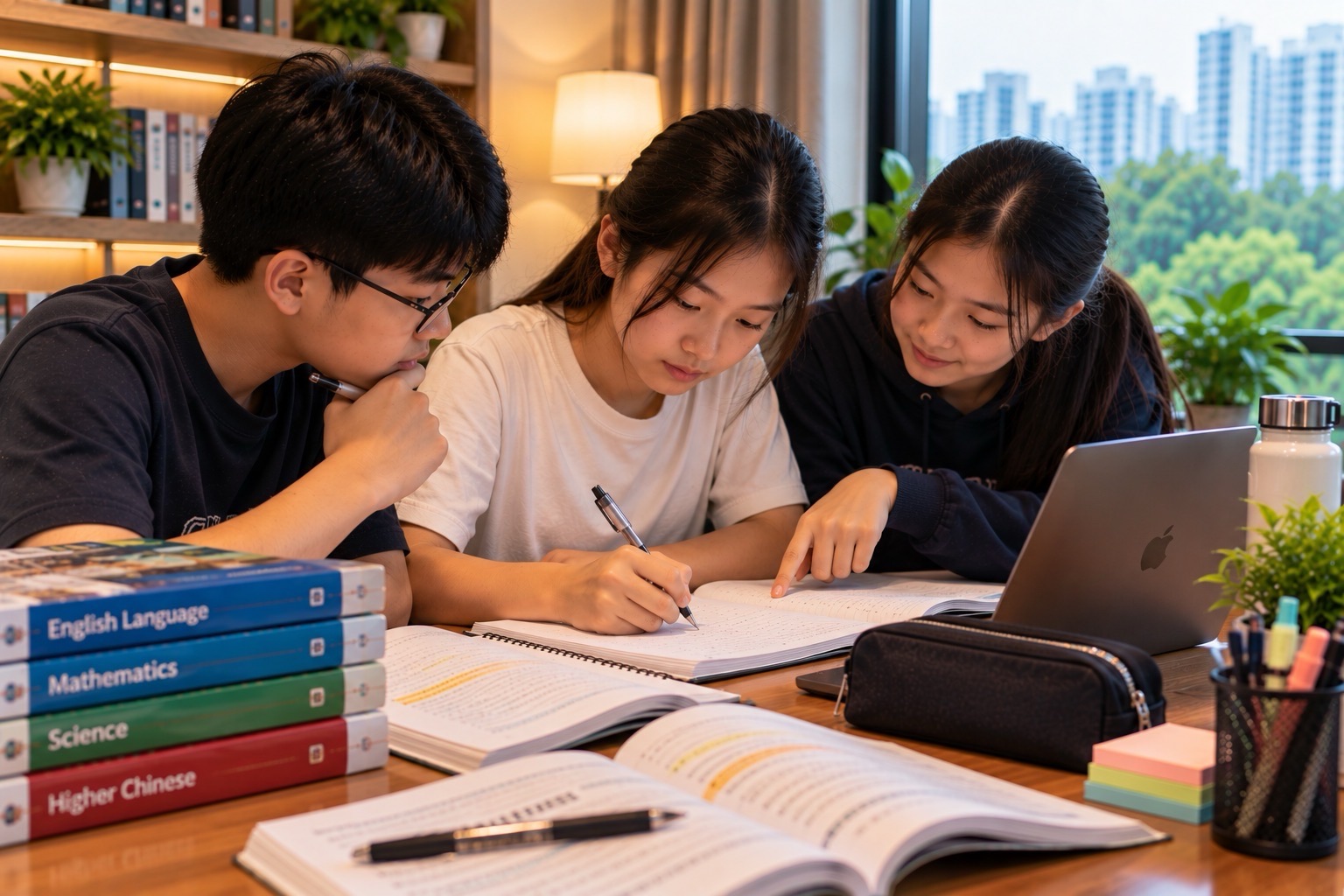
Bowen Secondary School at 2 Lorong Napiri, Singapore 547529, is a co-educational government secondary school in Hougang that eligible Punggol families can consider through Posting Group 2 (PG2). For the completed 2026 Secondary 1 intake, the historical PG2 PSLE Score range was 21–24, with 24 the last admitted score in that group. This previous intake result does not guarantee admission in 2027. A parent should check the pupil’s formal Posting Group eligibility, the current MOE SchoolFinder range, the school’s offerings and the actual daily journey from Punggol before ranking Bowen in the Secondary 1 choice form.
Bowen’s distinctive programme is Bowen ChANgeMakers, which combines Applied Learning in Business and Entrepreneurship with Learning for Life in Community and Youth Leadership. In Secondary 1, students use design thinking to identify school problems and pitch practical solutions; in Secondary 2, they engage in structured service and design projects with community partners. Bowen also publishes a targeted AForte Applied Learning Modules programme for students studying predominantly G1 and G2 subjects, aimed at developing Attitude, Attendance, Academic performance and Aspirations. A pupil’s opportunities therefore involve different levels of participation: core school-wide learning, relevant G1/G2 support, optional enrichment and selected leadership activities should never be advertised as one guaranteed package.
- School: Bowen Secondary School, 2 Lorong Napiri, Hougang, Singapore 547529.
- Historical 2026 PG2 range: 21–24, using PSLE 2025 results; not a future 2027 cut-off.
- Full SBB: PG2 is used for admission; G2 and G3 describe individual subject curriculum levels.
- ALP: Business and Entrepreneurship, emphasising authentic application and creative problem-solving.
- LLP: Community and Youth Leadership, emphasising service, character and responsibility.
- Signature integration: Bowen ChANgeMakers, connecting social entrepreneurship with design thinking.
- Secondary 1: School-focused problem identification and prototype pitches over two terms.
- Secondary 2: A published five-week combination of service learning and design thinking with community partners.
- Upper secondary: ChANgeAdvocates and Bowen Congress, encouraging sustained advocacy and reflection.
- AForte: Applied Learning Modules particularly for pupils taking predominantly G1/G2 subjects, developing the four As.
- BowenEXPLORE!: Student-directed interest learning during designated HBL time, with Heart, Body, Mind and Soul domains.
- Next step: Verify the child’s actual group, programme participation, 2027 school instructions and travel route before choosing.
Definition lock: Bowen PG2 is not the old Normal (Academic) stream
Posting Group 2 is part of Singapore’s Secondary 1 placement process under Full Subject-Based Banding. It identifies a route by which pupils may enter a school and gives a broad starting reference for academic learning. G2 refers instead to the syllabus level of a particular subject. A child can enter Bowen through PG2 and have different eligible subject levels across the timetable, rather than being permanently defined by one whole-student academic stream.
This is especially important because Bowen’s AForte programme refers to students taking predominantly G1 and G2 subjects. That description concerns an appropriate group of learners for a targeted educational experience. It does not mean every PG2 pupil is identical or that AForte can determine what a student is capable of doing throughout life.
The right conversation begins with the child’s specific strengths and needs. One learner may be confident in a design challenge but need help explaining the evidence in writing. Another may be academically secure yet uncomfortable speaking to adults about a community problem. A third may enjoy technical work but struggle with daily organisation.
Bowen’s programmes offer contexts in which these abilities can develop. Admission, individual academic levels and selective enrichment remain different decisions, and they must be explained separately.
What the 2026 historical PG2 range tells a parent
Bowen’s 2026 intake recorded a PG2 range of 21–24. Lower PSLE totals represent stronger aggregate results, and 24 was the last admitted score for that group. The number reflects the completed exercise for pupils who sat the PSLE in 2025. It is not a predetermined minimum or maximum for the following year’s applicants.
A Punggol pupil obtaining score 24 for the 2027 intake might reasonably investigate Bowen. However, the school could be more or less sought after in the new exercise. Vacancies, other applicants’ results, preference order and official tie-break rules determine admission. Parents should not equate the previous last admitted score with a reserved seat.
There is another potential error. Bowen’s PG3 and PG1 figures differ from PG2’s. These groups must not be compared as though they are one universal school-ranking scale. A child may have a permitted Posting Group choice at certain PSLE scores and needs to understand that decision before ranking institutions.
The historical range belongs in a shortlist alongside actual teaching, programmes, travel and support, not at the top as the only measure of school quality.
Bowen’s location and the Punggol commute
Bowen is at Lorong Napiri in Hougang. A Punggol family may have a reasonable public transport route, but the convenience depends on the actual household address and school-day timing. The nearest school on a straight-line map is not always the easiest to reach, and a bus service that is comfortable at noon may be crowded in the morning.

Parents should practise the real journey with the pupil. Identify the relevant stop, correct direction, crossing and school entrance. Include time for walking and a backup if a transfer is delayed. An independent Secondary 1 pupil can gradually learn those decisions rather than relying indefinitely on a parent to manage every detail.
Test the late-CCA journey too. A pupil who attends a sports or performing arts activity may get home substantially later than on an ordinary classroom day. Food, sleep, homework and family time are all affected.
If Bowen’s educational environment is a strong match, a longer commute may be a reasonable trade-off. But the family should understand its real cost rather than assume “Hougang is nearby” resolves every transport question.
Business and Entrepreneurship: what the ALP means
Bowen’s 2026 official signature-programme page identifies Business and Entrepreneurship as a focus of its Applied Learning Programme. The idea is to connect learning with real-world situations, encourage integration across subjects and develop creative problem-solving. This is not an assertion that every pupil will run a registered company or become a successful entrepreneur while at school.
Entrepreneurship begins by recognising a need and thinking about how a useful solution can be delivered. Students might consider a product, a service or a community initiative. They need to understand users, costs, practical constraints and evidence. The strongest proposal is not necessarily the one with the most complicated technology or dramatic pitch.
For a PG2 pupil, authentic problem-solving can provide reasons to strengthen academic skills. Mathematics may be needed for comparing costs, while English helps communicate clearly and Humanities helps understand people’s circumstances. The experience can motivate learning without replacing formal subject mastery.
The school should explain which activities are delivered to the whole cohort and which are selective extensions. Parents should not confuse an ALP description with an automatic commercial internship.
ChANgeMakers: integrating enterprise and community service
Bowen ChANgeMakers is the school’s flagship integration of ALP and LLP. The official programme aims to develop empathetic, socially responsible and inventive students who see problems as opportunities to create positive change. The combination is distinctive because a pupil is expected to consider both the practicality of an idea and the people it is intended to benefit.
Social entrepreneurship can be misunderstood as selling something while donating a small profit. A deeper approach asks whether a solution actually addresses a community need and whether it can be sustained. A product that looks innovative but is difficult for a beneficiary to use may have little real value.
ChANgeMakers teaches the student to listen, propose, prototype and reflect. Those steps require cooperation with people who may have very different perspectives. A technically impressive plan can be improved when the user points out an obstacle the designer had overlooked.
Parents can ask the child what assumption changed during a project. That is more informative than a picture of the final presentation.
Secondary 1: ChANgeMakers within the school
Bowen’s official 2026 page describes a Secondary 1 programme lasting two terms, in which pupils use design thinking to find ways to improve their school environment or community. The examples include learning needs, classroom cleanliness, canteen queues and environmental protection. Students consider perspectives of pupils, teachers, cleaners, stallholders and security staff.
These examples show why empathy comes before pitching. A proposed solution to a canteen queue may look sensible to students but create extra work for stallholders. A classroom-cleanliness idea may fail if it ignores available supplies or actual responsibility. The team should consult appropriately and test its assumptions.
The programme culminates in presentations where pupils pitch ideas and answer teachers’ questions. That makes the accuracy of explanation important. A good pitch identifies the problem, shows the evidence and explains the design’s limitations without pretending success is certain.
A PG2 child who finds formal essays difficult may discover motivation through explaining a project the team genuinely worked on. That learning can then be connected to clear English writing.
The student’s first design-thinking cycle
A simple cycle can begin with identifying the user, defining the problem, developing several ideas, building a prototype and obtaining feedback. None of those stages should be skipped merely because one idea feels exciting. The first proposal is a hypothesis about what might help, not a personal identity the child must defend.
Suppose a group considers a school noticeboard that pupils often overlook. Before building a digital replacement, the team should investigate whether the issue concerns location, confusing language or the timing of updates. If information remains difficult to find, a different format may help. If the information itself is incomplete, new technology might not solve anything.
A pupil learns how to separate a symptom from a cause. This reasoning transfers to academic work. When an algebra answer is wrong, identifying the first invalid step is better than changing the final number at random.
Parents can ask the teenager to describe which solution the group considered but rejected. Thoughtful rejection can indicate strong learning.
Pitching a solution without inventing evidence
Bowen’s Secondary 1 showcase provides an opportunity for students to present their ideas and respond to questions. A pitch is useful when it persuades through accurate reasoning rather than exaggerated promises. A child should be able to explain what was tested, who was consulted and what uncertainty remains.
A common weakness is saying that a design will solve a problem for everyone after one small classroom trial. Responsible communication recognises that results can vary. If only a few users tried the prototype, the pupil should explain that limitation instead of manufacturing percentages or testimonials.
This habit connects with English situational writing and Humanities source analysis. Claims need appropriate evidence and an audience-aware structure. A clear response is often more persuasive than a long collection of sophisticated phrases.
Parents should encourage students to answer a question honestly with “we have not tested that yet” when appropriate. Intellectual integrity is not a weakness in a presentation.
Secondary 2: ChANgeMakers in the community
Bowen’s official ChANgeMakers page describes a five-week Secondary 2 programme combining service learning and design thinking. Pupils engage with community partners and reflect on actual needs. Public examples include MINDS, AWWA and Bright Vision Hospital. These partners provide meaningful historical and programme context, but a school should confirm which arrangements apply to the 2027 cohort.
The programme asks pupils to understand the people they serve before proposing an intervention. A teenager may learn that an activity designed by adults is not always suitable for every beneficiary. Observing respectfully and seeking feedback can reveal what is genuinely useful.
Teachers facilitate reflections after service sessions so pupils can connect experience with values, empathy and responsible planning. This is important: a student who completes an activity without thinking about its impact may learn less than one who carefully identifies an improvement.
The family can ask how the school handles consent, privacy and accessibility when students work with external partners. Those are core elements of good service, not administrative details.
MINDS, AWWA and the need for respectful inclusion
When a school collaborates with organisations serving people with different needs, students must learn to respect individual dignity and agency. A pupil should not assume that a person with a disability requires the same assistance as someone else or should be photographed as part of a class portfolio without consent.
A useful design project might begin by asking whether an everyday activity is accessible, comfortable and meaningful to the participant. The child must be willing to hear that a proposed prototype does not work well and revise it. The affected person’s experience should have more influence than the student’s desire for a successful display.
Parents can reinforce this by asking what the pupil learned from the partner organisation rather than simply what the school students “gave” to others. Service is most valuable as a reciprocal learning experience.
The actual partner for a particular class may vary. Public examples do not guarantee identical encounters for every subsequent cohort.
Bright Vision Hospital and healthcare-related service
Bowen’s public programme references Bright Vision Hospital among the community partners involved in the Secondary 2 ChANgeMakers experience. Working in a healthcare-related context requires particular respect for professional rules, confidentiality and the needs of patients and staff. Students should follow school and partner guidance rather than attempt independent activities in a clinical setting.
The educational purpose is not to let teenagers practise medicine. It is to build empathy, communication and practical understanding of community needs. A student may become more aware that a simple design or activity must accommodate different physical capabilities and daily routines.
The child should be able to describe the community issue without disclosing personal health information about participants. A school project can be thoughtful and specific while preserving dignity and privacy.
Parents should not claim that this experience guarantees a nursing qualification, hospital internship or future job. Later pathways have their own formal prerequisites and selection processes.
From observation to a useful prototype
After meeting community partners, Bowen students use design thinking to consider problems identified during the service experience. The official page describes prototypes pitched to panels including teachers and staff from partner organisations. This structure can improve realism because the people familiar with the issue can challenge the student’s assumptions.
A good prototype needs to be understandable, appropriate and feasible. If a team proposes equipment requiring expensive maintenance, a partner might point out that it cannot be sustained. A pupil who learns to simplify the idea has gained a valuable engineering and social lesson.
Students should record what feedback they received and how they responded. A final product may not be implemented, but the educational process can still develop design, listening and evidence-based decision-making.
A parent should distinguish the school’s planned learning process from guarantees that every project will become a real product adopted by a welfare organisation.
Upper-secondary ChANgeAdvocates and Bowen Congress
Bowen’s official signature-programme page describes ChANgeAdvocates in upper secondary, allowing students to champion social causes and present work at Bowen Congress. Older pupils can take greater responsibility for choosing beneficiaries, analysing needs and developing a sustained case for change.
Advocacy should remain grounded in accurate information. A pupil who cares deeply about a cause may be tempted to use dramatic statistics without checking them. Good leadership requires verifying the facts, understanding diverse perspectives and choosing a realistic action.
A student may also discover that community improvement requires long-term work rather than one event. Projects can benefit when older pupils document their experience so younger cohorts understand what succeeded and what still needs attention.
Selected pupils interested in advanced design thinking may join additional interest-group experiences. Those selective pathways should not be described as automatically available to every PG2 entrant.
Social entrepreneurship beyond selling a product
The ChANgeMakers programme makes entrepreneurship relevant to community development. A social entrepreneur identifies a need and designs a practical way to address it; sometimes a product is involved, while other times the intervention is an activity, process or service.
For a school pupil, the learning might involve comparing the cost and usefulness of two options, testing accessibility or communicating with a specific audience. Formal financial literacy matters, but profit is not the only measure of success. A community organisation may value simplicity, reliability and dignity more than commercial novelty.
A child who understands the difference between a buyer, a user and a beneficiary is developing deeper reasoning. Those parties may have different needs and influence over a solution.
Parents should ask how the student decided whether the project worked, not just whether it was selected for a showcase.
AForte: a focused programme for predominantly G1/G2 learners
Bowen’s AForte Applied Learning Modules are particularly relevant to this PG2 series. The official programme explicitly describes itself as a signature ApLM for pupils studying predominantly G1 and G2 subjects. The name refers to discovering one’s forte: a strength or skill in which a person can excel.
It is important to explain this accurately. AForte is not the same as the national PG2 admission category, nor is it a new examined G2 subject. It is a structured set of experiences intended to develop engagement in school, personal capabilities and awareness of future education and work.
The school’s stated objectives include four areas: Attitude, Attendance, Academic performance and Aspirations. These are useful because a pupil’s difficulty may be partly organisational, motivational or related to poor understanding of possible pathways rather than simply a weak examination technique.
Parents should ask the school whether the particular child participates and which modules apply. Predominantly G1/G2 does not automatically mean identical needs or identical programme arrangements.
The four As: Attitude
Attitude can mean willingness to learn, respect for others and the ability to respond constructively to correction. It should not be reduced to an adult telling a teenager to think positively in every situation. A pupil who is genuinely confused needs an explanation, not a scolding disguised as motivational advice.
AForte’s Building Self experiences are described as supporting emotional awareness, responsible decisions and positive relationships. Those capabilities can help a teenager manage challenges in a mixed form class, CCA or project. A child who understands how to ask for help is better equipped to address an academic gap.
Parents can encourage the pupil to identify one behaviour they want to practise, such as recording homework accurately or checking work before submission. Success should be observable and manageable.
A meaningful attitude programme recognises the student’s actual circumstances, rather than assuming every difficulty reflects poor character.
The four As: Attendance
Regular school attendance creates opportunities for learning, relationships and participation. However, attendance problems can arise for different reasons: illness, family circumstances, transport, school avoidance, fatigue or difficulty with peers. A good support plan investigates the cause instead of treating the number of missed days as the entire explanation.
Bowen’s AForte approach includes attendance in its four As. Parents can discuss punctuality and the practical school journey, while also recognising that genuine health and safety concerns require appropriate school procedures.
A pupil who is repeatedly late because the journey is unpredictable may need an earlier departure or better transport plan. Another who avoids school because of bullying may need safeguarding and support, not merely a reminder to leave home sooner. Different causes require different responses.
The aim is reliable participation supported by a workable routine and respectful school-home communication.
The four As: Academic performance
Academic performance should be understood through actual subject-level work. A pupil studying G2 Mathematics may struggle with algebraic distribution while being confident with graphs. Another may write fluent English sentences but fail to address comprehension questions precisely. A single aggregate percentage will not identify what each needs.
A productive intervention starts by inspecting the marked answer. Locate the first incorrect reasoning step, teach the missing concept and ask the child to apply it to a changed example. Revisit the idea after several days to check retention.
The AForte programme may support engagement and study habits, but it does not replace the ordinary English, Mathematics, Science and Humanities curriculum. Teachers should maintain the educational standards of the task while giving appropriate support.
Parents should celebrate genuine improvements in understanding and independence, not only the pursuit of a higher G-level label.
The four As: Aspirations
Aspirations in AForte involve helping pupils imagine realistic post-secondary options and identify the skills needed to reach them. Bowen describes exposure to ITE courses, polytechnic opportunities and career-related elective modules. This matters because a teenager may work more purposefully when an academic subject has a visible connection to a meaningful interest.
A pupil who likes photography may discover that a related course still requires clear English, technical knowledge and project organisation. Another interested in engineering may realise that Mathematics is foundational. The point is to connect school learning with possibilities, not guarantee admission.
Parents should encourage the pupil to explore several options without locking in one occupation at thirteen. Actual SEC subject levels, grades and future admissions criteria determine eligibility at graduation.
An informed aspiration is both ambitious and accurate: “I want to learn what the course involves and improve the relevant skill” is more productive than assuming one programme will be available automatically.
AForte Sports Discovery
Bowen’s AForte page describes Sports Discovery sessions introducing students to activities such as bowling, kin-ball, fencing, golf and self-defence techniques. These experiences allow pupils to explore movement and perhaps discover a capability or interest outside familiar school games.
The educational purpose is not to produce an elite athlete from every participant. A pupil may gain confidence trying something new, learn safety procedures or discover that teamwork is enjoyable in an unfamiliar activity. Another may decide the activity is not a personal interest, which is also useful information.
Parents should distinguish these programme sessions from a regular school sports CCA. Attending an introductory fencing activity does not automatically make the pupil a member of a competitive team.
The school determines safety, equipment and scheduling. Families should not reproduce specialist activities unsupervised at home because they appeared in a publicity list.
AForte Elective Modules and industry awareness
The official AForte description lists elective-module examples including Aeronautics, E-Entrepreneurship, Food Science Culinary, Photography and Mechatronics. The exact selection and availability may change, and pupils do not necessarily attend every named module. The school also arranges exposure to ITE and polytechnic environments.
A student should use such experiences to understand real learning tasks. Does a culinary programme involve accurate measurements and safe procedures? Does photography require planning and visual communication? Does mechatronics combine mechanics with control systems? These questions turn a short module into useful career exploration.
Parents may be tempted to describe every module as a guaranteed route to a diploma. That would be misleading. The experience can build interest and inform choice, while future admissions depend on actual qualifications and requirements.
Encourage the child to write a short reflection: what was enjoyable, what was difficult, and what further information would help decide whether to pursue the field.
The CARE-bean Corner
Bowen’s AForte page describes a CARE-bean Corner activity space next to the school hall. It developed from the earlier Project Cabin collaboration with Singapore Children’s Society and provides student-centred activities, games and opportunities for healthy social interaction.
Such a space can be valuable for school engagement when it helps pupils build positive relationships and feel comfortable participating in school life. The presence of games does not mean the school has abandoned academic expectations; it recognises that belonging and wellbeing support learning.
A parent should ask how the school manages access, supervision and the role of the Care Team, especially if the pupil has difficulty forming friendships or needs a constructive after-school environment. The current arrangements should be confirmed before treating the space as automatically open at every hour.
School wellbeing initiatives are not substitutes for formal counselling or specialised help where serious difficulties exist. They are one part of a broader support system.
BowenEXPLORE! and independent learning
Bowen’s October 2026 BowenEXPLORE! page describes one hour on each designated Home-Based Learning day for pupil-directed exploration. Students choose topics within broad areas of Heart, Body, Mind and Soul, complete learning at their own pace and reflect on what they discovered.
This differs from ordinary subject homework. The learner is given some autonomy to decide what they wish to investigate and how to represent the result. The educational objective is self-directed learning, not simply finishing a teacher-supplied worksheet.
A pupil who chooses a photography topic may need to define what they want to learn, seek reliable materials and reflect honestly. Another who explores a fitness skill may need to understand appropriate safety and progress. The school provides the framework, while the child gradually owns the learning decisions.
Parents should allow room for curiosity without doing the project for the teenager. An authentic modest outcome is more educational than an impressive presentation produced mainly by adults.
Heart, Body, Mind and Soul as interest domains
The four BowenEXPLORE! domains help pupils think beyond a narrow examination focus. Heart may involve relationships and service, Body physical wellbeing, Mind curiosity and intellectual development, and Soul reflection or meaning as defined by the school activities. The actual school resources explain how topics are approved and documented.
The family should not assume that a pupil may choose any activity without constraints. The school guides topic selection and uses SLS lessons for planning and reflection. Some activities may need supervision or be unsuitable for independent work.
A student could use the programme to explore an interest that later informs CCA or education choices. However, the value lies in learning to plan and reflect, not in making every interest serve a future admissions application.
Ask the child why a topic mattered and what they would change after the experience. Such questions encourage ownership and judgement.
Bowen Horizons and FIESTA
Bowen’s signature-programme index describes Bowen Horizons as overseas exposure opportunities for selected Secondary 2 and 3 students and Bowen FIESTA as structured activities that enrich school culture. These programmes can broaden experiences, but the school determines the current itinerary, selection and year-level arrangements.
An overseas opportunity should be evaluated by the learning objectives and practical conditions. A pupil can develop cultural understanding through respectful contact and reflection, but a previous trip photograph does not guarantee a particular 2027 destination or place.
School-wide enrichment activities can support friendships and confidence. A family should ask how shy pupils are included and what the child actually learns rather than assume every activity is equally meaningful for everyone.
The ordinary academic timetable remains the core of school life, so parents should balance extension opportunities with rest and sustained subject learning.
Full SBB and the Bowen academic timetable
A PG2 pupil enters Bowen through the posting system and receives an actual subject-level offer. The pupil may study different subjects at G2 or other eligible levels under Full SBB, while attending mixed form-class and common curriculum experiences with classmates of varied strengths.
A new teenager may need time to understand which room and teacher correspond to each levelled lesson. A simple timetable, one assignment record and confidence asking questions can prevent avoidable confusion. Parents should check school-issued booklists before buying materials, especially if some subjects are offered at a level different from the child’s general admission group.
A strong result in one G2 subject may create opportunities for later adjustment under school and MOE criteria, but the change is not automatic. The student needs sufficient independent understanding and readiness for the additional demand.
The aim is suitable challenge and an encouraging school environment, not a permanent competition among pupils’ subject levels.
G2 Mathematics: cost, ratio and financial reasoning
Business and entrepreneurship projects can give purpose to mathematical ideas. Pupils may compare prices, calculate proportions, interpret simple revenue and expense scenarios or examine a graph. The student should understand that the context changes but the mathematical principle remains consistent.
Suppose a child writes 4(x + 3) = 4x + 3. The error is failing to distribute the multiplier to both terms. The correct reasoning is four groups of x + 3, giving 4x + 12. The teacher should explain the structure and then test a changed example independently.
Another student may know the distributive law but misread a word problem. That learner needs accurate interpretation of quantities and relationships, not simply a larger worksheet of the same algebra pattern.
Parents can ask the teenager to explain one calculation used in an ALP prototype without copying a spreadsheet’s output. Independent reasoning is the key measure of understanding.
G2 English: pitching and answering questions
A ChANgeMakers pitch requires clear communication with a particular audience. Students must state the problem, explain their proposed method and provide relevant evidence. A speech that sounds impressive but makes unsupported claims is weaker than a concise explanation that acknowledges limitations.
The same approach supports formal G2 English. For comprehension, use claim, evidence and explanation: what does the passage imply, which words support that inference, and how does the evidence justify the response? For situational writing, identify audience, purpose, tone and required details.
A student who is confident in conversation may still need help organising written paragraphs. Another who writes well may be nervous answering questions aloud. Different skills require different forms of practice.
A family can support both without insisting that every presentation be perfectly polished. Accuracy and growth are more important than performance anxiety.
Science and evidence in practical projects
An entrepreneurial or community project may include technical claims about a material, health, transport or environmental benefit. Pupils should learn to distinguish observation from a scientific conclusion. One successful demonstration does not prove a solution always works.
A useful group tests assumptions and records what happened. If several variables were changed together, it may be difficult to know which caused the effect. If only a few people tried the prototype, the team should acknowledge the limited scope of feedback.
These are skills relevant to G2 Science, where formal answers often require explaining mechanisms and supporting conclusions with evidence. The applied context can motivate the child to understand rather than memorise.
Parents can ask which claim the team is most confident about and which still needs more testing. A careful acknowledgement of uncertainty demonstrates maturity.
CCAs and school belonging
Bowen publishes CCAs across sports, performing arts, uniformed groups and clubs. Its DSA information for 2026 highlights Entrepreneurship, Community Youth Leadership, Marching Band, Badminton and Football, with separate selection requirements. A pupil should distinguish ordinary CCA participation from DSA and selected competition opportunities.
A child may enjoy a team or performance activity that is unrelated to the academic subject level. Such experiences can provide friendship, responsibility and confidence. Parents should ask about realistic attendance, training times, equipment and the journey home after CCA.
LEAPS 2.0 recognition follows formal MOE categories and school records. A club name or one service event is not an automatic bonus point entitlement. The family should value sustained learning and contribution rather than choose activities solely for admissions calculations.
An appropriate CCA is one the teenager can engage in consistently without undermining health and schoolwork.
How DSA interacts with PG2
A pupil may apply through Bowen’s DSA talent domains before the PSLE result is known. The school’s official 2026 page gives dates and requirements for that completed exercise, but parents preparing for 2027 must use new MOE and school instructions rather than recycle last year’s calendar.
A Confirmed Offer remains conditional on the student qualifying for a Posting Group offered by the school. Talent does not override the academic group-compatibility requirement. A successful allocation also requires a commitment to the school and relevant activities.
A student interested in entrepreneurship can show genuine projects and reflection; a sports pupil can describe real training and participation; a leadership applicant can discuss actual responsibilities. Adults should not fabricate achievements or create a portfolio that the child cannot explain.
An unsuccessful DSA application does not remove the ordinary S1 posting option or the opportunity to develop an interest after admission.
A four-week start if the pupil is posted to Bowen
During the first week, focus on transport, reporting instructions, classrooms and subject levels. In the second, build a reliable assignment record and identify how school communications arrive. During the third, ask what the child enjoyed about ChANgeMakers or another learning experience. In the fourth, review one recurring academic gap and discuss it with the teacher if needed.
This is a suggested home routine, not a school-issued orientation timetable. Bowen’s actual current instructions take priority. A new Secondary 1 pupil may need time to form friendships and learn the school culture before taking on many extra activities.
If the teenager feels anxious about a pitch or group project, ask what part is difficult. The issue may be unfamiliarity with the audience, uncertainty about the reasoning or a social concern. Each deserves a different response.
A positive transition means the child becomes better able to participate, organise work and seek help independently.
Three hypothetical Bowen PG2 pupils
The practical problem-solver. A PG2 pupil enjoys designing solutions for school problems but struggles with formal English presentations. Bowen’s Secondary 1 ChANgeMakers experience offers a context for learning clear claims and evidence. The family practises a concise explanation and lets the child answer new questions independently.
The learner seeking direction. Another pupil finds some academic subjects difficult and has no clear future interest. AForte may provide relevant applied modules, strengths discovery and career exposure if the school includes the child. The parent asks about actual participation rather than treating the programme as an automatic qualification.
The service-minded teenager. A third student is interested in community work but tends to assume their own ideas are best. Through appropriate service and design thinking, the pupil learns to listen to beneficiaries and revise a proposal. The parent recognises empathy and honest reflection rather than only a public award.
These profiles are fictional and do not predict school admission or programme allocation.
Choosing Bowen as one of six schools
Begin with the child’s official PSLE Score and permitted Posting Group. Compare Bowen’s historical 2026 PG2 21–24 range with the correct category, remembering that the next outcome can differ. Then investigate the school’s programme, support for individual subject-level learning, CCA and ordinary daily timetable.
Let the student identify a genuine reason for wanting Bowen. Is it the ChANgeMakers approach, the AForte opportunities where applicable, a particular CCA or the school culture? A real reason is more informative than an abstract claim about prestige.
Test transport from home. A pupil may love the school’s activities but struggle with a long late journey. Consider how school, family and independent study will fit together.
Rank all six preferences genuinely under current MOE rules, with realistic alternatives. An old cut-off is a guide, not a guaranteed reservation.
Frequently asked questions about Bowen PG2
Does Bowen Secondary admit PG2 pupils?
Yes. The completed 2026 intake included PG2 pupils with a historical PSLE Score range of 21–24.
Is a score of 24 guaranteed admission in 2027?
No. It is the last admitted PG2 score in the previous intake. The new exercise determines its own outcome.
Is Bowen in Punggol?
No. It is at 2 Lorong Napiri in Hougang, an area Punggol families may consider if the commute works.
What is Bowen ChANgeMakers?
A signature programme integrating Business and Entrepreneurship applied learning with Community and Youth Leadership through social design projects.
Do Secondary 1 pupils take part in a school-focused design project?
Bowen’s published programme describes a two-term Secondary 1 experience that leads to design proposals and pitches about school-related issues. Confirm the current cohort’s schedule.
What does AForte mean?
A Bowen Applied Learning Modules programme for predominantly G1/G2 subject learners, emphasising Attitude, Attendance, Academic performance and Aspirations.
Is AForte a national SEC examination subject?
No. It is an applied-learning and developmental programme, separate from formal examinable G-level subjects.
Does every Bowen pupil attend every ITE elective module?
No. Available modules and allocations depend on the programme, cohort and school arrangements.
What is BowenEXPLORE!?
A student-directed learning initiative during designated HBL time, with topics across Heart, Body, Mind and Soul.
Can a PG2 pupil study some subjects at G3?
Potentially, where eligible and offered under Full SBB. The school’s formal subject-level decision controls.
Does joining ChANgeMakers guarantee LEAPS points or a DSA outcome?
No. Formal co-curricular attainment and DSA selection follow separate criteria.
Does being wait-listed for a DSA place guarantee eventual admission?
No. Allocation depends on the official preference process, vacancies and Posting Group eligibility.
Your Next Step
Read Bowen’s current ChANgeMakers, AForte and BowenEXPLORE! pages alongside MOE SchoolFinder. Ask which programmes the child will actually experience, where the school offers additional support and how applied learning connects to formal subjects. Test the route from Punggol and discuss whether the teenager would enjoy ordinary school life there before ranking the six choices.
This article owns Bowen’s PG2 school profile. The wider Punggol selection guide explains general posting, the other Hougang articles describe different signature programmes, and the separate post-secondary guides cover admissions after SEC.
Official sources and related reading
- Bowen Secondary: Applied Learning and LLP, Business and Entrepreneurship
- Bowen Secondary: ChANgeMakers, Secondary 1–upper secondary
- Bowen Secondary: AForte Applied Learning Modules
- Bowen Secondary: BowenEXPLORE!
- Bowen Secondary: Signature programmes index
- Bowen Secondary: Current DSA and talent information
- Bowen Secondary: The Bowen Experience
- MOE SchoolFinder
- 2026 Bowen historical PSLE group ranges
- MOE Full Subject-Based Banding
- eduKatePunggol: Yuying Secondary PG2 school profile


