
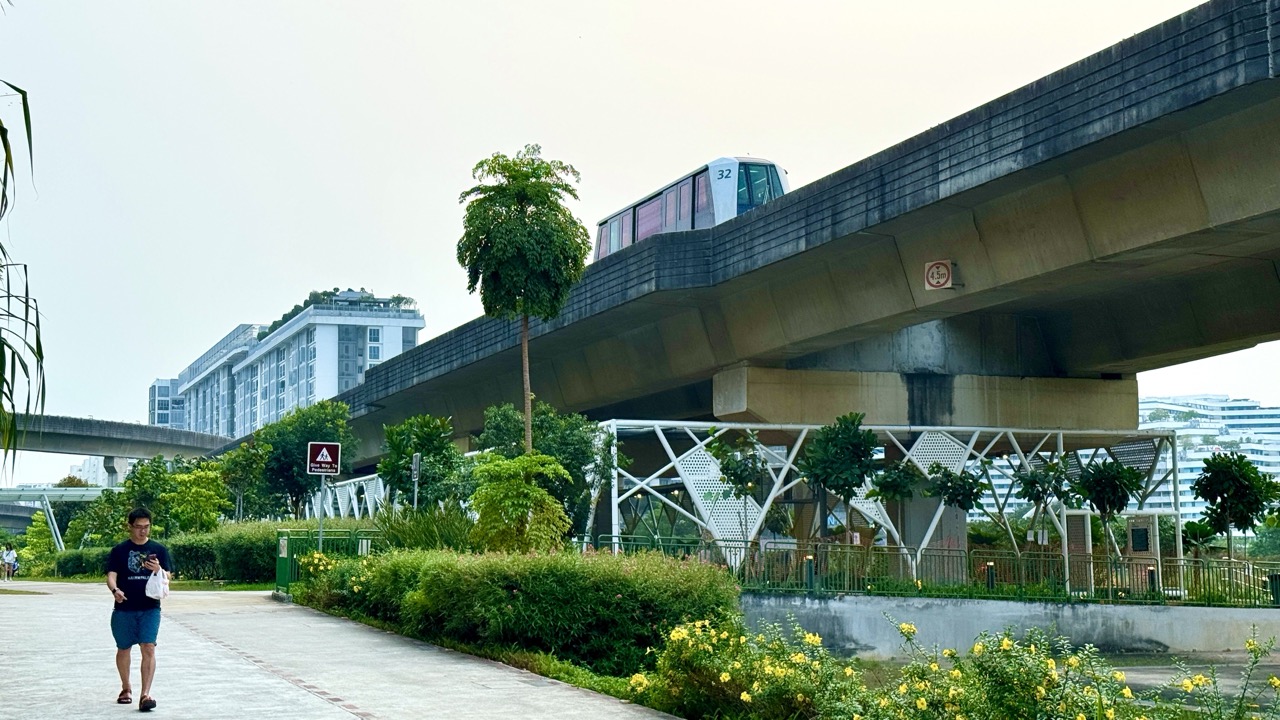
What should Punggol residents expect from the LRT in 2027? LTA says the expansion of the Sengkang–Punggol LRT depot is on track for completion in 2027, supporting the gradual arrival of more two-car trains. Separately, the morning off-peak free rail travel scheme has been extended through 26 December 2027 under the current announcement.
This is a real transport milestone, but not a new LRT line opening, a guaranteed reduced waiting time on every loop or the arrival of all 41 two-car vehicles in 2027. The full 41-train fleet is a 2030 target, while the new depot works, free travel rules and scheduled train deployments each have different dates.

Punggol LRT: the 2027 timeline
| Milestone | What Punggol residents can actually expect |
|---|---|
| Already operating | Punggol LRT East and West Loops, opened from 2005 with 14 stations. |
| 2027 infrastructure target | Sengkang–Punggol depot expands from 3.5 to 11.1 hectares, with more workshop and stabling capacity. |
| Trains | 25 new two-car vehicles in renewal order; remaining 18 after the first seven progressively deployed from early 2027. |
| 2030 milestone | Eight additional two-car vehicles on top of renewal programme, with 41 two-car LRVs in total by 2030. |
| Existing network disruption resolved | Sengkang West Inner Loop reopened on 4 October 2026; not an ongoing blanket Punggol closure. |
| Extended fare scheme | First eligible weekday morning rail trip free before 7.30am or 9am–9.45am, through 26 December 2027 under current announcement. |
| Not promised | Exact Punggol loop vehicle allocation or particular headway changes on 1 January 2027. |
Information checked 29 October 2026 using LTA and the Ministry of Transport. Future fleet deployments and service adjustments should be confirmed by updated official announcements.
Why 2027 matters to Punggol LRT commuters
Did you know that 2027 is a real infrastructure milestone for the Sengkang–Punggol LRT, even though Punggol LRT itself opened back in 2005? LTA’s 2 October 2026 release says the expansion of the Sengkang–Punggol LRT depot is on track for completion by 2027. The enlarged facility is intended to support additional two-car trains and make maintenance and train dispatch more efficient.
Residents should distinguish a depot completion target from a promised change to the timetable of their own station. More stabling space and better workshop capacity can make a larger fleet possible; they do not prove that the next train at Kadaloor, Samudera, Soo Teck or Cove will arrive a stated number of minutes sooner on a specific morning.
This article explains what is already operating in October 2026, what the 2027 works mean and what LTA actually says about the subsequent fleet growth.
Punggol has two LRT loops, not a new 2027 line
LTA describes the Punggol LRT as a driverless system with 14 stations serving residential precincts in two loops, connected at Punggol MRT and bus interchange. The Punggol LRT opened in 2005, while the broader Sengkang–Punggol LRT system also includes the separate Sengkang station and loops.
The East Loop serves established eastern Punggol destinations such as Cove, Meridian, Coral Edge, Riviera, Kadaloor, Oasis and Damai. The West Loop includes places such as Sam Kee, Teck Lee, Punggol Point, Samudera, Nibong, Sumang and Soo Teck. Not every station has the same walking route or nearby facilities.
A household must use the actual direction shown by the operating LRT service rather than assume the loop naming itself settles every train’s calling order, especially if work or operational adjustments occur. In October 2026, the line is operating; the depot expansion is an enabling upgrade, not an announcement of a new route through every estate.
The depot grows from 3.5 hectares to 11.1 hectares
The Ministry of Transport’s rail-development information describes an expansion of the depot from approximately 3.5 hectares to 11.1 hectares. The facility is near Tongkang station in Sengkang and sits above the North East Line depot. It supports both Sengkang and Punggol LRT services.
The scope is more substantial than a platform repaint. The project includes new reception tracks to introduce trains into service, maintenance workshop space and additional traction power facilities needed to operate a larger fleet of two-car trains.
Depots are controlled operational facilities. A resident cannot treat the larger site as a new public attraction or freely enter a train-maintenance workshop. Its importance is indirect: supporting vehicles, inspections, fault diagnosis and a reliable daily service.
Before using the numbers in a conversation about estate development, remember that the expanded depot is in Sengkang, not a new twelve-hectare park in Punggol or extra residential land available for sale.
The October 2026 works have already changed operating conditions
LTA announced on 2 October 2026 that the Sengkang West Inner Loop could resume full service from 4 October, two weeks earlier than the earlier scheduled date of 18 October. This followed work to connect new depot reception tracks and modify the existing running tracks and signalling.
Temporary Sengkang West shuttle buses A and B stopped after the evening peak on 2 October 2026. A Punggol resident who reads an older disruption article must not assume that those replacement buses are still operating indefinitely.
Because the temporary disruption primarily affected the Sengkang West Inner Loop, it should not be reported as a blanket closure of Punggol East or West Loops. Infrastructure work can have network-wide long-term benefits while its temporary local effects are more limited.
For 2027 journeys, confirm the current line-specific LTA or SBS Transit service notice. One older PDF showing a work period is not the same as an active disruption.
The new two-car trains started passenger service in 2025
LTA introduced the first two new third-generation two-car Sengkang–Punggol LRT vehicles for public passenger service on 15 July 2025. By the end of February 2026, seven of the 25 new vehicles were expected to be in service, according to a parliamentary reply published on 12 February 2026.
The other eighteen vehicles in that order are to be progressively deployed from early 2027 onward after depot works, with the precise operating plan determined by demand and readiness. A planned rollout across the entire Sengkang–Punggol network is not a guarantee that each loop receives a fixed number of new vehicles in each month.
Different vehicle generations may operate in the same system for some time. A resident cannot identify the complete future fleet from one photograph of a new-looking train. Dates and the operator’s fleet announcements are the correct evidence.
The practical gain from two-car operation is higher passenger capacity per two-car train and more flexibility to serve changing demand. Actual capacity depends on the number of trains in service, headways and operations at the time.
The 2030 fleet target is forty-one two-car vehicles
LTA’s 2 October 2026 statement said it would procure eight additional third-generation two-car vehicles on top of the existing programme. It expects the total Sengkang–Punggol fleet to reach 41 two-car vehicles by 2030.
The figure is not 41 brand-new vehicles arriving in 2027. It combines the continuing second-generation two-car vehicles, the ongoing procurement to replace the first-generation fleet and the extra eight vehicles to support longer-term demand.
Another way to interpret the change is that the operational system is moving towards a larger, more two-car-oriented fleet over several years. The timeline has more than one milestone: depot work by 2027, replacement vehicles deployed progressively and the 41-vehicle objective by 2030.
Families should avoid making a fixed 2027 journey-time promise from a 2030 fleet number. A procurement decision is necessary for future capacity, but trains still require delivery, safety testing, commissioning and deployment.
What features the third-generation trains add
LTA describes passenger-facing improvements including more ergonomic seats, efficient LED lighting, clearer information displays, visible door-closing lights and better air conditioning. Inter-car doors can help evacuation during an emergency.
For maintainers, new diagnostic panels and more accessible components can assist fault identification and repairs. These are useful operational changes, even if a passenger mostly notices the air conditioning, quieter ride or clearer display.
That does not mean a vehicle can never break down. Reliability is a continuing process involving infrastructure, software, vehicles, staff and maintenance practices. A newer generation reduces or manages some risks but does not abolish them.
Teach children to stay clear of closing doors and to follow staff and signs rather than rely on the train looking modern. Passenger safety depends on behaviour as well as equipment design.
The free morning off-peak travel scheme continues into 2027
Another immediately useful development is the extension of free weekday morning off-peak rail travel on eligible North East Line and Sengkang–Punggol LRT journeys. The programme began on 27 December 2025 and LTA announced a one-year extension on 2 October 2026. Its current official message describes availability through 26 December 2027.
Commuters who tap in at a Sengkang–Punggol LRT station, or at any of the six North East Line stations from Punggol Coast to Kovan, before 7.30am or between 9am and 9.45am on a weekday other than a public holiday qualify for free travel on the first rail trip of the journey.
No prior sign-up is required for the rail waiver, provided a traveller uses the same permitted payment mode to tap in and out. A separate Travel Smart Journeys programme may offer bus-leg rebates for eligible people who sign up, with conditions.
Parents should check whether the actual tap-in time and station qualify. A train departing at 7.29am is not proof that every person who arrives at the ticket gate after 7.30am receives the waiver. The timetable and journey planning should remain grounded in the official fare rules.
Who might benefit from changing a commuting routine
A working adult whose schedule is flexible may save the cost of the first rail leg by tapping in during an eligible morning off-peak period. Someone who must report to work or school during the peak may not be able to change the journey; that person may benefit indirectly if congestion is reduced.
LTA reported in March 2026 that about eight percent of relevant North East Line commuters had shifted out of the morning peak after the introduction of the scheme, and the October 2026 extension followed further observations. Those are programme-level figures, not a promise that every carriage will be ten percent emptier in 2027.
Parents should not shift a child’s school arrival merely to qualify for a fare benefit if doing so creates an unsafe or impractical routine. The total household cost includes sleep, childcare and supervision, not only the fare.
The scheme has an end date under the current announcement. A future extension after December 2027 should not be presumed before LTA or the relevant fare authority announces one.
How East and West Loop residents can plan a 2027 trip
A household near Cove or Meridian on the East Loop may use the LRT to reach Punggol MRT, then transfer to the North East Line for work or shopping. A family near Samudera, Nibong or Soo Teck may make a similar interchange from the West Loop.
Where the journey includes a school, clinic or other destination, the final walking segment still matters. The school at Northshore may be closer to Punggol Point LRT than to the Coast MRT, and a child’s designated campus gate may not be the nearest entrance on a map.
Use LTA’s current rail network map and the MyTransport.SG or operator information for service changes. A longer train or more depot capacity does not alter the legal location of crossings, school entrances or bus stops.
Have a practical backup for a disrupted journey. Teach older pupils how to identify a service advisory and contact a trusted adult without sharing private home or school routines publicly.
How to evaluate progress when 2027 arrives
The first question is whether LTA confirms the expanded depot has been completed and commissioned. The second is how many additional trains have entered passenger service, not only how many were ordered.
The third question is whether the service has improved in ways residents can observe or the authority can measure, such as capacity, reliable headways and fewer disruptions. The fourth is whether the existing free off-peak policy remains available under the published dates.
One needs a date and an accountable source for each claim. A line in a long-term plan, a partial construction milestone and a verified operational outcome are all different kinds of evidence.
The responsible conclusion is that 2027 is an important transition year for the LRT system, while the full 2030 fleet objective remains later.
2027 commuter checklist
- Check the current East or West Loop direction at the actual station.
- Verify whether any announced depot milestone has been completed and commissioned.
- Distinguish ordered vehicles from deployed passenger-service trains.
- Use eligible stations, correct tap-in windows and the same payment method for the free first rail leg.
- Do not move a child’s school arrival simply to obtain a fare saving without a safe and workable plan.
- Use LTA or SBS Transit service advisories for current closures, not a 2026 works poster.
- Plan a real backup for medical, school and work trips.
Frequently asked questions
Is Punggol getting a completely new LRT line in 2027?
No. The Punggol LRT is already in service; the key 2027 target is expanded Sengkang–Punggol depot capacity.
How much larger is the depot?
MOT describes expansion from 3.5 hectares to 11.1 hectares.
Where is the depot?
Near Tongkang station in Sengkang, supporting both Sengkang and Punggol LRT.
Were Punggol’s loops shut because of the 2026 works?
The principal extended closure affected Sengkang West Inner Loop, which resumed full service on 4 October 2026.
How many new vehicles were on order?
Twenty-five third-generation two-car LRVs in the fleet-renewal order, plus eight additional vehicles announced October 2026.
Do all 18 remaining vehicles enter service on 1 January 2027?
No. LTA describes progressive deployment from early 2027 onward based on operational readiness and demand.
What is the long-term fleet total?
Forty-one two-car LRVs by 2030 according to LTA’s October 2026 release.
Will all Punggol LRT rides be free in 2027?
No. The free scheme is for eligible first rail trips starting from specified stations in defined weekday morning windows.
Which morning times qualify for the free first rail trip?
Before 7.30am or from 9am to 9.45am on weekdays excluding public holidays.
How long is the scheme currently extended?
LTA’s 2026 message says through 26 December 2027, subject to later official policy.
Must I sign up to receive the free rail fare?
No separate rail waiver registration; tap in and out with the same eligible payment mode.
Are bus rebates the same as the free rail fare?
No. Travel Smart Journeys is a separate optional scheme with its own enrolment and eligible bus-leg rules.
Official LTA, MOT and SimplyGo sources
- LTA 2 October 2026: depot progress, service restoration and 41-train 2030 fleet
- MOT 12 February 2026 parliamentary reply on 18 LRVs from early 2027
- MOT rail information: depot from 3.5 to 11.1 hectares and 2027 target
- LTA Punggol LRT station network and loops
- LTA 15 July 2025 first new two-car LRT passenger service
- LTA free off-peak travel scheme and eligible hours
- LTA official updates including extension to 26 December 2027
- SimplyGo Travel Smart Journeys programme FAQ
Related Punggol transport guides
- Punggol 2027: North Eastern Riverine Loop and local connections
- Punggol 2027: Seletar Link roads and City Direct buses
- Punggol 2027: Smart Parking at Northshore and Matilda
- Punggol 2027: autonomous shuttles Ai.R, Zig and on-demand rides
- Punggol 2027: Northshore Plaza and Samudera LRT
Editorial note: 29 October 2026. Depot and fleet projections are identified separately from actual passenger operation; the 2027 off-peak fare extension is time-limited and subject to subsequent updates.


