
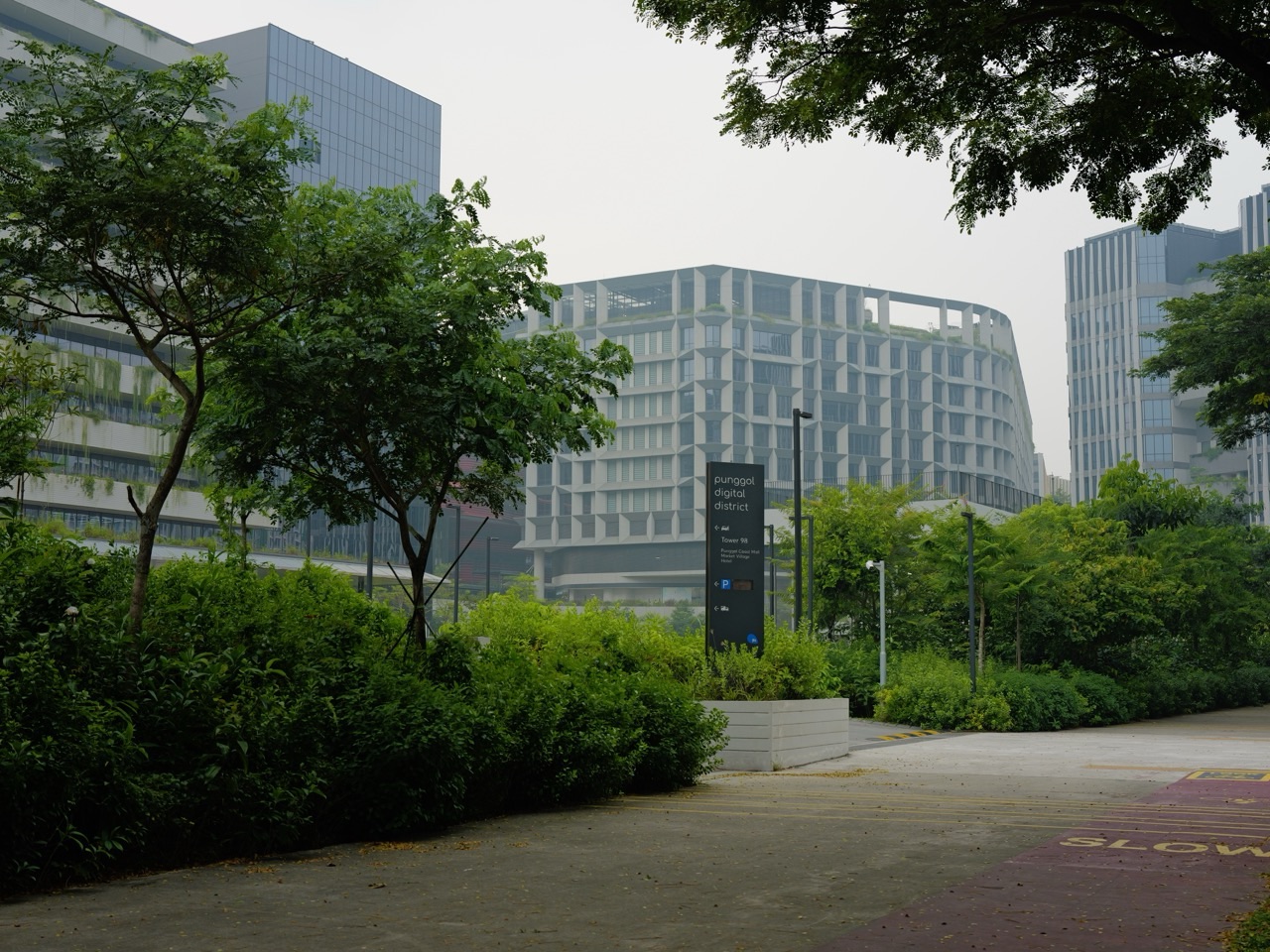
What should Punggol residents expect from the Digital District’s technology systems in 2027? JTC’s operating Open Digital Platform connects information from more than 20,000 sensors across buildings and infrastructure. A July 2026 partnership with Panasonic is intended to test smarter facilities management, while a separate district smart-grid project, rooftop solar design and ENGIE cooling system aim to reduce resource use.
These technologies are not the same as a new 2027 mall opening or a guarantee that nearby HDB residents receive cheaper electricity. Punggol Coast Mall, Hawker Centre and the SIT campus are already present; smart-grid milestones, testbeds and projected savings need to be understood on their own terms.

Punggol Digital District 2027: the verified facts
| Technology or claim | What is established before 2027 |
|---|---|
| Already operating | Punggol Digital District’s mixed-use facilities and the Open Digital Platform; JTC describes 20,000+ sensor feeds. |
| 2026 testbed partnership | JTC and Panasonic announced development and validation of AI-supported facilities-management solutions in July 2026. |
| Smart-grid design target | JTC’s 2024 appointment targeted 2026 completion of a solar, battery and smart-demand district grid; verify its actual phase. |
| Planned solar output | More than 3,000 MWh a year according to JTC’s design figures, not a verified bill discount for every household. |
| District cooling | ENGIE central chilled-water system, designed for over 30,000 refrigeration tons across the district at full build-out. |
| Not established | A particular robot operating everywhere, unfettered access to sensor data, or exact 2027 savings for nearby residents. |
Fact-check position: 27 October 2026. Projected capacity and energy reductions are not measured outcomes unless explicitly reported as such by the authority or operator.
What is genuinely changing in Punggol’s technology district?
Did you know that the Digital District is designed not only as a place for people to work and study but as a place where entire buildings can be measured and managed as one network? Its Open Digital Platform is a real project, and JTC’s July 2026 statement describes more than 20,000 sensors feeding a district-level operating system.
The 2027 story is therefore different from simply announcing another office tower. Students, companies and facilities teams may see smart-system experiments expand as occupancy grows, while ordinary residents already have access to public places such as Punggol Coast Mall, the hawker centre and parts of the Heritage Trail.
However, planned experiments, expected efficiency figures and public access are not all the same thing. The existence of sensors is not a guarantee that every public lift is autonomous or that every neighbourhood household’s electricity bill will fall in 2027.
Punggol Digital District is already a working mixed-use neighbourhood
JTC identifies Punggol Digital District as a 50-hectare business park closely integrated with the Singapore Institute of Technology’s campus. Its ecosystem includes technology employers, government and industry organisations, academic facilities and community amenities.
Punggol Coast MRT has been operating since December 2024. Punggol Coast Mall and Hawker Centre are open, while the first 400 metres of the Heritage Trail are listed as accessible by JTC. Those are places a member of the public can visit now, subject to normal building and path rules.
Business spaces, laboratories and university offices are separate from public routes. A connected digital district is not an invitation to enter secure data centres, plant rooms or private campuses. The safest way to explore is to use the visitor routes advertised by JTC, the mall or event organisers.
The district’s longer-term job and student figures represent capacity or overall vision, not a live tally of vacancies. Families evaluating future education or employment should still use named course and employer requirements.
What the Open Digital Platform actually does
The Open Digital Platform, developed by JTC and the Government Technology Agency, combines information from multiple building and district systems rather than forcing each one to operate in complete isolation. JTC’s July 2026 announcement says it receives real-time inputs from more than 20,000 sensors across the district.
Some systems monitor temperature, lighting, energy use, building occupancy and infrastructure conditions. Information is used in district management and research. A digital twin creates a virtual representation that can simulate situations and test proposed changes before operators deploy them into physical buildings.
This is closer to a system for managing an urban environment than a phone app promising residents secret access to every building. Operational decisions, access permissions and safety processes remain the responsibility of the relevant organisations.
For a student, the key idea is the relationship between measurement and action. Collecting data is useful only if someone understands what was measured, how accurate it is and what conclusion can safely follow.
Why the July 2026 Panasonic partnership matters for 2027
On 9 July 2026, JTC announced a partnership with Panasonic Electric Works and Panasonic’s Singapore R&D centre to develop and test smart facility-management solutions through the Open Digital Platform. Panasonic was identified as the first partner to use the platform for this type of live testing.
JTC describes plans for AI-enabled anomaly detection, inspection and coordinated responses to problems in building systems. Panasonic has already developed building-automation and AI-supported inspection tools at its innovation hub, while the collaboration is intended to validate them with actual operational data.
The public announcement is an agreement to jointly develop, deploy and validate technologies. It should not be rewritten as a claim that every proposed system has passed testing, received all approvals or been installed in every tower by January 2027.
Residents may hear about new robotics or maintenance pilots in 2027. The reliable question is which site is involved, whether a trial is approved, what problem is being tested and whether visitors are allowed to participate or observe.
Twenty thousand sensors does not mean unlimited public surveillance
A district with large numbers of sensors can raise understandable questions about personal privacy and corporate data. JTC’s July 2026 statement explicitly says that testbed data shared with tenants is curated and anonymised, and that proprietary tenant and project data is isolated through controlled access, permissions and separate logical zones.
That is a description of the intended governance, not an argument that privacy or security no longer matters. Residents and workers are entitled to expect clear procedures, responsible handling and oversight as technologies are deployed.
Anonymised or aggregate data can be useful for learning about traffic or energy patterns, but permission to use a platform does not give a student or visitor automatic access to all raw information. The distinction between a digital demonstration and actual secure production data should be maintained.
Children learning about smart cities should ask what a sensor detects, what data is retained, who can view it and what protections limit misuse. An ‘AI-enabled’ label is not an adequate answer by itself.
The smart grid: solar power, battery storage and shifting demand
JTC appointed Univers and PacificLight in November 2024 to design, build and operate a district-level smart grid. Its purpose is to integrate rooftop solar panels, battery energy storage and smart management of electricity demand across the business district.
JTC’s earlier release targeted completion in 2026. Its sustainability page describes an intended annual solar generation of more than 3,000 megawatt-hours and an estimated reduction of emissions. A target or design estimate should not be presented as measured electricity already generated throughout 2027 unless the authority publishes the actual data.
The grid is meant to help businesses shift some electricity demand away from peaks and manage energy sources more efficiently. That is not equivalent to every Punggol HDB flat being connected to the same grid or receiving a guaranteed household tariff discount.
EV charging is another potential part of the district-level system. But a planned demand-response or battery-control trial may require regulatory approval and the consent of participating operators. A driver’s own charger availability and tariff should be checked separately.
District cooling: understand how it is different from residential air-conditioning
JTC describes an interconnected district cooling system operated by ENGIE. The design uses central plants to produce chilled water distributed through underground pipes to district buildings, replacing the need for each connected building to operate a large separate chilling plant.
The scheme is described as having combined capacity over 30,000 refrigeration tons at full build-out. JTC states that centralised cooling could reduce energy consumption by up to 30 percent relative to standard commercial-building systems and save an estimated 3,700 tonnes of carbon emissions annually at full development.
These figures are engineering design comparisons and projections. They do not prove that a tenant already pays 30 percent less for cooling in 2027, and they should not be treated as household savings for nearby HDB residents.
As the district opens in phases, cooling capacity can be expanded to match actual occupied buildings. A functioning central plant, the addition of capacity and the real price paid by a commercial tenant are different facts.
How passive building design fits into the smart systems
JTC explains that building design uses simulations to consider daylight, natural airflow and solar heat exposure. These are passive approaches, meaning the shape and orientation of buildings can reduce some demands before machinery and software begin working.
Rooftop solar generation and green spaces add further environmental features. JTC also describes integrating urban farms and conserving trees near the Heritage Trail as part of district planning. These are design intentions and stages of development; not every roof is an open public garden or an operating farm.
A student can compare two principles: reducing the load on a building through shade and ventilation, and managing the remaining load through a smart grid and district cooling. Technology is not a substitute for basic physical design.
For an ordinary Punggol visitor, comfortable shaded routes and public spaces matter more immediately than the sophistication of an internal platform. Their actual condition should be judged by experience and access, not only a sustainability certification.
What the technology means for schools and SIT students
JTC describes the district as a living laboratory connecting industry and applied education at SIT. Companies may use it to investigate practical problems in robotics, cybersecurity, energy and facilities operations.
This creates potential examples for school projects about temperature, energy demand, data quality and the ethical use of automation. But proximity to the district does not grant an individual pupil access to a private laboratory, building control system or proprietary dataset.
Some official outreach and learning visits may be arranged for school groups. Families should use the published programme and registration process. A child cannot simply enter a secure building because the wider district promotes education.
The useful learning principle is to start with a real question and appropriate public evidence. Ask what a system is trying to improve, which variables matter, what a fair comparison looks like and how an experiment can fail without creating a public safety hazard.
What residents might notice in 2027 without false promises
As more students and employees use the district, the public may experience changes in foot traffic, retail demand and how some facilities are maintained. Companies may publicise new approved pilots. These are possible effects of growth, not a quantified prediction that congestion or costs will move by a particular amount.
An autonomous delivery demonstration, if approved, is not proof that deliveries to every HDB block have been launched. A trial may only cover controlled buildings or specific workflows.
Most district technologies will be largely invisible to visitors: data processing, energy dispatch, plant-room systems and predictive maintenance. Their success should be judged by reliable service, measured performance and appropriate governance, rather than by how futuristic a public space looks.
Existing public amenities still matter. A nearby resident may be more directly helped by a working LRT connection, a safe pedestrian crossing and an affordable food option than by any one software experiment.
How to assess a new smart-district announcement
First identify the project owner and the actual scope. Is it JTC’s smart grid, GovTech’s platform, ENGIE’s district cooling, Panasonic’s pilot or an SIT research initiative? These are connected but separate responsibilities.
Then classify the status: design, agreement, prototype, live pilot, approved deployment or measured outcome. A press release about a memorandum of understanding does not certify a finished product, just as a predicted energy saving is not a verified bill reduction.
Next identify who benefits and who can access it. A business tenant may have controlled data access while a resident has access only to public areas. A learner may be invited on an official tour but not enter an operations centre.
Finally check date and measurement. A 2024 project target for 2026 should be revalidated in 2027 before being described as complete. New trials should carry their own dates and relevant safety conditions.
What to check when reading a new 2027 technology announcement
- Name the responsible operator: JTC, Panasonic, ENGIE, an SIT team or another partner.
- Distinguish a design target or MOU from an approved working installation.
- Check whether a claimed energy saving is a projected comparison or a verified measurement.
- Do not infer that district-level smart grid electricity is supplied to every HDB home.
- Ask how data access and anonymisation are governed before a public or school demonstration.
- Use official tour and tenant processes rather than entering private operations spaces.
- Keep 2026 construction targets separate from a 2027 operational confirmation.
Frequently asked questions
Is Punggol Digital District still only a future plan in 2027?
No. The mall, hawker centre, SIT campus and other facilities are already operating, although further phases remain.
How many sensors does JTC describe?
More than 20,000 across the district and its systems, according to JTC’s July 2026 announcement.
What is a digital twin?
A model of physical facilities and conditions used to visualise and test proposed operating changes.
Did Panasonic announce a completed deployment in July 2026?
JTC announced a partnership to develop, deploy and validate solutions; individual rollouts need their own evidence.
Can every resident see the raw data?
No. JTC describes curated/anonymised test data and controlled access for tenant and project information.
When was the smart grid expected to be completed?
JTC’s November 2024 announcement targeted 2026, subject to later project updates.
What is the solar generation target?
JTC projects more than 3,000 MWh annually, a target rather than proof of actual yearly output.
Does the smart grid cut all Punggol HDB utility bills?
No such guarantee exists. It is built around district-level facilities and participating business consumers.
What is district cooling?
Central plants supply chilled water to multiple connected buildings through pipes.
Does 30% energy reduction mean 30% cheaper air-con bills?
No. It is a projected energy comparison for district cooling, not a promised retail tariff.
Can students test robots in any PDD building?
No. Official permissions and programmes govern access and live testbed operations.
Official JTC source material
- JTC: 9 July 2026 Panasonic partnership and 20,000+ sensors
- JTC: 3 November 2024 smart-grid appointment and 2026 design target
- JTC: Punggol Digital District sustainability and solar design
- JTC: ENGIE district cooling system and energy comparisons
- JTC: operating PDD district and education/business ecosystem
- JTC: public facilities and what is open now
- JTC: LaunchPad PDD phases and technology testbedding
Related Punggol neighbourhood guides
- Punggol 2027: Digital District Campus Heart, Nexus and public spaces
- Punggol 2027: Coast MRT, mall and planned hotel
- Future of Punggol: scaling district cooling to 30,000 refrigeration tons
- Future of Punggol: solar canopies and rooftop farms
- Punggol 2027: Digital Hub and Sport Centre preschools
- Punggol neighbourhood guide
Editorial note: 27 October 2026. Sensor figures, technical partnerships and projected energy benefits are derived from JTC publications. This article does not assert live implementation of every planned 2027 pilot or promise individual financial savings.


