
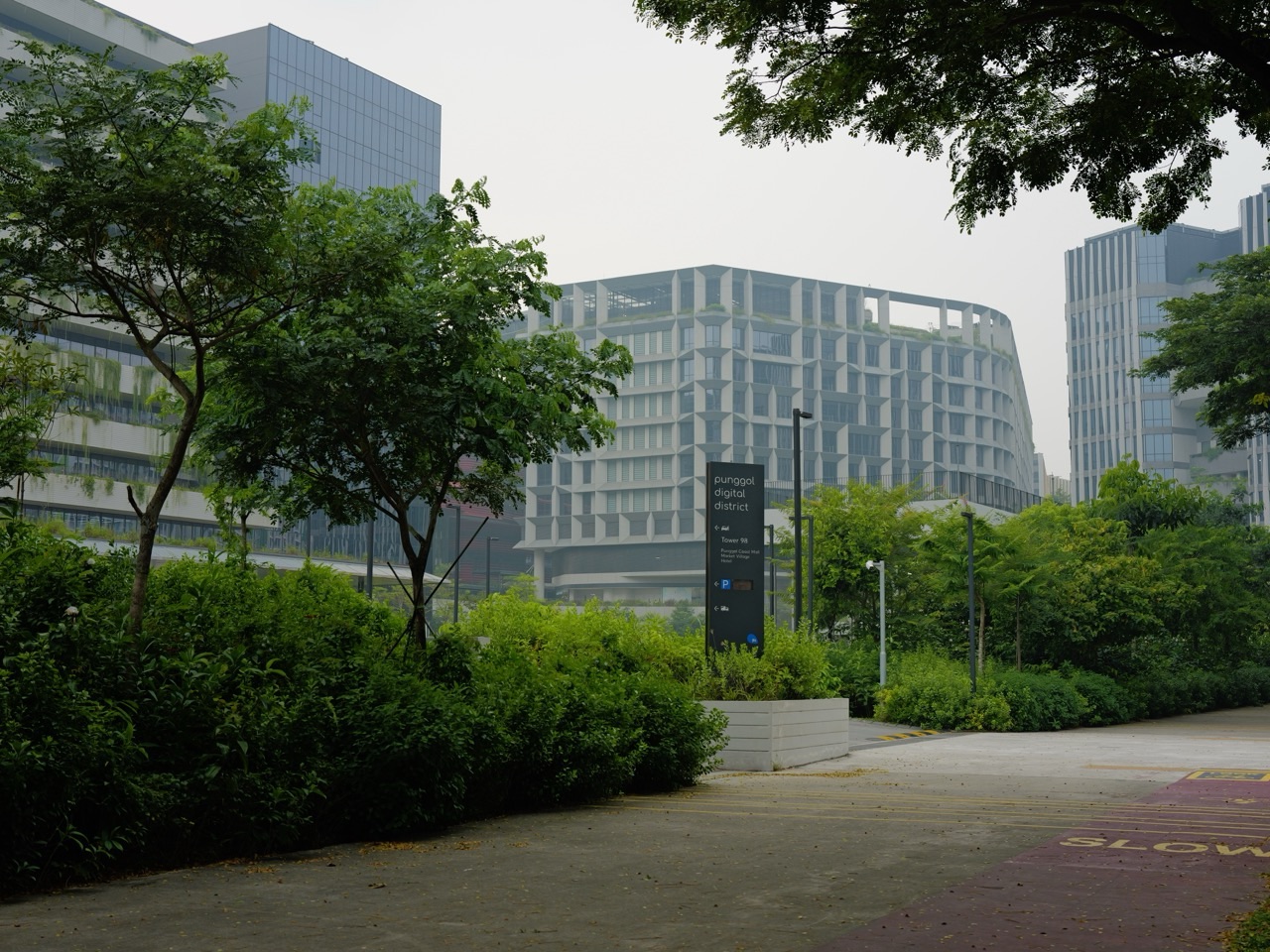
The future of Punggol Digital District depends partly on infrastructure residents never see. A central chilled-water network operated by ENGIE is designed to cool offices, university buildings, shops and other developments as their occupancy grows. Its planned capacity is huge, but the real engineering question is how to scale it efficiently and prove the promised savings.

The answer first: one cooling network, many different buildings
Updated 23 October 2026. ENGIE South East Asia designed, built and operates major parts of Punggol Digital District’s District Cooling System (DCS), a centralised chilled-water network whose combined planned cooling capacity across the district exceeds 30,000 refrigeration tons. JTC explains that an underground central plant sends chilled water to buildings through pipes and heat-transfer stations. The system is designed to support a mix of university facilities, business park towers, retail, community spaces and future uses as the district progressively fills.
The distinctive future story is scalability. A district containing UOB, OCBC, SIT, shops, students and other tenants does not acquire all of its cooling demand at the same instant. ENGIE says the plant has provisions for adding capacity as more buildings become operational and demand patterns develop. This creates the potential to supply cooling efficiently at different stages without requiring every individual building to duplicate an entire large cooling plant.
JTC and ENGIE have associated the cooling system with an estimated up to 30% reduction in energy consumption compared with standard commercial buildings and around 3,700 tonnes of carbon emissions avoided per year at full development. These are stated design or projected benefits, not independently verified savings measured for every month of 2026. The numbers should not be confused with the separate smart-grid estimate of around 1,700 tonnes of emissions reduction.
What is district cooling in plain English?
A conventional large building might have its own chillers to cool water or air. District cooling instead produces chilled water at central plants and circulates it through a managed network, with building-side equipment transferring the cooling to appropriate internal air-conditioning systems. The water flows within an engineered loop; the system is not a public drinking-water service.
Concentrating equipment can offer efficiency and space advantages, especially when different types of buildings need cooling at different times. A lecture theatre may have intense use at certain hours, while an office may peak in the afternoon and a hospitality property may require cooling for longer daily periods. Coordinating demand can allow central systems to be operated more effectively.
District cooling does not remove the need for indoor ventilation, controls or building maintenance. It changes how chilled water is supplied and managed. Residents should not expect cold water from the district system to flow into their household taps.
The meaning of 30,000 refrigeration tons
A refrigeration ton, often abbreviated RT, is a technical unit of cooling capacity rather than the physical weight of the equipment or a quantity of ice delivered to a building. The figure refers to how much cooling the system is designed to provide under rated conditions. It is not an annual electricity-use measure or a monthly bill.
JTC describes interconnected cooling plants with a combined capacity exceeding 30,000 RT. ENGIE’s account refers to nearly 30,000 RT for its PDD system. Those public descriptions should be read with their stated scope: combined district design and operator system capacity. A writer should avoid treating minor differences in rounded figures as evidence of an unannounced extra plant.
Actual consumption depends on temperature, occupancy, building type and operating systems. A maximum technical capacity is not proof that the network runs at maximum output every hour.
Why the expansion is phased
Punggol Digital District is not one building handed over in a single week. SIT’s campus has been operating while commercial tenants occupy business park space progressively and additional facilities develop. JTC’s own guide describes different tenants and amenities reaching operation at different times. The cooling system therefore needs to handle changing loads without becoming inefficient during the transition.
ENGIE says its underground plant has space and arrangements to add capacity as the district grows. Instead of commissioning the entire future output for a small initial load, operators can monitor demand and bring equipment into use appropriately. Expansion needs coordination with buildings already operating, including continuity of their required cooling.
The public sources do not establish an exact date when every future cooling module will be commissioned. “Primed for future expansion” is a design feature, not a claim that all available capacity is actively in use on 23 October 2026.
Why cooling demand differs between buildings
A university campus has classrooms, laboratories, workshops, libraries and offices. Demand varies when lectures end, examinations begin or equipment is running. A technology office has workers, server or equipment rooms and different meeting patterns. A mall has retailers and crowds; a hotel can have guests around the clock. Their cooling patterns are not identical.
When connected to a coordinated system, some diversity can be useful because peak demand may not occur simultaneously. This can support more efficient use of central equipment, though the amount of benefit depends on actual patterns. If all major buildings suddenly peak together, demand management becomes more challenging.
JTC and ENGIE describe the need to customise the system to the different building services. The strongest future outcome will be one supported by measured load data, not an assumption that mixed land use guarantees perfect efficiency.
The 4-kilometre underground pipe network
JTC’s Green Mark District announcement describes a 4km underground chilled-water pipe network serving its business park. This physical network is part of what makes central cooling possible. Pipes move chilled water between production and users while limiting unwanted heat exchange and managing circulation.
A four-kilometre pipe network is not a public walking tunnel, and it should not be confused with the district’s elevated Collaboration Loop or ground-level Campus Boulevard. The pipes form part of managed infrastructure to which visitors have no general access rights.
The network also creates maintenance obligations. A central system needs a plan for inspection, fault isolation and repair while minimising disruption to dependent buildings. Longer infrastructure does not automatically mean better service; operation and system design matter.
Why the plant is underground
PDD intentionally moves several major utilities and service functions below the primary public level, helping reserve more ground space for pedestrian activity, parks and social areas. The district cooling plant fits within this three-dimensional approach. Underground facilities are less visually prominent, while the public realm can be used for gardens, sheltered movement and gathering.
A large central plant can also free individual building owners from dedicating as much roof or technical floor space to standalone chiller equipment. That may create opportunities for other functions, such as solar panels or accessible landscaped terraces, subject to actual approved designs. The benefit is a planning option rather than an automatic public amenity.
Subterranean cooling equipment still requires access, ventilation, drainage and appropriate fire or building safety arrangements. Putting systems underground makes them less visible; it does not remove their engineering complexity.
Thermal energy storage: cooling can be shifted in time
ENGIE describes energy storage alongside central chilled-water circulation as part of balancing production and demand. In district cooling, thermal storage can hold cooling capacity for later use under appropriate operating conditions. This can reduce the need to produce all required cooling at the precise moment occupants demand it.
The practical value depends on storage size, losses, pumping, electricity tariffs and future demand. A storage tank or other thermal system is not automatically an ordinary electrical battery, though both can contribute to managing energy over time. The project’s specific storage technology should be described accurately rather than using a generic battery metaphor for everything.
The best operating strategy should maintain occupant comfort while avoiding unnecessary peaks and energy waste. That requires controls and measurement, not a simple instruction to shut cooling down whenever power is expensive.
How the chilled water reaches a classroom
A simplified model begins at the central plant, where water is cooled and circulated through an engineered network. At a building, transfer equipment makes cooling available to the relevant air-conditioning distribution systems. Heat picked up through the building is carried back through the system according to its design. The loop is monitored and controlled to meet demand.
Actual engineering arrangements vary, and a public explainer should not invent valve layouts or temperatures for a particular classroom. Building-side air handling, ventilation, humidity management and local controls remain important. A central chilled-water connection does not imply that every room has identical temperature or a permanently fixed air flow.
For school students, the concept demonstrates a networked utility: one specialised production system supports many buildings rather than each building solving the whole problem independently.
Why thermal comfort is not just cold air
People can be uncomfortable even in a building where cooling capacity is sufficient. Air distribution, humidity, direct sunlight, occupant activity and ventilation all influence the experience. A university classroom crowded with students has different needs from a small meeting room or a large open retail space.
District cooling provides the underlying chilled-water service, while building operators still need to manage internal equipment. A failure to maintain air-handling units or controls can create local discomfort even when the central network works correctly. This distinction matters when judging complaints.
The future goal should be reliable comfort and efficient operation together, not merely the lowest measured electricity consumption or the coldest room.
Up to 30% energy reduction: how to read the claim
JTC and ENGIE associate the cooling network with up to thirty per cent lower energy consumption compared with standard commercial buildings. The comparison is meaningful as a projected design benchmark, but the actual outcome depends on what a ‘standard’ baseline includes and which buildings are compared.
A valid analysis needs measured electricity consumption over a consistent period, building load information, ambient conditions and the extent of the system covered. A centre with low occupancy may use less energy even if its equipment is less efficient, so simply comparing two electricity bills can mislead.
The phrase ‘up to’ also matters: it describes a potential upper-range benefit, not a promise that every tenant’s monthly bill falls by exactly thirty per cent. Charges and contracts require their own information.
3,700 tonnes of avoided carbon: a full-development estimate
The DCS has been projected to avoid approximately 3,700 tonnes of CO₂ emissions each year at full development. This is a system-level estimate tied to the assumptions in JTC’s original planning account. It is not a measured emissions inventory for each year since 2024 and cannot be assigned entirely to one building or tenant.
Readers should keep this figure separate from PDD’s other sustainability statistics, including smart-grid generation and rooftop solar. Combining individual projected reductions without a clear accounting boundary risks double counting. The sensible future audit identifies which electricity use or emissions the cooling estimate covers.
Public reporting becomes more credible when it publishes the method as well as the attractive headline.
Difference between ENGIE cooling and the smart grid
The district cooling system supplies central chilled-water services. The smart grid integrates electricity-related systems including solar, battery storage and energy demand management, working with JTC’s Open Digital Platform. The two networks can exchange useful information and may coordinate operations, but they do not perform the same function.
JTC’s smart-grid partnership with Univers and PacificLight is distinct from ENGIE’s cooling operation. The organisations may need to collaborate, but a press release about one should not be treated as the operator’s direct guarantee about the other.
This boundary prevents the claim that every solar megawatt-hour flows directly into the chiller or that a battery alone is responsible for the DCS’s published emissions estimate. Energy systems are integrated but accounting must remain precise.
The Open Digital Platform and cooling data
The Open Digital Platform is designed to help operators share authorised information about district systems and optimise performance. Cooling demand is an obvious category of operational data, but that does not make raw building readings freely available to every member of the public.
Useful data might describe overall thermal load, equipment performance, fault conditions or changing demand patterns under proper permissions. The platform can support research and informed decisions where information is accurate and responsibly governed.
A smart dashboard cannot substitute for sensors, maintenance or engineering judgment. If data are incomplete, an optimiser can make poor decisions with considerable confidence. A sound future system needs monitoring and a clear way for technicians to override unsafe or unsuitable actions.
What artificial intelligence can and cannot control
AI and machine learning can potentially help forecast cooling demand, identify unusual equipment behaviour and improve maintenance scheduling. Such models must be trained and evaluated on suitable data and tested within safe operating boundaries. They can assist operators rather than automatically taking responsibility for every engineering decision.
The system must handle unexpected occupancy, equipment faults and sensor failures. Safety, comfort and operational continuity should take precedence over an algorithm’s proposed savings. A model that predicts one low-demand period incorrectly could make buildings uncomfortable if operated without safeguards.
For students, the lesson is that successful AI deployment needs domain expertise and accountability, not only mathematical modelling.
Why a mixed-use district is a demanding testbed
A conventional office park may have fairly similar daily rhythms across buildings. PDD includes teaching, research, finance, digital offices, retail and community spaces, with hospitality premises also part of the development vision. These contrasting uses make the cooling network a more challenging and potentially informative demonstration.
Different stakeholders have different priorities. Students want comfortable learning spaces, retailers need good customer environments and building managers need predictable operating costs. Some laboratories or specialised rooms can also have stricter technical requirements. ENGIE’s description highlights the need to design around fire, plumbing and other existing building services.
The resulting insights could inform later projects elsewhere, but the system must prove itself in operation over time.
What the ENGIE–SIT collaboration means
ENGIE and Singapore Institute of Technology have described a memorandum of understanding to develop a district cooling centre of excellence, supporting applied research and industry learning. The DCS can serve as a live educational environment for topics such as optimisation, decarbonisation and predictive maintenance.
Students may benefit from work attachments and supervised projects when actually offered by the institution and operator. But the existence of a memorandum does not grant every student access to plant rooms, internal operational data or a guaranteed internship. Programme eligibility, safety training and project scope remain specific.
A technically strong project should distinguish a classroom model from a measurement obtained under a formally authorised site collaboration.
A student’s thermodynamics project
A lower-secondary class can study heat transfer using safe objects at different temperatures and appropriate measuring methods, avoiding hazardous temperatures and electrical equipment near water. Students can explain why heat moves from warmer to cooler systems and why chilled-water networks need insulation.
An older student might model how a room’s cooling requirement changes with occupancy and sunlight under explicitly hypothetical assumptions. They should state what the model leaves out, such as humidity, air handling and building thermal mass. No one needs access to ENGIE’s commercial equipment to learn the underlying principles.
The strongest report will include a definition of the unit being used and explain that refrigeration tons measure capacity, not actual yearly energy consumption.
A Mathematics exercise: peak demand is not total annual use
Imagine two hypothetical buildings: one needs its maximum cooling at lunchtime, while another peaks in the early evening. If the peaks do not coincide, the maximum simultaneous load of the combined system may be lower than the sum of their separate maximum capacities. This illustrates one potential advantage of central supply.
Students can plot two fictional demand curves and calculate their sum hour by hour. The exercise should use invented units and be labelled a model, not ENGIE’s actual operating profile. It reveals why accurate time-series data are essential for planning a large shared utility.
A common mistake is to add separate peak figures without asking whether they occur at the same time.
An engineering case study: what if one chiller fails?
A centralised network brings efficiency opportunities but also concentrates some dependence on shared infrastructure. A responsible plant needs operational plans for equipment failure, maintenance and unexpected demand. It may use redundant equipment, control systems and isolation arrangements designed for continuity, but the exact redundancy strategy at PDD should not be invented from general principles.
An operator must consider the consequences of a fault for universities, offices and shops and prepare appropriate responses. A future public report could discuss high-level reliability without revealing sensitive operational details.
The example illustrates that energy-efficient design and resilient design should reinforce each other; one cannot simply assume a central plant will never suffer an outage.
What facility-management staff will do
Technicians keep central chillers, pumps, controls and distribution equipment safe and effective. Their work includes inspections, planned maintenance, responding to alarms and documenting operating conditions. As capacity grows, procedures and staffing need to match the system’s changing demands.
A modern system may provide better diagnostic information, but workers still need to understand the physics behind unusual readings. A temperature sensor could be wrong, a valve could stick or a pump could underperform. Software alerts provide clues, not guaranteed explanations.
For Punggol career exploration, this shows how sustainability creates technical jobs in maintenance, engineering and operations alongside roles in software and AI.
What businesses should ask before signing a space lease
A potential tenant should clarify which chilled-water service arrangements apply, how cooling capacity is allocated, the relevant supply agreement and the division of maintenance responsibility. A press release about district efficiency does not establish a universal tariff or a tenant’s annual bill.
A restaurant, office or laboratory has a different operating profile. Where the landlord or operator requires a service agreement, the tenant should review its technical and financial terms with suitable advice before committing. Service availability, peak demand and fit-out requirements may affect the space’s suitability.
The district’s green branding can be valuable context, but financial decisions need precise contracts and operational specifications.
How rooftop space can benefit from underground cooling
Individual buildings with less rooftop chiller equipment may gain flexibility for other approved uses such as solar panels, vegetation or amenity areas. JTC explicitly links the district cooling approach to freeing roof space for sustainability features.
However, every potential new roof function still requires design review and appropriate permissions. A rooftop farm, for example, needs structural capacity, drainage and safe access. The cooling system does not automatically make every roof available for public recreation.
PDD’s wider approach shows why building systems should be planned together rather than adding new features independently after all space has been allocated.
A working parent’s experience of reliable cooling
For someone employed at PDD, district cooling may never be visible. They experience it through a comfortable office or learning space. Their daily concerns are more likely to be whether the room is too warm, whether air quality and ventilation are appropriate, and whether maintenance disruptions are communicated.
A central DCS does not guarantee an identical climate in every room or an exact temperature setting. Local building controls and the needs of different users still matter. A complaint should be directed through the relevant facility operator rather than assuming the entire district plant is malfunctioning.
This is a reminder that invisible infrastructure earns trust through reliable everyday experience, not through the size of its plant room.
A future hotel and longer cooling hours
PDD’s hotel and serviced-residence development has a separate completion target in 2027. A hospitality property may need cooling on a different schedule from daytime offices or classrooms. Its addition can change the combined load profile of the district network as occupancy grows.
That does not establish the hotel’s eventual chilled-water demand or operating bill. ENGIE and individual building managers need real design and operating data to size connections and run equipment efficiently. An artist’s impression of a hotel room cannot supply those numbers.
The future value of an expandable central plant is that it can be planned for different building types arriving over time.
How to assess cooling performance after further phases open
A future evaluation could report actual connected floor area, energy use per unit of delivered cooling, demand peaks, system reliability, and how the network performs as new buildings enter service. Where reported, measurements should be compared with an appropriate baseline rather than presented as proof of savings merely because a district has won an award.
Weather and occupancy are important variables. An unusually cool month can reduce electricity use without any change in engineering efficiency, while new tenants can increase total consumption even if efficiency per unit improves.
The strongest report will state what was measured and which savings remain projections.
The difference between cooling capacity and cooling delivered
A capacity figure describes what equipment is designed to provide under defined conditions. Delivered cooling refers to the amount actually supplied to buildings over a measured time. A 30,000-RT design network can operate well below that rating when demand is low, and system performance may vary.
Readers should not convert refrigeration tons directly into household bills, megawatt-hours or emissions without relevant conversion factors, operating hours and assumptions. This is a common source of misleading sustainability calculations.
In a learning exercise, students can distinguish a car’s maximum speed from the distance it actually travels. The analogy is imperfect but illustrates why capacity and consumption are separate measures.
What ‘future expansion’ looks like in an operating utility
Adding capacity to a district cooling plant can involve equipment, controls, power distribution and integration with existing network assets. This work must be coordinated carefully so current users continue receiving an appropriate service. New capacity is not useful until it is safely commissioned and can deliver cooling through the relevant connections.
ENGIE has stated the plant was designed with future provision, while the district’s buildings progressively open and demand evolves. It has not, in the cited article, published a universal year when every planned additional module enters operation.
A responsible future-of-Punggol update should report actual additions when confirmed, not merely restate maximum design capacity as if it were new every year.
Frequently asked questions
How much cooling capacity is planned? JTC describes interconnected plants with over 30,000 refrigeration tons combined. Who operates the DCS? ENGIE is the central named cooling operator. What flows through the district? Chilled water in an engineered service network, not drinking water. Is the cooling plant publicly accessible? The source does not establish public entry rights.
Are all 30,000 RT operating now? A design capacity is not proof of continuous active load. Will electricity use always fall by 30%? Up to 30% is an estimated comparative benefit, not a universal customer guarantee. What is the 3,700-tonne figure? A projected annual CO₂ reduction at full development, not a measured figure for each year.
Does SIT use the cooling system? JTC and SIT describe campus integration. Are internships automatic? No; they depend on formal programmes and selection. Is district cooling the same as the solar smart grid? No; they are complementary but different systems.
How to measure useful cooling rather than equipment size
The headline refrigeration-ton capacity describes what a cooling plant is designed to provide. A useful operational assessment instead considers energy consumption relative to cooling delivered over time, as well as reliability and indoor comfort. A very large plant operating at low demand could use fewer total units of energy than during a busy period yet still perform inefficiently for the actual load.
Measurements need a clear boundary. Does the account include central pumps, the distribution network and building-side equipment, or only chiller electricity? Are readings taken across the same period and weather conditions? These questions determine whether two apparent efficiency figures are comparable. A future report that provides a method will be more valuable than one publishing a single unexplained percentage.
Punggol’s mixed uses make this challenge particularly instructive. Students, hotel guests and office workers create different patterns that must be described accurately before a reliable comparison is possible.
Demand diversity can help—but should be demonstrated
A multi-use district may avoid some coincident demand because different buildings peak at different times. But that possibility depends on real operating schedules. University exams, large commercial events and warm weather can increase cooling loads across several facilities at once. Predicting diversity from building labels alone is unreliable.
ENGIE describes the PDD plant as expandable to accommodate the progressive opening of buildings. As further tenants move in, measured load profiles can help engineers decide which additional capacity is needed and how to operate it efficiently. That is more precise than assuming a fixed percentage saving regardless of occupancy.
A future public case study could show an appropriately anonymised hourly load curve with clear explanation of how it was measured. The public does not need access to secure plant controls in order to understand the engineering principle.
What happens when a tenant has a special cooling requirement
A laboratory, food operation or equipment room can have cooling and ventilation requirements unlike a normal office. A shared chilled-water source may provide capacity, but the tenant still needs appropriately designed building-side services. JTC’s account of the ENGIE plant specifically notes the challenge of integrating cooling with different building functions and other building systems.
A business planning to rent space should discuss the nature and timing of its loads with qualified designers and the appropriate service provider before fitting out. It would be imprudent to assume that a district-level design guarantee automatically covers every special process or future expansion. Contracted capacity and local installation details matter.
This is one reason an integrated district depends on cooperation rather than simply connecting every building to a pipe without further engineering.
Why predicted carbon reductions can change with the electricity system
The emissions associated with cooling depend partly on electricity consumption and the emissions intensity of the power used. If the electricity supply becomes cleaner, the same amount of saved electricity may correspond to a different quantity of avoided emissions. Conversely, a larger connected building area can increase total consumption even while efficiency improves.
JTC’s projected 3,700 tonnes of CO₂ avoided each year at full development should therefore retain its original context. It cannot be treated as a measured 2026 result or summed casually with savings from rooftop solar, batteries and other systems that affect overlapping electrical consumption.
The correct later report needs a stated baseline and accounting method. A credible sustainability story keeps the assumptions visible so the numbers remain informative as technology and occupancy change.
A facilities-team training scenario
Suppose a campus maintenance team receives an alarm suggesting a building is not receiving enough cooling. It must first distinguish a central supply issue from a local valve, pump, sensor or air-handling problem. Changing central plant settings without diagnosis could create new problems for other users.
A good response process uses authorised data, safe operating procedures and communication between building and plant personnel. The team records the fault, tests a hypothesis, applies a permitted correction and confirms whether comfort and equipment conditions recover. The scenario is hypothetical and does not reveal ENGIE’s internal procedures.
For learners, this is a practical model of engineering diagnosis. The goal is not to guess which machine failed, but to use evidence and avoid interventions outside one’s authority.
The human side of temperature complaints
People experience temperature differently. One student may find a classroom cold while another feels warm, and a large event can create rapidly changing occupancy. Complaints are useful information but must be interpreted alongside measured conditions. A shared cooling network cannot make every individual preference identical.
Facility managers can provide clear channels for reporting discomfort and investigate whether local settings, sunlight, humidity or equipment condition are responsible. Some adjustments might be possible at the building level without changing the entire district’s chilled-water supply. Good communication helps users understand what the service can and cannot do.
A future evaluation that includes both energy outcomes and user experience will provide a more balanced picture than a report concerned only with technical capacity.
A simple energy-budget lesson for parents and students
Create a fictional school campus with a lecture hall, library and office. Assign each a hypothetical cooling demand for four time periods and sum the values. Students will find that the maximum combined requirement depends on when the buildings peak, not only the largest number for each separately.
Then introduce a pretend thermal storage system that can move some cooling production to an earlier period within clearly stated constraints. Ask what happens when storage is empty or a warmer day increases demand. The exercise should use invented values and must not be presented as a copy of ENGIE’s operational parameters.
This activity connects time-series mathematics, energy conservation and planning decisions in a way that ordinary families can understand without accessing engineering systems.
What an honest 2027–2030 follow-up would contain
A later update should identify which parts of the district have entered operation since 2026, whether the central plant has added capacity, and what the operator has actually measured. It should distinguish capacity installation from demand, projected environmental benefits from audited outcomes, and improvements in building-side equipment from changes to the central network.
If ENGIE, JTC or SIT publishes a new programme or research result, the article can document its date and exact scope. If no new data are public, the original design projection should remain labelled as such rather than being rewritten as a fact simply because time has passed.
This is the long-term value of a future-Punggol series: following a real infrastructure experiment beyond its announcement while keeping sources and uncertainty clear.
Official sources and the specific future question
The key explanation of future expandable capacity is JTC’s account of ENGIE’s PDD district cooling system. The technical design targets and four-kilometre pipe network are described in JTC’s May 2024 Green Mark District announcement. For the separate electricity systems see JTC’s November 2024 smart-grid partnership.
For background on how chilled water works, read the existing PDD cooling guide where available. This article’s distinct purpose is how a 30,000-RT central system can serve a progressively occupied multi-use district, what its efficiency estimates actually mean and which operating data would verify the future benefits.
Editorial boundary: Future energy and emissions figures are estimates from named project sources, not promises of individual utility-bill savings. All classroom and tenant scenarios are illustrative, not reports of restricted plant operations.
| System | Correct interpretation |
| Operator | ENGIE South East Asia |
| Combined capacity | Over 30,000 refrigeration tons (district design) |
| Underground piping | 4km network serving JTC business park, per 2024 JTC source |
| Energy saving | Up to 30% versus standard commercial buildings, projected comparison |
| Emissions | Around 3,700 tonnes CO₂ avoided per year at full development, projected |
| Growth | Plant designed for future capacity additions as buildings open |
| Distinct system | Univers/PacificLight electricity smart grid |
| Not established | Individual tenant tariff, public plant access, actual 2026 annual audited saving |


