
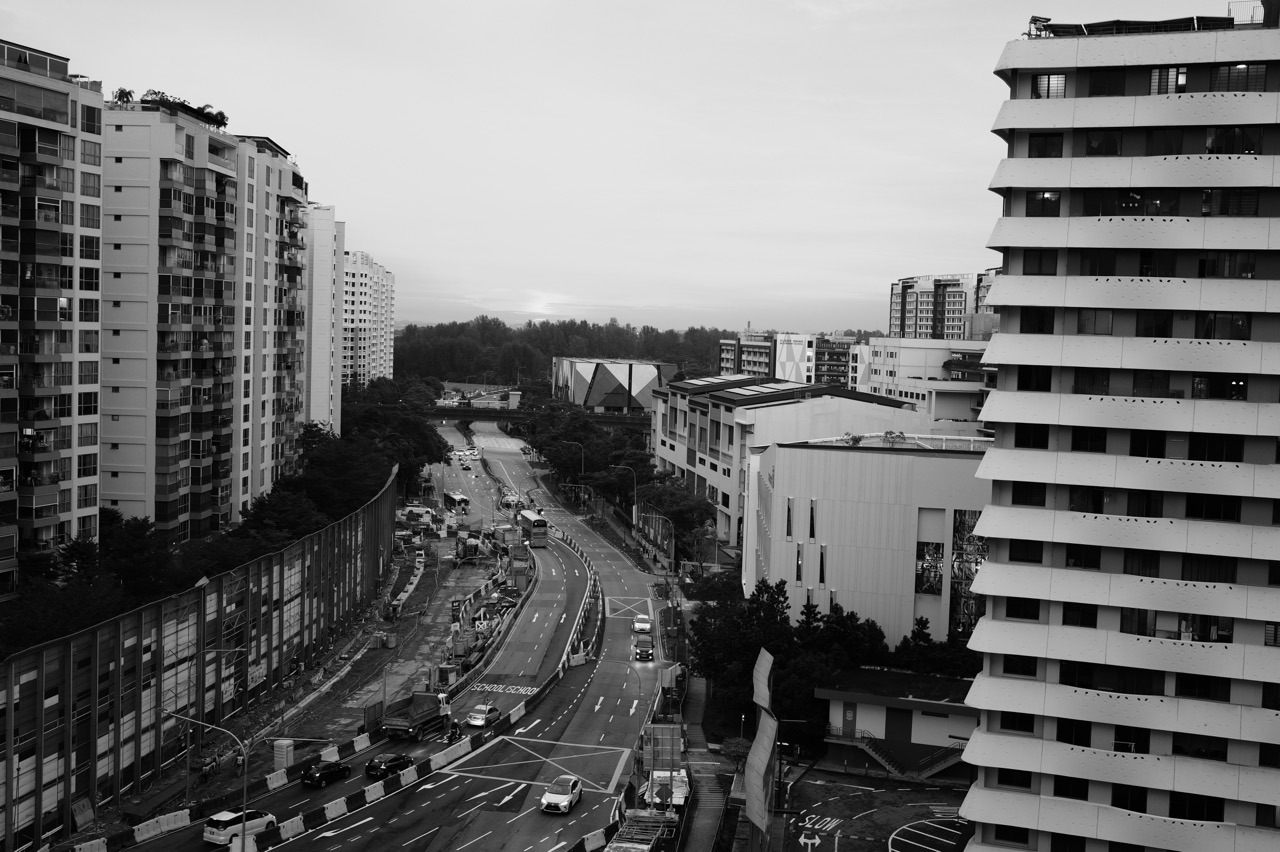
The quick answer: Below Punggol’s footpaths and roads are different utility systems that support water supply, sewerage, stormwater drainage, electricity, communications and sometimes gas. A visible access cover, inspection chamber or roadwork trench is only the surface clue. You cannot reliably identify every pipe’s contents, depth, operator or safety level from a cover’s shape or colour. Utility owners, qualified surveyors and licensed detection workers use records and established procedures before work occurs. Residents should never lift covers or dig to investigate them.

Walk along a Punggol footpath and you will notice small changes in the paving, metal covers, access panels and occasional worksite barriers. These details are easy to ignore until somebody is digging nearby or a service stops working. Yet beneath a built town is an elaborate network of infrastructure that cannot simply be placed anywhere. Pipes and cables must be laid, protected, inspected, renewed and sometimes relocated as the area grows.
This guide answers a narrower question than the general construction or roadworks articles: what are the main hidden services, why do they need access from the surface, and what should an ordinary resident know without interfering with them? The emphasis is on correct distinctions, source-backed facts, safe behaviour and useful reporting. It is not an excavation manual and does not publish speculative cable locations, utility depths or worksite entry instructions.
Start by separating these underground systems
| System | What it broadly carries | Source to verify |
|---|---|---|
| Potable-water mains | Treated water to customers | PUB |
| Used-water sewerage | Wastewater to reclamation plants | PUB |
| Stormwater drainage | Rainfall runoff away from surfaces | PUB or asset manager |
| Electrical network | Electricity through network cables and substations | SP PowerGrid or applicable owner |
| Telecommunications ducts and cables | Communications signals through network plant | Relevant telecom licensee; IMDA framework |
| Gas network | Gas through regulated distribution infrastructure | Relevant licensed network operator |
| Private estate service connections | Connections between a building and wider networks | Building owner, appointed professionals, utility owner |
1. The underground city is a collection of networks
A new town is often described through its visible pieces: towers, shops, bridges and parks. The systems below ground do not receive the same attention, even though residents rely on them constantly. When a tap runs, a toilet flushes, a device connects to the internet or the lights turn on, different networks are involved. They may share a general road corridor but they do not become a single pipe merely because they are buried beneath the same surface.
Each utility has particular engineering, ownership and safety requirements. Potable water needs protection from contamination. Sewers need the ability to convey used water to treatment. Electricity cables require protection against damage and electrical hazards. Telecommunications cables are vulnerable to severing during earthworks. Surface drains must carry runoff during rain. These different needs explain why a road project can involve several consultations even when the visible excavation is small.
Residents should not expect one agency to answer everything about the ground below their block. PUB’s responsibilities differ from the electricity and gas networks of SP Group, and telecommunications operators have their own network assets under IMDA’s regulatory framework. The correct first question is not ‘What is buried under my foot?’ but ‘Which public or private service is affected, and whose verified information applies?’
Punggol example
When a family walks beside a Punggol road being resurfaced, it can explain that ordinary road pavement might cover various services. The visible trench does not reveal exactly which utility is present, and pedestrians should not cross barricades to find out. The educational point is the separation of systems, not the location of hidden components.
2. Rainwater and used water take different routes
PUB states clearly that Singapore has separate systems for collecting rainwater and used water. Rainwater travels through drains, canals and rivers toward reservoirs. Used water from homes and businesses travels through an underground sewer network to water reclamation plants for treatment. Mixing these ideas is an everyday misunderstanding: a roadside stormwater inlet is not simply a public toilet drain at a larger scale.
The difference matters because stormwater and sewage are subject to different safety, public-health and treatment concerns. An inlet that carries rain from a road must not be treated as a place to discard cleaning chemicals or rubbish. A household sanitary pipe is not the correct outlet for uncontrolled runoff from a construction site. System connections and discharges are regulated; their purpose cannot be changed by convenience.
Punggol Waterway and the Punggol and Serangoon reservoir catchments are part of the wider rainwater story, but the local sewerage network is a separate service. PUB’s documentation identifies rehabilitation work in the Punggol and Serangoon catchments as part of its public-sewer maintenance programme. That reference establishes an important local connection without implying that a particular cover on a specific street belongs to that programme.
Punggol example
A Primary student asks whether the rain from the playground goes to the same treatment plant as water from the kitchen sink. The parent can explain the two networks in simple terms, using PUB’s published water-loop diagram. The precise connection at their block remains a question for actual service records.
3. Drinking-water pipes are a distribution service
Water supplied to homes must be transported from treatment and supply infrastructure through an extensive distribution network. PUB’s February 2025 statement described a potable-water pipeline network of about 6,000 kilometres serving Singapore. The important fact for a Punggol household is that this infrastructure must remain protected and maintained so that treated water reaches customers safely. It is not merely a generic metal pipe in the ground.
PUB undertakes water-pipe maintenance and renewal because pipes age and can deteriorate; construction activity can also damage them. A leak in a public main differs from a leak at a tap or appliance within a flat. The first may require utility response and public work arrangements. The second ordinarily begins with the household’s own maintenance or a licensed plumber where appropriate. An unusual wet patch beside a footpath is a reason to report, not enough to declare a water-main failure.
Never open a valve chamber or roadside cover to ‘check the pipe’. Water supply systems can operate under pressure and may involve live connections and controlled operational procedures. The public can assist by noticing abnormal water flow, erosion, damaged surfaces or other visible hazards and passing on precise locations. Repair work belongs to authorised crews.
Punggol example
A resident sees clear water escaping from a paved joint during dry weather. They record the position, whether water reaches the road and how long it has been visible, without stepping into a damaged surface. The reporting party can establish whether it is a potable-water fault or something else.
4. A sewer is not a convenient drainage channel
PUB describes used water as sewage and sullage from domestic and commercial activities, collected through a combination of gravity sewers and pumping stations toward water reclamation plants. The sewerage network has to remain free-flowing. Blockages or damaged pipes can lead to leakage, odour and public-health concerns. This makes the design and maintenance of sewer systems very different from dealing with water after a rainstorm.
Households contribute to system performance through what they discharge. Cooking fats, unsuitable solids and foreign materials can choke sanitary pipes. Businesses face additional requirements for trade effluent and related controls. The route for used water is not a general waste-disposal service. Toilets and sinks should be used for their intended functions, and any renovation work that changes sanitary plumbing must follow relevant approvals and professional guidance.
A public sewer manhole provides access for authorised maintenance and inspection. It should never be opened by a passer-by, even if there is a bad smell nearby. Confined spaces can be hazardous; PUB’s professional forms address approval before workers enter public sewerage installations. A resident who suspects a sewer fault should use official utility or premises-management channels, not attempt inspection.
Punggol example
A smell emerges near a roadside cover. The resident describes the location and recurring time, but avoids claiming from smell alone that a public sewer has burst. Several causes are possible, and only the competent team can check the network safely.
5. Public sewers and private sanitary lines have a responsibility split
PUB says it maintains Singapore’s public sewerage reticulation system and conducts systematic checks and repairs. But not every sanitary line inside a property is a public sewer. Its guidance explains that private sewers, also called sanitary drain-lines, are owned and maintained by the relevant private premises owners. This is particularly relevant in a town containing HDB homes, condominiums, retail buildings and mixed-use developments.
The boundary between private internal systems and public infrastructure matters when a leak or blockage appears. A problem within a flat’s plumbing may need household action, while a defect in common property may involve estate management and a public main may require PUB. A management office can help determine the relevant responsibility, but a passer-by should not infer it from the shape of the nearest manhole cover.
PUB’s rehabilitation programme has included private premises in the Punggol and Serangoon reservoir catchment, illustrating the need to protect sewer integrity across different property types. That programme history does not establish the condition of any one present-day pipe. The practical resident decision is to report the symptom accurately and let the appropriate owner investigate.
Punggol example
A condominium resident and an HDB resident both notice slow drainage. They should not assume the exact same maintenance party handles their problem. Each should begin with the relevant premises-management channel and the affected appliance or shared area, escalating to PUB where appropriate.
6. Street drains and subsurface sewer pipes are not interchangeable
An open roadside grate can be part of a stormwater drainage route, while an enclosed underground pipe or access chamber may serve a different system. Public infrastructure is designed around flow rates, contaminants and operational access. An attempt to route household waste into a surface drain can pollute runoff entering waterways, and diverting stormwater into a sewer can burden sanitary infrastructure. Singapore’s separate network approach exists for good reasons.
From the surface, however, it is not always possible to identify the exact function of a particular covered opening. Some covers have markings, but these are not a safe substitute for records or an authorised assessment. A cover might also serve private equipment, communications chambers or another utility. Residents should not invent a classification based on a colour pattern seen in a photograph.
The distinction becomes practical when a fault occurs. A flooded roadside inlet after heavy rain needs a description of surface water and access conditions. Sewage backing up inside a building requires a different immediate response. A loose cover on a pedestrian route is first a physical safety hazard regardless of the network beneath it. Identify the hazard before debating the technical system.
Punggol example
Two covers sit a few metres apart on a Punggol walkway. A child asks which is for rain and which is for wastewater. Without a verified plan, the responsible answer is that the visible covers cannot be identified with certainty. What can be taught is how the two networks differ in purpose.
7. Electricity cables need specialist protection
SP Group operates important electricity-network infrastructure in Singapore, including extensive underground cables and substations. The complexity of the network means that excavation can cause serious damage or interruption if a contractor does not follow protective arrangements. SP Group’s published description of its earthworks surveillance work demonstrates why monitoring and prevention are important. Underground electricity is not something a member of the public can inspect by opening a chamber.
The fact that an electrical cable may be buried does not make the area a safe location for casual digging. Damage can endanger workers and disrupt supply to many people. Network owners and contractors use plans, professional detection and procedures appropriate to the work. Exact underground alignments and cable conditions should not be guessed from a pole, surface marking or a service box.
Residents do not need technical voltages or detailed maps to act responsibly. Keep away from exposed cables, construction pits and equipment rooms. Report damaged enclosures or unusual hazards through the appropriate channels. A household power issue can also arise from internal circuit protection, so one dark flat does not automatically establish a damaged external cable.
Punggol example
A nearby construction site is active when several lights in a building go off. The timing may make residents wonder about cable damage, but correlation is not confirmation. Report the power issue to the responsible parties and do not approach the site to inspect exposed services.
8. Telecommunications ducts carry a different kind of network
Communications infrastructure includes underground cables and associated network equipment. Telecom disruptions sometimes result from accidental cuts during excavation, which is one reason IMDA has a regulatory and licensing framework for cable-detection work. Not every internet problem comes from a severed public fibre cable: faults may also arise from customer routers, local devices, building connections or the service provider’s own systems.
IMDA’s Earthworks Requirements describe a formal process for contractors working near telecommunication plant. The process includes obtaining utility layout information, engaging licensed detection workers, notifications and approvals. These are industry controls; they are not instructions for residents to locate cables themselves. Professional detection is needed because the actual route can be difficult to establish safely from surface appearance.
For the reader, the useful lesson is that a footpath can contain infrastructure for services that are invisible in everyday life. When roadworks occur, operators may need to coordinate with one or more telecom licensees. The fact that a phone loses signal near a trench does not prove the trench contains a communications cable. A proper fault report should start with the user’s observed service problem.
Punggol example
A family loses home broadband during nearby streetworks. It checks its service provider’s outage information before blaming the contractor. If there is an official network incident, follow the provider’s guidance; do not enter the worksite to photograph cables.
9. Why some earthworks take more preparation than the digging
From the road, a small excavation may look like a simple job. The preparatory tasks can be more complex: determining which services might be affected, consulting their owners, obtaining suitable plans, completing required detection work, preparing protection measures and arranging appropriate permissions. Different agencies oversee different types of underground infrastructure. These are not bureaucratic decorations; they manage real risks to workers, neighbours and service continuity.
IMDA publishes a nine-step earthworks process for work near telecommunication cables. Its structure involves industry coordination before commencement, rather than ‘dig first and identify what you hit’. PUB likewise publishes procedures for specified activities near water and sewer pipes. Electricity-network owners have their own safety processes. The exact obligations depend on the work, affected assets and current rules, so no one universal checklist should be copied across all utilities.
Residents may see surveyors or contractors marking ground surfaces before barriers appear. The observation may indicate preparatory work, but it does not reveal the complete purpose or timing of the project. Without a posted notice or official record, do not declare that a new MRT station, broadband line or water main has been approved because somebody marked the pavement.
Punggol example
A child sees temporary marks on a Punggol path and asks what they mean. The parent explains that trained teams often need to locate and protect services before digging. The specific marks are not interpreted as a map for public excavation, and the family does not alter them.
10. A manhole cover is an access point, not an invitation
Manholes and other access chambers allow authorised workers to inspect, maintain or connect infrastructure. The visible cover is designed to sit within a road, pavement or service area. It may be heavy, mechanically secured or part of a hazardous confined space. Some covers have embossed names or symbols, but these cannot establish every technical detail below ground.
A cover should remain secure and level with the surrounding surface. A loose, displaced or damaged cover can endanger pedestrians, cyclists and vehicles. The first step is to keep people away from the immediate hazard and notify the relevant operator or public authority. Do not test its strength by jumping on it, drive across it to ‘see if it moves’ or lift it with a makeshift tool.
Confined spaces can have unsafe atmospheres, difficult access and other risks even before the specific equipment inside is considered. No resident should enter an access chamber as an educational activity. PUB’s guidance for professional sewer work explicitly addresses prior approval for entry to public sewerage installations. The safe public role is observation and reporting.
Punggol example
A Punggol resident hears a metallic knock whenever cars pass over one cover. They can report the precise road location and the recurring noise or movement, from a safe position. They should not try to wedge the cover with an object or carry out a self-repair.
11. Covers, gratings and utility cabinets may have different purposes
Not every metal fitting beside a road is a manhole. Gratings admit surface water into drains. Cabinets may house equipment or controls. Inspection chambers and larger access covers provide access to different underground or enclosed services. Their design can reflect function and access needs, but colour, size or metal pattern alone cannot be treated as a reliable universal key.
In a developing Punggol precinct you may see such features close to playgrounds, parking areas, crossings and footpaths. Their proximity does not establish a direct connection. A cabinet near a street lamp may have an electrical function, but that cannot be assumed without verification. A grated inlet close to a drain could be stormwater-related; still, the actual underground route is not exposed to casual inspection.
For families teaching urban geography, a better question is how these fittings allow infrastructure to be serviced without taking apart an entire street. This encourages curiosity while respecting safety. Do not use a visible code on a cover as the basis for sharing speculative maps of sensitive utility networks.
Punggol example
During a short Punggol walk, a student counts different visible types of pavement fittings without touching them. Each is described by location and appearance rather than an invented hidden purpose. Official source material supplies the broader functions.
12. Why road repairs may reopen a surface that looks new
People understandably dislike repeated roadworks, especially on routes used for school and work. Yet a surface can be renewed for one purpose while a separate utility later needs inspection, relocation or repair. Roadowners and utility operators plan and coordinate many activities, but emergencies, faults, changing developments and constraints may still require access. Without the actual works notice, a pedestrian cannot determine whether two nearby works are wasteful duplication.
SP Group’s account of underground network protection notes how difficult excavation can be when critical cables and other infrastructure coexist beneath roads. PUB describes long-term pipe maintenance and renewal. The reality is that buried services have useful lives and sometimes develop faults. In a growing town, new buildings can also require service connections. The time between visible construction events does not by itself reveal the engineering or procurement reasons.
Resident feedback should target what can be verified: recurring closures, access difficulties, uneven reinstatement or poor signs. If the aim is to ask why a road has been opened again, use a published works notice or the responsible agency’s formal enquiry channel. Do not claim the project is fraudulent or unnecessary based only on its repetition.
Punggol example
A newly paved route beside Punggol HDB blocks is later excavated. Rather than sharing a photograph labelled ‘pointless roadworks’, a local writer checks the project name, location and scope. If official information is absent, the article should simply state the observed works and outstanding question.
13. Reinstatement matters as much as what happens underground
After utility work, the public sees the surface left behind. An excavation needs appropriate restoration of roads or footpaths so that people can move safely. Uneven paving, loose edges, ponding, unexpected level differences or surfaces that trip mobility aids can make the aftermath more troublesome than the work itself. The fact that a buried utility repair was completed does not guarantee that the pedestrian environment feels restored.
Responsibility for the surface can depend on the road or estate asset and the works arrangements. Some defects need the works contractor to rectify them; others may go through the relevant public-road or estate-management process. Residents need not settle that contractual question in advance. A precise report describing the reinstatement defect and its location helps the receiving party route it.
Do not remove temporary barriers simply because the trench appears covered. Curing periods, further inspections or unfinished work may require controlled access. The safe approach is to follow posted routes until the site is formally reopened, then report any remaining hazard if the path has a visibly defective surface.
Punggol example
A stroller wheel catches on a newly raised pavement edge beside a Punggol worksite. The parent avoids forcing the stroller through the obstacle, records the place and submits a description of the level difference. The report concerns the finished route’s accessibility, not the unseen pipe.
14. Ground settlement and sinkhole speculation require evidence
Cracks or dips in a pavement can be unsettling. Possible explanations include local surface wear, soil movement, utility-related issues or other construction conditions. A layperson seeing a depression does not have enough information to diagnose an underground cavity, a burst sewer or an impending sinkhole. Dramatic language may draw attention but can spread unnecessary alarm and distract from the actual hazard.
The useful action is to assess the immediate pedestrian risk without entering danger. Keep clear of a clearly unstable patch, follow barriers and notify the appropriate authority. If conditions suggest an urgent collapse or traffic hazard, use the relevant urgent channels. A photograph can document a visible change, while the engineering cause requires professional investigation and records.
Comparing images over time can help show whether a defect is growing, but do not approach a dangerous area merely to replicate an old camera angle. Good public reporting separates ‘the surface has visibly sunk’ from ‘the underground sewer has failed’. The second statement needs verification that may only emerge after an authorised inspection.
Punggol example
A crack develops near a Punggol crossing. A resident reports the exact location and why pedestrians must step into the road to avoid it. That is sufficient to identify a safety concern; guessing whether an underground cable trench caused it is unnecessary.
15. Water leaks do not always announce which pipe is damaged
Unexpected water on the pavement during dry weather may prompt suspicion of a water-main leak, but the source could be less obvious. Surface drainage, irrigation, cleaning operations, building services and other causes may produce similar visible effects. Colour or clarity alone cannot securely identify the network. A water-service fault needs the appropriate utility response, and a sudden dangerous release should be treated as an urgent hazard.
PUB’s public information describes its maintenance programme for potable-water pipes, including preventive inspection and renewal. The utility has the means to assess the network. Residents should not attempt to locate the source by prying covers, digging alongside pipes or turning valves outside their authority. Such actions can worsen damage and pose risks.
The most useful report includes whether the flow is continuous, the affected pavement or road, any visible surface erosion and when the issue was noticed. Do not expose yourself to traffic or unstable ground for a close-up image. If a specialist finds the problem is within private plumbing, the appropriate premises manager or owner may then be involved.
Punggol example
Water seeps through a paved joint along a Punggol footpath on a dry morning. A safe report states the junction and nearby block, the visible flow and whether pedestrians are forced off the route. It does not label the water ‘treated drinking water’ based only on its appearance.
16. Gas pipes add another reason not to interfere
Underground gas distribution infrastructure has its own safety requirements, distinct from sewerage, stormwater, electricity and telecommunications. Gas network damage can be hazardous. SP Group has described protection and monitoring work for buried electricity and gas networks during excavation. Residents should treat unusual signs of a possible gas problem seriously, without investigating or touching equipment.
A person should not try to trace a suspected gas line using surface markings, pull on a pipe, operate an unfamiliar valve or enter a restricted chamber. If a gas leak is suspected, follow the operator’s published emergency safety instructions and the applicable emergency-response channels. Avoid actions that could create ignition risks and move away from danger. The priority is safety, not gathering evidence for a social-media post.
Even when an excavation looks shallow, the presence of gas, electricity and other possible services is one reason utility owners have formal notification and protection procedures. A resident does not need to know every technical clearance distance. The sensible approach is to respect barriers and leave physical work to trained personnel.
Punggol example
A passer-by encounters an unusual smell near a worksite and worries it might be gas. They should not approach a trench to confirm the theory. They move to safety and use the appropriate official emergency contacts, describing what was observed without claiming to know the exact pipe.
17. The construction notice is more reliable than visual guesswork
Roadwork notices, development signs and official agency announcements can identify the responsible party, intended work and relevant contact details. The same construction site can involve multiple utilities, so a simple description on a hoarding may not list every buried asset. Still, official notices are more trustworthy than speculation based on the colour of excavated soil or the machinery parked nearby.
Dates on notices require care. The start and end of a permitted works period may not mean the same thing as a new service’s operational opening date. A trench being filled does not establish that broadband is live or that a water pipe is carrying supply. Site work, testing, connection and service commencement can be separate stages. Readers benefit when local publishing labels each stage correctly.
Residents can check published works information through relevant authority channels and request clarification where necessary. When using a photograph, include when it was taken and what it actually shows. Do not infer that a proposed facility is approved, operating or delayed merely because workers are present at one location.
Punggol example
A new utility cabinet appears beside a Punggol development. An article can truthfully say the cabinet was installed as observed. It should not claim a specific fibre upgrade or commissioning date without confirmation from the actual operator.
18. New districts still depend on old-fashioned physical infrastructure
Punggol Digital District is associated with digital services and smart building ideas, but the basic services that support it remain physical. Electricity requires supply networks, internet connectivity depends on communications infrastructure, and buildings need water, drainage and sewerage. A smart software layer does not eliminate the consequences of a broken cable or a blocked pipe. The invisible work remains essential even when a district is presented through sleek architectural renderings.
JTC and development partners may plan integrated services for particular new precincts, but the descriptions must be read as site-specific and time-specific. It is not valid to conclude that every Punggol estate shares the same underground network layout or that all systems in an evolving district have reached the same operational stage. A district can be future-oriented while individual works are still subject to ordinary approvals and maintenance.
The useful systems lesson is about dependencies. One building’s digital service may rely on electrical power, network connectivity, cooling and building access. When an outage occurs, it can affect several activities without proving that every underlying system failed simultaneously. Reporting should separate observed symptoms from the exact technical cause.
Punggol example
An educational visit near Punggol Digital District can ask students to list the physical systems a digital classroom needs. They might name electricity, broadband, potable water, wastewater and drainage. The aim is to identify dependencies, not to map restricted service corridors.
19. How to report a utility-related street hazard
Begin with the immediate risk. A missing cover, exposed cable, forceful water leak, unstable road surface or suspected gas issue may require urgent action through the relevant emergency or utility channel. Stay clear and warn nearby people without putting yourself at risk. Do not spend time obtaining dramatic photographs from a dangerous angle. Safety takes priority over a perfect municipal report.
For an ordinary problem, record the exact Punggol road, block or nearby landmark; the side of the road; the time; and what is visibly wrong. Separate the effect from a hypothesis. ‘Loose metal cover moves when vehicles pass’ is observable. ‘The sewer below has collapsed’ is an unverified diagnosis. Use a contextual photo from a safe public position. Where the owner is unclear, municipal-feedback services can help route the concern.
Be mindful about privacy and security when sharing details publicly. A report does not require publishing an imagined detailed layout of utility cables or a close-up of a restricted control panel. Explain the pedestrian or service impact instead. After a case is acknowledged, follow official updates and avoid reopening the asset yourself to check whether somebody has fixed it.
Punggol example
A manhole cover on a Punggol footpath sits unevenly after roadworks. The resident avoids stepping on it and reports the location, surface condition and potential trip hazard. The operator’s task is to identify the network and repair method; the resident has already supplied what is needed.
20. What a child can learn about infrastructure without touching it
A neighbourhood walk can teach systems thinking with no need to inspect live equipment. Ask where clean water comes from, where used water goes, why rain uses a separate route and how electricity and communications reach buildings. Draw a conceptual map that represents different networks with differently labelled lines. The map is a model of functions, not a claim about their precise real-world alignment.
For Primary students, the task can focus on identifying safe observable fixtures and writing questions. Secondary students can investigate why utilities need protection during excavation, using IMDA and PUB’s published materials. Older students can study network resilience, maintenance responsibilities and the economic trade-offs of underground rather than above-ground services. The level of explanation becomes deeper without making the field activity riskier.
The strongest lesson is intellectual humility. Visible infrastructure provides clues but not complete data. A technical label on a cover, an excavator at a site or a repair crew at night does not automatically tell you everything below ground. Civil engineering requires reliable plans, procedures and professional verification. Respecting that boundary makes an educational article more trustworthy.
Punggol example
A child wants to know what is beneath a pavement cover. Instead of lifting it, the parent uses PUB’s diagrams and IMDA’s earthworks overview to explain different network functions. The cover remains unopened. Curiosity is satisfied through reading and reasoning rather than dangerous contact.
Four field situations and the correct judgement
The cracked pavement near a school gate
Parents see a crack spreading near a Punggol school entrance. The priority is safe arrival and dismissal, not identifying a hidden pipe. A useful report names the exact gate and walking direction and says whether children must avoid the affected section. The cause might require engineering investigation, especially if a subsurface issue is suspected. Parents should not push students toward traffic or encourage them to jump over barriers for a photograph. The distinction between observed hazard and unknown cause keeps the report credible.
The brief internet outage during nearby roadworks
A family notices its home broadband is down while construction continues nearby. This may raise a suspicion of cable damage, but the family should first check the service provider’s outage information and basic device indicators without tampering with shared network equipment. If the operator confirms an external issue, follow the updates. If not, an in-home issue may need customer support. The connection between two events in time is not proof of causation. That discipline is useful for residents and reporters alike.
The puddle during a dry afternoon
A small stream of water crosses a pavement on a dry day. The safe action is to record the position and hazard and notify the relevant service, not to guess whether it is a public water main, an irrigation pipe or a concealed drain. The surrounding paving might be slippery or unstable. A photograph taken from a safe public position and a clear location description can guide inspection. The person reporting does not need a utility layout plan to act responsibly.
The resurfaced road that is opened again
A section of road is resurfaced, then later reopened by contractors. Local residents wonder whether the original work was wasted. A careful explanation distinguishes observation from project intent: one activity may have involved surfacing, while another concerns a utility connection or fault. Confirm posted scopes or seek an official explanation before alleging poor coordination. At the same time, report any unsafe diversion or defective reinstatement. Scrutiny can be accurate and constructive without pretending to know the unseen engineering.
Frequently asked questions
1. Does every Punggol manhole cover lead to a sewer?
No. Different covers may serve different underground services or access chambers. Do not identify them by appearance alone.
2. Is rainwater collected in the same pipes as toilet wastewater?
No. PUB describes separate rainwater and used-water collection systems in Singapore.
3. Can a resident lift a cover to check a smell or blockage?
No. Report the issue and leave entry or inspection to authorised professionals.
4. Why are telecom cables protected before earthworks?
Damage can disrupt communications and create repair costs. IMDA sets industry requirements involving plans, licensed detection and approvals.
5. Can a shallow excavation damage a serious utility?
Any excavation around buried services requires appropriate professional assessment. Never assume a worksite is safe because it looks shallow.
6. Do all utility lines belong to the Town Council?
No. PUB, SP Group, telecom operators, private building owners and others may own different systems.
7. What is the role of PUB’s public sewers?
They convey used water toward water reclamation plants. PUB manages public sewerage assets and conducts maintenance and rehabilitation.
8. Who maintains private sanitary drain-lines?
PUB explains that private sewers are owned and maintained by private premises owners, subject to the applicable requirements.
9. Does water on the pavement prove a main has burst?
No. The visible symptom may have several causes. Report the observed flow and location without an unsupported diagnosis.
10. Can I identify underground cable routes from paint marks?
Do not attempt to reconstruct or excavate a utility route. Professionals use owner information and licensed detection procedures.
11. What if a cover is loose and dangerous?
Avoid it and report the exact location promptly. Use urgent channels when there is immediate danger.
12. Can Punggol students learn about buried infrastructure safely?
Yes. Use official diagrams, conceptual maps and observations from public paths, without opening covers or entering worksites.
Primary sources and practical references
PUB: Rainwater and used water use two separate collection systems
PUB: Used Water Network and water reclamation
PUB: Public Sewers and sewer rehabilitation
PUB: Private sewers and owner responsibility
PUB: Water pipe maintenance and renewal, February 2025
PUB: Approvals and forms for activities near water and sewer pipes
IMDA: Earthworks Requirements and nine-step industry process
IMDA: Telecommunication cable detection work
SP Group: Protecting Our Underground Network
SP Group: PowerGrid network overview
LTA: Public-road defects and obstructions
OneService: Report municipal issues
Continue with related Punggol guides
Things to Know About Punggol | Construction Hoardings and Roadwork Notices
Things to Know About Punggol | Rain Gardens, Swales and Where Stormwater Goes
Things to Know About Punggol | Streetlights, Estate Lighting and Safer Walks After Dark
Understanding Punggol | Waterway, Reservoirs, Rainwater, Floods and Water Safety
The most useful thing to know about Punggol’s underground services is that they are separate, professionally managed systems. A visible cover or trench can prompt an intelligent question, but it rarely provides a complete answer. Good residents notice hazards, respect barriers and report precisely; engineers and utility owners determine the hidden condition. That division helps the town operate safely.


