
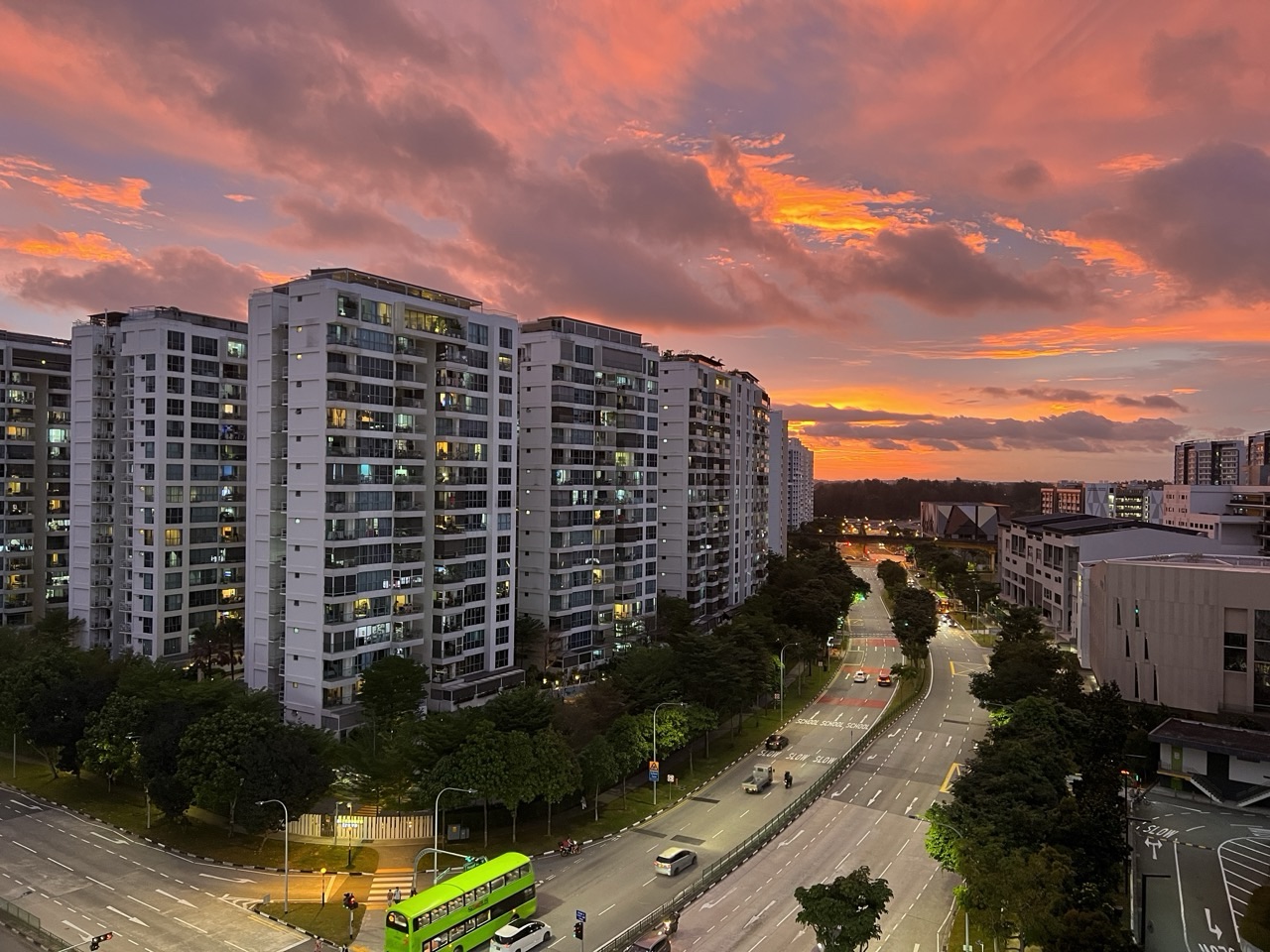
Quick answer: Punggol’s street lights, HDB common-area lights, park lights, mall lights and emergency exit lighting are not one system with one operator. LTA manages public street lighting under its remit, Town Councils maintain public lighting in HDB common property, and parks or private developments follow their own management arrangements. An area can be open to visitors without being brightly lit through the night. When a light fails, the exact location and type of fixture tell you whom to notify.

Most people judge the route home by how far it is on a map. After dusk, the same route has additional questions: can you see the edge of the kerb, does a covered walkway remain usable, are the steps and ramps visible, and who can repair an unlit section? A station entrance, a roadside crossing, the space beneath an HDB block and a path beside a park may appear continuous to the pedestrian, yet fall under different lighting regimes and maintenance responsibilities.
This article explains how lighting helps Punggol function after dark, not merely where to take night photographs. It covers ownership, switching times, LEDs, remote monitoring, visibility, glare, staircases, accessibility, responsible reporting, park access and emergency lighting. Every claim is framed for the exact type of light and location. The separate guides on step-free routes, construction diversions and general emergency readiness are linked at the end rather than repeated as competing search pages.
First identify the light you are looking at
| Light or location | Usual first responsibility to verify | Resident question |
|---|---|---|
| Public road and street lighting | LTA for fixtures under its remit | Is this a faulty public street light? |
| HDB corridor, lift lobby or void deck | Relevant Town Council or facility manager | Which block, floor, side and fixture? |
| Park or park-connector lighting | NParks or applicable park operator | What are this area’s opening and lighting conditions? |
| Mall or private residential development | Building owner or management | Is this part of a privately operated common area? |
| Exit signs and emergency lighting | Relevant building fire-safety responsibilities | Is a safety-related fitting faulty? |
| Temporary construction route illumination | Works operator and relevant road authority | Is the diversion safe and properly maintained? |
1. Why a continuous walk can cross several lighting systems
Punggol is a good example of how transport, housing and recreation sit close together. A commuter may leave an MRT station, cross a public road, pass along a sheltered estate path and continue beside a park in a short journey. Although the walking route feels like one place, the lighting is attached to different assets. Ownership and maintenance are defined by property, road and facility boundaries rather than by how long a pedestrian needs to walk.
HDB says Town Councils are responsible for managing common property in HDB towns, including public lighting, corridors and void decks. LTA describes public street lights as part of its road-safety responsibilities. NParks publishes opening conditions for parks and park connectors, while malls and condominiums have their own management structures. This division does not mean a resident must become an expert in agency boundaries. It means the first report needs to identify the asset accurately.
A light attached to a bus shelter, beside a road, within a shopping centre and above an HDB lift landing may have different technical schedules and reporting arrangements. Do not send every lighting complaint to the first town-level contact you find. Where responsibility is unclear, municipal-feedback services can help route the issue. The relevant operator can then inspect the particular fixture and its electrical system.
Punggol example
A family walks from Punggol MRT toward a residential block. They notice a well-lit crossing, a dim path near a landscaped edge and a dark lift lobby. These are three distinct observations. The most useful response is to record their locations separately, not describe an entire neighbourhood as having no lights.
2. A street light is a road-safety asset
Street lighting helps road users identify the travelling surface, junctions, obstacles and other people in low-light conditions. The aim is not to reproduce the brightness of daylight. Designers consider how light reaches the carriageway and adjacent spaces, the nature of traffic, the environment and the relevant technical requirements. The result may look very different from decorative lighting outside a shop or at a public art installation.
LTA explains that its street-lighting programme follows operating schedules tied to seasonal sunrise and sunset times and has adopted a Remote Control and Monitoring System, or RCMS, that makes operations more responsive. Its Road Safety page also explains that during bad weather motorists should use headlights to improve visibility. Streetlights are one safety measure among several, not a replacement for responsible driving.
An important nuance for pedestrians is that a working light may not illuminate every nearby corner to the same level. Buildings, trees, parked vehicles and terrain can shape the apparent visibility of a path. A person’s feeling that a spot is dark is worth listening to, but it does not by itself prove that an LTA streetlight is defective. Report a visible failure precisely, and distinguish design feedback from a maintenance defect.
Punggol example
A parent crossing Punggol Central should not assume that every shadow is caused by a broken lamp. First observe from a safe place whether a particular fitting is unlit compared with nearby similar lights. If so, identify the road, side and nearby marker, then use an official reporting channel.
3. HDB common-area lighting is a different maintenance question
The common corridor, lift lobby, void deck, staircase approach and precinct walkway are closer to the everyday responsibilities of HDB estate management. HDB describes public lighting in HDB common property as part of Town Council management and maintenance. That includes looking after functional shared spaces rather than the electrical appliances inside a resident’s flat. A bulb failing in your living room is not an estate common-area fault.
OneService’s explanation of lighting maintenance notes that Town Councils inspect reported faults and may need a technician to determine the cause. Repairs or replacements may sometimes depend on parts and contractors. It is useful to understand this because an acknowledgement message does not mean somebody has already replaced the lamp. The eventual work may involve a driver, cable, fitting or other component, not just a visible bulb.
Residents can make the inspection easier by including the precise block, floor, staircase or lift number and the fitting’s position. If several lights on one landing have failed, say so; it may be a different problem from one individual fitting. Do not open panels or attempt to change a common-area light yourself. Electrical work and access to shared fixtures belong to authorised personnel.
Punggol example
The light beside a Punggol block’s Lift B entrance stops working. A useful report names the block, Lift B, ground-floor entrance, side facing the covered walkway, and the evening it was observed. ‘Streetlight broken near my house’ is less likely to guide the correct team.
4. Lighting schedules are not universal across locations
Street lights can switch according to changing sunrise and sunset times, and LTA’s RCMS permits more responsive operating control. It would be misleading to describe one exact clock time as the switching rule for every public-road fixture on every date. Singapore’s apparent sunset and weather conditions vary, and different asset classes may use different controls. A photo of an unlit lamp in the afternoon is normally not evidence of a fault.
Park lighting brings another distinction. NParks lists Punggol Waterway Park as open 24 hours, but opening-hours information alone does not establish that every path or feature is equally illuminated all night. Individual park connectors and facilities may have published lighting hours or separate restrictions. Some natural areas intentionally have more limited access or different lighting arrangements. Check current signs and the park’s official page for the exact area.
A private mall, sports facility or residential estate may have its own operating schedule and maintenance plan. Not all fixtures are intended to remain on after closing. When writing about a dark area, state whether it was supposed to be lit at that time if verified. Otherwise report an observation such as ‘This path was unlit at 8.30 pm’ and let the responsible manager establish the reason.
Punggol example
A family sees lights switched off at a recreational corner after closing. It should not immediately call that a breakdown. Check posted hours and whether the space is meant to be in use. If the main accessible route is dangerously unlit, that is a separate safety concern worth reporting.
5. What LTA’s remote monitoring actually changes
LTA’s Remote Control and Monitoring System is a useful example of ordinary urban infrastructure becoming more responsive. LTA describes a system that can control street-light operation and identify faults without relying only on residents or night patrols to discover them. The agency’s published materials discuss the system’s use to adjust operation with lighting conditions and the timing of sunrise and sunset, as well as to send fault information for repairs.
Technology can shorten the time between a fault occurring and an agency knowing about it, but it does not eliminate every need for human inspection. A report may still identify a shadowed path, a fixture in an unusual location or the effect of vegetation that remote monitoring does not fully explain. The monitoring system is designed for particular lighting assets and should not be assumed to include every private balcony, park path or HDB corridor.
Another important distinction is between the system’s published capability and an exact real-time claim about one Punggol lamp. Without an official diagnostic record you cannot truthfully say that a particular fixture has sent a fault alert. The supportable claim is that LTA uses remote monitoring for its public street-lighting programme. Residents should still describe what they see and use established feedback channels.
Punggol example
A pupil sees a new-looking road lamp and assumes it has a camera watching pedestrians. That does not follow. Street-light monitoring relates to equipment status and control; do not invent surveillance functions based on a box or sensor on a pole. Ask what official documentation establishes before making a privacy claim.
6. LED lighting changes the appearance of an evening street
Older streetlighting was often associated with a warm amber appearance. LTA has described its transition toward more energy-efficient LED technology and the different visual appearance of white LED streetlights. Colour alone is not a reliable guide to whether a lamp is safe or defective. A modern fitting can produce a different kind of light distribution and colour rendering from one that was installed many years earlier.
LED lighting offers operational benefits including reduced energy consumption and longer expected replacement intervals under the conditions described by the agency. But no fixture lasts forever. Drivers, lenses, seals, control gear or electrical connections can develop faults. Some problems present as an unlit fitting, others as flicker or an uneven patch of illumination. Residents should report the observed effect and leave diagnosis to maintenance teams.
Light colour also affects photographs. A phone camera can exaggerate the apparent brightness of a white LED and make a nearby darker area disappear through automatic exposure. Conversely, a bright lamp can appear blown out while a road surface looks black. That is why maintenance reports benefit from a wider contextual photograph and exact words instead of a dramatic image alone.
Punggol example
Two Punggol streets look different at night: one amber, one white. Rather than assuming one is illegally lit or dangerous, a student can compare the visible conditions and consult LTA’s public explanations of lighting technology. Visual differences are a starting point for questions, not automatic evidence of a fault.
7. Brightness is not the same as good visibility
A light can be very bright and still produce uncomfortable glare. An exposed high-intensity source may be difficult to look toward, while the walking surface just beyond it remains hard to see. Effective outdoor lighting depends on where the light is directed, the uniformity across a route and the ability to perceive steps, kerbs and people. Maximum brightness in one spot is not a sensible goal for every part of a neighbourhood.
Changes in brightness matter as well. Your eyes adapt when you move from a brightly lit mall entrance into a darker open path. The transition may briefly reduce your ability to identify an obstacle. A route with reasonably consistent useful illumination can be easier to follow than a route with alternating intense pools of light and deep shadow. This is especially noticeable for older adults or people with some forms of visual impairment.
Report glare and dark areas as design or accessibility concerns rather than automatically alleging that a lamp violates a technical standard. A formal lighting assessment requires appropriate measurements and an understanding of the relevant classification and requirements. Everyday observation is valuable, but it is not a substitute for a professionally conducted lighting test.
Punggol example
A grandparent says a new light above a walkway is too harsh while the kerb ahead remains difficult to see. The family can report both the glare and the visibility concern, giving the exact direction of travel. That is more useful than demanding ‘make everything brighter’ without considering the resulting effect.
8. Trees and buildings change how light reaches the path
Trees provide shade, greenery and ecological benefits in Punggol, but their branches can change the distribution of light at night. A lamp that works as designed may become partly screened as vegetation grows. Similarly, building edges, covered linkways, fences and temporary construction structures can cast shadows. If the route feels dark, consider whether the fitting is unlit or whether an obstruction prevents useful light from reaching the walking surface.
Vegetation management is not something residents should improvise. Cutting branches around public lighting can damage trees or create hazards, and the relevant tree manager may be different from the lighting operator. A report should identify the tree and fixture by location and explain the visibility effect. Let the responsible organisations coordinate any pruning or adjustment that is appropriate.
Trees are also part of why light levels vary with weather. After rain, leaves and wet surfaces can reflect light differently. A path may look darker when the sky is overcast than when moonlight and sky glow are present. These effects are useful observations but should not be mistaken for a claim that one fixed lighting level applies to every night.
Punggol example
A Punggol walkway was comfortably visible months ago but is now shaded by denser tree growth. A resident can photograph the path and the affected fixture from safe positions and describe the concern. That is a request for assessment, not permission to cut the tree.
9. Wet pavements and night walks are a combined problem
Even good lighting cannot reveal every slippery patch on a dark, wet surface. Rain can create reflections that obscure shallow puddles, paving joints or painted markings. Wet leaves can make a path slippery. A lamp may be operational while the route remains difficult to use because of pooling water or surface damage. Therefore, a report about a dangerous walking location may need to include both lighting and pavement conditions.
After a Punggol downpour, choose well-used, clearly visible routes where safe alternatives exist. Avoid flooded footpaths and keep away from canal edges in poor visibility. Do not rely on a phone torch to justify entering an isolated or closed route. A torch may help you see a sign or uneven step, but it cannot correct deep water, a missing railing or an unsafe construction diversion.
When describing a maintenance issue, distinguish the contributing factors. ‘The light beside this ramp is not working’ is one observation. ‘The ramp becomes slippery with water after rain’ is another. If both are present, report both. The responsible operator can then investigate lighting and drainage without being misled by a single generic complaint about darkness.
Punggol example
A parent using a stroller reaches a wet unlit path near a Punggol block. The best choice is a safer alternative instead of testing the puddle depth. Later, a location-specific report notes the light failure and water accumulation separately.
10. Lift lobbies and staircases matter more than their appearance suggests
People use lift lobbies and stairs when carrying groceries, helping young children and supporting older relatives. A single dark step can be a serious obstacle. These spaces need consistent, practical visibility; they are not merely circulation areas between photogenic public spaces. Where a light fails at a shared staircase, the impact may be greater than a fault at a decorative feature.
Emergency lighting is another category. SCDF’s fire code distinguishes ordinary lighting from lighting required to guide occupants to exits during certain emergencies. Requirements depend on the building and relevant classifications, and technical performance should not be guessed from a casual look. An illuminated exit sign is not proof that the entire emergency system is compliant; nor does a missing decorative light establish a fire-code breach.
The important household action is to notice and report obvious failures in safety-critical shared areas. Do not obstruct access to fittings or tamper with exit signs, test switches or emergency power equipment. If an evacuation is actually required, follow official emergency guidance and use safe exit routes rather than relying on a phone map or unfamiliar shortcut.
Punggol example
An older resident reports that a stair landing is dark. The family records the staircase number and floor without climbing onto railings to photograph the lamp. If the darkness creates immediate risk, they avoid the route where possible and alert the responsible estate party promptly.
11. Step-free paths need continuous useful illumination
A route may be technically step-free in daylight but hard to navigate at night. A ramp, kerb transition or crossing requires enough visibility for people to follow it without guessing where the usable surface ends. For wheelchair users, someone with low vision or a parent with a pram, a small dark section can make an otherwise accessible route feel unsafe. Accessibility should be considered from entrance to destination, not fixture by fixture.
Look for a clearly visible continuous path, legible signs, suitably lit crossings and a safe way to turn around when conditions are poor. Avoid improvising a shortcut through landscaping or across a vehicle access road because one route appears too dim. A safer alternative may be slightly longer but better marked. A good family meeting plan names the practical entrance and route instead of only the nearest landmark.
When reporting a concern, explain whom the dark section affects and what decision it forces. For example, a single dark approach to a ramp may require a detour to the road. The claim should be factual and proportionate. You do not need to diagnose the illuminance level in lux to demonstrate that the route has become difficult for a particular user.
Punggol example
Two relatives reach the same Punggol building: one via the main entrance and another via an accessible side ramp. If the side ramp is unlit, a ‘building looks bright’ photograph may conceal the issue. Describe the exact route and the lack of a practical alternative.
12. Park opening hours and lighting hours are different
NParks lists Punggol Waterway Park as open 24 hours. That is useful information for residents choosing when to visit, but it should not be stretched into the claim that every park path, pavilion, boardwalk or connected natural area receives identical artificial lighting. The operating conditions of a particular facility may differ from those of the wider park. Temporary closures or maintenance notices can also change access.
Some NParks-managed park connectors have separately published lighting hours, and some nature-focused spaces have more restrictive operating conditions. Residents should check the precise park or connector listing and any on-site instructions. A route that is legally open may still require extra care during periods of darkness, while a closed facility must not be entered merely because someone has brought a bright torch.
Lighting can also affect wildlife and habitat conditions. Darker zones may exist for practical or ecological reasons, but do not assume that every dim patch is a deliberate conservation feature. Without information from NParks or the manager, an unlit section might be a design choice, temporary condition or fault. Keep conclusions grounded in the actual published conditions.
Punggol example
A family plans a night walk along Punggol Waterway. It checks the park listing, then chooses a known, publicly accessible path with suitable lighting and a clear return route. It does not assume that an adjacent nature trail is open and illuminated on the same terms.
13. What an unlit lamp can and cannot tell you
A lamp that is off at night may indicate a local electrical fault, an operating schedule, maintenance, a supply issue or a deliberate control setting. A row of lamps being off together may suggest a different pattern from one dark fitting among lit neighbours. These observations help the operator troubleshoot, but they are not a diagnosis. Residents should avoid posting that a whole substation has failed based on one row of dark lights.
OneService notes that lighting faults may involve wear, electrical problems or components needing replacement. The appropriate technical response requires inspection. In LTA’s domain, remote monitoring can help detect specific faults. In an HDB estate, the Town Council may need a technician to assess the local fitting. The system does not become more reliable when residents speculate about wiring or open service panels.
Collect only safe information: where the lamp is, when it was seen, whether adjacent similar lights were operating and what risk the failure creates. A short report can be complete with these details. Better evidence is not always more photographs; it may simply be the correct street or block name and direction of travel.
Punggol example
After dinner, a resident sees a single unlit fixture beside a busy crossing while others are operating. They report the precise junction and which side is affected. They do not climb the pole, use a laser pointer or attempt to reset equipment.
14. Reporting through OneService can reduce confusion
OneService is intended to let residents report municipal issues even when they do not know the exact agency at first. Its September 2026 chatbot FAQ specifically names broken lights as a reportable municipal concern and asks for a description, precise location, time observed and an image. Where taking a photograph of the exact light is unsafe or impractical, the FAQ explains that an image of the surroundings can be supplied with a detailed description.
A useful lighting report does not need jargon. Identify whether the problem is a roadside pole, a sheltered walkway light, a lift landing or a park path. Explain if it is an individual fitting or a longer dark stretch. Add the nearest block, pole marking if visible from a safe distance, junction or entrance. Do not include residents’ faces or flat interiors unnecessarily, and avoid standing on the road to improve the angle.
After submission, keep the reference number and read later updates. The responsible agency or Town Council may inspect, repair, replace or plan other work, depending on its findings. An automated acknowledgement does not mean the lamp has been fixed. If conditions change or the safety risk escalates, follow up with a factual update rather than repeated generalised complaints.
Punggol example
A parent near a Punggol sheltered linkway reports three adjacent unlit fittings at the same evening hour. Their submission includes one contextual photograph from the pavement, the block and entrance reference, and the effect on a nearby ramp. These details make the complaint actionable without requiring technical measurements.
15. Private development and public road boundaries can be confusing
Condominiums, shopping centres and mixed-use projects add another management layer in Punggol. A light mounted on a private façade may illuminate a public-facing path, while a public streetlight stands beside the same pavement. A pedestrian cannot always see the ownership boundary. Complaints should therefore avoid assuming that anything outdoors belongs to LTA or that anything beside a block belongs to a Town Council.
Private estates may have building management offices, security teams or MCSTs responsible for their lighting installations. A tenant in a retail development may have a landlord or facility operator handling common-space faults. If a light is inside a privately controlled compound, the managing agent may be the better initial contact. A roadside obstruction or safety issue affecting the public can still require coordination with public authorities.
Good reporting describes the fixture and exact location. It is reasonable to say, ‘At the entrance shared between the road and this building, the canopy light is out.’ The operator can establish jurisdiction. A hand-drawn location on a public map can help, provided it does not disclose unnecessary personal details.
Punggol example
Someone notices darkness outside a Punggol condominium’s pedestrian gate. Before claiming that LTA has neglected the street, the resident identifies whether the dark fitting is on a public lighting pole or attached to the estate gate. That single distinction can prevent a complaint being sent down the wrong route.
16. Light pollution, privacy and comfort deserve consideration
More artificial light is not automatically better. Poorly directed lights can shine into bedroom windows, produce uncomfortable glare or illuminate areas that do not need continuous brightness. The effects on residents vary: a lamp that feels reassuring along a path can be intrusive when it shines directly toward a nearby flat. This is a legitimate design trade-off, not an argument for leaving public walkways unsafe.
Requests should explain the actual concern. ‘Light enters the bedroom after midnight through an uncovered fixture’ is a clearer starting point than demanding the removal of all lights in a courtyard. A qualified review may consider shielding, direction, controls or other measures, but residents should not attempt to adjust fixtures themselves. The same principle applies to decorative lighting on private buildings and community facilities.
Environmental considerations matter around greenery and water. Wildlife may respond to artificial light, but species-specific conclusions require evidence. A dark spot may be intentional, accidental or temporary. Instead of ascribing ecological motives without confirmation, ask the park manager what operating regime applies to that exact area.
Punggol example
A family living near a common walkway finds a newly installed light shines into a window. They report the direction and timing of the nuisance while recognising the walkway’s safety function. A balanced request describes the trade-off and seeks assessment rather than asserting that public lighting has no place nearby.
17. Temporary routes and construction works change the lighting need
Construction hoardings and pedestrian diversions are familiar features in a developing town. They may change the position of a walkway, screen existing lights or introduce temporary fixtures. A route safe during the day can become confusing after dusk when its turns, crossings and barriers are harder to see. Lighting is therefore part of the pedestrian-safety question, alongside route width, signs and physical protection.
The relevant works operator and road authority may need to manage temporary lighting or rectify unsafe conditions. A commuter should follow designated diversion signs and avoid entering fenced worksites. Do not take an unofficial shortcut through a construction gap because the original route is brighter. Temporary arrangements can change between visits, so last week’s walk is not proof of tonight’s access.
When reporting, provide the worksite or road reference and describe which part of the approved pedestrian route is dark. This is different from a complaint about a permanent HDB lamp. The location and timing help the right party inspect the current worksite conditions.
Punggol example
A sheltered path beside construction is diverted behind hoardings. In daylight the turn is obvious; after dusk the entrance looks almost invisible. Report the diversion sign and dark turning point from a safe public position. The problem is route usability, not merely aesthetic brightness.
18. How to plan a practical evening walking route in Punggol
Begin with the journey’s essentials: starting point, destination, who is walking, weather, transport connections and the time of return. Choose a route that is publicly accessible and comfortable for the slowest member of the group. A familiar route with continuous useful lighting may be preferable to a shorter but poorly marked shortcut. Distinguish sheltered from illuminated: a roof can keep off rain without making the floor easy to see.
Before leaving, check current operating hours for facilities you intend to pass through, particularly malls, park attractions and managed amenities. If you are visiting Punggol Waterway Park, use NParks’ listing and any site notices for the relevant area. Carry a charged phone and let others know the plan when appropriate, but do not treat a device as a substitute for safe access. Under heavy rain, choose a safer route or postpone a discretionary walk.
During the walk, observe footing, cycle-path interactions, vehicle crossings and any temporary works. A flashlight can be a backup to read a sign, not a reason to enter a closed route. For children, teach a straightforward decision rule: stay where you can see the route and other users, cross only at proper facilities and return to a safer path when unsure.
Punggol example
A family walking after dinner from a Punggol transport stop plans one clear entrance, one optional rest point and one return route. They are not chasing the darkest or most picturesque waterfront location. Their useful measure of success is a safe, unhurried trip everyone can repeat.
19. Photography is not a reliable lighting audit
Night photography is appealing in Punggol because bridges, shopfronts, trains and water reflections can make dramatic subjects. But modern phones adjust exposure, contrast and colour automatically. A photograph taken in night mode may show details that the photographer could barely see, while a short exposure may make a safe path look much darker. Neither result is a calibrated measurement of lighting conditions.
To document a fault, photograph the fitting and its context without standing in traffic or filming unrelated residents. State what you saw with your own eyes, including whether nearby lights were working. If you need a technical illuminance assessment, the responsible professional must use appropriate equipment and reference the applicable standard. A handheld phone app’s arbitrary number is not proof of regulatory compliance or breach.
Photographs also reflect a moment. Clouds, rain, tree cover, temporary construction and building lights can change the scene. Use a date and location caption. Avoid reusing an attractive photograph from years ago as if it establishes conditions tonight. For local editorial publishing, a beautiful dusk image can illustrate the topic without being falsely presented as a maintenance inspection.
Punggol example
A student posts a night-mode image of the Punggol waterfront with the caption ‘The park is brilliantly lit everywhere.’ That conclusion is not supported by one frame. A better caption names the photographed location and time and limits the claim to what the image actually depicts.
20. Four questions make most lighting issues easier to solve
First, what is this light for: a public road, shared estate circulation, park, private facility or emergency exit? Second, what was actually observed: off, flickering, obscured, glaring or simply not intended to operate then? Third, what is the impact on users: difficult crossing, dark ramp, uncomfortable glare or an unlit closed facility? Fourth, who can receive a precise report without residents touching electrical equipment?
These questions preserve the distinction between fact and interpretation. A working lamp may still leave an accessibility issue. A dark fixture may be correctly switched off during the day. Several adjacent failed fittings may indicate a shared issue, but a passer-by cannot establish the electrical cause. Responsible reporting communicates what matters while leaving diagnosis and repairs to authorised specialists.
Punggol becomes easier to navigate after dark when its lighting is seen as a set of connected public services rather than a decorative glow. Road safety, common-area access, park management, energy efficiency and emergency preparedness each contribute. Residents do not need to memorise engineering specifications. They need to recognise different spaces, choose safe routes, and pass on clear, accurate information when something needs attention.
Punggol example
If you can name the exact place, describe the actual problem and identify who uses that route, your report is already more useful than ‘Punggol is dark’. The guiding principle is continuous safe movement through a town whose spaces have different managers.
Four situations Punggol families can plan for
The older adult returning from a medical appointment
A senior comes home after sunset and finds the ramp beside the usual block entrance very dark. The family should first choose a safer path and avoid a risky shortcut, then report the exact ramp and fitting. A useful record includes the approach direction, nearest lift and whether any lamp is operating. The next step is a Town Council or routed municipal enquiry, not opening the fitting. The lesson is that lighting matters to the continuity of an accessible journey, not only the overall brightness of the estate.
The cyclist meeting pedestrians beside an LRT line
A shared path near elevated tracks can bring walkers, people with prams and cyclists together. In the evening, light distribution, visibility around corners and responsible speeds matter. Cyclists should follow applicable path rules and use suitable lights where required; pedestrians should make themselves predictable and avoid abruptly stepping into a cycling line. A single broken lamp may justify a maintenance report, but does not authorise users to disregard signs or separate pedestrian and cycle spaces.
The park walk after a heavy shower
A family wants to walk beside Punggol Waterway after a thunderstorm because the reflections look beautiful. It checks weather and access conditions and chooses a route known to be open and adequately visible. A flooded or unlit section is a reason to return, not to test a phone torch against moving water. If an official path’s light is visibly faulty, the family notes the location for an appropriate report from safety. Enjoying the park and respecting infrastructure limits are compatible.
The light that shines into a bedroom
A neighbour appreciates a bright corridor fitting, while another finds it shines into a bedroom. The first person’s safety interest and the second person’s comfort can both be real. A productive complaint explains the direction, time and effect of the light without demanding that an important route be darkened. The relevant manager can assess shielding or controls. The issue shows why simply adding more brightness does not settle good lighting design.
Frequently asked questions
1. Who maintains street lighting in Punggol?
LTA manages public street lighting under its responsibility. Identify the exact asset before assuming that applies to every lamp outdoors.
2. Who repairs HDB corridor and void deck lights?
The relevant Town Council ordinarily manages common-property public lighting; verify your block’s current managing entity.
3. Are Punggol street lights always on at the same hour?
No single fixed clock time should be assumed. LTA uses operating schedules associated with sunrise and sunset and remote control capabilities.
4. Why are some lights white instead of orange?
LTA has been transitioning to energy-efficient LED lighting, which can differ in appearance from older lamps.
5. Can a light be working while the path still looks dark?
Yes. Shadows, vegetation, glare, route geometry and adaptation between bright and dim areas can affect usefulness.
6. Is Punggol Waterway Park open at night?
NParks lists the park as open 24 hours, but verify specific facilities, notices and lighting conditions before visiting.
7. Does an unlit path mean a power outage?
Not necessarily. One fixture may have a local fault or be on a different operating schedule. Do not diagnose a supply failure from appearance alone.
8. Can I replace a broken light in the common corridor?
Do not tamper with shared electrical fixtures. Report the location to authorised estate maintenance personnel.
9. Where can I report a dark shared walkway?
Use the posted operator contact or OneService, which supports reports of broken municipal lighting with location information and photographs.
10. How do I show a lighting fault in a photograph?
Take a safe contextual image and describe the observation. Phone cameras alter night exposure and cannot provide a formal lighting measurement.
11. Are all park connectors illuminated overnight?
Do not assume so. Consult the specific NParks park or connector information and posted restrictions.
12. What if a dark staircase affects someone with limited mobility?
Treat it as an access and safety concern. Choose a safe alternative where possible and report the precise staircase and floor promptly.
Official sources for fact-checking
LTA: Public Street Lighting and road safety
LTA: Watt a Smart Street Light!
HDB: Functions of HDB Branches and Town Councils
OneService: Lighting Maintenance and feedback handling
OneService: Chatbot FAQs updated 15 September 2026
NParks: Find a Park or Park Connector
SCDF: Fire Code 2023, Exit Lighting and Exit Signs
LTA: Contact Us and public lighting enquiries
Related Punggol articles
Things to Know About Punggol | Sheltered Walkways, Ramps, Levels and Step-Free Routes
Things to Know About Punggol | Void Decks and Shared HDB Spaces
Understanding Punggol | Power Outages, Circuit Breakers and Emergency Readiness
A well-lit town is not one where every surface is flooded with light. It is one where people can move safely through the spaces they actually use, where lighting respects neighbours and where faults are easy to describe and repair. Punggol’s mix of streets, parks, HDB estates and public facilities makes that distinction especially useful.


