
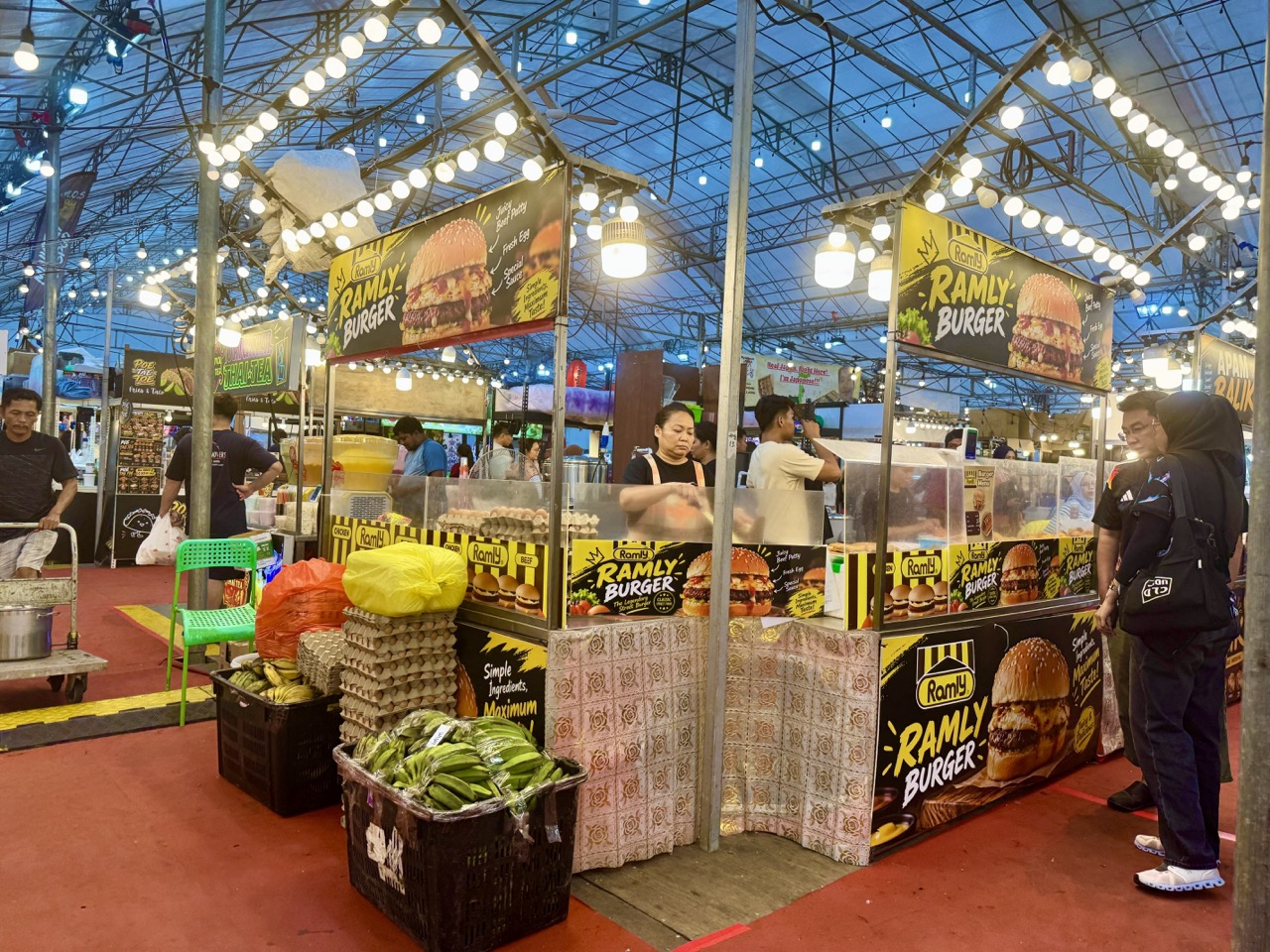
Punggol’s October 2026 pasar malam gives families a real-world picture of how a temporary food business operates. Our new photographs show burger stalls, biryani queues, macaroni and cheese and drinks. We can observe people shopping and food being prepared; we cannot deduce a vendor’s turnover or earnings from a photograph. The article explores revenue, costs, queues and break-even using explicitly hypothetical numerical examples, not purported figures from any photographed business.
The October market was advertised for 30 September–31 October 2026, daily from noon until 10pm on the field beside Waterway Point, near Punggol MRT Exit B. These are dated event details, not a claim that an individual stall or future edition will follow the same schedule. The photographs include long biryani queues, burger preparation, macaroni and cheese, sugarcane drinks and shoppers. Let us separate what the camera shows from what the business actually needs to know.

Fast answers for parents, pupils and aspiring entrepreneurs
- For families: compare menu prices, time spent waiting, dietary suitability and spending limits rather than treating the longest line as a recommendation.
- For Primary Mathematics: work with totals, change, ratio and percentages using clearly fictional examples or actual receipts.
- For Secondary Mathematics: model revenue, variable cost, contribution, fixed cost and break-even.
- For a small business: food stock, workforce, equipment, compliance, preparation capacity and bad-weather risks matter.
- For regulation: SFA distinguishes fair-organiser permits from applicable individual food-preparation stall licences.
- For evidence: a photograph is not an audit, current menu, food-safety rating or sales forecast.
Why Punggol’s October night market makes economics understandable
A textbook may present supply, demand and price as separate definitions. A real market shows them interacting at the same time. People have limited money and time, vendors have finite equipment and ingredients, and a temporary venue brings several kinds of food into one shared setting. The photograph of a queue is therefore an invitation to ask how orders arrive and are completed, not a reason to guess which business has the largest profit.
These are ordinary decisions, not abstract puzzles invented for homework. A parent can choose a shorter queue to accommodate a young child; a teenager might wait longer for a favourite meal; a vendor might plan more ingredients for a weekend than a quiet weekday. The same market works differently for each participant. Good explanation starts with their actual goals and the trade-offs attached to them.
The organiser’s role is different from the food seller’s
Singapore Food Agency requires a temporary-fair permit for qualifying events. The organiser must handle the necessary approvals for the site, prepare a layout that addresses different types of stalls and provide or arrange the stipulated facilities and oversight. The individual operator of a stall preparing food has separate duties, including the applicable food stall licence. Those roles are connected, but they are not one document or one person’s job.
An aspiring vendor should ask what the organiser is offering, what is permitted at the site, which facilities are included and what must be provided independently. It is not safe to assume that occupying a pitch permits cooking anything. The financial terms of individual Punggol stalls have not been disclosed in these photographs, so this guide will not invent rental figures or private contract conditions.
A temporary trading window affects the entire plan
A permanent shop can gradually develop repeat trade from the same premises. A temporary food seller has only the event’s advertised duration in which to serve customers at that site. Moving equipment, arranging staff, bringing stock, setting up, operating and clearing out may all be part of the period. A market visitor sees the food being handed over but seldom sees the preparation that made the purchase possible.
This limited window explains why forecasts and contingency plans matter. A rainy evening, a sell-out or a change in demand can affect one day in a short run. None of that tells us a named vendor is doing well or badly. It simply means the business problem includes uncertainty and a deadline as well as the appealing prospect of customers.
What a queue proves, and what it cannot prove
Our biryani photographs show people waiting at a particular moment. That is the observation. It is not evidence of the stall’s total daily sales, margin, number of transactions, stock remaining, staff wages or average waiting time. Even a picture of a very long queue can be explained in several ways: many people may have arrived together, cooking may take time, or orders may be prepared in batches.
A more meaningful question than ‘Is this the best stall?’ is ‘What additional evidence would show why the line formed?’ The answer might involve order arrival rates, preparation steps or customer surveys designed and conducted ethically. A casual visitor is not entitled to interrupt workers or inspect their records. For family learning, fictional numbers explain the mechanism perfectly well.

Why revenue is not the same as profit
Revenue is money received from sales before business expenses are taken away. Imagine, purely for instruction, a seller completing forty orders at S$8 each. Revenue would be S$320. If ingredients and packaging cost S$3 per item, forty units use S$120 in those variable expenses. The remaining S$200 is contribution toward fixed costs and, only after those are covered, potential profit.
That simple separation prevents a common mistake. A child might see S$320 coming in and assume the owner earned S$320. An adult might see a full queue and make an even larger guess. Neither is justified. Actual accounts may include wages, equipment, rent or event charges, transport, utilities, wastage and other costs. The example figures are intentionally fictional; they are not Punggol menu prices.
Variable and fixed costs must be defined for the same period
In a simplified model, variable cost changes with each unit sold, while fixed cost is treated as unchanged across the particular output range and accounting period. Ingredients and packaging can be useful variable-cost examples. A paid event space or equipment rental might be a fixed-cost example for that period, depending on real terms. Actual businesses often face costs that do not fit perfectly into either category.
A student must name the unit, period and assumed relationship. If fixed costs are S$500 for a fictional trading scenario and unit contribution is S$5, the break-even quantity is 500 divided by 5, or 100 units. That is the point where contribution covers the model’s fixed cost. It does not determine the sales volume required by a real photographed vendor.
A cost increase changes break-even even when menu price stays unchanged
Suppose the fictional S$8 item now has S$4 rather than S$3 variable cost. Unit contribution falls from S$5 to S$4. Holding fixed costs at S$500 makes simplified break-even equal to 125 items. The calculation is useful because a one-dollar unit-cost change has altered the target by twenty-five units. The stall might sell the same number of meals yet have a different financial result.
Should the seller change prices? Not automatically. The decision might affect customer demand, competitors and perceived value. A good student should consider different possibilities rather than assuming there is only one response. Our hypothetical figures support a discussion of mechanisms; they do not disclose how real stallholders priced or sourced the food in October 2026.
A simple function for secondary-school Mathematics
Let q denote units sold by a fictional single-product business. Assume price S$8, variable cost S$3 and fixed cost S$500. A simplified profit function is P(q)=5q−500. At q=0, the result is −500. At q=100, the result is zero. At q=140, the result is S$200. The straight line arises because the assumptions make each extra sale contribute the same amount.
Students can graph the relationship with units sold along the horizontal axis and modelled profit along the vertical axis. Explain the y-intercept and slope in words. Then identify limitations: a temporary stall has capacity limits, different dishes may have different contributions, and costs and selling prices can vary. A mathematically correct straight line is not necessarily a complete business forecast.
A queue grows when arrivals exceed completions
Consider a purely imaginary stall receiving fifteen orders every ten minutes while it completes ten. If both rates remain constant, the backlog increases by five orders in each interval. Staff can be preparing meals continuously even as the line becomes longer. It is therefore unfair to describe a vendor as inefficient simply because customers are waiting in a photograph.
Actual arrivals are not steady. An order may contain several dishes, food can be prepared in batches, and some visitors may give up before buying. A proper study would need observations over time. The point of the fictional model is understanding rates, not predicting that someone in the biryani queue waited a particular number of minutes.
The slowest stage may be somewhere you cannot see
Imagine one production line that can grill twelve portions in ten minutes, but assemble and package only eight complete meals in the same time. Packaging might become the bottleneck. Adding a bigger grill would not automatically deliver more orders. The whole process includes receiving an order, preparing the food, adding condiments, packaging, payment and pickup.
The real workflow may distribute labour differently or overlap steps. We cannot identify a real stall’s bottleneck from the public photograph. The scenario is useful because it teaches people to study complete systems before assuming a visible worker or machine causes a delay. Children can draw simple process boxes, while older students can calculate the limiting throughput.
Preparation in batches changes the feeling of a line
Suppose a fictional rice counter releases six completed meals every five minutes, rather than one at a regular shorter interval. The average completed orders over an hour could be similar, but customers may see the queue sit still before moving in a group. Waiting-time experience depends on the batch cycle, arrival time and actual order composition.
This does not establish that the pictured biryani seller follows that method. It illustrates why a long or stationary line cannot be diagnosed from a single image. The general insight transfers to restaurant kitchens, school canteens and other situations in which several work stages interact.
Stock planning balances shortage against waste
A temporary stall must decide how much stock to prepare or bring. Too little can lead to missed sales and disappointed customers. Too much can create costs and food waste; safe storage and disposal remain necessary. Demand may depend on time of day, rain, weekends and event programme. One successful hour cannot safely stand for the entire run.
In a classroom scenario, let a hypothetical business record thirty sales on Tuesday and sixty on Saturday. Those two numbers are not a complete forecast, but they show why one constant daily quantity may be unrealistic. A stronger plan uses repeated records and clear uncertainty limits. Public visitors should not infer private stock decisions from the size of a line.
Competition and variety can help explain why people visit
The photo collection contains burgers, biryani, macaroni and cheese and drinks. Those products give different buyers different options, and the resulting selection can make a temporary market attractive to groups with mixed tastes. Businesses compete for visitor spending, but the cluster of stalls may also draw people who want to browse rather than visit one isolated counter.
Neither effect guarantees success. A vendor’s outcome depends on price, product, preparation, customer preferences and other costs. Without transaction data, the pictures cannot tell us which stall benefited most. The useful concept is that competition and shared attraction can coexist. A student should avoid turning this possibility into a confident statement about an individual seller.
Opportunity cost belongs in the family decision
A person who chooses a hypothetical fifteen-minute queue instead of a five-minute alternative gives up ten minutes that could have been used elsewhere. That forgone alternative is an opportunity cost. It might be worthwhile because the desired dish matters more to them. Another person may reasonably decide the wait is too long. The correct personal choice depends on circumstances.
Parents can use this idea in ordinary conversation. Ask what the family gains by waiting and what it would rather do with the time. Avoid framing the answer as a school test while everyone is hungry. Economics becomes more useful when it clarifies a real decision without dismissing different preferences.
What does a family spending limit actually cover?
A main dish is often only part of a night-market outing. Drinks, desserts, games and transport may each affect total cost, even if they appear small when considered individually. A family can decide how much it is comfortable spending, then allocate that amount with the actual current prices in front of them. The goal is choice and clarity, not denying every treat.
Imagine a completely fictional meal with dishes at S$9.50 and S$8.80, plus two drinks at S$2.60 each. The total is S$23.50, leaving S$6.50 from a S$30 allowance. The arithmetic is suitable for an older primary pupil. These are not verified prices for the photographed market, so the family must use real receipts for real budgeting.
Why a ratio is not a business ranking
Suppose two imaginary stalls complete thirty-six and twenty-four orders in one comparable interval. Their order-count ratio simplifies from 36:24 to 3:2. Together they handle sixty orders. But that fact would not tell us which sold more individual items, because one order might include several servings. It would not tell us which earned more profit either, because prices and costs can differ.
A student should label the measured unit before working. ‘People in a queue’, ‘completed orders’, ‘servings sold’ and ‘dollars of revenue’ are not interchangeable. Turning one into another without evidence can make a calculation look precise while being wrong. That habit of checking quantities matters far beyond a pasar malam.
Sugarcane drinks illustrate product-specific food rules
Our new images show drinks near other food stalls, including a sugarcane counter. SFA publishes particular conditions for fruit juices and sugarcane preparation at temporary fairs, including how produce must be stored and how sugarcane milling equipment is configured. The details illustrate why food handling requires more than simply installing a counter with an appealing menu.
That does not mean we can assess the pictured machine from the outside. The photo gives visual context but does not reveal its sanitation or the condition of ingredients. Readers seeking the exact rule should consult the current SFA requirements. A careful guide can explain the reason for regulatory oversight without accusing the actual vendor of a breach.
Macaroni and cheese shows how products can be differentiated
Macaroni and cheese is not the same kind of purchase as biryani or a burger. Different portion sizes, sauces, preparation methods and customer preferences can matter. Product differentiation allows a business to offer something distinctive rather than simply charge a lower price for an identical meal. The photographs show different food categories in the same temporary setting.
It would be misleading to infer that one style is more popular or profitable than another solely because its photo appears in the upload. The camera may have recorded one counter several times and another only once. Media frequency is not market share. Product differentiation is a useful concept, but its commercial outcome requires transaction and cost evidence.
Why drinks change the value of a combination meal
A family might select a main dish and only later consider a drink. From the consumer’s perspective, the full meal cost includes both. From a vendor’s perspective, a drink can have different ingredients, packaging, preparation and contribution from the main. If a stall bundles items, the final margin depends on the combined costs and actual price.
In a fictional model, a burger could contribute S$5 per sale and a drink S$1.50. Twenty burgers and ten drinks would contribute S$115 before fixed costs. These quantities are invented, not a disclosure about a photographed stall. The example helps secondary pupils move beyond a single-product equation toward a two-variable calculation.
Why a customer may leave a queue before ordering
Not everybody visible near a stall completes a purchase. Someone may read the menu, find an ingredient unsuitable, decide the price is outside their budget or choose another line. A photograph of waiting people therefore cannot be multiplied by an assumed selling price to produce sales revenue. The number of people present and number of transactions are fundamentally different measurements.
A reliable economic study would need properly collected actual sales and arrival data, ideally with the business’s cooperation. For a school lesson, hypothetical examples avoid the ethical problem of tracking individual customers. Understanding that demand and completed sales differ is often the most important lesson a student can learn from a busy scene.
The real cost of waiting can be emotional as well as financial
The opportunity cost of a queue includes time, but families also experience fatigue, restlessness and changing attention. A young child may not understand why adults are willing to stand for a particular food; an older person may need to sit. Those practical circumstances are relevant to choosing a stall even when menu prices are identical.
An economist can describe preferences and constraints without pretending that everybody values the same item. For a parent, the right action may be to switch to a shorter line and preserve a pleasant outing. The market visit succeeds when the family enjoys an appropriate meal, not when it has matched someone else’s list of must-try foods.
What happens when ingredient prices rise but the menu does not change?
Imagine a fictional seller keeps a selling price constant while some ingredients become more expensive. The contribution per item falls, so the seller must sell more units to cover the same fixed cost, or change some other part of the operation. The earlier example illustrated this by moving break-even from 100 to 125 units when variable cost increased from S$3 to S$4.
Actual decisions can include supplier negotiations, different product mixes or pricing changes, each with trade-offs. We should not assume any photographed vendor made a particular adjustment or had a specific supplier problem. The correct general lesson is that visible menu price tells only one part of the business story.
Why a full queue might not mean high capacity utilisation
A queue can persist even if one step in the preparation process is temporarily constrained. Other equipment or workers may be waiting for that step to finish, making overall capacity less than the sum of individual capacities. Conversely, a line could reflect a short arrival wave rather than a long-lasting throughput problem. Context changes the interpretation.
A student should avoid confusing the existence of a queue with an exact utilisation rate. To calculate one, they would need a defined capacity and measured output over the same interval. The photograph does not supply those values. It can inspire a systems question, but the answer must come from a carefully specified model or relevant data.
The value of a clear and honest menu board
Customer-facing information is part of the service process. A readable menu, accurate prices and clear collection instructions can help people decide before they reach the counter. Confusion may slow ordering or lead to disappointed expectations. This is a general design consideration for temporary markets, not an audit of signage in the photograph.
Students can propose a fictional menu layout with a clearly stated main dish, optional extras and total prices. They should not reproduce another business’s branding without permission or assert that a particular stall made misleading claims. The lesson is that good communication supports better economic decisions by helping buyers understand what is actually offered.
Why food stock has a safety dimension
Inventory is not only a question of how many meals might be sold. Food must be stored and handled within the relevant safety requirements, and unused items may have limits on safe reuse. An over-optimistic forecast can create waste and potential food-safety problems, while an under-forecast can result in a sell-out. A responsible business tries to manage both.
It would be wrong to claim that a named stall reused food or stored it improperly just because an event was crowded. The photographs have no basis for those accusations. A young entrepreneur should use current food-safety guidance and a realistic operating plan instead of romanticising temporary street-food work as something with few responsibilities.
Why public waste facilities affect the market experience
Cups, boxes, tissues and food scraps accumulate when many customers buy takeaway items. SFA’s temporary-fair requirements address adequate bins, waste collection and clearing the site after the event. These may be shared responsibilities arranged by the fair organiser rather than visible tasks of every single stall. They still contribute to the quality of the public event.
Families can dispose of rubbish in appropriate receptacles and keep narrow aisles clear. For an older pupil, waste management provides a practical example of a cost that is easy to ignore when looking only at sales revenue. A safe market depends on the wider system, not just the speed of cooking.
How a buyer can ask about allergens without delaying everybody
Food names often fail to reveal every ingredient or preparation detail. A customer with an important dietary requirement should ask directly and use current certification or product information where relevant. When staff cannot confirm something essential, choosing another suitable meal is a reasonable decision. Guessing from food appearance or a photograph creates avoidable risk.
The question should be concise and asked at an appropriate time. A vendor is entitled to say that a requested modification cannot be made. Consumers should not pressure workers to offer assurances beyond what they know. This balances the customer’s genuine need with respect for the busy workplace.
What a child learns from paying for food
Ordering a meal involves reading, speaking, listening, counting and checking the actual transaction. A primary pupil can practise a polite order with an adult beside them and confirm the amount shown. The learning does not require a prolonged interview with the vendor or a quiz while a queue is forming.
After eating, ask the child to explain the sequence: choose, queue, order, pay, collect and enjoy. A Primary Mathematics question might use the real receipt; an English question could ask for a short accurate description. When the child is tired, simply eating together is also a worthwhile family experience.
What a secondary pupil learns from scenario testing
Rather than making one confident forecast, construct low-, middle- and high-demand cases. Suppose the fictional stall has S$5 unit contribution and S$500 fixed costs. At sixty sales, contribution is S$300 and there is a S$200 shortfall. At one hundred, the model reaches break-even. At one hundred and forty, contribution is S$700 and exceeds fixed costs by S$200.
Every case uses invented figures, and the real stall’s capacity or stock might make some volumes impossible. The exercise is useful because it reveals sensitivity to quantity. A robust answer identifies the assumptions and explains that financial outcomes cannot be deduced from one queue photograph.
Weather changes the value of a temporary venue
Singapore’s outdoor markets operate in a climate where rain, heat and lightning can affect comfort and attendance. An event may advertise broad hours while individual stalls adjust for conditions or sell out. The exact timing and operational decisions belong to the organiser and vendors. A family should never use the advertised end-of-day time as a guarantee of a safe visit during a thunderstorm.
A vendor might plan several demand scenarios because outdoor conditions can change, but we cannot know what contingency arrangements any pictured business adopted. The general business lesson is risk management. The family lesson is equally simple: follow current weather warnings and event instructions, and be prepared to choose another meal.
A market photo needs a date to remain trustworthy
An October 2026 image can still be useful next year if it clearly says what event it documents. But it must not be presented as proof that the same stalls remain at Punggol MRT or that menu prices are unchanged. Temporary markets have time limits. A reader finding the article after 31 October should see that distinction immediately.
The photographic record captures a moment in local history while the economic concepts remain transferable. That is a better way to write lasting local content than to turn a temporary event into a permanent directory. A future pasar malam needs its own fresh source check.
Why business data and public photographs have different permissions
A stall’s private sales and costs may be confidential, while a wide photograph of its public-facing counter documents a visible scene. Publishing one does not grant access to the other. Students should not infer private earnings or personal circumstances from the appearance of workers or customers. Doing so would produce both a weak analysis and an unfair portrait.
If a genuine school inquiry requires vendor participation, seek permission and explain how information will be used. A respectful refusal should be accepted. For most Maths and Economics exercises, a clearly labelled fictional dataset works well without placing extra demands on people preparing meals.
The organiser’s licence is not proof of every individual outcome
SFA’s regulatory framework describes what an organiser and licensed food-preparation stalls are required to do. It does not mean a third-party article can certify the inspected condition of every stall from photographs. Specific compliance questions require official records or proper inspection, not visual guesswork.
The same principle applies to praise. A counter that looks orderly is not automatically proven safe, and a counter with a busy queue is not automatically unsafe. Explain the rule and let the responsible authority or verified evidence answer any particular compliance question. This prevents both unwarranted allegations and unearned endorsements.
How pricing relates to value without defining it completely
Two meals can have different prices because of ingredients, preparation, size and other factors. Yet an observer should not assume the cost structure of a particular vendor from a menu board. Buyers also value taste, convenience, portion and dietary suitability differently. A price is useful information, but a personal value judgement needs context.
A fair comparison can begin with actual displayed prices and portions on the visit date, not a headline copied from last year’s market. An older student can calculate a percentage difference while admitting that a smaller price does not automatically mean a better purchase. Mathematical precision and consumer judgement are complementary.
What the photographs say about the wider Punggol neighbourhood
The market’s proximity to the MRT and Waterway Point made it visible as part of Punggol’s town-centre scene. Other permanent dining options, including One Punggol Hawker Centre, operate under different arrangements. A visitor might choose between a temporary festive atmosphere and a regular meal depending on time, weather or personal preferences.
That comparison is useful only when the venues are identified correctly. The pasar malam’s date range should not be copied into the hawker centre’s description. Our separate One Punggol Hawker Centre guide handles the permanent facility and its 2026 operator change.
A good final answer identifies the missing evidence
Imagine a student concludes, ‘The photographs prove that customers queued for food at a Punggol temporary market.’ That is grounded. A stronger next sentence might say, ‘Revenue and profit cannot be determined without sales and cost records.’ This is the correct separation between a picture, a possible economic explanation and the evidence needed for a financial claim.
The writing need not sound uncertain about everything. We can be confident about the event’s advertised dates, the scene described by the images and the mathematical consequences of specified fictional assumptions. We should be appropriately cautious about private vendor outcomes, current menu information and any fact the photographs do not establish.


Frequently asked questions about pasar malam economics
When did this Punggol pasar malam operate?
Event reports advertised 30 September–31 October 2026, noon–10pm daily, near Punggol MRT Exit B.
Does the longest queue mean the best food?
Not necessarily; arrivals, service capacity and product preferences also shape lines.
Can a queue reveal profit?
No. The photograph has no completed-sales or cost records.
What is revenue?
Money received from sales before costs are deducted.
What is a variable cost?
In a simplified model, a cost that changes with the number of units produced, such as ingredients per serving.
What is contribution per unit?
Selling price less the relevant variable cost per item.
How do you calculate break-even?
Fixed cost divided by unit contribution under the model’s stated constant-price assumptions.
Are the article’s example prices actual?
No. All worked sales, costs and prices are fictional educational examples.
What is a bottleneck?
The operation that limits the rate at which finished orders are delivered.
Why do food queues build?
Orders may arrive faster than a counter can safely complete them.
Are all food stall licences the same?
No. SFA distinguishes the temporary-fair permit holder and applicable individual food-preparation stall licences.
Does an SFA licence fee equal the stall’s rent?
No. Public regulatory charges and commercial operating costs are different.
Can a photo establish halal certification?
No. Check valid certification and ask vendors about current food and preparation.
Can a photo prove food-safety compliance?
No. It does not provide internal temperatures, training records or official inspection findings.
Can children calculate spending?
Yes, with verified receipts or clearly invented prices rather than asserting unknown market menu amounts.
How can a Secondary student use this market?
Model cost, contribution, profit functions, queue rates and break-even with explicit assumptions.
Is a food market the same as a permanent hawker centre?
No. The photographed pasar malam had a limited event run; One Punggol Hawker Centre is a permanent facility.
What if a stall has sold out?
Choose another suitable option and avoid assuming the vendor mismanaged stock without evidence.
Can we interview vendors during their rush?
Seek permission, choose an appropriate time and accept a refusal rather than obstructing workers.
How does weather matter?
Outdoor visitor flows and operating conditions can change with heat, rain and storms.
Does the photo prove everyone was buying food?
No. Some people may be browsing or waiting without completing a transaction.
Can one crowded image forecast next weekend?
No. More representative observations and context are required.
What is an opportunity cost?
The value of an alternative forgone when choosing an action, including waiting time.
Should a family spend the whole allowance?
Not necessarily. A budget defines a ceiling, not a purchase obligation.
Can new vendors use these example figures in a real business plan?
No. They must obtain actual costs, legal terms, demand evidence and operational requirements.
What happens when October ends?
The dated images remain an archive; any future event requires fresh organiser and location checks.
Where do I find current SFA requirements?
Use the official SFA requirements and application pages, not an image-based claim.
Is this a recommendation of any photographed food stall?
No. It is an educational analysis of market operations and decisions.
References, photograph notes and related Punggol guides
- Singapore Food Agency — Temporary-Fair Requirements (updated September 2026)
- Singapore Food Agency — Licence and Permit Applications
- SethLui — Punggol Pasar Malam October 2026
- Ahboy — Singapore Pasar Malam Schedule
- Punggol Pasar Malam Visitor and Family Guide
- Money-Smart Families in Punggol
- Punggol in Pictures — October 2026 Archive
Editorial record, 23 October 2026. Original photographs are from the new eduKatePunggol October 2026 media collection. Financial and queue-rate calculations use hypothetical prices, costs, quantities and periods. The photographs cannot establish individual vendors’ profits, current prices, certifications or future location. Check current official and organiser sources before commercial or consumer decisions.
Three practical checks before applying these ideas
Check the time period. A daily sales target and a full-event fixed cost cannot be combined carelessly. If a fictional business is modelled over a month, its fixed expenses and unit sales must be defined for that same month. When readers compare two stalls, they should also compare equivalent periods. Otherwise, the arithmetic may be correct while the interpretation is misleading. That warning matters particularly for temporary food fairs with fixed advertised end dates.
Check the unit. A person waiting is not necessarily an order, a completed order may contain several portions, and a portion sold does not automatically equal profit. Many errors begin when one quantity quietly becomes another. Primary students can label their tables in words; Secondary students can state variables formally. Both habits make the economic explanation more credible and protect against exaggerated claims based on one photograph.
Check who owns the fact. SFA is authoritative for the general licensing framework, the organiser for current event arrangements, individual vendors for their actual menus and the photographs for visible moments. A long line can inspire a hypothesis but cannot verify an earnings claim. Keeping these sources separate helps the article remain useful long after this October 2026 market has finished.


