
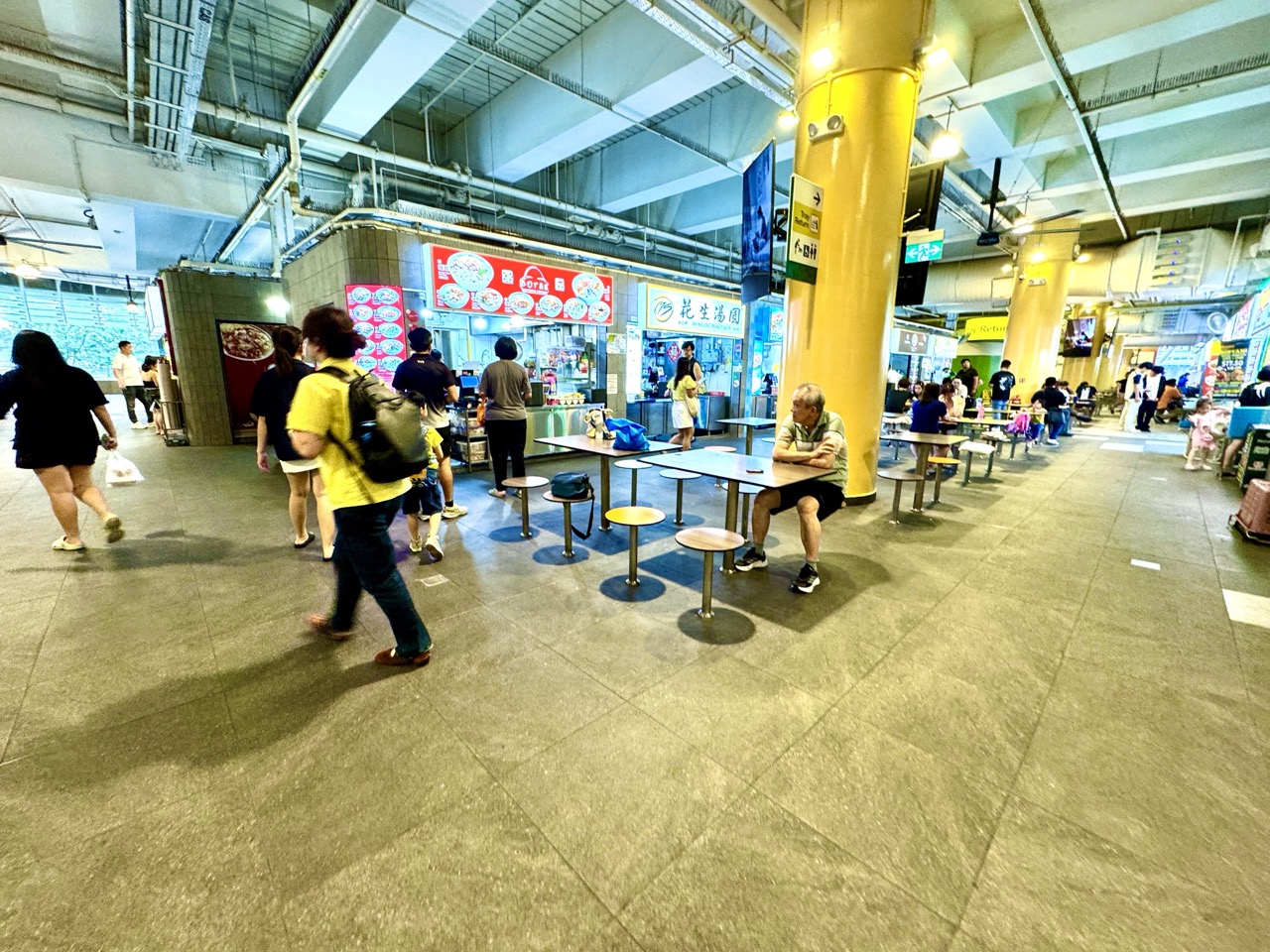
One Punggol Hawker Centre is on Level 2 of the One Punggol community hub at 1 Punggol Drive, Singapore 828629. It is an everyday place for families to eat, but the details people need are surprisingly practical: where to find a seat, how to handle several food queues, where to return used trays, and what changed when the hawker centre’s operator changed in 2026. Our new October 2026 photographs show actual Level 2 food counters, diners, collection points, queues and a family seated among other visitors. This guide explains the visit without inventing stall ratings or promising that an item will always be sold.
The important 2026 update: Timbre+ Hawkers ended its management tenure on 14 August 2026, and Hawkermania, a Kimly subsidiary, was appointed to manage the centre from 15 August 2026. The Ministry of Sustainability and the Environment documented the former contract’s early termination, and the appointment was reported following the National Environment Agency’s announcement. Some older directories still name Timbre, including a People’s Association facilities page prepared before the transition. A good current guide must distinguish an old operator from a current one, just as it should distinguish the centre’s permanent location from the changing list of stallholders.

One Punggol Hawker Centre at a glance
- Address: 1 Punggol Drive, Singapore 828629; the hawker centre is on Level 2 of One Punggol.
- Nearest local rail orientation: Sam Kee LRT serves the hub area; Punggol MRT is another town-centre connection. Check your actual entrance and direction signs.
- Original opening: the hawker centre began operating in October 2022, with 34 purpose-built cooked-food stalls recorded in official centre descriptions.
- 2026 management: Hawkermania was appointed from 15 August 2026, succeeding Timbre+ Hawkers.
- Photographed in October 2026: stall fronts, food queues, diners, collection activity and seating.
- Opening hours and specific dishes: check the current operator and individual stall notices rather than relying on an old directory.
- Public dining etiquette: clear your litter and return your used trays and crockery at the designated return points.
- For families: agree where everyone will sit, who supervises the children and how food collection will work before separating into different queues.
Why this article exists when a Punggol food guide already exists
Our established One Punggol Hawker Centre Guide is the broader food-discovery destination, discussing dishes, stalls and choices. This page has a narrower, more durable job: it explains how a family uses the Level 2 space, how movement through queues and tables works, which public responsibilities apply, and why 2026 operator information needs updating. Readers who want a list of cuisines should start with the food guide. Readers who want a comfortable first visit with children, a grandparent or several competing appetites can use this practical companion.
Keeping those jobs separate prevents a common local-content problem. An article may be long but still fail because it tries to rank stalls, provide a transport directory, narrate a building history and explain every community service all at once. Here, the useful unit is the visit from arrival to departure. Our photographs follow that idea: look for the entrance, notice the tables, understand where people queue, order and eat, and finish by clearing the space properly.
Arriving at One Punggol without confusing the building with the hawker centre
One Punggol is a mixed-use community hub. The People’s Association describes it as a development bringing together community, library, public-service, childcare, senior-care and hawker facilities. That breadth is useful, but it also means an instruction such as ‘meet me at One Punggol’ may not be precise enough for relatives arriving from different directions. A family should choose a specific landmark and floor. For the food visit, ‘the Level 2 hawker centre’ is a better starting instruction than merely naming the development.
When you reach the building, follow current floor signs and lift or escalator directions. A person who uses a wheelchair or stroller should check the accessible route rather than assume that every visible staircase has a convenient alternative immediately alongside it. An architectural overview is not a guarantee that every route is equally comfortable. It is better to spend an extra minute finding a suitable entrance than to arrive hurried and then improvise while carrying hot food.

What the food photographs tell us, and what they cannot
The new photos show people ordering, waiting, collecting and eating. They establish that the venue is used in different ways and that multiple food lines can exist simultaneously. They do not establish which stalls were open throughout the day, whether the same dishes will be offered next week, or how long any particular queue takes. A camera records a fraction of a visit. It cannot see a stall’s internal food-handling practices, ingredients list, queue management policy or the full seating situation outside its frame.
That distinction protects readers. ‘Customers were queuing at several counters when photographed’ is a defensible caption. ‘This hawker centre always has long lunchtime queues’ would require systematic evidence. Similarly, a photo of a child beside an adult does not establish their relationship. Our captions should describe people without identifying them or creating stories about why they are there. A good local guide combines the photographs with current operator and government information for facts the photos cannot prove.
The 2026 operator change: what is actually known
On 12 January 2026, the Ministry of Sustainability and the Environment said the previous operator, Timbre+ Hawkers, and NEA had mutually agreed to end the tenancy on 14 August 2026 because of operational challenges. It also confirmed that the centre would remain under the socially-conscious enterprise hawker centre model rather than moving to direct NEA management. This is important context, but it does not justify speculation about individual vendors’ finances or private negotiations.
A June 2026 report following NEA’s appointment identified Hawkermania, a subsidiary of Kimly, as the incoming operator from 15 August. The change was a management transition, not a statement that the building or food culture had been replaced. Parents simply need to know that a page written in 2024 or early 2026 might name the former operator. For real-time stall enquiries, operating-hour changes or events, consult the current centre management. Do not assume that an old app, menu, payment benefit or operator-run programme still applies.
A little history, kept in its proper place
The centre opened in October 2022 as part of One Punggol’s development. Earlier descriptions identify 34 stall spaces and a large communal dining area. The Pasir Ris–Punggol Town Council’s 2025 report described more than 700 seats, helping explain why the site can accommodate many diners across different groups. These figures describe the facility in those sources, not a personally measured October 2026 seat count or a guarantee that every seat will be available at lunchtime.
Historical context makes the building easier to appreciate without being the main purpose of a dining guide. One Punggol’s broader integration is covered in the One Punggol development and history story. Here we use history mainly to correct outdated operator information and understand why a community centre places food among other public services.
The most useful first minute: read the room
After entering the dining level, take one slow look at the food counters, seating clusters and return stations. Resist the urge to join the nearest queue before you know whether your group can eat comfortably. If a parent is supervising a child, deciding where to sit matters more than reaching a stall thirty seconds sooner. If an older visitor needs an accessible seat, that should help determine the plan before people fan out.
Do not stop abruptly at the escalator landing or in front of a popular stall to study the whole room. Move to a suitable side area, then look. People need clear routes to order, carry hot bowls, return trays and leave. A crowded hawker centre works when visitors respect the movement around them. The most helpful start is often not a purchase; it is a quiet decision about how the group will move.
One family, several queues: a simple allocation of roles
A group of four can become four separate problems when everyone orders independently. One person may be in a slow noodle queue, another may be trying to find seats and a third may have a hot drink ready while nobody knows where to meet. Before ordering, agree who will stay with children, whether the others are comfortable going to separate counters and which table or landmark is the meeting point. Avoid leaving a young child alone just to save a few minutes in line.
For a two-adult family, one adult might supervise the children while the other collects food, with both remaining contactable and a clear return plan. With one adult, it may be better to choose a single suitable queue and eat together. Don’t treat an efficiency tip as an instruction to leave a toddler guarding a table. Supervision and accessibility come before perfect speed.

Finding a seat without treating the tables as private property
During busy periods, table finding can be the trickiest part of a meal. Walk calmly and watch for places genuinely becoming free, rather than standing over diners to pressure them into leaving. When you find a suitable table, use it for the number of people actually in your party. Don’t occupy a large cluster for a small group when others are waiting. If a person with limited mobility needs room around their chair, check whether the space can accommodate it without blocking nearby routes.
Some Singapore diners use small objects to signal a seat is occupied, but an object left on a table can be ambiguous and is not a universal ownership rule. Don’t rely on an unattended bag as a safe way to hold seats; it creates a security risk. When in doubt, ask politely and respect people’s answers. A family should not end up arguing with strangers because an informal signal was misunderstood.
When tables are full, change the plan rather than forcing space
A full dining room can be frustrating, particularly when children are hungry. The temptation is to buy first and search later, hoping something opens at exactly the right moment. That can leave adults standing with hot trays in a crowded aisle. Depending on your group, it may be wiser to wait for a suitable table before placing a cooked-to-order meal, choose takeaway where available, or use another food option in the wider neighbourhood.
There is no reason to compete for a table as though lunch were a sports final. A family with a stroller or a relative who cannot stand for long has different constraints from two adults happy to browse. Decide on a sensible threshold: perhaps a short look around and then a calm alternative. This avoids spending the whole visit making other diners feel watched. The aim is to enjoy food, not conquer a seating arrangement.
Why queues look longer than they are, and shorter than they are
A line of six customers does not automatically take twice as long as a line of three. Some stalls prepare dishes in batches; others customise each order. Some customers collect several meals at once, while others are waiting to pay. A person looking at the queue from ten metres away rarely knows which stage of service the front customer has reached. Treat the queue as a clue about demand and workflow, not a reliable stopwatch.
If time is tight, ask the staff about the current waiting estimate when it is practical to do so. Listen to the answer without holding up the next customer. A family with school pickup commitments can choose a shorter or more predictable option. Someone with a leisurely afternoon can afford to explore. The best queue is the one that fits your circumstances and food requirements, not the line with the most people photographing it.
How to choose food when a family disagrees
It is normal for one person to want noodles, another to prefer rice and a child to request the dish they recognise from home. A hawker centre is useful because it offers choice, but that choice should not become an argument between hungry people. Ask everyone to choose one priority and perhaps one acceptable alternative. If a stall is closed or the queue is too long, move to the alternative without presenting it as a punishment.
Parents can help young children make manageable decisions: ‘Would you prefer rice or noodles for lunch?’ is easier than asking them to evaluate every counter in the hall. Teenagers may enjoy more autonomy but still benefit from a spending limit and a meeting plan. A grandparent may have dietary or comfort preferences that deserve equal weight. The good family choice is not necessarily one dish for all; it is a meal everyone can manage.
A spending plan that works without pretending to know today’s prices
Specific prices change, and different stalls may revise menus. Rather than publish a price for a photographed dish that we cannot verify, start with a family ceiling. Suppose four people have a hypothetical S$48 food-and-drink allowance. They could earmark S$36 for main dishes, S$8 for drinks and S$4 as a reserve. Those are planning figures, not published stall prices or a recommendation to spend exactly that amount.
Once you see real menus, update the plan. If mains cost more than expected, reduce optional extras or choose another meal rather than quietly overspending. This makes a useful everyday mathematics exercise for an older child: track the amounts actually paid, include any payment fees if relevant and check the remaining budget. It teaches responsibility in the context of a real family decision without turning lunch into a formal test.
Reading menu boards carefully
Menu boards can contain dish names, prices, portion options and ingredients or topping choices. Do not assume a photograph taken this month captures tomorrow’s board. Look at the display at the counter, clarify what is included and ask whether the final price differs with add-ons. A child learning to order should understand that a dish name and its photographed example may not indicate every ingredient or variation.
If a price or portion is unclear, a short polite question is more useful than guessing. Avoid interrupting a stallholder in the middle of handling a hot wok or multiple orders. Let the customer ahead finish, then ask plainly. Parents can model the words ‘Could you please tell me what’s included?’ and ‘Thank you’. These simple interactions are part of what makes a hawker meal feel connected to everyday life.
Dietary needs: ask the stall, not the photograph
A stall selling a familiar dish cannot automatically be treated as halal-certified, vegetarian, allergy-safe or suitable for a medically prescribed diet. Recipes vary, preparation equipment may be shared and sauces can contain ingredients that are not obvious from the food’s appearance. If a family member has a serious allergy or restriction, ask clear questions and check any current certification or displayed information relevant to the requirement.
Do not pressure staff to make a safety promise they cannot support. An honest ‘I cannot confirm’ means you should choose another appropriate meal rather than taking a chance. Photograph captions cannot establish certification or cross-contact controls. A responsible neighbourhood guide avoids guessing about individual businesses on matters with real health consequences.
Hot soup, drinks and the route back to the table
A meal is not safely completed the moment it is paid for. Somebody may still need to carry a hot bowl through crowded aisles while children change direction unexpectedly. Before collecting soup or a hot drink, decide who will carry it and which route back to the table is clear. Avoid balancing several containers on a stroller handle or asking a small child to carry a heavy tray between strangers.
Move at a comfortable pace and leave enough space behind the person ahead. If you spill something, warn nearby people and ask staff for assistance rather than walking away. The floor is a shared environment; even a small slippery patch can matter to an older diner or somebody using a mobility aid. Caring for the next visitor is a practical part of enjoying a public food centre.
The quiet labour behind a busy meal
One Punggol’s photos show food being ordered and collected, but behind the visible action are cooks, counter staff, suppliers, dishwashers, cleaners and other workers. A hawker centre depends on an intricate sequence: food arrives, ingredients are stored, dishes are prepared, diners pay, tables are used, crockery returns, cleaning happens and waste is managed. None of that can be explained by a single close-up of an attractive plate.
A useful way to teach children respect is to notice workers without treating them as an exhibit. Speak courteously, don’t record someone at close range while they are busy and move aside once an order is collected. Children can learn that the clean table they enjoy is the result of real work. Saying thank you is a small acknowledgement, not a performance staged for a camera.
Returning trays is a responsibility, not a courtesy option
Singapore’s National Environment Agency and Singapore Food Agency require diners to clear their table litter and return used trays and crockery at hawker centres, food courts and coffeeshops. Enforcement has operated for years, and the agencies explain that cleaners remain essential for clearing return racks, sorting items and sanitising surfaces. The idea is shared responsibility: diners leave tables ready for cleaning rather than walking away from plates and used tissues.
When finishing at One Punggol, identify the appropriate return point, collect the used crockery safely and clear litter from the table. Younger children can participate under adult supervision without being given hot, heavy or breakable items beyond their ability. Never assume that a photographed utensil station is the tray-return station. Follow actual signs and any separation instructions at the facility.

What to do if a tray return rack is full
A full rack is a real operational problem, and diners should not attempt to force plates into a dangerously unstable stack. NEA’s public guidance says no enforcement action will be taken against a diner leaving used trays and crockery near a full return station in the circumstances described by the agency. Where possible, look for another functioning station or ask staff what to do. Do not leave hot bowls on a walking path or block the nearest exit.
This is a useful illustration of why rules require judgement. The overall obligation to clear tables remains, but a visibly full station creates a practical exception. A parent can explain to a child that the right action is not simply to follow instructions blindly; it is to achieve the purpose of a clean and safe shared dining environment while taking current conditions into account.
Used tissues, shells and takeaway rubbish
Returning a tray while leaving used tissues, plastic wrappers or food scraps on the table does not complete the cleaning responsibility. NEA’s Clean Tables Campaign explains that diners must also clear litter. Use the appropriate bin or return point as indicated. Be particularly careful with hot sauces, bones and liquids, which can make a surface messy or unsafe for the next person.
If you packed takeaway but ate a portion at the table, dispose of your packaging properly before leaving. It is tempting to believe that a cleaner will pick up every small item because one is nearby, but that shifts avoidable work to somebody else. Children can learn the habit by scanning their seat area before standing up. It need not become a lecture; ‘Let’s leave the table ready’ is enough.
The difference between table clearing and table cleaning
Diners return their own trays and litter. Professional cleaners still wipe and sanitise tables, manage return points and maintain the wider premises. Those duties are different. Returning your tray doesn’t mean you should spray unknown chemicals on a shared dining surface; likewise, seeing a cleaner approach doesn’t mean you should abandon dirty crockery on the table. Follow the venue’s workflow.
If a table is visibly dirty despite being cleared, ask staff for assistance or choose a different suitable seat rather than pretending that the surface is hygienic. Public spaces work when people understand the boundaries of their responsibilities. A family can help by keeping spills contained and giving the staff enough room to do their work properly.
Sharing the hawker centre with older relatives
An older person might enjoy the variety of stalls but find long queues, sudden changes in direction or loud surroundings tiring. Ask what they would like, rather than assuming every senior needs the same arrangements. A person may prefer a table near a convenient path, a shorter visit or help carrying hot dishes. Others will happily choose and order independently. Respecting the person’s preference is more important than creating a one-size-fits-all ‘elder-friendly’ itinerary.
Before splitting up, decide who will be at the table and how the group will communicate if plans change. Avoid asking anyone to stand holding a place for the whole group if they are uncomfortable. If seating is unsuitable, switching to takeaway or another food option may be a perfectly good decision. The point of an integrated community hub is convenience, but convenience has to be experienced by the actual people visiting.
With a stroller and a young child
A stroller can help a family get around, but it also occupies space that other diners need. Don’t leave it across aisles, near an escalator or beside a tray-return route. Find a suitable place that keeps the child under supervision without obstructing movement. If the table arrangement is tight, consider whether the child can sit safely in an appropriate seating option. Do not assume a high chair is available without checking.
Food ordering is easier when the supervising adult has both attention and hands free. If you are alone with a toddler, a complicated plan involving multiple counters may be less practical than one main meal followed by a calm exit. A hawker centre is not a place where efficiency matters more than the child. Make choices that reduce juggling, especially when dishes are very hot.
With a family member using a wheelchair
The wider One Punggol development was designed with universal-design objectives, but individual journeys still depend on current lifts, paths, seat layouts and temporary obstacles. Ask the visitor which route and seating arrangement works. Do not assume that one visible doorway proves every counter is accessible. If needed, locate staff who can explain current access arrangements and an appropriate place to pause.
Keep mobility-aid turning space clear and avoid drawing attention to the person in a way they have not invited. A wheelchair user may want to order personally or may prefer help; the only reliable way to know is to ask them. If the dining area becomes crowded or uncomfortable, be willing to change the plan. Accessibility is about actual use, not a checklist ticked by a distant photographer.
Why an integrated hub can simplify a family day
One Punggol combines services and activities in a single development. A family might plan lunch alongside a separate library visit, community-club activity or official appointment. That can reduce unnecessary travel, but it should not be turned into a mandatory all-day circuit. Each facility has its own access rules, hours and purpose. The hawker centre’s Level 2 seating is not automatically a waiting room for every other service in the building.
For families with mixed-age members, consider a modest sequence: complete the main errand, eat, then decide whether everyone wants one more activity. This is more comfortable than announcing a five-stop programme in advance. Our One Punggol integrated hub guide explains the rest of the building and should own the broader facilities directory.
The lunch rush as a lesson in systems
A busy hawker centre is an excellent example of a small system with interdependent parts. Stalls prepare food; customers join lines; people use tables; cleaners turn tables around; delivery workers collect orders; waste is cleared. When one part slows, others may feel the effect. For instance, a long queue can make the aisle harder to navigate, while a blocked return station may slow cleaning and reduce seating turnover.
An older student can model this without conducting a survey of strangers. Draw boxes marked ‘arrive’, ‘choose’, ‘order’, ‘collect’, ‘eat’ and ‘return’. Then discuss what happens if a step is delayed. The exercise builds systems thinking from observation. It does not require asserting that any actual worker, vendor or operator is inefficient. The aim is to understand relationships, not criticise people based on a snapshot.
A queue is not a restaurant ranking
When people see a long line, they may assume the food is the best in the centre. The line might indeed reflect loyal customers, but it could also result from slower cooking, a lunchtime arrival wave or a short staffing period. Without comparing food quality, customer satisfaction and preparation times, a queue cannot stand in for a fair ranking. Our photographs should never be captioned ‘the number-one stall’ just because it was busy that afternoon.
Parents can use the moment to teach a child the difference between an observation and an inference. ‘Seven people were in line when we looked’ is an observation if actually counted; ‘this must be the tastiest dish’ is an inference. Ask what else could explain the line. It is a simple, lively way to develop critical thinking while waiting for lunch, provided the conversation doesn’t obstruct the stall.
A hypothetical queue-time example
Suppose a food counter takes an average of two minutes to complete an order and there are four customers ahead. A simple rough estimate is eight minutes before your turn, but this estimate is sensitive to whether orders overlap, some customers buy multiple meals and preparation occurs in batches. Don’t present it as a reliable prediction. It is useful precisely because it shows what assumptions are needed before a calculation has meaning.
A secondary pupil could compare two models: sequential service at two minutes each, or two orders handled concurrently. The difference illustrates why everyday numbers need context. Back at home, the student might write ‘My model assumed one order at a time; the real queue did not necessarily behave like that.’ This is clearer reasoning than calculating a suspiciously exact wait from an unmeasured photograph.
An everyday budgeting example
Imagine a family with a hypothetical S$50 limit. Four main dishes come to S$33.20, drinks cost S$7.60 and a shared dessert costs S$5.40. The running total is S$46.20, leaving S$3.80. These figures are teaching examples, not prices from a photographed One Punggol stall. Ask a child to explain the leftover amount, then discuss whether unused money needs to be spent simply because it was allocated.
Older children can explore constraints: one family member may require a particular meal, so the budget for extras needs to change. That teaches flexible allocation rather than a rigid shopping list. In a real visit, record the prices actually displayed and paid. Avoid making public claims about a vendor’s pricing based on an exercise with invented numbers.
An English conversation exercise at the counter
Ordering food requires listening, speaking and clarifying. A Primary 3 pupil might practise a polite request such as ‘Could I have one portion without chilli, please?’ The vendor may say that modification is not possible. The learning then becomes how to respond respectfully and choose another dish. The purpose is to communicate accurately within the normal pace of service, not to turn an occupied counter into a classroom.
After lunch, ask the child to describe the visit using concrete verbs: ‘We looked, compared, queued, collected and returned our trays.’ A secondary student can write a balanced paragraph about why hawker centres matter to community life, mentioning both variety and the practical challenges of busy periods. Keep facts grounded in what the student actually saw.
A Social Studies question: who makes the space work?
Food centres are often described as beloved community spaces. That description is meaningful only when we acknowledge the work and rules behind the result. Stallholders, visitors, operators, regulators and cleaners have different responsibilities. NEA oversees the socially-conscious enterprise hawker-centre model; the appointed operator handles operational matters; diners contribute through conduct and proper clearing. These roles overlap in purpose but should not be confused.
A thoughtful student could ask how affordability, business sustainability, hygiene, accessibility and convenience are balanced. The question cannot be answered by accusing a particular stall of charging too much from a photograph. It requires current policy, operator information and a respectful understanding of different participants. The 2026 management transition is a useful real example of how a public facility can remain in use while its administrative arrangements change.
How a photograph can be evidence without becoming an exaggeration
Our Level 2 images capture a public place at work: people near counters, someone carrying food, families sitting, and movement around the room. Such photographs make abstract advice tangible. But their upload date only tells us when the file appeared in the media library; even a recorded capture date would not establish conditions outside that moment. Do not treat the picture as a live crowd meter or proof of current stall line-ups.
When writing captions, keep the observation narrow. ‘Customers queue at Level 2 counters’ is useful; ‘customers queue for the famous best-value dish’ would need verified menu and independent evaluation. Images of people should not be used to invent their occupations or personal relationships. Ethical local photography serves readers without turning other residents into characters in an invented story.
What if you encounter delivery riders?
Our new photograph labels some workers collecting food orders. In a crowded food hall, delivery collection creates another movement pattern: staff need to locate orders and riders must reach designated handover points. Diners should avoid blocking pickup routes or crowding the counter to photograph the interaction. It is not necessary to speculate about workers’ earnings, schedules or employers from what they are wearing.
Children may notice the different kinds of work. Explain that some meals are cooked for dine-in customers and others are collected for delivery, but both rely on staff preparing and handing over orders accurately. Keep the conversation respectful. A busy counter is not the place to ask workers extended interview questions when they need to collect food promptly.

Dealing calmly with a missing or incorrect order
Mistakes can happen in any busy service setting. Before leaving the counter, confirm that the number of items and the order details match what you paid for. If something appears wrong, politely show the receipt or order number and explain the difference. Avoid blaming staff without checking whether your group collected the correct items. A clear description usually does more good than a raised voice.
If a food-safety or allergy issue is involved, do not eat the item while hoping it will be fine. Ask for appropriate clarification or replacement and make your own safe decision. Keep payment details private when showing a digital receipt; a vendor generally needs the relevant transaction details, not the contents of your whole banking screen.
If a drink spills or a child drops a tray
The priority is safety. Warn people who might slip or step into broken crockery, keep the child away from hot liquid and seek assistance from the venue staff. If anyone is injured, take suitable immediate action according to the seriousness of the situation. A child who has dropped something may already feel upset; public humiliation won’t make the floor safer or the mistake easier to learn from.
Once the hazard is contained, the child can help in an age-appropriate way, perhaps by moving belongings out of the path or telling an adult what happened. Do not ask a child to pick up broken glass or handle very hot liquid. The incident may become a useful lesson about careful movement, but that reflection belongs after everyone is safe.
How to plan a very quick meal between errands
A twenty-minute lunch is possible only if seating and food service happen to cooperate. It should not be promised as an exact One Punggol ‘express route’. If the group is short on time, choose a familiar option with manageable queue conditions, keep the order simple and be prepared to switch plans if service looks slow. A person with a scheduled appointment may need to prioritise punctuality over trying a new stall.
For those who are travelling onward, remember that leaving the table is not the end of the process. Allow a few minutes for tray return, toilets if needed and reaching the correct exit or station connection. Planning backwards from the next fixed commitment can prevent an otherwise pleasant meal from becoming stressful.
How to plan a forty-five-minute family lunch
A relaxed meal can begin with a short walk past the stalls, followed by one main ordering period, eating at a suitable table and clearing up. Forty-five minutes is a sample personal timetable, not a verified lunch duration. The actual time will change with queues, how quickly food is prepared and the needs of the people visiting.
Make room for one person to change their mind without restarting the whole outing. If a child decides they are no longer hungry, don’t force a second queue just to keep to an itinerary. If an older relative wants time to sit after eating, honour that preference where the table situation allows; during a busy rush, also be mindful of diners waiting for places.
How to plan a visit with three generations
With grandparents, parents and young children, everyone has different energy levels and meal requirements. Ask about those preferences before entering a crowded food hall. Perhaps the older person wants a shorter walk and a comfortable place to sit, while the child needs an earlier meal. A three-generation visit is often easier when the family agrees on a simple main purpose rather than expecting everyone to sample a dozen counters.
Don’t assume that a grandparent will want somebody to order on their behalf. Ask. Similarly, a teenager may be happy to collect a drink but should not be given responsibility for the safety of a much younger sibling without a clear adult arrangement. The experience should feel like a meal together, not a complicated logistics exercise.
When one person arrives late
Agree on a meeting point that isn’t a queue entrance, collection counter or escalator landing. A visitor arriving late can then find the group without disrupting the flow of people carrying trays. If you have a reserved or occupied table, be considerate about how much extra space you are keeping for someone who has not yet arrived. Public seating needs to work for other diners too.
Phone messages such as ‘near the hawker centre’ may not be sufficient in a multi-level community hub. Send the correct building name, floor and a practical landmark. Avoid sharing a child’s personal location publicly. A simple, private group message can solve confusion without posting identifiable photographs of strangers to illustrate where the family is seated.
One Punggol versus Punggol Coast Hawker Centre
These are separate venues. One Punggol Hawker Centre is on Level 2 of One Punggol at 1 Punggol Drive. Punggol Coast Hawker Centre is associated with Punggol Digital District and the newer Punggol Coast transport node. Do not send relatives to ‘the Punggol hawker centre’ without specifying which one. Their operators, stall lists, transit approaches and dates of opening differ.
Our wider Punggol Hawker Centres and Coffee Shops Map owns that town-wide comparison. This article should not duplicate a second venue’s stall directory. Its job is to help someone who has already selected One Punggol navigate the Level 2 experience and understand the operator change.
What older online listings get wrong
An article or tourism description published before August 2026 can correctly say that Timbre operated One Punggol at the time it was written. That becomes misleading when copied into an October 2026 directory without a date. Other old listings may repeat historical hours, old app benefits or a stall that has changed operators. The responsible way to use such a page is as a dated source, not a live authority.
Check the publication date, the specific fact and whether the organisation responsible for it has issued newer information. We rely on official MSE information and 2026 reporting for the management transition, and on the People’s Association for the Level 2 location. For a particular dish, price or today-only promotion, the live stall or operator notice is better evidence than either.
How to read a centre’s advertised stall count
Published descriptions of One Punggol refer to 34 stall spaces. That tells readers something about the planned scale of the centre, but it does not mean exactly 34 counters are trading at every hour. Some units might change tenants or operating arrangements; individual hawkers may take rest days. A sign saying ’34 stalls’ and the number of active lunch vendors on a particular day can be different without any contradiction.
If a family is coming specifically for a certain dish, verify the current stall identity and opening status. This is particularly important after an operator transition, when older social posts or menus can linger online. Don’t travel across Singapore because a photograph shows a counter once served a particular meal. A photo-led guide should encourage curiosity and careful checking in equal measure.
What public-hygiene rules mean for children
NEA’s public guidance gives a practical distinction: children under twelve and some diners with relevant limitations are treated differently for enforcement, but families should still cultivate the habit of keeping tables clean when they can. A young child can put a tissue in the proper place, check for a forgotten water bottle and thank the cleaner. A responsible adult should handle any crockery that is too hot or heavy.
The point of teaching is not to frighten children with fines. It is to help them understand that a public dining table is shared by many families. Someone who arrives next should not have to navigate sticky plates or litter left behind. When children see adults clear tables consistently, the lesson becomes an ordinary habit rather than an abstract rule.
What the centre cannot tell you from a single photograph
Even a sharp photograph cannot verify pest-control records, actual food temperatures, kitchen inspections or whether a specific dish contains an allergen. Those are not visually obvious from public dining pictures. Avoid accusing a business of poor hygiene because you see a worker near a used-tray station, or assuming perfect compliance because the counters look clean. Use official food-safety information, relevant displayed notices and direct enquiry for decisions that matter.
A family can apply sensible consumer judgement: examine the current stall conditions, ask questions and decline food if something cannot be confirmed. If there is a genuine concern, use appropriate official feedback channels. Thoughtful guides should not confuse visual impressions with regulatory findings.
Keeping the space welcoming for other diners
A hawker centre is a shared room with people arriving for many reasons: a quick workday meal, a relaxed family lunch, a break between appointments or takeaway. Keep routes clear, limit unnecessary noise and move away from counters once your order is ready. If somebody is struggling with a mobility aid, give them room without making assumptions about whether they need help.
If your group is taking photographs, stay out of the way of the actual activity. People don’t need their faces featured in a local blog because they happened to be eating lunch. A wide scene can capture the character of the space while respecting privacy. Courtesy is not an extra feature of an integrated hub; it is part of how the hub remains useful.
A child-friendly activity: observe the meal’s full journey
For a primary-age child, try a short conversation after eating: where did we arrive, how did we choose food, how did we pay, where did the dishes go and who helped make the next table ready? This is an everyday explanation of a process. Avoid turning it into an assignment while the child is still hungry. Speak naturally, using the experience the child actually had.
An older child can draw a simple flowchart with ‘arrive’, ‘find a suitable table’, ‘choose’, ‘order’, ‘collect’, ‘eat’ and ‘return’. Ask whether any steps sometimes happen in a different order. Perhaps the group orders before sitting, or one adult finds a table while another queues. The exercise shows that processes can have more than one valid sequence depending on real-world constraints.
A student inquiry: why can a lunch rush become a bottleneck?
Ask a secondary student to think in terms of capacity rather than simply saying a hawker centre is ‘too crowded’. Seating turnover, order preparation, payment time and movement paths can each constrain the experience. In a hypothetical model, if a stall can fulfil ten orders in twenty minutes but fifteen arrive, a queue grows. If new orders then arrive at the same rate, the backlog cannot disappear without a change in throughput. The numbers illustrate a model; they are not measurements of any One Punggol business.
A thoughtful conclusion would identify what evidence is missing: actual order arrival rates, staff numbers, transaction times, opening hours and table-use patterns. The student should not propose that workers rush dangerously or that residents be excluded to solve the model. Real operations balance safety, fairness, comfort and economics as well as speed.
A media-literacy exercise using the new photos
Look at two photographs of the Level 2 hall taken from different angles. One might show a dense group near the counters; another might include a larger field of tables. Ask how the framing changes your impression. Does the first photo justify calling the entire venue crowded? Does the second prove there are always seats? Neither does. Viewpoint, timing and what lies outside the camera frame matter.
Ask the learner to write two captions: a strictly descriptive one and a speculative one. Then revise the speculative version so uncertainty is visible. ‘The image suggests a busy ordering moment’ is more careful than ‘every visitor waits a long time’. The skill is useful for reading school texts, social-media images and local news as well as for choosing lunch.
A respectful conversation about affordability
Hawker centres are important partly because people value accessible everyday meals. But ‘affordable’ is relative to a household and should not be used as a blanket claim about every menu. The socially-conscious enterprise model includes measures intended to support affordability while operators and stallholders manage real costs. A family can compare displayed prices and portions in a way that respects both its own budget and the work behind each dish.
A thoughtful discussion can ask why different dishes cost different amounts, how ingredients, rent, labour and time affect a small food business, and what value means to different customers. That is a richer conversation than dismissing a stall as expensive based on one image. Do not invent vendor margins or personal financial circumstances without evidence.
Can a family use the hawker centre as a study space?
An empty table might look tempting for a long tutoring session or laptop meeting, but public dining tables exist primarily for meals. During busy periods, extended occupation can reduce seating for people who need to eat. Unless a specific operator arrangement allows other uses, it is considerate to finish the meal, clear the table and move to a more suitable venue for extended work.
The same principle applies to filming or gathering a large group for an event. A public food hall is not automatically a free private-event space. Enquire with the operator for organised use rather than assuming permission. The wider One Punggol guide points to spaces with different purposes.
What to do after a meal
Many visitors are already at One Punggol for an errand, class or library visit. After clearing the table, check whether the next facility is actually open and whether everyone wants to continue. The building’s services have different schedules. A child may prefer a quiet return home after a crowded meal, while another family might be happy to browse the library. There is no reason to bundle every option into one visit.
If the group includes somebody who needs to rest, adjust the plan before they become exhausted. A simple meal together may be the day’s highlight. The quality of a community hub is partly that it provides choices; you don’t have to use all of them to benefit from being there.
A gentle checklist for a first-time family visitor
Before leaving home, confirm that One Punggol is the intended venue rather than Punggol Coast. Check current travel information and any closure notices. If someone has dietary requirements, identify one or two possible meal options but don’t assume the stall will be open. Agree who is supervising children and how the group will reconnect if adults need different counters. Choose a flexible spending limit and allow time for queues.
On arrival, read the current signs, look for suitable seating and identify the return point. At the counter, confirm the price and any necessary food details. During the meal, keep hot food away from unsupervised children and leave enough room for people to pass. Before leaving, return used crockery and litter. These habits are straightforward, but together they make a visit significantly easier.
Frequently asked questions about One Punggol Hawker Centre
Where is One Punggol Hawker Centre?
It is on Level 2 of One Punggol at 1 Punggol Drive, Singapore 828629. Use the building’s current wayfinding signs for an appropriate entrance and route.
Is this the same as Punggol Coast Hawker Centre?
No. One Punggol and Punggol Coast are different hawker centres. Specify the location when meeting relatives or arranging a trip.
Who operates One Punggol Hawker Centre in October 2026?
Hawkermania was appointed to operate the centre from 15 August 2026 after Timbre+ Hawkers ended its tenure on 14 August. Older directories may still display the former operator.
Did the centre close permanently when the operator changed?
The announced plan was for an orderly operator transition with minimal disruption, not permanent closure. Current stall operations or temporary cleaning closures still require a present-day check.
How many stalls are there?
Official and historical descriptions cite 34 cooked-food stall units, but that figure is not a promise that all stalls are open simultaneously or that the same vendors remain in place.
What are the opening hours?
Current daily hours and individual stall schedules should be verified with the current operator or stall. Older timetable listings may predate the August 2026 management change.
Are all stalls halal or vegetarian?
No blanket certification or menu claim is made here. Inspect current certificates and ask each stall about ingredients, preparation and cross-contact where relevant.
Do diners have to return trays?
Yes, Singapore public dining rules require diners to clear litter and return trays and crockery in the manner directed. Follow current return-station signage and assistance arrangements.
What if the tray-return point is full?
Follow NEA guidance: look for another available station or seek assistance, and do not pile crockery dangerously or obstruct walkways. NEA sets out how full-rack cases are handled.
Is it suitable for families with small children?
Families can use the centre, but choose a safe supervision and seating arrangement, especially when adults collect hot food from different counters. Confirm any specific amenities as needed.
Can a wheelchair user eat here?
The wider hub incorporates inclusive-design features, but actual access to a particular seat or counter depends on current routes and layout. Check suitable entrances and ask staff for assistance if needed.
Does a long queue mean the food is best?
Not necessarily. Queues reflect service capacity, demand, preparation time and timing. Read menus and ask questions; don’t infer quality rankings from one photo.
Can I reserve a table with my bag?
Do not leave valuables unattended, block circulation or treat an informal reservation practice as a guaranteed right to public seating.
Can I do homework for hours at a dining table?
Public tables are principally for eating. During busy periods, finish your meal and use an appropriate separate study location rather than occupying seats needed by other diners.
Can I use these photos to find a stall?
They show an October 2026 visit and provide visual context, but they are not a live stall directory. Check updated signs, the current operator or the stall directly.
Where do I read about other facilities under the same roof?
Use our dedicated One Punggol integrated hub guide rather than assuming the food centre’s timetable governs the library, Community Club or public-service facilities.
Sources, editorial boundaries and useful onward routes
- People’s Association — One Punggol Hub Info (the location of the Level 2 hawker centre and the mixed-use hub; earlier published operator information is historical).
- Ministry of Sustainability and the Environment — 12 January 2026 reply on the centre’s operator transition.
- The Straits Times — June 2026 Hawkermania appointment report.
- NEA — Hawker Centres Managed by Appointed Operators.
- NEA — Clean Tables Campaign, requirements and exceptions.
- NEA — Reducing disposables in public dining.
- One Punggol Hawker Centre Guide — existing food and stall discovery hub.
- One Punggol Integrated Hub Guide — other floors and facilities.
- Complete Punggol Guide — onward routes beyond the town centre.
Editorial and image note: reviewed 22 October 2026. Original photographs are from eduKatePunggol’s October 2026 photo uploads, including Level 2 stall queues and diners. Captions state only what the images support. The August operator change was checked against government reporting and contemporary news. Stall ownership, menus, prices, hours, activities, access and cleaning closures can change; current on-site and operator information takes precedence. No individual’s identity or personal circumstances are inferred from the photographs.


